Questions · Page 2 of 16

MCQ

MCQ 511 Mark
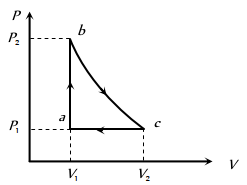
Carbon monoxide is carried around a closed cycle $a b c$ in which $b c$ is an isothermal process as shown in the figure. The gas absorbs 7000 $J$ of heat as its temperature increases from $300 K$ to $1000 K$ in going from $a$ to $b$. The quantity of heat rejected by the gas during the process $c a$ is
Image
  • A
    $4200 \mathrm{~J}$
  • B
    $5000 \mathrm{~J}$
  • C
    $9000 \mathrm{~J}$
  • $9800 \mathrm{~J}$
Answer
Correct option: D.
$9800 \mathrm{~J}$
(d) For path $a b:(\Delta U)_{a b}=7000 \mathrm{~J}$
By using $\Delta U=\mu C_V \Delta T 7000=\mu \times \frac{5}{2} R \times 700 \Rightarrow \mu=0.48$
For path $c a$
$(\Delta Q)_{c a}=(\Delta U)_{c a}+(\Delta W)_{c a} $
$\because(\Delta U)_{a b}+(\Delta U)_{b c}+(\Delta U)_{c a}=0 $
$\therefore 7000+0(\Delta U)_{ca}=0\Rightarrow(\Delta U)_{c a}=-7000 \mathrm{~J}$
Also $((\Delta W)_{ca}=P_1\left(V_1-V_2\right)=\mu R\left(T_1-T_2\right)$ $=0.48\times8.31\times(300-1000)=-2792.16\mathrm{~J}$
on solving equations (i), (ii) and (iii)
$(\Delta Q)_{c a}=-7000-2792.16=-9792.16 \mathrm{~J}=-9800 \mathrm{~J}$
View full question & answer
MCQ 521 Mark
A cycle tyre bursts suddenly. This represents an
  • A
    Isothermal process
  • B
    Isobaric process
  • C
    Isochoric process
  • Adiabatic process
Answer
Correct option: D.
Adiabatic process
(d) The process is very fast, so the gas fails to gain or lose heat. Hence this process in adiabatic
View full question & answer
MCQ 531 Mark
Carbon monoxide is carried around a closed cycle $a b c$ in which $b c$ is an isothermal process as shown in the figure. The gas absorbs 7000 $J$ of heat as its temperature increases from $300 K$ to $1000 K$ in going from $a$ to $b$. The quantity of heat rejected by the gas during the process $c a$ is
Image
  • A
    $4200 \mathrm{~J}$
  • B
    $5000 \mathrm{~J}$
  • C
    $9000 \mathrm{~J}$
  • $9800 \mathrm{~J}$
Answer
Correct option: D.
$9800 \mathrm{~J}$
(d) For path $a b:(\Delta U)_{a b}=7000 \mathrm{~J}$
By using $\Delta U=\mu C_V \Delta T 7000=\mu \times \frac{5}{2} R \times 700 \Rightarrow \mu=0.48$
For path $c a$
$(\Delta Q)_{c a}=(\Delta U)_{c a}+(\Delta W)_{c a} $
$\because(\Delta U)_{a b}+(\Delta U)_{b c}+(\Delta U)_{c a}=0 $
$\therefore 7000+0(\Delta U)_{ca}=0\Rightarrow(\Delta U)_{c a}=-7000 \mathrm{~J}$
Also $((\Delta W)_{ca}=P_1\left(V_1-V_2\right)=\mu R\left(T_1-T_2\right)$ $=0.48\times8.31\times(300-1000)=-2792.16\mathrm{~J}$
on solving equations (i), (ii) and (iii)
$(\Delta Q)_{c a}=-7000-2792.16=-9792.16 \mathrm{~J}=-9800 \mathrm{~J}$
View full question & answer
MCQ 541 Mark
A cycle tyre bursts suddenly. This represents an
  • A
    Isothermal process
  • B
    Isobaric process
  • C
    Isochoric process
  • Adiabatic process
Answer
Correct option: D.
Adiabatic process
(d) The process is very fast, so the gas fails to gain or lose heat. Hence this process in adiabatic
View full question & answer
MCQ 551 Mark
Work done per mol in an isothermal change is
  • A
    $R T \log _{10} \frac{V_2}{V_1}$
  • B
    $R T \log _{10} \frac{V_1}{V_2}$
  • $R T \log _e \frac{V_2}{V_1}$
  • D
    $R T \log _e \frac{V_1}{V_2}$
Answer
Correct option: C.
$R T \log _e \frac{V_2}{V_1}$
For isothermal process $P V=R T \Rightarrow P=\frac{R T}{V}$
$\therefore W=PdV=\int_{V_1}^{V_2} \frac{R T}{V} d V=R T \log _e \frac{V_2}{V_1}$
View full question & answer
MCQ 561 Mark
Work done per mol in an isothermal change is
  • A
    $R T \log _{10} \frac{V_2}{V_1}$
  • B
    $R T \log _{10} \frac{V_1}{V_2}$
  • $R T \log _e \frac{V_2}{V_1}$
  • D
    $R T \log _e \frac{V_1}{V_2}$
Answer
Correct option: C.
$R T \log _e \frac{V_2}{V_1}$
For isothermal process $P V=R T \Rightarrow P=\frac{R T}{V}$
$\thereforeW=PdV=\int_{V_1}^{V_2} \frac{R T}{V} d V=R T \log _e \frac{V_2}{V_1}$
View full question & answer
MCQ 571 Mark
Work done per mol in an isothermal change is
  • A
    $R T \log _{10} \frac{V_2}{V_1}$
  • B
    $R T \log _{10} \frac{V_1}{V_2}$
  • $R T \log _e \frac{V_2}{V_1}$
  • D
    $R T \log _e \frac{V_1}{V_2}$
Answer
Correct option: C.
$R T \log _e \frac{V_2}{V_1}$
For isothermal process $P V=R T \Rightarrow P=\frac{R T}{V}$
$\thereforeW=PdV=\int_{V_1}^{V_2} \frac{R T}{V} d V=R T \log _e \frac{V_2}{V_1}$
View full question & answer
MCQ 581 Mark
If an ideal gas is compressed isothermally then
  • A
    No work is done against gas
  • Heat is relased by the gas
  • C
    The internal energy of gas will increase
  • D
    Pressure does not change
Answer
Correct option: B.
Heat is relased by the gas
(b) In isothermal process, heat is released by the gas to maintain the constant temperature.
View full question & answer
MCQ 591 Mark
In an isochoric process if $T_1=27^{\circ} \mathrm{C}$ and $T_2=127^{\circ} \mathrm{C}$, then $P_1 / P_2$ will be equal to
  • A
    $9 / 59$
  • B
    $2 / 3$
  • $3 / 4$
  • D
    None of these
Answer
Correct option: C.
$3 / 4$
At constant volume $P \propto T \Rightarrow \frac{P_1}{P_2}=\frac{T_1}{T_2} \Rightarrow \frac{P_1}{P_2}=\frac{300}{400}=\frac{3}{4}$
View full question & answer
MCQ 601 Mark
If an ideal gas is compressed isothermally then
  • A
    No work is done against gas
  • Heat is relased by the gas
  • C
    The internal energy of gas will increase
  • D
    Pressure does not change
Answer
Correct option: B.
Heat is relased by the gas
(b) In isothermal process, heat is released by the gas to maintain the constant temperature.
View full question & answer
MCQ 611 Mark
In an isochoric process if $T_1=27^{\circ} \mathrm{C}$ and $T_2=127^{\circ} \mathrm{C}$, then $P_1 / P_2$ will be equal to
  • A
    $9 / 59$
  • B
    $2 / 3$
  • $3 / 4$
  • D
    None of these
Answer
Correct option: C.
$3 / 4$
At constant volume $P \propto T \Rightarrow \frac{P_1}{P_2}=\frac{T_1}{T_2} \Rightarrow \frac{P_1}{P_2}=\frac{300}{400}=\frac{3}{4}$
View full question & answer
MCQ 621 Mark
If an ideal gas is compressed isothermally then
  • A
    No work is done against gas
  • Heat is relased by the gas
  • C
    The internal energy of gas will increase
  • D
    Pressure does not change
Answer
Correct option: B.
Heat is relased by the gas
(b) In isothermal process, heat is released by the gas to maintain the constant temperature.
View full question & answer
MCQ 631 Mark
In an isochoric process if $T_1=27^{\circ} \mathrm{C}$ and $T_2=127^{\circ} \mathrm{C}$, then $P_1 / P_2$ will be equal to
  • A
    $9 / 59$
  • B
    $2 / 3$
  • C
    $3 / 4$
  • None of these
Answer
Correct option: D.
None of these
(d) At constant volume $P \propto T \Rightarrow \frac{P_1}{P_2}=\frac{T_1}{T_2} \Rightarrow \frac{P_1}{P_2}=\frac{300}{400}=\frac{3}{4}$
View full question & answer
MCQ 641 Mark
Heat is not being exchanged in a body. If its internal energy is increased, then
  • Its temperature will increase
  • B
    Its temperature will decrease
  • C
    Its temperature will remain constant
  • D
    None of these
Answer
Correct option: A.
Its temperature will increase
(a) With rise in temperature, internal energy also increases.
View full question & answer
MCQ 651 Mark
Heat is not being exchanged in a body. If its internal energy is increased, then
  • Its temperature will increase
  • B
    Its temperature will decrease
  • C
    Its temperature will remain constant
  • D
    None of these
Answer
Correct option: A.
Its temperature will increase
(a) With rise in temperature, internal energy also increases.
View full question & answer
MCQ 661 Mark
Heat is not being exchanged in a body. If its internal energy is increased, then
  • Its temperature will increase
  • B
    Its temperature will decrease
  • C
    Its temperature will remain constant
  • D
    None of these
Answer
Correct option: A.
Its temperature will increase
(a) With rise in temperature, internal energy also increases.
View full question & answer
MCQ 671 Mark
Which relation is correct for isometric process
  • $\Delta Q=\Delta U$
  • B
    $\Delta W=\Delta U$
  • C
    $\Delta Q=\Delta W$
  • D
    None of these
Answer
Correct option: A.
$\Delta Q=\Delta U$
(a) For isochoric process $\Delta V=0 \Rightarrow \Delta W=0$From FLOT $\Delta Q=\Delta U+\Delta W \Rightarrow \Delta Q=\Delta U$
View full question & answer
MCQ 681 Mark
Which relation is correct for isometric process
  • $\Delta Q=\Delta U$
  • B
    $\Delta W=\Delta U$
  • C
    $\Delta Q=\Delta W$
  • D
    None of these
Answer
Correct option: A.
$\Delta Q=\Delta U$
(a) For isochoric process $\Delta V=0 \Rightarrow \Delta W=0$From FLOT $\Delta Q=\Delta U+\Delta W \Rightarrow \Delta Q=\Delta U$
View full question & answer
MCQ 691 Mark
Which relation is correct for isometric process
  • $\Delta Q=\Delta U$
  • B
    $\Delta W=\Delta U$
  • C
    $\Delta Q=\Delta W$
  • D
    None of these
Answer
Correct option: A.
$\Delta Q=\Delta U$
(a) For isochoric process $\Delta V=0 \Rightarrow \Delta W=0$From FLOT $\Delta Q=\Delta U+\Delta W \Rightarrow \Delta Q=\Delta U$
View full question & answer
MCQ 701 Mark
$\Delta U+\Delta W=0$ is valid for
  • Adiabatic process
  • B
    Isothermal process
  • C
    lsobaric process
  • D
    Isochoric process
Answer
Correct option: A.
Adiabatic process
(a) In adiabatic process $\Delta Q=0 \Rightarrow \Delta U+\Delta W=0$$(\because \Delta Q=\Delta U+\Delta W)$
View full question & answer
MCQ 711 Mark
$\Delta U+\Delta W=0$ is valid for
  • Adiabatic process
  • B
    Isothermal process
  • C
    lsobaric process
  • D
    Isochoric process
Answer
Correct option: A.
Adiabatic process
(a) In adiabatic process $\Delta Q=0 \Rightarrow \Delta U+\Delta W=0$$(\because \Delta Q=\Delta U+\Delta W)$
View full question & answer
MCQ 721 Mark
$\Delta U+\Delta W=0$ is valid for
  • Adiabatic process
  • B
    Isothermal process
  • C
    lsobaric process
  • D
    Isochoric process
Answer
Correct option: A.
Adiabatic process
(a) In adiabatic process $\Delta Q=0 \Rightarrow \Delta U+\Delta W=0$$(\because \Delta Q=\Delta U+\Delta W)$
View full question & answer
MCQ 731 Mark
The internal energy of an ideal gas depends upon
  • A
    Specific volume
  • B
    Pressure
  • Temperature
  • D
    Density
Answer
Correct option: C.
Temperature
(c)
View full question & answer
MCQ 741 Mark
The internal energy of an ideal gas depends upon
  • A
    Specific volume
  • B
    Pressure
  • Temperature
  • D
    Density
Answer
Correct option: C.
Temperature
(c)
View full question & answer
MCQ 751 Mark
The internal energy of an ideal gas depends upon
  • A
    Specific volume
  • B
    Pressure
  • Temperature
  • D
    Density
Answer
Correct option: C.
Temperature
(c)
View full question & answer
MCQ 761 Mark
In isothermic process, which statement is wrong
  • A
    Temperature is constant
  • B
    Internal energy is constant
  • No exchange of energy
  • D
    and are correct
Answer
Correct option: C.
No exchange of energy
(c) In isothermal process, exchange of energy takes place between system and surrounding to maintain the system temperature constant.
View full question & answer
MCQ 771 Mark
For adiabatic process, wrong statement is
  • A
    $d Q=0$
  • B
    $d U=-d W$
  • C
    $Q=$ constant
  • Entropy is not constant
Answer
Correct option: D.
Entropy is not constant
(d)
View full question & answer
MCQ 781 Mark
In isothermic process, which statement is wrong
  • A
    Temperature is constant
  • B
    Internal energy is constant
  • No exchange of energy
  • D
    and are correct
Answer
Correct option: C.
No exchange of energy
(c) In isothermal process, exchange of energy takes place between system and surrounding to maintain the system temperature constant.
View full question & answer
MCQ 791 Mark
For adiabatic process, wrong statement is
  • A
    $d Q=0$
  • B
    $d U=-d W$
  • C
    $Q=$ constant
  • Entropy is not constant
Answer
Correct option: D.
Entropy is not constant
(d)
View full question & answer
MCQ 801 Mark
In isothermic process, which statement is wrong
  • A
    Temperature is constant
  • B
    Internal energy is constant
  • No exchange of energy
  • D
    and are correct
Answer
Correct option: C.
No exchange of energy
(c) In isothermal process, exchange of energy takes place between system and surrounding to maintain the system temperature constant.
View full question & answer
MCQ 811 Mark
For adiabatic process, wrong statement is
  • A
    $d Q=0$
  • B
    $d U=-d W$
  • C
    $Q=$ constant
  • Entropy is not constant
Answer
Correct option: D.
Entropy is not constant
(d)
View full question & answer
MCQ 821 Mark
The pressure in the tyre of a car is four times the atmospheric pressure at $300 K$. If this tyre suddenly bursts, its new temperature will be $(\gamma=1.4)$
  • A
    $300(4)^{1.4 / 0.4}$
  • B
    $300\left(\frac{1}{4}\right)^{-0.4 / 1.4}$
  • C
    $300(2)^{-0.4 / 1.4}$
  • $300(4)^{-0.4 / 1.4}$
Answer
Correct option: D.
$300(4)^{-0.4 / 1.4}$
For adiabatic process $\frac{T^\gamma}{P^{\gamma-1}}=$ constant
$\Rightarrow \frac{T_2}{T_1}=\left(\frac{P_1}{P_2}\right)^{\frac{1\gamma}{\gamma}}\Rightarrow\frac{T_2}{300}=\left(\frac{4}{1}\right)^{\frac{(1-1.4)}{1.4}} \Rightarrow T_2=300(4)^{-\frac{0.4}{1.4}}$
View full question & answer
MCQ 831 Mark
The pressure in the tyre of a car is four times the atmospheric pressure at $300 K$. If this tyre suddenly bursts, its new temperature will be $(\gamma=1.4)$
  • A
    $300(4)^{1.4 / 0.4}$
  • B
    $300\left(\frac{1}{4}\right)^{-0.4 / 1.4}$
  • C
    $300(2)^{-0.4 / 1.4}$
  • $300(4)^{-0.4 / 1.4}$
Answer
Correct option: D.
$300(4)^{-0.4 / 1.4}$
For adiabatic process $\frac{T^\gamma}{P^{\gamma-1}}=$ constant
$\Rightarrow \frac{T_2}{T_1}=\left(\frac{P_1}{P_2}\right)^{\frac{1\gamma}{\gamma}}\Rightarrow\frac{T_2}{300}=\left(\frac{4}{1}\right)^{\frac{(1-1.4)}{1.4}} \Rightarrow T_2=300(4)^{-\frac{0.4}{1.4}}$
View full question & answer
MCQ 841 Mark
The pressure in the tyre of a car is four times the atmospheric pressure at $300 K$. If this tyre suddenly bursts, its new temperature will be $(\gamma=1.4)$
  • A
    $300(4)^{1.4 / 0.4}$
  • B
    $300\left(\frac{1}{4}\right)^{-0.4 / 1.4}$
  • C
    $300(2)^{-0.4 / 1.4}$
  • $300(4)^{-0.4 / 1.4}$
Answer
Correct option: D.
$300(4)^{-0.4 / 1.4}$
For adiabatic process $\frac{T^\gamma}{P^{\gamma-1}}=$ constant
$\Rightarrow \frac{T_2}{T_1}=\left(\frac{P_1}{P_2}\right)^{\frac{1\gamma}{\gamma}}\Rightarrow\frac{T_2}{300}=\left(\frac{4}{1}\right)^{\frac{(1-1.4)}{1.4}} \Rightarrow T_2=300(4)^{-\frac{0.4}{1.4}}$
View full question & answer
MCQ 851 Mark
Which of the following is correct in terms of increasing work done for the same initial and final state
  • Adiabatic < lsothermal < lsobaric
  • B
    Isobaric $<$ Adiabatic $<$ lsothermal
  • C
    Adiabatic $<$ Isobaric $<$ lsothermal
  • D
    None of these
Answer
Correct option: A.
Adiabatic < lsothermal < lsobaric
View full question & answer
MCQ 861 Mark
Which of the following is correct in terms of increasing work done for the same initial and final state
  • Adiabatic < lsothermal < lsobaric
  • B
    Isobaric $<$ Adiabatic $<$ lsothermal
  • C
    Adiabatic $<$ Isobaric $<$ lsothermal
  • D
    None of these
Answer
Correct option: A.
Adiabatic < lsothermal < lsobaric
View full question & answer
MCQ 871 Mark
Which of the following is correct in terms of increasing work done for the same initial and final state
  • Adiabatic < lsothermal < lsobaric
  • B
    Isobaric $<$ Adiabatic $<$ lsothermal
  • C
    Adiabatic $<$ Isobaric $<$ lsothermal
  • D
    None of these
Answer
Correct option: A.
Adiabatic < lsothermal < lsobaric
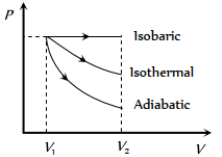
In thermodynamic process, work done is equal to the area covered by the $P V$ curve with volume axis.
Hence, according to graph shown
$W_{\text {adiabatic }}<W_{\text {isothermal }}<W_{\text {isobaric }}$

 
View full question & answer
MCQ 881 Mark
Temperature is a measurement of coldness or hotness of an object. This definition is based on
  • Zeroth law of thermodynamics
  • B
    First law of thermodynamics
  • C
    Second law of thermodynamics
  • D
    Newton's law of cooling
Answer
Correct option: A.
Zeroth law of thermodynamics
(a)
View full question & answer
MCQ 891 Mark
If $\gamma=2.5$ and volume is equal to $\frac{1}{8}$ times to the initial volume then pressure $P^{\prime}$ is equal to (Initial pressure $=P$ )
  • A
    $\quad P^{\prime}=P$
  • B
    $P^{\prime}=2 P$
  • $P^{\prime}=P \times(2)^{15 / 2}$
  • D
    $P^{\prime}=7 P$
Answer
Correct option: C.
$P^{\prime}=P \times(2)^{15 / 2}$
(c) $\frac{P_2}{P_1}=\left(\frac{V_1}{V_2}\right)^\gamma \Rightarrow \frac{P^{\prime}}{P}=(8)^{5 / 2} \Rightarrow P^{\prime}=P \times(2)^{15 / 2}$
View full question & answer
MCQ 901 Mark
Temperature is a measurement of coldness or hotness of an object. This definition is based on
  • Zeroth law of thermodynamics
  • B
    First law of thermodynamics
  • C
    Second law of thermodynamics
  • D
    Newton's law of cooling
Answer
Correct option: A.
Zeroth law of thermodynamics
(a)
View full question & answer
MCQ 911 Mark
If $\gamma=2.5$ and volume is equal to $\frac{1}{8}$ times to the initial volume then pressure $P^{\prime}$ is equal to (Initial pressure $=P$ )
  • A
    $\quad P^{\prime}=P$
  • B
    $P^{\prime}=2 P$
  • $P^{\prime}=P \times(2)^{15 / 2}$
  • D
    $P^{\prime}=7 P$
Answer
Correct option: C.
$P^{\prime}=P \times(2)^{15 / 2}$
(c) $\frac{P_2}{P_1}=\left(\frac{V_1}{V_2}\right)^\gamma \Rightarrow \frac{P^{\prime}}{P}=(8)^{5 / 2} \Rightarrow P^{\prime}=P \times(2)^{15 / 2}$
View full question & answer
MCQ 921 Mark
Temperature is a measurement of coldness or hotness of an object. This definition is based on
  • Zeroth law of thermodynamics
  • B
    First law of thermodynamics
  • C
    Second law of thermodynamics
  • D
    Newton's law of cooling
Answer
Correct option: A.
Zeroth law of thermodynamics
(a)
View full question & answer
MCQ 931 Mark
If $\gamma=2.5$ and volume is equal to $\frac{1}{8}$ times to the initial volume then pressure $P^{\prime}$ is equal to (Initial pressure $=P$ )
  • A
    $\quad P^{\prime}=P$
  • B
    $P^{\prime}=2 P$
  • $P^{\prime}=P \times(2)^{15 / 2}$
  • D
    $P^{\prime}=7 P$
Answer
Correct option: C.
$P^{\prime}=P \times(2)^{15 / 2}$
(c) $\frac{P_2}{P_1}=\left(\frac{V_1}{V_2}\right)^\gamma \Rightarrow \frac{P^{\prime}}{P}=(8)^{5 / 2} \Rightarrow P^{\prime}=P \times(2)^{15 / 2}$
View full question & answer
MCQ 941 Mark
Out of the following which quantity does not depend on path
  • Temperature
  • B
    Energy
  • C
    Work
  • D
    None of these
Answer
Correct option: A.
Temperature
(a)
View full question & answer
MCQ 951 Mark
A gas $(\gamma=1.3)$ is enclosed in an insulated vessel fitted with insulating piston at a pressure of $10^5 \mathrm{~N} / \mathrm{m}^2$. On suddenly pressing the piston the volume is reduced to half the initial volume. The final pressure of the gas is
  • A
    $2^{0.7} \times 10^5$
  • $2^{1.3} \times 10^5$
  • C
    $2^{1.4} \times 10^5$
  • D
    None of these
Answer
Correct option: B.
$2^{1.3} \times 10^5$
(b)$\left.\because P V^\gamma=k \text { (constant }\right)$
$ \Rightarrow P_1 V_1^\gamma=P_2 V_2^\gamma $
$\Rightarrow P_2=P_1\left(\frac{V_1}{V_2}\right)^\gamma=10^5\times(2)^{1.3} \quad\left(\because V_2=\frac{V_1}{2}\right)$
View full question & answer
MCQ 961 Mark
Out of the following which quantity does not depend on path
  • Temperature
  • B
    Energy
  • C
    Work
  • D
    None of these
Answer
Correct option: A.
Temperature
(a)
View full question & answer
MCQ 971 Mark
A gas $(\gamma=1.3)$ is enclosed in an insulated vessel fitted with insulating piston at a pressure of $10^5 \mathrm{~N} / \mathrm{m}^2$. On suddenly pressing the piston the volume is reduced to half the initial volume. The final pressure of the gas is
  • A
    $2^{0.7} \times 10^5$
  • $2^{1.3} \times 10^5$
  • C
    $2^{1.4} \times 10^5$
  • D
    None of these
Answer
Correct option: B.
$2^{1.3} \times 10^5$
(b)$\left.\because P V^\gamma=k \text { (constant }\right)$
$ \Rightarrow P_1 V_1^\gamma=P_2 V_2^\gamma $
$\Rightarrow P_2=P_1\left(\frac{V_1}{V_2}\right)^\gamma=10^5\times(2)^{1.3} \quad\left(\because V_2=\frac{V_1}{2}\right)$
View full question & answer
MCQ 981 Mark
Out of the following which quantity does not depend on path
  • Temperature
  • B
    Energy
  • C
    Work
  • D
    None of these
Answer
Correct option: A.
Temperature
(a)
View full question & answer
MCQ 991 Mark
A gas $(\gamma=1.3)$ is enclosed in an insulated vessel fitted with insulating piston at a pressure of $10^5 \mathrm{~N} / \mathrm{m}^2$. On suddenly pressing the piston the volume is reduced to half the initial volume. The final pressure of the gas is
  • A
    $2^{0.7} \times 10^5$
  • $2^{1.3} \times 10^5$
  • C
    $2^{1.4} \times 10^5$
  • D
    None of these
Answer
Correct option: B.
$2^{1.3} \times 10^5$
(b)$\left.\because P V^\gamma=k \text { (constant }\right)$
$ \Rightarrow P_1 V_1^\gamma=P_2 V_2^\gamma $
$\Rightarrow P_2=P_1\left(\frac{V_1}{V_2}\right)^\gamma=10^5\times(2)^{1.3} \quad\left(\because V_2=\frac{V_1}{2}\right)$
View full question & answer
MCQ 1001 Mark
A thermally insulated container is divided into two parts by a screen. In one part the pressure and temperature are $P$ and $T$ for an ideal gas filled. In the second part it is vacuum. If now a small hole is created in the screen, then the temperature of the gas will
  • A
    Decrease
  • B
    Increase
  • Remain same
  • D
    None of the above
Answer
Correct option: C.
Remain same
(c) This is the case of free expansion of gas. In free expansion $\Delta U=0 \Rightarrow$ Temp. remains same.
View full question & answer
MCQ - Page 2 - JEE physics STD 12 Science Questions - Vidyadip