MCQ 4011 Mark
During the adiabatic expansion of $2$ moles of a gas, the internal energy of the gas is found to decrease by $2$ joules, the work done during the process on the gas will be equal to
AnswerCorrect option: D. $-2 J$
$d Q=0=-2+d W \Rightarrow d W=2 J$
$\Rightarrow$ Work done by the gas $=2\mathrm{~J}$
$\Rightarrow$ Work done on the gas $=-2 J$
View full question & answer→MCQ 4021 Mark
During the adiabatic expansion of $2$ moles of a gas, the internal energy of the gas is found to decrease by $2$ joules, the work done during the process on the gas will be equal to
- A
$1 J$
- B
$-1 J$
- C
$2 J$
- ✓
$-2 J$
AnswerCorrect option: D. $-2 J$
$d Q=0=-2+d W \Rightarrow d W=2 J$$\Rightarrow$ Work done by the gas $=2\mathrm{~J} \Rightarrow$ Work done on the gas $=-2 J$
View full question & answer→MCQ 4031 Mark
During the adiabatic expansion of $2$ moles of a gas, the internal energy of the gas is found to decrease by $2$ joules, the work done during the process on the gas will be equal to
- A
$1 J$
- B
$-1 J$
- C
$2 J$
- ✓
$-2 J$
AnswerCorrect option: D. $-2 J$
$d Q=0=-2+d W \Rightarrow d W=2 J$$\Rightarrow$ Work done by the gas $=2\mathrm{~J} \Rightarrow$ Work done on the gas $=-2 J$
View full question & answer→MCQ 4041 Mark
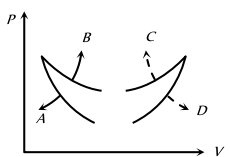
Four curves $A, B, C$ and $D$ are drawn in the adjoining figure for a given amount of gas. The curves which represent adiabatic and isothermal changes are
- A
$C$ and $D$ respectively
- B
$D$ and $C$ respectively
- ✓
$A$ and $B$ respectively
- D
$B$ and $A$ respectively
AnswerCorrect option: C. $A$ and $B$ respectively
(c) As we know that slope of isothermal and adiabatic curves are always negative and slope of adiabatic curve is always greater than that of isothermal curveHence in the given graph curve $A$ and $B$ represents adiabatic and isothermal changes respectively.
View full question & answer→MCQ 4051 Mark
Four curves $A, B, C$ and $D$ are drawn in the adjoining figure for a given amount of gas. The curves which represent adiabatic and isothermal changes are
- A
$C$ and $D$ respectively
- B
$D$ and $C$ respectively
- ✓
$A$ and $B$ respectively
- D
$B$ and $A$ respectively
AnswerCorrect option: C. $A$ and $B$ respectively
(c) As we know that slope of isothermal and adiabatic curves are always negative and slope of adiabatic curve is always greater than that of isothermal curveHence in the given graph curve $A$ and $B$ represents adiabatic and isothermal changes respectively.
View full question & answer→MCQ 4061 Mark
Four curves $A, B, C$ and $D$ are drawn in the adjoining figure for a given amount of gas. The curves which represent adiabatic and isothermal changes are
- A
$C$ and $D$ respectively
- B
$D$ and $C$ respectively
- ✓
$A$ and $B$ respectively
- D
$B$ and $A$ respectively
AnswerCorrect option: C. $A$ and $B$ respectively
(c) As we know that slope of isothermal and adiabatic curves are always negative and slope of adiabatic curve is always greater than that of isothermal curveHence in the given graph curve $A$ and $B$ represents adiabatic and isothermal changes respectively.
View full question & answer→MCQ 4071 Mark
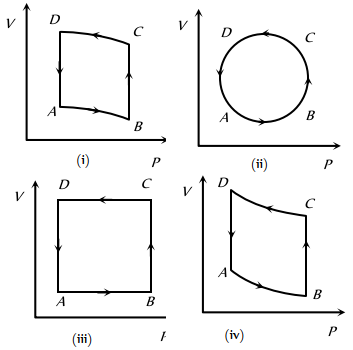
In the diagrams (i) to (iv) of variation of volume with changing pressure is shown. A gas is taken along the path $A B C D$. The change in internal energy of the gas will be
- A
Positive in all cases (i) to (iv)
- B
Positive in cases (i), (ii) and (iii) but zero in (iv) case
- C
Negative in cases (i), (ii) and (iii) but zero in (iv) case
- ✓
Answer(d) In all given cases, process is cyclic and in cyclic process $\Delta U=0$.
View full question & answer→MCQ 4081 Mark
In the diagrams (i) to (iv) of variation of volume with changing pressure is shown. A gas is taken along the path $A B C D$. The change in internal energy of the gas will be
- A
Positive in all cases (i) to (iv)
- B
Positive in cases (i), (ii) and (iii) but zero in (iv) case
- C
Negative in cases (i), (ii) and (iii) but zero in (iv) case
- ✓
Answer(d) In all given cases, process is cyclic and in cyclic process $\Delta U=0$.
View full question & answer→MCQ 4091 Mark
In the diagrams (i) to (iv) of variation of volume with changing pressure is shown. A gas is taken along the path $A B C D$. The change in internal energy of the gas will be
- A
Positive in all cases (i) to (iv)
- B
Positive in cases (i), (ii) and (iii) but zero in (iv) case
- C
Negative in cases (i), (ii) and (iii) but zero in (iv) case
- ✓
Answer(d) In all given cases, process is cyclic and in cyclic process $\Delta U=0$.
View full question & answer→MCQ 4101 Mark
The $P-V$ graph of an ideal gas cycle is shown here as below. The adiabatic process is described by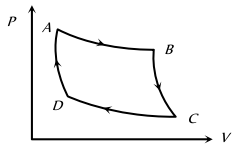
- A
$A B$ and $B C$
- B
$A B$ and $C D$
- ✓
$B C$ and $D A$
- D
$B C$ and $C D$
AnswerCorrect option: C. $B C$ and $D A$
(c) $A D$ and $B C$ represent adiabatic process (more slope)$A B$ and $D C$ represent isothermal process (less slope)
View full question & answer→MCQ 4111 Mark
The $P-V$ graph of an ideal gas cycle is shown here as below. The adiabatic process is described by
- A
$A B$ and $B C$
- B
$A B$ and $C D$
- ✓
$B C$ and $D A$
- D
$B C$ and $C D$
AnswerCorrect option: C. $B C$ and $D A$
(c) $A D$ and $B C$ represent adiabatic process (more slope)$A B$ and $D C$ represent isothermal process (less slope)
View full question & answer→MCQ 4121 Mark
The $P-V$ graph of an ideal gas cycle is shown here as below. The adiabatic process is described by
- A
$A B$ and $B C$
- B
$A B$ and $C D$
- ✓
$B C$ and $D A$
- D
$B C$ and $C D$
AnswerCorrect option: C. $B C$ and $D A$
(c) $A D$ and $B C$ represent adiabatic process (more slope)$A B$ and $D C$ represent isothermal process (less slope)
View full question & answer→MCQ 4131 Mark
First law of thermodynamics is a special case of
- A
- ✓
Law of conservation of energy
- C
- D
AnswerCorrect option: B. Law of conservation of energy
(b) Heat supplied to a gas raise its internal energy and does some work against expansion, so it is a special case of law of conservation of energy.
View full question & answer→MCQ 4141 Mark
First law of thermodynamics is a special case of
- A
- ✓
Law of conservation of energy
- C
- D
AnswerCorrect option: B. Law of conservation of energy
(b) Heat supplied to a gas raise its internal energy and does some work against expansion, so it is a special case of law of conservation of energy.
View full question & answer→MCQ 4151 Mark
First law of thermodynamics is a special case of
- A
- ✓
Law of conservation of energy
- C
- D
AnswerCorrect option: B. Law of conservation of energy
(b) Heat supplied to a gas raise its internal energy and does some work against expansion, so it is a special case of law of conservation of energy.
View full question & answer→MCQ 4161 Mark
For an adiabatic expansion of a perfect gas, the value of $\frac{\Delta P}{P}$ is equal to
- A
$-\sqrt{\gamma} \frac{\Delta V}{V}$
- B
$-\frac{\Delta V}{V}$
- ✓
$-\gamma \frac{\Delta V}{V}$
- D
$-\gamma^2 \frac{\Delta V}{V}$
AnswerCorrect option: C. $-\gamma \frac{\Delta V}{V}$
$P \cdot \gamma^{Y-1} d V+V^Y \cdot d P=0 $
$ -\gamma \cdot V^{Y-1} d V=V^Y \frac{d P}{P}$
$ \text { or } \frac{d P}{P}=\gamma-\frac{V^{Y-1}}{V^y} \cdot d V=-\gamma \frac{d V}{V}$
$ \therefore \quad \frac{\Delta P}{P}=-\gamma \frac{\Delta V}{V}$
View full question & answer→MCQ 4171 Mark
For an adiabatic expansion of a perfect gas, the value of $\frac{\Delta P}{P}$ is equal to
- A
$-\sqrt{\gamma} \frac{\Delta V}{V}$
- B
$-\frac{\Delta V}{V}$
- ✓
$-\gamma \frac{\Delta V}{V}$
- D
$-\gamma^2 \frac{\Delta V}{V}$
AnswerCorrect option: C. $-\gamma \frac{\Delta V}{V}$
$P \cdot \gamma^{Y-1} d V+V^Y \cdot d P=0 $
$ -\gamma \cdot V^{Y-1} d V=V^Y \frac{d P}{P} $
$ \text { or } \frac{d P}{P}=\gamma-\frac{V^{Y-1}}{V^y} \cdot d V=-\gamma \frac{d V}{V} $
$\therefore \quad \frac{\Delta P}{P}=-\gamma \frac{\Delta V}{V}$
View full question & answer→MCQ 4181 Mark
For an adiabatic expansion of a perfect gas, the value of $\frac{\Delta P}{P}$ is equal to
- A
$-\sqrt{\gamma} \frac{\Delta V}{V}$
- B
$-\frac{\Delta V}{V}$
- ✓
$-\gamma \frac{\Delta V}{V}$
- D
$-\gamma^2 \frac{\Delta V}{V}$
AnswerCorrect option: C. $-\gamma \frac{\Delta V}{V}$
$P \cdot \gamma^{Y-1} d V+V^Y \cdot d P=0 $
$ -\gamma \cdot V^{Y-1} d V=V^Y \frac{d P}{P} $
$ \text { or } \frac{d P}{P}=\gamma-\frac{V^{Y-1}}{V^y} \cdot d V=-\gamma \frac{d V}{V} $
$\therefore \quad \frac{\Delta P}{P}=-\gamma \frac{\Delta V}{V}$
View full question & answer→MCQ 4191 Mark
The adiabatic Bulk modulus of a perfect gas at pressure is given by
- A
$P$
- B
$2 P$
- C
$P / 2$
- ✓
$\gamma P$
AnswerCorrect option: D. $\gamma P$
(d) Adiabatic Bulk modulus $E_\phi=\gamma P$
View full question & answer→MCQ 4201 Mark
The adiabatic Bulk modulus of a perfect gas at pressure is given by
- A
$P$
- B
$2 P$
- C
$P / 2$
- ✓
$\gamma P$
AnswerCorrect option: D. $\gamma P$
(d) Adiabatic Bulk modulus $E_\phi=\gamma P$
View full question & answer→MCQ 4211 Mark
The adiabatic Bulk modulus of a perfect gas at pressure is given by
- A
$P$
- B
$2 P$
- C
$P / 2$
- ✓
$\gamma P$
AnswerCorrect option: D. $\gamma P$
(d) Adiabatic Bulk modulus $E_\phi=\gamma P$
View full question & answer→MCQ 4221 Mark
The pressure and density of a diatomic gas $(\gamma=7 / 5)$ change adiabatically from $(P, d)$ to $(P, d)$. If $\frac{d^{\prime}}{d}=32$, then $\frac{P^{\prime}}{P}$ should be
AnswerVolume of the gas $V=\frac{m}{d}$ and using (PV^\gamma=$constantWeget(\frac{P^{\prime}}{P}=\left(\frac{V}{V^{\prime}}\right)^\gamma=\left(\frac{d^{\prime}}{d}\right)^\gamma=(32)^{7/ 5}=128$
View full question & answer→MCQ 4231 Mark
The pressure and density of a diatomic gas $(\gamma=7 / 5)$ change adiabatically from $(P, d)$ to $(P, d)$. If $\frac{d^{\prime}}{d}=32$, then $\frac{P^{\prime}}{P}$ should be
AnswerVolume of the gas $V=\frac{m}{d}$ and using (PV^\gamma=$constantWeget(\frac{P^{\prime}}{P}=\left(\frac{V}{V^{\prime}}\right)^\gamma=\left(\frac{d^{\prime}}{d}\right)^\gamma=(32)^{7/ 5}=128$
View full question & answer→MCQ 4241 Mark
The pressure and density of a diatomic gas $(\gamma=7 / 5)$ change adiabatically from $(P, d)$ to $(P, d)$. If $\frac{d^{\prime}}{d}=32$, then $\frac{P^{\prime}}{P}$ should be
AnswerVolume of the gas $V=\frac{m}{d}$ and using (PV^\gamma=$constantWeget(\frac{P^{\prime}}{P}=\left(\frac{V}{V^{\prime}}\right)^\gamma=\left(\frac{d^{\prime}}{d}\right)^\gamma=(32)^{7/ 5}=128$
View full question & answer→MCQ 4251 Mark
A system performs work $\Delta W$ when an amount of heat is $\Delta Q$ added to the system, the corresponding change in the internal energy is $\Delta U$. A unique function of the initial and final states (irrespective of the mode of change) is
AnswerCorrect option: D. $\Delta U$
(d) Change in internal energy ( $\Delta U$ ) depends upon initial an findstateofthefunction while $\Delta Q$ and $\Delta W$ are path dependent also.
View full question & answer→MCQ 4261 Mark
A system performs work $\Delta W$ when an amount of heat is $\Delta Q$ added to the system, the corresponding change in the internal energy is $\Delta U$. A unique function of the initial and final states (irrespective of the mode of change) is
AnswerCorrect option: D. $\Delta U$
(d) Change in internal energy ( $\Delta U$ ) depends upon initial an findstateofthefunction while $\Delta Q$ and $\Delta W$ are path dependent also.
View full question & answer→MCQ 4271 Mark
A system performs work $\Delta W$ when an amount of heat is $\Delta Q$ added to the system, the corresponding change in the internal energy is $\Delta U$. A unique function of the initial and final states (irrespective of the mode of change) is
AnswerCorrect option: D. $\Delta U$
(d) Change in internal energy ( $\Delta U$ ) depends upon initial an findstateofthefunction while $\Delta Q$ and $\Delta W$ are path dependent also.
View full question & answer→MCQ 4281 Mark
A system changes from the state $\left(P_1, V_1\right)$ to $\left(P_2 V_2\right)$ as shown in the figure. What is the work done by the system
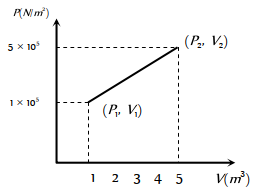
AnswerCorrect option: C. $12 \times 10^5$ joule
Work done $=$ Area of $P V$ graph (here trapezium)
$=\frac{1}{2}\left(1 \times 10^5+5 \times 10^5\right) \times(5-1)=12 \times 10^5 J$
View full question & answer→MCQ 4291 Mark
A system changes from the state $\left(P_1, V_1\right)$ to $\left(P_2 V_2\right)$ as shown in the figure. What is the work done by the system
AnswerCorrect option: C. $12 \times 10^5$ joule
Work done $=$ Area of $P V$ graph (here trapezium)
$=\frac{1}{2}\left(1 \times 10^5+5 \times 10^5\right) \times(5-1)=12 \times 10^5 J$
View full question & answer→MCQ 4301 Mark
A system changes from the state $\left(P_1, V_1\right)$ to $\left(P_2 V_2\right)$ as shown in the figure. What is the work done by the system
AnswerCorrect option: C. $12 \times 10^5$ joule
Work done $=$ Area of $P V$ graph (here trapezium)
$=\frac{1}{2}\left(1 \times 10^5+5 \times 10^5\right) \times(5-1)=12 \times 10^5 J$
View full question & answer→MCQ 4311 Mark
For an isothermal expansion of a perfect gas, the value of $\frac{\Delta P}{P}$ is equal
- A
$-\gamma^{1 / 2} \frac{\Delta V}{V}$
- ✓
$-\frac{\Delta V}{V}$
- C
$-\gamma \frac{\Delta V}{V}$
- D
$-\gamma^2 \frac{\Delta V}{V}$
AnswerCorrect option: B. $-\frac{\Delta V}{V}$
Differentiate $P V=$ constant w.r.t $V$
$\Rightarrow P \Delta V+V\Delta P=0\Rightarrow \frac{\Delta P}{P}=-\frac{\Delta V}{V}$
View full question & answer→MCQ 4321 Mark
For an isothermal expansion of a perfect gas, the value of $\frac{\Delta P}{P}$ is equal
- A
$-\gamma^{1 / 2} \frac{\Delta V}{V}$
- ✓
$-\frac{\Delta V}{V}$
- C
$-\gamma \frac{\Delta V}{V}$
- D
$-\gamma^2 \frac{\Delta V}{V}$
AnswerCorrect option: B. $-\frac{\Delta V}{V}$
Differentiate $P V=$ constant w.r.t $V$
$\Rightarrow P \Delta V+V\Delta P=0\Rightarrow \frac{\Delta P}{P}=-\frac{\Delta V}{V}$
View full question & answer→MCQ 4331 Mark
For an isothermal expansion of a perfect gas, the value of $\frac{\Delta P}{P}$ is equal
- A
$-\gamma^{1 / 2} \frac{\Delta V}{V}$
- ✓
$-\frac{\Delta V}{V}$
- C
$-\gamma \frac{\Delta V}{V}$
- D
$-\gamma^2 \frac{\Delta V}{V}$
AnswerCorrect option: B. $-\frac{\Delta V}{V}$
Differentiate $P V=$ constant w.r.t $V$
$\Rightarrow P \Delta V+V\Delta P=0\Rightarrow \frac{\Delta P}{P}=-\frac{\Delta V}{V}$
View full question & answer→MCQ 4341 Mark
The slopes of isothermal and adiabatic curves are related as
- A
lsothermal curve slope $=$ adiabatic curve slope
- B
lsothermal curve slope $=\gamma \times$ adiabatic curve slope
- ✓
Adiabatic curve slope $=\gamma \times$ isothermal curve slope
- D
Adiabatic curve slope $=\frac{1}{2} \times$ isothermal curve slope
AnswerCorrect option: C. Adiabatic curve slope $=\gamma \times$ isothermal curve slope
Adiabatic curve slope $=\gamma \times$ isothermal curve slope
View full question & answer→MCQ 4351 Mark
First law of thermnodynamics is given by
- ✓
$d Q=d U+P d V$
- B
$d Q=d U \times P d V$
- C
$d Q=(d U+d V) P$
- D
$d Q=P d U+d V$
AnswerCorrect option: A. $d Q=d U+P d V$
(a) $\Delta Q=\Delta U+\Delta W$ and $\Delta W=P \Delta V$
View full question & answer→MCQ 4361 Mark
First law of thermnodynamics is given by
- ✓
$d Q=d U+P d V$
- B
$d Q=d U \times P d V$
- C
$d Q=(d U+d V) P$
- D
$d Q=P d U+d V$
AnswerCorrect option: A. $d Q=d U+P d V$
(a) $\Delta Q=\Delta U+\Delta W$ and $\Delta W=P \Delta V$
View full question & answer→MCQ 4371 Mark
First law of thermnodynamics is given by
- ✓
$d Q=d U+P d V$
- B
$d Q=d U \times P d V$
- C
$d Q=(d U+d V) P$
- D
$d Q=P d U+d V$
AnswerCorrect option: A. $d Q=d U+P d V$
(a) $\Delta Q=\Delta U+\Delta W$ and $\Delta W=P \Delta V$
View full question & answer→MCQ 4381 Mark
The isothermal Bulk modulus of an ideal gas at pressure $P$ is
- ✓
$ P$
- B
$\gamma P$
- C
$P / 2$
- D
$P / \gamma$
View full question & answer→MCQ 4391 Mark
The isothermal Bulk modulus of an ideal gas at pressure $P$ is
- ✓
$ P$
- B
$\gamma P$
- C
$P / 2$
- D
$P / \gamma$
View full question & answer→MCQ 4401 Mark
The isothermal Bulk modulus of an ideal gas at pressure $P$ is
- ✓
$ P$
- B
$\gamma P$
- C
$P / 2$
- D
$P / \gamma$
View full question & answer→MCQ 4411 Mark
The work done in an adiabatic change in a gas depends only on
Answer(c) Work done in adiabatic change $=\frac{\mu R\left(T_1-T_2\right)}{\gamma-1}$
View full question & answer→MCQ 4421 Mark
The work done in an adiabatic change in a gas depends only on
Answer(c) Work done in adiabatic change $=\frac{\mu R\left(T_1-T_2\right)}{\gamma-1}$
View full question & answer→MCQ 4431 Mark
The work done in an adiabatic change in a gas depends only on
Answer(c) Work done in adiabatic change $=\frac{\mu R\left(T_1-T_2\right)}{\gamma-1}$
View full question & answer→MCQ 4441 Mark
Which of the following processes is reversible
- A
Transfer of heat by radiation
- B
Electrical heating of a nichrome wire
- C
Transfer of heat by conduction
- ✓
Answer(d) Slow isothermal expansion or compression of an ideal gas is reversible process, while the other given process are irreversible in nature.
View full question & answer→MCQ 4451 Mark
An ideal gas heat engine operates in Carnot cycle between $227^{\circ} \mathrm{C}$ and $127^{\circ} \mathrm{C}$. It absorbs $6 \times 10^4 \mathrm{cals}$ of heat at higher temperature. Amount of heat converted to work is
- A
$2.4 \times 10^4 \mathrm{cal}$
- B
$6 \times 10^4 \mathrm{cal}$
- ✓
$1.2 \times 10^4 \mathrm{cal}$
- D
$4.8 \times 10^4 \mathrm{cal}$
AnswerCorrect option: C. $1.2 \times 10^4 \mathrm{cal}$
(c)$\eta=\frac{T_1-T_2}{T_1}=\frac{W}{Q} $
$\Rightarrow W=\frac{Q}{\left(T_1-T_2\right)}{T_1} $
$=\frac{6 \times 10^4[(227+273)-(273+127)]}{(227+273)}$
$=\frac{6 \times 10^4 \times 100}{500}=1.2 \times 10^4 \mathrm{cal}$
View full question & answer→MCQ 4461 Mark
Which of the following processes is reversible
- A
Transfer of heat by radiation
- B
Electrical heating of a nichrome wire
- C
Transfer of heat by conduction
- ✓
Answer(d) Slow isothermal expansion or compression of an ideal gas is reversible process, while the other given process are irreversible in nature.
View full question & answer→MCQ 4471 Mark
An ideal gas heat engine operates in Carnot cycle between $227^{\circ} \mathrm{C}$ and $127^{\circ} \mathrm{C}$. It absorbs $6 \times 10^4 \mathrm{cals}$ of heat at higher temperature. Amount of heat converted to work is
- A
$2.4 \times 10^4 \mathrm{cal}$
- B
$6 \times 10^4 \mathrm{cal}$
- ✓
$1.2 \times 10^4 \mathrm{cal}$
- D
$4.8 \times 10^4 \mathrm{cal}$
AnswerCorrect option: C. $1.2 \times 10^4 \mathrm{cal}$
(c)$\eta=\frac{T_1-T_2}{T_1}=\frac{W}{Q} $
$\Rightarrow W=\frac{Q}{\left(T_1-T_2\right)}{T_1} $
$=\frac{6 \times 10^4[(227+273)-(273+127)]}{(227+273)}$
$=\frac{6 \times 10^4 \times 100}{500}=1.2 \times 10^4 \mathrm{cal}$
View full question & answer→MCQ 4481 Mark
Which of the following processes is reversible
- A
Transfer of heat by radiation
- B
Electrical heating of a nichrome wire
- C
Transfer of heat by conduction
- ✓
Answer(d) Slow isothermal expansion or compression of an ideal gas is reversible process, while the other given process are irreversible in nature.
View full question & answer→MCQ 4491 Mark
An ideal gas heat engine operates in Carnot cycle between $227^{\circ} \mathrm{C}$ and $127^{\circ} \mathrm{C}$. It absorbs $6 \times 10^4 \mathrm{cals}$ of heat at higher temperature. Amount of heat converted to work is
- A
$2.4 \times 10^4 \mathrm{cal}$
- B
$6 \times 10^4 \mathrm{cal}$
- ✓
$1.2 \times 10^4 \mathrm{cal}$
- D
$4.8 \times 10^4 \mathrm{cal}$
AnswerCorrect option: C. $1.2 \times 10^4 \mathrm{cal}$
(c)$\eta=\frac{T_1-T_2}{T_1}=\frac{W}{Q} $
$\Rightarrow W=\frac{Q}{\left(T_1-T_2\right)}{T_1} $
$=\frac{6 \times 10^4[(227+273)-(273+127)]}{(227+273)}$
$=\frac{6 \times 10^4 \times 100}{500}=1.2 \times 10^4 \mathrm{cal}$
View full question & answer→MCQ 4501 Mark
One mole of an ideal gas at an initial temperature of $T K$ does $6 R$ joules of work adiabatically. If the ratio of specific heats of this gas at constant pressure and at constant volume is $5 / 3$, the final temperature of gas will be
- A
$(T+2.4) K$
- B
$(T-2.4) K$
- C
$(T+4) K$
- ✓
$(T-4) K$
AnswerCorrect option: D. $(T-4) K$
(d)$W=\frac{R\left(T_i-T_f\right)}{\gamma-1} \Rightarrow 6 R=\frac{R\left(T-T_f\right)}{\left(\frac{5}{3}-1\right)} \Rightarrow T_f=(T-4) K .$
View full question & answer→