MCQ 3511 Mark
In a thermodynamic process, pressure of a fixed mass of a gas is changed in such a manner that the gas molecules gives out $20 \mathrm{~J}$ of heat and $10 \mathrm{~J}$ of work is done on the gas. If the initial internal energy of the gas was $40 \mathrm{~J}$, then the final internal energy will be
- A
$30 \mathrm{~J}$
- B
$20 \mathrm{~J}$
- ✓
$60 \mathrm{~J}$
- D
$40 \mathrm{~J}$
AnswerCorrect option: C. $60 \mathrm{~J}$
(c)$\Delta Q=\Delta U+\Delta W=\left(U_f-U_i\right)+\Delta W $
$\Rightarrow 30=\left(U_f-40\right)+10 $
$\Rightarrow U_f=60 J$
View full question & answer→MCQ 3521 Mark
In a thermodynamic process, pressure of a fixed mass of a gas is changed in such a manner that the gas molecules gives out $20 \mathrm{~J}$ of heat and $10 \mathrm{~J}$ of work is done on the gas. If the initial internal energy of the gas was $40 \mathrm{~J}$, then the final internal energy will be
- A
$30 \mathrm{~J}$
- B
$20 \mathrm{~J}$
- ✓
$60 \mathrm{~J}$
- D
$40 \mathrm{~J}$
AnswerCorrect option: C. $60 \mathrm{~J}$
(c)$\Delta Q=\Delta U+\Delta W=\left(U_f-U_i\right)+\Delta W $
$\Rightarrow 30=\left(U_f-40\right)+10 $
$\Rightarrow U_f=60 J$
View full question & answer→MCQ 3531 Mark
The efficiency of Carnot's engine operating between reservoirs, maintained at temperatures $27^{\circ} \mathrm{C}$ and $-123^{\circ} \mathrm{C}$, is
- ✓
$50 \%$
- B
$24 \%$
- C
$0.75 \%$
- D
$0.4 \%$
AnswerCorrect option: A. $50 \%$
(a) $\quad \eta=1-\frac{T_2}{T_1}=1-\frac{(273+123)}{(273+27)}=1-\frac{150}{300}=\frac{1}{2}=50 \%$
View full question & answer→MCQ 3541 Mark
The efficiency of Carnot's engine operating between reservoirs, maintained at temperatures $27^{\circ} \mathrm{C}$ and $-123^{\circ} \mathrm{C}$, is
- ✓
$50 \%$
- B
$24 \%$
- C
$0.75 \%$
- D
$0.4 \%$
AnswerCorrect option: A. $50 \%$
(a) $\quad \eta=1-\frac{T_2}{T_1}=1-\frac{(273+123)}{(273+27)}=1-\frac{150}{300}=\frac{1}{2}=50 \%$
View full question & answer→MCQ 3551 Mark
The efficiency of Carnot's engine operating between reservoirs, maintained at temperatures $27^{\circ} \mathrm{C}$ and $-123^{\circ} \mathrm{C}$, is
- ✓
$50 \%$
- B
$24 \%$
- C
$0.75 \%$
- D
$0.4 \%$
AnswerCorrect option: A. $50 \%$
(a) $\quad \eta=1-\frac{T_2}{T_1}=1-\frac{(273+123)}{(273+27)}=1-\frac{150}{300}=\frac{1}{2}=50 \%$
View full question & answer→MCQ 3561 Mark
If the door of a refrigerator is kept open, then which of the following is true
- A
- ✓
- C
Room is either cooled or heated
- D
Room is neither cooled nor heated
Answer(b) In a refrigerator, the heat dissipated in the atmosphere is more than that taken from the cooling chamber, therefore the room is heated if the door of a refrigerator is kept open.
View full question & answer→MCQ 3571 Mark
If the door of a refrigerator is kept open, then which of the following is true
- A
- ✓
- C
Room is either cooled or heated
- D
Room is neither cooled nor heated
Answer(b) In a refrigerator, the heat dissipated in the atmosphere is more than that taken from the cooling chamber, therefore the room is heated if the door of a refrigerator is kept open.
View full question & answer→MCQ 3581 Mark
If the door of a refrigerator is kept open, then which of the following is true
- A
- ✓
- C
Room is either cooled or heated
- D
Room is neither cooled nor heated
Answer(b) In a refrigerator, the heat dissipated in the atmosphere is more than that taken from the cooling chamber, therefore the room is heated if the door of a refrigerator is kept open.
View full question & answer→MCQ 3591 Mark
When heat in given to a gas in an isobaric process, then
- A
The work is done by the gas
- B
Internal energy of the gas increases
- ✓
Both $A$ and $B$
- D
AnswerCorrect option: C. Both $A$ and $B$
Both $A$ and $B$
View full question & answer→MCQ 3601 Mark
When heat in given to a gas in an isobaric process, then
- A
The work is done by the gas
- B
Internal energy of the gas increases
- ✓
- D
Answer(c) When heat is supplied at constant pressure, a part of it goes in the expansion of gas and remaining part is used to increase the temperature of the gas which in turn increases the internal energy.
View full question & answer→MCQ 3611 Mark
When heat in given to a gas in an isobaric process, then
- A
The work is done by the gas
- B
Internal energy of the gas increases
- ✓
Both $A$ and $B$
- D
AnswerCorrect option: C. Both $A$ and $B$
Both $A$ and $B$
View full question & answer→MCQ 3621 Mark
An ideal heat engine working between temperature $T$ and $T$ has an efficiency $\eta$, the new efficiency if both the source and sink temperature are doubled, will be
- A
$\frac{\eta}{2}$
- ✓
$\eta$
- C
$2 \eta$
- D
$3 \eta$
AnswerCorrect option: B. $\eta$
(b) In first case $\eta_1=\frac{T_1-T_2}{T_1}$In second case $\eta_2=\frac{2 T_1-2 T_2}{2 T_1}=\frac{T_1-T_2}{T_1}=\eta$
View full question & answer→MCQ 3631 Mark
An ideal heat engine working between temperature $T$ and $T$ has an efficiency $\eta$, the new efficiency if both the source and sink temperature are doubled, will be
- A
$\frac{\eta}{2}$
- ✓
$\eta$
- C
$2 \eta$
- D
$3 \eta$
AnswerCorrect option: B. $\eta$
(b) In first case $\eta_1=\frac{T_1-T_2}{T_1}$In second case $\eta_2=\frac{2 T_1-2 T_2}{2 T_1}=\frac{T_1-T_2}{T_1}=\eta$
View full question & answer→MCQ 3641 Mark
An ideal heat engine working between temperature $T$ and $T$ has an efficiency $\eta$, the new efficiency if both the source and sink temperature are doubled, will be
- A
$\frac{\eta}{2}$
- ✓
$\eta$
- C
$2 \eta$
- D
$3 \eta$
AnswerCorrect option: B. $\eta$
(b) In first case $\eta_1=\frac{T_1-T_2}{T_1}$In second case $\eta_2=\frac{2 T_1-2 T_2}{2 T_1}=\frac{T_1-T_2}{T_1}=\eta$
View full question & answer→MCQ 3651 Mark
A Carnot engine working between $300 \mathrm{~K}$ and $600 \mathrm{~K}$ has work output of $800 \mathrm{~J}$ per cycle. What is amount of heat energy supplied to the engine from source per cycle
- A
$1800 \mathrm{~J} / \mathrm{cycle}$
- B
$1000 \mathrm{~J} / \mathrm{cycle}$
- C
$2000 \mathrm{~J} / \mathrm{cycle}$
- ✓
$1600 \mathrm{~J} / \mathrm{cycle}$
AnswerCorrect option: D. $1600 \mathrm{~J} / \mathrm{cycle}$
$\eta=\frac{T_1-T_2}{T_1}-\frac{W}{Q} \Rightarrow Q=\left(\frac{T_1}{T_1-T_2}\right) W $
$=\frac{600}{(600-300)} \times 800=1600 \mathrm{~J}$
View full question & answer→MCQ 3661 Mark
A Carnot engine working between $300 \mathrm{~K}$ and $600 \mathrm{~K}$ has work output of $800 \mathrm{~J}$ per cycle. What is amount of heat energy supplied to the engine from source per cycle
- A
$1800 \mathrm{~J} / \mathrm{cycle}$
- B
$1000\mathrm{~J} / \mathrm{cycle}$
- C
$2000\mathrm{~J} / \mathrm{cycle}$
- ✓
$1600 \mathrm{~J} / \mathrm{cycle}$
AnswerCorrect option: D. $1600 \mathrm{~J} / \mathrm{cycle}$
$\eta =\frac{T_1-T_2}{T_1}-\frac{W}{Q} \Rightarrow Q=\left(\frac{T_1}{T_1-T_2}\right) W$
$ =\frac{600}{(600-300)} \times 800=1600 \mathrm{~J}$
View full question & answer→MCQ 3671 Mark
A Carnot engine working between $300 \mathrm{~K}$ and $600 \mathrm{~K}$ has work output of $800 \mathrm{~J}$ per cycle. What is amount of heat energy supplied to the engine from source per cycle
- A
$1800 \mathrm{~J} / \mathrm{cycle}$
- B
$1000 \mathrm{~J} / \mathrm{cycle}$
- C
$2000 \mathrm{~J} / \mathrm{cycle}$
- ✓
$1600 \mathrm{~J} / \mathrm{cycle}$
AnswerCorrect option: D. $1600 \mathrm{~J} / \mathrm{cycle}$
$\eta =\frac{T_1-T_2}{T_1}-\frac{W}{Q} \Rightarrow Q=\left(\frac{T_1}{T_1-T_2}\right) W$
$=\frac{600}{(600-300)} \times 800=1600 \mathrm{~J}$
View full question & answer→MCQ 3681 Mark
- A
$\Delta U=0$
- ✓
$\Delta U=$ negative
- C
$\Delta U=$ positive
- D
$\Delta W=$ zero
AnswerCorrect option: B. $\Delta U=$ negative
In case of adiabatic expansion $\Delta W=$ positive and $\Delta Q=0$
from FLOT $(\Delta Q=\Delta U+\Delta W) \Rightarrow \Delta U=-\Delta W \quad$ i.e., $\Delta U$ will be negative.
View full question & answer→MCQ 3691 Mark
- A
$\Delta U=0$
- ✓
$\Delta U=$ negative
- C
$\Delta U=$ positive
- D
$\Delta W=$ zero
AnswerCorrect option: B. $\Delta U=$ negative
In case of adiabatic expansion $\Delta W=$ positive and $\Delta Q=0$
from FLOT $(\Delta Q=\Delta U+\Delta W) \Rightarrow \Delta U=-\Delta W \quad$ i.e., $\Delta U$ will be negative.
View full question & answer→MCQ 3701 Mark
- A
$\Delta U=0$
- ✓
$\Delta U=$ negative
- C
$\Delta U=$ positive
- D
$\Delta W=$ zero
AnswerCorrect option: B. $\Delta U=$ negative
In case of adiabatic expansion $\Delta W=$ positive and $\Delta Q=0$
from FLOT $(\Delta Q=\Delta U+\Delta W) \Rightarrow \Delta U=-\Delta W \quad$ i.e., $\Delta U$ will be negative.
View full question & answer→MCQ 3711 Mark
In a Carnot engine, when $T_2=0^{\circ} \mathrm{C}$ and $T_1=200^{\circ} \mathrm{C}$, its efficiency is $\eta_1$ and when $T_1=0{ }^{\circ} \mathrm{C}$ and $T_2=-200{ }^{\circ} \mathrm{C}$, its efficiency is $\eta_2$, then what is $\eta_1 / \eta_2$
- ✓
$0.577$
- B
$0.733$
- C
$0.638$
- D
AnswerCorrect option: A. $0.577$
$\eta=1-\frac{T_2}{T_1}=\frac{T_1-T_2}{T_1} \Rightarrow \eta_1=\frac{(473-273)}{473}=\frac{200}{473}$and $\eta_2=\frac{273-73}{273}=\frac{200}{273}$
So required ratio $\frac{\eta_1}{\eta_2}=\frac{273}{473}=0.577$
View full question & answer→MCQ 3721 Mark
In a Carnot engine, when $T_2=0^{\circ} \mathrm{C}$ and $T_1=200^{\circ} \mathrm{C}$, its efficiency is $\eta_1$ and when $T_1=0{ }^{\circ} \mathrm{C}$ and $T_2=-200{ }^{\circ} \mathrm{C}$, its efficiency is $\eta_2$, then what is $\eta_1 / \eta_2$
- ✓
$0.577$
- B
$0.733$
- C
$0.638$
- D
AnswerCorrect option: A. $0.577$
$\eta=1-\frac{T_2}{T_1}=\frac{T_1-T_2}{T_1} \Rightarrow \eta_1=\frac{(473-273)}{473}=\frac{200}{473}$and $\eta_2=\frac{273-73}{273}=\frac{200}{273}$
So required ratio $\frac{\eta_1}{\eta_2}=\frac{273}{473}=0.577$
View full question & answer→MCQ 3731 Mark
In a Carnot engine, when $T_2=0^{\circ} \mathrm{C}$ and $T_1=200^{\circ} \mathrm{C}$, its efficiency is $\eta_1$ and when $T_1=0{ }^{\circ} \mathrm{C}$ and $T_2=-200{ }^{\circ} \mathrm{C}$, its efficiency is $\eta_2$, then what is $\eta_1 / \eta_2$
- ✓
$0.577$
- B
$0.733$
- C
$0.638$
- D
AnswerCorrect option: A. $0.577$
$\eta=1-\frac{T_2}{T_1}=\frac{T_1-T_2}{T_1} \Rightarrow \eta_1=\frac{(473-273)}{473}=\frac{200}{473}$and $\eta_2=\frac{273-73}{273}=\frac{200}{273}$
So required ratio $\frac{\eta_1}{\eta_2}=\frac{273}{473}=0.577$
View full question & answer→MCQ 3741 Mark
The temperature of reservoir of Carnot's engine operating with an efficiency of $70 \%$ is $1000 K$. The temperature of its sink is
- ✓
$300 K$
- B
$400 K$
- C
$500 \mathrm{~K}$
- D
$700 K$
AnswerCorrect option: A. $300 K$
(a) $\quad \eta=1-\frac{T_2}{T_1} \Rightarrow \frac{70}{100}=1-\frac{T_2}{1000}\Rightarrow T_2=300 \mathrm{~K}$
View full question & answer→MCQ 3751 Mark
In the following figure, four curves $A, B, C$ and $D$ are shown. The curves are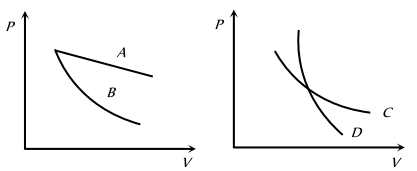
- A
lsothermal for $A$ and $D$ while adiabatic for $B$ and $C$
- B
Adiabatic for $A$ and $C$ while isothermal for $B$ and $D$
- C
Isothermal for $A$ and $B$ while adiabatic for $C$ and $D$
- ✓
lsothermal for $A$ and $C$ while adiabatic for $B$ and $D$
AnswerCorrect option: D. lsothermal for $A$ and $C$ while adiabatic for $B$ and $D$
(d) Adiabatic curves are more stepper than isothermal curves.
View full question & answer→MCQ 3761 Mark
The temperature of reservoir of Carnot's engine operating with an efficiency of $70 \%$ is $1000 K$. The temperature of its sink is
- ✓
$300 K$
- B
$400 K$
- C
$500 \mathrm{~K}$
- D
$700 K$
AnswerCorrect option: A. $300 K$
(a) $\quad \eta=1-\frac{T_2}{T_1} \Rightarrow \frac{70}{100}=1-\frac{T_2}{1000}\Rightarrow T_2=300 \mathrm{~K}$
View full question & answer→MCQ 3771 Mark
In the following figure, four curves $A, B, C$ and $D$ are shown. The curves are
- A
lsothermal for $A$ and $D$ while adiabatic for $B$ and $C$
- B
Adiabatic for $A$ and $C$ while isothermal for $B$ and $D$
- C
Isothermal for $A$ and $B$ while adiabatic for $C$ and $D$
- ✓
lsothermal for $A$ and $C$ while adiabatic for $B$ and $D$
AnswerCorrect option: D. lsothermal for $A$ and $C$ while adiabatic for $B$ and $D$
(d) Adiabatic curves are more stepper than isothermal curves.
View full question & answer→MCQ 3781 Mark
The temperature of reservoir of Carnot's engine operating with an efficiency of $70 \%$ is $1000 K$. The temperature of its sink is
- ✓
$300 K$
- B
$400 K$
- C
$500 \mathrm{~K}$
- D
$700 K$
AnswerCorrect option: A. $300 K$
(a) $\quad \eta=1-\frac{T_2}{T_1} \Rightarrow \frac{70}{100}=1-\frac{T_2}{1000}\Rightarrow T_2=300 \mathrm{~K}$
View full question & answer→MCQ 3791 Mark
In the following figure, four curves $A, B, C$ and $D$ are shown. The curves are
- A
lsothermal for $A$ and $D$ while adiabatic for $B$ and $C$
- B
Adiabatic for $A$ and $C$ while isothermal for $B$ and $D$
- C
Isothermal for $A$ and $B$ while adiabatic for $C$ and $D$
- ✓
lsothermal for $A$ and $C$ while adiabatic for $B$ and $D$
AnswerCorrect option: D. lsothermal for $A$ and $C$ while adiabatic for $B$ and $D$
(d) Adiabatic curves are more stepper than isothermal curves.
View full question & answer→MCQ 3801 Mark
The temperature of sink of Carnot engine is $27^{\circ} \mathrm{C}$. Efficiency of engine is $25 \%$. Then temperature of source is
- A
$227^{\circ} \mathrm{C}$
- B
$327^{\circ} \mathrm{C}$
- ✓
$127^{\circ} \mathrm{C}$
- D
$27^{\circ} \mathrm{C}$
AnswerCorrect option: C. $127^{\circ} \mathrm{C}$
(c)$\eta=1-\frac{T_2}{T_1} \Rightarrow \frac{25}{100}=1-\frac{300}{T_1} \Rightarrow \frac{1}{4}=1-\frac{300}{T_1}$$T_1=400 \mathrm{~K}=127^{\circ} \mathrm{C}$
View full question & answer→MCQ 3811 Mark
The temperature of sink of Carnot engine is $27^{\circ} \mathrm{C}$. Efficiency of engine is $25 \%$. Then temperature of source is
- A
$227^{\circ} \mathrm{C}$
- B
$327^{\circ} \mathrm{C}$
- ✓
$127^{\circ} \mathrm{C}$
- D
$27^{\circ} \mathrm{C}$
AnswerCorrect option: C. $127^{\circ} \mathrm{C}$
(c)$\eta=1-\frac{T_2}{T_1} \Rightarrow \frac{25}{100}=1-\frac{300}{T_1} \Rightarrow \frac{1}{4}=1-\frac{300}{T_1}$$T_1=400 \mathrm{~K}=127^{\circ} \mathrm{C}$
View full question & answer→MCQ 3821 Mark
The temperature of sink of Carnot engine is $27^{\circ} \mathrm{C}$. Efficiency of engine is $25 \%$. Then temperature of source is
- A
$227^{\circ} \mathrm{C}$
- B
$327^{\circ} \mathrm{C}$
- ✓
$127^{\circ} \mathrm{C}$
- D
$27^{\circ} \mathrm{C}$
AnswerCorrect option: C. $127^{\circ} \mathrm{C}$
(c)$\eta=1-\frac{T_2}{T_1} \Rightarrow \frac{25}{100}=1-\frac{300}{T_1} \Rightarrow \frac{1}{4}=1-\frac{300}{T_1}$$T_1=400 \mathrm{~K}=127^{\circ} \mathrm{C}$
View full question & answer→MCQ 3831 Mark
- A
In an isobaric process, $\Delta p=0$
- B
In an isochoric process, $\Delta W=0$
- C
In an isothermal process, $\Delta T=0$
- ✓
In an isothermal process, $\Delta Q=0$
AnswerCorrect option: D. In an isothermal process, $\Delta Q=0$
(d) In isothermal process $\Delta Q \neq 0$.
View full question & answer→MCQ 3841 Mark
- A
In an isobaric process, $\Delta p=0$
- B
In an isochoric process, $\Delta W=0$
- C
In an isothermal process, $\Delta T=0$
- ✓
In an isothermal process, $\Delta Q=0$
AnswerCorrect option: D. In an isothermal process, $\Delta Q=0$
(d) In isothermal process $\Delta Q \neq 0$.
View full question & answer→MCQ 3851 Mark
- A
In an isobaric process, $\Delta p=0$
- B
In an isochoric process, $\Delta W=0$
- C
In an isothermal process, $\Delta T=0$
- ✓
In an isothermal process, $\Delta Q=0$
AnswerCorrect option: D. In an isothermal process, $\Delta Q=0$
(d) In isothermal process $\Delta Q \neq 0$.
View full question & answer→MCQ 3861 Mark
The efficiency of Carnot engine when source temperature is $T$ and sink temperature is $T$ will be
- ✓
$\frac{T_1-T_2}{T_1}$
- B
$\frac{T_2-T_1}{T_2}$
- C
$\frac{T_1-T_2}{T_2}$
- D
$\frac{T_1}{T_2}$
AnswerCorrect option: A. $\frac{T_1-T_2}{T_1}$
View full question & answer→MCQ 3871 Mark
The efficiency of Carnot engine when source temperature is $T$ and sink temperature is $T$ will be
- ✓
$\frac{T_1-T_2}{T_1}$
- B
$\frac{T_2-T_1}{T_2}$
- C
$\frac{T_1-T_2}{T_2}$
- D
$\frac{T_1}{T_2}$
AnswerCorrect option: A. $\frac{T_1-T_2}{T_1}$
View full question & answer→MCQ 3881 Mark
The efficiency of Carnot engine when source temperature is $T$ and sink temperature is $T$ will be
- ✓
$\frac{T_1-T_2}{T_1}$
- B
$\frac{T_2-T_1}{T_2}$
- C
$\frac{T_1-T_2}{T_2}$
- D
$\frac{T_1}{T_2}$
AnswerCorrect option: A. $\frac{T_1-T_2}{T_1}$
View full question & answer→MCQ 3891 Mark
A Carnot engine operates between $227^{\circ} \mathrm{C}$ and $27^{\circ} \mathrm{C}$. Efficiency of the engine will be
- A
$\frac{1}{3}$
- ✓
$\frac{2}{5}$
- C
$\frac{3}{4}$
- D
$\frac{3}{5}$
AnswerCorrect option: B. $\frac{2}{5}$
(b) $\quad \eta=1-\frac{T_2}{T_1}=1-\frac{300}{500}=\frac{2}{5}$
View full question & answer→MCQ 3901 Mark
A Carnot engine operates between $227^{\circ} \mathrm{C}$ and $27^{\circ} \mathrm{C}$. Efficiency of the engine will be
- A
$\frac{1}{3}$
- ✓
$\frac{2}{5}$
- C
$\frac{3}{4}$
- D
$\frac{3}{5}$
AnswerCorrect option: B. $\frac{2}{5}$
(b) $\quad \eta=1-\frac{T_2}{T_1}=1-\frac{300}{500}=\frac{2}{5}$
View full question & answer→MCQ 3911 Mark
A Carnot engine operates between $227^{\circ} \mathrm{C}$ and $27^{\circ} \mathrm{C}$. Efficiency of the engine will be
- A
$\frac{1}{3}$
- ✓
$\frac{2}{5}$
- C
$\frac{3}{4}$
- D
$\frac{3}{5}$
AnswerCorrect option: B. $\frac{2}{5}$
(b) $\quad \eta=1-\frac{T_2}{T_1}=1-\frac{300}{500}=\frac{2}{5}$
View full question & answer→MCQ 3921 Mark
Which of the following parameters does not characterize the thermodynamic state of matter
MCQ 3931 Mark
Which of the following parameters does not characterize the thermodynamic state of matter
MCQ 3941 Mark
Which of the following parameters does not characterize the thermodynamic state of matter
MCQ 3951 Mark
A gas expands $0.25 \mathrm{~m}^3$ at constant pressure $10^3 \mathrm{~N} / \mathrm{m}^2$, the work done is
- A
$2.5$ ergs
- ✓
$250 \mathrm{~J}$
- C
$250 \mathrm{~W}$
- D
$250 \mathrm{~N}$
AnswerCorrect option: B. $250 \mathrm{~J}$
(b) $\Delta W=P \Delta V=10^3 \times 0.25=250 \mathrm{~J}$
View full question & answer→MCQ 3961 Mark
A gas expands $0.25 \mathrm{~m}^3$ at constant pressure $10^3 \mathrm{~N} / \mathrm{m}^2$, the work done is
- A
$2.5$ ergs
- ✓
$250 \mathrm{~J}$
- C
$250 \mathrm{~W}$
- D
$250 \mathrm{~N}$
AnswerCorrect option: B. $250 \mathrm{~J}$
(b) $\Delta W=P \Delta V=10^3 \times 0.25=250 \mathrm{~J}$
View full question & answer→MCQ 3971 Mark
A gas expands $0.25 \mathrm{~m}^3$ at constant pressure $10^3 \mathrm{~N} / \mathrm{m}^2$, the work done is
- A
$2.5$ ergs
- ✓
$250 \mathrm{~J}$
- C
$250 \mathrm{~W}$
- D
$250 \mathrm{~N}$
AnswerCorrect option: B. $250 \mathrm{~J}$
(b) $\Delta W=P \Delta V=10^3 \times 0.25=250 \mathrm{~J}$
View full question & answer→MCQ 3981 Mark
When a gas expands adiabatically
- A
No energy is required for expansion
- B
Energy is required and it comes from the wall of the container of the gas
- ✓
Internal energy of the gas is used in doing work
- D
Law of conservation of energy does not hold
AnswerCorrect option: C. Internal energy of the gas is used in doing work
(c) $\Delta Q=\Delta U+\Delta W=0 \Rightarrow \Delta W=-\Delta U$if $\Delta W$ is positive i.e., gas does work then $\Delta U$ should be negative meaning internal energy is used in doing work.
View full question & answer→MCQ 3991 Mark
When a gas expands adiabatically
- A
No energy is required for expansion
- B
Energy is required and it comes from the wall of the container of the gas
- ✓
Internal energy of the gas is used in doing work
- D
Law of conservation of energy does not hold
AnswerCorrect option: C. Internal energy of the gas is used in doing work
(c) $\Delta Q=\Delta U+\Delta W=0 \Rightarrow \Delta W=-\Delta U$if $\Delta W$ is positive i.e., gas does work then $\Delta U$ should be negative meaning internal energy is used in doing work.
View full question & answer→MCQ 4001 Mark
When a gas expands adiabatically
- A
No energy is required for expansion
- B
Energy is required and it comes from the wall of the container of the gas
- ✓
Internal energy of the gas is used in doing work
- D
Law of conservation of energy does not hold
AnswerCorrect option: C. Internal energy of the gas is used in doing work
(c) $\Delta Q=\Delta U+\Delta W=0 \Rightarrow \Delta W=-\Delta U$if $\Delta W$ is positive i.e., gas does work then $\Delta U$ should be negative meaning internal energy is used in doing work.
View full question & answer→