Questions · Page 6 of 6

MCQ

MCQ 2511 Mark
A circular disc is placed in front of a narrow source. When the point of observation is at a distance of 1 meter from the disc, then the disc covers first HPZ. The intensity at this point is $l$. The intensity at a point distance $25 cm$ from the disc will be
  • $I_1=0.531 I_0$
  • B
    $I_1=0.053 I_0$
  • C
    $I_1=53 I_0$
  • D
    $I_1=5.03 I_0$
Answer
Correct option: A.
$I_1=0.531 I_0$
(a) $I_0=R^2=\frac{R_2^2}{4}$
Number of $H P Z$ covered by the disc at $b=25 cm$
$n_1 b_1=n_2 b_2 \\n_2=\frac{n_1 b_1}{b_2}+\frac{1 \times 1}{0.25}=4$
Hence the intensity at this point is
$I=R^{\prime 2}=\left(\frac{ R _5}{2}\right)^2$
$=\left(\frac{R_5}{R_4} \times \frac{R_4}{R_3} \times \frac{R_3}{R_2}\right)^2 \times\left(\frac{R_2}{2}\right)^2$ or $1=[0.9]^6$$I_1=0.531 I_0$
Hence the correct answer will be (a).
View full question & answer
MCQ 2521 Mark
Two coherent sources $S$ and $S$ are separated by a distance four times the wavelength $\lambda$ of the source. The sources lie along $y$ axis whereas a detector moves along $+x$ axis. Leaving the origin and far off points the number of points where maxima are observed is
  • A
    (a) 2
  • (b) 3
  • C
    (c) 4
  • D
    (d) 5
Answer
Correct option: B.
(b) 3
(b)$I_A=R_1^2 $
$I_B=\left(R_1-R_2\right)^2=R_1^2\left(1-\frac{R_2}{R_1}\right)^2=R_1^2\left(1-\frac{3}{4}\right)^2=\frac{R_1^2}{16} $
$I_C=\left(R_1-R_2+R_3\right)^2=R_1^2\left(1-\frac{R_2}{R_1}+\frac{R_3}{R_1}\right)^2 $
$=R_1^2\left(1-\frac{R_2}{R_1}+\frac{R_3}{R_2} \times \frac{R_2}{R_1}\right)^2 \\=R_1^2\left(1-\frac{3}{4}+\frac{3}{4} \times \frac{3}{4}\right)^2=\left(\frac{13}{16}\right)^2 R_1^2=\frac{169}{256} R_1^2 $
$\therefore I_A: I_B: I_C=R_1^2: \frac{R_1^2}{16}: \frac{169}{256} R_1^2=256: 16: 169$
View full question & answer
MCQ 2531 Mark
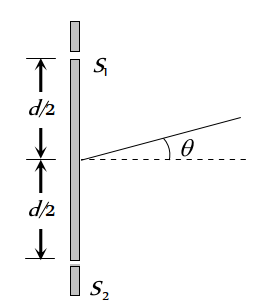
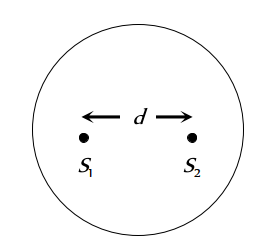
Two coherent sources separated by distance $d$ are radiating in phase having wavelength $\lambda$. A detector moves in a big circle around the two sources in the plane of the two sources. The angular position of $n=4$ interference maxima is given as
Image
  • (a) $\sin ^{-1} \frac{n \lambda}{d}$
  • B
    (b) $\cos ^{-1} \frac{4 \lambda}{d}$
  • C
    (c) $\tan ^{-1} \frac{d}{4 \lambda}$
  • D
    (d) $\cos ^{-1} \frac{\lambda}{4 d}$
Answer
Correct option: A.
(a) $\sin ^{-1} \frac{n \lambda}{d}$
(a) $I_0=R^2=\frac{R_2^2}{4}$
Number of $H P Z$ covered by the disc at $b=25 cm$
$n_1 b_1=n_2 b_2 \\n_2=\frac{n_1 b_1}{b_2}+\frac{1 \times 1}{0.25}=4$
Hence the intensity at this point is
$I=R^{\prime 2}=\left(\frac{ R _5}{2}\right)^2$
$=\left(\frac{R_5}{R_4} \times \frac{R_4}{R_3} \times \frac{R_3}{R_2}\right)^2 \times\left(\frac{R_2}{2}\right)^2$ or $1=[0.9]^6$$I_1=0.531 I_0$
Hence the correct answer will be (a).
View full question & answer
MCQ 2541 Mark
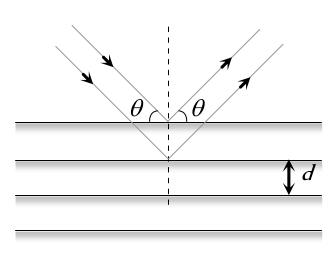
A beam with wavelength $\lambda$ falls on a stack of partially reflecting planes with separation $d$. The angle $\theta$ that the beam should make with the planes so that the beams reflected from successive planes may interfere constructively is (where $n=1,2, \ldots .$. )
Image
  • A
    $\sin ^{-1}\left(\frac{n \lambda}{d}\right)$
  • $\tan ^{-1}\left(\frac{n \lambda}{d}\right)$
  • C
    $\sin ^{-1}\left(\frac{n \lambda}{2 d}\right)$
  • D
    $\cos ^{-1}\left(\frac{n \lambda}{2 d}\right)$
Answer
Correct option: B.
$\tan ^{-1}\left(\frac{n \lambda}{d}\right)$
View full question & answer
MCQ 2551 Mark
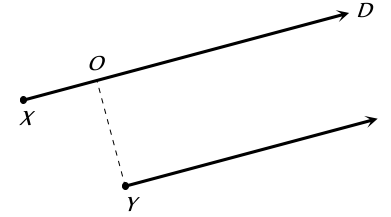
Two point sources $X$ and $Y$ emit waves of same frequency and speed but $Y$ lags in phase behind $X$ by $2 \pi /$ radian. If there is a maximum in direction $D$ the distance $X O$ using $n$ as an integer is given by

Image

  • A
    (a) $\frac{\lambda}{2}(n-l)$
  • B
    (b) $\lambda(n+l)$
  • C
    (c) $\frac{\lambda}{2}(n+l)$
  • D
    (d) $\lambda(n-l)$
View full question & answer
MCQ 2561 Mark
In a double slit arrangement fringes are produced using light of wavelength $4800 \mathring A$. One slit is covered by a thin plate of glass of refractive index $1.4$ and the other with another glass plate of same thickness but of refractive index $1.7.$ By doing so the central bright shifts to original fifth bright fringe from centre. Thickness of glass plate is
  • $8 \mu m$
  • B
    $6 \mu m$
  • C
    $4 \mu m$
  • D
    $10 \mu m$
Answer
Correct option: A.
$8 \mu m$
View full question & answer
MCQ 2571 Mark
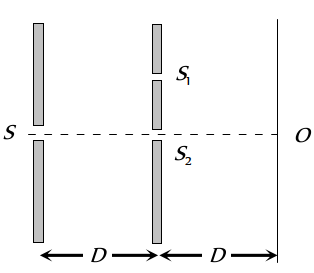
Two ideal slits $S$ and $S$ are at a distance $d$ apart, and illuminated by light of wavelength $\lambda$ passing through an ideal source slit $S$ placed on the line through $S$ as shown. The distance between the planes of slits and the source slit is $D$. A screen is held at a distance $D$ from the plane of the slits. The minimum value of $d$ for which there is darkness at $O$ is

Image

  • A
    (a) $\sqrt{\frac{3 \lambda D}{2}}$
  • (b) $\sqrt{\lambda D}$
  • C
    (c) $\sqrt{\frac{\lambda D}{2}}$
  • D
    (d) $\sqrt{3 \lambda D}$
Answer
Correct option: B.
(b) $\sqrt{\lambda D}$
(b) For maxima $2 \pi n=\frac{2 \pi}{\lambda}(X O)-2 \pi l$$\text { or } \frac{2 \pi}{\lambda}(X O)=2 \pi(n+l) \quad \text { or }(X O)=\lambda(n+l)$
View full question & answer
MCQ 2581 Mark
A flake of glass (refractive index 1.5 ) is placed over one of the openings of a double slit apparatus. The interference pattern displaces itself through seven successive maxima towards the side where the flake is placed. if wavelength of the diffracted light is $\lambda=600 nm$, then the thickness of the flake is
  • A
    (a) $2100 nm$
  • B
    (b) $4200 nm$
  • C
    (c) $8400 nm$
  • D
    (d) None of these
View full question & answer
MCQ 2591 Mark
In a Young's double slit experiment, the slits are $2 mm$ apart and are illuminated with a mixture of two wavelength $\lambda_0=750 nm$ and $\lambda=900 nm$. The minimum distance from the common central bright fringe on a screen $2 m$ from the slits where a bright fringe from one interference pattern coincides with a bright fringe from the other is
  • A
    (a) $1.5 mm$
  • B
    (b) $3 mm$
  • C
    (c) $4.5 mm$
  • D
    (d) $6 mm$
View full question & answer
MCQ 2601 Mark
In Young's double slit experiment how many maximas can be obtained on a screen (including the central maximum) on both sides of the central fringe if $\lambda=2000 \mathring A$ and $d=7000 \mathring A$
  • A
    (a) 12
  • B
    (b) 7
  • (c) 18
  • D
    (d) 4
Answer
Correct option: C.
(c) 18
(c)$\text { Shift }=\frac{\beta}{\lambda}(\mu-1) t $
$\Rightarrow 7 \beta=\frac{\beta}{\lambda}(\mu-1) t $
$\Rightarrow t=\frac{7 \lambda}{(\mu-1)}$
$=\frac{7\times 600}{(1.5-1)}=8400 nm$
View full question & answer
MCQ 2611 Mark
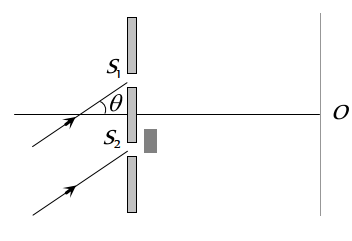
A monochromatic beam of light falls on YDSE apparatus at some angle (say $\theta$ ) as shown in figure. A thin sheet of glass is inserted in front of the lower slit $S$. The central bright fringe (path difference = o) will be obtained
Image
  • A
    (a) At $O$
  • B
    (b) Above $O$
  • (c) Below $O$
  • D
    (d) Anywhere depending on angle $\theta$, thickness of plate $t$ and refractive index of glass $\mu$
Answer
Correct option: C.
(c) Below $O$
(c) From the given data, note that the fringe width $(\beta)$ for $\lambda_1=900 nm$ is greater than fringe width $(\beta)$ for $\lambda_2=750 nm$.This means that at though the central maxima of the two coincide, but first maximum for $\lambda_1=900 nm$ will be further away from the first maxima for $\lambda_2=750 nm$, and so on. A stage may come when this mismatch equals $\beta$, then again maxima of $\lambda_1=900 nm$, will coincide with a maxima of $\lambda_2=750 nm$, let this correspond to $n$ order fringe for $\lambda$. Then it will correspond to $(n+1)^{\text {th }}$ order fringe for $\lambda$.Therefore
$\frac{n \lambda_1 D}{d}=\frac{(n+1) \lambda_2 D}{d}$
$\Rightarrow n \times 900 \times 10^{-9}=(n+1) 750 \times 10^{-9} $
$\Rightarrow n=5$
 Minimum distance from $\text { Central maxima }=\frac{n \lambda_1 D}{d}=\frac{5 \times 900 \times 10^{-9} \times 2}{2 \times 10^{-3}} $
$=45 \times 10^{-4} m =4.5 mm$
View full question & answer
MCQ 2621 Mark
The maximum intensity in Young's double slit experiment is $l$. Distance between the slits is $d=5 \lambda$, where $\lambda$ is the wavelength of monochromatic light used in the experiment. What will be the intensity of light in front of one of the slits on a screen at a distance $D=10 d$
  • A
    (a) $\frac{I_0}{2}$
  • (b) $\frac{3}{4} I _0$
  • C
    (c) $I$
  • D
    (d) $\frac{I_0}{4}$
Answer
Correct option: B.
(b) $\frac{3}{4} I _0$
(b) For maximum intensity on the screen$d \sin \theta=n \lambda \Rightarrow \sin \theta=\frac{n \lambda}{d}=\frac{n(2000)}{7000}=\frac{n}{3.5}$Since maximum value of $\sin \theta$ is 1So $n=0,1,2,3$, only. Thus only seven maximas can be obtained on both sides of the screen.
View full question & answer
MCQ 2631 Mark
In Young's double slit experiment the $y$-coordinates of central maxima and $10^*$ maxima are $2 cm$ and $5 cm$ respectively. When the YDSE apparatus is immersed in a liquid of refractive index 1.5 the corresponding $y$-coordinates will be
  • A
    (a) $2 cm , 7.5 cm$
  • B
    (b) $3 cm , 6 cm$
  • C
    (c) $2 cm , 4 cm$
  • (d) $4 / 3 cm , 10 / 3 cm$
Answer
Correct option: D.
(d) $4 / 3 cm , 10 / 3 cm$
(d) If $d \sin \theta=(\mu-1) t$, central fringe is obtained at $O$ If $d \sin \theta>(\mu-1) t$, central fringe is obtained above $O$ and If $d \sin \theta<(\mu-1) t$, central fringe is obtained below $O$.
View full question & answer
MCQ 2641 Mark
Interference fringes may be observed due to superposition of
  • A
    (a) (i) and (ii)
  • B
    (b) (i) and (iii)
  • C
    (c) (ii) and (iv)
  • D
    (d) (iii) and (iv)
View full question & answer
MCQ 2651 Mark
Four light waves are represented by
  • A
    (i) $y=a \sin \omega t$
  • B
    (ii) $y=a_2 \sin (\omega t+\phi)$
  • (iii) $y=a_1 \sin 2 \omega t$
  • D
    (iv) $y=a_2 \sin 2(\omega t+\phi)$
Answer
Correct option: C.
(iii) $y=a_1 \sin 2 \omega t$
(c) Fringe width $\beta \propto \lambda$. Therefore, $\lambda$ and hence $\beta$ decreases 1.5 times when immersed in liquid. The distance between central maxima and 10 maxima is $3 cm$ in vacuum. When immersed in liquid it will reduce to $2 cm$. Position of central maxima will not change while $10^*$ maxima will be obtained at $y=4 cm$.
View full question & answer
MCQ 2661 Mark
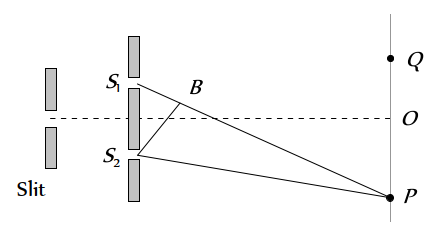
In the figure is shown Young's double slit experiment. $Q$ is the position of the first bright fringe on the right side of $O . P$ is the $11^*$fringe on the other side, as measured from $Q$. If the wavelength of the light used is $6000 \times 10^{-10} m$, then $S _1 B$ will be equal to

Image

  • A
    (a) $6 \times 10^{-6} m$
  • (b) $6.6 \times 10^{-6} m$
  • C
    (c) $3.138 \times 10^{-7} m$
  • D
    (d) $3.144 \times 10^{-7} m$
Answer
Correct option: B.
(b) $6.6 \times 10^{-6} m$
(b) Resultant intensity $I=I_1+I_2+2 \sqrt{I_1 I_2} \cos \phi$At central position with coherent source (and $I_1=I_2=I_0$$I_{\text {con }}=4 I_0$In case of incoherent at a given point, $\phi$ varies randomly with time so $(\cos \phi)^\alpha=0$$\therefore I_{\text {In coh }}=I_1+I_2=2 I_0$Hence $\frac{I_{c o h}}{I_{\text {Incoh }}}=\frac{2}{1}$.
View full question & answer
MCQ 2671 Mark
In hydrogen spectrum the wavelength of $H _\alpha$ line is $656 nm$ whereas in the spectrum of a distant galaxy, $H _\alpha$ line wavelength is $706 nm$. Estimated speed of the galaxy with respect to earth is [IIT-JEE 1999; UPSEAT 2003]
  • A
    (a) $2 \times 10^8 m / s$
  • (b) $2 \times 10^7 m / s$
  • C
    (c) $2 \times 10^6 m / s$
  • D
    (d) $2 \times 10^5 m / s$
Answer
Correct option: B.
(b) $2 \times 10^7 m / s$
(b) In this case, we can assume as if both the source and the observer are moving towards each other with speed $v$.
Hence $v^{\prime}=\frac{c-u_o}{c-u_s} v=\frac{c-(-v)}{c-v} v=\frac{c+v}{c-v} v $
$=\frac{(c+v)(c-v)}{(c-v)^2} v=\frac{c^2-v^2}{c^2+v^2-2 v c} v$
Since $v<<c$, therefore $v^{\prime}=\frac{c^2}{c^2-2 v c}=\frac{c}{c-2 v} v$
$\text { (a) } \Delta \lambda=\lambda \cdot \frac{v}{c} \text { where } v=r \omega=r \times\left(\frac{2 \pi}{T}\right) $
$\therefore \Delta \lambda=\frac{4320 \times 7 \times 10^8 \times 2 \times 3.14}{3 \times 10^8 \times 22 \times 86400}=0.033 \mathring A$
View full question & answer
MCQ 2681 Mark
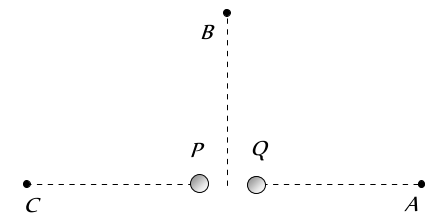
Figure here shows $P$ and $Q$ as two equally intense coherent sources emitting radiations of wavelength $20 m$. The separation $P Q$ is $5.0 m$ and phase of $P$ is ahead of the phase of $Q$ by 90. $A, B$ and $C$ are three distant points of observation equidistant from the mid-point of $P Q$. The intensity of radiations at $A, B, C$ will bear the ratio

Image

  • A
    (a) $0: 1: 4$
  • (b) $4: 1: 0$
  • C
    (c) $0: 1: 2$
  • D
    (d) $2: 1: 0$
Answer
Correct option: B.
(b) $4: 1: 0$
(b) By using phase difference $\phi=\frac{2 \pi}{\lambda}(\Delta)$For path difference $\lambda$, phase difference $\phi_1=2 \pi$ and for path difference $\lambda / 4$, phase difference $\phi=\pi / 2$.Also by using $I=4 I_0 \cos ^2 \frac{\phi}{2} \Rightarrow \frac{I_1}{I_2}=\frac{\cos ^2\left(\phi_1 / 2\right)}{\cos ^2\left(\phi_2 / 2\right)}$$\Rightarrow \frac{K}{I_2}=\frac{\cos ^2(2 \pi / 2)}{\cos ^2\left(\frac{\pi / 2}{2}\right)}=\frac{1}{1 / 2} \Rightarrow I_2=\frac{K}{2} \text {. }$
View full question & answer
MCQ 2691 Mark
In an interference arrangement similar to Young's double slit experiment, the slits $S$ and $S$ are illuminated with coherent microwave sources each of frequency $10 Hz$. The sources are synchronized to have zero phase difference. The slits are separated by distance $d=150 m$. The intensity $l(\theta)$ is measured as a function of $\theta$, where $\theta$ is defined as shown. If $l$ is maximum intensity, then $I(\theta)$ for $0 \leq \theta \leq 90^{\circ}$ is given by

Image

  • A
    (a) $I(\theta)=I_0$ for $\theta=0^{\circ}$
  • B
    (b) $I(\theta)=I_0 / 2$ for $\theta=30^{\circ}$
  • C
    (c) $I(\theta)=I_0 / 4$ for $\theta=90^{\circ}$
  • (d) $I(\theta)$ is constant for all values of $\theta$
Answer
Correct option: D.
(d) $I(\theta)$ is constant for all values of $\theta$
(d) $\quad I=a_1^2+a_2^2+2 a_1 a_2 \cos \phi$Put $a_1^2+a_2^2=A$ and $a_1 a_2=B ; \therefore I=A+B \cos \phi$
View full question & answer
MCQ 2701 Mark
In a Young's double slit experiment the source $S$ and the two slits $A$ and $B$ are vertical with slit $A$ above slit $B$. The fringes are observed on a vertical screen $K$. The optical path length from $S$ to $B$ is increased very slightly (by introducing a transparent material of higher refractive index) and the optical path length from $S$ to $A$ is not changed, as a result the fringe system on $K$ moves
  • A
    (a) Vertically downwards slightly
  • B
    (b) Vertically upwards slightly
  • C
    (c) Horizontally, slightly to the left
  • D
    (d) Horizontally, slightly to the right
View full question & answer
MCQ 2711 Mark
In Young's double slit experiment, if the two slits are illuminated with separate sources, no interference pattern is observed because
  • A
    (a) There will be no constant phase difference between the two waves
  • B
    (b) The wavelengths are not equal
  • C
    (c) The amplitudes are not equal
  • D
    (d) None of the above
View full question & answer
MCQ 2721 Mark
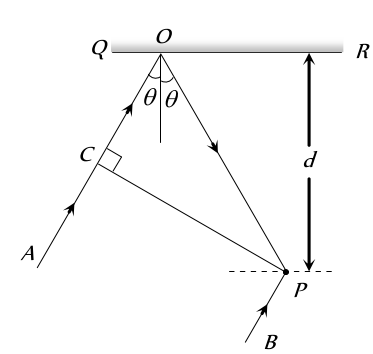
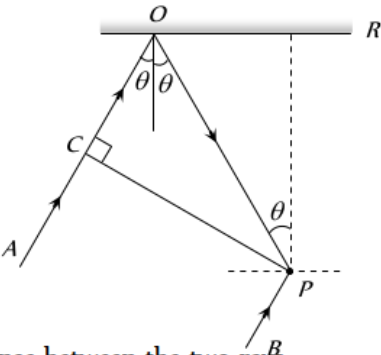
In the adjacent diagram, $CP$ represents a wavefront and $A O \& B P$, the corresponding two rays. Find the condition on $\theta$ for constructive interference at $P$ between the ray $B P$ and reflected ray $O P$
Image
  • A
    $\cos \theta=3 \lambda / 2 d$
  • $\cos \theta=\lambda / 4 d$
  • C
    $\sec \theta-\cos \theta=\lambda / d$
  • D
    $\sec \theta-\cos \theta=4 \lambda / d$
Answer
Correct option: B.
$\cos \theta=\lambda / 4 d$
$\because P R=d \Rightarrow P O=d \sec \theta \text { and } C O=P O \cos 2 \theta$
$=d \sec \theta \cos 2 \theta \text { is }$

Path difference between the two rays
$\Delta=C O+P O=(d \sec \theta+d \sec \theta \cos 2 \theta)$
Phase difference between the two rays is $\phi=\pi$ (One is reflected, while another is direct)
Therefore condition for constructive interference should be
$\Delta=\frac{\lambda}{2}, \frac{3 \lambda}{2} \ldots \ldots$
$\text { or } d \sec \theta(1+\cos 2 \theta)=\frac{\lambda}{2} $
$\text { or } \frac{d}{\cos \theta}\left(2 \cos ^2 \theta\right)=\frac{\lambda}{2} \Rightarrow \cos \theta=\frac{\lambda}{4 d}$
 
View full question & answer
MCQ - Page 6 - JEE physics STD 12 Science Questions - Vidyadip