MCQ 511 Mark
A body of mass $M_1$ collides elastically with another mass $M_2$ at rest. There is maximum transfer of energy when
AnswerCorrect option: C. $M_1=M_2$
View full question & answer→MCQ 521 Mark
A body of mass $2 \mathrm{~kg}$ moving with a velocity of $3 \mathrm{~m} / \mathrm{sec}$ collides head on with a body of mass $1 \mathrm{~kg}$ moving in opposite direction with a velocity of $4 \mathrm{~m} / \mathrm{sec}$. After collision, two bodies stick together and move with a common velocity which in $\mathrm{m} / \mathrm{sec}$ is equal to
- A
$1 / 4$
- B
$1 / 3$
- ✓
$2 / 3$
- D
$3 / 4$
AnswerCorrect option: C. $2 / 3$
(c)$m_1 v_1-m_2 v_2=\left(m_1+m_2\right) v $
$\Rightarrow 2\times3-1\times 4=(2+1) v \Rightarrow v=\frac{2}{3} \mathrm{~m} / \mathrm{s}$
View full question & answer→MCQ 531 Mark
Which of the following statements is true
AnswerCorrect option: C. Total kinetic energy is not conserved but momentum is conserved in inelastic collisions
View full question & answer→MCQ 541 Mark
A body moves a distance of $10 \mathrm{~m}$ along a straight line under the action of a force of $5 \mathrm{~N}$. If the work done is $25$ joules, the angle which the force makes with the direction of motion of the body is
- A
$0^{\circ}$
- B
$30^{\circ}$
- ✓
$60^{\circ}$
- D
$90^{\circ}$
AnswerCorrect option: C. $60^{\circ}$
$W=F s \cos \theta \Rightarrow \cos \theta=\frac{W}{F}=\frac{25}{50}=\frac{1}{2}\Rightarrow \theta=60^{\circ}$
View full question & answer→MCQ 551 Mark
A particle of mass $m$ moving eastward with a speed $v$ collides with another particle of the same mass moving northward with the same speed $v$. The two particles coalesce on collision. The new particle of mass $2 \mathrm{~m}$ will move in the north-easterly direction with a velocity
- A
$v / 2$
- B
$2 v$
- ✓
$v / \sqrt{2}$
- D
$\mathrm{v}$
AnswerCorrect option: C. $v / \sqrt{2}$
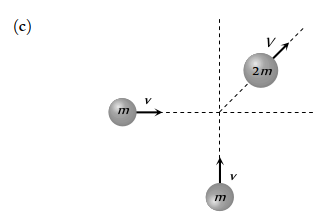
Initial momentum of the system
$\vec{P}_i=m v \hat{i}+m \hat{v j} $
$\left|\vec{P}_i\right|=\sqrt{2} m v$
Final momentum of the system $=2 \mathrm{mV}$
By the law of conservation of momentum $\sqrt{2} m v=2 m V $
$\Rightarrow V=\frac{v}{\sqrt{2}}$ View full question & answer→MCQ 561 Mark
Tripling the speed of the motor car multiplies the distance needed for stopping it by
Answer(c) $s \propto u^2$ i.e. if speed becomes three times then distance needed for stoppingwill be nine times.
View full question & answer→MCQ 571 Mark
A body of mass $m$ moving with a constant velocity $v$ hits another body of the same mass moving with the same velocity $v$ but in the opposite direction and sticks to it. The velocity of the compound body after collision is
Answer(c) Initial momentum of the system $=m v-m v=0$As body sticks together $\therefore$ final momentum $=2 \mathrm{mV}$By conservation of momentum $2 m V=0 \therefore V=0$
View full question & answer→MCQ 581 Mark
A body of mass $m$ is moving in a circle of radius $r$ with a constant speed $v$. The force on the body is $\frac{m v^2}{r}$ and is directed towards the centre. What is the work done by this force in moving the body over half the circumference of the circle
- A
$\frac{m v^2}{\pi r^2}$
- ✓
- C
$\frac{m v^2}{r^2}$
- D
$\frac{\pi r^2}{m v^2}$
AnswerWork done by centripetal force is always zero, because force and in stantaneousdisplacement are always perpendicular.
$W=\vec{F} \cdot s=F s \cos\theta=Fs\cos\left(90^{\circ}\right)=0$
View full question & answer→MCQ 591 Mark
A light and a heavy body have equal kinetic energy. Which one has a greater momentum ?
- A
- ✓
- C
- D
It is not possible to say anything without additional information
Answer(b) $\quad P=\sqrt{2 m E}$ if $E$ are equal then $P \propto \sqrt{m}$i.e. heavier body will possess greater momentum.
View full question & answer→MCQ 601 Mark
Two balls at same temperature collide. What is conserved
MCQ 611 Mark
A bullet hits and gets embedded in a solid block resting on a horizontal frictionless table. What is conserved ?
- A
Momentum and kinetic energy
- B
- ✓
- D
Neither momentum nor kinetic energy
View full question & answer→MCQ 621 Mark
From a stationary tank of mass 125000 pound a small shell of mass 25 pound is fired with a muzzle velocity of $1000 \mathrm{ft} / \mathrm{sec}$. The tank recoils with a velocity of
- A
$0.1 \mathrm{ft} / \mathrm{sec}$
- ✓
$0.2 \mathrm{ft} / \mathrm{sec}$
- C
$0.4 \mathrm{ft} / \mathrm{sec}$
- D
$0.8 \mathrm{ft} / \mathrm{sec}$
AnswerCorrect option: B. $0.2 \mathrm{ft} / \mathrm{sec}$
(b) According to conservation of momentum Momentum of tank $=$Momentumofshell$125000\times v_{-}=25 \times 1000 \Rightarrow v-0.2 \mathrm{ft} / \mathrm{sec}$
View full question & answer→MCQ 631 Mark
Two springs of spring constants $1500 \mathrm{~N} / \mathrm{m}$ and $3000 \mathrm{~N} / \mathrm{m}$ respectively are stretched with the same force. They will have potential energy in the ratio
- A
$4: 1$
- B
$1: 4$
- ✓
$2: 1$
- D
$1: 2$
AnswerCorrect option: C. $2: 1$
(c) $U=\frac{F^2}{2 k} \Rightarrow \frac{U_1}{U_2}=\frac{k_2}{k_1}$ (if force are same)
$\therefore \frac{U_1}{U_2}=\frac{3000}{1500}=\frac{2}{1}$
View full question & answer→MCQ 641 Mark
A car of mass ' $m$ ' is driven with acceleration ' $a$ ' along a straight level road against a constant external resistive force ' $R$. When the velocity of the car is ' $V$, the rate at which the engine of the car is doing work will be
- A
$R V$
- B
$\mathrm{maV}$
- ✓
$(R+m a) V$
- D
$(m a-R) V$
AnswerCorrect option: C. $(R+m a) V$
Force required to move with constant velocity
$\therefore$ Power $=F V$Forceisrequired to oppose the resistive force $R$ and also to accelerate the body of mass with acceleration$(a).$
$\therefore$ Power $=(R+m a) V$
View full question & answer→MCQ 651 Mark
A particle of mass $m$ moving with velocity $v$ strikes a stationary particle of mass $2 \mathrm{~m}$ and sticks to it. The speed of the system will be
- A
$v / 2$
- B
$2 \mathrm{v}$
- ✓
$v / 3$
- D
$3 v$
AnswerCorrect option: C. $v / 3$
View full question & answer→MCQ 661 Mark
A frictionless track $A B C D E$ ends in a circular loop of radius $R$. A body slides down the track from point $A$ which is at $a$ height $h=5$ $\mathrm{cm}$. Maximum value of $R$ for the body to successfully complete the loop is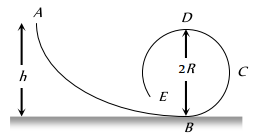
AnswerCorrect option: D. $2 \mathrm{~cm}$
Condition for vertical looping $h=\frac{5}{2r}=5\mathrm{~cm}\quad\therefore r=2\mathrm{~cm}$
View full question & answer→MCQ 671 Mark
A particle of mass $\mathrm{m}$ moving with horizontal speed $6 \mathrm{~m} / \mathrm{sec}$ as shown in figure. If $m \ll M$ then for one dimensional elastic collision, the speed of lighter particle after collision will be
- ✓
$2 \mathrm{~m} / \mathrm{sec}$ in original direction
- B
$2 \mathrm{~m} / \mathrm{sec}$ opposite to the original direction
- C
$4 \mathrm{~m} / \mathrm{sec}$ opposite to the original direction
- D
$4 \mathrm{~m} / \mathrm{sec}$ in original direction
AnswerCorrect option: A. $2 \mathrm{~m} / \mathrm{sec}$ in original direction
View full question & answer→MCQ 681 Mark
If a long spring is stretched by $0.02 \mathrm{~m}$, its potential energy is $U$. If the spring is stretched by $0.1 \mathrm{~m}$, then its potential energy will be
- A
$\frac{U}{5}$
- B
$U$
- C
$5 \ U$
- ✓
$25\ \mathrm{U}$
AnswerCorrect option: D. $25\ \mathrm{U}$
(d) $U \propto x^2 \Rightarrow \frac{U_2}{U_1}=\left(\frac{x_2}{x_1}\right)^2=\left(\frac{0.1}{0.02}\right)^2=25 \therefore U_2=25\ U$
View full question & answer→MCQ 691 Mark
A ball of mass $m$ moving with velocity $V$, makes a head on elastic collision with a ball of the same mass moving with velocity $2 \mathrm{~V}$ towards it. Taking direction of $V$ as positive velocities of the two balls after collision are
- A
$-V$ and $2 V$
- B
$2 V$ and $-V$
- C
$V$ and $-2 V$
- ✓
$-2 V$ and $V$
AnswerCorrect option: D. $-2 V$ and $V$
(d) Due to elastic collision of bodies having equal mass, their velocities get interchanged.
View full question & answer→MCQ 701 Mark
A particle of mass $m$ moving with a velocity $\vec{V}$ makes a head on elastic collision with another particle of same mass initially at rest. The velocity of the first particle after the collision will be
- A
$\vec{V}$
- B
$-\vec{V}$
- C
$-2 \vec{V}$
- ✓
Answer(d) In perfectly elastic head on collision of equal masses velocities gets interchanged
View full question & answer→MCQ 711 Mark
If a lighter body (mass $M_1$ and velocity $V_1$ ) and a heavier body (mass $M_2$ and velocity $V_2$ ) have the same kinetic energy, then
- A
$M_2 V_2
- B
$M_2 V_2=M_1 V_1$
- C
$M_2 V_1=M_1 V_2$
- ✓
$M_2 V_2>M_1 V_1$
AnswerCorrect option: D. $M_2 V_2>M_1 V_1$
(d) $P=\sqrt{2 m E}$. If kinetic energy are equal then $P \propto \sqrt{m}$ i.e., heavier body posses large momentum As $M_1$
View full question & answer→MCQ 721 Mark
A force $\boldsymbol{F}=(5 \hat{\boldsymbol{i}}+3 \hat{\boldsymbol{j}})$ newton is applied over a particle which displaces it from its origin to the point $\boldsymbol{r}=(2 \hat{i}-1 \hat{\boldsymbol{j}})$ metres. The work done on the particle is
- A
$-7$ joules
- B
$+13$ joules
- ✓
$+7$ joules
- D
$+11$ joules
AnswerCorrect option: C. $+7$ joules
$W=\vec{F} \cdot \vec{s}=(5 \hat{i}+3 \hat{j}) \cdot(2\hat{i}\hat{j})=10-3=7\mathrm{~J}$
View full question & answer→MCQ 731 Mark
A body of mass $m$ having an initial velocity $v$, makes head on collision with a stationary body of mass $M$. After the collision, the body of mass $m$ comes to rest and only the body having mass $M$ moves. This will happen only when
- A
$m \gg M$
- B
$m<<$
- ✓
$m=M$
- D
$m=\frac{1}{2} M$
Answer(c) Velocity exchange takes place when the masses of bodies are equal
View full question & answer→MCQ 741 Mark
If the kinetic energy of a body increases by $0.1 \%$, the percent increase of its momentum will be
- ✓
$0.05 \%$
- B
$0.1 \%$
- C
$1.0 \%$
- D
$10 \%$
AnswerCorrect option: A. $0.05 \%$
(a) $P=\sqrt{2 m E} \therefore P \propto \sqrt{E}$Percentage increase in $P=\frac{1}{2}$ (percentage increase in $E$ )$=\frac{1}{2}(0.1 \%)=0.05 \%$
View full question & answer→MCQ 751 Mark
A body of mass $m \mathrm{~kg}$ is lifted by a man to a height of one metre in $30 \mathrm{sec}$. Another man lifts the same mass to the same height in 60 sec. The work done by them are in the ratio
- A
$1: 2$
- ✓
$1: 1$
- C
$2: 1$
- D
$4: 1$
AnswerCorrect option: B. $1: 1$
(b) Work done does not depend on time.
View full question & answer→MCQ 761 Mark
Two bodies of masses $m_1$ and $m_2$ have equal kinetic energies. If $p_1$ and $p_2$ are their respective momentum, then ratio $p_1: p_2$ is equal to
- A
$m_1: m_2$
- B
$m_2: m_1$
- ✓
$\sqrt{m_1}: \sqrt{m_2}$
- D
$m_1^2: m_2^2$
AnswerCorrect option: C. $\sqrt{m_1}: \sqrt{m_2}$
(c) $\quad P=\sqrt{2 m E}$
$\therefore P\propto \sqrt m\ \text{if}\ \ \text{(E=const)}(\therefore\frac{P_1}{P_2})=\sqrt{\frac{m_1}{m_2}}$
View full question & answer→MCQ 771 Mark
A light and a heavy body have equal momenta. Which one has greater K.E
Answer(a) $E=\frac{P^2}{2 m}$ if $P=$ constant then $E \propto \frac{1}{m}$
View full question & answer→MCQ 781 Mark
The kinetic energy of a body of mass $3 \mathrm{~kg}$ and momentum $2 \mathrm{Ns}$ is
- A
- ✓
$\frac{2}{3} J$
- C
$\frac{3}{2} J$
- D
$4 \mathrm{~J}$
AnswerCorrect option: B. $\frac{2}{3} J$
(b) $E=\frac{P^2}{2 m}=\frac{4}{2 \times 3}=\frac{2}{3} \mathrm{~J}$
View full question & answer→MCQ 791 Mark
The potential energy of a weight less spring compressed by a distance a is proportional to
- A
$a$
- ✓
$a^2$
- C
$a^{-2}$
- D
$a^0$
Answer(b) Potential energy of spring $=\frac{1}{2} K x^2$$\therefore P E\propto^2\Rightarrow P E \propto a^2$
View full question & answer→MCQ 801 Mark
In an explosion a body breaks up into two pieces of unequal masses. In this
- ✓
Both parts will have numerically equal momentum
- B
Lighter part will have more momentum
- C
Heavier part will have more momentum
- D
Both parts will have equal kinetic energy
AnswerCorrect option: A. Both parts will have numerically equal momentum
(a) Both part will have numerically equal momentum and lighter part will have more velocity.
View full question & answer→MCQ 811 Mark
A bullet of mass $m$ moving with velocity $v$ strikes a block of mass $M$ at rest and gets embedded into it. The kinetic energy of the composite block will be
- ✓
$\frac{1}{2} m v^2 \times \frac{m}{(m+M)}$
- B
$\frac{1}{2} m v^2 \times \frac{M}{(m+M)}$
- C
$\frac{1}{2} m v^2 \times \frac{(M+m)}{M}$
- D
$\frac{1}{2} M v^2 \times \frac{m}{(m+M)}$
AnswerCorrect option: A. $\frac{1}{2} m v^2 \times \frac{m}{(m+M)}$
(a) By conservation of momentum, $\quad m v+M \times 0=(m+M) V$ Velocity of compositeblock$V=\left(\frac{m}{m+M}\right) v$K.E. of composite block $=\frac{1}{2}(M+m) V^2$$=\frac{1}{2}(M+m)\left(\frac{m}{M+m}\right)^2 v^2=\frac{1}{2} m v^2\left(\frac{m}{m+M}\right)$
View full question & answer→MCQ 821 Mark
If the momentum of a body increases by $0.01 \%$, its kinetic energy will increase by
- A
$0.01 \%$
- ✓
$0.02 \%$
- C
$0.04 \%$
- D
$0.08 \%$
AnswerCorrect option: B. $0.02 \%$
(b) $E \propto P^2$ (if $m=$ constant)Percentage increase in $E=2$ (Percentage increase in $P$ )$=2 \times 0.01 \%=0.02 \%$
View full question & answer→MCQ 831 Mark
The force constant of a weightless spring is $16 \mathrm{~N} / \mathrm{m}$. A body of mass $1.0 \mathrm{~kg}$ suspended from it is pulled down through $5 \mathrm{~cm}$ and then released. The maximum kinetic energy of the system (spring + body) will be
- ✓
$2 \times 10^{-2} J$
- B
$4 \times 10^{-2} \mathrm{~J}$
- C
$8 \times 10^{-2} \mathrm{~J}$
- D
$16 \times 10^{-2} \mathrm{~J}$
AnswerCorrect option: A. $2 \times 10^{-2} J$
(a) Max. K.E. of the system $=$ Max. P.E. of the system$\frac{1}{2} k x^2==\frac{1}{2}\times(16) \times\left(5 \times 10^{-2}\right)^2=2 \times 10^{-2} J$
View full question & answer→MCQ 841 Mark
A body of mass $5 \mathrm{~kg}$ is moving with a momentum of $10 \mathrm{~kg}-\mathrm{m} / \mathrm{s}$. A force of $0.2 \mathrm{~N}$ acts on it in the direction of motion of the body for 10 seconds. The increase in its kinetic energy is
Answer(d) Change in momentum $=$ Force $\times$ time
$P_2P_1=F\times t=0.2\times 10=2 $
$\Rightarrow P_2=2+P_1=2+10=12 \mathrm{~kg}\mathrm{m}\mathrm{s}$
IncreaseinK.E$=\frac{1}{2 m} \left (P_2^2-P_1^2\right)=\frac{1}{2\times5}\left[(12)^2-(10)^2\right]=\frac{44}{10}=4.4 \mathrm{~J}$
View full question & answer→MCQ 851 Mark
Two bodies of masses $m$ and $2 m$ have same momentum. Their respective kinetic energies $E_1$ and $E_2$ are in the ratio
- A
$1: 2$
- ✓
$2: 1$
- C
$1: \sqrt{2}$
- D
$1: 4$
AnswerCorrect option: B. $2: 1$
$E=\frac{P^2}{2 m}$. If momentum are same then $E\propto\frac{1}{m}$
$[\therefore \frac{E_1}{E_2}=\frac{m_2}{m_1}=\frac{2 m}{m}=\frac{2}{1}]$
View full question & answer→MCQ 861 Mark
The quantities remaining constant in a collision are
- A
Momentum, kinetic energy and temperature
- B
Momentum and kinetic energy but not temperature
- C
Momentum and temperature but not kinetic energy
- ✓
Momentum but neither kinetic energy nor temperature
AnswerCorrect option: D. Momentum but neither kinetic energy nor temperature
View full question & answer→MCQ 871 Mark
A sphere of mass $m$, moving with velocity $V$, enters a hanging ban of sand and stops. If the mass of the bag is $M$ and it is raised by height $h$, then the velocity of the sphere was
- ✓
$\frac{M+m}{m} \sqrt{2 g h}$
- B
$\frac{M}{m} \sqrt{2 g h}$
- C
$\frac{m}{M+m} \sqrt{2 g h}$
- D
$\frac{m}{M} \sqrt{2 g h}$
AnswerCorrect option: A. $\frac{M+m}{m} \sqrt{2 g h}$
View full question & answer→MCQ 881 Mark
In which case does the potential energy decrease
- A
- B
- C
On moving a body against gravitational force
- ✓
On the rising of an air bubble in water
AnswerCorrect option: D. On the rising of an air bubble in water
(d) In compression or extension of a spring work is done against restoring force.In moving a body against gravity work is done against gravitational force of attraction.lt means in all three cases potential energy of the system increases.But when the bubble rises inthedirection of upthrust force then system works so the potential energy of the system decreases.
View full question & answer→MCQ 891 Mark
A smooth sphere of mass $M$ moving with velocity $u$ directly collides elastically with another sphere of mass $m$ at rest. After collision their final velocities are $v$ and $v$ respectively. The value of $v$ is
AnswerCorrect option: C. $\frac{2 u}{1+\frac{m}{M}}$
View full question & answer→MCQ 901 Mark
In an elastic collision of two particles the following is conserved
- A
Momentum of each particle
- B
- C
Kinetic energy of each particle
- ✓
Total kinetic energy of both the particles
AnswerCorrect option: D. Total kinetic energy of both the particles
View full question & answer→MCQ 911 Mark
A $50 \mathrm{~g}$ bullet moving with velocity $10 \mathrm{~m} / \mathrm{s}$ strikes a block of mass $950 \mathrm{~g}$ at rest and gets embedded in it. The loss in kinetic energy will be
- A
$100 \%$
- ✓
$95 \%$
- C
$5 \%$
- D
$50 \%$
AnswerCorrect option: B. $95 \%$
View full question & answer→MCQ 921 Mark
You lift a heavy book from the floor of the room and keep it in the book-shelf having a height $2 \mathrm{~m}$. In this process you take 5 seconds. The work done by you will depend upon
- A
Mass of the book and time taken
- ✓
Weight of the book and height of the book-shelf
- C
Height of the book-shelf and time taken
- D
Mass of the book, height of the book-shelf and time taken
AnswerCorrect option: B. Weight of the book and height of the book-shelf
(b) Work done $=$ Force $\times$ displacement $=$ Weight of the book $\times$ Height of the book shelf
View full question & answer→MCQ 931 Mark
The potential energy of a certain spring when stretched through a distance ' $S$ is 10 joule. The amount of work (in joule) that must be done on this spring to stretch it through an additional distance ' $S$ will be
Answer(a)
$\frac{1}{2} k S^2=10 \mathrm{~J}$
Given in the problem $\frac{1}{2} k\left[(2 S)^2-(S)^2\right]$
$=3 \times \frac{1}{2k}S^2=3\times10=30\mathrm{~J}$
View full question & answer→MCQ 941 Mark
A bomb of $12 \mathrm{~kg}$ explodes into two pieces of masses $4 \mathrm{~kg}$ and $8 \mathrm{~kg}$. The velocity of $8 \mathrm{~kg}$ mass is $6 \mathrm{~m} / \mathrm{sec}$. The kinetic energy of the other mass is
- A
$48 \mathrm{~J}$
- B
$32 \mathrm{~J}$
- C
$24 \mathrm{~J}$
- ✓
$288 \mathrm{~J}$
AnswerCorrect option: D. $288 \mathrm{~J}$
View full question & answer→MCQ 951 Mark
An electric motor creates a tension of 4500 newton in a hoisting cable and reels it in at the rate of $2 \mathrm{~m} / \mathrm{sec}$. What is the power of electric motor
- A
$15 \mathrm{~kW}$
- ✓
$9 \mathrm{~kW}$
- C
$225 \mathrm{~W}$
- D
$9000 \mathrm{HP}$
AnswerCorrect option: B. $9 \mathrm{~kW}$
(b) $P=F_V=4500 \times 2=9000 \mathrm{~W}=9 \mathrm{~kW}$
View full question & answer→MCQ 961 Mark
The force constant of a wire is $k$ and that of another wire is $2 k$. When both the wires are stretched through same distance, then the work done
- A
$W_2=2 W_1^2$
- ✓
$W_2=2 W_1$
- C
$W_2=W_1$
- D
$W_2=0.5 W_1$
AnswerCorrect option: B. $W_2=2 W_1$
(b) $W=\frac{1}{2} k x^2$ If both wires are stretched through same distancethen $(W\propto k).$
As $k_2=2 k_1$ so
$W_2=2 W_1$
View full question & answer→MCQ 971 Mark
Which one of the following is not a conservative force
- A
- B
Electrostatic force between two charges
- C
Magnetic force between two magnetic dipoles
- ✓
Answer(d) Friction is a non-conservative force.
View full question & answer→MCQ 981 Mark
A force $\vec{F}=6 \hat{i}+2 \hat{j}-3 \hat{k}$ acts on a particle and produces a displacement of $\vec{s}=2 \hat{i}-3 \hat{j}+x \hat{k}$. If the work done is zero, the value of $x$ is
Answer$W=\vec{F} \cdot s=(6 \hat{i}+2 \hat{j}-3 \hat{k}) \cdot(2\hat{i}-3\hat{j}+x \hat{k})=0 $
$12-6-3 x=0 \Rightarrow x=2$
View full question & answer→MCQ 991 Mark
A machine which is $75$ percent efficient, uses $12$ joules of energy in lifting up a $1 \mathrm{~kg}$ mass through a certain distance. The mass is then allowed to fall through that distance. The velocity at the end of its fall is (in $m s^{-1}$ )
- A
$\sqrt{24}$
- B
$\sqrt{32}$
- ✓
$\sqrt{18}$
- D
$\sqrt{9}$
AnswerCorrect option: C. $\sqrt{18}$
Potential energy of a body $=75 \%$ of $12 \mathrm{~J}$ $mgh=9J$
$\Rightarrow h=\frac{9}{1 \times 10}=0.9 m$
Now when this mass allow to fall then it acquire velocity
$v=\sqrt{2 g h}=\sqrt{2 \times 10 \times 0.9}=\sqrt{18} \mathrm{~m} / \mathrm{s} \text {. }$
View full question & answer→MCQ 1001 Mark
A ball is released from the top of a tower. The ratio of work done by force of gravity in first, second and third second of the motion of the ball is
- A
$1: 2: 3$
- B
$1: 4: 9$
- ✓
$1: 3: 5$
- D
$1: 5: 3$
AnswerCorrect option: C. $1: 3: 5$
When the ball is released from the top of tower then ratio of distances covered bytheball in first, second and third second
$h_I: h_{I I}: h_{I I I}=1: 3: 5: \quad$ $because(\left.h_n \propto(2 n-1)\right]$
$\therefore$ Ratio of work done $m g h_I: m g h_{I I}: m g h_{I II}=1: 3: 5$
View full question & answer→