MCQ 1011 Mark
If $a\,.\,b = b\,.\,c = c\,.\,a = 0$ , then what is the value of the scalar triple product $ [a b c] $ ?
- A
$1$
- B
$-1$
- ✓
$|a||b||c|$
- D
$0$
AnswerCorrect option: C. $|a||b||c|$
c
(c) We have ${{a}}.\,{{b}} = {{b}}.{{c}} = {{c}}.\,{{a}} = 0$and the scalar triple product of three vectors is that, $[{{a}}\,{{b}}\,{{c}}] = ({{a}} \times {{b}}).{{c}}$
$\because {{a}}.\,{{b}} = 0,\,\,\,\,\,\,\therefore {{a}}\, \bot \,{{b}}$
So, angle between ${{a}}$ and ${{b}}$ is $\theta = 90^o$
Similarly, $[{{a}}\,{{b}}\,{{c}}] = |{{a}}||{{b}}|{{\hat n}}.\,{{c}}$, where ${{\hat n}}$ is a normal vector
$\therefore [{{a}}\,{{b}}\,{{c}}] = |{{a}}||{{b}}|{{\hat n}}\,\,\,{{c}}$
$\because {{\hat n}}$ and ${{c}}$ are parallel to each other
$\therefore [{{a}}\,{{b}}\,{{c}}] = |{{a}}||{{b}}||{{\hat n}}|\,\,\,\,|{{c}}|\cos \theta $$ = |{{a}}||{{b}}||{{c}}|$.
View full question & answer→MCQ 1021 Mark
If $a$ is perpendicular to $b$ and $c,|a| = 2,|b| = 3$, $|c| = 4$ and the angle between $b$ and $c$ is $\frac{{2\pi }}{3}$, then $[a\;b\;c]$ is equal to
- A
$4\sqrt 3 $
- B
$6\sqrt 3 $
- ✓
$12\sqrt 3 $
- D
$18\sqrt 3 $
AnswerCorrect option: C. $12\sqrt 3 $
c
(c) $[a\,b\,c] = a.(b \times c)$$ = a.(|b||c|\sin \theta \,\hat n)$
= $a(3 \times 4\sin \frac{{2\pi }}{3}.\hat n)$= $a.(12 \times \frac{{\sqrt 3 }}{2}\hat n)$
= $6\sqrt 3 |a||\hat n|$= $6\sqrt 3 \times 2 \times 1 \Rightarrow 12\sqrt 3 $.
View full question & answer→MCQ 1031 Mark
If a vector $\alpha$ lie in the plane of $\beta$ and $\gamma$ then which is correct
- ✓
$[\alpha \,\,\beta \,\,\gamma ] = 0$
- B
$[\alpha \,\,\beta \,\,\gamma ] = 1$
- C
$[\alpha \,\,\beta \,\,\gamma ] = 3$
- D
$[\beta \,\,\gamma \,\,\alpha ] = 1$
AnswerCorrect option: A. $[\alpha \,\,\beta \,\,\gamma ] = 0$
a
(a) As vector $\alpha $ lies in the plane of $\beta $ and $\gamma $
==> $\alpha ,\,\beta ,\,\gamma $ are coplanar
==> $[\alpha \,\,\beta \,\,\gamma ] = 0$.
View full question & answer→MCQ 1041 Mark
The equation of the plane containing the lines $r = {a_1} + \lambda {a_2}$ and $r = {a_2} + \lambda {a_1}$ is
- ✓
$[r\,\;{a_1}\;\,{a_2}] = 0$
- B
$[r\;\,{a_1}\;\,{a_2}] = {a_1}.\;{a_2}$
- C
$[r\;\,{a_2}\;\,{a_1}] = {a_1}.\;{a_2}$
- D
AnswerCorrect option: A. $[r\,\;{a_1}\;\,{a_2}] = 0$
a
(a) The required plane passes through a point having position vector ${a_1}$ and is parallel to the vectors ${a_1}$ and ${a_2}$. If $r$ is the position vector of any point on the plane, then $r - {a_1},{a_1},{a_2}$ are coplanar.
Therefore, $(r - {a_1}).({a_1} \times {a_2}) = 0$
==> $[r\,\,{a_1}\,{a_2}]$=$[{a_1}\,{a_1}\,{a_2}] \Rightarrow [r\,{a_1}\,{a_2}] = 0$
Hence, the required plane is $[r\,\,{a_1}\,{a_2}] = 0$.
View full question & answer→MCQ 1051 Mark
The length of the perpendicular from the origin to the plane passing through three non-collinear points $a,\,b,\,c$ is
- ✓
$\frac{{[a\,b\,c]}}{{|a \times b + c \times a + b \times c|}}$
- B
$\frac{{2\,[a\,b\,c]}}{{|a \times b + b \times c + c \times a|}}$
- C
$[a\,b\,c]$
- D
AnswerCorrect option: A. $\frac{{[a\,b\,c]}}{{|a \times b + c \times a + b \times c|}}$
a
(a) The vector equation of the plane passing through points $a,b,c$ is
$r.(a \times b + b \times c + c \times a) = [a\;b\;c]$
Therefore, the length of the perpendicular from the origin to this plane is given by
$= \frac{{[a\,b\,c]}}{{|a \times b + b \times c + c \times a|}}$.
View full question & answer→MCQ 1061 Mark
The length of the perpendicular from the origin to the plane passing through the point $ a $ and containing the line $r = b + \lambda c$ is
- A
$\frac{{[a\,b\,c]}}{{|a \times b + b \times c + c \times a|}}$
- B
$\frac{{\,[a\,b\,c]}}{{|a \times b + b \times c|}}$
- ✓
$\frac{{[a\,b\,c]}}{{|b \times c + c \times a|}}$
- D
$\frac{{[a\,b\,c]}}{{|c \times a + a \times b|}}$
AnswerCorrect option: C. $\frac{{[a\,b\,c]}}{{|b \times c + c \times a|}}$
c
(c) The given plane passes through $a$ and is parallel to the vectors $b - a$ and $c$. So it is normal to $(b - a) \times c$.
Hence, its equation is $(r - a).((b - a) \times c) = 0$
or
$r.(b \times c + c \times a) = [a\,b\,c\,]$
The length of the perpendicular from the origin to this plane is
$=\frac{{[a\,b\,c]}}{{|b \times c + c \times a|}}$.
View full question & answer→MCQ 1071 Mark
The volume of the tetrahedron, whose vertices are given by the vectors $ - i + j + k,\,\,i - j + k$ and $i + j - k$ with reference to the fourth vertex as origin, is
- A
$\frac{5}{3}$cubic unit
- ✓
$\frac{2}{3}$ cubic unit
- C
$\frac{3}{5}$cubic unit
- D
AnswerCorrect option: B. $\frac{2}{3}$ cubic unit
b
(b) Volume of tetrahedron $ABCD$ is, $\frac{1}{6}|\overrightarrow {AB} \times \overrightarrow {AC} \,.\,\overrightarrow {AD} |$, where $A( - 1,\,1,\,1),$ $B(1,\, - 1,\,1),$ $C(1,\,1,\, - 1)$ and $D(0,\,0,\,0).$
$ = \frac{1}{6}|(2i - 2j) \times (2i - 2k)\,.\,(i - j - k)|$
$ = \frac{1}{6}\left| {\,\begin{array}{*{20}{c}}2&{ - 2}&0\\2&0&{ - 2}\\1&{ - 1}&{ - 1}\end{array}\,} \right| = \frac{1}{6}( - 4) = - \frac{2}{3} = \frac{2}{3}$ cubic unit.
View full question & answer→MCQ 1081 Mark
If $x$ is parallel to $y$ and $z$ where $x = 2i + j + \alpha k$, $y = \alpha i + k$ and $z = 5i - j$, then $\alpha $ is equal to
- A
$ \pm \sqrt 5 $
- B
$ \pm \sqrt 6 $
- ✓
$ \pm \sqrt 7 $
- D
AnswerCorrect option: C. $ \pm \sqrt 7 $
c
(c) Given $x$ is parallel to $ y$ and $z$
$\therefore $ $x\,.\,(y \times z) = 0$ $ \Rightarrow $ $[x\,\,y\,\,z] = 0$
==> $\left| {\,\begin{array}{*{20}{c}}2&1&\alpha \\\alpha &0&1\\5&{ - 1}&0\end{array}\,} \right| = 0 \Rightarrow \alpha = \pm \,\sqrt 7 $.
View full question & answer→MCQ 1091 Mark
$a, b, c$ are three non-zero, non-coplanar vectors and $p, q, r$ are three other vectors such that $p = \frac{{b \times c}}{{a\,.\,b \times c}}$,$q = \frac{{c \times a}}{{a\,.\,b \times c}}$, $r = \frac{{a \times b}}{{a\,.\,b \times c}}$. Then $[p\,q\,r]$ equals
AnswerCorrect option: B. $\frac{1}{{a\,.\,b \times c}}$
b
(b) $[p\,q\,r] = p\,.\,(q \times r)$
$ = \frac{{b \times c}}{{a\,.\,b \times c}}.\left[ {\frac{{c \times a}}{{a\,.\,b \times c}} \times \frac{{a \times b}}{{a\,.\,b \times c}}} \right]$
$ = \frac{{(b \times c)\,.\,\left[ {(c \times a)\, \times \,(a \times b)} \right]}}{{{{[a\;.\,(b \times c)]}^3}}}$
$\frac{{(b \times c)\,.\,\left[ {\{ (c \times a)\,.\,b\} a - \{ (c \times a)\,.\,a\} b} \right]}}{{{{[a\,.\,(b \times c)]}^3}}}$
$ = \frac{{(b \times c)\left[ {\{ (c \times a)\,.\,b\} a} \right]}}{{{{[a\,.\,(b \times c)]}^3}}}$,
$ = \frac{{(b \times c)\left[ {\{ (a\,.\,(b \times c)\} a} \right]}}{{{{[a\,.\,(b \times c)]}^3}}} = \frac{{[a\,.\,(b \times c)]\,\,[(b \times c)\,.\,a]}}{{{{[a\,.\,(b \times c)]}^3}}}$
$ = \frac{1}{{a\,.\,b \times c}}.$
View full question & answer→MCQ 1101 Mark
If $\vec a = 2\hat i - \hat j + \hat k,\,\,\vec b = \hat i + \hat j - 2\hat k$ and $\vec c = \hat i + 3\hat j - \left( {{\lambda ^2} + 3\lambda } \right)\hat k$ (where $\lambda $ is a constant) and $\vec a $ is perpendicular to $\vec c - \lambda \vec b$, then sum of different values of $\lambda$ is
Answera
$(2 \hat{i}-\hat{j}+\hat{k}) \cdot[(1-\lambda) \hat{i}+(3-\lambda) \hat{j}$
$\left.\quad+\left(2 \lambda-\lambda^{2}-3 \lambda\right) \hat{k}\right]=0$
$\Rightarrow \quad 2-2 \lambda-3+\lambda+2 \lambda-\lambda^{2}-3 \lambda=0$
$\Rightarrow \quad-\lambda^{2}-2 \lambda-1=0$
$\Rightarrow \quad(\lambda+1)^{2}=0$
$\Rightarrow \quad \lambda=-1$
View full question & answer→MCQ 1111 Mark
Volume of purullclopipcd determined by vectors $\vec a + \vec b,\vec b + \vec c$ and $\vec c + \vec a$ is $4$. Then the volume of the parallelopiped determined by vectors $\vec a \times \vec b,\vec b \times \vec c$ and $\vec c \times \vec a$ is
Answerd
$[\vec{a}+\vec{b} \quad \vec{b}+\vec{c} \quad \vec{c}+\vec{a}]=4 \Rightarrow[\vec{a} \vec{\,b} \vec{\,c}]=2$
New volume $=[\vec{a} \times \vec{b} \quad \vec{b} \times \vec{c} \quad \vec{c} \times \vec{a}]$
$=\left[\begin{array}{lll}{\vec{a}} & {\vec{b}} & {\vec{c}}\end{array}\right]^{2}=4$
View full question & answer→MCQ 1121 Mark
The value of $\lambda $ for which points $A(2,2,1)$ , $B(1,1,1)$ , $C(-\lambda ,2,1)$ and $D(3,0,-1)$ are coplanar, is $\lambda =$ ............
Answera
$[\overrightarrow {{\rm{AB}}} \,\overrightarrow {{\rm{AC}}} \,\overrightarrow {{\rm{AD}}} ] = 0$
$\Rightarrow\left|\begin{array}{ccc}{-1} & {-1} & {0} \\ {-\lambda-2} & {0} & {0} \\ {1} & {-2} & {-2}\end{array}\right|=0 \Rightarrow \lambda=-2$
View full question & answer→MCQ 1131 Mark
The value of $\hat{i} .(\hat{j} \times \hat{k})+\hat{j} \cdot(\hat{i} \times \hat{k})+\hat{k} \cdot(\hat{i} \times \hat{j})$ is
Answera
$\hat{i} \cdot(\hat{j} \times \hat{k})+\hat{j} \cdot(\hat{i} \times \hat{k})+\hat{k} \cdot(\hat{i} \times \hat{j})$
$=\hat{i} \cdot \hat{i}+\hat{j} \cdot(-\hat{j})+\hat{k}\cdot \hat{k}$
$=1-\hat{j} \cdot \hat{j}+1$
$=1-1+1$
$=1$
The correct answer is $A.$
View full question & answer→MCQ 1141 Mark
If $u = i \times (a \times i) + j \times (a \times j) + k \times (a \times k),$ then
- A
$u = 0$
- B
$u = i + j + k$
- ✓
$u = 2a$
- D
$u = a$
AnswerCorrect option: C. $u = 2a$
c
(c) Let $a = xi + yj + zk$
$i \times (a \times i) + j \times (a \times j) + k \times (a \times k)$
$ = (i.i)a - i(a.i) + (j.j)a - j(a.j) + (k.k)a - k(a.k)$
$ = 3a - a = 2a.$
View full question & answer→MCQ 1151 Mark
If $a = i + 2j - 2k,\,\,b = 2i - j + k$and $c = i + 3j - k,$ then $a \times (b \times c)$ is equal to
- ✓
$20i - 3j + 7k$
- B
$20i - 3j - 7k$
- C
$20i + 3j - 7k$
- D
AnswerCorrect option: A. $20i - 3j + 7k$
a
(a) $a \times (b \times c) = a \times \left| {\begin{array}{*{20}{c}}i&j&k\\2&{ - 1}&1\\1&3&{ - 1}\end{array}} \right| = a \times ( - 2i + 3j + 7k)$
$ = \left| {\begin{array}{*{20}{c}}i&j&k\\1&2&{ - 2}\\{ - 2}&3&7\end{array}} \right| = 20i - 3j + 7k.$
View full question & answer→MCQ 1161 Mark
If $\alpha = 2i + 3j - k,\,\,\beta = - i + 2j - 4k$ and $\gamma = i + j + k,$ then $(\alpha \times \beta).(\alpha \times \gamma)$ is equal to
Answerd
(d) $\alpha\,.\,[\,\gamma \times (\alpha \times \beta)]$$ = \alpha\,.\,[(\gamma\,.\,\beta)\alpha - (\gamma\,.\,\alpha)\,\beta]$
$ = {(\alpha)^2}(\gamma\,.\,\beta) - (\gamma\,.\,\alpha)(\beta\,.\,\alpha)$$ = 14( - 3) - (4)(8) = - 74$.
View full question & answer→MCQ 1171 Mark
$[b \times c\,\,c \times a\,\,a \times b]$ is equal to
- A
$a \times (b \times c)$
- B
$2\,[a\,b\,c]$
- ✓
${[a\,b\,c]^2}$
- D
$[a\,b\,c]$
AnswerCorrect option: C. ${[a\,b\,c]^2}$
c
(c) $[b \times c\,\,\,c \times a\,\,\,a \times b]$$ = (b \times c)\,.[(c \times a)\, \times \,(a \times b)]$
Let $a \times b = d$
so , $(b \times c)[(c \times a) \times d] = (b \times c)[(d.\,a)c - (d.c).a]$
$ = (b \times c)[a.(a \times b).c - (a \times b)c.a]$
$ = (b \times c)[a\,b\,c]a = a.[b \times c].[a\,b\,c]$
$ = [a\,b\,c][a\,b\,c] = {[a\,b\,c]^2}$.
View full question & answer→MCQ 1181 Mark
Given three unit vector $a,\,b,\,c$ such that $a\, \bot \,b$ and $a||b$ , then $a\times (b\times c)$ is
Answerb
(b) $a\times (b\times c)=(a\,.\,c)\,b-(a\,.\,b)\,c$
$\because \,\,a\, \bot \,\,b\,\,,\,\,\,\therefore \,\,\,a\,.\,b = 0$
$\because a|\,|c$, $\therefore \,\,\,a\,.\,c = 1$ $(a, b$ and $ c $ are unit vectors)
$a \times (b \times c) = (1)b - (0)\,c\,$=$ b.$
View full question & answer→MCQ 1191 Mark
If the vectors $a $ and $b$ are mutually perpendicular, then $a \times \{ a \times \{ a \times (a \times b)\} \} $ is equal to
- A
$|a{|^2}b$
- B
$|a{|^3}b$
- ✓
$|a{|^4}b$
- D
AnswerCorrect option: C. $|a{|^4}b$
c
(c) $a \times [a \times \{ a \times (a \times b)\} ] = a \times [a \times \{ a \times ab\,\hat n\} ]$
$ = a \times [a \times {a^2}b] = a \times {a^3}b\,\hat n = |a{|^4}b.$
View full question & answer→MCQ 1201 Mark
$a\times [a\times (a\times b)]$ is equal to
- A
$(a \times a\,)\,.\,(b \times a)$
- B
$|a \times d{|^2}$
- C
$[a\,.\,(a \times b)]\,a$
- ✓
$(a.\,a)\,(b \times a)$
AnswerCorrect option: D. $(a.\,a)\,(b \times a)$
d
(d) $a \times [a \times (a \times b)] = a \times \{ (a\,.\,b)\,a - (a\,.\,a)b\} $
$ = (a\,.\,b)(a \times a) - (a\,.\,a)(a \times b)$$ = (a\,.\,b)\,0 + (a\,.\,a)(b \times a)$
$ = (a\,.\,a)\,\,(b \times a)$.
View full question & answer→MCQ 1211 Mark
If the non-zero vectors $ a $ and $b$ are perpendicular to each other, then the solution of the equation $r \times a = b$ is given by
- ✓
$r = xa + \frac{1}{{a\,.\,\,a}}(a \times b)$
- B
$r = xb - \frac{1}{{b\,.\,\,b}}(a \times b)$
- C
$r = xa \times b$
- D
$r = xb \times a$
AnswerCorrect option: A. $r = xa + \frac{1}{{a\,.\,\,a}}(a \times b)$
a
(a) Since $a,\,\,b$ and $a \times b$ are non-coplanar, hence $r = xa + yb + z(a \times b)$ for some scalars $x,\,\,y$ and $z.$
Now, $b = r \times a = \left\{ {xa + yb + z(a \times b)} \right\} \times a$
$ = y(b \times a) + z[(a \times b) \times a]$$ = - y(a \times b) - z\,[a \times (a \times b)]$
$ = - y(a \times b) - z\,[(a\,.\,b)a - (a\,.\,a)\,b]$
$ = - y(a \times b) + z(a\,.\,a)b$,
$ \Rightarrow y = 0$ and $z = \frac{1}{{(a\,.\,a)}} \Rightarrow r = xa + \frac{1}{{a\,.\,a}}(a \times b)$.
View full question & answer→MCQ 1221 Mark
If $a \times r = b + \lambda a$ and $a\,\,.\,\,r = 3,$ where $a = 2i + j - k$ and $b = - i - 2j + k,$ then $r$ and $\lambda$ are equal to
- A
$r = \frac{7}{6}i + \frac{2}{3}j,\,\,\lambda = \frac{6}{5}$
- ✓
$r = \frac{7}{6}i + \frac{2}{3}j,\,\,\lambda = \frac{5}{6}$
- C
$r = \frac{6}{7}i + \frac{2}{3}j,\,\,\lambda = \frac{6}{5}$
- D
AnswerCorrect option: B. $r = \frac{7}{6}i + \frac{2}{3}j,\,\,\lambda = \frac{5}{6}$
b
(b) Given, $a \times r = b + \lambda \,a \Rightarrow (a \times r)\,.\,a = b\,.\,a + \lambda \,a\,.\,a$
$ \Rightarrow 0 = b\,.\,a + \lambda \,|a{|^2} \Rightarrow \lambda = - \frac{{b\,.\,\,a}}{{|a{|^2}}} = \frac{5}{6}$
Also, $(a \times r) \times a = b \times a + \lambda \,a \times a \Rightarrow r = \frac{7}{6}i + \frac{2}{3}j$.
View full question & answer→MCQ 1231 Mark
$a$ and $ b$ are two non-collinear vectors, then $xa + yb$ (where $x$ and $y$ are scalars) represents a vector which is
AnswerCorrect option: C. Coplanar with $a$ and $b$
c
(c) $xa + yb$ represents a vector coplanar with $a $ and $b.$
View full question & answer→MCQ 1241 Mark
If $a, b, c $ are three non-coplanar vectors such that $a + b + c = \alpha \,d$ and $b + c + d = \beta \,a,$ then $a + b + c + d$ is equal to
- ✓
$0$
- B
$\alpha {\rm{ }}a$
- C
$\beta {\rm{ }}b$
- D
$(\alpha + \beta )\,c$
Answera
(a) We have $a + b + c = \alpha {\rm{ }}d$ and $b + c + d = \beta \,a$
$\therefore \,\,\,a + b + c + d = (\alpha + 1)d$ and $a + b + c + d = (\beta + 1)\,a.$
$ \Rightarrow (\alpha + 1)\,d = (\beta + 1)\,a$
If $\alpha \, \ne \, - 1,$ then $(\alpha + 1)\,d = (\beta + 1)\,a \Rightarrow d = \frac{{\beta + 1}}{{\alpha + 1}}a$
$ \Rightarrow a + b + c = \alpha \,d \Rightarrow a + b + c = \alpha \left( {\frac{{\beta + 1}}{{\alpha + 1}}} \right)a$
$ \Rightarrow \left( {1 - \frac{{\alpha (\beta + 1)}}{{\alpha + 1}}} \right)\,a + b + c = 0$
$ \Rightarrow a,\,b,\,c$ are coplanar which is contradiction to the given condition, $\therefore \,\,\,\alpha = - 1$ and so $a + b + c + d = 0.$
View full question & answer→MCQ 1251 Mark
If $l\,a + m\,b + n\,c = 0,$ where $l,\,m,\,\,n$ are scalars and $a, b, c $ are mutually perpendicular vectors, then
- A
$l = m = n = 1$
- B
$l + m + n = 1$
- ✓
$l = m = n = 0$
- D
$l \ne 0,\,\,m \ne 0,\,\,n \ne 0$
AnswerCorrect option: C. $l = m = n = 0$
c
(c) $la + mb + nc = 0$
Squaring both sides, we get
${a^2}{l^2} + {m^2}{b^2} + {n^2}{c^2} + 2l\,m\,a\,.\,b + 2l\,n\,a\,.\,c + 2m\,n\,b\,.\,c = 0$
But $a,\,b,\,c$ are mutually perpendicular
So, $a\,.\,b,$ $b\,.\,c$ and $c\,.\,a$ are equal to zero.
Therefore, ${a^2}{l^2} + {m^2}{b^2} + {n^2}{c^2} = 0\,\,i.e.,\,\,l,\,\,m,\,\,n$are equal to zero because ${a^2},\,\,{b^2}$ and ${c^2}$ cannot be equal to zero.
View full question & answer→MCQ 1261 Mark
If $|a|\, = a$ and $|b|\, = b,$ then ${\left( {\frac{a}{{{a^2}}} - \frac{b}{{{b^2}}}} \right)^2} = $
- A
${\left( {\frac{{a + b}}{{ab}}} \right)^2}$
- B
$\frac{{{{(a - b)}^2}}}{{ab}}$
- ✓
${\left( {\frac{{a - b}}{{ab}}} \right)^2}$
- D
$\frac{{{{(a + b)}^2}}}{{ab}}$
AnswerCorrect option: C. ${\left( {\frac{{a - b}}{{ab}}} \right)^2}$
c
(c) ${\left( {\frac{a}{{{a^2}}} - \frac{b}{{{b^2}}}} \right)^2} = \frac{{{a^2}}}{{{a^4}}} + \frac{{{b^2}}}{{{b^4}}} - \frac{{2a\,.\,b}}{{{a^2}{b^2}}}$,{$\because $ $a^2 = a^2$ etc.}
$ = \frac{{{a^2} + {b^2} - 2a\,.\,b}}{{{a^2}{b^2}}} = {\left( {\frac{{a - b}}{{ab}}} \right)^2}.$
View full question & answer→MCQ 1271 Mark
Let $\vec{v}$ be a vector such that $\overrightarrow{ v } \times((\hat{ i }-\hat{ k }) \times((3 \hat{ i }+4 \hat{ j }) \times(\hat{ j }+\hat{ k }))))=\overrightarrow{0}$. Suppose $\overrightarrow{ v } \cdot \hat{j}=-7$. Then $\overrightarrow{ v } \cdot \hat{i}$ is
Answera
(a)$\vec{a} \times(\vec{b} \times \vec{c})=(\vec{a} \cdot \vec{c}) \vec{b}-(\vec{a} \cdot \vec{b}) \vec{c}$
$(\hat{i}-\hat{k}) \times((3 \hat{i}+4 \hat{j}) \times(\hat{j}+\hat{k}))$
$=-3 \hat{i}-4 \hat{j}-3 \hat{j}-3 \hat{k}=-3 \hat{i}-7 \hat{j}-3 \hat{k}$
Now $\overrightarrow{ v } \times(3 \hat{ i }+7 \hat{ j }+3 \hat{ k })=\overrightarrow{0}$
$\Rightarrow \overrightarrow{ v }=\lambda(3 \hat{ i }+7 \hat{ j }+3 \hat{ k })$
Also $\overrightarrow{ v } \cdot \overrightarrow{ j }=-7 \Rightarrow 7 \lambda=-7 \Rightarrow \lambda=-1$
$\Rightarrow \overrightarrow{ v }=-3 \hat{ i }-7 \hat{ j }-3 \hat{ k }$
so, $\overrightarrow{ v } \cdot \hat{i}=-3$
View full question & answer→MCQ 1281 Mark
Let $a =\hat{ i }+\hat{ j }+\hat{ k }, b =2 \hat{ i }+2 \hat{ j }+\hat{ k }$ and $c = 5 \hat{ i }+\hat{ j }-\hat{ k } $ be three vectors. The area of the region formed by the set of points whose position vectors $\vec{r}$ satisfy the equations $r \cdot a =5$ and $| r - b |+| r - c |=4$ is closest to the integer.
Answera
(a)
Since, $| r - b |+| r - c |=4$ is equation of ellipsoid in plane $r \cdot a =5$ or $x+y+z=5$.
$\therefore$ Distance between foci $=| b - c |$
$\text { and } 2 a=4 \quad=|3 \hat{ i }-\hat{ j }-2 \hat{ k }|=\sqrt{14}=2 a e$
$\therefore \quad e=\frac{\sqrt{14}}{4} \Rightarrow e^2=1-\frac{b^2}{a^2}$
$\Rightarrow \frac{14}{16}=1-\frac{b^2}{4} \Rightarrow \frac{b^2}{4}=\frac{2}{16}$
$b^2=\frac{1}{2}$
$\therefore$ Area of ellipsoid
$=\pi a b=\pi(2)\left(\frac{1}{\sqrt{2}}\right)=\sqrt{2} \pi$
And from the given options the closest integer to $\sqrt{2} \pi$ is $4$.
View full question & answer→MCQ 1291 Mark
Let $A$ be the set of vectors $a =\left(a_1, a_2, a_3\right)$ satisf ying $\left(\sum_{i=1}^3 \frac{a_i}{2^i}\right)^2=\sum_{i=1}^3 \frac{a_i^2}{2^i}$ Then,
AnswerCorrect option: B. $A$ contains exactly one element
b
(b)
Given, $\left(\sum_{i=1}^3 \frac{ a _i}{2^i}\right)^2=\sum_{i=1}^3 \frac{a_i^2}{2^i}$
$\Rightarrow\left(\frac{a_1}{2}+\frac{a_2}{4}+\frac{a_3}{8}\right)^2=\frac{a_1^2}{2}+\frac{a_2^2}{4}+\frac{\iota_3^2}{8}$
$\Rightarrow \frac{a_1^2}{4}+\frac{a_2^2}{16}+\frac{ a _3^2}{64}+\frac{ c _1 a_2}{4}+\frac{a_2 u _3}{16}+\frac{ a _3 a_1}{8}$
$\Rightarrow \frac{a_1^2}{4}+\frac{3 a_2^2}{16}+\frac{7 a_3^2}{64}=\frac{a_1 a_2}{4}+\frac{a_2 a_3}{16}+\frac{a_3 a_1}{8}$
$\Rightarrow 16 a_1^2+12 a_2^2+7 a_3^2$
$=16 a_1 a_2+4 a_2 a_3+8 a_3 a_1$
$\Rightarrow\left(8 a_1^2+8 a_2^2-16 a_1 a_2\right)+\left(4 a_2^2+a_3^2-4 a_2 a_3\right)$
$+\left(2 a_3^2+8 a_1^2-8 a_3 a_1\right)+4 a_3^2=0$
$\Rightarrow 8\left(a_1-a_2\right)^2+\left(2 a_2-a_3\right)^2+2\left(a_3-2 a_1\right)^2$ $+4 a_3^2=0$
The above relation will be true if $a_1=a_2, 2 a_2=a_3, a_3=2 a$ and $a_3=0$
So, $a_1=a_2=a_3=0$
Then, set $A$ contains exactly one element.
View full question & answer→MCQ 1301 Mark
Let $A B C$ be an acute scalene triangle, and $O$ and $H$ be its circumcentre and orthocentre respectively. Further, let $N$ be the mid-point of $O$. The value of the vector sum $\overrightarrow{N A}+\overrightarrow{N B}+\overrightarrow{N C}$ is
- A
$\overrightarrow{0}$ (zero vector)
- B
$\overrightarrow{H O}$
- ✓
$\frac{1}{2} \overrightarrow{H O}$
- D
$\frac{1}{2} \overrightarrow{O H}$
AnswerCorrect option: C. $\frac{1}{2} \overrightarrow{H O}$
c
(c)
Let position vector of $\triangle A B C$ are $A(\vec{a}), B(\vec{b})$ and $C(\vec{c})$
Let circumeentre of $\triangle A B C, O$ (origin).
Centroid of $\triangle A B C$ is $\frac{\vec{a}+\vec{b}+\vec{c}}{3}$
We know that centroid divide orthocentre and circumcentre in $2: 1$
$H G: G O=2: 1$
$\overrightarrow{O G}=\left(\frac{\overrightarrow{ a }+\vec{b}+\vec{c}}{3}\right)$
$\overrightarrow{O H}=\vec{a}+\vec{b}+\vec{c}$
$\vec{N}$ is mid-point of $\overrightarrow{O H}$
$\vec{N}=\frac{\vec{a}+\vec{b}+\vec{c}}{2}$
$\overrightarrow{N A}+\overrightarrow{N B}+\overrightarrow{N C}$
$=\vec{a}-\left(\frac{\vec{a}+\vec{b}+\vec{c}}{2}\right)+\vec{b}-\left(\frac{\vec{a}+\vec{b}+\vec{c}}{2}\right)$ $+\vec{c}-\left(\frac{\vec{a}+\vec{b}+\vec{c}}{2}\right)$
$=(\vec{a}+\vec{b}+\vec{c})-\frac{3(\vec{a}+\vec{b}+\vec{c})}{2}$
$=-\frac{1}{2}(\vec{a}+\vec{b}+\vec{c})=-\frac{1}{2} \overrightarrow{O H}=\frac{1}{2} \overrightarrow{H O}$
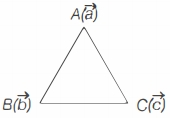
View full question & answer→MCQ 1311 Mark
Let $\vec{v}$ be a vector in the plane such that $| v - i |=| v -2 i |=| v - j |$. Then, $| v |$ lies in the interval
- A
$(0,1]$
- B
$(1,2]$
- ✓
$(2,3]$
- D
$(3,4]$
AnswerCorrect option: C. $(2,3]$
c
(c)
We have,
$| v - i |=| v -2 i |=| v - j |$
Clearly, $v$ is circumcentre of $\triangle A B C$.
where $A(1,0), B(2,0), C(0,1)$ and $O(x, y)$
$\therefore \quad O A^2=O B^2=O C^2$
$(x-1)^2+(y-0)^2=(x-2)^2+y^2$
$=x^2+(y-1)^2$
$\Rightarrow x^2-2 x+1+y^2=x^2-4 x+4+y^2$
$=x^2+y^2-2 y+1$
$\Rightarrow \quad 2 x=3 \Rightarrow x=\frac{3}{2}$
$\Rightarrow x^2-2 x+1+y^2=x^2+y^2-2 y+1$
$\Rightarrow \quad x=y=3 / 2$
$\therefore \quad(x, y)=\left(\frac{3}{2}, \frac{3}{2}\right)$
$\Rightarrow \quad \vec{v}=\frac{3}{2} \hat{i}+\frac{3}{2} \hat{j}$
$|\vec{v}|=\sqrt{\frac{9}{4}+\frac{9}{4}}=\frac{3 \sqrt{2}}{2}$ lie in $(2,3]$
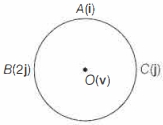
View full question & answer→MCQ 1321 Mark
Let $\vec{a}=6 \hat{i}-3 \hat{j}-6 \hat{k}$ and $\vec{d}=\hat{i}+\hat{j}+\hat{k}$. Suppose that $\overrightarrow{ e }=\vec{b}+\vec{c}$, where $\vec{b}$ is parallel to $\vec{d}$ and $\vec{c}$ is perpendicular to $\vec{d}$. Then $\vec{c}$ is
- A
$5 \hat{i}-4 \hat{j}-\hat{k}$
- ✓
$7 \hat{i}-2 \hat{j}-\bar{\hbar} \hat{k}$
- C
$4 \hat{i}-5 \hat{j}+\hat{k}$
- D
$3 \hat{i}+6 \hat{j}-9 \hat{k}$
AnswerCorrect option: B. $7 \hat{i}-2 \hat{j}-\bar{\hbar} \hat{k}$
b
(b)
Given,
$\vec{a}=6 \hat{i}-3 \hat{j}-6 \hat{k}, \vec{d}=\hat{i}+\hat{j}+\hat{k}$ and $b$ is parallel to $d$ and cis perpendicular to $d$.
$\therefore \quad b=\lambda d$ and $\vec{c} \cdot \vec{d}=0$
$b=\lambda(\hat{i}+\hat{j}+\hat{k})$
Now, $\quad \overrightarrow{ a }=\vec{b}+\vec{c}$
$\Rightarrow \vec{c}=\vec{e}-\vec{b}=(6 \hat{i}-3 \hat{j}-6 \hat{k})-\lambda(\hat{i}+\hat{j}+\hat{k})$
$\Rightarrow c=(6-\lambda) \hat{i}-(3+\lambda) \hat{j}-(6+\lambda) \hat{k}$
$\Rightarrow \quad \vec{c} \cdot \vec{d}=0$
$\therefore \quad((6-\lambda) \hat{i}-(3+\lambda) \hat{j}-(6+\lambda) \hat{k})$
$\therefore 6-\lambda-3-\lambda-6=\lambda=0-j \lambda+k)=0$
$\rightarrow 6-\lambda-3-\lambda-6-\lambda=0 \Rightarrow \lambda=-1$
$\therefore \quad c=7 \hat{i}-2 \hat{j}-5 \hat{k}$
View full question & answer→MCQ 1331 Mark
Let $v _1, v _2, v _3, v _4$ be unit vectors in the $X Y$-plane, one each in the interior of the four quadrants. Which of the following statements is necessarily true?
- A
$v _1+ v _2+ v _3+ v _4=0$
- B
There exist i, $j$ with $1 \leq i < j \leq 4$ such that $v _{ i }+ v _{ j }$ is in the first quadrant
- ✓
There exist $i$, $j$ with $1 \leq i < j \leq 4$ such that $v _{ i } \cdot v _{ j } < 0$
- D
There exist $i , j$ with $1 \leq i < j \leq 4$ such that $v _{ i } \cdot v _{ j } > 0$
AnswerCorrect option: C. There exist $i$, $j$ with $1 \leq i < j \leq 4$ such that $v _{ i } \cdot v _{ j } < 0$
c
(c)
We have, $v _1, v _2, v _3, v _4$ be unit vectors lie in $X Y$-plane.
Let
$v _1=\cos \alpha i +\sin \alpha j \alpha \in\left(0,90^{\circ}\right)$
$v _2=\cos \beta i +\sin \beta j \beta \in\left(90^{\circ}, 180^{\circ}\right)$
$v _3=\cos \gamma i +\sin \gamma j \gamma \in\left(180^{\circ}, 270^{\circ}\right)$
$v _1=\cos \delta i +\sin \delta j \delta \in\left(270^{\circ}, 360^{\circ}\right)$
(a) $v _1+ v _2+ v _3+ v _4=0$ not necessarily true for all $v _1, v _2, v _3$ and $v _4$
(b) $v _i+ v _j(1 \leq i < j \leq 4)$
$v _1+ v _2=(\cos \alpha+\cos \beta) i +(\sin \alpha+\sin \beta) j$
If $y$ coordinate is positive i.e.
$\alpha$ in 1st quadrant $\beta$ in $2$ nd quadrant.
But in this case $x$-coordinate is not necessarily positive.
(c) $\quad v _i= v _j(1 \leq i < j \leq 4)$
Let $\alpha$ in 1st quadrant, $\gamma$ in 3 rd quadrant $\therefore \quad v _i \cdot v _j<0$
(d) $v _i, v _j=(\cos \alpha \cos \beta)+\sin \alpha \sin \beta$
$=\cos (\alpha-\beta)$ is positive $0<|\alpha-\beta|<\frac{\pi}{2}$
View full question & answer→MCQ 1341 Mark
Let $\vec{a}, \vec{b}, \vec{c}$ be three vectors in the $x y z$-space such that $\vec{a} \times \vec{b}=\vec{b} \times \vec{c}=\vec{c} \times \vec{a} \neq 0$ ? If $A, B, C$ are points with position vectors $\overrightarrow{ a }, \vec{b}, \vec{c}$ respectively, then the number of possible positions of the centroid of $\triangle A B C$ is
Answera
(a)
We have, The position vector of the vertices of $\triangle A B C, A(\vec{a}), B(\vec{b})$ and $C(\vec{c})$ respectively.
Given,
$\vec{a} \times \vec{b}=\vec{b} \times \vec{c}=\vec{c} \times \vec{a} \neq 0$
$\vec{a} \times \vec{b}=\vec{b} \times \vec{c}$
$\vec{a} \times \vec{b}+\vec{c} \times \vec{b}=0$
$(\vec{a}+\vec{c}) \times \vec{b}=0$
$\vec{e}+\vec{c}=\lambda \vec{b}$
${[\because \overrightarrow{\vec{e}}+\vec{c}}$ is parallel to ${\vec{b}] }$
View full question & answer→MCQ 1351 Mark
Let $\vec{u}=2 \hat{i}-\hat{j}+\hat{k}, \vec{v}=-3 \hat{j}+2 \hat{k}$ be vectors in $R^3$ and $\vec{w}$ be a unit vector in the $X Y$-plane. Then, the
- A
$\sqrt{5}$
- B
$\sqrt{12}$
- C
$\sqrt{1} \overline{3}$
- ✓
$\sqrt{17}$
AnswerCorrect option: D. $\sqrt{17}$
d
(d)
We have,
$\vec{u}=2 \hat{i}-\hat{j}+\hat{k} \text { and } \vec{v}=-3 \hat{j}+2 \hat{k}$
$\vec{u} \times \vec{v}=\left|\begin{array}{ccc}\hat{i} & \hat{j} & \hat{k} \\ 2 & -1 & 1 \\ 0 & -3 & 2\end{array}\right|$
$=(-2+3) \hat{i}-(4-0) \hat{j}+(-6-0) \hat{k}$
$\vec{u} \times \vec{v}=\hat{i}-4 \hat{j}-6 \hat{k}$
$\vec{w}$ is a unit vector in $X Y$-plane.
Let $\vec{w}=\cos \theta \hat{i}+\sin \theta \hat{j}$
$\therefore|(\vec{u} \times \vec{v}) \cdot \vec{w}|=\mid(\hat{i}-4 \hat{j}-6 \hat{k})$ $=\cos \theta-4 \sin \theta$
$\therefore \text { Maximum value of }$
$\cos \theta-4 \sin \theta=\sqrt{1+4^2}=\sqrt{17}$
View full question & answer→MCQ 1361 Mark
Let $A B C$ be a triangle and $P$ be a point inside $A B C$ such that $\overrightarrow{P A}+2 \overrightarrow{P B}+3 \overrightarrow{P C}=0$. The ratio of the area of $\triangle A B C$ to that of $\triangle A P C$ is
- A
$2$
- B
$\frac{3}{2}$
- C
$\frac{5}{3}$
- ✓
$3$
Answerd
(d)
Given,
Point $P$ inside the $\triangle A B C$ such that
$P A +2 P B +3 P C =0$
Let $\quad P A = a - P$
$PB = b - P$
PC $=$ c - P
$\therefore( a - P )+2( b - P )+3( c - P )=0$
$\Rightarrow \quad a +2 b +3 c =3 P$
$\Rightarrow \quad P =\frac{ a +2 b +3 c }{6}$
Area of $\triangle A P C=\frac{1}{2} \mid a \times P + P \times c+c \times$ a
$=\frac{1}{2}\left| a \times \frac{( a +2 b +3 c )}{6}+\frac{( a +2 b +3 c )}{6}\right|$
$=\frac{1}{2 \times 6} \mid 2(a \times b)+3(a \times c)+(a \times c)+2$
$( b \times c )+6 c \times a \mid$
$=\frac{1}{6}| a \times b + b \times c + c \times a |$
$\frac{\text { Area of } \triangle A B C}{\text { Area of } \triangle A P C}=\frac{\frac{1}{2}|a \times b+b \times c+c \times a|}{\frac{1}{6}|a \times b+b \times c+c \times a|}$
$=3$
$\therefore$ Ratio $=3: 1$
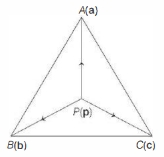
View full question & answer→MCQ 1371 Mark
A vector which bisects the angle between $a =3 i -4 k$ and $b =5 j +12 k$ is
AnswerCorrect option: B. $39 i +25 j +8 k$
b
(b)
We have,
$a =3 i -4 k$ and $b =5 j +12 k$
We know that,
angle bisector of vector $a$ and $b$
$=\lambda\left[\frac{ a }{| a |}+\frac{ b }{| b |}\right]$
$\therefore \lambda\left[\frac{3 \hat{ i }-4 \hat{ k }}{5}+\frac{5 \hat{ j }+12 \hat{ k }}{13}\right]$
$=\lambda\left[\frac{39 \hat{ i }-52 \hat{ k }+25 \hat{ j }+60 \hat{ k }}{65}\right]$
$=\lambda[39 \hat{ i }+2 \hat{ j}+8 \hat{ k }]$
View full question & answer→MCQ 1381 Mark
The position vectors of the vertices $A, B$ and $C$ of a triangle are $2 \hat{i}-3 \hat{j}+3 \hat{k}, \quad 2 \hat{i}+2 \hat{j}+3 \hat{k} \quad$ and $-\hat{i}+\hat{j}+3 \hat{k}$ respectively. Let $l$ denotes the length of the angle bisector $\mathrm{AD}$ of $\angle \mathrm{BAC}$ where $\mathrm{D}$ is on the line segment $\mathrm{BC}$, then $2 l^2$ equals:
Answerd
$AB=5$
$AC=5$
$\therefore \mathrm{D}$ is midpoint of $\mathrm{BC}$
$ \mathrm{D}\left(\frac{1}{2}, \frac{3}{2}, 3\right) $
$ \therefore l=\sqrt{\left(2-\frac{1}{2}\right)^2+\left(-3-\frac{3}{2}\right)^2+(3-3)^2} $
$ l=\sqrt{\frac{45}{2}} $
$ \therefore 2 l^2=45$
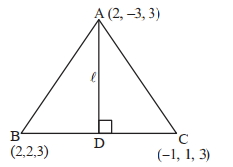
View full question & answer→MCQ 1391 Mark
Let $\vec{a}, \vec{b}$ and $\vec{c}$ be three non-zero vectors such that $\vec{b}$ and $\vec{c}$ are non-collinear if $\vec{a}+5 \vec{b}$ is collinear with $\overrightarrow{\mathrm{c}}, \overrightarrow{\mathrm{b}}+6 \overrightarrow{\mathrm{c}}$ is collinear with $\overrightarrow{\mathrm{a}}$ and $\vec{a}+\alpha \vec{b}+\beta \vec{c}=\overrightarrow{0}$, then $\alpha+\beta$ is equal to
Answera
$ \overrightarrow{\mathrm{a}}+5 \mathrm{~b}=\lambda \overrightarrow{\mathrm{c}} $
$ \overrightarrow{\mathrm{b}}+6 \overrightarrow{\mathrm{c}}=\mu \overrightarrow{\mathrm{a}}$
Eliminating $\vec{a}$
$ \lambda \overrightarrow{\mathrm{c}}-5 \overrightarrow{\mathrm{b}}=\frac{6}{\mu} \overrightarrow{\mathrm{c}}+\frac{1}{\mu} \overrightarrow{\mathrm{b}} $
$ \therefore \mu=\frac{-1}{5}, \lambda=-30 $
$ \alpha=5, \beta=30$
View full question & answer→MCQ 1401 Mark
If $\lambda>0$, let $\theta$ be the angle between the vectors $\vec{a}=\hat{i}+\lambda \hat{j}-3 \hat{k}$ and $\vec{b}=3 \hat{i}-\hat{j}+2 \hat{k}$. If the vectors $\vec{a}+\vec{b}$ and $\vec{a}-\vec{b}$ are mutually perpendicular, then the value of $(14 \cos \theta)^2$ is equal to
Answera
$ (\vec{a}+\vec{b}) \cdot(\vec{a}-\vec{b})=0, \lambda>0 $
$ |\vec{a}|^2-|\vec{b}|^2=0 \rightarrow 1+\lambda^2+9=9+1+4 $
$ \therefore \lambda=2, \cos \theta=\frac{\vec{a}-\vec{b}}{|\vec{a}| \cdot|\vec{b}|}=\frac{3-\lambda-6}{\sqrt{14} \cdot \sqrt{14}} $
$ 14 \cos \theta=3-8=-5 $
$ \therefore(14 \cos \theta)^2=25$
View full question & answer→MCQ 1411 Mark
Let $\vec{a}=\hat{i}+2 \hat{j}+3 \hat{k}, \quad \vec{b}=2 \hat{i}+3 \hat{j}-5 \hat{k} \quad$ and $\overrightarrow{\mathrm{c}}=3 \hat{\mathrm{i}}-\hat{\mathrm{j}}+\lambda \hat{\mathrm{k}}$ be three vectors. Let $\overrightarrow{\mathrm{r}}$ be a unit vector along $\vec{b}+\vec{c}$. If $\vec{r} . \vec{a}=3$, then $3 \lambda$ is equal to :
Answerb
$ \overrightarrow{\mathrm{r}}=\mathrm{k}(\overrightarrow{\mathrm{b}}+\overrightarrow{\mathrm{c}}) $
$ \overrightarrow{\mathrm{r}} \cdot \overrightarrow{\mathrm{a}}=3 $
$ \overrightarrow{\mathrm{r}} \cdot \overrightarrow{\mathrm{a}}=\mathrm{k}(\overrightarrow{\mathrm{b}} \cdot \overrightarrow{\mathrm{a}}+\overrightarrow{\mathrm{c}} \cdot \overrightarrow{\mathrm{a}}) $
$ 3=\mathrm{k}(2+6-15+3-2+3 \lambda) $
$ 3=\mathrm{k}(-6+3 \lambda) $ ...............($1$)
$ \overrightarrow{\mathrm{r}}=\mathrm{k}(5 \hat{\mathrm{i}}+2 \hat{\mathrm{j}}-(5-\lambda) \hat{\mathrm{k}}) $
$ |\overrightarrow{\mathrm{r}}|=\mathrm{k} \sqrt{25+4+25+\lambda^2-10 \lambda}=1 . $ ...............($2$)
$ \mathrm{k}=\frac{3}{-6+3 \lambda}=\frac{1}{-2+\lambda} \quad \text { put in }(2) $
$ 4+\lambda^2-4 \lambda=54+\lambda^2-10 \lambda $
$ 6 \lambda=50 $
$ 3 \lambda=25$
View full question & answer→MCQ 1421 Mark
Let $A(2,3,5)$ and $C(-3,4,-2)$ be opposite vertices of a parallelogram $A B C D$ if the diagonal $\overrightarrow{B D}=\hat{i}+2 \hat{j}+3 \hat{k}$ then the area of the parallelogram is equal to
- A
$\frac{1}{2} \sqrt{410}$
- ✓
$\frac{1}{2} \sqrt{474}$
- C
$\frac{1}{2} \sqrt{586}$
- D
$\frac{1}{2} \sqrt{306}$
AnswerCorrect option: B. $\frac{1}{2} \sqrt{474}$
b
Area $=|\overrightarrow{\mathrm{AC}} \times \overrightarrow{\mathrm{BD}}|$
$=\left|\begin{array}{ccc}\hat{i} & \hat{j} & \hat{k} \\ 5 & -1 & 7 \\ 1 & 2 & 3\end{array}\right|$
$=\frac{1}{2}|-17 \hat{\mathrm{i}}-8 \hat{\mathrm{j}}+11 \hat{\mathrm{k}}|=\frac{1}{2} \sqrt{474}$
View full question & answer→MCQ 1431 Mark
Let $\vec{a}$ and $\vec{b}$ be two vectors such that $|\vec{b}|=1$ and $|\vec{b} \times \vec{a}|=2$. Then $|(\vec{b} \times \vec{a})-\vec{b}|^2$ is equal to
Answerb
$|\vec{b}|=1 \&|\vec{b} \times \vec{a}|=2 $
$(\vec{b} \times \vec{a}) \cdot \vec{b}=\vec{b} \cdot(\vec{b} \times \vec{a})=0 $
$|(\vec{b} \times \vec{a})-\vec{b}|^2=|\vec{b} \times \vec{a}|^2+|\vec{b}|^2 $
$=4+1=5$
View full question & answer→MCQ 1441 Mark
If $\mathrm{A}(1,-1,2), \mathrm{B}(5,7,-6), \mathrm{C}(3,4,-10)$ and $\mathrm{D}(-1,-4,-2)$ are the vertices of a quadrilateral $\mathrm{ABCD}$, then its area is :
- ✓
$12 \sqrt{29}$
- B
$24 \sqrt{29}$
- C
$24 \sqrt{7}$
- D
$48 \sqrt{7}$
AnswerCorrect option: A. $12 \sqrt{29}$
a
$ \mathrm{A}(1,-1,2) $
$ \mathrm{B}(5,7,-6) $
$ \mathrm{C}(3,4,-10) $
$ \mathrm{D}(-1,-4,-2) $
Area $=\frac{1}{2}|\overrightarrow{\mathrm{AC}} \times \overrightarrow{\mathrm{BD}}|=\frac{1}{2}|(2 \hat{\mathrm{i}}+5 \hat{\mathrm{j}}-12 \hat{\mathrm{k}}) \times(6 \hat{\mathrm{i}}+11 \hat{\mathrm{j}}-4 \hat{\mathrm{k}})| $
$ =\frac{1}{2}|112 \hat{\mathrm{i}}-64 \hat{\mathrm{j}}-8 \hat{\mathrm{k}}| $
$ =4|14 \hat{\mathrm{i}}-8 \hat{\mathrm{j}}-\hat{\mathrm{k}}| $
$ =4 \sqrt{196+64+1} $
$ =4 \sqrt{261} $
$ =12 \sqrt{29}$
View full question & answer→MCQ 1451 Mark
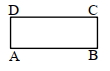
If $\mathrm{A}(3,1,-1), \mathrm{B}\left(\frac{5}{3}, \frac{7}{3}, \frac{1}{3}\right), \mathrm{C}(2,2,1)$ and $\mathrm{D}\left(\frac{10}{3}, \frac{2}{3}, \frac{-1}{3}\right)$ are the vertices of a quadrilateral $\mathrm{ABCD}$, then its area is
- ✓
$\frac{4 \sqrt{2}}{3}$
- B
$\frac{5 \sqrt{2}}{3}$
- C
$2 \sqrt{2}$
- D
$\frac{2 \sqrt{2}}{3}$
AnswerCorrect option: A. $\frac{4 \sqrt{2}}{3}$
a
$Image$
Area $=\frac{1}{2}|\overline{\mathrm{BD}} \times \overline{\mathrm{AC}}|$
$ \overline{\mathrm{BD}}=\frac{5}{3} \hat{\mathrm{i}}-\frac{5}{3} \hat{\mathrm{j}}-\frac{2}{3} \hat{\mathrm{k}} $
$ \overline{\mathrm{AC}}=\hat{\mathrm{i}}-\hat{\mathrm{j}}-2 \hat{\mathrm{k}}$
View full question & answer→MCQ 1461 Mark
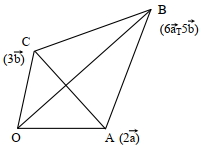
Let $\overrightarrow{\mathrm{OA}}=2 \overrightarrow{\mathrm{a}}, \overrightarrow{\mathrm{OB}}=6 \overrightarrow{\mathrm{a}}+5 \overrightarrow{\mathrm{b}}$ and $\overrightarrow{\mathrm{OC}}=3 \overrightarrow{\mathrm{b}}$, where $O$ is the origin. If the area of the parallelogram with adjacent sides $\overrightarrow{\mathrm{OA}}$ and $\overrightarrow{\mathrm{OC}}$ is $15$ sq. units, then the area (in sq. units) of the quadrilateral $\mathrm{OABC}$ is equal to :
Answerd
$Image$
Area of parallelogram having sides
$ \overrightarrow{\mathrm{OA}} \& \overrightarrow{\mathrm{OC}}=|\overrightarrow{\mathrm{OA}} \times \overrightarrow{\mathrm{OC}}|=|2 \overrightarrow{\mathrm{a}} \times 3 \overrightarrow{\mathrm{b}}|=15 $
$ 6|\overrightarrow{\mathrm{a}} \times \overrightarrow{\mathrm{b}}|=15 $
$ \Rightarrow|\overrightarrow{\mathrm{a}} \times \overrightarrow{\mathrm{b}}|=\frac{5}{2} \ldots \ldots .(1)$
Area of quadrilateral
$ \mathrm{OABC}=\frac{1}{2}\left|\overrightarrow{\mathrm{d}}_1 \times \overrightarrow{\mathrm{d}}_2\right| $
$ =\frac{1}{2}|\overrightarrow{\mathrm{AC}} \times \overrightarrow{\mathrm{OB}}|=\frac{1}{2}|(3 \overrightarrow{\mathrm{b}}-2 \overrightarrow{\mathrm{a}}) \times(6 \overrightarrow{\mathrm{a}}+5 \overrightarrow{\mathrm{b}})| $
$ =\frac{1}{2}|18 \overrightarrow{\mathrm{b}} \times \overrightarrow{\mathrm{a}}-10 \overrightarrow{\mathrm{a}} \times \overrightarrow{\mathrm{b}}|=14|\overrightarrow{\mathrm{a}} \times \overrightarrow{\mathrm{b}}| $
$ =14 \times \frac{5}{2}=35$
View full question & answer→MCQ 1471 Mark
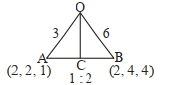
Let $O$ be the origin and the position vector of $A$ and $B$ be $2 \hat{i}+2 \hat{j}+\hat{k}$ and $2 \hat{i}+4 \hat{j}+4 \hat{k}$ respectively. If the internal bisector of $\angle A O B$ meets the line $A B$ at $\mathrm{C}$, then the length of $\mathrm{OC}$ is
- A
$\frac{2}{3} \sqrt{31}$
- ✓
$\frac{2}{3} \sqrt{34}$
- C
$\frac{3}{4} \sqrt{34}$
- D
$\frac{3}{2} \sqrt{31}$
AnswerCorrect option: B. $\frac{2}{3} \sqrt{34}$
b
Lengh of $O C=\frac{\sqrt{136}}{3}=\frac{2 \sqrt{34}}{3}$
View full question & answer→MCQ 1481 Mark
The least positive integral value of $\alpha$, for which the angle between the vectors $\alpha \hat{\mathrm{i}}-2 \hat{\mathrm{j}}+2 \mathrm{k}$ and $\alpha \hat{\mathrm{i}}+2 \alpha \hat{\mathrm{j}}-2 \mathrm{k}$ is acute, is
Answera
$ \cos \theta=\frac{(\alpha \hat{\mathrm{i}}-2 \hat{\mathrm{j}}+2 \hat{\mathrm{k}}) \cdot(\alpha \hat{\mathrm{i}}+2 \alpha \hat{\mathrm{j}}-2 \hat{\mathrm{k}})}{\sqrt{\alpha^2+4+4} \sqrt{\alpha^2+4 \alpha^2+4}} $
$ \cos \theta=\frac{\alpha^2-4 \alpha-4}{\sqrt{\alpha^2+8} \sqrt{5 \alpha^2+4}} $
$ \Rightarrow \alpha^2-4 \alpha-4>0 \quad \Rightarrow(\alpha-2)^2>8 $
$ \Rightarrow \alpha^2-4 \alpha+4>8 \quad \alpha-2<-2 \sqrt{2} $
$ \Rightarrow \alpha-2>2 \sqrt{2} \text { or } \alpha-2 \sqrt{2} $
$ \alpha>2+2 \sqrt{2} \text { or } \alpha<2-2 \sqrt{2} $
$ \alpha \in(-\infty,-0.82) \cup(4.82, \infty)$
Least positive integral value of $\alpha \Rightarrow 5$
View full question & answer→MCQ 1491 Mark
Let a unit vector $\hat{\mathrm{t}}=\mathrm{x} \hat{\mathrm{i}}+\mathrm{y} \hat{\mathrm{j}}+\mathrm{z} \hat{\mathrm{k}}$ make angles $\frac{\pi}{2}, \frac{\pi}{3}$ and $\frac{2 \pi}{3}$ with the vectors $\frac{1}{\sqrt{2}} \hat{\mathrm{i}}+\frac{1}{\sqrt{2}} \hat{\mathrm{k}}, \frac{1}{\sqrt{2}} \hat{\mathrm{j}}+\frac{1}{\sqrt{2}} \hat{\mathrm{k}}$ and $\quad \frac{1}{\sqrt{2}} \hat{\mathrm{i}}+\frac{1}{\sqrt{2}} \hat{\mathrm{j}} \quad$ respectively. If $\overrightarrow{\mathrm{v}}=\frac{1}{\sqrt{2}} \hat{\mathrm{i}}+\frac{1}{\sqrt{2}} \hat{\mathrm{j}}+\frac{1}{\sqrt{2}} \hat{\mathrm{k}}$, then $|\hat{\mathrm{u}}-\overrightarrow{\mathrm{v}}|^2$ is equal to
- A
$\frac{11}{2}$
- ✓
$\frac{5}{2}$
- C
$9$
- D
$7$
AnswerCorrect option: B. $\frac{5}{2}$
b
Unit vector $\hat{\mathrm{u}}=\mathrm{x} \hat{\mathrm{i}}+\mathrm{y} \hat{\mathrm{j}}+\mathrm{z} \hat{\mathrm{k}}$
$ \overrightarrow{\mathrm{p}}_1=\frac{1}{\sqrt{2}} \hat{\mathrm{i}}+\frac{1}{\sqrt{2}} \hat{\mathrm{k}}, \overrightarrow{\mathrm{p}}_2=\frac{1}{\sqrt{2}} \hat{\mathrm{j}}+\frac{1}{\sqrt{2}} \hat{\mathrm{k}}$
$ \overrightarrow{\mathrm{p}}_3=\frac{1}{\sqrt{2}} \hat{\mathrm{i}}+\frac{1}{\sqrt{2}} \hat{\mathrm{j}}$
Now angle between $\hat{\mathrm{u}}$ and $\overrightarrow{\mathrm{p}}_1=\frac{\pi}{2}$ $\hat{\mathrm{u}} \cdot \overrightarrow{\mathrm{p}}_1=0 \Rightarrow \frac{\mathrm{x}}{\sqrt{2}}+\frac{\mathrm{z}}{\sqrt{2}}=0$
$\Rightarrow \mathrm{x}+\mathrm{z}=0$ $.........(i)$
Angle between $\hat{\mathrm{u}}$ and $\overrightarrow{\mathrm{p}}_2=\frac{\pi}{3}$
$\hat{\mathrm{u}} \cdot \overrightarrow{\mathrm{p}}_2=|\hat{\mathrm{u}}| \cdot\left|\overrightarrow{\mathrm{p}}_2\right| \cos \frac{\pi}{3}$
$ \Rightarrow \frac{\mathrm{y}}{\sqrt{2}}+\frac{\mathrm{z}}{\sqrt{2}}=\frac{1}{2} \Rightarrow \mathrm{y}+\mathrm{z}=\frac{1}{\sqrt{2}}$ $..............(ii)$
Angle between $\hat{\mathrm{u}}$ and $\overrightarrow{\mathrm{p}}_3=\frac{2 \pi}{3}$
$ \hat{\mathrm{u}} \cdot \overrightarrow{\mathrm{p}}_3=|\hat{\mathrm{u}}| \cdot\left|\overrightarrow{\mathrm{p}}_3\right| \cos \frac{2 \pi}{3} $
$ \Rightarrow \frac{\mathrm{x}}{\sqrt{2}}+\frac{4}{\sqrt{2}}=\frac{-1}{2} \Rightarrow \mathrm{x}+\mathrm{y}=\frac{-1}{\sqrt{2}}$ $............(iii)$
from equation $(i)$, $(ii)$ and $(iii)$ we get
$x=\frac{-1}{\sqrt{2}} \quad y=0 \quad z=\frac{1}{\sqrt{2}}$
Thus $\hat{\mathrm{u}}-\overrightarrow{\mathrm{v}}=\frac{-1}{\sqrt{2}} \hat{\mathrm{i}}+\frac{1}{\sqrt{2}} \hat{\mathrm{k}}-\frac{1}{\sqrt{2}} \hat{\mathrm{i}}-\frac{1}{\sqrt{2}} \hat{\mathrm{j}}-\frac{1}{\sqrt{2}} \hat{\mathrm{k}}$
$\hat{\mathrm{u}}-\overrightarrow{\mathrm{v}}=\frac{-2}{\sqrt{2}} \hat{\mathrm{i}}-\frac{1}{\sqrt{2}} \hat{\mathrm{j}} $
$ \therefore|\hat{\mathrm{u}}-\overrightarrow{\mathrm{v}}|^2=\left(\sqrt{\frac{4}{2}+\frac{1}{2}}\right)^2=\frac{5}{2}$
View full question & answer→MCQ 1501 Mark
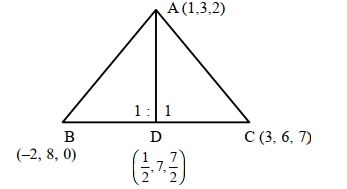
Consider a $\triangle \mathrm{ABC}$ where $\mathrm{A}(1,3,2), \mathrm{B}(-2,8,0)$ and $\mathrm{C}(3,6,7)$. If the angle bisector of $\angle \mathrm{BAC}$ meets the line $B C$ at $D$, then the length of the projection of the vector $\overrightarrow{A D}$ on the vector $\overrightarrow{A C}$ is:
- ✓
$\frac{37}{2 \sqrt{38}}$
- B
$\frac{\sqrt{38}}{2}$
- C
$\frac{39}{2 \sqrt{38}}$
- D
$\sqrt{19}$
AnswerCorrect option: A. $\frac{37}{2 \sqrt{38}}$
a
$ \mathrm{A}(1,3,2) ; \mathrm{B}(-2,8,0) ; \mathrm{C}(3,6,7) ; $
$ \overrightarrow{\mathrm{AC}}=2 \hat{\mathrm{i}}+3 \hat{\mathrm{j}}+5 \hat{\mathrm{k}} $
$ \mathrm{AB}=\sqrt{9+25+4}=\sqrt{38} $
$ \mathrm{AC}=\sqrt{4+9+25}=\sqrt{38} $
$ \overrightarrow{\mathrm{AD}}=-\frac{1}{2} \hat{\mathrm{i}}+4 \hat{\mathrm{j}}+\frac{3}{2} \hat{\mathrm{k}}=-\frac{1}{2}(\hat{\mathrm{i}}+8 \hat{\mathrm{j}}+3 \hat{\mathrm{k}})$
Length of projection of $\overrightarrow{\mathrm{AD}}$ on $\overrightarrow{\mathrm{AC}}$
$=\left|\frac{\overrightarrow{\mathrm{AD}} \cdot \overrightarrow{\mathrm{AC}}}{|\overrightarrow{\mathrm{AC}}|}\right|=\frac{37}{2 \sqrt{38}}$
View full question & answer→