MCQ 511 Mark
If $|a|\, = 3,\,\,|b|\, = 4$ then a value of $\lambda$ for which $a + \lambda b$ is perpendicular to $a - \lambda b$ is
- A
$\frac{9}{16}$
- ✓
$\frac{3}{4}$
- C
$\frac{3}{2}$
- D
$\frac{4}{3}$
AnswerCorrect option: B. $\frac{3}{4}$
b
(b) Since $a + \lambda b$ is perpendicular to $a - \lambda b$, then their product will be zero.
So, $(a + \lambda b).(a - \lambda b) = 0$ ==> $|a{|^2} - {\lambda ^2}|b{|^2} = 0$
or ${\lambda ^2} = \frac{{|a{|^2}}}{{|b{|^2}}} \Rightarrow {\lambda ^2} = \frac{9}{{16}}$ or $\lambda = \pm \frac{3}{4}$,
$[\because \,|a| = 3,|b| = 4]$
View full question & answer→MCQ 521 Mark
If $a, b $ and $c $ are unit vectors such that $a + b - c = 0,$ then the angle between $a$ and $b$ is
- A
$\pi /6$
- B
$\pi /3$
- C
$\pi /2$
- ✓
$2\pi /3$
AnswerCorrect option: D. $2\pi /3$
d
(d) Given condition is $a + b = c.$
Using dot product, $(a + b).(a + b) = c.c$
$ \Rightarrow a.a + b.b + 2a.b = c.c$
$ \Rightarrow \,|a|.|a|\cos 0^\circ + |b|.|b|\cos 0^\circ + 2|a|.|b|\cos \alpha $
$ = \,|c|.|c|\cos 0^\circ $, $(\because \,\,\,|a|\, = \,|b|\, = \,|c|\, = 1)$
$ \Rightarrow 1 + 1 + 2\cos \alpha = 1 \Rightarrow \cos \alpha = - \frac{1}{2} \Rightarrow \alpha = \frac{{2\pi }}{3}$.
View full question & answer→MCQ 531 Mark
If the sum of two unit vectors is a unit vector, then the magnitude of their difference is
- A
$\sqrt 2 $
- ✓
$\sqrt 3 $
- C
$\frac{1}{{\sqrt 3 }}$
- D
$1$
AnswerCorrect option: B. $\sqrt 3 $
b
(b) Let $|a| = 1$ and $|b| = 1$
Also $|a + b{|^2} = {1^2} \Rightarrow 1 + 1 + 2\cos \theta = 1$$ \Rightarrow \theta = 120^\circ $
$\therefore \,\,\,|a - b{|^2} = 1 + 1 - 2\cos \theta = 3$$ \Rightarrow \,|a - b|\, = \sqrt 3 .$
View full question & answer→MCQ 541 Mark
Let $a $ and $ b$ be two unit vectors inclined at an angle $\theta $, then $\sin \,(\theta /2)$ is equal to
- ✓
$\frac{1}{2}|a-b|$
- B
$\frac{1}{2}|a+b|$
- C
$|a-b|$
- D
$|a+b|$
AnswerCorrect option: A. $\frac{1}{2}|a-b|$
a
(a) $|a - b|{\rm{ }} = \sqrt {{1^2} + {1^2} - {{2.1}^2}\,\cos \theta } = \sqrt {2\,(1 - \cos \theta )} $
$ \Rightarrow \sqrt 2 \times \sqrt 2 \,\sin \frac{\theta }{2} = 2\sin \frac{\theta }{2}$$ \Rightarrow \,\sin \frac{\theta }{2} = \frac{{|a - b|}}{2}$.
View full question & answer→MCQ 551 Mark
The angle between the vectors $a + b$ and $a -b$, when $a = (1,\,1,\,4)$ and $b = (1,\, - 1,\,4)$ is .............. $^o$
Answera
(a) $a = (1,\,1,\,4) = i + j + 4k,$ $b = (1,\, - 1,\,4) = i - j + 4k$
$\therefore a + b = 2i + 8k$=> $a - b = 2j$
Since, $(a + b)\,.\,(a - b) = 0$
$\therefore (a + b) \bot (a - b)$. Hence $\theta = 90^\circ $.
View full question & answer→MCQ 561 Mark
A vector of length $3$ perpendicular to each of the vectors $3\,i + j - 4\,k$ and $6\,i + 5\,j - 2\,k$ is
- ✓
$2\,i - 2\,j + k$
- B
$ - \,2\,i + 2\,j + k$
- C
$2\,i + 2\,j - k$
- D
AnswerCorrect option: A. $2\,i - 2\,j + k$
a
(a) Let the vector is $xi + yj + zk.$ Now according to the conditions,
$\sqrt {{x^2} + {y^2} + {z^2}} = 3 \Rightarrow {x^2} + {y^2} + {z^2} = 9$
.....$(i)$
$6x + 5y - 2z = 0$ .....$(ii)$
and $3x + y - 4z = 0$ .....$(iii)$
it is perpendicular to both vectors, hence by ${a_1}{b_1} + {a_2}{b_2} + {a_3}{b_3} = 0]$
On solving the equation $(i),$ $(ii)$ and $(iii),$ we get $x = 2,$ $y = - 2$ and $z = 1.$
Therefore, the required vector is $2i - 2j + k.$
Trick : By inspection, the vector $2i - 2j + k$ is of length $3 $ and also perpendicular to the given vectors.
View full question & answer→MCQ 571 Mark
If the position vectors of $ A $ and $B$ be $6i + j - 3k$ and $4i - 3j - 2k,$ then the work done by the force $\vec F = i -3 j + 5k$ in displacing a particle from $A$ to $ B $ is ............ $\mathrm{unit}$
Answera
(a) $|W|\, = (i - 3j + 5k).( - 2i - 4j + k) = - 2 + 12 + 5 = 15unit\,\,$.
View full question & answer→MCQ 581 Mark
If the force $\overrightarrow F = i + 2j + 3k$ moves from $i + j - k$ to $2i - j + k,$ then work done will be represented by
Answera
(a) $|W| = (i + 2j + 3k)\,.\,(i - 2j + 2k) = 1 - 4 + 6 = 3.$
View full question & answer→MCQ 591 Mark
The work done by the force $F = 2i - 3j + 2k$ in displacing a particle from the point $(3, 4, 5) $ to the point $(1, 2, 3) $ is ............ $\mathrm{unit}$
Answera
(a) Here $F = 2i - 3j + 2k,$ $d = - 2i - 2j - 2k$
Work done $ = F\,.\,d = - 4 + 6 - 4 = - 2$ or $2$ unit.
View full question & answer→MCQ 601 Mark
Force $3i + 2j + 5k$ and $2i + j - 3k$ are acting on a particle and displace it from the point $2i - j - 3k$ to the point $4i - 3j + 7k,$ then work done by the force is ............... $\mathrm{unit}$
Answerc
(c) Resultant force $F = 5i + 3j + 2k$
and displacement $d = 2i - 2j + 10k,$ then
Work done $W = F\,.\,d = 10 - 6 + 20 = 24\,unit.$
View full question & answer→MCQ 611 Mark
A particle acted on by two forces $3i + 2j - 3k$ and $2i + 4j + 2k$ is displaced from the point $i + 2j + k$ to $5i + 4j + 2k.$ The total work done by the forces is equal to ............ $\mathrm{unit}$
- A
$63$
- B
$39 $
- C
$33$
- ✓
$31 $
Answerd
(d) Required work done
$ = (3i + 2j - 3k + 2i + 4j + 2k)\,.\,(5i + 4j + 2k - i - 2j - k)$
$ = (5i + 6j - k)\,.\,(4i + 2j + k)\, = 20 + 12 - 1 = 31$.
View full question & answer→MCQ 621 Mark
A force of magnitude $ 5$ units acting along the vector $2i - 2j + k$ displaces the point of application from $(1,\,2,\,3)$ to $(5,\,3,\,7)$, then the work done is
- A
$50/7$
- ✓
$50/3$
- C
$25/3$
- D
$25/4$
AnswerCorrect option: B. $50/3$
b
(b) Required work done = (Force vector).(Displacement vector)
Force vector$ = 5\,.\,\left( {\frac{{2i - 2j + k}}{{|2i - 2j + k|}}} \right) = \frac{5}{3}(2i - 2j + k)$
$\therefore $ Required work done
$ = \frac{5}{3}(2i - 2j + k).[(5i + 3j + 7k) - (i + 2j + 3k)]$
$ = \frac{5}{3}[(2i - 2j + k).(4i + j + 4k)] = \frac{5}{3}[8 - 2 + 4] = \frac{{50}}{3}$unit.
View full question & answer→MCQ 631 Mark
If $|a| = |b| = 1$ and $|a + b| = \sqrt 3 $, then the value of $(3a - 4b).(2a + 5b)$ is
- A
$-21$
- ✓
$-21/2$
- C
$21$
- D
$21/2$
AnswerCorrect option: B. $-21/2$
b
(b) $(3a - 4b)(2a + 5b) = 6|a{|^2} - 20|b{|^2} + 7a.b = 6 - 20 + 7a.b$
Given, $|a + b{|^2} = {(\sqrt 3 )^2}$
==>$|a{|^2} + |b{|^2} + 2a.b = 3$
==> $2a.b = 1$ ==> $a.b = \frac{1}{2}$
Therefore, $(3a - 4b)\;.\;(2a + 5b)$
$ = 6 - 20 + 7 \times \frac{1}{2}$$ = - 14 + \frac{7}{2}$$ = \frac{{ - 21}}{2}$.
View full question & answer→MCQ 641 Mark
A unit vector in the plane of $i + 2j + k$ and $i + j + 2k$are perpendicular to $2i + j + k$ is
- A
$j - k$
- B
$\frac{{i + j}}{{\sqrt 2 }}$
- C
$\frac{{j + k}}{{\sqrt 2 }}$
- ✓
$\frac{{j - k}}{{\sqrt 2 }}$
AnswerCorrect option: D. $\frac{{j - k}}{{\sqrt 2 }}$
d
(d) Position vectors in the plane of vectors $i + 2j + k$ and $i + j + 2k$ are $ = (i + 2j + k) - (i + j + 2k)$
$ = j - k$
$\therefore $ Unit vector $ = \frac{{j - k}}{{\sqrt 2 }}$
$\left( {\because {\text{ }}\left( {\frac{{j - k}}{{\sqrt 2 }}} \right).(2i + j + k) = \frac{{ - 1 + 1}}{{\sqrt 2 }} = 0} \right)$
View full question & answer→MCQ 651 Mark
Given $a = i + j - k,\,\,b = - i + 2j + k$ and $c = - i + 2j - k.$ A unit vector perpendicular to both $a + b$ and $b + c$ is
Answerc
(c) Obviously, $b + c = - 2i + 4j$ and $a + b = 3j.$
Hence the unit vector $k$ is perpendicular to both $b + c$ and $a + b.$
View full question & answer→MCQ 661 Mark
The locus of a point equidistant from two given points $ a$ and $ b $ is given by
- ✓
$[r - \frac{1}{2}(a + b)]\,.\,\,(a - b) = 0$
- B
$[r - \frac{1}{2}(a - b)]\,.\,\,(a + b) = 0$
- C
$[r - \frac{1}{2}(a + b)].(a + b) = 0$
- D
$[r - \frac{1}{2}(a - b)]\,.\,\,(a - b) = 0$
AnswerCorrect option: A. $[r - \frac{1}{2}(a + b)]\,.\,\,(a - b) = 0$
a
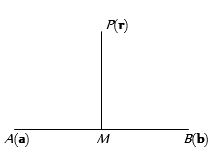
(a) Let $P(r)$ be equidistant from $A\,\,(a)$ and $B\,\,(b)$ and $PM$ be perpendicular to $AB.$
Then $M$ is the mid point of $AB.$
$\therefore $ Position vector of $M$ is $\frac{1}{2}(a + b).$
$\overrightarrow {PM} \,.\,\overrightarrow {BA} = 0$ or $\left[ {r - \frac{1}{2}(a + b)} \right]\,.\,(a - b) = 0.$
View full question & answer→MCQ 671 Mark
The distance from the point $ - i + 2j + 6k$ to the straight line through the point $(2, 3, -4)$ and parallel to the vector $6i + 3j - 4k$ is
Answera
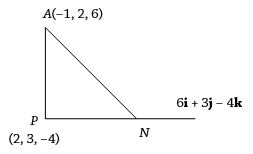
(a) We have $\overrightarrow {AP} = - 3i - j + 10k$
$\therefore |\overrightarrow {AP} | = \sqrt {9 + 1 + 100} = \sqrt {110} $
$PN = $Projection of $\overrightarrow {AP} $ on $6i + 3j - 4k$
$ = \left| {\frac{{\overrightarrow {AP} .(6i + 3j - 4k)}}{{|6i + 3j - 4k|}}} \right|$$ = \left| {\frac{{ - 18 - 3 - 40}}{{\sqrt {61} }}} \right| = \sqrt {61} $
$\therefore AN = \sqrt {A{P^2} - A{N^2}} $$ = \sqrt {110 - 61} = 7$.
View full question & answer→MCQ 681 Mark
The points $O,\,A,\,B,\,C,\,D$ are such that $\overrightarrow {OA} = a,$ $\overrightarrow {OB} = b,\,$ $\overrightarrow {OC} = 2a + 3b$ and $\overrightarrow {OD} = a - 2b.$ If $|a|\, = 3\,|b|,$ then the angle between $\overrightarrow {BD} $ and $\overrightarrow {AC} $ is
- A
$\frac{\pi }{3}$
- B
$\frac{\pi }{4}$
- C
$\frac{\pi }{6}$
- ✓
Answerd
(d) We have $\overrightarrow {BD} = \overrightarrow {OD} - \overrightarrow {OB} = a - 2b - b = a - 3b$
and $\overrightarrow {AC} = \overrightarrow {OC} - \overrightarrow {OA} = 2a + 3b - a = a + 3b.$
Let $\theta $ be the angle between $\overrightarrow {BD} $ and $\overrightarrow {AC} .$
Then $\cos \theta = \frac{{\overrightarrow {BD} \,.\,\overrightarrow {AC} }}{{|\overrightarrow {BD} |\,|\overrightarrow {AC} |}} = \frac{{|a{|^2} - 9|b{|^2}}}{{|\overrightarrow {BD} |\,|\overrightarrow {AC} |}}$
$ = \frac{{9|b{|^2} - 9|b{|^2}}}{{|\overrightarrow {BD} |\,|\overrightarrow {AC} |}}$,
$(\because \,\,\,\left| \,a\, \right|=3|b|)$
$ \Rightarrow \cos \theta = 0^\circ \Rightarrow \theta = \frac{\pi }{2}.$
View full question & answer→MCQ 691 Mark
A unit vector in $xy$ - plane that makes an angle ${45^o}$ with the vector $(i + j)$ and an angle of ${60^o}$ with the vector $(3i - 4j)$ is
Answerd
(d) Let the vector be $x\,i + y\,j$
$\therefore \,\cos \,{45^o} = \frac{{x + y}}{{\sqrt 2 \sqrt {{x^2} + {y^2}} }} \Rightarrow 1 = \frac{{x + y}}{{\sqrt {{x^2} + {y^2}} }}$
$ \Rightarrow \,x + y = \sqrt {{x^2} + {y^2}} $ also $\sqrt {{x^2} + {y^2}} = 1\, \Rightarrow \,x + y = 1$
Again $\cos \,{60^o} = \frac{{3x - 4y}}{5}\, \Rightarrow \frac{5}{2} = 3x - 4y$
$5 = 6x - 8y$ …..$(i)$
$1 = x + y$ …..$(ii)$
==> No value in the given options set satisfies the above relations. Thus $(d)$ is correct.
View full question & answer→MCQ 701 Mark
Let $u = i + j, v = i -j$ and $w = i + 2j + 3k$. If $n$ is a unit vector such that $u.n = 0$ and $v.n = 0$ then $|w\,.\,n|$ is equal to
Answerd
(d) $\because $ $n$ is perpendicular to $u$ and $v$
$n = u \times v$
$n = \frac{{\left| {\,\begin{array}{*{20}{c}}i&j&k\\1&1&0\\1&{ - 1}&0\end{array}\,} \right|}}{{\sqrt 2 \times \sqrt 2 }} = \frac{{ - 2k}}{2} = - k$
$|w\,.\,n|\, = \,|(i + 2j + 3k)\,.\,( - k)|\, = \,| - 3|\, = 3$.
View full question & answer→MCQ 711 Mark
The vector $b = 3j + 4k$ is to be written as the sum of a vector ${b_1}$ parallel to $a = i + j$ and a vector ${b_2}$ perpendicular to a. Then ${b_1} = $
- ✓
$\frac{3}{2}\,(i + j)$
- B
$\frac{2}{3}\,(i + j)$
- C
$\frac{1}{2}\,(i + j)$
- D
$\frac{1}{3}\,(i + j)$
AnswerCorrect option: A. $\frac{3}{2}\,(i + j)$
a
(a) Since ${b_1}\,||\,a,$ therefore ${b_1} = a(i + j)$
${b_2} = b - {b_1} = (3 - a)i - aj + 4k$
Also ${b_2}.\,a = 0 \Rightarrow (3 - a) - a \Rightarrow a = \frac{3}{2}$
Hence ${b_1} = \frac{3}{2}(i + j).$
View full question & answer→MCQ 721 Mark
Forces of magnitudes $3$ and $2$ units acting in the directions $5\,i + 3\,j + 4\,k$ and $3\,i + 4\,j - 5\,k$ respectively act on a particle which is displaced from the points $(1, -1, -1)$ to $(3, 3, 1)$. The work done by the forces is equal to
AnswerCorrect option: C. $\frac{{57}}{5}\sqrt 2 $ unit
c
(c) Unit vector in the direction of $5i + 3j + 4k$ $ = \frac{{5i + 3j + 4k}}{{\sqrt {25 + 9 + 16} }}$
Unit vector in the direction of
$3i + 4j - 5k = $$\frac{{3i + 4j - 5k}}{{\sqrt {9 + 16 + 25} }}$
Force of magnitude $3$ i.e., ${F_1} = \frac{{3(5i + 3j + 4k)}}{{5\sqrt 2 }}$
Force of magnitude $2$ i.e., ${F_2} = \frac{{2(3i + 4j - 5k)}}{{5\sqrt 2 }}$
$\therefore$ Net force $F = {F_1} + {F_2} \Rightarrow F = \frac{1}{{5\sqrt 2 }}(21i + 17j + 2k$)
Displacement $d = {d_2} - {d_1} = (3i + 3j + k) - (i - j - k)$
$d = (2i + 4j + 2k)$
$\therefore$ Work done
$ = F.\,d = \frac{1}{{5\sqrt 2 }}(21i + 17j + 2k)$.$(2i + 4j + 2k)$
$ = \frac{{57\sqrt 2 }}{5}$unit.
View full question & answer→MCQ 731 Mark
If $\overrightarrow a = 2\widehat i - \widehat j + \widehat k,\,\overrightarrow b = \,\widehat i + \widehat j - 2\widehat k$ and $\overrightarrow c = \widehat i + 3\widehat j - ({\lambda ^2} + 3\lambda )\widehat k$ (where $\lambda$ is a constant)
and $\overrightarrow a$ is perpendicular to $\overrightarrow c - \lambda \overrightarrow b$, then sum of different values of $\lambda$ is
Answera
$(2 \hat i - \hat j+ \hat k ).((1- \lambda ) \hat i + (3 - \lambda) \hat j+ (2 \lambda - \lambda^2 - 3 \lambda) \hat k) = 0$
$\Rightarrow$ $2 -2\lambda -3 + \lambda + 2\lambda -\lambda^2 -3\lambda = 0$
$\Rightarrow$ $-\lambda^2 -2\lambda -1 = 0$
$\Rightarrow$ $(\lambda + 1)^2 = 0$
$\Rightarrow$ $\lambda = -1$
View full question & answer→MCQ 741 Mark
Let $\left| {\vec a} \right| = \left| {\vec b} \right| = \left| {\vec a - \vec b} \right| = \,1$ then angle between $\vec a$ and $\vec b$ is
- A
$\frac{\pi }{6}$
- ✓
$\frac{\pi }{3}$
- C
$\frac{\pi }{4}$
- D
$\frac{\pi }{2}$
AnswerCorrect option: B. $\frac{\pi }{3}$
b
$|\overrightarrow a - \overrightarrow b {|^2} = 1$
$ \Rightarrow |\vec a{|^2} + |\vec b{|^2} - 2\left| {\vec a} \right|\left| {\vec b} \right|\cos \theta = 1$
$ \Rightarrow \cos \theta=1 / 2 \Rightarrow \cos \theta=1 / 2 $
$\Rightarrow \theta=\pi / 3$
View full question & answer→MCQ 751 Mark
Let $\vec{a}$ and $\vec{b}$ be two unit vectors and $\theta$ is the angle between them. Then $\vec{a}+\vec{b}$ is a unit vector if $\theta =$
- A
$\frac{ \pi}{2}$
- B
$\frac{ \pi}{3}$
- C
$\frac{ \pi}{4}$
- ✓
$\frac{2 \pi}{3}$
AnswerCorrect option: D. $\frac{2 \pi}{3}$
d
Let $\vec{a}$ and $\vec{b}$ be two unit vectors and $\theta$ be the angle between them.
Then, $|\vec{a}|=|\vec{b}|=1$
Now, $\vec{a}+\vec{b}$ is a unit vector if $|\vec{a}+\vec{b}|=1$
$|\vec{a}+\vec{b}|=1$
$\Rightarrow(\vec{a}+\vec{b})^{2}=1$
$\Rightarrow(\vec{a}+\vec{b}) \cdot(\vec{a}+\vec{b})=1$
$\Rightarrow \vec{a} \cdot \vec{a}+\vec{a} \cdot \vec{b}+\vec{b} \cdot \vec{a}+\vec{b}\cdot \vec{b}=1$
$\Rightarrow|\vec{a}|^{2}+2 \vec{a} \cdot \vec{b}+|\vec{b}|^{2}=1$
$\Rightarrow 1^{2}+2|\vec{a}||\vec{b}| \cos \theta+1^{2}=1$
$\Rightarrow 1+2.1 .1 \cos \theta+1=1$
$\Rightarrow \cos \theta=-\frac{1}{2}$
$\Rightarrow \theta=\frac{2 \pi}{3}$
Hence, $\vec{a}+\vec{b}$ is a unit vector if $\theta=\frac{2 \pi}{3}$
The correct answer is $D$.
View full question & answer→MCQ 761 Mark
If $ a$ is any vector in space, then
- ✓
$a = (a\,.\,i)\,i + \,(a\,.\,j)\,j + \,(a\,.\,k)\,k$
- B
$a = (a\, \times \,i) + \,(a\, \times \,j)\, + \,(a\, \times \,k)\,$
- C
$a = j\,(a\,.\,i)\, + k\,(a\,.\,j)\, + \,i\,(a\,.\,k)\,$
- D
$a = (a\, \times \,i) \times i + \,(a\, \times \,j) \times j\, + \,(a\, \times \,k) \times k\,$
AnswerCorrect option: A. $a = (a\,.\,i)\,i + \,(a\,.\,j)\,j + \,(a\,.\,k)\,k$
a
(a) Let$a = {a_1}i + {a_2}j + {a_3}k,$then $a.i = {a_1},$ $a.j = {a_2},$ $a.k = {a_3}$
$\therefore \,\,\,a = (a\,.\,i)i + (a\,.\,j)j + (a\,.\,k)k$.
View full question & answer→MCQ 771 Mark
If $a = (1,\,\, - 1,\,\,1)$ and $c = ( - 1,\,\, - 1,\,\,0),$ then the vector $b$ satisfying $a \times b = c$ and $a\,\,.\,\,b = 1$ is
- A
$(1, 0, 0)$
- ✓
$(0, 0, 1)$
- C
$(0, -1, 0)$
- D
AnswerCorrect option: B. $(0, 0, 1)$
b
(b) Let $b = {b_1}i + {b_2}j + {b_3}k$
But $(i - j + k).({b_1}i + {b_2}j + {b_3}k) = 1$$ \Rightarrow {b_1} - {b_2} + {b_3} = 1$
......$(i)$
and $a \times b = \left| {\begin{array}{*{20}{c}}i&j&k\\1&{ - 1}&1\\{{b_1}}&{{b_2}}&{{b_3}}\end{array}} \right|$
$ = - i({b_2} + {b_3}) + j({b_1} - {b_3}) + k({b_2} + {b_1})$
$ \Rightarrow a \times b = c$
Comparing the coefficients of $i,\,\,j$ and $k$ respectively,
we get ${b_2} + {b_3} = 1$…..$(ii)$
${b_1} - {b_3} = - 1$…..$(iii)$
${b_2} + {b_1} = 0$…..$(iv)$
By solving the equations $(i),$ $(ii),$ $(iii)$ and $(iv),$ we get ${b_1} = 0,$ ${b_2} = 0$ and ${b_3} = 1$.
View full question & answer→MCQ 781 Mark
If $a = 2i + 3j - 5k,\,\,b = mi + nj + 12k$ and $a \times b = 0,$ then $(m,\,\,n) = $
- A
$\left( { - \frac{{24}}{5},\,\frac{{36}}{5}} \right)$
- B
$\left( {\frac{{24}}{5},\, - \frac{{36}}{5}} \right)$
- ✓
$\left( { - \frac{{24}}{5},\, - \frac{{36}}{5}} \right)$
- D
$\left( {\frac{{24}}{5},\,\frac{{36}}{5}} \right)$
AnswerCorrect option: C. $\left( { - \frac{{24}}{5},\, - \frac{{36}}{5}} \right)$
c
(c) $a \times b = \left| {\begin{array}{*{20}{c}}i&j&k\\2&3&{ - 5}\\m&n&{12}\end{array}} \right|$
$ = (36 + 5n)\,i - (24 + 5m)\,j + (2n - 3m)\,k = 0$
$ \Rightarrow m = \frac{{ - 24}}{5},\,\,\,n = \frac{{ - 36}}{5}$.
View full question & answer→MCQ 791 Mark
For any two vectors $a $ and $b$ , ${(a \times b)^2}$ is equal to
AnswerCorrect option: C. ${a^2}{b^2} - {(a\,.\,b)^2}$
c
(c) ${(a \times b)^2} = (a \times b)\,.\,(a \times b) = (ab\sin \theta \,\hat n)(ab\sin \theta \,\hat n)$
$ = {a^2}{b^2}{\sin ^2}\theta = {a^2}{b^2}(1 - {\cos ^2}\theta )$
$ = {a^2}{b^2} - {a^2}{b^2}{\cos ^2}\theta = {a^2}{b^2} - {(a\,.\,b)^2}.$
View full question & answer→MCQ 801 Mark
The scalars $l $ and $m$ such that $la + mb = c,$ where $ a, b $ and $ c $ are given vectors, are equal to
- ✓
$l = \frac{{(c \times b)\,.\,(a \times b)}}{{{{(a \times b)}^2}}},\,\,m = \frac{{(c \times a)\,.\,(b \times a)}}{{{{(b \times a)}^2}}}$
- B
$l = \frac{{(c \times b)\,.\,(a \times b)}}{{(a \times b)}},\,\,m = \frac{{(c \times a)\,.\,(b \times a)}}{{(b \times a)}}$
- C
$l = \frac{{(c \times b)\, \times \,(a \times b)}}{{{{(a \times b)}^2}}},\,\,m = \frac{{(c \times a)\, \times \,(b \times a)}}{{(b \times a)}}$
- D
AnswerCorrect option: A. $l = \frac{{(c \times b)\,.\,(a \times b)}}{{{{(a \times b)}^2}}},\,\,m = \frac{{(c \times a)\,.\,(b \times a)}}{{{{(b \times a)}^2}}}$
a
(a) Here $(la + mb) \times b = c \times b \Rightarrow la \times b = c \times b$
$ \Rightarrow l{(a \times b)^2} = (c \times b)\,.\,(a \times b) \Rightarrow l = \frac{{(c \times b)\,.\,(a \times b)}}{{{{(a \times b)}^2}}}$
Similarly, $m = \frac{{(c \times a)\,.\,(b \times a)}}{{{{(b \times a)}^2}}}$.
View full question & answer→MCQ 811 Mark
If $i,\,\,j,\,\,k$ are unit orthonormal vectors and $ a $ is a vector, if $a \times r = j,$ then $a . r$ is
Answerd
(d) Since $|a \times r{|^2} + |a\,.\,r{|^2} = |a{|^2}|r{|^2}$
$ \Rightarrow \,|j{|^2} + {(a\,.\,r)^2} = \,|a{|^2}|r{|^2}$$ \Rightarrow \,(a\,.\,r) = \pm \sqrt {|a{|^2}|r{|^2} - 1} $
This shows that $a\,.\,r$ depends on $|r|$ for given $a.$
Hence $a\,.\,r$ is arbitrary scalar.
View full question & answer→MCQ 821 Mark
A vector perpendicular to both of the vectors $i + j + k$ and $i + j$ is
- A
$i + j$
- B
$i -j$
- ✓
$c(i - j),c$ is a scalar
- D
AnswerCorrect option: C. $c(i - j),c$ is a scalar
c
(c) Vector perpendicular to both of the vectors $i+j+k$
and $i+j$ is $\frac{(i+j+k)\times (i+j)}{|(i+j+k)\times (i+j)|}$
, $ = \frac{{ - i + j}}{{\sqrt 2 }} = \frac{{ - 1}}{{\sqrt 2 }}(i - j)$ or where $ c$ is a scalar.
View full question & answer→MCQ 831 Mark
The position vectors of the points $A, B $ and $ C $ are $i + j,\,\,j + k$ and $k + i$ respectively. The vector area of the $\Delta ABC = \pm \,\frac{1}{2}\overrightarrow \alpha $ where $\overrightarrow \alpha = $
- A
$ - i + j + k$
- B
$i - j + k$
- C
$i + j - k$
- ✓
$i + j + k$
AnswerCorrect option: D. $i + j + k$
d
(d) Vector area $ = \frac{1}{2}(\overrightarrow {AB} \times \overrightarrow {AC} ) = \frac{1}{2}|( - i + k) \times ( - j + k)|$
$ = \frac{1}{2}\left| {\begin{array}{*{20}{c}}i&j&k\\{ - 1}&0&1\\0&{ - 1}&1\end{array}} \right| = \frac{1}{2}(i + j + k)$
Hence by comparing, $\overrightarrow \alpha = i + j + k.$
View full question & answer→MCQ 841 Mark
If $|a|\, = 2,\,\,|b|\, = 3$ and $a, b$ are mutually perpendicular, then the area of the triangle whose vertices are $0,\,\,a + b,\,\,a - b$ is
Answerc
(c) Let the position vectors of the points $A,\,\,B,\,\,C$ are
$0$ , $a + b,\,\,a - b$ and $\theta = 90^\circ .$
Area of triangle $ = \frac{1}{2}|\overrightarrow {AB} \times \overrightarrow {AC} |$
$ = \frac{1}{2}|(a + b) \times (a - b)| = \frac{1}{2}|2b \times a|$
$ = ba\sin \theta = 3 \times 2\sin 90^\circ = 6.$
View full question & answer→MCQ 851 Mark
The area of the parallelogram whose diagonals are the vectors $2a - b$ and $4a - 5b,$ where $a $ and $ b $ are the unit vectors forming an angle of ${45^o},$ is
- A
$3\sqrt 2 $
- ✓
$\frac{3}{{\sqrt 2 }}$
- C
$\sqrt 2 $
- D
AnswerCorrect option: B. $\frac{3}{{\sqrt 2 }}$
b
(b) Let $p = 2a - b$ and $q = 4a - 5b.$
Then $p \times q = (2a - b) \times (4a - 5b) = - 6(a \times b)$
$ = - 6|a||b|\sin \frac{\pi }{4}\hat n = - 6 \times \frac{1}{{\sqrt 2 }}\hat n = - 3\sqrt 2 \,\hat n.$
Hence the area of the given parallelogram
$ = \frac{1}{2}|p \times q|\, = \frac{3}{{\sqrt 2 }}.$
View full question & answer→MCQ 861 Mark
Three forces $i + 2\,j - 3\,k,\,\,2\,i + 3\,j + 4\,k$ and $i - j + k$ are acting on a particle at the point $ (0, 1, 2)$ . The magnitude of the moment of the forces about the point $(1,\, - 2,\,0)$ is
- A
$2\sqrt {35} $
- ✓
$6\sqrt {10} $
- C
$4\sqrt {17} $
- D
AnswerCorrect option: B. $6\sqrt {10} $
b
(b) Let ${F_1} = i + 2j - 3k,$${F_2} = 2i + 3j + 4k$, ${F_3} = i - j + k$.
$O\,(0,\,1,\,2)$ and $P\,(1,\, - 2,\,0) \Rightarrow \overrightarrow {OP} = i - 3j - 2k$
Resultant force $(F) = {F_1} + {F_2} + {F_3} = 4i + 4j + 2k$
Hence moment of force is $ = \overrightarrow {OP} \times F$
$ = \left| {\begin{array}{*{20}{c}}i&j&k\\1&{ - 3}&{ - 2}\\4&4&2\end{array}} \right| = 2i - 10j + 16k$
Magnitude of moment of force is
$|\overrightarrow {OP} \times F| = \sqrt {4 + 100 + 256} = 6\sqrt {10} .$
View full question & answer→MCQ 871 Mark
Let the points $ A, B $ and $ P $ be $ (-2, 2, 4), (2, 6, 3)$ and $ (1,2,1)$ respectively. The magnitude of the moment of the force represented by $\overrightarrow {AB} $ and acting at $A$ about $P $ is
- A
$15$
- ✓
$3\sqrt {41} $
- C
$3\sqrt {57} $
- D
AnswerCorrect option: B. $3\sqrt {41} $
b
(b) $F = \overrightarrow {AB} = 4i + 4j - k$ and $\overrightarrow {AP} = 3i - 3k$
Moment of the force is $\overrightarrow {AP} \times \overrightarrow {AB} $
$ = \left| {\begin{array}{*{20}{c}}i&j&k\\3&0&{ - 3}\\4&4&{ - 1}\end{array}} \right| = 12i - 9j + 12k$
$\therefore $ Magnitude is, $\sqrt {144 + 81 + 144} = 3\sqrt {41} .$
View full question & answer→MCQ 881 Mark
A force of magnitude $6 $ acts along the vector $(9,\,6,\, - 2)$ and passes through a point $A$ $(4, -1, -7).$ The moment of the force about the point $O (1, -3, 2)$ is
- ✓
$\frac{{150}}{{11}}\,(2i - 3j)$
- B
$\frac{6}{{11}}\,(50i - 75j + 36k)$
- C
$150\,(2i - 3j)$
- D
$6\,(50i - 75j + 36k)$
AnswerCorrect option: A. $\frac{{150}}{{11}}\,(2i - 3j)$
a
(a) $\overrightarrow {OA} = 3i + 2j - 9k;$ $F = (9i + 6j - 2k) \times \frac{6}{{11}}$
$\therefore $ Moment $ = \overrightarrow {OA} \times F = \frac{6}{{11}}\left| {\,\begin{array}{*{20}{c}}i&j&k\\3&2&{ - 9}\\9&6&{ - 2}\end{array}\,} \right|$
$ = \frac{6}{{11}}(50i - 75j) = \frac{{150}}{{11}}(2i - 3j)$.
View full question & answer→MCQ 891 Mark
If $a = i - j,b = i + j,\,\,\,c = i + 3j + 5k$ and $n$ is a unit vector such that $b.n = 0,a.n = 0$ then the value of $|c\;.\;n|$ is equal to
Answerc
(c) $\because n$ is perpendicular to $a$ and $b$
$n = a \times b$; $n = $ $\frac{{\left| {\begin{array}{*{20}{c}}i&j&k\\1&{ - 1}&0\\1&1&0\end{array}} \right|}}{{\sqrt 2 \times \sqrt 2 }}$ = $\frac{{2k}}{2} = k$
$\therefore |c\;.\;n|\; = \,|(i + 3j + 5k).(k)|\, = \;|5|\, = 5$.
View full question & answer→MCQ 901 Mark
A unit vector perpendicular to the plane containing the vectors $i - j + k$ and $ - i + j + k$ is
- A
$\frac{{i - j}}{{\sqrt 2 }}$
- B
$\frac{{i + k}}{{\sqrt 2 }}$
- C
$\frac{{j - k}}{{\sqrt 2 }}$
- ✓
$\frac{{i + j}}{{\sqrt 2 }}$
AnswerCorrect option: D. $\frac{{i + j}}{{\sqrt 2 }}$
d
(d) Unit vectors perpendicular to the plane of $a$ and $b$ = $ \pm \frac{{a \times b}}{{|a \times b|}}$
$\therefore $ Required vector is $ \pm \frac{{(i - j + k) \times ( - i + j + k)}}{{\left| {(i - j + k) \times ( - i + j + k)} \right|}}$
$ = \pm \frac{{( - (i + j))}}{{\sqrt 2 }}i.e.,\;\frac{{ - (i + j)}}{{\sqrt 2 }}$ and $\frac{{i + j}}{{\sqrt 2 }}$.
View full question & answer→MCQ 911 Mark
The moment about the point $M( - 2,\,4,\, - 6)$ of the force represented in magnitude and position by $\overrightarrow {AB} $ where the points $A$ and $ B$ have the co-ordinates $(1,\,2,\, - 3)$ and $(3,\, - 4,\,2)$ respectively, is
- ✓
$8i -9j -14k$
- B
$2i -6j + 5k$
- C
$-3i + 2j -3k$
- D
$-5i + 8j -8k$
AnswerCorrect option: A. $8i -9j -14k$
a
(a) Force $F = \overrightarrow {AB} = \left( {3 - 1} \right)\,i + \left( { - 4 - 2} \right)\,j + \left( {2 + 3} \right)\,k$
$ = 2i - 6j + 5k$
Moment of Force $\overrightarrow F $ w.r.t $M = \overrightarrow {MA} \times \overrightarrow F $
$\because \,\,\,\overrightarrow {MA} = \left( {1 + 2} \right)\,i + \left( {2 - 4} \right)\,j + \left( { - 3 + 6} \right)\,k = 3i - 2j + 3k$
Now $\overrightarrow {MA} \times \overrightarrow F = \left| {\,\begin{array}{*{20}{c}}i&j&k\\3&{ - 2}&3\\2&{ - 6}&5\end{array}\,} \right|$
$ = i\,\left( { - 10 + 18} \right) + j\,\left( {6 - 15} \right) + k\,\left( { - 18 + 4} \right)$
$ = 8i - 9j - 14k$.
View full question & answer→MCQ 921 Mark
The point of intersection of $r \times a = b \times a$ and $r \times b = a \times b$, where $a = i + j$ and $b = 2i - k$ is
- ✓
$3i + j - k$
- B
$3i - k$
- C
$3i + 2j + k$
- D
AnswerCorrect option: A. $3i + j - k$
a
(a) We have $r \times b = a \times b$and $r \times a = b \times a$
Adding $r \times (a + b) = 0$i.e., r is parallel to $a + b$
or $r = \lambda (i + j + 2i - k)$
$r = \lambda (3i + j - k)$ for $\lambda = 1 \Rightarrow r = (3i + j - k)$.
View full question & answer→MCQ 931 Mark
If $|a \times b|\, = 4$ and $|a\,.\,b|\, = 2$, then $|a{|^2}\,\,|b{|^2} = $
Answerd
(d) Given $|a \times b|\, = 4$ $ \Rightarrow \left| {\,|a||b|\sin \theta \,\,\hat n} \right| = 4$
$ \Rightarrow \left| {\,|a||b|\sin \theta \,} \right| = 4$ …..$(i)$
Also $|a\,.\,b|\, = 2$ $ \Rightarrow \left| {\,|a||b|\cos \theta \,} \right| = 2$
$ \Rightarrow \left| {\,|a||b|\cos \theta \,} \right| = 2$ …..$(ii)$
Now squaring and adding equation $(i)$ and $(ii),$ we get
$|a{|^2}\,.\,|b{|^2}{\sin ^2}\theta \, + |a{|^2}\,.\,|b{|^2}{\cos ^2}\theta = {4^2} + {2^2}$
$\therefore \,|a{|^2}\,.\,|b{|^2}({\sin ^2}\theta + {\cos ^2}\theta ) = 16 + 4$
$ \Rightarrow \,|a{|^2}\,.\,|b{|^2} \times \,1 = 20.$
View full question & answer→MCQ 941 Mark
Let the vectors $\vec{a}$ and $\vec{b}$ be such that $|\vec{a}|=3$ and $|\vec{b}|=\frac{\sqrt{2}}{3},$ then $\vec{a} \times \vec{b}$ is a unit vector, if the angle between $\vec{a}$ and $\vec{b}$ is
- ✓
$\frac{\pi}{4}$
- B
$\frac{\pi}{6}$
- C
$\frac{\pi}{3}$
- D
$\frac{\pi}{2}$
AnswerCorrect option: A. $\frac{\pi}{4}$
a
It is given that $|\vec{a}|=3$ and $|\overrightarrow{ b }|=\frac{\sqrt{2}}{3}$
We know that $\vec{a} \times \vec{b}=|\vec{a}||\vec{b}| \sin \theta \,\hat{n},$ where is a unit vector perpendicular to both $\vec{a}$ and $\vec{b}$ and $\theta$ is the angle between $\vec{a}$ and $\vec{b}$.
Now, $\vec{a} \times \vec{b}$ is a unit vector if $|\vec{a} \times \vec{b}|=1$
$|\vec{a} \times \vec{b}|=1$
$\Rightarrow|| \vec{a}|| \vec{b}|\sin \theta \hat{n}|=1$
$\Rightarrow|\vec{a}||\overrightarrow{ b }||\sin \theta|=1$
$\Rightarrow 3 \times \frac{\sqrt{2}}{3} \times \sin \theta=1$
$\Rightarrow \sin \theta=\frac{1}{\sqrt{2}}$
$\Rightarrow \theta=\frac{\pi}{4}$
Hence, $\vec{a} \times \vec{b}$ is a unit vector if the angle between $\vec{a}$ and $\vec{b}$ is $\frac{\pi}{4}$
The correct answer is $A$.
View full question & answer→MCQ 951 Mark
If $d = \lambda \,(a \times b) + \mu \,(b \times c) + \nu \,(c \times a)$and $[a\,b\,c] = \frac{1}{8},$ then $\lambda + \mu + \nu $ is equal to
- ✓
$8d\,.\,(a + b + c)$
- B
$8d\, \times \,(a + b + c)$
- C
$\frac{{d\,}}{8}.\,(a + b + c)$
- D
$\frac{{d\,}}{8} \times \,(a + b + c)$
AnswerCorrect option: A. $8d\,.\,(a + b + c)$
a
(a) $d\,.\,c = \lambda (a \times b)\,.\,c + \mu (b \times c)\,.\,c + \nu (c \times a)\,.c$
$ = \lambda \,[a\,b\,c] + 0 + 0 = \lambda \,[a\,b\,c] = \frac{\lambda }{8}$
Hence $\lambda = 8(d\,.\,c),$ $\mu = 8(d\,.\,a)$ and $\nu = 8(d\,.\,b)$
Therefore, $\lambda + \mu + \nu = 8d\,.\,c + 8d.\,a + 8d\,.\,b$
$ = 8d\,.\,(a + b + c).$
View full question & answer→MCQ 961 Mark
If $p = \frac{{b \times c}}{{[a\,b\,c]}},\,\,q = \frac{{c \times a}}{{[a\,b\,c]}},\,\,r = \frac{{a \times b}}{{[a\,b\,c]}},\,\,$where $a, b, c $ are three non-coplanar vectors, then the value of $(a + b + c)\,.\,(p + q + r)$ is given by
Answera
(a) $p + q + r = \frac{{b \times c + c \times a + a \times b}}{{[a\,b\,c]}}$
$(a + b + c)\,.\,(p + q + r) = \frac{{[a\,b\,c] + [b\,c\,a] + [c\,a\,b]}}{{[a\,b\,c]}} = 3$.
View full question & answer→MCQ 971 Mark
If the given vectors $( - bc,\,{b^2} + bc,\,{c^2} + bc),$ $({a^2} + ac,\, - ac,\,{c^2} + ac)$ and $({a^2} + ab,\,{b^2} + ab,\, - ab)$ are coplanar, where none of $a, b $ and $ c $ is zero, then
AnswerCorrect option: B. $bc + ca + ab = 0$
b
(b) Accordingly, $\left| {\,\begin{array}{*{20}{c}}{ - bc}&{{b^2} + bc}&{{c^2} + bc}\\{{a^2} + ac}&{ - ac}&{{c^2} + ac}\\{{a^2} + ab}&{{b^2} + ab}&{ - ab}\end{array}\,} \right| = 0$
$ \Rightarrow {(ab + bc + ca)^3} = 0 \Rightarrow ab + bc + ca = 0.$
View full question & answer→MCQ 981 Mark
Given vectors $a, b, c $ such that $a\,.(b \times c)$$ = \lambda \ne 0,\,$ the value of $(b \times c)\,.\,(a + b + c)/\lambda $ is
- A
$3$
- ✓
$1$
- C
$ - 3\lambda $
- D
$3/\lambda $
Answerb
(b) $\frac{(b\times c)\,.\,(a+b+c)}{\lambda }$ $=\frac{(b\times c)\,.\,a+(b\times c)\,.\,b+(b\times c)\,.\,c}{\lambda }$
$=\frac{(b\times c)\,.\,a+0+0}{\lambda }$
$ = \frac{\lambda }{\lambda } = 1$,
($\because $ Given $a.\,(b\times c)=\lambda =(b\times c)\,.\,a$)
View full question & answer→MCQ 991 Mark
$(a + b)\,.\,(b + c) \times (a + b + c) = $
- A
$-[a b c]$
- ✓
$[a b c]$
- C
$0$
- D
$2[a b c]$
AnswerCorrect option: B. $[a b c]$
b
(b) $(a + b)\,.\,(b + c) \times (a + b + c)$
$ = (a + b).\{ - \,a\, \times \,b\, + c \times a + b \times b + c \times b + b \times c + c \times c\} $
$ = (a + b)\,.\,\{ - \,a \times b + b \times c + c \times a + c \times b\} $
$[\because \,\,b \times b = 0\,o\,c \times c = 0]$
$ = (a + b).( - \,a \times b + c \times a)$
$ = - \,[a\,a\,b] + [a\,c\,a] - [b\,a\,b] + [b\,c\,a]$
$ = 0 + 0 - 0 + [b\,c\,a]$$ = [a\,b\,c]$.
View full question & answer→MCQ 1001 Mark
The value of $\lambda$ for which the four points $2i + 3j - k,$ $i + 2j + 3k$, $3i + 4j - 2k,\,\,i - \lambda j + 6k$ are coplanar
Answerc
(c) Let four points $A,B,C,D$represent the given points
So, $\overrightarrow {AB} = - i - j + 4k,\,\,\overrightarrow {BC} = 2i + 2j - 5k,$
$\overrightarrow {CD} = - 2i - (\lambda + 4)j + 3k$
From the condition, $[\overrightarrow {AB} \,\,\overrightarrow {BC} \,\,\overrightarrow {CD} ] = 0$
==> $\left| {\,\begin{array}{*{20}{c}}{ - 1}&{ - 1}&4\\2&2&{ - 5}\\{ - 2}&{ - (\lambda + 4)}&3\end{array}\,} \right| = 0$
==> $ - 1[2.3 - 5(\lambda + 4)] + 1[6 - 10] + 4[ - 2(\lambda + 4) + 4] = 0$
$ \Rightarrow \lambda = - 2$.
View full question & answer→