MCQ 2011 Mark
$A (2,6,2), B (-4,0, \lambda), C (2,3,-1)$ and $D (4,5,0)$, $|\lambda| \leq 5$ are the vertices of a quadrilateral $A B C D$. If its area is $18$ square units, then $5-6 \lambda$ is equal to $.........$.
Answerc
$A (2,6,2) \quad B (-4,0, \lambda), C (2,3,-1) D (4,5,0)$
$\text { Area }=\frac{1}{2}|\overrightarrow{B D} \times \overline{A C}|=18$
$\overrightarrow{A C} \times \overline{B D}=\left|\begin{array}{ccc}\hat{i} & \hat{j} & \hat{k} \\ 0 & -3 & -3 \\ 8 & 5 & -\lambda \end{array}\right|$
$=(3 \lambda+15) \hat{i}-\hat{j}(-24)+\hat{k}(-24)$
$\overline{A C} \times \overline{B D}=(3 \lambda+15) \hat{i}+24 \hat{j}-24 \hat{k}$
$=\sqrt{(3 \lambda+15)^2+(24)^2+(24)^2}=36 $
$ =\lambda^2+10 \lambda+9=0 $
$=\lambda=-1,-9$
$|\lambda| \leq 5 \Rightarrow \lambda=-1$
$5-6 \lambda=5-6(-1)=11$
View full question & answer→MCQ 2021 Mark
Let $\vec{a}=2 \hat{i}+3 \hat{j}+4 \hat{k}, \vec{b}=2 \hat{i}-2 \hat{j}-2 \hat{k}$ and $\overrightarrow{ c }=-\hat{ i }+4 \hat{ j }+3 \hat{ k }$. If $\overrightarrow{ d }$ is a vector perpendicular to both $\vec{b}$ and $\overrightarrow{ c }$ and $\overrightarrow{ a } \cdot \overrightarrow{ d }=18$, Then $|\overrightarrow{ a } \times \overrightarrow{ d }|^2$ is equal to $..........$.
Answerd
$\overrightarrow{ a }=\lambda(\overrightarrow{ b } \times \overrightarrow{ c })$
$\overrightarrow{ b } \times \overrightarrow{ c }=\left|\begin{array}{ccc}\hat{ i } & \hat{ j } & \hat{ k } \\ 1 & -2 & -2 \\ -1 & 4 & 3\end{array}\right|=2 \hat{i}-\hat{ j }+2 \hat{ k }$
$\overrightarrow{ d }=\lambda(2 \hat{ i }-\hat{ j }+2 \hat{ k })$
$\vec{a} \cdot \vec{d}=18$
$\lambda=2$
So $\overrightarrow{ d }=2(2 \hat{ i }-\hat{ j }+2 \hat{ k })$
$\overrightarrow{ d } \times \overrightarrow{ a }=\left|\begin{array}{ccc}\hat{ i } & \hat{ j } & \hat{ k } \\ 4 & -2 & 4 \\ 2 & 3 & 4\end{array}\right|=-20 \hat{ i }-8 \hat{ j }+16 \hat{ k }$
$|\overrightarrow{ d } \times \overrightarrow{ a }|^2=720$
View full question & answer→MCQ 2031 Mark
Let $\vec{a}=6 \hat{i}+9 \hat{j}+12 \hat{k}, \vec{b}=\alpha \hat{i}+11 \hat{j}-2 \hat{k}$ and $\vec{c}$ be vectors such that $\vec{a} \times \vec{c}=\vec{a} \times \vec{b}$. If $\vec{a} \cdot \vec{c}=-12$, $\vec{c} .(\hat{i}-2 \hat{j}+\hat{k})=5$, then $\vec{c} \cdot(\hat{i}+\hat{j}+\hat{k})$ is equal to $.............$.
Answerb
$\overrightarrow{ a } \times \overrightarrow{ c }=\overrightarrow{ a } \times 5$
$\Rightarrow \overrightarrow{ a } \times(\overrightarrow{ c }-\overrightarrow{ b })=0$
$\vec{a} \|^{ I }(\overrightarrow{ c }-\overrightarrow{ b })$
$\therefore \overrightarrow{ a }=\lambda(\overrightarrow{ c }-\overrightarrow{ b })$
$(6,9,12)=\lambda[x-\alpha, y-11, z+2]$
$\frac{x-\alpha}{2}=\frac{y-11}{3}=\frac{z+2}{4}$
$4 y-44=3 z+6$
$4 y-3 z=50$
$6 x+9 y+12 z=-12$
$2 x+3 y+4 z=-4$
$(\because x-2 y+z=5)$
$2 x-4 y+2 z=10$
$+\quad-$
$7 y+2 z=-14 \ldots(2)$
$8 y-6 z=100$
$21 y+6 z=-42$
$29 y =58$
$y =2, z =-14$
$\therefore x -4-14=5$
$x =23$
$\overline{ c }=(23,2,-14)$
$\overline{ c } \cdot(1,1,1)=23+2-14=11$
View full question & answer→MCQ 2041 Mark
The area of the quadrilateral $ABCD$ with vertices $A (2,1,1), B (1,2,5), C (-2,-3,5)$ and $D (1,-6,-$ 7) is equal to
- A
$48$
- ✓
$8 \sqrt{38}$
- C
$54$
- D
$9 \sqrt{38}$
AnswerCorrect option: B. $8 \sqrt{38}$
b
$\text { Vector Area }=\overrightarrow{ v }$
$=\frac{1}{2} \overrightarrow{ AB } \times \overrightarrow{ AC }+\frac{1}{2} \overrightarrow{ AC } \times \overrightarrow{ AD }$
$=\frac{1}{2}(\overrightarrow{ AB }-\overrightarrow{ AD }) \times \overrightarrow{ AC }$
$=\frac{1}{2}(8 \hat{ j }+12 \hat{ k }) \times(-4)(\hat{ i }+\hat{ j }-\hat{ k })$
$=\frac{1}{2}\left|\begin{array}{lll}\hat{ i } & \hat{ j } & \hat{ k } \\ 0 & 8 & 12 \\ 1 & 1 & -1\end{array}\right|$
$=(-2)(-20 \hat{ i }+12 \hat{ j }-8 \hat{ k })$
$=8(5 \hat{ i }-3 \hat{ j }+2 \hat{ k })$
$\therefore \text { Area }=|\overrightarrow{ v }|=8 \sqrt{25+9+4}=8 \sqrt{38} \text { Ans. }$
$\left(\begin{array}{l}\overrightarrow{ AB }=-\hat{ i }+\hat{ j }+4 \hat{ k } \\ \overrightarrow{ AD }=-\hat{ i }-7 \hat{ j }-8 \hat{ k } \\ \overrightarrow{ AC }=-4 \hat{ i }-4 \hat{ j }+4 \hat{ k }\end{array}\right)$
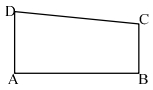
View full question & answer→MCQ 2051 Mark
Let $\overrightarrow{ a }$ be a non-zero vector parallel to the line of intersection of the two planes described by $\hat{i}+\hat{j}, \hat{i}+\hat{k}$ and $\hat{i}-\hat{j}, \hat{j}-\hat{k}$. If $\theta$ is the angle between the vector $\vec{a}$ and the vector $\vec{b}=2 \hat{i}-2 \hat{j}+\hat{k}$ and $\vec{a} \cdot \vec{b}=6$ then the ordered pair $(\theta,|\vec{a} \times \vec{b}|)$ is equal to
- A
$\left(\frac{\pi}{4}, 3 \sqrt{6}\right)$
- B
$\left(\frac{\pi}{3}, 3 \sqrt{6}\right)$
- C
$\left(\frac{\pi}{3}, 6\right)$
- ✓
$\left(\frac{\pi}{4}, 6\right)$
AnswerCorrect option: D. $\left(\frac{\pi}{4}, 6\right)$
d
$\overrightarrow{ n }_1$ and $\overrightarrow{ n }_2$ are normal vector to the plane $\hat{i}+\hat{j}, \hat{i}+\hat{k}$ and $\hat{i}-\hat{j} ; \hat{j}-\hat{k}$ respectively
$\overrightarrow{ n }_1=\left|\begin{array}{lll}\hat{ i } & \hat{ j } & \hat{ j } \\ 1 & 1 & 0 \\ 1 & 0 & 1\end{array}\right|=\hat{ i }-\hat{ j }-\hat{ k }$
$\overrightarrow{ n }_2=\left|\begin{array}{ccc}\hat{ i } & \hat{ j } & \hat{ j } \\ 1 & -1 & 0 \\ 1 & 0 & -1\end{array}\right|=\hat{i}+\hat{j}+\hat{ k }$
$\overrightarrow{ a }=\lambda\left|\overrightarrow{ n }_2 \times \overrightarrow{ n }_2\right|$
$=\lambda\left|\begin{array}{ccc}\hat{ i } & \hat{ j } & \hat{ k } \\ 1 & -1 & -1 \\ 1 & 1 & 1\end{array}\right|=\lambda(-2 \hat{ j }+2 \hat{ k })$
$\overrightarrow{ a } \cdot \overrightarrow{ b }=\lambda|0+4+2|=6$
$\Rightarrow \lambda=1$
$\vec{\alpha}=-2 \hat{ j }+2 \hat{ k }$
$\cos \theta=\frac{\overrightarrow{ a } \cdot \overrightarrow{ b }}{| a || b |}$
$\cos \theta=\frac{6}{2 \sqrt{2} \times 3}=\frac{1}{\sqrt{2}}$
$\theta=\frac{\pi}{4}$
$\text { Now } \quad|\overrightarrow{ a } \cdot \overrightarrow{ b }|^2+|\overrightarrow{ a } \times \overrightarrow{ b }|^2=| a |^2| b |^2$
$36+\left|\overrightarrow{ a } \times b ^2\right|=8 \times 9=72$
$|\vec{a} \times b|^2=36$
$|\vec{a} \times \vec{b}|=6$
View full question & answer→MCQ 2061 Mark
Let $\vec{a}=\hat{i}+2 \hat{j}+3 \hat{k}$ and $\vec{b}=\hat{i}+\hat{j}-\hat{k}$. If $\vec{c}$ is a vector such that $\vec{a} \cdot \vec{c}=11, \vec{b} \cdot(\vec{a} \times \vec{c})=27$ and $\vec{b} \cdot \vec{c}=-\sqrt{3}|\vec{b}|$, then $|\vec{a} \times \vec{c}|^2$ is equal to
Answera
Sol. $\overrightarrow{ a }=\hat{ i }+2 \hat{ j }+3 \hat{ k }, \overrightarrow{ b }=\hat{ i }+\hat{ j }-\hat{ k }$
$\vec{b} \cdot(\vec{a} \times \vec{c})=27, \vec{a} \cdot \vec{b}=0$
$\vec{b} \times(\vec{a} \times \vec{c})=-3 \vec{a}$
Let $\theta$ be angle between $\vec{b}, \vec{a} \times \vec{c}$
Then $|\vec{b}| \cdot|\vec{a} \times \vec{c}| \sin \theta=3 \sqrt{14}$
$|\vec{b}| \cdot|\vec{a} \times \vec{c}| \cos \theta=27$
$\Rightarrow \sin \theta=\frac{\sqrt{14}}{\sqrt{95}}$
$\therefore|\overrightarrow{ b }| \times|\overrightarrow{ a } \times \overrightarrow{ c }|=3 \sqrt{95}$
$\Rightarrow|\overrightarrow{ a } \times \overrightarrow{ c }|=\sqrt{3} \times \sqrt{95}$
View full question & answer→MCQ 2071 Mark
Let $\vec{a}=3 \hat{i}+\hat{j}-\hat{k}$ and $\overrightarrow{ c }=2 \hat{ i }-3 \hat{ j }+3 \hat{k}$. If $\vec{b}$ is $a$ vector such that $\vec{a}=\vec{b} \times \vec{c}$ and $|\vec{b}|^2=50$, then $|72-| \vec{b}+\left.\vec{c}\right|^2 \mid$ is equal to $..........$.
Answerc
$|\overrightarrow{ a }|=\sqrt{11},|\vec{c}|=\sqrt{22}$
$|\vec{a}|=|\overrightarrow{ b } \times \overrightarrow{ c }|=|\overrightarrow{ b }||\overrightarrow{ c }| \sin \theta$
$\sqrt{11}=\sqrt{50} \sqrt{22} \sin \theta$
$\Rightarrow \sin \theta=\frac{1}{10}$
$|\vec{b}+\vec{c}|^2=|\vec{b}|^2+|\vec{c}|^2+2 \vec{b} \cdot \vec{c}$
$=|\overrightarrow{ b }|^2+|\overrightarrow{ c }|^2+2|\overrightarrow{ b }||\overrightarrow{ c }| \cos \theta$
$=50+22+2 \times \sqrt{50} \times \sqrt{22} \times \frac{\sqrt{99}}{10}$
$=72+66$
$|72-| \vec{b}+\left.\vec{c}\right|^2 \mid=66$
View full question & answer→MCQ 2081 Mark
Let $\quad \vec{u}=\hat{i}-\hat{j}-2 \hat{k}, \vec{v}=2 \hat{i}+\hat{j}-\hat{k}, \vec{v} \cdot \vec{w}=2 \quad$ and $\vec{v} \times \vec{w}=\vec{u}+\lambda \vec{v}$. Then $\vec{u} \cdot \vec{w}$ is equal to $......$
- ✓
$1$
- B
$\frac{3}{2}$
- C
$2$
- D
$-\frac{2}{3}$
Answera
$\overrightarrow{ u }=(1,-1,-2), \overrightarrow{ v }=(2,1,-1), \overrightarrow{ v } \cdot \overrightarrow{ w }=2$
$\overrightarrow{ v } \times \overrightarrow{ w }=\overrightarrow{ u }+\lambda \overrightarrow{ v } \ldots \ldots \ldots \ldots \ldots \ldots \ldots(1)$
Taking dot with $\overrightarrow{ w }$ in (1)
$\overrightarrow{ w } \cdot(\overrightarrow{ v } \times \overrightarrow{ w })=\overrightarrow{ u } \cdot \overrightarrow{ w }+\lambda \overrightarrow{ v } \cdot \overrightarrow{ w }$
$\Rightarrow 0=\overrightarrow{ u } \cdot \overrightarrow{ w }+2 \lambda$
Taking dot with $\vec{v}$ in $(1)$
$\overrightarrow{ v } \cdot(\overrightarrow{ v } \times \overrightarrow{ w })=\overrightarrow{ u } \cdot \overrightarrow{ v }+\lambda \overrightarrow{ v } \cdot \overrightarrow{ v }$
$\Rightarrow 0=(2-1+2)+\lambda(6)$
$\lambda=-\frac{1}{2}$
$\Rightarrow \overrightarrow{ u } \cdot \overrightarrow{ w }=-2 \lambda=1$
View full question & answer→MCQ 2091 Mark
If the vectors $\vec{a}=\lambda \hat{i}+\mu \hat{j}+4 \hat{k}, \vec{b}=2 \hat{i}+4 \hat{j}-2 \hat{k}$ and $\vec{c}=2 \hat{i}+3 \hat{j}+\hat{k}$ are coplanar and the projection of $\vec{a}$ on the vector $\vec{b}$ is $\sqrt{54}$ units, then the sum of all possible values of $\lambda+\mu$ is equal to
Answerc
$\left|\begin{array}{ccc}\lambda & \mu & 4 \\ -2 & 4 & -2 \\ 2 & 3 & 1\end{array}\right|=0$
$\lambda(10)=\mu(2)+4(-14)=0$
$10 \lambda-2 \mu=56$
$5 \lambda-\mu=28$
$\frac{\vec{a} \cdot \vec{b}}{|\vec{b}|}=\sqrt{54}$
$\frac{-2 \lambda+4 \mu-8}{\sqrt{24}}=\sqrt{54}$
$-2 \lambda+4 \mu-8=\sqrt{54 \times 24}$
By solving equation $(1)$ and $(2)$
$\Rightarrow \lambda+\mu=24$
View full question & answer→MCQ 2101 Mark
Let $\vec{a}, \vec{b}$ and $\vec{c}$ be three non-zero non-coplanar vectors. Let the position vectors of four points $A, B, \quad C$ and $D$ be $\vec{a}-\vec{b}+\vec{c}, \lambda \vec{a}-3 \vec{b}+4 \vec{c}$, $-\vec{a}+2 \vec{b}-3 \vec{c}$ and $2 \vec{a}-4 \vec{b}+6 \vec{c}$ respectively. If $\overrightarrow{A B}$, $\overline{ AC }$ and $\overline{ AD }$ are coplanar, then $\lambda$ is :
Answerc
$\overline{A B}=(\lambda-1) \bar{a}-2 \bar{b}+3 \bar{c}$
$\overline{A C}=2 \bar{a}+3 \bar{b}-4 \bar{c}$
$\overline{A D}=\bar{a}-3 \bar{b}+5 \bar{c}$
$\left|\begin{array}{ccc}\lambda-1 & -2 & 3 \\ -2 & 3 & -4 \\ 1 & -3 & 5\end{array}\right|=0$
$\Rightarrow(\lambda-1)(15-12)+2(-10+4)+3(6-3)=0$
$\Rightarrow(\lambda-1)=1 \Rightarrow \lambda=2$
View full question & answer→MCQ 2111 Mark
The foot of perpendicular from the origin $O$ to a plane $P$ which meets the co-ordinate axes at the points $A, B, C$ is $(2, a, 4), a \in N$. If the volume of the tetrahedron $OABC$ is $144$ unit $^3$, then which of the following points is $NOT$ on $P$ ?
- A
$(2,2,4)$
- B
$(0,4,4)$
- ✓
$(3,0,4)$
- D
$(0,6,3)$
AnswerCorrect option: C. $(3,0,4)$
c
Equation of Plane:
$(2 \hat{i}+a \hat{j}+4 \hat{ k }) \cdot[( x -2) \hat{ i }+( y - a ) \hat{ j }+( z -4) \hat{ k }]=0$
$\Rightarrow 2 x + ay +4 z =20+ a ^2$
$\Rightarrow A \equiv\left(\frac{20+ a ^2}{2}, 0,0\right)$
$B \equiv\left(0, \frac{20+ a ^2}{ a }, 0\right)$
$C \equiv\left(0,0, \frac{20+ a ^2}{4}\right)$
$\Rightarrow \text { Volume of tetrahedron }$
$=\frac{1}{6}[\overrightarrow{ a } \overrightarrow{ b } \overrightarrow{ c }]$
$=\frac{1}{6} \overrightarrow{ a } .(\overrightarrow{ b } \times \overrightarrow{ c })$
$\Rightarrow\left(20+ a ^2\right)^3=144 \times 48 \times a$
$\Rightarrow a =2$
$\Rightarrow \text { Equation of plane is } 2 x +2 y +4 z =24$
$\text { Or } x + y +2 z =12$
$\Rightarrow(3,0,4) \quad \text { Not lies on the Plane }$
$x + y +2 z =12$
View full question & answer→MCQ 2121 Mark
Let $\vec{v}=\alpha \hat{i}+2 \hat{j}-3 \hat{k}, \vec{w}=2 \alpha \hat{i}+\hat{j}-\hat{k}$, and $\overrightarrow{ u }$ be a vector such that $|\vec{u}|=\alpha > 0$. If the minimum value of the scalar triple product $[\vec{u} \vec{v} \vec{w}]$ is $-\alpha \sqrt{3401}$, and $|\vec{u} . \hat{i}|^2=\frac{m}{n}$ where $m$ and $n$ are coprime natural numbers, then $m + n$ is equal to $.........$.
- A
$3502$
- B
$3503$
- ✓
$3501$
- D
$3504$
AnswerCorrect option: C. $3501$
c
${[\vec{u} \vec{v} \vec{w}]=\vec{u} \cdot(\vec{v} \times \vec{w})}$
$\min .(|u||\vec{v} \times \vec{w}| \cos \theta)=-\alpha \sqrt{3401}$
$\cos \theta=-1$
$|u|=\alpha \text { (Given) }$
$|\vec{v} \times \vec{w}|=\sqrt{3401}$
$\vec{v} \times \vec{w}=\left|\begin{array}{ccc}\hat{i} & \hat{j} & \hat{k} \\ \alpha & 2 & -3 \\ 2 \alpha & 1 & -1\end{array}\right|$
$\vec{v} \times \vec{w}=\hat{i}-5 \alpha \hat{j}-3 \alpha \hat{k}$
$|\vec{v} \times \vec{w}|=\sqrt{1+25 \alpha^2+9 \alpha^2}=\sqrt{3401}$
$34 \alpha^2=3400$
$\alpha^2=100$
$\alpha=10 \quad(\text { as } \alpha > 0)$
So $\vec{u} =\lambda(\hat{i}-5 \alpha \hat{j}-3 \alpha \hat{k})$
$\vec{u} =\sqrt{\lambda^2+25 \alpha^2 \lambda^2+9 \alpha^2 \lambda}$
$\alpha^2 =\lambda^2\left(1+25 \alpha^2+9 \alpha^2\right)$
$100 =\lambda^2(1+34 \times 100)$
$\lambda^2 =\frac{100}{3401}=\frac{m}{n}$
View full question & answer→MCQ 2131 Mark
Let the position vectors of the points $A , B , C$ and $D$ be $5 \hat{i}+5 \hat{j}+2 \lambda \hat{k}, \hat{i}+2 \hat{j}+3 \hat{k},-2 \hat{i}+\lambda \hat{j}+4 \hat{k}$ and $-\hat{ i }+5 \hat{ j }+6 \hat{ k }$. Let the set $S =\{\lambda \in R$ : The points $A$, $B , C$ and D are coplanar $\}$. Then $\sum_{\lambda \in S}(\lambda+2)^2$ is equal to
- ✓
$41$
- B
$25$
- C
$13$
- D
$\frac{37}{2}$
Answera
Since $A, B, C, D$ are coplanner
Hence $\left[\begin{array}{lll}\overrightarrow{ BA } & \overrightarrow{ CA } & \overrightarrow{ DA }\end{array}\right]=0$
$\begin{aligned}& \left|\begin{array}{ccc}4 & 3 & 2 \lambda-3 \\7 & 5-\lambda & 2 \lambda-4 \\6 & 0 & 2 \lambda-6\end{array}\right|=0 \\& \lambda=2,3 \text { Hence } \sum_{\lambda \in S}(\lambda+2)^2=41\end{aligned}$
View full question & answer→MCQ 2141 Mark
Let the vectors $\overrightarrow{ u }_1=\hat{ i }+\hat{ j }+ a \hat{ k }, \overrightarrow{ u }_2=\hat{ i }+ b \hat{ j }+\hat{ k }$ and $\overrightarrow{ u }_3=c \hat{ i }+\hat{ j }+\hat{ k }$ be coplanar. If the vectors $\overrightarrow{ v }_1=(a+b) \hat{i}+c \hat{j}+c \hat{k}, \quad \overrightarrow{ v }_2=a \hat{i}+(b+c) \hat{j}+a \hat{k} \quad$ and $\overrightarrow{ v }_3=b \hat{ i }+ b \hat{ j }+( c + a ) \hat{ k }$ are also coplanar, then $6( a +$ $b + c )$ is equal to $..............$.
Answerc
${\left[\overrightarrow{ u }_1 \overrightarrow{ u }_2 \overrightarrow{ u }_3\right]=0 \quad \therefore\left|\begin{array}{lll}1 & 1 & a \\ 1 & b & 1 \\ c & 1 & 1\end{array}\right|=0}$
$\Rightarrow b -1+ c -1+ a (1- bc )=0$
$\therefore abc = a + b + c -2$
$\left[\overrightarrow{ v }_1 \overrightarrow{ v }_2 \overrightarrow{ v }_3\right]=0 \quad \therefore\left|\begin{array}{ccc} a + b & c & c \\ a & b + c & a \\ b & b & c + a \end{array}\right|=0$
$R_3 \rightarrow R_3-\left(R_1+R_2\right) \Rightarrow\left|\begin{array}{ccc}a+b & c & c \\ a & b+c & a \\ -2 a & -2 c & 0\end{array}\right|=0$
$\Rightarrow-2 a\left(a c-b c-c^2\right)+2 c\left(a^2+a b-a c\right)=0$
$\Rightarrow-2 a^2 c+2 a b c+2 a c^2+2 a^2 c+2 a b c-2 a c^2=0$
$\Rightarrow 4 a b c=0 \quad \therefore a b c=0$
$\therefore a + b + c =2 \quad \therefore 6( a + b + c )=12$ Ans.
View full question & answer→MCQ 2151 Mark
Let $\vec{a}=2 \hat{i}+7 \hat{j}-\hat{k}, \vec{b}=3 \hat{i}+5 \hat{k}$ and $\vec{c}=\hat{i}-\hat{j}+2 \hat{k}$ Let $\vec{d}$ be a vector which is perpendicular to both $\overrightarrow{ a }$ and $\overrightarrow{ b }, \quad$ and $\quad \overrightarrow{ c } \cdot \overrightarrow{ d }=12$. Then $(-\hat{i}+\hat{j}-\hat{k}) \cdot(\vec{c} \times \vec{d})$ is equal to $........$.
Answerc
$\overrightarrow{ a }=2 \hat{ i }+7 \hat{ j }-\hat{ k }$
$\overrightarrow{ b }=3 \hat{ i }+5 \hat{ k }$
$\overrightarrow{ c }=\hat{ i }-\hat{ j }+2 \hat{ k }$
$\overrightarrow{ d }=\lambda(\overrightarrow{ a } \times \overrightarrow{ b })=\lambda\left|\begin{array}{ccc}\hat{ i } & \hat{ j } & \hat{ k } \\ 2 & 7 & -1 \\ 3 & 0 & 5\end{array}\right|$
$\overrightarrow{ d }=\lambda(35 \hat{ i }-13 \hat{ j }-21 \hat{ k })$
$\lambda(35+13-42)=12$
$\lambda=2$
$\overrightarrow{ d }=2(35 \hat{ i }-13 \hat{ j }-21 \hat{ k })$
$(\hat{ i }+\hat{ j }-\hat{ k })(\overrightarrow{ c } \times \overrightarrow{ d })$
$=\left|\begin{array}{ccc}-1 & 1 & -1 \\ 1 & -1 & 2 \\ 70 & -26 & -42\end{array}\right|=44$
View full question & answer→MCQ 2161 Mark
Let $S$ be the set of all $(\lambda, \mu)$ for which the vectors $\lambda \hat{ i }-\hat{ j }+\hat{ k }, \hat{ i }+2 \hat{ j }+\mu \hat{ k }$ and $3 \hat{ i }-4 \hat{ j }+5 \hat{ k }$, where $\lambda-\mu=5$, are coplanar, then $\sum_{(\lambda, \mu) \in S} 80\left(\lambda^2+\mu^2\right)$ is equal to :
- A
$2370$
- B
$2130$
- ✓
$2290$
- D
$2210$
AnswerCorrect option: C. $2290$
c
$\left|\begin{array}{ccc}\lambda & -1 & 1 \\ 1 & 2 & \mu \\ 3 & -4 & 5\end{array}\right|=0 \quad and\, \lambda-\mu=5$
$\lambda(10+4 \mu)+(5-3 \mu)+(-10)=0$
$(\mu+5)(4 \mu+10)+5-3 \mu-10=0$
$\mu=-15 ; \lambda=5 / 4$
$\mu=-3 ; \lambda=2$
$\text { Hence } \sum_{(\lambda, \mu) \in S} 80\left(\lambda^2+\mu^2\right)$
$=80\left(\frac{250}{16}+13\right)$
$=1250+1040$
$=2290$
View full question & answer→MCQ 2171 Mark
If $\vec{a}, \vec{b}, \overrightarrow{ c }$ are three non-zero vectors and $\hat{ n }$ is a unit vector perpendicular to $\vec{c}$ such that $\overrightarrow{ a }=\alpha \overrightarrow{ b }-\hat{ n },(\alpha \neq 0) \quad$ and $\quad \overrightarrow{ b } \cdot \overrightarrow{ c }=12$, then $|\overrightarrow{ c } \times(\overrightarrow{ a } \times \overrightarrow{ b })|$ is equal to :
Answerc
$\hat{ n } \perp \overrightarrow{ c } \quad \overrightarrow{ a }=\alpha \overrightarrow{ b }-\overrightarrow{ n }$
$\overrightarrow{ b } \cdot \overrightarrow{ c }=12$
$\overrightarrow{ a } \cdot \overrightarrow{ c }=\alpha(\overrightarrow{ b } \cdot \overrightarrow{ c })-\overrightarrow{ n } \cdot \overrightarrow{ c }$
$\overrightarrow{ a } \cdot \overrightarrow{ c }=\alpha(\overrightarrow{ b } \cdot \overrightarrow{ c })$
$|\overrightarrow{ c } \times(\overrightarrow{ a } \times \overrightarrow{ b })|=|(\overrightarrow{ c } \cdot \overrightarrow{ b }) \overrightarrow{ a }-(\overrightarrow{ c } \cdot \overrightarrow{ a }) \overrightarrow{ b }|$
$=|(\overrightarrow{ c } \cdot \overrightarrow{ b }) \overrightarrow{ a }-\alpha(\overrightarrow{ b } \cdot \overrightarrow{ c }) \overrightarrow{ b }|$
$=|(\overrightarrow{ c } \cdot \overrightarrow{ b })||\overrightarrow{ a }-\alpha \overrightarrow{ b }|$
$=12 \times(|\overrightarrow{ n }|)$
$=12 \times 1$
$=12$
View full question & answer→MCQ 2181 Mark
Let $\vec{\alpha}=4 \hat{ i }+3 \hat{ j }+5 \hat{ k }$ and $\vec{\beta}=\hat{ i }+2 \hat{ j }-4 \hat{ k }$. Let $\vec{\beta}_1$ be parallel to $\vec{\alpha}$ and $\vec{\beta}_2$ be perpendicular to $\vec{\alpha}$. If $\vec{\beta}=\vec{\beta}_1+\vec{\beta}_2$, then the value of $5 \vec{\beta}_2 \cdot(\hat{ i }+\hat{ j }+\hat{ k })$ is
Answerc
Let $\vec{\beta}_1=\lambda \vec{\alpha}$
Now $\vec{\beta}_2=\vec{\beta}-\vec{\beta}_1$
$=(\hat{ i }+2 \hat{ j }-4 \hat{ k })-\lambda(4 \hat{ i }+3 \hat{ j }+5 \hat{ k })$
$=(1-4 \lambda) \hat{ i }+(2-3 \lambda) \hat{ j }-(5 \lambda+4) \hat{ k }$
$\vec{\beta}_2 \cdot \vec{\alpha}=0$
$\Rightarrow 4(1-4 \lambda)+3(2-3 \lambda)-5(5 \lambda+4)=0$
$\Rightarrow 4-16 \alpha+6-9 \lambda-25 \lambda-20=0$
$\Rightarrow 50 \lambda=-10$
$\Rightarrow \lambda=\frac{-1}{5}$
$\vec{\beta}_2=\left(1+\frac{4}{5}\right) \hat{ i }+\left(2+\frac{3}{5}\right) \hat{ j }-(-1+4) \hat{ k }$
$\vec{\beta}_2=\frac{9}{5} \hat{ i }+\frac{13}{5} \hat{ j }-3 \hat{ k }$
$5 \vec{\beta}_2=9 \hat{ i }+13 \hat{ j }-15 \hat{ k }$
$5 \vec{\beta}_2 \cdot(\hat{ i }+\hat{ j }+\hat{ k })=9+13-15=7$
View full question & answer→MCQ 2191 Mark
An are $P Q$ of a circle subtends a right angle at its centre $O$. The mid point of the arc $P Q$ is $R$. If $\overline{O P}=\vec{u}, \overline{O R}=\vec{v}$ and $\overrightarrow{O Q}=\alpha \vec{u}+\beta \vec{v}$, then $\alpha, \beta^2$ are the roots of the equation
- ✓
$x ^2- x -2=0$
- B
$3 x^2+2 x-1=0$
- C
$x^2+x-2=0$
- D
$3 x ^2-2 x -1=0$
AnswerCorrect option: A. $x ^2- x -2=0$
a
$|\vec{u}|=|\vec{v}|=|\alpha \vec{u}+\beta \vec{v}|$
$(\vec{u}) \cdot(\alpha \vec{u}+\beta \vec{v})=0$
$\vec{u} \cdot \vec{v}=|u||v| \cos 45^{\circ}$
$\alpha=-\frac{\beta}{\sqrt{2}}$
$=|\alpha \vec{u}+\beta \vec{v}|=r$
$\alpha^2+\beta^2+\sqrt{2} \alpha \beta=1$
$\alpha=-1, \beta^2=2$
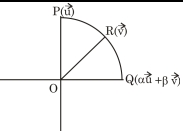
View full question & answer→MCQ 2201 Mark
Let $\lambda \in Z, \vec{a}=\lambda \hat{i}+\hat{j}-\hat{k}$ and $\vec{b}=3 \hat{i}-\hat{j}+2 \hat{k}$. Let $\overrightarrow{ c }$ be a vector such that $(\vec{a}+\vec{b}+\vec{c}) \times \vec{c}=\overrightarrow{0}, \vec{a} \cdot \vec{c}=-17$ and $\vec{b} \cdot \vec{c}=-20$ Then $|\overrightarrow{ c } \times(\lambda \hat{i}+\hat{j}+\hat{ k })|^2$ is equal to
Answerb
$(\vec{a}+\vec{b}+\overrightarrow{ c }) \times \overrightarrow{ c }=0$
$(\vec{a}+\vec{b}) \times \vec{c}=0$
$\overrightarrow{ c }=\alpha(\overrightarrow{ a }+\overrightarrow{ b })=\alpha(\lambda+3) \hat{ i }+\alpha \hat{ k }$
$\vec{b} \cdot \vec{c}=-20 \Rightarrow 3 \alpha(\lambda+3)+2 \alpha=-20$
$\vec{a} . \vec{c}=-17 \Rightarrow \alpha \lambda(\lambda+3)-\alpha=-17$
$\Rightarrow \alpha(3 \lambda+9+2)=-20$
$\alpha\left(\lambda^2+3 \lambda-1\right)=-17$
$17(3 \lambda+11)=20\left(\lambda^2+3 \lambda-1\right)$
$20 \lambda^2+9 \lambda-207=0$
$\lambda=3 \quad(\lambda \in Z)$
$\Rightarrow \alpha=-1 \quad \Rightarrow \overrightarrow{ c }=-(6 \hat{ i }+\hat{ k })$
$\overrightarrow{ v }=\overrightarrow{ c } \times(3 \hat{ i }+\hat{ j }+\hat{ k })$
$=\left|\begin{array}{lll}\hat{i} & \hat{j} & \hat{k} \\ -6 & 0 & -1 \\ 3 & 1 & 1\end{array}\right|=\hat{i}+3 \hat{j}-6 \hat{k}$
$|\overrightarrow{ v }|^2=(-1)^2+3^2+6^2=46$
View full question & answer→MCQ 2211 Mark
Let $\vec{a}=\hat{i}+4 \hat{j}+2 \hat{k}, \vec{b}=3 \hat{i}-2 \hat{j}+7 \hat{k}$ and $\overrightarrow{ c }=2 \hat{ i }-\hat{ j }+4 \hat{ k }$. If a vector $\overrightarrow{ d }$ satisfies $\overrightarrow{ d } \times \overrightarrow{ b }=\overrightarrow{ c } \times \overrightarrow{ b }$ and $\overrightarrow{ d } \cdot \overrightarrow{ a }=24$, then $|\overrightarrow{ d }|^2$ is equal to $.........$.
Answera
$\overrightarrow{ d } \times \overrightarrow{ b }=\overrightarrow{ c } \times \overrightarrow{ b }$
$\Rightarrow(\overrightarrow{ d }-\overrightarrow{ c }) \times \overrightarrow{ b }=0$
$\Rightarrow \overrightarrow{ d }=\overrightarrow{ c }+\lambda \overrightarrow{ b }$
$\text { Also } \overrightarrow{ d } \cdot \overrightarrow{ a }=24$
$\Rightarrow(\overrightarrow{ c }+\lambda \overrightarrow{ b }) \cdot \overrightarrow{ a }=24$
$\lambda=\frac{24-\overrightarrow{ a } \cdot \overrightarrow{ c }}{\overrightarrow{ b } \cdot \overrightarrow{ a }}=\frac{24-6}{9}=2$
$\Rightarrow \overrightarrow{ d }=\overrightarrow{ c }+2(\overrightarrow{ b })$
$\qquad=8 \hat{ i }-5 \hat{ j }+18 \hat{ k }$
$\Rightarrow|\overrightarrow{ d }|^2=64+25+324=413$
View full question & answer→MCQ 2221 Mark
Let $\vec{a}=\hat{i}+\hat{j}+2 \hat{k}, \vec{b}=2 \hat{i}-3 \hat{j}+\hat{k}$ and $\overrightarrow{ c }=\hat{ i }-\hat{ j }+\hat{ k }$ be three given vectors. Let $\vec{v}$ be a vector in the plane of $\vec{a}$ and $\overrightarrow{ b }$ whose projection on $\overrightarrow{ c }$ is $\frac{2}{\sqrt{3}}$. If $\overrightarrow{ v } . \hat{ j }=7$, then $\overrightarrow{ v } \cdot(\hat{ i }+\hat{ k })$ is equal to
Answerd
$\overrightarrow{ v }=\lambda \overrightarrow{ a }+\mu \overrightarrow{ b }$
$\vec{v}=\lambda(1,1,2)+\mu(2,-3,1)$
$\vec{v}=(\lambda+2 \mu, \lambda-3 \mu, 2 \lambda+\mu)$
$\overrightarrow{ v } \cdot \hat{ j }=7$
$\lambda-3 \mu=7$
$\overrightarrow{ v } \cdot \frac{\overrightarrow{ c }}{|\overrightarrow{ c }|}=\frac{2}{\sqrt{3}}$
$\overrightarrow{ V } \cdot \overrightarrow{ C }=2$
$\lambda+2 \mu-\lambda+3 \mu+2 \lambda+\mu=2$
$2 \lambda+6 \mu=2$
$\lambda+3 \mu=1$
$\lambda-3 \mu=7$
$2 \lambda=8$
$\lambda=4$
$\mu=-1$
We get $\quad \overrightarrow{ v }=(2,7,7)$
View full question & answer→MCQ 2231 Mark
Let $\quad \overrightarrow{ a }=\alpha \hat{ i }+3 \hat{ j }-\hat{ k }, \overrightarrow{ b }=3 \hat{ i }-\beta \hat{ j }+4 \hat{ k } \quad$ and $\overrightarrow{ c }=\hat{ i }+2 \hat{ j }-2 \hat{ k }$ where $\alpha, \beta \in R$, be three vectors. If the projection of $\vec{a}$ on $\vec{c}$ is $\frac{10}{3}$ and $\overrightarrow{ b } \times \overrightarrow{ c }=-6 \hat{ i }+10 \hat{ j }+7 \hat{ k }$, then the value of $\alpha+\beta$ equal to
Answera
$\frac{\overrightarrow{ a } \cdot \overrightarrow{ c }}{|\overrightarrow{ c }|}=\frac{10}{3}$
$\Rightarrow \frac{\alpha+6+2}{\sqrt{1+4+4}}=\frac{10}{3} \Rightarrow \alpha=2$
and
$\left|\begin{array}{ccc}\hat{ i } & \hat{ j } & \hat{ k } \\ 3 & -\beta & 4 \\ 1 & 2 & -2\end{array}\right|=-6 \hat{ i }+\hat{ j }+\hat{ k }$
$\Rightarrow 2 \beta-8=-6 \Rightarrow \beta=1$
$\Rightarrow \alpha+\beta=3$
View full question & answer→MCQ 2241 Mark
Let $\vec{a}=\hat{i}-\hat{j}+2 \hat{k}$ and $\vec{b}$ be a vector such that $\vec{a} \times \vec{b}=2 \hat{i}-\hat{k}$ and $\vec{a} \cdot \vec{b}=3$. Then the projection of $\vec{b}$ on the vector $\vec{a}-\vec{b}$ is :-
AnswerCorrect option: A. $\frac{2}{\sqrt{21}}$
a
$\vec{a}=\hat{i}-\hat{j}+2 \hat{k}$
$\vec{a} \times \vec{b}=2 \hat{i}-\hat{k}$
$\vec{a} \cdot \vec{b}=3$
$|\vec{a} \times \vec{b}|^{2}+|\vec{a} \cdot \vec{b}|^{2}=|\vec{a}|^{2} \cdot|\vec{b}|^{2}$
$5+9=6|\vec{b}|^{2}$
$|b|^{2}=\frac{7}{3}$
$|\vec{a}-\vec{b}|=\sqrt{|\vec{a}|^{2}+|\vec{b}|^{2}-2 \vec{a} \cdot \vec{b}}=\sqrt{\frac{7}{3}}$
projection of $\vec{b}$ on $\vec{a}-\vec{b}=\frac{\vec{b} \cdot(\vec{a}-\vec{b})}{|\vec{a}-\vec{b}|}$
$=\frac{\vec{b} \cdot \vec{a}-|\vec{b}|^{2}}{|\vec{a}-\vec{b}|}=\frac{3-\frac{7}{3}}{\sqrt{\frac{7}{3}}}$
$=\frac{2}{\sqrt{21}}$
View full question & answer→MCQ 2251 Mark
Let $\vec{a}=\alpha \hat{i}+\hat{j}-\hat{k}$ and $\vec{b}=2 \hat{i}+\hat{j}-\alpha \hat{k}, \alpha>0$. If the projection of $\vec{a} \times \vec{b}$ on the vector $-\hat{i}+2 \hat{j}-2 \hat{k}$ is $30 ,$ then $\alpha$ is equal to
- A
$\frac{15}{2}$
- B
$8$
- C
$\frac{13}{2}$
- ✓
$7$
Answerd
$\vec{a} \times \vec{b}=(1-\alpha) \hat{i}+\left(\alpha^{2}-2\right) \hat{j}+(\alpha-2) \hat{k}$
Projection of $\vec{a} \times \vec{b}$ on $-\hat{i}+2 \hat{j}-2 \hat{k}$
$=\frac{(\vec{a} \times \vec{b}) \cdot(-\hat{i}+2 \hat{j}-2 \hat{k})}{3}=30$
$2 \alpha^{2}-\alpha-91=0$
$\alpha=7,-\frac{13}{2}$
View full question & answer→MCQ 2261 Mark
Let $\theta$ be the angle between the vectors $\vec{a}$ and $\vec{b}$, where $|\vec{a}|=4,|\vec{b}|=3 \quad \theta \in\left(\frac{\pi}{4}, \frac{\pi}{3}\right)$. Then $|(\vec{a}-\vec{b}) \times(\vec{a}+\vec{b})|^{2}+4(\vec{a} \cdot \vec{b})^{2}$ is equal to
Answera
$|\vec{a}|=4,|\vec{b}|=3 \quad \theta \in\left(\frac{\pi}{4}, \frac{\pi}{3}\right)$
$|(\vec{a}-\vec{b}) \times(\vec{a}+\vec{b})|^{2}+4(\vec{a} \cdot \vec{b})^{2}$
$|\vec{a} \times \vec{b}-\vec{b} \times \vec{a}|^{2}+4 a^{2} b^{2} \cos ^{2} \theta$
$2|\vec{a} \times \vec{b}|^{2}+4 a^{2} b^{2} \cos ^{2} \theta$
$4 a^{2} b^{2} \sin ^{2} \theta+4 a^{2} b^{2} \cos ^{2} \theta$
$4 a^{2} b^{2}=4 \times 16 \times 9$
$=576$
View full question & answer→MCQ 2271 Mark
Let $\vec{a}=\hat{i}+\hat{j}-\hat{k}$ and $\vec{c}=2 \hat{i}-3 \hat{j}+2 \hat{k}$. Then the number of vectors $\vec{b}$ such that $\vec{b} \times \vec{c}=\vec{a}$ and $|\vec{b}| \in\{1,2, \ldots ., 10\}$ is
Answerd
$\vec{a}=i+j-k$
$\vec{c}=2 i-3 j+2 k$
$\vec{b} \times \vec{c}=\vec{a}$
$|\vec{b}| \in\{1,2 \ldots \ldots 10\}$
$\because \vec{b} \times \vec{c}=\vec{a}$
$\Rightarrow \vec{a}$ is perpendicular to $\vec{b}$ as well as $\vec{a}$ is perpendicular to $\vec{C}$
Now $\vec{a} \cdot \vec{c}=2-3-2=-3 \neq 0$
This $\vec{b} \times \vec{c}=\vec{a}$ is not possible.
No. of vectors $\vec{b}=0$
View full question & answer→MCQ 2281 Mark
If $ \overrightarrow{ a }=2 \hat{ i }+\hat{ j }+3 \hat{ k }, \overrightarrow{ b }=3 \hat{ i }+3 \hat{ j }+\hat{ k } $ and $\overrightarrow{ c }= c _{1} \hat{ i }+ c _{2} \hat{ j }+ c _{3} \hat{ k }$ are coplanar vectors and $\overrightarrow{ a } \cdot \overrightarrow{ c }=5, \overrightarrow{ b } \perp \overrightarrow{ c }$, then $122\left( c _{1}+ c _{2}+ c _{3}\right)$ is equal to.......
Answera
$\overline{ a } \cdot \overline{ c }=5 \Rightarrow 2 c _{1}+ c _{2}+3 c _{3}=5$..........$(1)$
$\overline{ b } \cdot \overline{ c }=0 \Rightarrow 3 c _{1}+3 c _{2}+ c _{3}=0$.............$(2)$
And $[\overline{ a } \overline{ b } \overline{ c }]=0 \Rightarrow\left|\begin{array}{ccc} c _{1} & c _{2} & c _{3} \\ 2 & 1 & 3 \\ 3 & 3 & 1\end{array}\right|=0$
$\Rightarrow 8 c_{1}-7 c_{2}-3 c_{3}=0$..............$(3)$
By solving $(1), (2), (3)$ we get
$c _{1}=\frac{10}{122}, c _{2}=\frac{-85}{122}, c _{3}=\frac{225}{122}$
$\therefore 122\left( c _{1}+ c _{2}+ c _{3}\right)=150$
View full question & answer→MCQ 2291 Mark
Let $\vec{a}=3 \hat{i}+\hat{j}$ and $\vec{b}=\hat{i}+2 \hat{j}+\hat{k}$. Let $\vec{c}$ be a vector satisfying $\vec{a} \times(\vec{b} \times \vec{c})=\vec{b}+\lambda \vec{c}$. If $\vec{b}$ and $\vec{c}$ are non-parallel, then the value of $\lambda$ is.
Answera
$\vec{a}=3 \hat{i}+\hat{j}, \vec{b}=\hat{i}+2 \hat{j}+\hat{k}$
As $\vec{a} \times(\vec{b} \times \vec{c})=\vec{b}+\lambda \vec{c}$
$\Rightarrow \overrightarrow{ a } \cdot \overrightarrow{ c }(\overrightarrow{ b })-(\overrightarrow{ a } \cdot \overrightarrow{ b }) \overrightarrow{ c }=\overrightarrow{ b }+\lambda \overrightarrow{ c }$
$\Rightarrow \vec{a} \cdot \vec{c}=1, \vec{a} \cdot \vec{b}=-\lambda$
$\Rightarrow(3 \hat{ i }+\hat{ j }) \cdot(\hat{ i }+2 \hat{ j }+\hat{ k })=-\lambda$
$\Rightarrow \lambda=-5$
View full question & answer→MCQ 2301 Mark
Let $\vec{b}=\hat{i}+\hat{j}+\lambda \hat{k}, \lambda \in R$. If $\vec{a}$ is a vector such that $\overrightarrow{ a } \times \overrightarrow{ b }=13 \hat{ i }-\hat{ j }-4 \hat{ k } \quad$ and $\quad \overrightarrow{ a } \cdot \overrightarrow{ b }+21=0$, then $(\vec{b}-\vec{a}) \cdot(\hat{k}-\hat{j})+(\vec{b}+\vec{a}) \cdot(\hat{i}-\hat{k})$ is equal to
Answerc
$(\overrightarrow{ a } \times \overrightarrow{ b }) \cdot \overrightarrow{ b }=0$
$\Rightarrow 13-1-4 \lambda=0 \Rightarrow \lambda=3$
$\Rightarrow \overrightarrow{ b }=\hat{ i }+\hat{ j }+3 \hat{ k } \Rightarrow \overrightarrow{ a } \times \overrightarrow{ b }=13 \hat{ i }-\hat{ j }-4 \hat{ k }$
$\Rightarrow(\overrightarrow{ a } \times \overrightarrow{ b }) \times \overrightarrow{ b }=(13 \hat{ i }-\hat{ j }-4 \hat{ k }) \times(\hat{ i }+\hat{ j }+3 \hat{ k })$
$\Rightarrow-21 \overrightarrow{ b }-11 \overrightarrow{ a }=\hat{ i }-43 \hat{ j }+14 \hat{ k }$
$\Rightarrow \overrightarrow{ a }=-2 \hat{ i }+2 \hat{ j }-7 \hat{ k }$
Now $(\overrightarrow{ b }-\overrightarrow{ a }) \cdot(\hat{ k }-\hat{ j })+(\overrightarrow{ b }+\overrightarrow{ a }) \cdot(\hat{ i }-\hat{ k })=14$
View full question & answer→MCQ 2311 Mark
Let $\vec{a}$ be a vector which is perpendicular to the vector $3 \hat{ i }+\frac{1}{2} \hat{ j }+2 \hat{ k }$. If $\overrightarrow{ a } \times(2 \hat{ i }+\hat{ k })=2 \hat{ i }-13 \hat{ j }-4 \hat{ k }$, then the projection of the vector $\vec{a}$ on the vector $2 \hat{ i }+2 \hat{ j }+\hat{ k }$ is
- A
$\frac{1}{3}$
- B
$1$
- ✓
$\frac{5}{3}$
- D
$\frac{7}{3}$
AnswerCorrect option: C. $\frac{5}{3}$
c
$(\vec{a} \times(2 \hat{i}+\hat{k})) \times\left(3 \hat{i}+\frac{1}{2} \hat{j}+2 \hat{k}\right)$
$=(2 \hat{i}-13 \hat{j}-4 \hat{k}) \times\left(3 \hat{i}+\frac{1}{2} \hat{j}+2 \hat{k}\right)$
$-(6+2) \overrightarrow{ a }=\left|\begin{array}{ccc}\hat{ i } & \hat{ j } & \hat{ k } \\ 2 & -13 & -4 \\ 3 & \frac{1}{2} & 2\end{array}\right|$
$\vec{a}=3 \hat{i}+2 \hat{j}-5 \hat{k}$
Projection of $\vec{a}$ on vector $2 \hat{i}+2 \hat{j}+\hat{k}$ is
$\overrightarrow{ a } \cdot \frac{(2 \hat{ i }+2 \hat{ j }+\hat{ k })}{3}=\frac{5}{3}$
View full question & answer→MCQ 2321 Mark
Let $A , B , C$ be three points whose position vectors respectively are: $\overrightarrow{ a }=\hat{ i }+4 \hat{ j }+3 \hat{ k }$ ; $\overrightarrow{ b }=2 \hat{ i }+\alpha \hat{ j }+4 \hat{ k }, \alpha \in R$ ;$\overrightarrow{ c }=3 \hat{ i }-2 \hat{ j }+5 \hat{ k }$ . If $\alpha$ is the smallest positive integer for which $\vec{a}, \vec{b}, \vec{c}$ are non-collinear, then the length of the median, in $\triangle ABC$, through $A$ is
- ✓
$\frac{\sqrt{82}}{2}$
- B
$\frac{\sqrt{62}}{2}$
- C
$\frac{\sqrt{69}}{2}$
- D
$\frac{\sqrt{66}}{2}$
AnswerCorrect option: A. $\frac{\sqrt{82}}{2}$
a
$\overline{ AB } \| \overline{ AC }$ if $\frac{1}{2}=\frac{\alpha-4}{-6}=\frac{1}{2} \Rightarrow \alpha=1$
$\vec{a}, \vec{b}, \vec{c}$ are non-collinear for $\alpha=2$ (smallest positive integer)
Mid-point of $BC = M \left(\frac{5}{2}, 0, \frac{9}{2}\right)$
$AM =\sqrt{\frac{9}{4}+16+\frac{9}{4}}=\frac{\sqrt{82}}{2}$
View full question & answer→MCQ 2331 Mark
Let $\vec{a}=\hat{i}-2 \hat{j}+3 \hat{k}, \vec{b}=\hat{i}+\hat{j}+\hat{k}$ and $\vec{c}$ be a vector such that $\overrightarrow{ a }+(\overrightarrow{ b } \times \overrightarrow{ c })=\overrightarrow{0}$ and $\overrightarrow{ b } \cdot \overrightarrow{ c }=5$. Then, the value of $3(\vec{c} \cdot \vec{a})$ is equal to
Answera
$\overrightarrow{ a }+\overrightarrow{ b } \times \overrightarrow{ c }=0$
$\overrightarrow{ a } \times \overrightarrow{ b }+|\overrightarrow{ b }|^{2} \overrightarrow{ c }-5 \overrightarrow{ b }=0$
It gives $\overrightarrow{ c }=\frac{1}{3}(10 \hat{ i }+3 \hat{ j }+2 \hat{ k })$
so $3 \vec{a} \cdot \vec{c}=10$
But it does not satisfy $\vec{a}+\vec{b} \times \vec{c}=0$.
This question has data error.
Alternate (Explanation) :
According to given $\vec{a}$ and $\vec{b}$
$\overrightarrow{ a } \cdot \overrightarrow{ b }=1-2+3=2 \ldots (i)$
but given equation
$\overrightarrow{ a }=-(\overrightarrow{ b } \times \overrightarrow{ c })$
$\Rightarrow \overrightarrow{ a } \perp \overrightarrow{ b } \Rightarrow \overrightarrow{ a } \cdot \overrightarrow{ b }=0$
which contradicts.
View full question & answer→MCQ 2341 Mark
Let $\vec{a}=a_{1} \hat{i}+a_{2} \hat{j}+a_{3} \hat{k} \quad a_{i}>0, i=1,2,3$ be $a$ vector which makes equal angles with the coordinates axes OX, OY and OZ. Also, let the projection of $\vec{a}$ on the vector $3 \hat{i}+4 \hat{j}$ be $7$ . Let $\vec{b}$ be a vector obtained by rotating $\vec{a}$ with $90^{\circ}$. If $\vec{a}, \vec{b}$ and $x$-axis are coplanar, then projection of a vector $\vec{b}$ on $3 \hat{i}+4 \hat{j}$ is equal to
- A
$\sqrt{7}$
- ✓
$\sqrt{2}$
- C
$2$
- D
$7$
AnswerCorrect option: B. $\sqrt{2}$
b
$\overrightarrow{ a }=a_{1} \hat{ i }+ a _{2} \hat{ j }+ a _{3} \hat{ k }$
$\overrightarrow{ a }=\lambda\left(\frac{1}{\sqrt{3}} \hat{ i }+\frac{1}{\sqrt{3}} \hat{ j }+\frac{1}{\sqrt{3}} \hat{ k }\right)=\frac{\lambda}{\sqrt{3}}(\hat{ i }+\hat{ j }+\hat{ k }$
Now projection of $\vec{a}$ on $\vec{b}=7$
$\Rightarrow \frac{\overrightarrow{ a } \cdot \overrightarrow{ b }}{|\overrightarrow{ b }|}=7$
$\frac{\lambda}{\sqrt{3}} \frac{(\hat{ i }+\hat{ j }+\hat{ k }) \cdot(3 \hat{ i }+4 \hat{ j })}{5}=7$
$\lambda=5 \sqrt{3}$
$\overrightarrow{ a }=5(\hat{ i }+\hat{ j }+\hat{ k })$
now $\overrightarrow{ b }=5 \alpha(\hat{ i }+\hat{ j }+\hat{ k })+\beta(\hat{ i })$
$\overrightarrow{ a } \cdot \overrightarrow{ b }=0$
$\Rightarrow 25 \alpha(3)+5 \beta=0$
$\Rightarrow 15 \alpha+\beta=0 \Rightarrow \beta=-15 \alpha$
$\overrightarrow{ b }=5 \alpha(-2 \hat{ i }+\hat{ j }+\hat{ k })$
$|\vec{b}|=5 \sqrt{3}$
$\Rightarrow \alpha=\pm \frac{1}{\sqrt{2}}$
$\vec{b}=\pm \frac{5}{\sqrt{2}}(-2 \hat{i}+\hat{j}+\hat{k})$
View full question & answer→MCQ 2351 Mark
Let $\vec{a}=\alpha \hat{i}+\hat{j}+\beta \hat{k}$ and $\vec{b}=3 \hat{i}-5 \hat{j}+4 \hat{k}$ be two vectors, such that $\vec{a} \times \vec{b}=-\hat{i}+9 \hat{i}+12 k$. Then the projection of $\vec{b}-2 \vec{a}$ on $\vec{b}+\vec{a}$ is equal to.
- A
$2$
- B
$\frac{39}{5}$
- C
$9$
- ✓
$\frac{46}{5}$
AnswerCorrect option: D. $\frac{46}{5}$
d
Let $\vec{a}=\alpha \hat{i}+\hat{j}+\beta \hat{k}, \vec{b}=3 \hat{i}-5 \hat{j}+4 \hat{k}$
$\vec{a} \times \vec{b}=-\hat{i}+9 \hat{j}+12 \hat{k}$
$\left|\begin{array}{ccc}\hat{i} & \hat{j} & \hat{k} \\ \alpha & 1 & \beta \\ 3 & -5 & 4\end{array}\right|$
$\Rightarrow(4+5 \beta) \hat{i}+(3 \beta-4 \alpha) \hat{j}+(-5 \alpha-3) \hat{k}$
$=-\hat{i}+9 \hat{j}+12 \hat{k}$
$\therefore 4+5 \beta=-1,3 \beta-4 \alpha=9,-5 \alpha-3=12$
$\beta=-1, \quad \alpha=-3$
$\therefore \vec{a}=-3 \hat{i}+\hat{j}-\hat{k}, \vec{b}=3 \hat{i}-5 \hat{j}+4 \hat{k}$
$\therefore \vec{a}+\vec{b}=-4 \hat{j}+3 \hat{k}$
$|\vec{a}|^{2}=11,|\vec{b}|^{2}=50$
$\vec{a} \cdot \vec{b}=-9+(-5)-4=-18$
$\therefore$ Projectile of $(\vec{b}-2 \vec{a})$ on $\vec{a}+\vec{b}$ is
$\frac{(\vec{b}-2 \vec{a}) \cdot(\vec{a}+\vec{b})}{|\vec{a}+\vec{b}|}$
$=\frac{|\vec{b}|^{2}-2|\vec{a}|^{2}-(\vec{a} \cdot \vec{b})}{|\vec{a}+\vec{b}|}=\frac{50-22-(-18)}{5}=\frac{46}{5}$
Ans. $\left(\frac{46}{5}\right)$
View full question & answer→MCQ 2361 Mark
Let $S$ be the set of all $a \in R$ for which the angle between the vectors $\overrightarrow{ u }= a \left(\log _{ e } b \right) \hat{ i }-6 \hat{ j }+3 \hat{ k }$ and $\vec{v}=\left(\log _{e} b\right) \hat{i}+2 \hat{j}+2 a\left(\log _{e} b\right) \hat{k},(b>1)$ is acute Then $S$ is equal to.
- A
$\left(-\infty,-\frac{4}{3}\right)$
- ✓
$\phi$
- C
$\left(-\frac{4}{3}, 0\right)$
- D
$\left(\frac{12}{7}, \infty\right)$
AnswerCorrect option: B. $\phi$
b
Sol. For angle to be acute
$\overrightarrow{ u } \cdot \overrightarrow{ v }>0$
$a \left(\log _{ e } b \right)^{2}-12+6 a \left(\log _{ e } b \right)>0$
$\forall b >1$
let $\log _{ e } b = t \Rightarrow t >0$ as $b >1$
$y =a at ^{2}+6 a at -12 \& y >0, \forall t >0$4
$a \in \phi$
View full question & answer→MCQ 2371 Mark
Let a vector $\vec{a}$ has a magnitude $9$ . Let a vector $\vec{b}$ be such that for every $(x, y) \in R \times R-\{(0,0)\}$, the vector $(x \vec{a}+y \vec{b})$ is perpendicular to the vector (6y $\vec{a}-18 \times \vec{b}$ ). Then the value of $|\vec{a} \times \vec{b}|$ is equal to.
- A
$9 \sqrt{3}$
- ✓
$27 \sqrt{3}$
- C
$9$
- D
$81$
AnswerCorrect option: B. $27 \sqrt{3}$
b
$|\vec{a}|=9 \&(x \vec{a}+y \vec{b}) \cdot(6 y \vec{a}-18 x \vec{b})=0$
$\Rightarrow 6 x y|\bar{a}|^{2}-18 x^{2}(\bar{a} \cdot \bar{b})+6 y^{2}(\bar{a} \cdot \bar{b})-18 x y|\bar{b}|^{2}=0$
$\Rightarrow 6 x y\left(|\vec{a}|^{2}-3|\bar{b}|^{2}\right)+(\bar{a} \cdot \bar{b})\left(y^{2}-3 x^{2}\right)=0$
This should hold $\forall x , y \in R \times R$
$\therefore|\overline{ a }|^{2}=3|\overline{ b }|^{2} \&(\overline{ a } \cdot \overline{ b })=0$
Now $|\bar{a} \times \bar{b}|^{2}=|\bar{a}|^{2}|\bar{b}|^{2}-(\bar{a} \cdot \bar{b})^{2}$
$=|\overline{ a }|^{2} \cdot \frac{|\overline{ a }|^{2}}{3}$
$\therefore \&|\overline{ a } \times \overline{ b }|$ $=\frac{|\overline{ a }|^{2}}{\sqrt{3}}$ $=\frac{81}{\sqrt{3}}=27 \sqrt{3}$
View full question & answer→MCQ 2381 Mark
Let $\vec{a}$ and $\vec{b}$ be two vectors such that $|\vec{a}+\vec{b}|^{2}=|\vec{a}|^{2}+2|\vec{b}|^{2}, \vec{a} \cdot \vec{b}=3 \quad$ and $\quad|\vec{a} \times \vec{b}|^{2}=75$.Then $|\vec{a}|^{2}$ is equal to $.......$
Answera
$|\vec{a}+\vec{b}|^{2}=|\vec{a}|^{2}+2|\vec{b}|^{2} ; \vec{a} \cdot \vec{b}=3$
As $|\vec{a}|^{2}+|\vec{b}|^{2}+2 \vec{a} \cdot \vec{b}=|\vec{a}|^{2}+2|\vec{b}|^{2}$
$|\vec{b}|^{2}=2 \vec{a} \cdot \vec{b}=6$
$|\vec{a} \times \vec{b}|^{2}=75$
$|\vec{a}|^{2}|\vec{b}|^{2}-(\vec{a} \cdot \vec{b})^{2}=75$
$6|\vec{a}|^{2}-9=75 \Rightarrow|\vec{a}|^{2}=14$
View full question & answer→MCQ 2391 Mark
Let $\hat{a}$ and $\hat{b}$ be two unit vectors such that the angle between them is $\frac{\pi}{4}$. If $\theta$ is the angle between the vectors $(\hat{a}+\hat{b})$ and $(\hat{a}+2 \hat{b}+2(\hat{a} \times \hat{b}))$ then the value of $164 \cos ^{2} \theta$ is equal to.
- ✓
$90+27 \sqrt{2}$
- B
$45+18 \sqrt{2}$
- C
$90+3 \sqrt{2}$
- D
$54+90 \sqrt{2}$
AnswerCorrect option: A. $90+27 \sqrt{2}$
a
$\hat{a}^{\wedge} \hat{b}=\frac{\pi}{4}=\phi$
$\hat{a} \cdot \hat{b}=|\hat{a}||\hat{b}| \cos \phi$
$\hat{a} \cdot \hat{b}=\cos \phi=\frac{1}{\sqrt{2}}$
$\cos \theta=\frac{(\hat{a}+\hat{b}) \cdot(\hat{a}+2 \hat{b}+2(\hat{a} \times \hat{b}))}{|\hat{a}+\hat{b}||\hat{a}+2 \hat{b}+2(\hat{a} \times \hat{b})|}$
$|\hat{a}+\hat{b}|^{2}=(\hat{a}+\hat{b}) \cdot(\hat{a}+\hat{b})$
$|\hat{a}+\hat{b}|^{2}=2+2 \hat{a} \cdot \hat{b}$
$=2+\sqrt{2}$
$\hat{a} \times \hat{b}=|\hat{a}||\hat{b}| \sin \phi \hat{n}$
$\hat{ a } \times \hat{ b }=\frac{\hat{ n }}{\sqrt{2}} \quad$ when $\hat{ n }$ is vector $\perp \hat a$ and $\hat{ b }$
let $\vec{c}=\hat{a} \times \hat{b}$
We know.
$\vec{c} \cdot \vec{a}=0$
$\overrightarrow{ c } \cdot \overrightarrow{ b }=0$
$|\hat{a}+2 \hat{b}+2 \vec{c}|^{2}$
$=1+4+\frac{(4)}{2}+4 \hat{ a } \cdot \hat{ b }+8 \hat{ b } \cdot \overrightarrow{ c }+4 \overrightarrow{ c } \cdot \hat{ a }$
$=7+\frac{4}{\sqrt{2}}=7+2 \sqrt{2}$
Now,$(\hat{a}+\hat{b}) \cdot(\hat{a}+2 \hat{b}+2 \vec{c})$
$=|\hat{a}|^{2}+2 \hat{a} \cdot \hat{b}+0+\hat{b} \cdot \hat{a}+2|\hat{b}|^{2}+0$
$=1+\frac{2}{\sqrt{2}}+\frac{1}{\sqrt{2}}+2$
$=3+\frac{3}{\sqrt{2}}$
$\cos \theta=\frac{3+\frac{3}{\sqrt{2}}}{\sqrt{2+\sqrt{2}} \sqrt{7+2 \sqrt{2}}}$
$\cos ^{2} \theta=\frac{9(\sqrt{2}+1)^{2}}{2(2+\sqrt{2})(7+2 \sqrt{2})}$
$\cos ^{2} \theta=\left(\frac{9}{2 \sqrt{2}}\right) \frac{(\sqrt{2}+1)}{(7+2 \sqrt{2})}$
$164 \cos ^{2} \theta=\frac{(82)(9)}{\sqrt{2}} \frac{(\sqrt{2}+1)}{(7+2 \sqrt{2})} \frac{(7-2 \sqrt{2})}{(7-2 \sqrt{2})}$
$=\frac{(82)}{\sqrt{2}} \frac{(9)[7 \sqrt{2}-4+7-2 \sqrt{2}]}{(41)}$
$=(9 \sqrt{2})[5 \sqrt{2}+3]$
$=90+27 \sqrt{2}$
View full question & answer→MCQ 2401 Mark
Let $\hat{a}, \hat{b}$ be unit vectors. If $\vec{c}$ be a vector such that the angle between $\hat{ a }$ and $\overrightarrow{ c }$ is $\frac{\pi}{12}$, and $\hat{ b }=\overrightarrow{ c }+2(\overrightarrow{ c } \times \hat{ a })$, then $|6 \overrightarrow{ c }|^{2}$ is equal to
- A
$6(3-\sqrt{3})$
- B
$3+\sqrt{3}$
- ✓
$6(3+\sqrt{3})$
- D
$6(\sqrt{3}+1)$
AnswerCorrect option: C. $6(3+\sqrt{3})$
c
$|\hat{b}|^{2}=|\vec{c}+2(\vec{c} \times \hat{a})|^{2}$
$|\hat{ b }|^{2}=| c |^{2}+4|\overrightarrow{ c } \times \hat{ a }|^{2}+4 \overrightarrow{ c } \cdot(\overrightarrow{ c } \times \hat{ a })$
$1=|c|^{2}+4|c|^{2} \sin ^{2} \frac{\pi}{12}+0$
$1=|c|^{2}+4|c|^{2}\left(\frac{\sqrt{3}-1}{2 \sqrt{2}}\right)^{2}$
$|c|^{2}=\frac{1}{3-\sqrt{3}}=\frac{3+\sqrt{3}}{6}$
So $6^{2}|c|^{2}=6(3+\sqrt{3})$
View full question & answer→MCQ 2411 Mark
If $\overrightarrow{ a } \cdot \overrightarrow{ b }=1, \overrightarrow{ b } \cdot \overrightarrow{ c }=2$ and $\overrightarrow{ c } \cdot \overrightarrow{ a }=3$, then the value of $[\vec{a} \times(\vec{b} \times \vec{c}), \vec{b} \times(\vec{c} \times \vec{a}), \vec{c} \times(\vec{b} \times \vec{a})]$ is
- ✓
$0$
- B
$-6 \overrightarrow{ a } \cdot(\overrightarrow{ b } \times \overrightarrow{ c })$
- C
$12 \overrightarrow{ c } \cdot(\overrightarrow{ a } \times \overrightarrow{ b })$
- D
$-12 \vec{b} \cdot(\vec{c} \times \vec{a})$
Answera
$\overrightarrow{ a } \times(\overrightarrow{ b } \times \overrightarrow{ c })=(\overrightarrow{ a } \cdot \overrightarrow{ c }) \overrightarrow{ b }-(\overrightarrow{ a } \cdot \overrightarrow{ b }) \overrightarrow{ c }=3 \overrightarrow{ b }-\overrightarrow{ c }$
$\overrightarrow{ b } \times(\overrightarrow{ c } \times \overrightarrow{ a })=(\overrightarrow{ b } \cdot \overrightarrow{ a }) \overrightarrow{ c }-(\overrightarrow{ b } \cdot \overrightarrow{ c }) \overrightarrow{ a }=\overrightarrow{ c }-2 \overrightarrow{ a }$
$\overrightarrow{ c } \times(\overrightarrow{ b } \times \overrightarrow{ a })=(\overrightarrow{ c } \cdot \overrightarrow{ a }) \overrightarrow{ b }-(\overrightarrow{ c } \cdot \overrightarrow{ b }) \overrightarrow{ a }=3 \overrightarrow{ b }-2 \overrightarrow{ a }$
${[3 \overrightarrow{ b }-\overrightarrow{ c }, \overrightarrow{ c }-2 \overrightarrow{ a }, 3 \overrightarrow{ b }-2 \overrightarrow{ a }]}$
$(3 \overrightarrow{ b }-\overrightarrow{ c }) \cdot[(\overrightarrow{ c }-2 \overrightarrow{ a }) \times(3 \overrightarrow{ b }-2 \overrightarrow{ a })]$
$(3 \overrightarrow{ b }-\overrightarrow{ c }) \cdot[3(\overrightarrow{ c } \times \overrightarrow{ b })-2(\overrightarrow{ c } \times \overrightarrow{ a })-6(\overrightarrow{ a } \times \overrightarrow{ b })]$
$-6[\overrightarrow{ b } \overrightarrow{ c } \overrightarrow{ a }+6[\overrightarrow{ c } \overrightarrow{ a } \overrightarrow{ b }]$
View full question & answer→MCQ 2421 Mark
Let the vectors $\vec{a}=(1+t) \hat{i}+(1-t) \hat{j}+\hat{k}$, $\overrightarrow{ b }=(1- t ) \hat{ i }+(1+ t ) \hat{ j }+2 \hat{ k }$ and $\overrightarrow{ c }=\hat{ i }- t \hat{ j }+\hat{ k }, t \in R$ be such that for $\alpha, \beta, \gamma \in R , \alpha \overrightarrow{ a }+\beta \overrightarrow{ b }+\gamma \overrightarrow{ c }=\overrightarrow{0}$ $\Rightarrow \alpha=\beta=\gamma=0$. Then, the set of all values of $t$ is.
- A
- B
equal to $N$
- ✓
equal to $R -\{0\}$
- D
equal to $R$
AnswerCorrect option: C. equal to $R -\{0\}$
c
By its given condition: $\vec{a}, \vec{b}, \vec{c}$ are linearly independent vectors
$[\overline{ a } \overline{ b } \overline{ c }] \neq 0$
Now, $[\bar{a} \bar{b} \bar{c}]$
$=\left|\begin{array}{ccc}1+ t & 1- t & 1 \\ 1- t & 1+ t & 2 \\ t & - t & 1\end{array}\right|$
$C _{2} \rightarrow C _{1}+ C _{2}$
$\left|\begin{array}{ccc}1+ t & 2 & 1 \\ 1- t & 2 & 2 \\ t & 0 & 1\end{array}\right|$
$=2\left|\begin{array}{ccc}1+ t & 1 & 1 \\ 1- t & 1 & 2 \\ t & 0 & 1\end{array}\right|$
$=2[(1+ t )-(1- t )+ t ]$
$=2[3 t ]=6 t$
$[\overline{ a } \overline{ b } \overline{ c }] \neq 0 \Rightarrow t \neq 0$
View full question & answer→MCQ 2431 Mark
If $(2,3,9),(5,2,1),(1, \lambda, 8)$ and $(\lambda, 2,3)$ are coplanar, then the product of all possible values of $\lambda$ is.
- A
$\frac{21}{2}$
- B
$\frac{59}{8}$
- C
$\frac{57}{8}$
- ✓
$\frac{95}{8}$
AnswerCorrect option: D. $\frac{95}{8}$
d
$A (2,3,9) ; B (5,2,1) ; C (1, \lambda, 8) ; D (\lambda, 2,3)$
$[\overline{ AB } \overline{ AC } \overline{ AD }]=0$
$\left|\begin{array}{ccc}3 & -1 & -8 \\ -1 & \lambda-3 & -1 \\ \lambda-2 & -1 & -6\end{array}\right|=0$
$\Rightarrow[-6(\lambda-3)-1]-8(1-(\lambda-3)(\lambda-2))+(6+(\lambda$
$-2)=0$
$3(-6 \lambda+17)-8\left(-\lambda^{2}+5 \lambda-5\right)+(\lambda+4)=8$
$8 \lambda^{2}-57 \lambda+95=0$
$\lambda_{1} \lambda_{2}=\frac{95}{8}$
View full question & answer→MCQ 2441 Mark
Let $\vec{a}=2 \hat{i}-\hat{j}+5 \hat{k}$ and $\vec{b}=\alpha \hat{i}+\beta \hat{j}+2 \hat{k}$. If $((\vec{a} \times \vec{b}) \times \hat{i}) \cdot \hat{k}=\frac{23}{2}$, then $|\vec{b} \times 2 \hat{j}|$ is equal to.
- A
$4$
- ✓
$5$
- C
$\sqrt{21}$
- D
$\sqrt{17}$
Answerb
$\vec{a}=2 \hat{i}-\hat{j}+5 \hat{k}, \vec{b}=\alpha \hat{i}+\beta \hat{j}+2 \hat{k}$
$((\vec{a} \times \vec{b}) \times \hat{i}) \cdot \hat{k}=\frac{23}{2}$, then $|\vec{b} \times 2 \hat{j}|$ is
$((\vec{a} \hat{i}) \vec{b}-(\vec{b} \hat{i}) \vec{a}) \cdot \hat{k}=\frac{23}{2}$
$(\vec{a} \cdot \hat{i})(\vec{b} \cdot \hat{i})-(\vec{b} \hat{i})(\vec{a} \cdot \hat{k})=\frac{23}{2}$
$2 \times 2-\alpha \times 5=\frac{23}{2} \Rightarrow 5 \alpha=4-\frac{23}{2} \Rightarrow \alpha=\frac{-3}{2}$
$\vec{b} \times 2 \hat{j}=\left|\begin{array}{ccc} \hat{i} & \hat{j} & \hat{k} \\ \alpha & \beta & 2 \\ 0 & 2 & 0 \end{array}\right|=-4 \hat{i}+2 \alpha \hat{k}$
$\therefore|\vec{b} \times 2 \hat{j}|=\sqrt{16+4 \alpha^{2}}=\sqrt{16+4 \times \frac{9}{4}}=5$
View full question & answer→MCQ 2451 Mark
Let $\vec{a}$ and $\vec{b}$ be the vectors along the diagonal of a parallelogram having area $2 \sqrt{2}$. Let the angle between $\vec{a}$ and $\vec{b}$ be acute. $|\vec{a}|=1$ and $|\vec{a} . \vec{b}|=|\vec{a} \times \vec{b}| .$ If $\vec{c}=2 \sqrt{2}(\vec{a} \times \vec{b})-2 \vec{b}$, then an angle between $\vec{b}$ and $\vec{c}$ is
- A
$\frac{\pi}{4}$
- B
$-\frac{\pi}{4}$
- C
$\frac{5 \pi}{6}$
- ✓
$\frac{3 \pi}{4}$
AnswerCorrect option: D. $\frac{3 \pi}{4}$
d
Area $=\frac{1}{2}|\overrightarrow{ a } \times \overrightarrow{ b }|=2 \sqrt{2} \Rightarrow|\overrightarrow{ a } \times \overrightarrow{ b }|=4 \sqrt{2}$
$|\overrightarrow{ a }|=1$ and $|\overrightarrow{ a } \cdot \overrightarrow{ b }|=|\overrightarrow{ a } \times \overrightarrow{ b }|$
$\Rightarrow \cos \theta=\sin \theta$
$\Rightarrow \theta=\frac{\pi}{4}$
$\therefore|\overrightarrow{ a } \times \overrightarrow{ b }|=4 \sqrt{2}\Rightarrow|\vec{a}||\overrightarrow{ b }| \sin \frac{\pi}{4}=4 \sqrt{2}$
$\Rightarrow|\overrightarrow{ b }|=8$
Now, $\overrightarrow{ c }=2 \sqrt{2}(\overrightarrow{ a } \times \overrightarrow{ b })-2 \overrightarrow{ b }$
$|\overrightarrow{ c }|=\sqrt{(2 \sqrt{2})^{2}|\overrightarrow{ a } \times \overrightarrow{ b }|^{2}+(2|\overrightarrow{ b }|)^{2}}=16 \sqrt{2}$
Now, $\overrightarrow{ b } \cdot \overrightarrow{ c }=-2|\overrightarrow{ b }|^{2}$
$\Rightarrow 8 \times 16 \sqrt{2} \times \cos \alpha=-2.64$
$\Rightarrow \cos \alpha=-\frac{1}{\sqrt{2}} \Rightarrow \alpha=\frac{3 \pi}{4}$
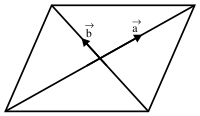
View full question & answer→MCQ 2461 Mark
Let $ABC$ be a triangle such that $\overrightarrow{ BC }=\overrightarrow{ a }, \overrightarrow{ CA }=\overrightarrow{ b }$, $\overrightarrow{ AB }=\overrightarrow{ c },|\overrightarrow{ a }|=6 \sqrt{2}, \quad|\overrightarrow{ b }|=2 \sqrt{3}$ and $\overrightarrow{ b } \cdot \overrightarrow{ c }=12$ Consider the statements.
$( S 1):|(\overrightarrow{ a } \times \overrightarrow{ b })+(\overrightarrow{ c } \times \overrightarrow{ b })|-|\overrightarrow{ c }|=6(2 \sqrt{2}-1)$
$( S 2): \angle ABC =\cos ^{-1}\left(\sqrt{\frac{2}{3}}\right)$. Then
AnswerCorrect option: C. only $(S 2)$ is true
c
$\overrightarrow{ a }+\overrightarrow{ b }+\overrightarrow{ c }=0$
$\overrightarrow{ b }+\overrightarrow{ c }=-\overrightarrow{ a }$
$|\overrightarrow{ b }|^{2}+|\overrightarrow{ c }|^{2}+2 \overrightarrow{ b } \cdot \overrightarrow{ c }=|\overrightarrow{ a }|^{2}$
$|\overrightarrow{ c }|^{2}=36$
$|\overrightarrow{ c }|=6$
$S 1:|\overrightarrow{ a } \times \overrightarrow{ b }+\overrightarrow{ c } \times \overrightarrow{ b }|-|\overrightarrow{ c }|$
$|(\overrightarrow{ a }+\overrightarrow{ c }) \times \overrightarrow{ b }|-|\overrightarrow{ c }|$
$|-\overrightarrow{ b } \times \overrightarrow{ b }|-|\overrightarrow{ c }|$
$0-6=-6$
$S 2: \overrightarrow{ a }+\overrightarrow{ b }+\overrightarrow{ c }=0$
$\overrightarrow{ b }+\overrightarrow{ c }=-\overrightarrow{ a }$
$|\overrightarrow{ a }|^{2}+|\overrightarrow{ b }|^{2}-2|\overrightarrow{ a }||\overrightarrow{ b }| \cos (\angle ACB )=|\overrightarrow{ c }|^{2}$
$\cos (\angle ACB )=\sqrt{\frac{2}{3}}$
View full question & answer→MCQ 2471 Mark
A vector $\vec{a}$ is parallel to the line of intersection of the plane determined by the vectors $\hat{i}, \hat{i}+\hat{j}$ and the plane determined by the vectors $\hat{i}-\hat{j}, \hat{i}+\hat{k}$. The obtuse angle between $\vec{a}$ and the vector $\vec{b}=\hat{i}-2 \hat{j}+2 \hat{k}$ is
- ✓
$\frac{3 \pi}{4}$
- B
$\frac{2 \pi}{3}$
- C
$\frac{4 \pi}{5}$
- D
$\frac{5 \pi}{6}$
AnswerCorrect option: A. $\frac{3 \pi}{4}$
a
$\vec{n}_{1}=\hat{ i } \times(\hat{ i }+\hat{ j })=\hat{ k }$
$\overrightarrow{ n }_{2}=(\hat{ i }+\hat{ k }) \times(\hat{ i }-\hat{ j })$
$=\hat{ i }+\hat{ j }-\hat{ k }$
Line of intersection along $\overrightarrow{ n }_{1} \times \overrightarrow{ n }_{2}$
$=\hat{ k } \times(\hat{ i }+\hat{ j }-\hat{ k })=-\hat{ i }+\hat{ j }$
D.R of $\vec{a}=-\hat{i}+\hat{j}$
D.R of $\vec{b}=\hat{i}-2 \hat{j}+2 \hat{k}$
$\vec{a} \cdot \vec{b}=-3$ and $(\vec{a} \wedge \vec{b})=\theta$
$\cos \theta=\frac{-3}{\sqrt{2} \times 3}$
$\theta=\frac{3 \pi}{4}$
View full question & answer→MCQ 2481 Mark
Let $\hat{a}$ and $\hat{b}$ be two unit vectors such that $|(\hat{ a }+\hat{ b })+2(\hat{ a } \times \hat{ b })|=2$. If $\theta \in(0, \pi)$ is the angle between $\hat{a}$ અને $\hat{b}$, then among the statements :
$( S_{1})$: $2|\hat{ a } \times \hat{ b }|=|\hat{ a }-\hat{ b }|$
$(S_{2})$ : The projection of $\hat{a}$ on $(\hat{a}+\hat{b})$ is $\frac{1}{2}$
AnswerCorrect option: C. Both $(S_{1})$ and $(S_{2})$ are true
c
$|(\hat{a}+\hat{b})+2(\hat{a} \times \hat{b})|=2, \theta \in(0, \pi)$
$((\hat{a}+\hat{b})+2(\hat{a} \times \hat{b})) \cdot((\hat{a}+\hat{b})+2(\hat{a} \times \hat{b}))=4$
$|\hat{a}+\hat{b}|^{2}+4|(\hat{a} \times \hat{b})|^{2}+0=4$
Let the angle be $\theta$ between $\hat{a}$ and $\hat{b}$
$2+2 \cos \theta+4 \sin ^{2} \theta=4$
$2+2 \cos \theta-4 \cos ^{2} \theta=0$
Let $\cos \theta= t$ then
$2 t ^{2}- t -1=0$
$2 t ^{2}-2 t + t -1=0$
$2 t ( t -1)+( t -1)=0$
$(2 t +1)( t -1)=0$
$t =-\frac{1}{2} \quad \text { or } \quad t =1$
$\cos \theta=-\frac{1}{2}$
$\theta=\frac{2 \pi}{3}$
not possible as $\theta \in(0, \pi)$
$S_{1} \quad 2|\vec{a} \times \vec{b}|=2 \sin \left(\frac{2 \pi}{3}\right)$
$|\hat{a}-\hat{b}| =\sqrt{1+1-2 \cos \left(\frac{2 \pi}{3}\right)}$
$=\sqrt{2-2 \times\left(-\frac{1}{2}\right)}$
$=\sqrt{3}$
$S_{1}$ is correct.
$S_{2}$ projection of $\hat{a}$ on $(\hat{a}+\hat{b})$.
$\frac{\hat{a} .(\hat{a}+\hat{b})}{|\hat{a}+\hat{b}|}=\frac{1+\cos \left(\frac{2 \pi}{3}\right)}{\sqrt{2+2 \cos \frac{2 \pi}{3}}}$
$=\frac{1-\frac{1}{2}}{\sqrt{1}}$
$=\frac{1}{2}$
View full question & answer→MCQ 2491 Mark
Let $\overrightarrow{ a }=\alpha \hat{ i }+2 \hat{ j }-\hat{ k }$ and $\overrightarrow{ b }=-2 \hat{ i }+\alpha \hat{ j }+\hat{ k }$, where $\alpha \in R$. If the area of the parallelogram whose adjacent sides are represented by the vectors $\vec{a}$ and $\vec{b}$ is $\sqrt{15\left(\alpha^{2}+4\right)}$, then the value of $2|\vec{a}|^{2}+(\vec{a} \cdot \vec{b})|\vec{b}|^{2}$ is equal to
Answerd
$\overrightarrow{ a }=\alpha \hat{ i }+2 \hat{ j }-\hat{ k }, \overrightarrow{ b }=-2$ $\hat{ i }+\alpha \hat{ j }+\hat{ k }$
area of parallelogram $=|\hat{a} \times \hat{b}|$
$|\hat{a} \times \hat{b}|=\sqrt{(\alpha+2)^{2}+(\alpha-2)^{2}+\left(\alpha^{2}+4\right)^{2}}$
Given $|\hat{a} \times \hat{b}|=\sqrt{15\left(\alpha^{2}+4\right)}$
$2\left(\alpha^{2}+4\right)+\left(\alpha^{2}+4\right)^{2}=15\left(\alpha^{2}+4\right)$
$\left(\alpha^{2}+4\right)^{2}=13\left(\alpha^{2}+4\right)$
$\Rightarrow \alpha^{2}+4=13 \therefore \alpha^{2}=9$
$2|\vec{a}|^{2}+(\vec{a} \cdot \vec{b})|\vec{b}|^{2}$
$|\vec{a}|^{2}=\alpha^{2}+4+1=\alpha^{2}+5$
$|\vec{b}|^{2}=4+\alpha^{2}+1=\alpha^{2}+5$
$\vec{a} \cdot \vec{b}=-2 \alpha+2 \alpha-1=-1$
$\therefore 2|\vec{a}|^{2}+(\vec{a} \cdot \vec{b})|\vec{b}|^{2}$
$2\left(\alpha^{2}+5\right)-1\left(\alpha^{2}+5\right)=\alpha^{2}+5=14$
View full question & answer→MCQ 2501 Mark
Let $\overrightarrow{ a }, \overrightarrow{ b }, \overrightarrow{ c }$ be three coplanar concurrent vectors such that angles between any two of them is same. If the product of their magnitudes is $14$ and $(\vec{a} \times \vec{b}) \cdot(\vec{b} \times \vec{c})+(\vec{b} \times \vec{c}) \cdot(\vec{c} \times \vec{a})+(\vec{c} \times \vec{a}) \cdot(\vec{a} \times \vec{b})=168$ then $|\vec{a}|+|\vec{b}|+|\vec{c}|$ is equal to.
Answerc
$|\vec{a}\|\vec{b}\| \vec{c}|=14$
$\overrightarrow{ a }^{\wedge} \overrightarrow{ b }=\overrightarrow{ b } \wedge \overrightarrow{ c }=\overrightarrow{ c }^{\wedge} \overrightarrow{ a }=\theta=\frac{2 \pi}{3}$
So, $\vec{a} \cdot \vec{b}=-\frac{1}{2} a b, \vec{b} \cdot \vec{c}=-\frac{1}{2} b c, \vec{a} \cdot \vec{c} .=-\frac{1}{2} a c$ (let)
$(\vec{a} \times \vec{b}) \cdot(\vec{b} \times \vec{c})=(\vec{a} \cdot \vec{b})(\vec{b} \cdot \vec{c})-(\vec{a} \cdot \vec{c})(\vec{b} \cdot \vec{b})$
$=\frac{1}{4} a b^{2} c+\frac{1}{2} a b^{2} c=\frac{3}{4} a b^{2} c$
Similarly
$(\overrightarrow{ b } \times \overrightarrow{ c }) \cdot(\overrightarrow{ c } \times \overrightarrow{ a })=\frac{3}{4} abc ^{2}$
$(\vec{c} \times \vec{a}) \cdot(\vec{a} \times \vec{b})=\frac{3}{4} a^{2} b c$
$168=\frac{3}{4} a b c(a+b+c)$
So, $(a+b+c)=16$
View full question & answer→