MCQ 11 Mark
A vector $r $ is equally inclined with the co-ordinate axes. If the tip of $ r $ is in the positive octant and $ |r| = 6,$ then $r$ is
AnswerCorrect option: D. $2\sqrt 3 (i + j + k)$
d
(d) Let $l,m,n$ be the $d.c's $ of $r.$ Then $l = m = n$, (given)
${l^2} + {m^2} + {n^2} = 1 \Rightarrow 3{l^2} = 1 \Rightarrow l = \frac{1}{{\sqrt 3 }} = m = n$
Now, $r = |r|(li + mj + nk) = 6\left( {\frac{1}{{\sqrt 3 }}i + \frac{1}{{\sqrt 3 }}j + \frac{1}{{\sqrt 3 }}k} \right)$
Hence,$r = 2\sqrt 3 (i + j + k)$.
View full question & answer→MCQ 21 Mark
Direction ratios of the normal to the plane passing through the points $(0, 1, 1), (1, 1, 2)$ and $(-1, 2, -2)$ are
- A
$(1, 1, 1)$
- B
$(2, 1, -1)$
- C
$(1, 2, -1)$
- ✓
$(1, -2, -1)$
AnswerCorrect option: D. $(1, -2, -1)$
d
(d) $l\,(1) + m(0) + n(2 - 1) = 0\,\, $
$\Rightarrow \,\,l + n = 0$
and $l\,( - 2) + m(1) + n( - 4) = 0\,\,\,\, $
$\Rightarrow \,\,\,2l - m + 4n = 0$
$\therefore \,\,\,l = - \frac{m}{2} = - \,n$.
Hence direction ratios are $(1,\,\, - 2,\,\, - 1)$.
View full question & answer→MCQ 31 Mark
A line makes angles $\alpha ,\beta ,\gamma $ with the co-ordinate axes. If $\alpha + \beta = {90^o}$, then $\gamma = $ ......... $^o$
Answerb
(b) Here, ${\cos ^2}\alpha + {\cos ^2}(90 - \alpha ) + {\cos ^2}\gamma = 1$
==> ${\cos ^2}\alpha + {\sin ^2}\alpha + {\cos ^2}\gamma = 1$
==> ${\cos ^2}\gamma + 1 = 1\,\, $
$\Rightarrow \,\,\gamma = {90^o}$.
View full question & answer→MCQ 41 Mark
If the sum of the squares of the distance of a point from the three co-ordinate axes be $36$,then its distance from the origin is
- A
$6$
- ✓
$3\sqrt 2 $
- C
$2\sqrt 3 $
- D
AnswerCorrect option: B. $3\sqrt 2 $
b
(b) Let $P\,(x,\,y,\,z).$ Now under given condition, we get
${\left[ {\sqrt {({x^2} + {y^2})} } \right]^2} + {\left[ {\sqrt {({y^2} + {z^2})} } \right]^2} + {\left[ {\sqrt {({z^2} + {x^2})} } \right]^2} = 36$
$ \Rightarrow \,\,{x^2} + {y^2} + {z^2} = 18$
Then distance from origin to the point $(x, y, z)$ is
$\sqrt {{x^2} + {y^2} + {z^2}} = \sqrt {18} = 3\sqrt 2 $.
View full question & answer→MCQ 51 Mark
If $x$ co-ordinates of a point $P$ of line joining the points $Q(2,\,2,\,1)$ and $R\,(5,\,2, - 2)$ is $4$, then the $z$ - coordinates of $P$ is
Answerb
(b) Suppose $P$ divides $QR$ in the ratio $\lambda :1$.
Then co-ordinates of $P$ are $\left( {\frac{{5\lambda + 2}}{{\lambda + 1}},\,\frac{{\lambda + 2}}{{\lambda + 1}},\,\frac{{ - 2\lambda + 1}}{{\lambda + 1}}} \right)$.
It is given that the $x$ - coordinate of $P$ is $4$.
i.e.,$\frac{{5\lambda + 2}}{{\lambda + 1}} = 4$
==> $\lambda = 2$
So, $z$-coordinate of $P$ is $\frac{{ - 2\lambda + 1}}{{\lambda + 1}} = \frac{{ - 4 + 1}}{{2 + 1}} = - 1$.
View full question & answer→MCQ 61 Mark
If $P(3,\,4,\,5),$ $Q(4,\,6,\,3),$ $R( - 1,\,2,\,4),$ $S(1,\,0,\,5)$ then the projection of $RS$ on $PQ$ is
AnswerCorrect option: B. $-4/3$
b
(b) Here, ${x_2} - {x_{`1}} = 2,\,{y_2} - {y_1} = - 2,\,{z_2} - {z_1} = 1$
Now, $l, m, n$ for $PQ$ are $\frac{1}{3},\frac{2}{3},\,\frac{{ - 2}}{3}$
$\therefore $ Projection of $RS$ on $PQ$ = $\sum l({x_2} - {x_1})$
= $\frac{2}{3} - \frac{4}{3} - \frac{2}{3} = \frac{{ - 4}}{3}$.
View full question & answer→MCQ 71 Mark
If $\theta $ is the angle between the lines $AB$ and $CD$, then projection of line segment $AB$ on line $CD$, is
- A
$AB\sin \theta $
- ✓
$AB\cos \theta $
- C
$AB\tan \theta $
- D
$CD\cos \theta $
AnswerCorrect option: B. $AB\cos \theta $
b
(b) It is a fundamental concept.
View full question & answer→MCQ 81 Mark
The co-ordinates of points $A,B,C,D$ are $(a, 2, 1), (1, -1, 1), (2, -3, 4)$ and $(a+1, a+2, a+3)$ respectively. If $AB = 5$ and $CD = 6$, then $a = $
Answerd
(d) $AB = \sqrt {{{(a - 1)}^2} + {3^2} + 0} = 5$
$ \Rightarrow \,\,a - 1 = \pm \,4$
$ \Rightarrow \,\,a = - 3,\,\,5$
$CD = \sqrt {{{(a - 1)}^2} + {{(a + 5)}^2} + {{(a - 1)}^2}} = 6$
$ \Rightarrow \,\,{a^2} - 2a - 15 = 0\,\, $
$\Rightarrow \,\,a = - 3,\,\,5$
But common solution of $(i)$ and $(ii)$ is $-3.$
View full question & answer→MCQ 91 Mark
If the co-ordinates of the points $A,B,C$ be $( - 1,\,3,\,2),\,\,(2,\,3,\,5)$ and $(3, 5,-2) $ respectively, then $\angle A = $ ..…… $^o$
Answerd
(d) Equation of $AB$ is $\frac{{x + 1}}{3} = \frac{{y - 3}}{0} = \frac{{z - 2}}{3}$ …..$(i)$
and that of $AC$ is $\frac{{x + 1}}{4} = \frac{{y - 3}}{2} = \frac{{z - 2}}{{ - 4}}$ .....$(ii)$
Hence $\angle A = {\cos ^{ - 1}}\left( {\frac{{12 + 0 - 12}}{{\sqrt {9 + 9} \sqrt {16 + 4 + 16} }}} \right) = {90^o}$.
View full question & answer→MCQ 101 Mark
The point of intersection of lines $\frac{{x - 4}}{5} = $ $\frac{{y - 1}}{2} = \frac{z}{1}$ and $\frac{{x - 1}}{2} = \frac{{y - 2}}{3} = \frac{{z - 3}}{4}$ is
- ✓
$(-1, -1, -1)$
- B
$(-1, -1, 1)$
- C
$(1, -1, -1)$
- D
$(-1, 1, -1)$
AnswerCorrect option: A. $(-1, -1, -1)$
a
(a)Trick : Both lines are satisfied by $(-1,-1, -1).$
View full question & answer→MCQ 111 Mark
Direction ratios of the line represented by the equation $x = ay + b,$ $z = cy + d$ are
- ✓
$(a, 1, c)$
- B
$(a, b -d, c)$
- C
$(c, 1, a)$
- D
$(b, ac, d)$
AnswerCorrect option: A. $(a, 1, c)$
a
(a) $x - ay - b = 0$ and $cy - z + d = 0$
$\therefore \,$ If $l, m, n$ are direction cosines,
then $\frac{l}{a} = \frac{m}{1} = \frac{n}{c}$.
Hence direction ratios are $(a, 1, c).$
View full question & answer→MCQ 121 Mark
The direction cosines of a line segment $AB$ are $ - 2/\sqrt {17} ,$ $3/\sqrt {17} ,\,\, - 2/\sqrt {17} .$ If $AB = \sqrt {17} $ and the co-ordinates of $A$ are $(3, -6, 10)$, then the co-ordinates of $B$ are
- A
$(1, -2, 4)$
- B
$(2,5,8)$
- C
$(-1, 3, -8)$
- ✓
$(1, -3, 8)$
AnswerCorrect option: D. $(1, -3, 8)$
d
(d) $x = 3 \pm \left( {\frac{{ - 2}}{{\sqrt {17} }}} \right)\,(\sqrt {17} ),\,\,\,$
$y = - \,6 \pm \left( {\frac{3}{{\sqrt {17} }}} \right)\,(\sqrt {17} )$
and $z = 10 \pm \,\left( {\frac{{ - 2}}{{\sqrt {17} }}} \right)\,\,\,(\sqrt {17} )$.
Hence the required co-ordinates are $(1,\, - 3,\,\,8)$ or $(5,\,\, - 9,\,\,12)$.
View full question & answer→MCQ 131 Mark
If centroid of the tetrahedron $OABC$, where $A,B,C$are given by $(a, 2, 3),(1, b, 2)$ and $(2, 1, c)$ respectively be $(1, 2, -1)$, then distance of $P(a,b,c)$ from origin is equal to
- ✓
$\sqrt {107} $
- B
$\sqrt {14} $
- C
$\sqrt {107/14} $
- D
AnswerCorrect option: A. $\sqrt {107} $
a
(a) Centroid$ \equiv $ $\left( {\frac{{\sum x}}{4},\,\frac{{\sum y}}{4},\frac{{\sum z}}{4}\,} \right)= (1, 2, -1)$
$ \Rightarrow \,\,a = 1,\,\,b = 5,\,\,c = - 9$;
$\therefore \,\,\sqrt {{a^2} + {b^2} + {c^2}} = \sqrt {107} $.
View full question & answer→MCQ 141 Mark
If $P \equiv (0,\,1,\,0),Q \equiv (0,\,0,\,1)$, then projection of $PQ$ on the plane $x + y + z = 3 $ is
- A
$\sqrt 3 $
- B
$3$
- ✓
$\sqrt 2 $
- D
$2$
AnswerCorrect option: C. $\sqrt 2 $
c
(c) Given plane is $x + y + z - 3 = 0$.
From point $P$ and $Q$ draw $PM$ and $QN$ perpendicular on the given plane and $QR \perp MP.$
$|MP|\, = \frac{{0 + 1 + 0 - 3}}{{\sqrt {{1^2} + {1^2} + {1^2}} }} = \frac{{ - 2}}{{\sqrt 3 }}$, $|NQ|\, = \frac{{ - 2}}{{\sqrt 3 }}$
$|PQ|\, = \sqrt {{{(0 - 0)}^2} + {{(0 - 1)}^2} + {{(1 - 0)}^2}} = \sqrt 2 $
$|RP| = |MP| - |MR|\, = \,|MP| - |NQ| = 0$
$|NM|\, = \,|QR|\, = \sqrt {P{Q^2} - R{P^2}} = \sqrt {{{(\sqrt 2 )}^2} - 0} $$ = \,\sqrt 2 .$
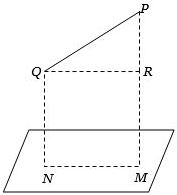
View full question & answer→MCQ 151 Mark
The co-ordinates of the foot of perpendicular drawn from point $P(1,0,3)$ to the join of points $A(4,7,1)$ and $B(3,5,3)$ is
- A
$(5, 7, 1)$
- ✓
$\left( {\frac{5}{3},\frac{7}{3},\frac{{17}}{3}} \right)$
- C
$\left( {\frac{2}{3},\frac{5}{3},\frac{7}{3}} \right)$
- D
$\left( {\frac{5}{3},\frac{2}{3},\frac{7}{3}} \right)$
AnswerCorrect option: B. $\left( {\frac{5}{3},\frac{7}{3},\frac{{17}}{3}} \right)$
b
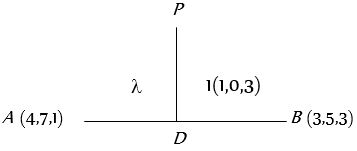
(b) Let $D$ be the foot of perpendicular drawn from $P(1,0,3)$ on the line $AB$ joining $(4, 7, 1)$ and $(3, 5, 3)$.
If $D$ divides $AB$ in ratio $\lambda :1$ then $D = \left( {\frac{{3\lambda + 4}}{{\lambda + 1}},\,\frac{{5\lambda + 7}}{{\lambda + 1}},\,\frac{{3\lambda + 1}}{{\lambda + 1}}} \right).....(i)$
$D.r’s$ of $PD$ are $2\lambda + 3,\,5\lambda + 7,\, - 2$
$D.r’s$ of $AB$ are $ - 1,\, - 2,\,2$
$PD\, \bot \,AB$; $ - (2\lambda + 3) - 2(5\lambda + 7) - 4 = 0$
==> $\lambda = \frac{{ - 7}}{4}$
Putting the value of $\lambda $ in $(i)$,
we get the point $D\left( {\frac{5}{3},\,\frac{7}{3},\,\frac{{17}}{3}} \right)$.
View full question & answer→MCQ 161 Mark
The direction ratios of the diagonals of a cube which joins the origin to the opposite corner are (when the $3$ concurrent edges of the cube are co-ordinate axes)
AnswerCorrect option: B. $1, 1, 1$
b
(b) Direction ratio of the diagonal of the line joining the origin to the opposite corner are $a - 0,\,a - 0,\,a - 0$ i.e., $1, 1, 1.$
View full question & answer→MCQ 171 Mark
The direction ratios of the lines $OA$ and $OB$ are $1, -2, -1$ and $3, -2, 3$. Then the direction cosines of the normal of plane $AOB$ where $O$ is the origin, are
- ✓
$\left( {\frac{4}{{\sqrt {29} }},\frac{3}{{\sqrt {29} }},\frac{{ - 2}}{{\sqrt {29} }}} \right)$
- B
$\left( {\frac{2}{{\sqrt {29} }}, - \frac{3}{{\sqrt {29} }},\frac{4}{{\sqrt {29} }}} \right)$
- C
$\left( { - \frac{4}{{\sqrt {29} }},\frac{2}{{\sqrt {29} }},\frac{3}{{\sqrt {29} }}} \right)$
- D
$\left( {\frac{4}{{\sqrt {29} }},\frac{2}{{\sqrt {29} }},\frac{{ - 3}}{{\sqrt {29} }}} \right)$
AnswerCorrect option: A. $\left( {\frac{4}{{\sqrt {29} }},\frac{3}{{\sqrt {29} }},\frac{{ - 2}}{{\sqrt {29} }}} \right)$
a
(a) Equation of a plane passing through origin is $ax + by + cz = 0,$ but it also passes through $(1, -2, -1)$ and $(3,-2,3)$, therefore $a - 2b - c = 0$ and $3a - 2b + 3c = 0$.
$ \Rightarrow \,\,a = - 2c$ and $b = - \frac{{3c}}{2}$
$\therefore \,\,$Plane is $ - 2cx - \frac{{3c}}{2}y + cz = 0\, \Rightarrow \,\,4x + 3y - 2z = 0.$
Hence direction cosines of plane are $\left( {\frac{4}{{\sqrt {29} }},\frac{3}{{\sqrt {29} }},\frac{{ - 2}}{{\sqrt {29} }}} \right)$
View full question & answer→MCQ 181 Mark
The position vector of a point at a distance of $3\sqrt {11} $ units from $i - j + 2k$ on a line passing through the points $i - j + 2k$ and $3i + j + k$ is
- A
$10i + 2j - 5k$
- ✓
$ - 8i - 4j - k$
- C
$8i + 4j + k$
- D
$ - 10i - 2j - 5k$
AnswerCorrect option: B. $ - 8i - 4j - k$
b
(b) The equation of a line passing through the points $A(i - j + 2k)$ and $B(3i + j + k)$ is
$r = (i - j + 2k) + \lambda (3i + j + k)$
The position vector of any point $P $ which is a variable point on the line, is $(i - j + 2k) + \lambda (3i + j + k)$
$\therefore \overrightarrow {AP} = \lambda (3i + j + k) \Rightarrow |\overrightarrow {AP} | = \lambda \sqrt {11} $
Now, if $\lambda $ $\sqrt {11} = 3\sqrt {11} $ i.e., $\lambda = 3$ then the position vector of the point $P$ is $10i + 2j + 5k$.
If $\lambda \sqrt {11} = - 3\sqrt {11} ,$ i.e., $\lambda = - 3$ then the position vector of the point $P$ is $ - 8i - 4j - k$.
View full question & answer→MCQ 191 Mark
The line through $i + 3j + 2k$ and perpendicular to the lines $r = (i + 2j - k) + \lambda (2i + j + k)$ and $r = (2i + 6j + k) + \mu (i + 2j + 3k)$ is
- A
$r = (i + 2j - k) + \lambda ( - i + 5j - 3k)$
- B
$r = i + 3j + 2k + \lambda (i - 5j + 3k)$
- C
$r = i + 3j + 2k + \lambda (i + 5j + 3k)$
- ✓
$r = i + 3j + 2k + \lambda ( - i + 5j - 3k)$
AnswerCorrect option: D. $r = i + 3j + 2k + \lambda ( - i + 5j - 3k)$
d
(d) The required line passes through the point $i + 3j + 2k$ and is perpendicular to the lines
$r = (i + 2j - k) + \lambda (2i + j + k)$
and $r = (2i + 6j + k) + \mu (i + 2j + 3k)$,
therefore it is parallel to the vector
$b = (2i + j + k) \times (i + 2j + 3k)$= $(i - 5j + 3k)$
Hence, the equation of the required line is
$r = (i + 3j + 2k) + \lambda '(i - 5j + 3k)$
==> $r = (i + 3j + 2k) + \lambda ( - i + 5j - 3k)$,
where $\lambda = - \lambda '$.
View full question & answer→MCQ 201 Mark
The distance between the planes given by $r.(i + 2j - 2k) + 5 = 0$ and $r.(i + 2j - 2k) - 8 = 0$ is
- A
$1 $ unit
- ✓
$\frac{{13}}{3}$ unit
- C
$13 $ unit
- D
AnswerCorrect option: B. $\frac{{13}}{3}$ unit
b
(b) The two planes are on the opposite side of the origin.
Therefore, if ${p_1}$ and ${p_2}$ are the lengths of the perpendicular from the origin to the planes $r.(i + 2j - 2k) + 5 = 0$ and $r.(i + 2j - 2k) - 8 = 0$ respectively,
then the required distance is given by ${p_1} + {p_2} = \frac{5}{3} + \frac{8}{3} = \frac{{13}}{3}$unit.
View full question & answer→MCQ 211 Mark
The shortest distance between the lines $r = (3i - 2j - 2k) + it$ and $r = i - j + 2k + js$ ($t$ and $s$ being parameters) is
- A
$\sqrt {21} $
- B
$\sqrt {102} $
- ✓
$4$
- D
$3$
Answerc
(c) The given lines are $r = {a_1} + \lambda {b_1},r = {a_2} + \mu {b_2}$,
where ${a_1} = 3i - 2j - 2k,\,\,\,{b_1} = i$
${a_2} = i - j + 2k,\,\,\,\,\,{b_2} = j$
$|{b_1} \times {b_2}|\, = \,|i \times j|\, = \,|k| = 1$
Now, $[({a_2} - {a_1})\;{b_1}\;{b_2}] = ({a_2} - {a_1}).({b_1} \times {b_2})$
$ = ( - 2i + j + 4k)(k) = 4$
Shortest distance $ = \frac{{[({a_2} - {a_1})({b_1} - {b_2})]}}{{|{b_1} \times {b_2}|}} = \frac{4}{1} = 4$.
View full question & answer→MCQ 221 Mark
The shortest distance between the lines ${r_1} = 4i - 3j - k + \lambda (i - 4j + 7k)$ and ${r_2} = i - j - 10k + \lambda (2i - 3j + 8k)$ is
Answerd
(d) The Given lines are ${r_1} = {a_1} + \lambda \,{b_1},\,\,\,\,{r_2} = {a_2} + \mu {b_2}$
Where ${a_1} = 4i - 3j - k;\,\,\,\,{b_1} = i - 4j + 7k$
${a_2} = i - j - 10k;\,\,\,\,{b_2} = 2i - 3j + 8k$
$|{b_1} \times {b_2}| = \left| {\begin{array}{*{20}{c}}i&j&k\\1&{ - 4}&7\\2&{ - 3}&8\end{array}} \right| = - 11i + 6j + 5k$
Now $[({a_2} - {a_1})\,\,{b_1}\,\,{b_2}] = ({a_2} - {a_1}).({b_1} \times {b_2})$
$ = ( - 3i + 2j - 9k)( - 11i + 6j + 5k) = 0$
Therefore, shortest distance $ = \frac{{[({a_2} - {a_1})\,\,{b_1}\,\,{b_2}]}}{{|{b_1} \times {b_2}|}} = 0$.
View full question & answer→MCQ 231 Mark
The symmetric equation of lines $3x + 2y + z - 5 = 0$ and $x + y - 2z - 3 = 0$, is
- A
$\frac{{x - 1}}{5} = \frac{{y - 4}}{7} = \frac{{z - 0}}{1}$
- B
$\frac{{x + 1}}{5} = \frac{{y + 4}}{7} = \frac{{z - 0}}{1}$
- ✓
$\frac{{x + 1}}{{ - 5}} = \frac{{y - 4}}{7} = \frac{{z - 0}}{1}$
- D
$\frac{{x - 1}}{{ - 5}} = \frac{{y - 4}}{7} = \frac{{z - 0}}{1}$
AnswerCorrect option: C. $\frac{{x + 1}}{{ - 5}} = \frac{{y - 4}}{7} = \frac{{z - 0}}{1}$
c
(c) Let $a, b, c$ be the $ d.r.'s $ of required line
$\therefore $ $3a + 2b + c = 0$ and $a + b - 2c = 0$
$\frac{a}{{ - 4 - 1}} = \frac{b}{{1 + 6}} = \frac{c}{{3 - 2}}$ or $\frac{a}{{ - 5}} = \frac{b}{7} = \frac{c}{1}$
In order to find a point on the required line we put $z = 0$ in the two given equation to obtain, $3x + 2y = 5$ and $x + y = 3$.
Solving these two equations, we obtain $x = - 1,\,y = 4$.
$\therefore $ Co-ordinates of point on required line are $( - 1,\,4,\,0)$.
Hence required line is$\frac{{x + 1}}{{ - 5}} = \frac{{y - 4}}{7} = \frac{{z - 0}}{1}$.
View full question & answer→MCQ 241 Mark
The acute angle between the line joining the points $(2,1,-3), (-3,1,7)$ and a line parallel to $\frac{{x - 1}}{3} = $ $\frac{y}{4} = \frac{{z + 3}}{5}$ through the point $(-1, 0, 4)$ is
- ✓
${\cos ^{ - 1}}\left( {\frac{7}{{5\sqrt {10} }}} \right)$
- B
${\cos ^{ - 1}}\left( {\frac{1}{{\sqrt {10} }}} \right)$
- C
${\cos ^{ - 1}}\left( {\frac{3}{{5\sqrt {10} }}} \right)$
- D
${\cos ^{ - 1}}\left( {\frac{1}{{5\sqrt {10} }}} \right)$
AnswerCorrect option: A. ${\cos ^{ - 1}}\left( {\frac{7}{{5\sqrt {10} }}} \right)$
a
(a) Direction ratio of the line joining the point $(2,\,\,1,\,\, - 3),\,$ $\,( - \,3,\,\,1,\,\,7)$ are $({a_1},\,\,{b_1},\,\,{c_1})\,$
$\, \Rightarrow \,\,( - \,3 - 2,\,\,1 - 1,\,\,7 - ( - 3))\,\, $
$\Rightarrow \,\,( - \,5,\,\,0,\,\,10)$
Direction ratio of the line parallel to line $\frac{{x - 1}}{3} = \frac{y}{4} = \frac{{z + 3}}{5}$ are $({a_2},\,{b_2},\,\,{c_2})\,\, $
$\Rightarrow \,\,(3,\,\,4,\,\,5)$
Angle between two lines,
$\cos \theta = \frac{{{a_1}{a_2} + {b_1}{b_2} + {c_1}{c_2}}}{{\sqrt {a_1^2 + b_1^2 + c_1^2} \sqrt {a_2^2 + b_2^2 + c_2^2} }}$
$\cos \theta = \frac{{( - \,5 \times 3) + (0 \times 4) + (10 \times 5)}}{{\sqrt {25 + 0 + 100} \sqrt {9 + 16 + 25} }}$
$\cos \theta = \frac{{35}}{{25\sqrt {10} }}\,\, $
$\Rightarrow \,\,\theta = {\cos ^{ - 1}}\left( {\frac{7}{{5\sqrt {10} }}} \right)$.
View full question & answer→MCQ 251 Mark
The point of intersection of the lines $\frac{{x - 5}}{3} = \frac{{y - 7}}{{ - 1}} = \frac{{z + 2}}{1},$ $\frac{{x + 3}}{{ - 36}} = \frac{{y - 3}}{2} = \frac{{z - 6}}{4}$ is
AnswerCorrect option: A. $21,\,\frac{5}{3},\frac{{10}}{3}$
a
(a) Given lines are,
$\frac{{x - 5}}{3} = \frac{{y - 7}}{{ - 1}} = \frac{{z + 2}}{1} = {r_1}$, (say)
and $\frac{{x + 3}}{{ - 36}} = \frac{{y - 3}}{2} = \frac{{z - 6}}{4} = {r_2}$, (say)
$\therefore $$x = 3{r_1} + 5 = - 36{r_2} - 3$, $y = - {r_1} + 7 = 3 + 2{r_2}$
and $z = {r_1} - 2 = 4{r_2} + 6$
On solving, we get $x = 21,\,y = \frac{5}{3},\,z = \frac{{10}}{3}$.
Trick: Check through options.
View full question & answer→MCQ 261 Mark
The distance of the point $(2, 3, 4)$ from the line $1 - x = \frac{y}{2} = \frac{1}{3}(1 + z)$ is
- A
$\frac{1}{7}\sqrt {35} $
- B
$\frac{4}{7}\sqrt {35} $
- C
$\frac{2}{7}\sqrt {35} $
- ✓
$\frac{3}{7}\sqrt {35} $
AnswerCorrect option: D. $\frac{3}{7}\sqrt {35} $
d
(d) Required distance = $\sqrt {\sum {{({x_1} - {x_2})}^2} - {{[\sum l({x_1} - {x_2})]}^2}} $
$ = \frac{3}{7}\sqrt {35} $.
View full question & answer→MCQ 271 Mark
The equations of the line passing through the point $(1,2,-4)$ and perpendicular to the two lines $\frac{{x - 8}}{3} = \frac{{y + 19}}{{ - 16}} = \frac{{z - 10}}{7}$ and $\frac{{x - 15}}{3} = \frac{{y - 29}}{8} = \frac{{z - 5}}{{ - 5}}$, will be
- ✓
$\frac{{x - 1}}{2} = \frac{{y - 2}}{3} = \frac{{z + 4}}{6}$
- B
$\frac{{x - 1}}{{ - 2}} = \frac{{y - 2}}{3} = \frac{{z + 4}}{8}$
- C
$\frac{{x - 1}}{2} = \frac{{y - 2}}{3} = \frac{{z + 4}}{6}$
- D
AnswerCorrect option: A. $\frac{{x - 1}}{2} = \frac{{y - 2}}{3} = \frac{{z + 4}}{6}$
a
(a) Line passing through the point $(1, 2, -4)$ is ,
$\frac{{x - 1}}{l} = \frac{{y - 2}}{m} = \frac{{z + 4}}{n}$
Now, according to question, $3l - 16m + 7n = 0$ and $3l + 8m - 5n = 0$
Hence required line is, $\frac{{x - 1}}{2} = \frac{{y - 2}}{3} = \frac{{z + 4}}{6}$.
View full question & answer→MCQ 281 Mark
Shortest distance between lines $\frac{{x - 6}}{1} = \frac{{y - 2}}{{ - 2}} = \frac{{z - 2}}{2}$ and $\frac{{x + 4}}{3} = \frac{y}{{ - 2}} = \frac{{z + 1}}{{ - 2}}$ is
Answerb
(b) Use formula, $S.D. = \frac{{\left| {\,\begin{array}{*{20}{c}}{10}&2&3\\1&{ - 2}&2\\3&{ - 2}&{ - 2}\end{array}\,} \right|}}{{\sqrt {{8^2} + {8^2} + {4^2}} }} = \frac{{108}}{{12}} = 9$.
View full question & answer→MCQ 291 Mark
The length and foot of the perpendicular from the point $(2, -1, 5)$ to the line $\frac{{x - 11}}{{10}} = \frac{{y + 2}}{{ - 4}} = \frac{{z + 8}}{{ - 11}}$ are
- A
$\sqrt {14} ,(1,\,2, - 3)$
- B
$\sqrt {14} ,(1,\, - 2,\,3)$
- ✓
$\sqrt {14} ,(1,\,2,\,3)$
- D
AnswerCorrect option: C. $\sqrt {14} ,(1,\,2,\,3)$
c
(c) Let co-ordinates of foot of perpendicular are $(a, b, c)$.
Since $\frac{{a - 11}}{{10}} = \frac{{b + 2}}{{ - 4}} = \frac{{c + 8}}{{ - 11}} = k$
Then, $a = 10k + 11,\,\,b = - 4k - 2,\,\,c = - 11k - 8.$
Here all alternates give $a =1$, then $k = -1$. So foot is $(1, 2, 3)$ and perpendicular distance between $(1, 2, 3)$ and $(2, -1, 5)$ is $\sqrt {14} $.
Trick : The foot must satisfy the line, so obviously $(1,2,3)$ satisfies. Now length of perpendicular is distance between the foot and the point i.e. $\sqrt {14} $. But students should remember here that it is not necessary that the line segment joining $(2, -1, 5)$ and $(1, 2, 3)$ is perpendicular to the given line, so they should check. Therefore, direction ratios of the line joining $(2, -1, 5)$ and $(1, 2, 3)$ are $(-1, 3, -2)$ and that of given line are $(10, -4, -11)$.
Hence the lines are perpendicular.
View full question & answer→MCQ 301 Mark
The point of intersection of the lines $\frac{{x + 1}}{3} = \frac{{y + 3}}{5} = \frac{{z + 5}}{7}$ and $\frac{{x - 2}}{1} = \frac{{y - 4}}{3} = \frac{{z - 6}}{5}$is
- A
$\left( {\frac{1}{2},\frac{1}{2}, - \frac{3}{2}} \right)$
- B
$\left( { - \frac{1}{2}, - \frac{1}{2},\frac{3}{2}} \right)$
- ✓
$\left( {\frac{1}{2}, - \frac{1}{2}, - \frac{3}{2}} \right)$
- D
$\left( { - \frac{1}{2},\frac{1}{2},\frac{3}{2}} \right)$
AnswerCorrect option: C. $\left( {\frac{1}{2}, - \frac{1}{2}, - \frac{3}{2}} \right)$
c
(c) Let $\frac{{x + 1}}{3} = \frac{{y + 3}}{5} = \frac{{z + 5}}{7} = \lambda $.....$(i)$
Then $x = 3\lambda - 1$, $y = 5\lambda - 3,\,z = 7\lambda - 5$
General point on this line is $(3\lambda - 1,\,5\lambda - 3,\,7\lambda - 5)$
Again let $\frac{{x - 2}}{1} = \frac{{y - 4}}{3} = \frac{{z - 6}}{5} = \mu $.....$(ii)$
Then $x = \mu + 2,\,y = 3\mu + 4,\,z = 5\mu + 6$
A general point on this line is $(\mu + 2,\,3\mu + 4,\,5\mu + 6)$
For intersection, they have a common point, for some values of $\lambda $ and $\mu $, we must have $bcx + cay - abz = 0$,
$(5\lambda - 3) = (3\mu + 4),\,\,\,\,\,\,(7\lambda - 5) = (5\mu + 6)$
From first two we have, $\mu = 3\lambda - 3$……$(iii)$
and $3\mu = 5\lambda - 7$ …..$(iv)$
From $(iii),$ put the values of $\mu $ in $(iv),$ we have $3(3\lambda - 3) = 5\lambda - 7$
==> $9\lambda - 9 = 5\lambda - 7$ or $4\lambda = 2$ or $\lambda = \frac{1}{2}$
Put $\lambda = \frac{1}{2}$ in $(iii),$ we get $\mu = - \frac{3}{2}$ (Putting $\lambda = \frac{1}{2}$)
The required point of intersection is
$\left[ {\frac{3}{2} - 1} \right],\,\left[ {\frac{5}{2} - 3} \right],\,\left[ {\frac{7}{2} - 5} \right] = \left[ {\frac{1}{2},\, - \frac{1}{2},\, - \frac{3}{2}} \right]$.
View full question & answer→MCQ 311 Mark
The angle between the line $\frac{{x + 1}}{3} = \frac{{y - 1}}{2} = \frac{{z - 2}}{4}$ and the plane $2x + y - 3z + 4 = 0$, is
- A
${\sin ^{ - 1}}\left( {\frac{4}{{\sqrt {406} }}} \right)$
- ✓
${\sin ^{ - 1}}\left( {\frac{{ - 4}}{{\sqrt {406} }}} \right)$
- C
${\sin ^{ - 1}}\left( {\frac{4}{{14\sqrt {229} }}} \right)$
- D
AnswerCorrect option: B. ${\sin ^{ - 1}}\left( {\frac{{ - 4}}{{\sqrt {406} }}} \right)$
b
(b) $\theta = {\sin ^{ - 1}}\left( {\frac{{6 + 2 - 12}}{{\sqrt {14} \,.\,\sqrt {29} }}} \right)\, \Rightarrow \,\,\theta = {\sin ^{ - 1}}\left( {\frac{{ - 4}}{{\sqrt {406} }}} \right)$.
View full question & answer→MCQ 321 Mark
If lines $\frac{{x - 3}}{2} = \frac{{y + 1}}{{ - 3}} = \frac{{z + a}}{p}$ and $\frac{{x + 2}}{2} = \frac{{y - 4}}{4} = \frac{{z + 5}}{2}$ are perpendicular coplanar lines, then value of $a + p$ is
- A
$\frac {3}{5}$
- ✓
$-\frac {2}{7}$
- C
$\frac {4}{7}$
- D
$-\frac {3}{5}$
AnswerCorrect option: B. $-\frac {2}{7}$
b
$\left|\begin{array}{ccc}{5} & {-5} & {5-a} \\ {2} & {-3} & {p} \\ {2} & {4} & {2}\end{array}\right|=0$
$\Rightarrow 60-30 p-14 a=0$ ......$(1)$
Lines are perpendicular
$\therefore 4-12+2 p=0$ .......$(2)$
from $(1)$ and $(2)$
$P=4, a=\frac{-30}{7}$
View full question & answer→MCQ 331 Mark
If the lines $\frac{{x - 1}}{2} = \frac{{y + 1}}{3} = \frac{{z - 1}}{4}\,and\,\frac{{x - 3}}{1} = \frac{{y - k}}{1} = \frac{z}{1}\,$ intersect, then $k =$
- A
$\frac{2}{9}$
- ✓
$\frac{9}{2}$
- C
$0$
- D
AnswerCorrect option: B. $\frac{9}{2}$
b
Any point on $\frac{x-1}{2}=\frac{y+1}{3}=\frac{z-1}{4}=\lambda$ is
$(2 \lambda+1,3 \lambda-1,4 \lambda+1) ; \quad \lambda \in \mathrm{R}$
Any point on $\frac{x-3}{1}=\frac{y-k}{2}=\frac{z}{1}=\mu$ is
$(\mu+3,2 \mu+\mathrm{k}, \mu) ; \mu \in \mathrm{R}$
The given lines intersect if and only if the system of equations (in $\lambda $ and $ \mu$)
${2 \lambda+1=\mu+3} $ ........$(i)$
${3 \lambda-1=2 \mu+k} $ ........$(ii)$
${4 \lambda+1=\mu}$ ..........$(iii)$
has a unique solution.
Solving $(i)$ and $(iii),$ we get $\lambda=\frac{-3}{2}, \mu=-5$
From $(ii),$ we get $\frac{-9}{2}-1=-10+k \Rightarrow k=\frac{9}{2}$
View full question & answer→MCQ 341 Mark
Shortest distance between the lines $\frac{{x - 2}}{3} = \frac{{y - 4}}{4} = \frac{{z - 5}}{5}\,and\,\frac{{x - 1}}{2} = \frac{{y - 2}}{3} = \frac{{z - 3}}{4}$ is equal to -
AnswerCorrect option: C. $\frac{{1}}{{\sqrt 6 }}$
c
$\overrightarrow{\mathrm{a}}: 2 \hat{\mathrm{i}}+4 \hat{\mathrm{j}}+5 \hat{\mathrm{k}} \quad ; \quad \overrightarrow{\mathrm{p}}=3 \hat{\mathrm{i}}+4 \hat{\mathrm{j}}+5 \hat{\mathrm{k}}$
$\overrightarrow {\rm{b}} :\widehat {\rm{i}} + 2\widehat {\rm{j}} + 3\widehat {\rm{k}};\quad \overrightarrow q = 2\widehat {\rm{i}} + 3\widehat {\rm{j}} + 4\widehat {\rm{k}}$
${\rm{SD}} = \left| {\frac{{\left( {\overrightarrow b - \overrightarrow a } \right).\left( {\overrightarrow p \times \overrightarrow q } \right)}}{{\left| {\overrightarrow p \times \overrightarrow q } \right|}}} \right|$
$=\left|\frac{-(\hat{i}+2 \hat{j}+2 \hat{k}) \times(\hat{i}-2 \hat{j}+\hat{k})}{|\hat{i}-2 \hat{j}+\hat{k}|}\right|=\frac{1}{\sqrt{6}}$
View full question & answer→MCQ 351 Mark
The shortest distance between the lines $\frac{{x - 3}}{3} = \frac{{y - 8}}{{ - 1}} = \frac{{z - 3}}{1}\& \frac{{x + 3}}{{ - 3}} = \frac{{y + 7}}{2} = \frac{{z - 6}}{4}$ is
- A
$\sqrt {30}$
- B
$2\sqrt {30}$
- C
$5\sqrt {30}$
- ✓
$3\sqrt {30}$
AnswerCorrect option: D. $3\sqrt {30}$
d
$\vec{n}=\left|\begin{array}{ccc}{\hat{i}} & {\hat{j}} & {\hat{k}} \\ {3} & {-1} & {1} \\ {-3} & {2} & {4}\end{array}\right|=\hat{i}(-6)-\hat{j}(15)+\hat{k}(3)$
$ \Rightarrow \overrightarrow n = \frac{{ - 6\widehat {\rm{i}} - 15\widehat {\rm{j}} + 3\widehat {\rm{k}}}}{{3\sqrt {30} }}$
$A = (3,8,3);B = ( - 3, - 7,6) \Rightarrow \overrightarrow {AB} = - 6\hat i - 15\hat j + 3\hat k$
$\mathrm{SD}=|\overrightarrow{\mathrm{AB}} \hat{\mathrm{n}}|=\frac{1}{3 \sqrt{30}}(36+225+9)=\frac{270}{\sqrt{270}}$
$=3 \sqrt{30}$
View full question & answer→MCQ 361 Mark
Let $A \equiv (\lambda + 2, 1 - 2\lambda , \lambda + 2)$ and $B \equiv (2k + 1, k, k +1)$ and $ \lambda , k \in R.$ Then minimum distance between $A$ and $B$ is -
- A
$0$
- B
$\frac{1}{{\sqrt {35} }}$
- C
$\frac{{\sqrt 3 }}{{\sqrt {35} }}$
- ✓
$\frac{3}{{\sqrt {35} }}$
AnswerCorrect option: D. $\frac{3}{{\sqrt {35} }}$
d
$\overrightarrow{\mathrm{r}}=(-2,-1,-2)+\lambda(1,-2,1)$
$\overrightarrow{\mathrm{r}}=(-1,0,-1)+\mathrm{k}(2,1,1)$
${\rm{S}}.{\rm{D}} = \left| {\frac{{(\hat i + \hat j + \hat k) \cdot (\hat i - 2\hat j + \hat k) \times (2\hat i + \hat j + \hat k)}}{{|(\hat i - 2\hat j + \hat k) \times (2\hat i + \hat j + \hat k)|}}} \right| = \frac{3}{{\sqrt {35} }}$
View full question & answer→MCQ 371 Mark
Shortest dist ance between the lines
${L_1}:\bar r = \hat i + \hat j + \lambda \left( {\hat i + \hat j - \hat k} \right)$
${L_2}:\bar r = \hat j + \hat k + \mu \left( {\hat j + 2\hat k - \hat i} \right)$ equal to
- ✓
$\frac{1}{{\sqrt {14} }}$
- B
$\frac{2}{{\sqrt {14} }}$
- C
$\frac{3}{{\sqrt {14} }}$
- D
$\frac{4}{{\sqrt {14} }}$
AnswerCorrect option: A. $\frac{1}{{\sqrt {14} }}$
a
Distance between the lines
$\mathrm{L}_{1}: \overline{\mathrm{r}}=\overline{\mathrm{a}}+\lambda \overline{\mathrm{b}}$
$\mathrm{L}_{2}: \overline{\mathrm{r}}=\overline{\mathrm{c}}+\mathrm{m} \overline{\mathrm{d}}$ is
$D = \frac{{\left| {(\bar a - \bar c) \cdot \left| {\bar b \times \bar d} \right|} \right|}}{{\left| {\bar b \times \bar d} \right|}} = \frac{1}{{\sqrt {14} }}$
View full question & answer→MCQ 381 Mark
Image of the point with position vector $2\hat i + \hat j + 3\hat k$ in the line whose vector equation is $\vec r = \hat j - 2\hat k + \lambda \left( {\hat i + \hat j - \hat k} \right)$ has the position vector
- ✓
$ - 4\hat i\, - \,\hat j\, - 5\hat k$
- B
$ - 4\hat i\, - \,5\hat j\, - \hat k$
- C
$ - \hat i\, - \,4\hat j\, - 5\hat k$
- D
$ - 4\hat i\, + \,\hat j\, - 5\hat k$
AnswerCorrect option: A. $ - 4\hat i\, - \,\hat j\, - 5\hat k$
View full question & answer→MCQ 391 Mark
The shortest distance between the lines $\frac{{x - 3}}{2} = \frac{{y + 15}}{{ - 7}} = \frac{{z - 9}}{5}$ and $\frac{{x + 1}}{2} = \frac{{y - 1}}{1} = \frac{{z - 9}}{{ - 3}}$ is
- A
$2 \sqrt 3$
- ✓
$4 \sqrt 3$
- C
$3 \sqrt 6$
- D
$5 \sqrt 6$
AnswerCorrect option: B. $4 \sqrt 3$
b
Given lines are -
$\mathrm{L}_{1} \equiv(3 \hat{\mathrm{i}}-15 \hat{\mathrm{j}}+9 \hat{\mathrm{k}})+\lambda(2 \hat{\mathrm{i}}-7 \hat{\mathrm{j}}+5 \hat{\mathrm{k}})$
$\mathrm{L}_{2} \equiv(-\hat{\mathrm{i}}+\hat{\mathrm{j}}+9 \hat{\mathrm{k}})+\mu(2 \hat{\mathrm{i}}+\hat{\mathrm{j}}-3 \hat{\mathrm{k}})$
$\mathrm{SD}=| \frac{\left(\mathrm{a}_{2}-\mathrm{a}_{1}\right) \cdot\left(\overrightarrow{\mathrm{b}}_{1} \times \overrightarrow{\mathrm{b}}_{2}\right)}{\left|\overrightarrow{\mathrm{b}}_{1} \times \overrightarrow{\mathrm{b}}_{2}\right|}$
Where $a_{1}=3 \hat{i}-15 \hat{j}+9 \hat{k} $ and $ a_{2}=-\hat{i}+\hat{j}+9 \hat{k}$
and $\quad \mathrm{b}_{1}=2 \hat{\mathrm{i}}-7 \hat{\mathrm{j}}+5 \hat{\mathrm{k}} $ and $ \overrightarrow{\mathrm{b}}_{2}=(2 \hat{\mathrm{i}}+\hat{\mathrm{j}}-3 \hat{\mathrm{k}})$
View full question & answer→MCQ 401 Mark
The equation of the line of shortest distance of the lines $\frac{{x - 6}}{3} = \frac{{y - 7}}{{ - 1}} = \frac{{z - 4}}{1}$ and $\frac{x}{{ - 3}} = \frac{{y + 9}}{2} = \frac{{z - 2}}{4}$
- A
$\frac{{x - 6}}{2} = \frac{{y - 7}}{5} = \frac{{z - 4}}{{ - 1}}$
- B
$\frac{x}{2} = \frac{{y + 9}}{5} = \frac{{z - 2}}{{ - 1}}$
- C
$\frac{{x + 3}}{2} = \frac{{y + 7}}{5} = \frac{{z + 6}}{{ - 1}}$
- ✓
$\frac{{x - 3}}{2} = \frac{{y - 8}}{5} = \frac{{z - 3}}{{ - 1}}$
AnswerCorrect option: D. $\frac{{x - 3}}{2} = \frac{{y - 8}}{5} = \frac{{z - 3}}{{ - 1}}$
d
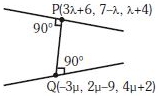
$\overrightarrow {{\rm{PQ}}} \cdot (3\widehat {\rm{i}} - \widehat {\rm{j}} + \widehat {\rm{k}}) = 0$ and
$\overrightarrow{\mathrm{PQ}} \cdot(-3 \hat{\mathrm{i}}+2 \hat{\mathrm{j}}+4 \hat{\mathrm{k}})=0$
$\overrightarrow {{\rm{PQ}}} = (3\lambda + 3\mu + 6)\widehat {\rm{i}} + (16 - \lambda - 2\mu )\widehat {\rm{j}} + (2 + \lambda - 4\mu )\widehat {\rm{k}}$
$\Rightarrow 7 \mu+11 \lambda=-4 \quad $ and $ \quad 29 \mu+7 \lambda=22$
$\Rightarrow \lambda=-1 $ and $ \mu=1$
$\mathrm{P} $ and $ \mathrm{Q}$ are $(3,8,3) $ and $(-3,-7,6)$ respectively
Hence equation of $\mathrm{PQ}$ is $\frac{\mathrm{x}-3}{2}=\frac{\mathrm{y}-8}{5}=\frac{\mathrm{z}-3}{-1}$
View full question & answer→MCQ 411 Mark
If lines $\frac{{x - 1}}{3} = \frac{{y - 2}}{{ - 1}} = \frac{{z - \lambda }}{2}$ and $\frac{{x + 1}}{{ - 2}} = \frac{y}{{3\lambda }} = \frac{{2z - 7}}{1}$ are coplanar then sum of value $(s)$ of $\lambda $ is
- ✓
$\frac{{182}}{{36}}$
- B
$\frac{{162}}{{36}}$
- C
$\frac{{72}}{{36}}$
- D
$\frac{{182}}{2}$
AnswerCorrect option: A. $\frac{{182}}{{36}}$
a
$\left|\begin{array}{ccc}{2} & {2} & {\lambda-\frac{7}{2}} \\ {3} & {-1} & {2} \\ {-2} & {3 \lambda} & {\frac{1}{2}}\end{array}\right|=0$
$\Rightarrow 2\left(-\frac{1}{2}-6 \lambda\right)-2\left(\frac{3}{2}+4\right)+\left(\lambda-\frac{7}{2}\right)(9 \lambda-2)=0$
$\Rightarrow 18 \lambda^{2}-91 \lambda-16=0$
$\Rightarrow \lambda_{1}+\lambda_{2}=\frac{91}{18}=\frac{182}{36}$
View full question & answer→MCQ 421 Mark
The shortest distance between the lines $\frac{x}{2} = \frac{y}{2} = \frac{z}{1}$ and $\frac{{x + 2}}{{ - 1}} = \frac{{y - 4}}{8} = \frac{{z - 5}}{4}$ lies in the interval
- A
$(3, 4]$
- ✓
$(2, 3]$
- C
$[1, 2)$
- D
$[0, 1)$
AnswerCorrect option: B. $(2, 3]$
b
Shortest distance between two lines
$\frac{x-x_{1}}{a_{1}}=\frac{y-y_{1}}{b_{1}}=\frac{z-z_{1}}{c_{1}}$ and
$\frac{x-x_{2}}{a_{2}}=\frac{y-y_{2}}{b_{2}}=\frac{z-z_{2}}{c_{2}}$ is given by,
$\frac{{\left| {\begin{array}{*{20}{c}}
{{x_2} - {x_1}}&{{y_2} - {y_1}}&{{z_2} - {z_1}}\\
{{a_1}}&{{b_1}}&{{c_1}}\\
{{a_2}}&{{b_2}}&{{c_2}}
\end{array}} \right|}}{{\sqrt {{{\left( {{b_1}{c_2} - {b_2}{c_1}} \right)}^2} + {{\left( {{c_1}{a_2} - {c_2}{a_1}} \right)}^2} + {{\left( {{a_1}{b_2} - {a_2}{b_1}} \right)}^2}} }}$
$\therefore \quad$ The shortest distance between given lines
are
$\frac{{\left| {\begin{array}{*{20}{c}}
{ - 2}&4&5\\
2&2&1\\
{ - 1}&8&4
\end{array}} \right|}}{{\sqrt {{{\left( {8 - 8} \right)}^2} + {{\left( { - 1 - 8} \right)}^2} + {{\left( {16 + 2} \right)}^2}} }}$
$ = \left| {\frac{{0 - 36 + 90}}{{\sqrt {405} }}} \right| = \frac{{54}}{{20.1}} = 2.68$
View full question & answer→MCQ 431 Mark
The lines $\frac{x-2}{2}=\frac{y}{-2}=\frac{z-7}{16}$ and $\frac{x+3}{4}=\frac{y+2}{3}=\frac{z+2}{1}$ intersect at the point $P$. If the distance of $P$ from the line $\frac{x+1}{2}=\frac{y-1}{3}=\frac{z-1}{1}$ is $l$, then $14 l^2$ is equal to.................
Answera
$ \frac{\mathrm{x}-2}{1}=\frac{\mathrm{y}}{-1}=\frac{\mathrm{z}-7}{8}=\lambda $
$ \frac{\mathrm{x}+3}{4}=\frac{\mathrm{y}+2}{3}=\frac{\mathrm{z}+2}{1}=\mathrm{k} $
$ \Rightarrow \lambda+2=4 \mathrm{k}-3 $
$ -\lambda=3 \mathrm{k}-2 $
$ \Rightarrow \mathrm{k}=1, \lambda=-1 $
$ 8 \lambda+7=\mathrm{k}-2 $
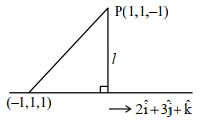
$ \therefore \mathrm{P}=(1,1,-1)$
Projection of $2 \hat{i}-2 \hat{k}$ on $2 \hat{i}+3 \hat{j}+\hat{k}$ is
$ =\frac{4-2}{\sqrt{4+9+1}}=\frac{2}{\sqrt{14}} $
$ \therefore l^2=8-\frac{4}{14}=\frac{108}{14} $
$ \Rightarrow 14 l^2=108$
View full question & answer→MCQ 441 Mark
Let $P Q R$ be a triangle with $R(-1,4,2)$. Suppose $M(2,1,2)$ is the mid point of $PQ$. The distance of the centroid of $\triangle \mathrm{PQR}$ from the point of intersection of the line $\frac{x-2}{0}=\frac{y}{2}=\frac{z+3}{-1}$ and $\frac{x-1}{1}=\frac{y+3}{-3}=\frac{z+1}{1}$ is
- A
$69$
- B
$9$
- ✓
$\sqrt{69}$
- D
$\sqrt{99}$
AnswerCorrect option: C. $\sqrt{69}$
c
Centroid $G$ divides $M R$ in $1: 2$
$\mathrm{G}(1,2,2)$
Point of intersection $A$ of given lines is $(2,-6,0)$
$\mathrm{AG}=\sqrt{69}$
View full question & answer→MCQ 451 Mark
Let $\vec{a}$ and $\vec{b}$ be two vectors such that $|\vec{a}|=1,|\vec{b}|=4$ and $\vec{a} \cdot \vec{b}=2$. If $\vec{c}=(2 \vec{a} \times \vec{b})-3 \vec{b}$ and the angle between $\vec{b}$ and $\vec{c}$ is $\alpha$, then $192 \sin ^2 \alpha$ is equal to
Answerd
$\overrightarrow{\mathrm{b}} \cdot \overrightarrow{\mathrm{c}}=(2 \overrightarrow{\mathrm{a}} \times \overrightarrow{\mathrm{b}}) \cdot \overrightarrow{\mathrm{b}}-3|\mathrm{~b}|^2 $
$|\mathrm{~b}||\mathrm{c}| \cos \alpha=-3|\mathrm{~b}|^2 $
$|\mathrm{c}| \cos \alpha=-12 \text {, as }|\mathrm{b}|=4 $
$\overrightarrow{\mathrm{a}} \cdot \overrightarrow{\mathrm{b}}=2 $
$\cos \theta=\frac{1}{2} \Rightarrow \theta=\frac{\pi}{3} $
$|\mathrm{c}|^2=|(2 \overrightarrow{\mathrm{a}} \times \overrightarrow{\mathrm{b}})-3 \overrightarrow{\mathrm{b}}|^2$
$=64 \times \frac{3}{4}+144=192$
$|\mathrm{c}|^2 \cos ^2 \alpha=144 $
$192 \cos ^2 \alpha=144 $
$192 \sin ^2 \alpha=48$
View full question & answer→MCQ 461 Mark
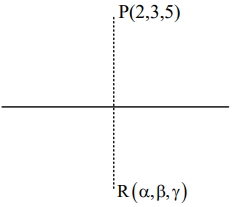
Let $(\alpha, \beta, \gamma)$ be mirror image of the point $(2,3,5)$ in the line $\frac{x-1}{2}=\frac{y-2}{3}=\frac{z-3}{4}$. Then $2 \alpha+3 \beta+4 \gamma$ is equal to
Answerb
$\because \overrightarrow{\mathrm{PR}} \perp(2,3,4) $
$\therefore \overrightarrow{\mathrm{PR}} \cdot(2,3,4)=0 $
$(\alpha-2, \beta-3, \gamma-5) \cdot(2,3,4)=0 $
$\Rightarrow 2 \alpha+3 \beta+4 \gamma=4+9+20=33$
View full question & answer→MCQ 471 Mark
A line passes through $A(4,-6,-2)$ and $B(16,-2,4)$. The point $\mathrm{P}(\mathrm{a}, \mathrm{b}, \mathrm{c})$ where $\mathrm{a}, \mathrm{b}, \mathrm{c}$ are non-negative integers, on the line $\mathrm{AB}$ lies at a distance of 21 units, from the point $\mathrm{A}$. The distance between the points $\mathrm{P}(\mathrm{a}, \mathrm{b}, \mathrm{c})$ and $\mathrm{Q}(4,-12,3)$ is equal to...........
Answerd
$\frac{x-4}{12}=\frac{x+6}{4}=\frac{z+2}{6} $
$\frac{x-4}{\frac{6}{7}}=\frac{y+6}{\frac{2}{7}}=\frac{z+2}{\frac{3}{7}}=21 $
$\left(21 \times \frac{6}{7}+4, \frac{2}{7} \times 21-6, \frac{3}{7} \times 21-2\right) $
$=(22,0,7)=(a, b, c) $
$\therefore \sqrt{324+144+16}=22$
View full question & answer→MCQ 481 Mark
Let the point, on the line passing through the points $P(1,-2,3)$ and $Q(5,-4,7)$, farther from the origin and at a distance of $9$ units from the point $\mathrm{P}$, be $(\alpha, \beta, \gamma)$. Then $\alpha^2+\beta^2+\gamma^2$ is equal to :
Answera
$PQ$ line
$ \frac{\mathrm{x}-1}{4}=\frac{\mathrm{y}+2}{-2}=\frac{\mathrm{z}-3}{4} $
$ \mathrm{pt}(4 \mathrm{t}+1,-2 \mathrm{t}-2,4 \mathrm{t}+3) $
$ \text { distance }^2=16 \mathrm{t}^2+4 \mathrm{t}^2+16 \mathrm{t}^2=81 $
$ \mathrm{t}= \pm \frac{3}{2} $
$ \operatorname{pt}(7,-5,9) $
$ \alpha^2+\beta^2+\gamma^2=155$
option ($1$)
View full question & answer→MCQ 491 Mark
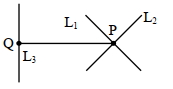
Let $P$ the point of intersection of the lines $\frac{x-2}{1}=\frac{y-4}{5}=\frac{z-2}{1}$ and $\frac{x-3}{2}=\frac{y-2}{3}=\frac{z-3}{2}$. Then, the shortest distance of $\mathrm{P}$ from the line $4 \mathrm{x}=2 \mathrm{y}=\mathrm{z}$ is
- A
$\frac{5 \sqrt{14}}{7}$
- B
$\frac{\sqrt{14}}{7}$
- ✓
$\frac{3 \sqrt{14}}{7}$
- D
$\frac{6 \sqrt{14}}{7}$
AnswerCorrect option: C. $\frac{3 \sqrt{14}}{7}$
c
$Image$
$ \mathrm{L}_1 \equiv \frac{\mathrm{x}-2}{1}=\frac{\mathrm{y}-4}{5}=\frac{\mathrm{z}-2}{1}=\lambda $
$ \mathrm{P}(\lambda+2,5 \lambda+4, \lambda+2) $
$ \mathrm{L}_2 \equiv \frac{\mathrm{x}-3}{2}=\frac{\mathrm{y}-2}{3}=\frac{\mathrm{z}-3}{2} $
$ \mathrm{P}(2 \mu+3,3 \mu+2,2 \mu+3) $
$ \lambda+2=2 \mu+3 \quad 3 \mu+2=5 \lambda+4 $
$ \lambda=2 \mu+1 \quad 3 \mu=5 \lambda+2 $
$ 3 \mu=5(2 \mu+1)+2 $
$ 3 \mu=10 \mu+7 $
$ \mu=-1 \quad \lambda=-1$
Both satisfies ($P$)
$ \mathrm{P}(1,-1,1) $
$ \mathrm{L}_3 \equiv \frac{\mathrm{x}}{1 / 4}=\frac{\mathrm{y}}{1 / 2}=\frac{\mathrm{z}}{1} $
$ \mathrm{~L}_3=\frac{\mathrm{x}}{1}=\frac{\mathrm{y}}{2}=\frac{\mathrm{z}}{4}=\mathrm{k}$
Coordinates of $\mathrm{Q}(\mathrm{k}, 2 \mathrm{k}, 4 \mathrm{k})$
$ \text { DR's of } \mathrm{PQ}=<\mathrm{k}-1,2 \mathrm{k}+1,4 \mathrm{k}-1> $
$ \mathrm{PQ} \perp \text { to } \mathrm{L}_3 $
$ (\mathrm{k}-1)+2(2 \mathrm{k}+1)+4(4 \mathrm{k}-1)=0 $
$ \mathrm{k}-1+4 \mathrm{k}+2+16 \mathrm{k}-4=0 $
$ \mathrm{k}=\frac{1}{7} $
$ \mathrm{Q}\left(\frac{1}{7}, \frac{2}{7}, \frac{4}{7}\right)$
$ \mathrm{Q}\left(\frac{1}{7}, \frac{2}{7}, \frac{4}{7}\right) $
$ \mathrm{PQ}=\sqrt{\left(1-\frac{1}{7}\right)^2+\left(-1-\frac{2}{7}\right)^2+\left(1-\frac{4}{7}\right)^2} $
$ =\sqrt{\frac{36}{49}+\frac{81}{49}+\frac{9}{49}}=\frac{\sqrt{126}}{7} $
$ \mathrm{PQ}=\frac{3 \sqrt{14}}{7}$
Option $-3$ will satisfy
View full question & answer→MCQ 501 Mark
Let $d$ be the distance of the point of intersection of the lines $\frac{x+6}{3}=\frac{y}{2}=\frac{z+1}{1} \quad$ and $\frac{x-7}{4}=\frac{y-9}{3}=\frac{z-4}{2}$ from the point $(7,8,9)$. Then $\mathrm{d}^2+6$ is equal to :
Answerc
$ \frac{x+6}{3}=\frac{y}{2}=\frac{z+1}{1}=\lambda $ .................($1$)
$ x=3 \lambda-6, y=2 \lambda, z=\lambda-1 $
$ \frac{x-7}{4}=\frac{y-9}{3}=\frac{z-4}{2}=\mu $ ........................($2$)
$ x=4 \mu+7, y=3 \mu+9, z=2 \mu+4 $
$ 3 \lambda-6=4 \mu+7 \Rightarrow 3 \lambda-4 \mu=13 $ ............$(3)\times 2$
$ 2 \lambda=3 \mu+9 \Rightarrow 2 \lambda-3 \mu=9 $ ............$(4)\times 3$
$ \quad 6 \lambda-8 \mu=26 $
$ \quad 6 \lambda-9 \mu=27 $
$ \quad-\quad+\quad- $
$ \quad \mu=-1 $
$ \Rightarrow 3 \lambda-4(-1)=13 $
$ \quad 3 \lambda=9 $
$ \quad \lambda=3 $
$ \text { int. point }(3,6,2) ;(7,8,9) $
$ d^2=16+4+49=69 $
Ans. $d^2+6=69+6=75$
View full question & answer→