MCQ 511 Mark
If the line $\frac{2-x}{3}=\frac{3 y-2}{4 \lambda+1}=4-z$ makes a right angle with the line $\frac{x+3}{3 \mu}=\frac{1-2 y}{6}=\frac{5-z}{7}$, then $4 \lambda+9 \mu$ is equal to :
Answerd
$\frac{2-x}{3}=\frac{3 y-2}{4 \lambda+1}=4-z$................($1$)
$\frac{x-2}{(-3)}=\frac{y-\frac{2}{3}}{\left(\frac{4 \lambda+1}{3}\right)}=\frac{z-4}{(-1)}$
$ \frac{x+3}{3 \mu}=\frac{1-2 y}{6}=\frac{5-z}{7} $...................($2$)
$ \frac{x+3}{3 \mu}=\frac{y-\frac{1}{2}}{(-3)}=\frac{z-5}{(-7)} $
Right angle $ \Rightarrow(-3)(3 \mu)+\left(\frac{4 \lambda+1}{3}\right)(-3)+(-1)(-7)=0 $
$ -9 \mu-4 \lambda-1+7=0 $
$ 4 \lambda+9 \mu=6$
View full question & answer→MCQ 521 Mark
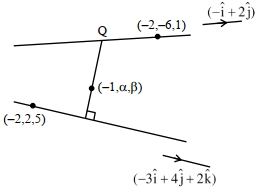
Let the point $(-1, \alpha, \beta)$ lie on the line of the shortest distance between the lines $\frac{x+2}{-3}=\frac{y-2}{4}=\frac{z-5}{2}$ and $\frac{x+2}{-1}=\frac{y+6}{2}=\frac{z-1}{0}$ Then $(\alpha-\beta)^2$ is equal to ....................
Answerd
$Image$
$ \mathrm{P}(-3 \lambda-2,4 \lambda+2,2 \lambda+5) $
$ \mathrm{Q}(-\mu-2,2 \mu-6,1) $
$ \mathrm{DRS} \text { of } \mathrm{PQ}=(3 \lambda-\mu, 2 \mu-4 \lambda-8,-2 \lambda-4)$
$D R S$ of $P Q=\left|\begin{array}{ccc}\hat{i} & \hat{j} & \hat{k} \\ -1 & 2 & 0 \\ -3 & 4 & 2\end{array}\right|$
$=(4 \hat{i}+2 \hat{j}+2 \hat{k})$
OR
$ (2,1,1) $
$ \frac{3 \lambda-\mu}{2}=\frac{2 \mu-4 \lambda-8}{1}=\frac{-2 \lambda-4}{1} $
$ \Rightarrow \mu=\lambda+2 \& 7 \lambda=\mu-8 $
$ \lambda=-1 \quad \mu=1 $
$ Q:(-3,-4,1) $
$ L_{P Q}=\frac{x+3}{2}=\frac{y+4}{1}=\frac{z-1}{1} $
$ (-1, \alpha, \beta) \Rightarrow 1=\frac{\alpha+4}{1}=\frac{\beta-1}{1} $
$ \Rightarrow \alpha=-3, \beta=2 $
$ (\alpha-\beta)^2=25$
View full question & answer→MCQ 531 Mark
The shortest distance between the lines $\frac{x-3}{2}=\frac{y+15}{-7}=\frac{z-9}{5}$ and $\frac{x+1}{2}=\frac{y-1}{1}=\frac{z-9}{-3}$ is
- A
$6 \sqrt{3}$
- ✓
$4 \sqrt{3}$
- C
$5 \sqrt{3}$
- D
$8 \sqrt{3}$
AnswerCorrect option: B. $4 \sqrt{3}$
b
$\frac{x-3}{2}=\frac{y+15}{-7}=\frac{z-9}{5} \& \frac{x+1}{2}=\frac{y-1}{1}=\frac{z-9}{-3}$
$\mathrm{S} . \mathrm{D}=\frac{\left|\left(\overline{\mathrm{a}}_2 \cdot \overline{\mathrm{a}}_1\right) \cdot\left(\overline{\mathrm{b}}_1 \cdot \overline{\mathrm{b}}_2\right)\right|}{\left|\overline{\mathrm{b}}_1 \times \overline{\mathrm{b}}_2\right|}$
$\begin{array}{ll}a_1=3,-15,9 & b_1=2,-7,5 \\ a_2=-1,1,9 & b_2=2,1,-3 \\ a_2-a_1=-4,16,0 & \end{array}$
$\overline{\mathrm{b}}_1 \times \overline{\mathrm{b}}_2=\left|\begin{array}{ccc}\hat{\mathrm{i}} & \hat{\mathrm{j}} & \hat{\mathrm{k}} \\ 2 & -7 & 5 \\ 2 & 1 & -3\end{array}\right|=\hat{\mathrm{i}}(16)-\hat{\mathrm{j}}(-16)+\hat{\mathrm{k}}(16)$
$ 16(\hat{\mathrm{i}}+\hat{\mathrm{j}}+\hat{\mathrm{k}}) $
$ \left|\overline{\mathrm{b}}_1 \times \overline{\mathrm{b}}_2\right|=16 \sqrt{3} $
$ \therefore\left(\overline{\mathrm{a}}_2-\overline{\mathrm{a}}_1\right) \cdot\left(\overline{\mathrm{b}}_1-\overline{\mathrm{b}}_2\right)=16[-4+16]=(16)(12) $
$ \text { S.D. }=\frac{(16)(12)}{16 \sqrt{3}}=4 \sqrt{3}$
View full question & answer→MCQ 541 Mark
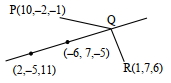
Let $P$ be the point $(10,-2,-1)$ and $Q$ be the foot of the perpendicular drawn from the point $\mathrm{R}(1,7,6)$ on the line passing through the points $(2,-5,11)$ and $(-6,7,-5)$. Then the length of the line segment $\mathrm{PQ}$ is equal to ..........
Answera
$ \text { Line }: \frac{x+6}{-8}=\frac{y-7}{12}=\frac{z+5}{-16} $
$ \frac{x+6}{2}=\frac{y-7}{-3}=\frac{z+5}{4}=\lambda $
$ Q(2 \lambda-6,7-3 \lambda, 4 \lambda-5) $
$ \overline{Q R}(2 \lambda-7,-3 \lambda, 4 \lambda-11) $
$ \overline{Q R} \cdot \text { dr's of line }=0 $
$ 4 \lambda-14+9 \lambda+16 \lambda-44=0 $
$ 29 \lambda=58 \Rightarrow \lambda=2 $
$ Q(-2,1,3) $
$ P Q=\sqrt{144+9+16}=\sqrt{169}=13$
View full question & answer→MCQ 551 Mark
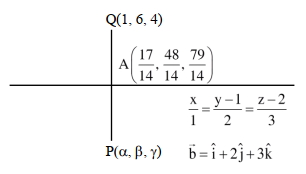
Let $\mathrm{P}(\alpha, \beta, \gamma)$ be the image of the point $\mathrm{Q}(1,6,4)$ in the line $\frac{x}{1}=\frac{y-1}{2}=\frac{z-2}{3}$. Then $2 \alpha+\beta+\gamma$ is equal to ..............
Answerd
$ \mathrm{A}(t, 2 t+1,3 \mathrm{t}+2) $
$ \overrightarrow{\mathrm{QA}}=(\mathrm{t}-1) \hat{\mathrm{i}}+(2 \mathrm{t}-5) \hat{\mathrm{j}}+(3 \mathrm{t}-2) \hat{\mathrm{k}} $
$ \overrightarrow{\mathrm{QA}} \cdot \overrightarrow{\mathrm{b}}=0 $
$ (\mathrm{t}-1)+2(2 \mathrm{t}-5)+3(3 \mathrm{t}-2)=0 $
$ 14 \mathrm{t}=17 $
$ \alpha=\frac{20}{14} \quad \beta=\frac{12}{14} \quad \gamma=\frac{102}{14} $
$ 2 \alpha+\beta+\gamma=\frac{154}{14}=11$
View full question & answer→MCQ 561 Mark
The shortest distance between the line
$\frac{x-3}{4}=\frac{y+7}{-11}=\frac{z-1}{5} \text { and } \frac{x-5}{3}=\frac{y-9}{-6}=\frac{z+2}{1}$ is :
- ✓
$\frac{187}{\sqrt{563}}$
- B
$\frac{178}{\sqrt{563}}$
- C
$\frac{185}{\sqrt{563}}$
- D
$\frac{179}{\sqrt{563}}$
AnswerCorrect option: A. $\frac{187}{\sqrt{563}}$
a
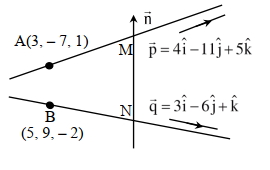
$\overrightarrow{\mathrm{n}}=\overrightarrow{\mathrm{p}} \times \overrightarrow{\mathrm{q}}$
$\vec{n}=\left|\begin{array}{ccc}\hat{i} & \hat{j} & \hat{k} \\ 4 & -11 & 5 \\ 3 & -6 & 1\end{array}\right|=19 \hat{i}+11 \hat{j}+9 \hat{k}$
S.d. $=$ projection of $\overrightarrow{\mathrm{AB}}$ on $\vec{n}$
$=\left|\frac{\overrightarrow{\mathrm{AB}} \cdot \overrightarrow{\mathrm{n}}}{|\overrightarrow{\mathrm{n}}|}\right|=\left|\frac{(2 \hat{\mathrm{i}}+16 \hat{\mathrm{j}}-3 \hat{\mathrm{k}}) \cdot(19 \hat{\mathrm{i}}+11 \hat{\mathrm{j}}+9 \hat{\mathrm{k}})}{\sqrt{361+121+81}}\right|$
$ =\frac{38+176-27}{\sqrt{563}} $
$ \text { S.d. }=\frac{187}{\sqrt{563}}$
View full question & answer→MCQ 571 Mark
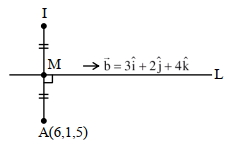
The square of the distance of the image of the point $(6,1,5)$ in the line $\frac{x-1}{3}=\frac{y}{2}=\frac{z-2}{4}$, from the origin is .............
Answerc
$ \text { Let } \mathrm{M}(3 \lambda+1,2 \lambda, 4 \lambda+2) $
$ \overrightarrow{\mathrm{AM}} \cdot \overrightarrow{\mathrm{b}}=0 $
$ \Rightarrow \quad 9 \lambda-15+4 \lambda-2+16 \lambda-12=0 $
$ \Rightarrow \quad 29 \lambda=29 $
$ \Rightarrow \quad \lambda=1 $
$ \mathrm{M}(4,2,6), \mathrm{I}=(2,3,7) $
$ \text { Required Distance }=\sqrt{4+9+49}=\sqrt{62}$
Ans. $62$
View full question & answer→MCQ 581 Mark
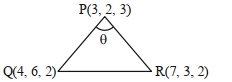
Let $P(3,2,3), Q(4,6,2)$ and $R(7,3,2)$ be the vertices of $\triangle \mathrm{PQR}$. Then, the angle $\angle \mathrm{QPR}$ is
AnswerCorrect option: D. $\frac{\pi}{3}$
d
Direction ratio of $\mathrm{PR}=(4,1,-1)$
Direction ratio of $\mathrm{PQ}=(1,4,-1)$
Now, $\cos \theta=\left|\frac{4+4+1}{\sqrt{18} \cdot \sqrt{18}}\right|$
$\theta=\frac{\pi}{3}$
View full question & answer→MCQ 591 Mark
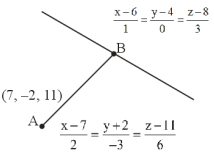
The distance, of the point $(7,-2,11)$ from the line $\frac{x-6}{1}=\frac{y-4}{0}=\frac{z-8}{3}$ along the line $\frac{x-5}{2}=\frac{y-1}{-3}=\frac{z-5}{6}$, is :
Answerb
$\mathrm{B}=(2 \lambda+7,-3 \lambda-2,6 \lambda+11)$
Point $B$ lies on $\frac{x-6}{1}=\frac{y-4}{0}=\frac{z-8}{3}$
$\frac{2 \lambda+7-6}{1}=\frac{-3 \lambda-2-4}{0}=\frac{6 \lambda+11-8}{3}$
$-3 \lambda-6=0$
$\lambda=-2$
$\text { B } \Rightarrow(3,4,-1)$
$\mathrm{AB} =\sqrt{(7-3)^2+(4+2)^2+(11+1)^2} $
$ =\sqrt{16+36+144} $
$ =\sqrt{196}=14$
View full question & answer→MCQ 601 Mark
If the shortest distance between the lines $\frac{x-4}{1}=\frac{y+1}{2}=\frac{z}{-3}$ and $\frac{x-\lambda}{2}=\frac{y+1}{4}=\frac{z-2}{-5}$ is $\frac{6}{\sqrt{5}}$, then the sum of all possible values of $\lambda$ is :
Answerb
$ \frac{x-4}{1}=\frac{y+1}{2}=\frac{z}{-3} $
$ \frac{x-\lambda}{2}=\frac{y+1}{4}=\frac{z-2}{-5}$
the shortest distance between the lines
$ =\left|\frac{(\overrightarrow{\mathrm{a}}-\overrightarrow{\mathrm{b}}) \cdot\left(\overrightarrow{\mathrm{d}_1} \times \overrightarrow{\mathrm{d}_2}\right)}{\left|\overrightarrow{\mathrm{d}_1} \times \overrightarrow{\mathrm{d}_2}\right|}\right|$
$=\left|\frac{\left|\begin{array}{ccc}\lambda-4 & 0 & 2 \\ 1 & 2 & -3 \\ 2 & 4 & -5\end{array}\right|}{\left|\begin{array}{ccc}\hat{i} & \hat{j} & \hat{k} \\ 1 & 2 & -3 \\ 2 & 4 & -5\end{array}\right|}\right|$
$=\left|\frac{(\lambda-4)(-10+12)-0+2(4-4)}{|2 \hat{i}-1 \hat{j}+0 \hat{k}|}\right|$
$\frac{6}{\sqrt{5}}=\left|\frac{2(\lambda-4)}{\sqrt{5}}\right|$
$ 3=|\lambda-4|$
$ \lambda-4= \pm 3 $
$\lambda=7,1$
Sum of all possible values of $\lambda$ is $=8$
View full question & answer→MCQ 611 Mark
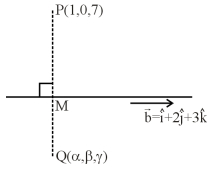
Let the image of the point $(1,0,7)$ in the line $\frac{x}{1}=\frac{y-1}{2}=\frac{z-2}{3}$ be the point $(\alpha, \beta, \gamma)$. Then which one of the following points lies on the line passing through $(\alpha, \beta, \gamma)$ and making angles $\frac{2 \pi}{3}$ and $\frac{3 \pi}{4}$ with $y$-axis and $z$-axis respectively and an acute angle with $\mathrm{x}$-axis?
- A
$(1,-2,1+\sqrt{2})$
- B
$(1,2,1-\sqrt{2})$
- ✓
$(3,4,3-2 \sqrt{2})$
- D
$(3,-4,3+2 \sqrt{2})$
AnswerCorrect option: C. $(3,4,3-2 \sqrt{2})$
c
$L_1=\frac{x}{1}=\frac{y-1}{2}=\frac{z-2}{3}=\lambda$
$ \mathrm{M}(\lambda, 1+2 \lambda, 2+3 \lambda) $
$ \overrightarrow{\mathrm{PM}}=(\lambda-1) \hat{i}+(1+2 \lambda) \hat{j}+(3 \lambda-5) \hat{k}$
$\overrightarrow{\mathrm{PM}}$ is perpendicular to line $\mathrm{L}_1$
$ \overrightarrow{\mathrm{PM}} \overrightarrow{\mathrm{b}}=0 \quad(\overrightarrow{\mathrm{b}}=\hat{\mathrm{i}}+2 \hat{\mathrm{j}}+3 \hat{\mathrm{k}}) $
$ \Rightarrow \lambda-1+4 \lambda+2+9 \lambda-15=0 $
$ 14 \lambda=14 \Rightarrow \lambda=1 $
$ \therefore \mathrm{M}=(1,3,5) $
$ \overrightarrow{\mathrm{Q}}=2 \overrightarrow{\mathrm{M}}-\overrightarrow{\mathrm{P}}[\mathrm{M} \text { is midpoint of } \overrightarrow{\mathrm{P}} \overrightarrow{\mathrm{Q}}] $
$ \overrightarrow{\mathrm{Q}}=2 \hat{\mathrm{i}}+6 \hat{\mathrm{j}}+10 \hat{\mathrm{k}}-\hat{\mathrm{i}}-7 \hat{\mathrm{k}} $
$ \overrightarrow{\mathrm{Q}}=\hat{\mathrm{i}}+6 \hat{\mathrm{j}}+3 \hat{\mathrm{k}} $
$ \therefore(\alpha, \beta, \gamma)=(1,6,3)$
Required line having direction cosine $(l, \mathrm{~m}, \mathrm{n})$
$ l^2+m^2+n^2=1 $
$ \Rightarrow l^2+\left(-\frac{1}{2}\right)^2+\left(-\frac{1}{\sqrt{2}}\right)^2=1$
$l^2=\frac{1}{4}$
$\therefore l=\frac{1}{2}$ [Line make acute angle with $\mathrm{x}$-axis]
Equation of line passing through $(1,6,3)$ will be
$\overrightarrow{\mathrm{r}}=(\hat{\mathrm{i}}+6 \hat{\mathrm{j}}+3 \hat{\mathrm{k}})+\mu\left(\frac{1}{2} \hat{\mathrm{i}}-\frac{1}{2} \hat{\mathrm{j}}-\frac{1}{\sqrt{2}} \hat{\mathrm{k}}\right)$
Option $(3)$ satisfying for $\mu=4$
View full question & answer→MCQ 621 Mark
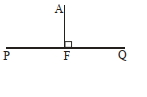
A line with direction ratios $2,1,2$ meets the lines $x=y+2=z$ and $x+2=2 y=2 z$ respectively at the point $P$ and $Q$. if the length of the perpendicular from the point $(1,2,12)$ to the line $\mathrm{PQ}$ is $l$, then $l^2$ is
Answerb
Let $\mathrm{P}(\mathrm{t}, \mathrm{t}-2, \mathrm{t})$ and $\mathrm{Q}(2 \mathrm{~s}-2, \mathrm{~s}, \mathrm{~s})$
$D.R$'s of $PQ$ are $2, 1,2$
$ \frac{2 s-2-t}{2}=\frac{s-t+2}{1}=\frac{s-t}{2} $
$ \Rightarrow t=6 \text { and } s=2 $
$ \Rightarrow P(6,4,6) \text { and } Q(2,2,2) $
$ P Q: \frac{x-2}{2}=\frac{y-2}{1}=\frac{z-2}{2}=\lambda$
Let $\mathrm{F}(2 \lambda+2, \lambda+2,2 \lambda+2)$
$\mathrm{A}(1,2,12)$
$\overrightarrow{\mathrm{AF}} \cdot \overrightarrow{\mathrm{PQ}}=0$
$\therefore \lambda=2$
So $\mathrm{F}(6,4,6)$ and $\mathrm{AF}=\sqrt{65}$
View full question & answer→MCQ 631 Mark
Let $O$ be the origin, and $\mathrm{M}$ and $\mathrm{N}$ be the points on the lines $\frac{x-5}{4}=\frac{y-4}{1}=\frac{z-5}{3}$ and $\frac{\mathrm{x}+8}{12}=\frac{\mathrm{y}+2}{5}=\frac{\mathrm{z}+11}{9}$ respectively such that $\mathrm{MN}$ is the shortest distance between the given lines. Then $\overrightarrow{\mathrm{OM}} \cdot \overrightarrow{\mathrm{ON}}$ is equal to ..................
Answerb
$L_1: \frac{\mathrm{x}-5}{4}=\frac{\mathrm{y}-4}{1}=\frac{\mathrm{z}-5}{3}=\lambda \quad \text { drs }(4,1,3)=\mathrm{b}_1 $
$M(4 \lambda+5, \lambda+4,3 \lambda+5) $
$L_2: \frac{\mathrm{x}+8}{12}=\frac{\mathrm{y}+2}{5}=\frac{\mathrm{z}+11}{9}=\mu $
$ N(12 \mu-8,5 \mu-2,9 \mu-11) $
$MN=(4 \lambda-12 \mu+13, \lambda-5 \mu+6,3 \lambda-9 \mu+16) . .(1)$
Now
$\overrightarrow{\mathrm{b}}_1 \times \overrightarrow{\mathrm{b}}_2=\left|\begin{array}{ccc}\hat{i} & \hat{\mathrm{j}} & \hat{\mathrm{k}} \\ 4 & 1 & 3 \\ 12 & 5 & 9\end{array}\right|=-6 \hat{\mathrm{i}}+8 \hat{\mathrm{k}}$ $.........(2)$
Equation $(1)$ and $(2)$
$\therefore \frac{4 \lambda-12 \mu+13}{-6}=\frac{\lambda-5 \mu+6}{0}=\frac{3 \lambda-9 \mu+16}{8}$
$I$ and $II$
$\lambda-5 \mu+6=0$ $..............(3)$
$I$ and $III$
$\lambda-3 \mu+4=0$ $.................(4)$
Solve $(3)$ and $(4)$ we get
$ \lambda=-1, \mu=1 $
$ \therefore \mathrm{M}(1,3,2)$
$ \mathrm{N}(4,3,-2) $
$ \therefore \overrightarrow{\mathrm{OM}} \cdot \overrightarrow{\mathrm{ON}}=4+9-4=9 $
View full question & answer→MCQ 641 Mark
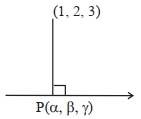
Let $(\alpha, \beta, \gamma)$ be the foot of perpendicular from the point $(1,2,3)$ on the line $\frac{x+3}{5}=\frac{y-1}{2}=\frac{z+4}{3}$. then $19(\alpha+\beta+\gamma)$ is equal to :
Answerb
Let foot $P(5 k-3,2 k+1,3 k-4)$
DR's $\rightarrow$ AP: $5 \mathrm{k}-4,2 \mathrm{k}-1,3 \mathrm{k}-7$
DR's $\rightarrow$ Line: $5,2,3$
Condition of perpendicular lines $(25 k-20)+(4 k-2)+(9 k-21)=0$
Then $\mathrm{k}=\frac{43}{38}$
Then $19(\alpha+\beta+\gamma)=101$
View full question & answer→MCQ 651 Mark
If $d_1$ is the shortest distance between the lines $x+1=2 y=-12 z, x=y+2=6 z-6$ and $d_2$ is the shortest distance between the lines $\frac{x-1}{2}=\frac{y+8}{-7}=\frac{z-4}{5}, \frac{x-1}{2}=\frac{y-2}{1}=\frac{z-6}{-3}$, then the value of $\frac{32 \sqrt{3} \mathrm{~d}_1}{\mathrm{~d}_2}$ is:
Answerb
$L_1: \frac{x+1}{1}=\frac{y}{1 / 2}=\frac{z}{-1 / 12}, L_2: \frac{x}{1}=\frac{y+2}{1}=\frac{z-1}{\frac{1}{6}}$
$\mathrm{d}_1=$ shortest distance between $\mathrm{L}_1 \& \mathrm{~L}_2$
$=\left|\frac{\left(\vec{a}_2-\vec{a}_1\right) \cdot\left(\vec{b}_1 \times \vec{b}_2\right)}{\left|\left(\vec{b}_1 \times \vec{b}_2\right)\right|}\right|$
$ \mathrm{d}_1=2 $
$\mathrm{~L}_3: \frac{\mathrm{x}-1}{2}=\frac{\mathrm{y}+8}{-7}=\frac{\mathrm{z}-4}{5}, \mathrm{~L}_4: \frac{\mathrm{x}-1}{2}=\frac{\mathrm{y}-2}{1}=\frac{\mathrm{z}-6}{-3} $
$ \mathrm{~d}_2=\text { shortest distance between } \mathrm{L}_3 \& \mathrm{~L}_4 $
$ \mathrm{~d}_2=\frac{12}{\sqrt{3}} \text { Hence } $
$ =\frac{32 \sqrt{3} \mathrm{~d}_1}{\mathrm{~d}_2}=\frac{32 \sqrt{3} \times 2}{\frac{12}{\sqrt{3}}}=16$
View full question & answer→MCQ 661 Mark
Let $L_1: \overrightarrow{\mathrm{r}}=(\hat{\mathrm{i}}-\hat{\mathrm{j}}+2 \hat{\mathrm{k}})+\lambda(\hat{\mathrm{i}}-\hat{\mathrm{j}}+2 \hat{\mathrm{k}}), \lambda \in \mathrm{R}$ $L_2: \overrightarrow{\mathrm{r}}=(\hat{\mathrm{j}}-\hat{\mathrm{k}})+\mu(3 \hat{\mathrm{i}}+\hat{\mathrm{j}}+\mathrm{p} \hat{\mathrm{k}}), \mu \in \mathrm{R}$ and $L_3: \overrightarrow{\mathrm{r}}=\delta(\ell \hat{\mathrm{i}}+\mathrm{m} \hat{\mathrm{j}}+\mathrm{n} \hat{\mathrm{k}}) \delta \in \mathrm{R}$
Be three lines such that $\mathrm{L}_1$ is perpendicular to $\mathrm{L}_2$ and $L_3$ is perpendicular to both $L_1$ and $L_2$. Then the point which lies on $\mathrm{L}_3$ is
- ✓
$(-1,7,4)$
- B
$(-1,-7,4)$
- C
$(1,7,-4)$
- D
$(1,-7,4)$
AnswerCorrect option: A. $(-1,7,4)$
a
$\mathrm{L}_3 \perp \mathrm{L}_1, \mathrm{~L}_2$
$\begin{aligned} & \mathrm{L}_1 \perp \mathrm{L}_2 \\ & 3-1+2 \mathrm{P}=0 \\ & \mathrm{P}=-1 \\ & \left|\begin{array}{ccc}\hat{\mathrm{i}} & \hat{\mathrm{j}} & \hat{\mathrm{k}} \\ 1 & -1 & 2 \\ 3 & 1 & -1\end{array}\right|=-\hat{\mathrm{i}}+7 \hat{\mathrm{j}}+4 \hat{\mathrm{k}}\end{aligned}$
$\therefore(-\delta, 7 \delta, 4 \delta)$ will lie on $L_3$
For $\delta=1$ the point will be $(-1,7,4)$
View full question & answer→MCQ 671 Mark
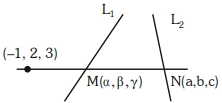
Let a line passing through the point $(-1,2,3)$ intersect the lines $L_1: \frac{x-1}{3}=\frac{y-2}{2}=\frac{z+1}{-2}$ at $\mathrm{M}(\alpha, \beta, \gamma)$ and $\mathrm{L}_2: \frac{\mathrm{x}+2}{-3}=\frac{\mathrm{y}-2}{-2}=\frac{\mathrm{z}-1}{4}$ at $\mathrm{N}(\mathrm{a}, \mathrm{b}$, c). Then the value of $\frac{(\alpha+\beta+\gamma)^2}{(a+b+c)^2}$ equals
Answerb
$\mathrm{M}(3 \lambda+1,2 \lambda+2,-2 \lambda-1) \quad \therefore \alpha+\beta+\gamma=3 \lambda+2 $
$\mathrm{~N}(-3 \mu-2,-2 \mu+2,4 \mu+1) \quad \therefore \mathrm{a}+\mathrm{b}+\mathrm{c}=-\mu+1$
$\frac{3 \lambda+2}{-3 \mu-1}=\frac{2 \lambda}{-2 \mu}=\frac{-2 \lambda-4}{4 \mu-2} $
$3 \lambda \mu+2 \mu=3 \lambda \mu+\lambda$
$2 \mu=\lambda $
$2 \lambda \mu-\lambda=\lambda \mu+2 \mu $
$\lambda \mu=\lambda+2 \mu \lambda \mu=2 \lambda$
$\Rightarrow \mu=2 \quad(\lambda \neq 0)$
$\therefore\lambda=4$
$ \alpha+\beta+\gamma=14$
$a+b+c=-1$
$\frac{(\alpha+\beta+\gamma)^2}{(a+b+c)^2}=196$
View full question & answer→MCQ 681 Mark
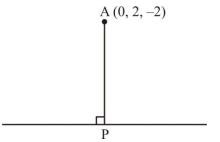
The distance of the point $Q(0,2,-2)$ form the line passing through the point $\mathrm{P}(5,-4,3)$ and perpendicular to the lines $\overrightarrow{\mathrm{r}}=(-3 \hat{\mathrm{i}}+2 \hat{\mathrm{k}})$ $\lambda(2 \hat{\mathrm{i}}+3 \hat{\mathrm{j}}+5 \hat{\mathrm{k}}), \quad \lambda \in \mathbb{R} \quad$ and $\quad \overrightarrow{\mathrm{r}}=(\hat{\mathrm{i}}-2 \hat{\mathrm{j}}+\hat{\mathrm{k}})+$ $\mu(-\hat{i}+3 \hat{J}+2 \hat{K}), \mu \in \mathbb{R}$ is
- A
$\sqrt{86}$
- B
$\sqrt{20}$
- C
$\sqrt{54}$
- ✓
$\sqrt{74}$
AnswerCorrect option: D. $\sqrt{74}$
d
A vector in the direction of the required line can be obtained by cross product of
$\left|\begin{array}{ccc}\hat{\mathrm{i}} & \hat{\mathrm{j}} & \hat{\mathrm{k}} \\ 2 & 3 & 5 \\ -1 & 3 & 2\end{array}\right|$
Required line,
$\overrightarrow{\mathrm{r}}=(5 \hat{\mathrm{i}}-4 \hat{\mathrm{j}}+3 \hat{\mathrm{k}})+\lambda^{\prime}(-9 \hat{\mathrm{i}}-9 \hat{\mathrm{j}}+9 \hat{\mathrm{k}})$
$\overrightarrow{\mathrm{r}}=(5 \hat{\mathrm{i}}-4 \hat{\mathrm{j}}+3 \hat{\mathrm{k}})+\lambda(\hat{\mathrm{i}}+\hat{\mathrm{j}}-\hat{\mathrm{k}})$
Now distance of $(0,2,-2)$
$\mathrm{P} . V . \text { of } \mathrm{P} \equiv(5+\lambda) \hat{\mathrm{i}}+(\lambda-4) \hat{\mathrm{j}}+(3-\lambda) \hat{\mathrm{k}}$
$\overrightarrow{\mathrm{AP}}=(5+\lambda) \hat{\mathrm{i}}+(\lambda-6) \hat{\mathrm{j}}+(5-\lambda) \hat{\mathrm{k}}$
$\overrightarrow{\mathrm{AP}} \cdot(\hat{\mathrm{i}}+\hat{\mathrm{j}}-\hat{\mathrm{k}})=0$
$5+\lambda+\lambda-6-5+\lambda=0 $
$\lambda=2$
$|\overrightarrow{\mathrm{AP}}|=\sqrt{49+16+9}$
$\mid \overrightarrow{\mathrm{AP}}=\sqrt{74}$
View full question & answer→MCQ 691 Mark
Let $\mathrm{Q}$ and $\mathrm{R}$ be the feet of perpendiculars from the point $\mathrm{P}(\mathrm{a}, \mathrm{a}, \mathrm{a})$ on the lines $\mathrm{x}=\mathrm{y}, \mathrm{z}=1$ and $\mathrm{x}=-\mathrm{y}$, $\mathrm{z}=-1$ respectively. If $\angle \mathrm{QPR}$ is a right angle, then $12 \mathrm{a}^2$ is equal to
Answerd
${x}{1}=\frac{y}{1}=\frac{z-1}{0}=r \rightarrow Q(r, r, 1) $
$\frac{x}{1}=\frac{y}{-1}=\frac{z+1}{0}=k \rightarrow R(k,-k,-1) $
$\overline{P Q}=(a-r) \hat{i}+(a-r) \hat{j}+(a-1) \hat{k} $
$a=r+a-r=0 $
$2 a=2 r \rightarrow a=r $
$\overrightarrow{P R}=(a-k) i+(a+k) \hat{j}+(a+1) \hat{k} $
$a-k-a-k=0 \Rightarrow k=0 $
$A s, P Q \perp P R $
$(a-r)(a-k)+(a-r)(a+k)+(a-1)(a+1)=0 $
$a=1 \text { or }-1$
$12 a^2=12$
View full question & answer→MCQ 701 Mark
The shortest distance between lines $\mathrm{L}_1$ and $\mathrm{L}_2$, where $L_1: \frac{x-1}{2}=\frac{y+1}{-3}=\frac{z+4}{2}$ and $L_2$ is the line passing through the points $\mathrm{A}(-4,4,3) \cdot \mathrm{B}(-1,6,3)$ and perpendicular to the line $\frac{x-3}{-2}=\frac{y}{3}=\frac{z-1}{1}$, is
- A
$\frac{121}{\sqrt{221}}$
- B
$\frac{24}{\sqrt{117}}$
- ✓
$\frac{141}{\sqrt{221}}$
- D
$\frac{42}{\sqrt{117}}$
AnswerCorrect option: C. $\frac{141}{\sqrt{221}}$
c
$\begin{aligned} & \mathrm{L}_2=\frac{\mathrm{x}+4}{3}=\frac{\mathrm{y}-4}{2}=\frac{\mathrm{z}-3}{0} \\ & \therefore \mathrm{S} . \mathrm{D}=\frac{\left|\begin{array}{ccc}\mathrm{x}_2-\mathrm{x}_1 & \mathrm{y}_2-\mathrm{y}_1 & \mathrm{z}_2-\mathrm{z}_1 \mid \\ 2 & -3 & 2 \\ 3 & 2 & 0\end{array}\right|}{\left|\overrightarrow{\mathrm{n}_1} \times \overrightarrow{\mathrm{n}_2}\right|} \\ & =\frac{\left|\begin{array}{ccc}5 & -5 & -7 \\ 2 & -3 & 2 \\ 3 & 2 & 0\end{array}\right|}{\left|\overrightarrow{\mathrm{n}_1} \times \overrightarrow{\mathrm{n}_2}\right|} \\ & =\frac{141}{|-4 \hat{\mathrm{i}}+6 \hat{\mathrm{j}}+13 \hat{\mathrm{k}}|} \\ & =\frac{141}{\sqrt{16+36+169}} \\ & =\frac{141}{\sqrt{221}}\end{aligned}$
View full question & answer→MCQ 711 Mark
If the shortest distance between the lines $\frac{x-\lambda}{-2}=\frac{y-2}{1}=\frac{z-1}{1}$ and $\frac{x-\sqrt{3}}{1}=\frac{y-1}{-2}=\frac{z-2}{1}$ is $1 ,$ then the sum of all possible values of $\lambda$ is :
- A
$0$
- ✓
$2 \sqrt{3}$
- C
$3 \sqrt{3}$
- D
$-2 \sqrt{3}$
AnswerCorrect option: B. $2 \sqrt{3}$
b
Passing points of lines $\mathrm{L}_1 \& \mathrm{~L}_2$ are $(\lambda, 2,1) \&(\sqrt{3}, 1,2)$
$(\lambda, 2,1) \&(\sqrt{3}, 1,2)$
$S.D$ $=\frac{\left|\begin{array}{ccc}\sqrt{3}-\lambda & -1 & 1 \\ -2 & 1 & 1 \\ 1 & -2 & 1\end{array}\right|}{\left|\begin{array}{ccc}\hat{i} & \hat{j} & \hat{k} \\ -2 & 1 & 1 \\ 1 & -2 & 1\end{array}\right|}$
$\begin{aligned} & 1=\left|\frac{\sqrt{3}-\lambda}{\sqrt{3}}\right| \\ & \lambda=0, \lambda=2 \sqrt{3}\end{aligned}$
View full question & answer→MCQ 721 Mark
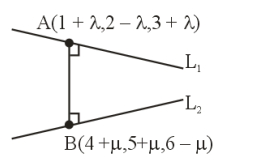
Let the line of the shortest distance between the lines $L_1: \vec{r}=(\hat{i}+2 \hat{j}+3 \hat{k})+\lambda(\hat{i}-\hat{j}+\hat{k})$ and $L_2: \vec{r}=(4 \hat{i}+5 \hat{j}+6 \hat{k})+\mu(\hat{i}+\hat{j}-\hat{k})$ intersect $\mathrm{L}_1$ and $\mathrm{L}_2$ at $\mathrm{P}$ and $\mathrm{Q}$ respectively. If $(\alpha, \beta, \gamma)$ is the midpoint of the line segment $PQ$, then $2(\alpha+\beta+\gamma)$ is equal to____.
Answera
$\overrightarrow{\mathrm{b}}=\hat{\mathrm{i}}-\hat{\mathrm{j}}+\hat{\mathrm{k}}\left(D R^{\prime} \text { s of } L_1\right)$
$\overrightarrow{\mathrm{d}}=\hat{\mathrm{i}}+\hat{\mathrm{j}}-\hat{\mathrm{k}}\left(\mathrm{DR}\right.$ 's of $\left.L_2\right)$
$\overrightarrow{\mathrm{b}} \times \overrightarrow{\mathrm{d}}=\left|\begin{array}{ccc}\hat{\mathrm{i}} & \hat{\mathrm{j}} & \hat{\mathrm{k}} \\ 1 & -1 & 1 \\ 1 & 1 & -1\end{array}\right|$
$=0 \hat{\mathrm{i}}+2 \hat{\mathrm{j}}+2 \hat{\mathrm{k}}(\mathrm{DR}$ 's of Line perpendicular to $\mathrm{L}_1$ and $\mathrm{L}_2$ )
$\mathrm{DR}$ of $\mathrm{AB}$ line
$=(0,2,2)=(3+\mu-\lambda, 3+\mu+\lambda, 3-\mu-\lambda)$
$\frac{3+\mu-\lambda}{0}=\frac{3+\mu+\lambda}{2}=\frac{3-\mu-\lambda}{2}$
Solving above equation we get $\mu=-\frac{3}{2}$ and $\lambda=\frac{3}{2}$
{ point }${A}=\left(\frac{5}{2}, \frac{1}{2}, \frac{9}{2}\right)$
$\mathrm{B}=\left(\frac{5}{2}, \frac{7}{2}, \frac{15}{2}\right)$
$\begin{aligned} & \text { Point of } \mathrm{AB}=\left(\frac{5}{2}, 2,6\right)=(\alpha, \beta, \gamma) \\ & 2(\alpha+\beta+\gamma)=5+4+12=21\end{aligned}$
View full question & answer→MCQ 731 Mark
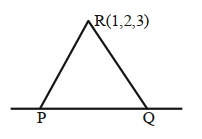
Let $P$ and $Q$ be the points on the line $\frac{x+3}{8}=\frac{y-4}{2}=\frac{z+1}{2}$ which are at a distance of $6$ units from the point $R(1,2,3)$. If the centroid of the triangle $PQR$ is $(\alpha, \beta, \gamma)$, then $\alpha^2+\beta^2+\gamma^2$ is:
Answerc
$ \mathrm{P}(8 \lambda-3,2 \lambda+4,2 \lambda-1) $
$ \mathrm{PR}=6 $
$ (8 \lambda-4)^2+(2 \lambda+2)^2+(2 \lambda-4)^2=36 $
$ \lambda=0,1 $
$ \text { Hence } \mathrm{P}(-3,4,-1) \& \mathrm{Q}(5,6,1) $
$ \text { Centroid of } \Delta \mathrm{PQR}=(1,4,1) \equiv(\alpha, \beta, \gamma) $
$ \alpha^2+\beta^2+\gamma^2=18$
View full question & answer→MCQ 741 Mark
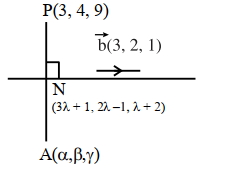
If the mirror image of the point $\mathrm{P}(3,4,9)$ in the line $\frac{x-1}{3}=\frac{y+1}{2}=\frac{z-2}{1}$ is $(\alpha, \beta, \gamma)$, then $14(\alpha+\beta+\gamma)$ is :
Answerc
$ \overrightarrow{\text { PN. }} \cdot \vec{b}=0 ? $
$ 3(3 \lambda-2)+2(2 \lambda-5)+(\lambda-7)=0 $
$14 \lambda=23 \Rightarrow \lambda=\frac{23}{14} $
$ \mathrm{~N}\left(\frac{83}{14}, \frac{32}{14}, \frac{51}{14}\right) $
$ \therefore \frac{\alpha+3}{2}=\frac{83}{14} \Rightarrow \alpha=\frac{62}{7} $
$ \frac{\beta+4}{2}=\frac{32}{14} \Rightarrow \beta=\frac{4}{7} $
$ \frac{\gamma+9}{2}=\frac{51}{14} \Rightarrow \gamma=\frac{-12}{7} $
$ \text { Ans. } 14(\alpha+\beta+\mathrm{r})=108$
View full question & answer→MCQ 751 Mark
If the shortest distance between the lines $\frac{x+2}{2}=\frac{y+3}{3}=\frac{z-5}{4}$ and $\frac{x-3}{1}=\frac{y-2}{-3}=\frac{z+4}{2}$ is $\frac{38}{3 \sqrt{5}} \mathrm{k}$ and $\int_0^{\mathrm{k}}\left[\mathrm{x}^2\right] \mathrm{dx}=\alpha-\sqrt{\alpha}$, where $[\mathrm{x}]$ denotes the greatest integer function, then $6 \alpha^3$ is equal to ............................
Answerd
$\frac{38}{3 \sqrt{5}} \hat{\mathrm{k}}=\frac{(5 \hat{\mathrm{i}}+5 \hat{\mathrm{j}}-9 \hat{\mathrm{k}})}{\sqrt{5}}$ $\left|\begin{array}{ccc}\hat{i} & \hat{j} & \hat{k} \\ 2 & 3 & 4 \\ 1 & -3 & 2\end{array}\right|$
$ \frac{38}{3 \sqrt{5}} \hat{\mathrm{k}}=\frac{19}{\sqrt{5}} $
$ \mathrm{k}=\frac{19}{\sqrt{5}} $
$ \mathrm{k}=\frac{3}{2} $
$ \int_0^{3 / 2}\left[\mathrm{x}^2\right]=\int_0^1 0+\int_1^{\sqrt{2}} 1+\int_{\sqrt{2}}^{3 / 2} 2 $
$ =\sqrt{2}-1+2\left(\frac{3}{2}-\sqrt{2}\right) $
$ =2-\sqrt{2} $
$ \alpha=2 $
$ \Rightarrow 6 \alpha^3=48$
View full question & answer→MCQ 761 Mark
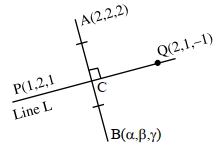
Consider a line $\mathrm{L}$ passing through the points $\mathrm{P}(1,2,1)$ and $\mathrm{Q}(2,1,-1)$. If the mirror image of the point $\mathrm{A}(2,2,2)$ in the line $\mathrm{L}$ is $(\alpha, \beta, \gamma)$, then $\alpha+\beta+6 \gamma$ is equal to....................
Answera
$DR'$s of Line $L \equiv-1: 1: 2$
$DR'$ s of $A B \equiv \alpha-2: \beta-2: \gamma-2$
$\mathrm{AB} \perp_{\mathrm{ar}} \mathrm{L} \Rightarrow 2-\alpha+\beta-2+2 \gamma-4=0$
$2 \gamma+\beta-\alpha=4$
Let $C$ is mid-point of $A B$
$\mathrm{C}\left(\frac{\alpha+2}{2}, \frac{\beta+2}{2}, \frac{\gamma+2}{2}\right)$
$DR'$ s of PC $=\frac{\alpha}{2}: \frac{\beta-2}{2}: \frac{\gamma}{2}$
line $\mathrm{L} \| \mathrm{PC} \Rightarrow \frac{-\alpha}{2}=\frac{\beta-2}{2}=\frac{\gamma}{4}=\mathrm{K}$ (let)
$ \alpha=-2 \mathrm{~K} $
$ \beta=2 \mathrm{~K}+2 $
$ \gamma=4 \mathrm{~K}$
use in ($1$) $\Rightarrow \mathrm{K}=\frac{1}{6}$
value of $\alpha+\beta+6 \gamma=24 \mathrm{~K}+2=6$
View full question & answer→MCQ 771 Mark
Let $(\alpha, \beta, \gamma)$ be the point $(8,5,7)$ in the line $\frac{x-1}{2}=\frac{y+1}{3}=\frac{z-2}{5}$. Then $\alpha+\beta+\gamma$ is equal to
Answerc
$Image$
$ \overrightarrow{\mathrm{AM}} \cdot(2 \hat{\mathrm{i}}+3 \hat{\mathrm{j}}+5 \hat{\mathrm{k}})=0 $
$ (2 \lambda-7)(2)+(3 \lambda-6)(3)+(5 \lambda-5)(5)=0 $
$ 38 \lambda=57 $
$ \lambda=\frac{3}{2} $
$ \mathrm{M}\left(4, \frac{7}{2}, \frac{19}{2}\right) $
$ \mathrm{A}^{\prime}(0,2,12)$
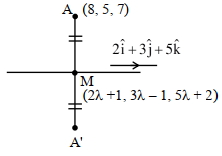
View full question & answer→MCQ 781 Mark
Let $\mathrm{P}(\alpha, \beta, \gamma)$ be the image of the point $\mathrm{Q}(3,-3,1)$ in the line $\frac{x-0}{1}=\frac{y-3}{1}=\frac{z-1}{-1}$ and $R$ be the point $(2,5,-1)$. If the area of the triangle $\mathrm{PQR}$ is $\lambda$ and $\lambda^2=14 \mathrm{~K}$, then $\mathrm{K}$ is equal to:
Answerd
$ \mathrm{RQ}=\sqrt{1+64+4}=\sqrt{69} $
$ \overrightarrow{\mathrm{RQ}}=\hat{\ell}-8 \hat{\mathrm{j}}+2 \hat{\mathrm{k}} $
$ \overrightarrow{\mathrm{RS}}=\hat{\ell}+\hat{\mathrm{j}}-\hat{\mathrm{k}} $
$ \cos \theta=\frac{\overrightarrow{\mathrm{RQ}} \cdot \overrightarrow{\mathrm{RS}}}{|\overrightarrow{\mathrm{RQ}}||\overrightarrow{\mathrm{RS}}|}=\left|\frac{1-8-2}{\sqrt{69} \sqrt{3}}\right|=\frac{9}{3 \sqrt{23}} $
$ \cos \theta=\frac{3}{\sqrt{23}}=\frac{\mathrm{RS}}{\mathrm{RQ}}=\frac{\mathrm{RS}}{\sqrt{69}} $
$ \mathrm{RS}=3 \sqrt{3} $
$ \sin \theta=\frac{\sqrt{14}}{\sqrt{23}}=\frac{\mathrm{QS}}{\sqrt{69}} $
$ \mathrm{QS}=\sqrt{42} $
$ \operatorname{area}=\frac{1}{2} \cdot 2 \mathrm{QS} \cdot \mathrm{RS}=\sqrt{42} \cdot 3 \sqrt{3} $
$ \lambda=9 \sqrt{14} $
$ \lambda^2=81.14=14 \mathrm{k} $
$ \mathrm{k}=81$
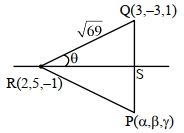
View full question & answer→MCQ 791 Mark
If the shortest distance between the lines $\frac{x-\lambda}{3}=\frac{y-2}{-1}=\frac{z-1}{1}$ and $\frac{x+2}{-3}=\frac{y+5}{2}=\frac{z-4}{4}$ is $\frac{44}{\sqrt{30}}$, then the largest possible value of $|\lambda|$ is equal to ..........
Answerc
$ \overline{\mathrm{a}}_1=\lambda \hat{\mathrm{i}}+2 \hat{\mathrm{j}}+\hat{\mathrm{k}} $
$ \overline{\mathrm{a}}_2=-2 \hat{\mathrm{i}}-5 \hat{\mathrm{j}}+4 \hat{\mathrm{k}} $
$ \overrightarrow{\mathrm{p}}-=3 \hat{\mathrm{i}}-\hat{\mathrm{j}}+\hat{\mathrm{k}} $
$ \overrightarrow{\mathrm{q}}-=-3 \hat{\mathrm{i}}+2 \hat{\mathrm{j}}+4 \hat{\mathrm{k}} $
$(\lambda+2) \hat{\mathrm{i}}+7 \hat{\mathrm{j}}-3 \hat{\mathrm{k}}=\overline{\mathrm{a}}_1-\overline{\mathrm{a}}_2$
$ \overrightarrow{\mathrm{p}} \times \overrightarrow{\mathrm{q}}-=-6 \hat{\mathrm{i}}-15 \hat{\mathrm{j}}+3 \hat{\mathrm{k}}$
$ \frac{44}{\sqrt{30}}=\frac{|-6 \lambda-12-105-9|}{\sqrt{(-6)^2+(-15)^2+3^2}} $
$ \frac{44}{\sqrt{30}}=\frac{|6 \lambda+126|}{3 \sqrt{30}} $
$ 132=|6 \lambda+126| $
$ \lambda=1, \lambda=-43 $
$ |\lambda|=43$
View full question & answer→MCQ 801 Mark
If the shortest distance between the lines
$ \mathrm{L}_1: \overrightarrow{\mathrm{r}}=(2+\lambda) \hat{\mathrm{i}}+(1-3 \lambda) \hat{\mathrm{j}}+(3+4 \lambda) \hat{\mathrm{k}}, \lambda \in \mathbb{R} $
$ \mathrm{L}_2: \overrightarrow{\mathrm{r}}=2(1+\mu) \hat{\mathrm{i}}+3(1+\mu) \hat{\mathrm{j}}+(5+\mu) \hat{k}, \mu \in \mathbb{R}$
is $\frac{\mathrm{m}}{\sqrt{\mathrm{n}}}$, where $\operatorname{gcd}(\mathrm{m}, \mathrm{n})=1$, then the value of $\mathrm{m}+\mathrm{n}$ equals.
Answerb
Shortes distance $(\mathrm{CD})=\left|\frac{\overline{\mathrm{AB}} \cdot \overrightarrow{\mathrm{p}} \times \overrightarrow{\mathrm{q}}}{|\overrightarrow{\mathrm{p}} \times \overrightarrow{\mathrm{q}}|}\right|$
$=\left|\frac{(0 \hat{i}+2 \hat{j}+2 \hat{k}) \cdot(-15 \hat{i}+7 \hat{j}+9 \hat{k})}{\sqrt{355}}\right|$
$=\frac{0+14+18}{\sqrt{355}}=\frac{32}{\sqrt{355}}$
$\therefore \mathrm{m}+\mathrm{n}=32+355=387$
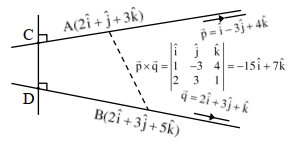
View full question & answer→MCQ 811 Mark
If the shortest distance between the lines $\frac{\mathrm{x}-\lambda}{2}=\frac{\mathrm{y}-4}{3}=\frac{\mathrm{z}-3}{4}$ and $\frac{x-2}{4}=\frac{y-4}{6}=\frac{z-7}{8}$ is $\frac{13}{\sqrt{29}}$, then a value of $\lambda$ is :
- A
$-\frac{13}{25}$
- B
$\frac{13}{25}$
- ✓
$1$
- D
$-1$
Answerc
$\left.\begin{array}{l}\overline{\mathrm{r}}_1=(\lambda \hat{\mathrm{i}}+4 \hat{\mathrm{j}}+3 \hat{\mathrm{k}})+\alpha(2 \hat{\mathrm{i}}+3 \hat{\mathrm{j}}+4 \hat{\mathrm{k}}) \\ \overline{\mathrm{r}_2}=(2 \hat{\mathrm{i}}+4 \hat{\mathrm{j}}+7 \hat{\mathrm{k}})+\beta(2 \hat{\mathrm{i}}+3 \hat{\mathrm{j}}+4 \hat{\mathrm{k}})\end{array}\right\} \begin{aligned} & \overline{\mathrm{b}}=2 \hat{\mathrm{i}}+3 \mathrm{j}+4 \hat{\mathrm{k}} \\ & \overline{\mathrm{a}}_1+\lambda \hat{\mathrm{i}}+4 \hat{\mathrm{j}}+3 \hat{\mathrm{k}} \\ & =2 \hat{\mathrm{i}}+4 \hat{\mathrm{j}}+7 \hat{\mathrm{k}}\end{aligned}$
Shortest dist. $=\frac{\left|\overline{\mathrm{b}} \times\left(\overline{\mathrm{a}}_2-\overline{\mathrm{a}}_1\right)\right|}{|\mathrm{b}|}=\frac{13}{\sqrt{29}} $
$ \frac{|(2 \hat{\mathrm{i}}+3 \hat{\mathrm{j}}+4 \hat{\mathrm{k}}) \times((2-\lambda) \hat{\mathrm{i}}+4 \hat{\mathrm{k}})|}{\sqrt{29}}=\frac{13}{\sqrt{29}} $
$ |-8 \hat{\mathrm{j}}-3(2-\lambda) \hat{\mathrm{k}}+12 \hat{\mathrm{i}}+4(2-\lambda) \hat{\mathrm{j}}|=13 $
$ |12 \hat{\mathrm{i}}-4 \lambda \hat{\mathrm{j}}+(3 \lambda-6) \hat{\mathrm{k}}|=13 $
$ 144+16 \lambda^2+(3 \lambda-6)^2=169 $
$ 16 \lambda^2+(3 \lambda-6)^2=25=\lambda \Rightarrow=1$
View full question & answer→MCQ 821 Mark
Let the line $\mathrm{L}$ intersect the lines
$\mathrm{x}-2=-\mathrm{y}=\mathrm{z}-1,2(\mathrm{x}+1)=2(\mathrm{y}-1)=\mathrm{z}+1$
and be parallel to the line $\frac{x-2}{3}=\frac{y-1}{1}=\frac{z-2}{2}$.
Then which of the following points lies on $\mathrm{L}$ ?
- A
$\left(-\frac{1}{3}, 1,1\right)$
- ✓
$\left(-\frac{1}{3}, 1,-1\right)$
- C
$\left(-\frac{1}{3},-1,-1\right)$
- D
$\left(-\frac{1}{3},-1,1\right)$
AnswerCorrect option: B. $\left(-\frac{1}{3}, 1,-1\right)$
b
$Image$
$\mathrm{L}_1: \frac{\mathrm{x}-2}{1}=\frac{\mathrm{y}}{-1}=\frac{\mathrm{z}-1}{1}=\lambda$
$\mathrm{L}_2: \frac{\mathrm{x}+1}{\frac{1}{2}}=\frac{\mathrm{y}-1}{\frac{1}{2}}=\frac{\mathrm{z}+1}{1}=\mu$
dr of line $MN$ will be $<3+\lambda-\frac{\mu}{2},-1-\lambda-\frac{\mu}{2}, 2+\lambda-\mu>\&$ it will be proportional to $<3,1,2>$
$Image$
$\Rightarrow \lambda=-\frac{4}{3} \& \mu=-\frac{2}{3}$
$\therefore$ Coordinate of $\mathrm{M}$ will be $<\left(\frac{2}{3}, \frac{4}{3},-\frac{1}{3}\right)$ and equation of required line will be.
$\frac{\mathrm{x}-\frac{2}{3}}{3}=\frac{\mathrm{y}-\frac{4}{3}}{1}=\frac{\mathrm{z}+\frac{1}{3}}{2}=\mathrm{k}$
So any point on this line will be
$ \left(\frac{2}{3}+3 \mathrm{k}, \frac{4}{3}+\mathrm{k},-\frac{1}{3}+2 \mathrm{k}\right) $
$ \because \frac{2}{3}+3 \mathrm{k}=-\frac{1}{3} \Rightarrow \mathrm{k}=-\frac{1}{3}$
$\therefore$ Point lie on the line for
$\mathrm{k}=-\frac{1}{3} \text { is }\left(-\frac{1}{3}, 1,-1\right)$
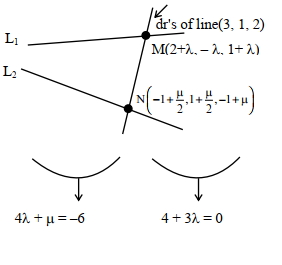
View full question & answer→MCQ 831 Mark
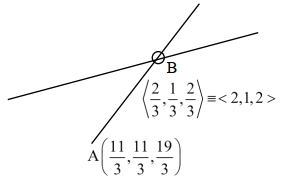
Consider the line $\mathrm{L}$ passing through the points $(1,2,3)$ and $(2,3,5)$. The distance of the point $\left(\frac{11}{3}, \frac{11}{3}, \frac{19}{3}\right)$ from the line $\mathrm{L}$ along the line $\frac{3 x-11}{2}=\frac{3 y-11}{1}=\frac{3 z-19}{2}$ is equal to :
Answera
$ \frac{x-1}{2-1}=\frac{y-2}{3-2}=\frac{z-3}{5-3} $
$ \Rightarrow \frac{x-1}{1}=\frac{y-2}{1}=\frac{z-3}{2}=\lambda$
$Image$
$ \mathrm{B}(1+\lambda, 2+\lambda, 3+2 \lambda) $
$ \text { D.R. of } \mathrm{AB}=<\frac{3 \lambda-8}{3}, \frac{3 \lambda-5}{3}, \frac{6 \lambda-10}{3}> $
$ \mathrm{B}\left(\frac{5}{3}, \frac{8}{3}, \frac{13}{3}\right) \frac{3 \lambda-8}{3 \lambda-5}=\frac{2}{1} \Rightarrow 3 \lambda-8=6 \lambda-10 $
$ 3 \lambda=2 $
$ \lambda=\frac{2}{3} $
$ \mathrm{AB}=\frac{\sqrt{36+9+36}}{3}=\frac{9}{3}=3$
View full question & answer→MCQ 841 Mark
The distance of the point $P (4,6,-2)$ from the line passing through the point $(-3,2,3)$ and parallel to a line with direction ratios $3,3,-1$ is equal to :
- A
$3$
- B
$\sqrt{6}$
- C
$2 \sqrt{3}$
- ✓
$\sqrt{14}$
AnswerCorrect option: D. $\sqrt{14}$
d
Equation of line is $\frac{x+3}{3}=\frac{y-2}{3}=\frac{z-3}{-1}=\lambda$ $M (3 \lambda-3,3 \lambda+2,3-\lambda)$
D.R of $\operatorname{PM}(3 \lambda-7,3 \lambda-4,5-\lambda)$
Since $P M$ is perpendicular to line
$\Rightarrow 3(3 \lambda-7)+3(3 \lambda-4)-1(5-\lambda)=0$
$\Rightarrow \lambda=2$
$\Rightarrow M (3,8,1) \Rightarrow PM =\sqrt{14}$
View full question & answer→MCQ 851 Mark
Consider the lines $L _1$ and $L _2$ given by
$L_1: \frac{ x -1}{2}=\frac{ y -3}{1}=\frac{ z -2}{2}$
$L _2: \frac{ x -2}{1}=\frac{ y -2}{2}=\frac{ z -3}{3}$
A line $L _3$ having direction ratios $1,-1,-2$, intersects $L _1$ and $L _2$ at the points $P$ and $Q$ respectively. Then the length of line segment $PQ$ is
- ✓
$2 \sqrt{6}$
- B
$3 \sqrt{2}$
- C
$4 \sqrt{3}$
- D
$4$
AnswerCorrect option: A. $2 \sqrt{6}$
a
Let $P=(2 \lambda+1, \lambda+3,2 \lambda+2)$
Let $Q=(\mu+2,2 \mu+2,3 \mu+3)$
$\Rightarrow \frac{2 \lambda-\mu-1}{1}=\frac{\lambda-2 \mu+1}{-1}=\frac{2 \lambda-3 \mu-1}{-2}$
$\Rightarrow \lambda=\mu=3 \Rightarrow P(7,6,8) \text { and } Q (5,8,12)$
$PQ =2 \sqrt{6}$
View full question & answer→MCQ 861 Mark
Let the co-ordinates of one vertex of $\triangle ABC$ be $A (0,2, \alpha)$ and the other two vertices lie on the line $\frac{x+\alpha}{5}=\frac{y-1}{2}=\frac{z+4}{3}$. For $\alpha \in Z$, if the area of $\triangle ABC$ is $21$ sq. units and the line segment $BC$ has length $2 \sqrt{21}$ units, then $\alpha^2$ is equal to $...........$.
Answerc
A. $\left( O _1 2, \alpha\right)$
$\left|\frac{1}{2} \cdot 2 \sqrt{21} \cdot\right| \begin{array}{ccc} i & j & k \\ \alpha & 1 & \alpha+4 \\ 5 & 2 & 3\end{array}\left|\frac{1}{\sqrt{25+4+9}}\right|=21 \sqrt{21}$
$\sqrt{(2 \alpha+5)^2+(2 \alpha+20)^2+(2 \alpha-5)^2}=\sqrt{21} \sqrt{38}$
$\Rightarrow 12 \alpha^2+80 \alpha+450=798$
$\Rightarrow 12 \alpha^2+80 \alpha-348=0$
$\Rightarrow \alpha=3 \Rightarrow \alpha^2=9$
View full question & answer→MCQ 871 Mark
The shortest distance between the lines $\frac{x-4}{4}=\frac{y+2}{5}=\frac{z+3}{3}$ and $\frac{x-1}{3}=\frac{y-3}{4}=\frac{z-4}{2}$ is
- ✓
$3 \sqrt{6}$
- B
$6 \sqrt{3}$
- C
$6 \sqrt{2}$
- D
$2 \sqrt{6}$
AnswerCorrect option: A. $3 \sqrt{6}$
a
$S _{ d }=\left|\frac{(\overrightarrow{ a }-\overrightarrow{ b }) \times\left(\overrightarrow{ n }_1 \times \overrightarrow{ n }_2\right)}{\left|\overrightarrow{ n }_1 \times \overrightarrow{ n }_2\right|}\right|$
$\overline{ a }=(4,-2,-3)$
$\overline{ b }=(1,3,4)$
$\overline{ n }_1=(4,5,3)$
$\overline{ n }_2=(3,4,2)$
$\overline{ n }_1 \times \overline{ n }_2=\left|\begin{array}{lll} i & j & k \\ 4 & 5 & 3 \\ 3 & 4 & 2\end{array}\right|=\hat{ i }(-2)-\hat{ j }(-1)+\hat{ k }(1)=(-2,1,1)$
$S_d=\frac{(3,-5,-7) \cdot(-2,1,1)}{\sqrt{6}}=\left|\frac{-6-5-7}{\sqrt{6}}\right|=3 \sqrt{6}$
View full question & answer→MCQ 881 Mark
The line, that is coplanar to the line $\frac{x+3}{-3}=\frac{y-1}{1}=\frac{z-5}{5}$, is
- A
$\frac{x+1}{1}=\frac{y-2}{2}=\frac{z-5}{5}$
- ✓
$\frac{x+1}{-1}=\frac{y-2}{2}=\frac{z-5}{5}$
- C
$\frac{x+1}{-1}=\frac{y-2}{2}=\frac{z-5}{4}$
- D
$\frac{x-1}{-1}=\frac{y-2}{2}=\frac{z-5}{5}$
AnswerCorrect option: B. $\frac{x+1}{-1}=\frac{y-2}{2}=\frac{z-5}{5}$
b
Condition of co-planarity
$\left|\begin{array}{lll}x_2-x_1 & a_1 & a_2 \\ y_2-y_1 & b_1 & b_2 \\ z_2-z_1 & c_1 & c_2\end{array}\right|=0$
Where $a_1, b_1, c_1$ are direction cosine of $1^{\text {st }}$ line and $a_2, b_2, c_2$ are direction cosine of $2^{\text {nd }}$ line.
Now, solving options
Point $(-3,1,5)$ and point $(-1,2,5)$
(1) $\left|\begin{array}{ccc}-3 & 1 & 5 \\ 1 & 2 & 5 \\ -2 & -1 & 0\end{array}\right|$
$=-3(5)-(10)+5(-1+4)$
$=-15-10+15=-10$
(2) Point $(-1,2,5)$
$\left|\begin{array}{ccc}-3 & 1 & 5 \\ -1 & 2 & 5 \\ -2 & -1 & 0\end{array}\right|$
$=3(5)-(10)+5(1+4)$
$-25+25=0$
(3) Point $(-1,2,5)$
$\left|\begin{array}{rrr}-3 & 1 & 5 \\ -1 & 2 & 4 \\ -2 & -1 & 0\end{array}\right|$
$-3(4)-(8)+5(1+4)$
$-12-8+25=5$
(4) Point $(-1,2,5)$
$\left|\begin{array}{ccc}-3 & 1 & 5 \\ -1 & 2 & 5 \\ 4 & 1 & 0\end{array}\right|$
$-3(-5)-(-20)+5(-1-8)$
$15+20-45=-10$
View full question & answer→MCQ 891 Mark
Let $S$ be the set of all values of $\lambda$, for which the shortest distance between the lines $\frac{x-\lambda}{0}=\frac{y-3}{4}=\frac{z+6}{1}$ and $\frac{x+\lambda}{3}=\frac{y}{-4}=\frac{z-6}{0}$ is $13$ Then $8\left|\sum_{\lambda \in S} \lambda\right|$ is equal to
Answerc
Shor test distance $=\frac{\left|\begin{array}{ccc}0 & 4 & 1 \\ 3 & -4 & 0 \\ 2 \lambda & 3 & -12\end{array}\right|}{\left|\begin{array}{ccc}\hat{ i } & \hat{ j } & \hat{ k } \\ 0 & 4 & 1 \\ 3 & -4 & 0\end{array}\right|}$
$13=\frac{|153+8 \lambda|}{|4 \hat{ i }+3 \hat{ j }-12 \hat{ k }|}$
$=\frac{|153+8 \lambda|}{13}$
$|153+8 \lambda|=169$
$153+8 \lambda=169,-169$
$\lambda=\frac{16}{8}, \frac{-322}{8}$
$8\left|\sum_{\lambda \in S} \lambda\right|=306$
View full question & answer→MCQ 901 Mark
The shortest distance between the lines $x+1=2 y=-$ $12 z$ and $x=y+2=6 z-6$ is
- ✓
$2$
- B
$3$
- C
$\frac{5}{2}$
- D
$\frac{3}{2}$
Answera
$\frac{x+1}{1}=\frac{y}{\frac{1}{2}}=\frac{z}{\frac{-1}{12}}$ and $\frac{x}{1}=\frac{y+2}{1}=\frac{z-1}{\frac{1}{6}}$
$\Rightarrow$ Shortest distance $=\frac{(\overrightarrow{ b }-\overrightarrow{ a }) \cdot(\overrightarrow{ p } \times \overrightarrow{ q })}{|\overrightarrow{ p } \times \overrightarrow{ q }|}$
S.D. $=(-\hat{ i }+2 \hat{ j }-\hat{ k }) \cdot \frac{(\overrightarrow{ p } \times \overrightarrow{ q })}{|\overrightarrow{ p } \times \overrightarrow{ q }|}$
$\left\{\overrightarrow{ p } \times \overrightarrow{ q } \equiv\left|\begin{array}{ccc}\hat{ i } & \hat{ j } & \hat{ k } \\ 1 & \frac{1}{2} & \frac{-1}{12} \\ 1 & 1 & \frac{1}{6}\end{array}\right|=\frac{1}{6} \hat{ i }-\frac{1}{4} \hat{ j }+\frac{1}{2} \hat{ k }\right.$ or $\left.2 \hat{ i }-3 \hat{ j }+6 \hat{ k }\right\}$
S.D. $=\frac{(-\hat{ i }+2 \hat{ j }-\hat{ k }) \cdot(2 \hat{ i }-3 \hat{ j }+6 \hat{ k })}{\sqrt{2^2+3^2+6^2}}=\left|\frac{-14}{7}\right|=2$
View full question & answer→MCQ 911 Mark
Shortest distance between the lines $\frac{x-1}{2}=\frac{y+8}{-7}=\frac{z-4}{5}$ and $\frac{x-1}{2}=\frac{y-2}{1}=\frac{z-6}{-3}$ is
- A
$2 \sqrt{3}$
- ✓
$4 \sqrt{3}$
- C
$3 \sqrt{3}$
- D
$5 \sqrt{3}$
AnswerCorrect option: B. $4 \sqrt{3}$
b
$\frac{x-1}{2}=\frac{y+8}{-7}=\frac{z-4}{5} \quad \vec{a}=\hat{i}-8 \hat{j}+4 \hat{k}$
$\frac{x-1}{2}=\frac{y-2}{1}=\frac{z-6}{-3} \quad \vec{b}=\hat{i}+2 \hat{j}+6 \hat{k}$
$\vec{p}=2 \hat{i}-7 \hat{j}+5 \hat{k}, \overrightarrow{ q }=2 \hat{i}+\hat{j}-3 \hat{k}$
$\overrightarrow{ p } \times \overrightarrow{ q }=\left|\begin{array}{ccc}\hat{ i } & \hat{ j } & \hat{ k } \\ 2 & -7 & 5 \\ 2 & 1 & -3\end{array}\right|$
$=\hat{i}(16)-\hat{j}(-16)+\hat{k}(16)$
$=16(\hat{i}+\hat{j}+\hat{k})$
$d =\left|\frac{( a - b ) \cdot(\overrightarrow{ p } \times \overrightarrow{ q })}{|\overrightarrow{ p } \times \overrightarrow{ q }|}\right|=\left|\frac{(-10 \hat{ j }-2 \hat{ k }) \cdot 16(\hat{ i }+\hat{ j }+\hat{ k })}{16 \sqrt{3}}\right|$
$=\left|\frac{-12}{\sqrt{3}}\right|=4 \sqrt{3}$
View full question & answer→MCQ 921 Mark
The shortest distance between the lines $\frac{x-5}{1}=\frac{y-2}{2}=\frac{z-4}{-3}$ and $\frac{x+3}{1}=\frac{y+5}{4}=\frac{z-1}{-5}$ is
- A
$7 \sqrt{3}$
- B
$5 \sqrt{3}$
- ✓
$6 \sqrt{3}$
- D
$4 \sqrt{3}$
AnswerCorrect option: C. $6 \sqrt{3}$
c
Shortest distance between two lines
$\frac{x-x_1}{a_1}=\frac{y-y_1}{a_2}=\frac{z-z_1}{a_3}$
$\frac{x-x_2}{b_1}=\frac{y-y_2}{b_2}=\frac{z-z_2}{b_3}$ is given as
$\frac{\left|\begin{array}{ccc}x_1-x_2 & y_1-y_2 & z_1-z_2 \\ a_1 & a_2 & a_3 \\ b_1 & b_2 & b_3\end{array}\right|}{\sqrt{\left(a_1 b_3-a_3 b_2\right)^2+\left(a_1 b_3-a_3 b_1\right)^2+\left(a_1 b_2-a_2 b_1\right)^2}}$
$\frac{\left|\begin{array}{ccc}5-(3) & 2-(-5) & 4-1 \\ 1 & 2 & -3 \\ 1 & 4 & -5\end{array}\right|}{\sqrt{(-10+12)^2+(-5+3)^2+(4-2)^2}}$
$=\frac{\left|\begin{array}{ccc}8 & 7 & 3 \\ 1 & 2 & -3 \\ 1 & 4 & -5\end{array}\right|}{\sqrt{(2)^2+(2)^2+(2)^2}}$
$=\frac{16+14+6}{\sqrt{12}}=\frac{36}{\sqrt{12}}=\frac{36}{2 \sqrt{3}}$
$=\frac{18}{\sqrt{3}}=6 \sqrt{3}$
View full question & answer→MCQ 931 Mark
The shortest distance between the lines $\frac{x-2}{3}=\frac{y+1}{2}=\frac{z-6}{2}$ and $\frac{x-6}{3}=\frac{1-y}{2}=\frac{z+8}{0}$ is equal to $............$
Answerc
Shortest distance between the lines
$\begin{array}{l}=\frac{\left|\begin{array}{ccc}4 & 2 & -14 \\3 & 2 & 2 \\3 & -2 & 0\end{array}\right|}{\left|\begin{array}{ccc}\hat{ i } & \hat{ j } & \hat{ k } \\3 & 2 & 2 \\3 & -2 & 0\end{array}\right|} \mid \\=\frac{16+12+168}{|-4 \hat{ i }+6 \hat{ j }-12 \hat{ k }|}=\frac{196}{14}=14\end{array}$
View full question & answer→MCQ 941 Mark
If the shortest between the lines $\frac{x+\sqrt{6}}{2}=\frac{y-\sqrt{6}}{3}=\frac{z-\sqrt{6}}{4}$ and $\frac{x-\lambda}{3}=\frac{y-2 \sqrt{6}}{4}=\frac{z+2 \sqrt{6}}{5}$ is $6$, then the square of sum of all possible values of $\lambda$ is
- A
$380$
- B
$3885$
- C
$386$
- ✓
$384$
Answerd
Shortest distance between the lines
$\frac{x+\sqrt{6}}{2}=\frac{y-\sqrt{6}}{3}=\frac{z-\sqrt{6}}{4}$
$\frac{x-\lambda}{3}=\frac{y-2 \sqrt{6}}{4}=\frac{2+2 \sqrt{6}}{5}$ is $6$
Vector along line of shortest distance
$=\left|\begin{array}{lll} i & j & k \\ 2 & 3 & 4 \\ 3 & 4 & 5\end{array}\right|, \Rightarrow-\hat{ i }+2 \hat{ j }- k$ (its magnitude is $\sqrt{6}$ )
$\begin{array}{l}\text { Now } \frac{1}{\sqrt{6}}\left|\begin{array}{ccc}\sqrt{6}+\lambda & \sqrt{6} & -3 \sqrt{6} \\2 & 3 & 4 \\3 & 4 & 5\end{array}\right|=\pm 6 \\\Rightarrow \lambda=-2 \sqrt{6}, 10 \sqrt{6}\end{array}$
So, square of sum of these values is $384$.
View full question & answer→MCQ 951 Mark
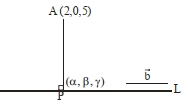
The foot of perpendicular of the point $(2,0,5)$ on the line $\frac{x+1}{2}=\frac{y-1}{5}=\frac{z+1}{-1}$ is $(\alpha, \beta, \gamma)$. Then. Which of the following is $NOT$ correct?
- A
$\frac{\alpha \beta}{\gamma}=\frac{4}{15}$
- B
$\frac{\alpha}{\beta}=-8$
- ✓
$\frac{\beta}{\gamma}=-5$
- D
$\frac{\gamma}{\alpha}=\frac{5}{8}$
AnswerCorrect option: C. $\frac{\beta}{\gamma}=-5$
c
$L : \frac{ x +1}{2}=\frac{ y -1}{5}=\frac{ z +1}{-1}=\lambda$ (let)
Let foot of perpendicular is
$P (2 \lambda-1,5 \lambda+1,-\lambda-1)$
$\overline{ PA }=(3-2 \lambda) \hat{ i }-(5 \lambda+1) \hat{ j }+(6+\lambda) \hat{ k }$
Direction ratio of line $\Rightarrow \vec{b}=2 \hat{i}+5 \hat{j}-\hat{k}$
$\text { Now, } \Rightarrow \overline{ PA } \cdot \overrightarrow{ b }=0$
$\Rightarrow 2(3-2 \lambda)-5(5 \lambda+1)-(6+\lambda)=0$
$\Rightarrow \lambda=\frac{-1}{6}$
$P (2 \lambda-1,5 \lambda+1,-\lambda-1) \equiv P (\alpha, \beta, \gamma)$
$\Rightarrow \alpha=2\left(-\frac{1}{6}\right)-1=-\frac{4}{3} \Rightarrow \alpha=-\frac{4}{3}$
$\Rightarrow \beta=5\left(-\frac{1}{6}\right)+1=\frac{1}{6} \Rightarrow \beta=\frac{1}{6}$
$\Rightarrow \gamma=-\lambda-1=\frac{1}{6}-1 \Rightarrow \gamma=-\frac{5}{6}$
$\therefore$ Check options
View full question & answer→MCQ 961 Mark
If the shortest distance between the line joining the points $(1, 2, 3)$ and $(2,3,4)$, and the line $\frac{x-1}{2}=\frac{y+1}{-1}=\frac{z-2}{0}$ is $\alpha$, then $28 \alpha^2$ is equal to $........$.
Answera
$\overrightarrow{ r }=(\hat{ i }+2 \hat{ j }+3 \hat{ k })+\lambda(\hat{ i }+\hat{ j }+\hat{ k }) \overrightarrow{ r }=\overrightarrow{ a }+\lambda \overrightarrow{ p }$
$\overrightarrow{ r }=(+\hat{ i }-\hat{ j }+2 \hat{ k })+\mu(2 \hat{ i }-\hat{ j }) \overrightarrow{ r }=\overrightarrow{ b }+\mu \overrightarrow{ q }$
$\overrightarrow{ p } \times \overrightarrow{ q }=\left|\begin{array}{ccc}\hat{ i } & \hat{ j } & \hat{ k } \\ 1 & 1 & 1 \\ 2 & -1 & 0\end{array}\right|=\hat{ i }+2 \hat{ j }-3 \hat{ k }$
$d =\left|\frac{(\overrightarrow{ b }-\overrightarrow{ a }) \cdot(\overrightarrow{ p } \times \overrightarrow{ q })}{|\overrightarrow{ p } \times \overrightarrow{ q }|}\right|$
$d =\left|\frac{(-3 \hat{ j }-\hat{ k }) \cdot(\hat{ i }+2 \hat{ j }-3 \hat{ k })}{\sqrt{14}}\right|$
$=\left|\frac{-6+3}{\sqrt{14}}\right|=\frac{3}{\sqrt{14}}$
$\alpha=\frac{3}{\sqrt{14}}$
Now, $28 \alpha^2= 28 \times \frac{9}{14}=18$
View full question & answer→MCQ 971 Mark
Let a line $L$ pass through the point $P (2,3,1)$ and be parallel to the line $x+3 y-2 z-2=0=x-y+2 z$. If the distance of $L$ from the point $(5,3,8)$ is $\alpha$, then $3 \alpha^2$ is equal to $......$.
Answerb
$\left|\begin{array}{ccc}\hat{ i } & \hat{ j } & \hat{ k } \\ 1 & 3 & -2 \\ 1 & -1 & 2\end{array}\right|=4 \hat{ i }-4 \hat{ j }-4 \hat{ k }$
$\therefore$ Equation of line is $\frac{ x -2}{1}=\frac{ y -3}{-1}=\frac{ z -1}{-1}$
Let $Q$ be $(5,3,8)$ and foot of $\perp$ from $Q$ on this line be $R$.
Now, $R \equiv( k +2,- k +3,- k +1)$
$D R$ of $Q R$ are $(k-3,-k,-k-7)$
$\therefore(1)( k -3)+(-1)(- k )+(-1)(- k -7)=0$
$\Rightarrow k =-\frac{4}{3}$
$\therefore \alpha^2=\left(\frac{13}{3}\right)^2+\left(\frac{4}{3}\right)^2+\left(\frac{17}{3}\right)^2=\frac{474}{9}$
$\therefore 3 \alpha^2=158$
View full question & answer→MCQ 981 Mark
Let the shortest distance between the lines $L : \frac{ x -5}{-2}=\frac{ y -\lambda}{0}=\frac{ z +\lambda}{1}, \lambda \geq 0$ and $L _1: x +1= y -$ $1=4-z$ be $2 \sqrt{6}$. If $(\alpha, \beta, \gamma)$ lies on $L$, then which of the following is NOT possible?
- ✓
$\alpha+2 \gamma=24$
- B
$2 \alpha+\gamma=7$
- C
$2 \alpha-\gamma=9$
- D
$\alpha-2 \gamma=19$
AnswerCorrect option: A. $\alpha+2 \gamma=24$
a
$\overline{ b _1} \times \overline{ b _2}=\left|\begin{array}{ccc}\hat{ i } & \hat{ j } & \hat{ k } \\ -2 & 0 & 1 \\ 1 & 1 & -1\end{array}\right|=-\hat{ i }-\hat{ j }-2 \hat{ k }$
$\begin{array}{l}\overline{ a _2}-\overline{ a _1}=6 \hat{ i }+(\lambda-1) \hat{ j }+(-\lambda-4) \hat{ k } \\ 2 \sqrt{6}=\left|\frac{-6-\lambda+1+2 \lambda+8}{\sqrt{1+1+4}}\right| \\ |\lambda+3|=12 \Rightarrow \lambda=9,-15 \\ \alpha=-2 k +5, \gamma= k -\lambda \text { where } k \in R \\ \Rightarrow \alpha+2 \gamma=5-2 \lambda=-13,35\end{array}$
View full question & answer→MCQ 991 Mark
One vertex of a rectangular parallelopiped is at the origin $O$ and the lengths of its edges along $x , y$ and $Z$ axes are $3,4$ and $5$ units respectively. Let $P$ be the vertex $(3,4,5)$. Then the shortest distance between the diagonal $OP$ and an edge parallel to $Z$ axis, not passing through $O$ or $P$ is:
- A
$\frac{12}{\sqrt{5}}$
- B
$\frac{12}{5 \sqrt{5}}$
- C
$12 \sqrt{5}$
- ✓
$\frac{12}{5}$
AnswerCorrect option: D. $\frac{12}{5}$
d
Equation of OP is $\frac{x}{3}=\frac{y}{4}=\frac{z}{5}$
$\begin{array}{ll}a_1=(0,0,0) & a_2=(3,0,5) \\b_1=(3,4,5) & b_2=(0,0,1)\end{array}$
Equation of edge parallel to $z$ axis
$\begin{aligned}& \frac{x-3}{0}=\frac{y-0}{0}=\frac{z-5}{1} \\& S . D=\frac{\left(\vec{a}_2-\vec{a}_1\right) \cdot\left(\vec{b}_1 \times \vec{b}_2\right)}{\left|\vec{b}_1 \times \vec{b}_2\right|} \\& \frac{\left|\begin{array}{lll}3 & 0 & 5 \\ 3 & 4 & 5 \\0 & 0 & 1\end{array}\right|}{\left|\begin{array}{rrr}\hat{i} & \hat{j} & \hat{ k } \\3 & 4 & 5 \\0 & 0 & 1\end{array}\right|}=\frac{3(4)}{|4 \hat{i}-3 \hat{j}|}=\frac{12}{5} \\&\end{aligned}$
View full question & answer→MCQ 1001 Mark
If the points with vectors $\alpha \hat{i}+10 \hat{j}+13 \hat{k}$, $6 \hat{i}+11 \hat{j}+11 \hat{k}, \frac{9}{2} \hat{i}+\beta \hat{j}-8 \hat{k}$ are collinear, then $(19 \alpha-6 \beta)^2$ is equal to $...........$.
Answera
$(\alpha, 10,13) ;(6,11,11),\left(\frac{9}{2}, \beta,-8\right)$
$\frac{\alpha-6}{3 / 2}=\frac{-1}{11-\beta}=\frac{2}{19} -19=22-2 \beta$
$\alpha-6=\frac{3}{19} 2 \beta=41$
$\alpha=6+\frac{3}{19}=\frac{117}{19}$
$\therefore(19 \alpha-6 \beta)^2=(117-123)^2=36$
View full question & answer→