MCQ 1011 Mark
The shortest distance between the lines $\frac{x+2}{1}=\frac{y}{-2}=\frac{z-5}{2}$ and $\frac{x-4}{1}=\frac{y-1}{2}=\frac{z+3}{0}$ is $......$.
Answerb
Given lines
$\frac{x+2}{1}=\frac{y}{-2}=\frac{z-5}{2} \& \frac{x-4}{1}=\frac{y-1}{2}=\frac{z+3}{0}$
Formula for shortest distance
S.D. $=\frac{\left|\begin{array}{ccc} x _2- x _1 & y_2-y_1 & z_2-z_1 \\ a _1 & b _1 & c _1 \\ a _2 & b _2 & c _2\end{array}\right|}{\left|\begin{array}{ccc}\hat{i} & \hat{j} & \hat{k} \\ a _1 & b _1 & c _1 \\ a _2 & b _2 & c _2\end{array}\right|}$
$=\frac{\left|\begin{array}{ccc}6 & 1 & -8 \\ 1 & -2 & 2 \\ 1 & 2 & 0\end{array}\right|}{\left|\begin{array}{ccc}\hat{ i } & \hat{ j } & \hat{ k } \\ 1 & -2 & 2 \\ 1 & 2 & 0\end{array}\right|}=\frac{54}{6}=9$
View full question & answer→MCQ 1021 Mark
Let a line $l$ pass through the origin and be perpendicular to the lines
$l_1: \overrightarrow{ r }=(\hat{ i }-11 \hat{ j }-7 \hat{ k })+\lambda(\hat{ i }+2 \hat{ j }+3 \hat{ k }), \lambda \in R$
and $l_2: \overrightarrow{ r }=(-\hat{ i }+\hat{ k })+\mu(2 \hat{ i }+2 \hat{ j }+\hat{ k }), \mu \in R$.
If $P$ is the point of intersection of $l$ and $l_1$, and $Q (\alpha$ $, \beta, \gamma)$ is the foot of perpendicular from $P$ on $l_2$, then $9(\alpha+\beta+\gamma)$ is equal to $..........$.
Answerb
$\text { Let } \ell=(0 \hat{ i }+0 \hat{ j }+0 \hat{ k })+\gamma( a \hat{ i }+ b \hat{ j }+ ck )$
$=\gamma( a \hat{ i }+ b \hat{ j }+ c \hat{ k })$
$a \hat{i}+b \hat{j}+c \hat{k}=\left|\begin{array}{lll}\hat{i} & \hat{j} & \hat{k} \\ 1 & 2 & 3 \\ 2 & 2 & 1\end{array}\right|$
$=\hat{ i }(2-6)-\hat{ j }(1-6)+\hat{ k }(2-4)$
$=-4 \hat{ i }-5 \hat{ j }-2 \hat{ k }$
$\ell=\gamma(-4 \hat{ i }+5 \hat{ j }-2 \hat{ k })$
$P$ is intersection of $\ell$ and $\ell_1$
$-4 \gamma=1+\lambda, 5 \gamma=-11+2 \lambda,-2 \gamma=-7+3 \lambda$
By solving there equation $\gamma=-1, P (4,-5,2)$
Let $Q (-1+2 \mu, 2 \mu, 1+\mu)$
$\overline{ PQ } \cdot(2 \hat{ i }+2 \hat{ j }+\hat{ k })=0$
$-2+4 \mu+4 \mu+1+\mu=0$
$9 \mu=1$
$\mu=\frac{1}{9}$
$Q\left(\frac{-7}{9}, \frac{2}{9}, \frac{10}{9}\right)$
$9(\alpha+\beta+\gamma)=9\left(\frac{-7}{9}+\frac{2}{9}+\frac{10}{9}\right)$
$=5$
View full question & answer→MCQ 1031 Mark
Let the lines $l_1: \frac{ x +5}{3}=\frac{ y +4}{1}=\frac{ z -\alpha}{-2}$ and $l_2: 3 x +$ $2 y+z-2=0=x-3 y+2 z-13$ be coplanar. If the point $P ( a , b , c )$ on $l_1$ is nearest to the point $Q (-$ $4,-3,2)$, then $|a|+|b|+|c|$ is equal to
Answerc
$(3 x+2 y+z-2)+\mu(x-3 y+2 z-13)=0$
$3(3+\mu)+1 \cdot(2-3 \mu)-2(1+2 \mu)=0$
$9-4 \mu=0$
$\mu=\frac{9}{4}$
$4(-15-8+\alpha-2)+9(-5+12+2 \alpha-13)=0$
$-100+4 \alpha-54+18 \alpha=0$
$\Rightarrow \alpha=7$
$\text { Let } P \equiv(3 \lambda-5, \lambda-4,-2 \lambda+7)$
$\text { Direction ratio of } P Q(3 \lambda-1, \lambda-1,-2 \lambda+5)$
$\text { But } P Q \perp \ell_1$
$\Rightarrow 3(3 \lambda-1)+1 \cdot(\lambda-1)-2(-2 \lambda+5)=0$
$\Rightarrow \lambda=1$
$P(-2,-3,5) \Rightarrow|a|+|b|+|c|=10$
View full question & answer→MCQ 1041 Mark
If the line $x = y = z$ intersects the line $x \sin A+ y$ $\sin B + z \sin C -18=0= x \sin 2 A + y \sin 2 B + z$ $\sin 2 C -9$, where $A , B , C$ are the angles of a triangle $ABC$, then $80\left(\sin \frac{ A }{2} \sin \frac{ B }{2} \sin \frac{ C }{2}\right)$ is equal to $..........$.
Answera
$\sin A +\sin B+\sin C=\frac{18}{x}$
$\sin 2 A+\sin 2 B+\sin 2 C=\frac{9}{x}$
$\therefore \sin A +\sin B+\sin C=2(\sin 2 A+\sin 2 B+\sin 2 C)$
$4 \cos A / 2 \cos B / 2 \cos C / 2=2(4 \sin A \sin B \sin C)$
$16 \sin A / 2 \sin B / 2 \sin C / 2=1$
$\text { Hence Ans. }=5$
View full question & answer→MCQ 1051 Mark
If the lines $\frac{x-1}{2}=\frac{2-y}{-3}=\frac{z-3}{\alpha}$ and $\frac{x-4}{5}=\frac{y-1}{2}=\frac{z}{\beta}$ intersect, then the magnitude of the minimum value of $8 \alpha \beta$ is $...............$.
Answerc
If the lines $\frac{x-1}{2}=\frac{2-y}{-3}=\frac{z-3}{\alpha}$
And $\frac{x-4}{5}=\frac{y-1}{2}=\frac{z}{\beta}$ intersect
Point on first line $(1,2,3)$ and point on second line $(4,1,0)$.
Vector joining both points is $-3 \hat{i}+\hat{j}+3 \hat{k}$
Now vector along first line is $2 \hat{i}+3 \hat{j}+\alpha \hat{k}$
Also vector along second line is $5 \hat{i}+2 \hat{j}+\beta \hat{k}$
Now these three vectors must be coplanar
$\begin{aligned}& \Rightarrow\left|\begin{array}{ccc}2 & 3 & \alpha \\5 & 2 & \beta \\ -3 & 1 & 3\end{array}\right|=0 \\& \Rightarrow 2(6-\beta)-3(15+3 \beta)+\alpha(11)=0 \\ & \Rightarrow \alpha-\beta=3\end{aligned}$
Now $\alpha=3+\beta$
Given expression $8(3+\beta) \cdot \beta=8\left(\beta^2+3 \beta\right)$
$=8\left(\beta^2+3 \beta+\frac{9}{4}-\frac{9}{4}\right)=8\left(\beta+\frac{3}{2}\right)^2-18$
So magnitude of minimum value $=18$
View full question & answer→MCQ 1061 Mark
If the shortest distance between the lines $\frac{x-1}{2}=\frac{y-2}{3}=\frac{z-3}{\lambda}$ and $\frac{x-2}{1}=\frac{y-4}{4}=\frac{z-5}{5}$ is $\frac{1}{\sqrt{3}}$, then the sum of all possible values of $\lambda$ is
Answera
SHORTEST distance $\frac{\left|\left(a_{2}-a_{1}\right) \cdot\left(b_{1} \times b_{2}\right)\right|}{\left|b_{1} \times b_{2}\right|}$
$a _{1}=(1,2,3)$
$a _{2}=(2,4,5)$
$\overrightarrow{ b }_{2}=2 \hat{ i }+3 \hat{ j }+\lambda \hat{ k }$
$\overrightarrow{ b }_{2}=\hat{ i }+4 \hat{ j }+5 \hat{ k }$
S.D. $=\frac{\left|((2-1) \hat{i}+(4-2) \hat{j}+(5-3) \hat{k}) \cdot\left(\vec{b}_{1} \times \vec{b}_{2}\right)\right|}{\left|b_{1} \times b_{2}\right|}$
$\overrightarrow{ b }_{1} \times \overrightarrow{ b }_{2}=\left|\begin{array}{ccc}\hat{ i } & \hat{ j } & \hat{ k } \\ 2 & 3 & \lambda \\ 1 & 4 & 5\end{array}\right|$
$=\hat{ i }(15-4 \lambda)+\hat{ j }(\lambda-10)+\hat{ k }(5)$
$=(15-4 \lambda) \hat{ i }+(\lambda-10) \hat{ j }+5 \hat{ k }$
$\left|\vec{b}_{1} \times \vec{b}_{2}\right|=\sqrt{(15-4 \lambda)^{2}+(\lambda-10)^{2}+25}$
S.D. $=\frac{|(\hat{ i }+2 \hat{ j }+2 \hat{ k }) \cdot[(15-4 \lambda) \hat{ i }+(\lambda-10) \hat{ j }+5 \hat{ k }]|}{\sqrt{(15-4 \lambda)^{2}+(\lambda-10)^{2}+25}}$
$\frac{|15-4 \lambda+2 \lambda-20+10|}{\sqrt{(15-4 \lambda)^{2}+(\lambda-10)^{2}+25}}=\frac{1}{\sqrt{3}}$
$3(5-2 \lambda)^{2}=225+16 \lambda^{2}-120 \lambda+\lambda^{2}+100-20 \lambda+25$
$12 \lambda^{2}+75-60 \lambda=17 \lambda^{2}-140 \lambda+350$
$5 \lambda^{2}-80 \lambda+275=0$
$\lambda^{2}-16 \lambda+55=0$
$(\lambda-5)(\lambda-11)=0$
$\Rightarrow \lambda=5,11$
View full question & answer→MCQ 1071 Mark
If the shortest distance between the line $\vec{r}=(-\hat{i}+3 \hat{k})+\lambda(\hat{i}-a \hat{j})$ and $\vec{r}=(-\hat{j}+2 \hat{k})+\mu(\hat{i}-\hat{j}+\hat{k})$ is $\sqrt{\frac{2}{3}}$, then the integral value of $a$ is equal to
Answera
$a_{1}=(-1,0,3)$
$a_{2}=(0,-1,2)$
$b_{1}=(1,-a, 0)$ dr's of line ($1$)
$b_{2}=(1,-1,1)$ dr's of line $(2)$
$\overline{ a }_{2}-\overline{ a }_{1}=(1,-1,-1)$
$\overline{ b }_{1} \times \overline{ b }_{2}=\left|\begin{array}{ccc}\hat{ i } & \hat{ j } & \hat{ k } \\ 1 & - a & 0 \\ 1 & -1 & 1\end{array}\right|$
$\overline{ b }_{1} \times \overline{ b }_{2}=\hat{ i }(- a )-\hat{ j }+\hat{ k }( a -1)$
$\left|\bar{b}_{1} \times \bar{b}_{2}\right|=\sqrt{ a ^{2}+1+( a -1)^{2}}$
$a _{2}- a _{1} \cdot \overline{ b }_{1} \times \overline{ b }_{2}=2-2 a$
$\frac{2(1-a)}{\sqrt{a^{2}+1+(a-1)^{2}}}=\sqrt{\frac{2}{3}}$
Squaring an both the side
After solving $a=2, \frac{1}{2}$
View full question & answer→MCQ 1081 Mark
If the two lines $l_{1}: \frac{ x -2}{3}=\frac{ y +1}{-2}, z =2$ and $l_{2}: \frac{x-1}{1}=\frac{2 y+3}{\alpha}=\frac{z+5}{2}$ perpendicular, then an angle between the lines $l_{2}$ and $l_{3}: \frac{1- x }{3}=\frac{2 y -1}{-4}=\frac{ z }{4}$ is
- A
$\cos ^{-1}\left(\frac{29}{4}\right)$
- ✓
$\sec ^{-1}\left(\frac{29}{4}\right)$
- C
$\cos ^{-1}\left(\frac{2}{29}\right)$
- D
$\cos ^{-1}\left(\frac{2}{\sqrt{29}}\right)$
AnswerCorrect option: B. $\sec ^{-1}\left(\frac{29}{4}\right)$
b
$l_{1}: \frac{ x -2}{3}=\frac{ y +1}{-2}=\frac{ z -2}{0}$
$l_{2}: \frac{x-1}{1}=\frac{y+3 / 2}{\alpha / 2}=\frac{z+5}{2}$
$l_{3}: \frac{x-1}{-3}=\frac{y-1 / 2}{-2}=\frac{z-0}{4}$
$l_{1} \perp l_{2} \Rightarrow \frac{|3-\alpha+0|}{\sqrt{13} \sqrt{1+\frac{\alpha^{2}}{4}+4}}=0 \Rightarrow \alpha=3$
angle between $l_{2}$ and $l_{3}$
$\cos \theta=\frac{|1 \times(-3)+(-2)(\alpha / 2)+2 \times 4|}{\sqrt{1+4+\frac{\alpha^{2}}{4}} \sqrt{9+16+4}}$
$\cos \theta=\frac{|-3-\alpha+8|}{\sqrt{5+\frac{\alpha^{2}}{4}} \sqrt{29}}$
put $\alpha=3$
$\cos \theta=\frac{2}{\sqrt{\frac{29}{4} \sqrt{29}}}=\frac{4}{29}$
$\theta=\cos ^{-1}\left(\frac{4}{29}\right) \Rightarrow \theta=\sec ^{-1}\left(\frac{29}{4}\right)$
View full question & answer→MCQ 1091 Mark
The shortest distance between the lines $\frac{x-3}{2}=\frac{y-2}{3}=\frac{z-1}{-1}$ and $\frac{x+3}{2}=\frac{y-6}{1}=\frac{z-5}{3}$ is
- ✓
$\frac{18}{\sqrt{5}}$
- B
$\frac{22}{3 \sqrt{5}}$
- C
$\frac{46}{3 \sqrt{5}}$
- D
$6 \sqrt{3}$
AnswerCorrect option: A. $\frac{18}{\sqrt{5}}$
a
$\frac{x-3}{2}=\frac{y-2}{3}=\frac{z-1}{-1}$
$\frac{x+3}{2}=\frac{y-6}{1}=\frac{z-5}{3}$
$A =(3,2,1) \quad B =(-3,6,5)$
$\overline{n_{1}}=2 \hat{i}+3 \hat{j}-\hat{k}$
$\overrightarrow{ n _{2}}=2 \hat{ i }+\hat{ j }-3 \hat{ k }$
$\overrightarrow{ BA }=6 \hat{ i }-4 \hat{ j }-4 \hat{ k }$
Shortest Distance $=\frac{\left[\overrightarrow{ BA } \overline{n_{1}} \overrightarrow{n_{2}}\right]}{\left|\overline{n_{1}} \times \overline{n_{2}}\right|}$
$\overline{n_{1}} \times \overrightarrow{n_{2}}=\left|\begin{array}{ccc}\hat{ i } & \hat{ j } & \hat{ k } \\ 2 & 3 & -1 \\ 2 & 1 & 3\end{array}\right|$
$=10 \hat{ i }-8 \hat{ j }-4 \hat{ k }$
$\left[\begin{array}{lll}\overrightarrow{ BA } & \overline{ n _{1}} & \overline{ n _{2}}\end{array}\right]=60+32+16=108$
$\left|\overline{n_{1}} \times \overline{n_{2}}\right|=\sqrt{100+64+16}=\sqrt{180}$
$S . D=\frac{108}{\sqrt{180}}=\frac{108}{6 \sqrt{5}}=\frac{18}{\sqrt{5}}$
View full question & answer→MCQ 1101 Mark
The shortest distance between the lines $\frac{x+7}{-6}=\frac{y-6}{7}=z$ and $\frac{7-x}{2}=y-2=z-6$ is
- ✓
$2 \sqrt{29}$
- B
$1$
- C
$\sqrt{\frac{37}{29}}$
- D
$\frac{\sqrt{29}}{2}$
AnswerCorrect option: A. $2 \sqrt{29}$
a
$L_{1}: \frac{x+7}{-6}=\frac{y-6}{7}=\frac{z-0}{1}$
Any point on it $\vec{a}_{1}(-7,6,0)$
and $L_{1}$ is parallel to $\vec{b}_{1}(-6,7,1)$
$L_{2}: \frac{x-7}{-2}=\frac{y-2}{1}=\frac{z-6}{1}$
Any point on it, $\vec{a}_{2}(7,2,6)$
and $L_{2}$ is parallel to $b_{2}(-2,1,1)$
Shortest distance between $L_{1}$ and $L_{2}$
$=\left|\frac{\left(\vec{a}_{2}-\vec{a}_{1}\right) \cdot\left(\vec{b}_{1} \times \vec{b}_{2}\right)}{\left|\vec{b}_{1} \times \vec{b}_{2}\right|}\right|=\left|\frac{(-14,4,-6) \cdot(3,2,4)}{\sqrt{9+4+16}}\right|$
$=2 \sqrt{29}$
View full question & answer→MCQ 1111 Mark
If two straight lines whose direction cosines are given by the relations $l+m-n=0,3l^{2}+m^{2}+c n l =0$ are parallel, then the positive value of $c$ is
Answera
$1+ m - n =0$
$3 l^{2}+ m ^{2}+ cl (1+ m )=0$
$n =1+ m$
$3 l ^{2}+ m ^{2}+ cl ^{2}+ clm =0$
$(3+ c ) l ^{2}+ clm + m ^{2}=0$
$(3+c)\left(\frac{l}{m}\right)^{2}+c\left(\frac{l}{m}\right)+1=0 \ldots \ldots(1)$
$\because$ lies are parallel.
Roots of $(1)$ must be equal
$\Rightarrow D=0$
$c ^{2}-4(3+ c )=0$
$c ^{2}-4 c -12=0$
$( c -6)( c +2)=0$
$c =6$ or $c =-2$
$+ve$ value of $c =6$
View full question & answer→MCQ 1121 Mark
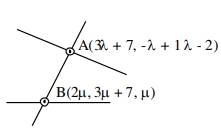
Let a line having direction ratios $1,-4,2$ intersect the lines $\frac{x-7}{3}=\frac{y-1}{-1}=\frac{z+2}{1}$ and $\frac{x}{2}=\frac{y-7}{3}=\frac{z}{1}$ at the point $A$ and $B$. Then $( AB )^{2}$ is equal to
Answerd
DR's of $A B$
$(3 \lambda-2 \mu+7,-\lambda-3 \mu-6, \lambda-\mu-2)$
$\frac{3 \lambda-2 \mu+7}{1}=\frac{-\lambda-3 \mu-6}{-4}=\frac{\lambda-\mu-2}{2}$
Taking first ($2$) $-12 \lambda+8 \mu-28=-\lambda-3 \mu-6$
$\lambda-\mu+2=0$
Taking second and third
$-2 \lambda-6 \mu-12=-4 \lambda+4 \mu+8$
$\lambda-5 \mu-10=0$
After solving above two equation $\lambda=-5, \mu=-3$
$A =(-8,6,7)$
$B =(-6,-2,-3)$
$\quad( AB )^{2}=4+64+16=84$
View full question & answer→MCQ 1131 Mark
Let $l_{1}$ be the line in $xy$-plane with $x$ and $y$ intercepts $\frac{1}{8}$ and $\frac{1}{4 \sqrt{2}}$ respectively, and $l_{2}$ be the line in $zx$-plane with $x$ and $z$ intercepts $-\frac{1}{8}$ and $-\frac{1}{6 \sqrt{3}}$ respectively. If $d$ is the shortest distance between the line $l_{1}$ and $l_{2}$, then $d ^{-2}$ is equal to
Answerb
$8 x+4 \sqrt{2} y=1, z=0$
$\Rightarrow \frac{x-\frac{1}{8}}{1}=\frac{y-0}{-\sqrt{2}}=\frac{z-0}{0}=\lambda$
$-8 x-6 \sqrt{3} z=1, y=0$
$\Rightarrow \frac{x+\frac{1}{8}}{3 \sqrt{3}}=\frac{y-0}{0}=\frac{z-0}{-4}$
$\left|\begin{array}{lll}\frac{1}{4} & 0 & 0 \\ 1 & -\sqrt{2} & 0 \\ 3 \sqrt{3} & 0 & -4\end{array}\right|=\sqrt{2}$
$d=\frac{1}{\sqrt{51}}$
$\frac{1}{d^{2}}=51$
View full question & answer→MCQ 1141 Mark
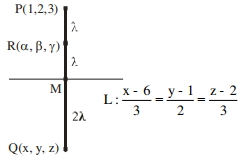
Let the image of the point $P (1,2,3)$ in the line $L : \frac{ x -6}{3}=\frac{ y -1}{2}=\frac{ z -2}{3}$ be $Q .$ let $R (\alpha, \beta, \gamma)$ be a point that divides internally the line segment $PQ$ in the ratio $1: 3$. Then the value of $22(\alpha+\beta+\gamma)$ is equal to
Answerd
Let $M$ be the mid-point of $PQ$
$\therefore M =(3 \lambda+6,2 \lambda+1,3 \lambda+2)$
Now, $\overrightarrow{ PM }=(3 \lambda+5) \hat{ i }+(2 \lambda-1) \hat{ j }+(3 \lambda-1) \hat{ k }$
$\because \overrightarrow{ PM } \perp(3 \hat{ i }+2 \hat{ j }+3 \hat{ k })$
$\therefore 3(3 \lambda+5)+2(2 \lambda-1)+3(3 \lambda-1)=0$
$\lambda=\frac{-5}{11}$
$\therefore M \left(\frac{51}{11}, \frac{1}{11}, \frac{7}{11}\right)$
Since $R$ is mid-point of $PM$
$22(\alpha+\beta+\gamma)=125$
View full question & answer→MCQ 1151 Mark
The length of the perpendicular from the point $(1,-2,5)$ on the line passing through $(1,2,4)$ and parallel to the line $x + y - z =0= x -2 y +3 z -5$ is.
- ✓
$\sqrt{\frac{21}{2}}$
- B
$\sqrt{\frac{9}{2}}$
- C
$\sqrt{\frac{73}{2}}$
- D
$1$
AnswerCorrect option: A. $\sqrt{\frac{21}{2}}$
a
$d.r$'s of the line $=\left|\begin{array}{ccc}\hat{i} & \hat{j} & \hat{k} \\ 1 & 1 & -1 \\ 1 & -2 & 3\end{array}\right|=\hat{i}-4 \hat{j}-3 \hat{k}$
$\therefore$ equation of line is
$\overrightarrow{ r }=\hat{ i }+2 \hat{ j }+4 \hat{ k }+\lambda(\hat{ i }-4 \hat{ j }-3 \hat{ k })$
Let $A (1,2,4)$ and $P$ be $(1+\lambda, 2-4 \lambda, 4-3 \lambda)$
$\therefore \overline{ PA } \cdot(\hat{ i }-4 \hat{ j }-3 \hat{ k })=0$
$\lambda=\frac{1}{2}$3
$P \left(\frac{1}{2}, 2, \frac{-5}{2}\right)$
$| AP |=\sqrt{\frac{21}{2}}$
View full question & answer→MCQ 1161 Mark
Let $Q$ and $R$ be two points on the line $\frac{ x +1}{2}=\frac{ y +2}{3}=\frac{ z -1}{2}$ at a distance $\sqrt{26}$ from the point $P (4,2,7)$. Then the square of the area of the triangle $PQR$ is $....$
Answera
Let $(2 \lambda-1,3 \lambda-2,2 \lambda+1)$ be any point on the line
$(2 \lambda-5)^{2}+(3 \lambda-4)^{2}+(2 \lambda-6)^{2}=26$
$\lambda=1,3$
$Q (1,1,3) ; R (5,7,7) ; \quad P (4,2,7)$
Area of triangle $PQR =1 / 2|\overrightarrow{ PQ } \times \overrightarrow{ PR }|$
$=\sqrt{153}$
View full question & answer→MCQ 1171 Mark
If the length of the perpendicular drawn from the point $P ( a , 4,2), a >0$ on the line $\frac{x+1}{2}=\frac{y-3}{3}=\frac{z-1}{-1}$ is $2 \sqrt{6}$ units and $Q \left(\alpha_{1}, \alpha_{2}, \alpha_{3}\right)$ is the image of the point $P$ in this line, then $a+\sum_{i=1}^{3} \alpha_{i}$ is equal to.
Answerb
$(2 \lambda-1-a) 2+(3 \lambda-1) 3+(-\lambda-1)(-1)=0$
$4 \lambda-2-2 a+9 \lambda-3+\lambda+1=0$
$14 \lambda-4-2 a =0$
$7 \lambda-2-a=0$
and,
$(2 \lambda-1-a)^{2}+(3 \lambda-1)^{2}+(\lambda+1)^{2}=24$
$5 \lambda-1)^{2}+(3 \lambda-1)^{2}+(\lambda+1)^{2}=24$
$35 \lambda^{2}-14 \lambda-21=0$
$(\lambda-1)(35 \lambda+21)=0$
For, $\lambda=1 \quad \Rightarrow a =5$
Let $\left(\alpha_{1}, \alpha_{2}, \alpha_{3}\right)$ be reflection of point $P$
$\alpha_{1}+5=2 \quad \alpha_{2}+4=12 \quad \alpha_{3}+2=0$
$\alpha_{1}=-3 \quad \alpha_{2}=8 \quad \alpha_{3}=-2$
$a+\alpha_{1}+\alpha_{2}+\alpha_{3}=8$
View full question & answer→MCQ 1181 Mark
Let $P (-2,-1,1)$ and $Q \left(\frac{56}{17}, \frac{43}{17}, \frac{111}{17}\right)$ be the vertices of the rhombus PRQS. If the direction ratios of the diagonal $RS$ are $\alpha,-1, \beta$, where both $\alpha$ and $\beta$ are integers of minimum absolute values, then $\alpha^{2}+\beta^{2}$ is equal to $.....$
Answerc
$RS \equiv(\alpha,-1, \beta)$
$DR$ of $PQ \equiv\left(\frac{56}{17}+2, \frac{43}{17}+1, \frac{111}{17}-1\right)$
$\equiv\left(\frac{90}{17}, \frac{60}{17}, \frac{94}{17}\right)$
$\frac{90}{17} \alpha+\frac{60}{17}(-1)+\frac{94}{17} \beta=0$
$90 \alpha+94 \beta=60$
$\beta=\frac{60-90 \alpha}{94}$
$\beta=\frac{30(2-3 \alpha)}{94}$
$\beta=-30 \frac{(3 \alpha-2)}{94}$
$\beta=\frac{-15}{47}(3 \alpha-2)$
$\Rightarrow \frac{\beta}{-15}=\frac{3 \alpha-2}{47}$
$\Rightarrow \beta=-15, \alpha=-15$
$\alpha^{2}+\beta^{2}=225+225$
$=450$
View full question & answer→MCQ 1191 Mark
The equation of the line through the point $(0,1,2)$ and perpendicular to the line $\frac{x-1}{2}=\frac{y+1}{3}=\frac{z-1}{-2}$ is
- A
$\frac{x}{3}=\frac{y-1}{4}=\frac{z-2}{3}$
- B
$\frac{x}{3}=\frac{y-1}{-4}=\frac{z-2}{3}$
- C
$\frac{x}{3}=\frac{y-1}{4}=\frac{z-2}{-3}$
- ✓
$\frac{x}{-3}=\frac{y-1}{4}=\frac{z-2}{3}$
AnswerCorrect option: D. $\frac{x}{-3}=\frac{y-1}{4}=\frac{z-2}{3}$
d
$\frac{x-1}{2}=\frac{y+1}{3}=\frac{z-1}{-2}=r$
$\Rightarrow P(x, y, z)=(2 r+1,3 r-1,-2 r+1)$
Since, $\overline{Q P} \perp(2 \hat{i}+3 \hat{j}-2 \hat{k})$
$\Rightarrow 4 r+2+9 r-6+4 r+2=0$
$\Rightarrow r =\frac{2}{17}$
$\Rightarrow P \left(\frac{21}{17}, \frac{-11}{17}, \frac{13}{17}\right)$
$\Rightarrow \overline{ PQ }=\frac{21 \hat{ i }-28 \hat{ j }-21 \hat{ k }}{17}$
So, $\overline{ QP }: \frac{ x }{-3}=\frac{ y -1}{4}=\frac{ z -2}{3}$

View full question & answer→MCQ 1201 Mark
The distance of line $3 y-2 z-1=0=3 x-z+4$ from the point $(2,-1,6)$ is :
- A
$\sqrt{26}$
- B
$2 \sqrt{5}$
- ✓
$2 \sqrt{6}$
- D
$4 \sqrt{2}$
AnswerCorrect option: C. $2 \sqrt{6}$
c
$3 y-2 z-1=0=3 x-z+4$
$3 y-2 z-1=0$ D.R's $\Rightarrow(0,3,-2)$
$3 x-z+4=0$ D. R's $\Rightarrow(3,-1,0)$
Let DR's of given line are $a, b, c$
Now $3 \mathrm{~b}-2 \mathrm{c}=0 \,\& 3 \mathrm{a}-\mathrm{c}=0$
$\therefore 6 \mathrm{a}=3 \mathrm{~b}=2 \mathrm{c}$
$a: b: c=3: 6: 9$
Any pt on line
$3 \mathrm{~K}-1,6 \mathrm{~K}+1,9 \mathrm{~K}+1$
Now $3(3 \mathrm{~K}-1)+6(6 \mathrm{~K}+1) 1+9(9 \mathrm{~K}+1)=0$
$\Rightarrow \mathrm{K}=\frac{1}{3}$
Point on line $\Rightarrow(0,3,4)$
Given point $(2,-1,6)$
$\Rightarrow \text { Distance }=\sqrt{4+16+4}=2 \sqrt{6}$
View full question & answer→MCQ 1211 Mark
If the shortest distance between the lines $\vec{r}_{1}=\alpha \hat{i}+2 \hat{j}+2 \hat{k}+\lambda(\hat{i}-2 \hat{j}+2 \hat{k}), \lambda \in R, \alpha>0$ and $\vec{r}_{2}=-4 \hat{i}-\hat{k}+\mu(3 \hat{i}-2 \hat{j}-2 \hat{k}), \mu \in R$ is $9$, then $\alpha$ is equal to $.....$
Answerd
If $\vec{r}=\bar{a}+\lambda \vec{b}$ and $\vec{r}=\vec{c}+\lambda \vec{d}$
then shortest distance between two lines is
$L=\frac{(\bar{a}-\vec{c}) \cdot(\bar{b} \times \bar{d})}{|b \times d|}$
$\therefore \vec{a}-\vec{c}=((\alpha+4) \hat{i}+2 \hat{j}+3 k)$
$\frac{\vec{b} \times \bar{d}}{|b \times d|}=\frac{(2 \hat{i}+2 \hat{j}+k)}{3}$
$\therefore((\alpha+4) \hat{i}+2 \hat{j}+3 \hat{j}) \cdot \frac{(2 \hat{i}+2 \hat{j}+k)}{3}=9$
or $\alpha=6$
View full question & answer→MCQ 1221 Mark
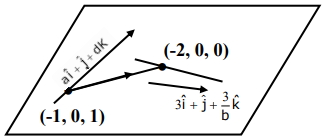
The lines $x=a y-1=z-2$ and $x=3 y-2=b z-2,(a b \neq 0)$ are coplanar, if:
- ✓
$b=1, a \in R-\{0\}$
- B
$a=2, b=3$
- C
$a=2, b=2$
- D
$a=1, b \in R-\{0\}$
AnswerCorrect option: A. $b=1, a \in R-\{0\}$
a
$\frac{x+1}{a}=y=\frac{z-1}{a}$
$\frac{x+2}{3}=y=\frac{z}{3 / b}$
lines are Co-planar
$\left|\begin{array}{ccc}a & 1 & a \\ 3 & 1 & \frac{3}{b} \\ -1 & 0 & -1\end{array}\right|=0 \Rightarrow-\left(\frac{3}{b}-a\right)-1(a-3)=0$
$a-\frac{3}{b}-a+3=0$
$b=1, a \in R-\{0\}$
View full question & answer→MCQ 1231 Mark
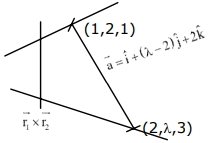
If the shortest distance between the straight lines $3(x-1)=6(y-2)=2(z-1)$ and $4(\mathrm{x}-2)=2(\mathrm{y}-\lambda)=(\mathrm{z}-3), \lambda \in \mathrm{R}$ is $\frac{1}{\sqrt{38}}$, then the integral value of $\lambda$ is equal to :
Answerc
$L_{1}: \frac{(x-1)}{2}=\frac{(y-2)}{1}=\frac{(z-1)}{3} \quad \vec{r}_{1}=2 \hat{i}+\hat{j}+3 \hat{k}$
$L_{2}: \frac{(x-2)}{1}=\frac{y-\lambda}{2}=\frac{z-3}{4} \quad \vec{r}_{2}=\hat{i}+2 \hat{j}+4 \hat{k}$
Shortest distance $=$ Projection of $\vec{a}$ on $\vec{r}_{1} \times \vec{r}_{2}$
$=\frac{\left|\vec{a} \cdot\left(\vec{r}_{1} \times \vec{r}_{2}\right)\right|}{\left|\vec{r}_{1} \times \vec{r}_{2}\right|}$
$\left|\overrightarrow{\mathrm{a}} \cdot\left(\vec{r}_{1} \times \vec{r}_{2}\right)\right|=\left|\begin{array}{ccc}1 & \lambda-2 & 2 \\ 2 & 1 & 3 \\ 1 & 2 & 4\end{array}\right|=|14-5 \lambda|$
$\left|\vec{r}_{1} \times \vec{r}_{2}\right|=\sqrt{38}$
$\therefore \frac{1}{\sqrt{38}}=\frac{|14-5 \lambda|}{\sqrt{38}}$
$\Rightarrow 14-5 \lambda \mid=1$
$\Rightarrow 14-5 \lambda=1 \text { or } 14-5 \lambda=-1$
$\Rightarrow \lambda=\frac{13}{5} \text { or } 3$
$\therefore$ Integral value of $\lambda=3$
View full question & answer→MCQ 1241 Mark
If the lines $\frac{x-k}{1}=\frac{y-2}{2}=\frac{z-3}{3}$ and $\frac{x+1}{3}=\frac{y+2}{2}=\frac{z+3}{1}$ are co-planar, then the value of $k$ is $.....$
Answerc
$\left|\begin{array}{ccc}k+1 & 4 & 6 \\ 1 & 2 & 3 \\ 3 & 2 & 1\end{array}\right|=0$
$\{\therefore$ Shortest distance between then is zero $\}$
$(k+1)[2-6]-4[1-9]+6[2-6]=0$
$\mathrm{~K}=1$
View full question & answer→MCQ 1251 Mark
Let $\alpha$ be the angle between the lines whose direction cosines satisfy the equations $l+m-n=0$ and $l^{2}+m^{2}-n^{2}=0 .$ Then the value of $\sin ^{4} \alpha+\cos ^{4} \alpha$ is
- A
$\frac{3}{4}$
- B
$\frac{3}{8}$
- ✓
$\frac{5}{8}$
- D
$\frac{1}{2}$
AnswerCorrect option: C. $\frac{5}{8}$
c
$n =\ell+ m$
Now, $\ell^{2}+ m ^{2}= n ^{2}=(\ell+ m )^{2}$
$\Rightarrow 2 \ell m =0$
If $\ell=0 \Rightarrow m = n =\pm \frac{1}{\sqrt{2}}$
And, If $m=0 \Rightarrow n=\ell=\pm \frac{1}{\sqrt{2}}$
So, direction cosines of two lines are
$\left(0, \frac{1}{\sqrt{2}}, \frac{1}{\sqrt{2}}\right)$ and $\left(\frac{1}{\sqrt{2}}, 0, \frac{1}{\sqrt{2}}\right)$
Thus, $\cos \alpha=\frac{1}{2} \Rightarrow \alpha=\frac{\pi}{3}$
View full question & answer→MCQ 1261 Mark
The angle between the straight lines, whose direction cosines are given by the equations $2 l+2 \mathrm{~m}-\mathrm{n}=0$ and $\mathrm{mn}+\mathrm{n} l+l \mathrm{~m}=0$, is :
AnswerCorrect option: A. $\frac{\pi}{2}$
a
$\mathrm{n}=2(\ell+\mathrm{m})$
$\ell \mathrm{m}+\mathrm{n}(\ell+\mathrm{m})=0$
$\ell \mathrm{m}+2(\ell+\mathrm{m})^{2}=0$
$2 \ell^{2}+2 \mathrm{~m}^{2}+5 \mathrm{~m} \ell=0$
$2\left(\frac{\ell}{\mathrm{m}}\right)^{2}+2+5\left(\frac{\ell}{\mathrm{m}}\right)=0$
$2 \mathrm{t}^{2}+5 \mathrm{t}+2=0$
$(\mathrm{t}+2)(2 \mathrm{t}+1)=0$
$\Rightarrow \mathrm{t}=-2 ;-\frac{1}{2}$
$(i)$ $\frac{\ell}{\mathrm{m}}=-2$
$\frac{\mathrm{n}}{\mathrm{m}}=-2$
$(-2 \mathrm{~m}, \mathrm{~m},-2 \mathrm{~m})$
$(-2,1,-2)$
$(ii)$ $\frac{\ell}{m}=-\frac{1}{2}$
$n=-2 \ell$
$(\ell,-2 \ell,-2 \ell)$
$(1,-2,-2)$
$\cos \theta=\frac{-2-2+4}{\sqrt{9} \sqrt{9}}=0 \Rightarrow 0=\frac{\pi}{2}$
View full question & answer→MCQ 1271 Mark
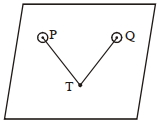
Let the position vectors of two points $P$ and $Q$ be $3 \hat{ i }-\hat{ j }+2 \hat{ k }$ and $\hat{ i }+2 \hat{ j }-4 \hat{ k },$ respectively. Let $R$ and $S$ be two points such that the direction ratios of lines $PR$ and $QS$ are $(4,-1,2)$ and $(-2,1,-2),$ respectively. Let lines $PR$ and $QS$ intersect at $T$. If the vector $\overline{ TA }$ is perpendicular to both $\overline{ PR }$ and $\overline{ QS }$ and the length of vector $\overline{ TA }$ is $\sqrt{5}$ units, then the modulus of a position vector of $A$ is
- A
$\sqrt{482}$
- ✓
$\sqrt{171}$
- C
$\sqrt{5}$
- D
$\sqrt{227}$
AnswerCorrect option: B. $\sqrt{171}$
b
$P (3,-1,2)$
$Q (1,2,-4)$
$\overline{ PR } \| 4 \hat{ i }-\hat{ j }+2 \hat{ k }$
$\overline{ QS } \|-2 \hat{ i }+\hat{ j }-2 \hat{ k }$
dr's of normal to the plane containing
$P , T $ and $Q$ will be proportional to :
$\left|\begin{array}{ccc}\hat{ i } & \hat{ j } & \hat{ k } \\ 4 & -1 & 2 \\ -2 & 1 & -2\end{array}\right|$
$\therefore \quad \frac{\ell}{0}=\frac{ m }{4}=\frac{ n }{2}$
For point, $T: \overline{P T}=\frac{x-3}{4}=\frac{y+1}{-1}=\frac{z-2}{2}=\lambda$
$\overline{ QT }=\frac{x-1}{-2}=\frac{y-1}{1}=\frac{z+4}{-2}=\mu$
$T :(4 \lambda+3,-\lambda-1,2 \lambda+2)$
$\quad \cong(2 \mu+1, \mu+2,-2 \mu-4)$
$4 \lambda+3=-2 \mu+1 \quad \Rightarrow 2 \lambda+\mu=-1$
$\lambda+\mu=-3 \quad \Rightarrow \quad \lambda=2$
$ \mu=-5 \quad \lambda+\mu=-3 \quad \Rightarrow \quad \lambda=2$
So point $T :(11,-3,6)$
$\overline{ OA }=(11 \hat{ i }-3 \hat{ j }+6 \hat{ k }) \pm\left(\frac{2 \hat{ j }+\hat{ k }}{\sqrt{5}}\right) \sqrt{5}$
$\overline{ OA }=(11 \hat{ i }-3 \hat{ j }+6 \hat{ k }) \pm(2 \hat{ j }+\hat{ k })$
$\overline{ OA }=11 \hat{ i }-\hat{ j }+7 \hat{ k }$
$9 \hat{ i }-5 \hat{ j }+5 \hat{ k }$
$|\overline{ OA }|=\sqrt{121+1+49}=\sqrt{171}$
$\sqrt{81+25+25}=\sqrt{131}$
View full question & answer→MCQ 1281 Mark
If the foot of the perpendicular from point $(4,3,8)$ on the line $L _{1}: \frac{ x - a }{l}=\frac{ y -2}{3}=\frac{ z - b }{4},$ $l \neq 0$ is $(3,5,7),$ then the shortest distance between the line $L _{1}$ and line $L _{2}: \frac{ x -2}{3}=\frac{ y -4}{4}=\frac{ z -5}{5}$ is equal to:
- A
$\frac{1}{2}$
- ✓
$\frac{1}{\sqrt{6}}$
- C
$\sqrt{\frac{2}{3}}$
- D
$\frac{1}{\sqrt{3}}$
AnswerCorrect option: B. $\frac{1}{\sqrt{6}}$
b
$(3,5,7)$ satisfy the line $L_{1}$
$\frac{3-a}{\ell}=\frac{5-2}{3}=\frac{7-b}{4}$
$\frac{3- a }{\ell}=1$ And $\frac{7-b}{4}=1$
$a+\ell=3 \quad \ldots(1)$ And $b=3$
$\overrightarrow{ v }_{1}=<4,3,8>-<3,5,7>$
$\overrightarrow{ v }_{1}=<1,-2,1>$
$\overrightarrow{ v }_{2}=\langle\ell, 3,4\rangle$
$\overrightarrow{ v }_{1} \cdot \overrightarrow{ v }_{2}=0 \quad \Rightarrow \quad \ell-6+4=0 \quad \Rightarrow \quad \ell=2$
$a +\ell=3 \Rightarrow a =1$
$L _{1}: \frac{ x -1}{2}=\frac{ y -2}{3}=\frac{ z -3}{4}$
$L _{2}: \frac{ x -2}{3}=\frac{ y -4}{4}=\frac{ z -5}{5}$
$A =<1,2,3>$
$B =<2,4,5>$
$\overline{ AB }=<1,2,2>$
$\overrightarrow{ p }=2 \hat{ i }+3 \hat{ j }+4 \hat{ k }$
$\overrightarrow{ q }=3 \hat{ i }+4 \hat{ j }+5 \hat{ k }$
$\overrightarrow{ p } \times \overrightarrow{ q }=-\hat{ i }+2 \hat{ j }-\hat{ k }$
Shortest distance $=\left|\frac{\overline{ AB } \cdot(\overrightarrow{ p } \times \overrightarrow{ q })}{|\overrightarrow{ p } \times \overrightarrow{ q }|}\right|=\frac{1}{\sqrt{6}}$
View full question & answer→MCQ 1291 Mark
Let $a, b \in R$. If the mirror image of the point $P( a ,6,9)$ with respect to the line
$\frac{x-3}{7}=\frac{y-2}{5}=\frac{z-1}{-9}$ is $(20, b,-a-9),$ then $|a+b|$ is equal to :
Answera
$P (9,6,9)$
$\frac{ x -3}{7}=\frac{ y -2}{5}=\frac{ z -1}{-9}$
$Q =(20, b ,- a -9)$
$\frac{\frac{20+a}{2}-3}{7}=\frac{\frac{b+6}{2}-2}{5}=\frac{-\frac{9}{2}-1}{-9}$
$\frac{14+9}{14}=\frac{b+2}{10}=\frac{a+2}{18}$
$\Rightarrow a=-56$ and $b=-32$
$\Rightarrow \quad|a+b|=88$
View full question & answer→MCQ 1301 Mark
Let $\lambda$ be an interger. If the shortest distance between the lines $x -\lambda=2 y -1=-2 z$ and $x = y +2 \lambda= z -\lambda$ is $\frac{\sqrt{7}}{2 \sqrt{2}},$ then the value of
$|\lambda|$ is ...... .
Answerd
$\frac{x-\lambda}{1}=\frac{y-\frac{1}{2}}{\frac{1}{2}}=\frac{z-0}{-\frac{1}{2}}$
$\frac{x-0}{1}=\frac{y+2 \lambda}{1}=\frac{z-\lambda}{1}$
Shortest distance $=\frac{\left( a _{2}- a _{1}\right) \cdot\left( b _{1} \times b _{2}\right)}{\left| b _{1} \times b _{2}\right|}$
$b _{1} \times b _{2}=\left|\begin{array}{ccc} i & j & k \\ 1 & \frac{1}{2} & -\frac{1}{2} \\ 1 & 1 & 1\end{array}\right|$
$=\hat{ i }\left(\frac{1}{2}+\frac{1}{2}\right)-\hat{ j }\left(1+\frac{1}{2}\right)+\hat{ k }\left(1-\frac{1}{2}\right)$
$=\hat{ i }-\frac{3}{2} \hat{ j }+\frac{\hat{ k }}{2}=\frac{2 \hat{ i }-3 \hat{ j }+\hat{ k }}{2}$
$\frac{b_{1} \times b_{2}}{\left|b_{1} \times b_{2}\right|}=\frac{2 \hat{i}-3 \hat{j}+\hat{k}}{\sqrt{14}}$
$\frac{\left(a_{2}-a_{1}\right) \cdot\left(b_{1} \times b_{2}\right)}{\left|b_{1} \times b_{2}\right|}=\left(-\lambda \hat{i}+\left(-2 \lambda+\frac{1}{2}\right)+\lambda \hat{k}\right)$
$\quad\quad\quad\quad\quad\quad\quad\left(\frac{2 \hat{i}-3 \hat{j}+\hat{k}}{\sqrt{14}}\right)$
$=\left|\frac{-2 \lambda+6 \lambda-\frac{3}{2}+\lambda}{\sqrt{14}}\right|=\frac{\sqrt{7}}{2 \sqrt{2}}$
$\left|5 \lambda-\frac{3}{2}\right|=\frac{7}{2}$
$5 \lambda=\frac{3}{2} \pm \frac{7}{2}$
$5 \lambda=5,-2$
$\lambda=1,-\frac{2}{5}$
View full question & answer→MCQ 1311 Mark
A line $'l'$ passing through origin is perpendicular to the lines $l_{1}: \overrightarrow{ r }=(3+ t ) \hat{ i }+(-1+2 t ) \hat{ j }+(4+2 t ) \hat{ k }$ ; $l_{2}: \overrightarrow{ r }=(3+2 s ) \hat{ i }+(3+2 s ) \hat{ j }+(2+ s ) \hat{ k }$ . If the co-ordinates of the point in the first octant on ${ }^{\prime} l_{2}^{\prime}$ at a distance of $\sqrt{17}$ from the point of intersection of $^{\prime} l^{\prime}$ and ${ }^{\prime} l_{1}^{\prime}$ are $( a , b , c ),$ then $18( a+ b + c )$ is equal to ........ .
Answerc
$\ell_{1}: \overrightarrow{ r }=(3+ t ) \hat{ i }+(-1+2 t ) \hat{ j }+(4+2 t ) \hat{ k }$
$\ell_{2}: \overrightarrow{ r }=(3+2 s ) \hat{ i }+(3+2 s ) \hat{ j }+(4+ s ) \hat{ k }$
$DR$ of $\ell_{1} \equiv(1,2,2)$
$DR$ of $\ell_{2} \equiv(2,2,1)$
$DR$ of $\ell$ (line $\perp$ to $\left.\ell_{1} \& \ell_{2}\right)$ $=(-2,3,-2)$
$\therefore \ell: \overrightarrow{ r }=-2 \mu \hat{ i }+3 \hat{ j }-2 \mu \hat{ k }$
for intersection of $\ell \& \ell_{1}$
$3+t=-2 \mu$
$-1+2 t=3 \mu$
$4+2 t=-2 \mu$
$\Rightarrow t =-1 \& \lambda=-1$
$\therefore$ Point of intersection $P \equiv(2,-3,2)$
Let point on $\ell_{2}$ be $Q(3+2 s, 3+2 s, 2+s)$
Given $PQ =\sqrt{17} \quad \Rightarrow( PQ )^{2}=17$
$\Rightarrow(2 s +1)^{2}+(6+2 s )^{2}+( s )^{2}=17$
$\Rightarrow 9 s ^{2}+28 s +20=0$
$\Rightarrow s =-2,-\frac{10}{9}$
$s \neq-2$ as point lies on $1^{\text {st }}$ octant.
$\therefore a =3+2\left(-\frac{10}{9}\right)=\frac{7}{9}$
$b =3+2\left(-\frac{10}{9}\right)=\frac{7}{9}$
$c =2+\left(-\frac{10}{9}\right)=\frac{8}{9}$
$\therefore 18(a+b+c)=18\left(\frac{22}{9}\right)=44$
View full question & answer→MCQ 1321 Mark
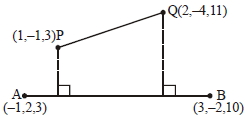
The projection of the line segment joining the points $(1,-1,3)$ and $(2,-4,11)$ on the line joining the points $(-1,2,3)$ and $(3,-2,10)$ is
Answera
Projection of $\overrightarrow{\mathrm{PQ}}$ on $\overrightarrow{\mathrm{AB}}=\left|\frac{\overrightarrow{\mathrm{PQ}} \cdot \overrightarrow{\mathrm{AB}}}{|\overrightarrow{\mathrm{AB}}|}\right|$
$=\left|\frac{(\hat{i}-3 \hat{j}+8 \hat{k}) \cdot(4 \hat{i}-4 \hat{j}+7 \hat{k})}{9}\right|=8$
View full question & answer→MCQ 1331 Mark
The shortest distance between the lines $\frac{x-3}{3}=\frac{y-8}{-1}=\frac{z-3}{1}$ and $\frac{x+3}{-3}=\frac{y+7}{2}=\frac{z-6}{4}$ is
- A
$\frac{7}{2} \sqrt{30}$
- ✓
$3\sqrt{30}$
- C
$3$
- D
${2} \sqrt{30}$
AnswerCorrect option: B. $3\sqrt{30}$
b
Shortest distance $=\frac{\left|\begin{array}{ccc}{6} & {15} & {-3} \\ {3} & {-1} & {1} \\ {-3} & {2} & {4}\end{array}\right|}{\sqrt{11 \times 29-49}}=\frac{270}{\sqrt{270}}$
$=\sqrt{270}=3 \sqrt{30}$
View full question & answer→MCQ 1341 Mark
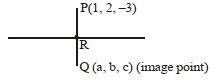
If $(a, b, c)$ is the image of the point $(1,2,-3)$ in the line, $\frac{x+1}{2}=\frac{y-3}{-2}=\frac{z}{-1},$ then $a+b+c$ is equal to
Answerb
Line is $\frac{x+1}{2}=\frac{y-3}{-2}=\frac{z}{-1}=\lambda:$ Let point $R$ is
$(2 \lambda-1,-2 \lambda+3,-\lambda)$
Direction ratio of $PQ \equiv(2 \lambda-2,-2 \lambda+1,3-\lambda)$
$PQ$ is $\perp$ to line
$\Rightarrow 2(2 \lambda-2)-2(-2 \lambda+1)-1(3-\lambda)=0$
$4 \lambda-4+4 \lambda-2-3+\lambda=0$
$9 \lambda=9 \Rightarrow \lambda=1$
$\Rightarrow \quad$ Point $R$ is (1,1,-1)
$\begin{array}{l|l|l} \frac{a+1}{2}=1 & \frac{b+2}{2}=1 & \frac{c-3}{2}=-1 \\ a=1 & b=0 & c=1 \end{array}$
$\Rightarrow a+b+c=2$
View full question & answer→MCQ 1351 Mark
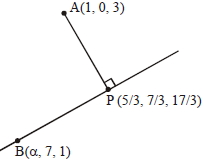
If the foot of the perpendicular drawn from the point $(1,0,3)$ on a line passing through $(\alpha, 7,1)$ is $\left(\frac{5}{3}, \frac{7}{3}, \frac{17}{3}\right),$ then $\alpha$ is equal to
Answerb
D.R. of $\mathrm{BP}=<\frac{5}{3}-\alpha, \frac{7}{3}-7, \frac{17}{3}-1>$
D.R. of $\mathrm{AP}=<\frac{5}{3}-1, \frac{7}{3}-0, \frac{17}{3}-3>$
$\mathrm{BP} \perp \mathrm{AP}$
$\Rightarrow \alpha=4$
View full question & answer→MCQ 1361 Mark
The lines $\overrightarrow{ r }=(\hat{ i }-\hat{ j })+\ell(2 \hat{ i }+\hat{ k })$ and $\overrightarrow{ r }=(2 \hat{ i }-\hat{ j })+ m (\hat{ i }+\hat{ j }-\hat{ k })$
- A
Intersect when $\ell=1$ and $m=2$
- B
Intersect when $\ell=2$ and $m=\frac{1}{2}$
- ✓
Do not intersect for any values of $\ell$ and $m$
- D
Intersect for all values of $\ell$ and $m$
AnswerCorrect option: C. Do not intersect for any values of $\ell$ and $m$
c
$\overrightarrow{ r }=\hat{ i }(1+2 \ell)+\hat{j}(-1)+\hat{ k }(\ell)$
$\overrightarrow{ r }=\hat{ i }(2+ m )+\hat{j}( m -1)+\hat{ k }(- m )$
For intersection
$\begin{array}{ll}1+2 \ell=2+m & \ldots \ldots (i)\\ -1=m-1 & \ldots \ldots (ii)\\ \ell=-m & \ldots \ldots(iii)\end{array}$
from (ii) $m =0$
from (iii) $\ell=0$
These values of $m$ and $\ell$ do not satisfy equation ( 1 ).
Hence the two lines do not intersect for any
values of $\ell$ and $m$.
View full question & answer→MCQ 1371 Mark
If a unit vector $\vec r$ makes angles $\frac{\pi }{3}$ with $\hat i$, $\frac{\pi }{4}$ with $\hat j$ and $\theta \in \left( {0,\pi } \right)$ with $\hat k$, then a value of $\theta$ is
- A
$\frac{{5\pi }}{{12}}$
- B
$\frac{{5\pi }}{{6}}$
- ✓
$\frac{{2\pi }}{{3}}$
- D
$\frac{{\pi }}{{4}}$
AnswerCorrect option: C. $\frac{{2\pi }}{{3}}$
c
$\cos ^{2} \alpha+\cos ^{2} \beta+\cos ^{2} \gamma=1$
$\Rightarrow \frac{1}{4}+\frac{1}{2}+\cos ^{2} \gamma=1$
$\Rightarrow \cos ^{2} \gamma=1-\frac{3}{4}=\frac{1}{4}$
$\Rightarrow \cos \gamma=\pm \frac{1}{2}$
$\Rightarrow \gamma=\frac{\pi}{3} \text { or } \frac{2 \pi}{3}$
View full question & answer→MCQ 1381 Mark
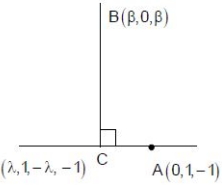
If the length of the perpendicular from the point $(\beta , 0, \beta )\, (\beta \neq 0)$ to the line $\frac{x}{1} = \frac{{y - 1}}{0} = \frac{{z + 1}}{{ - 1}}$ is $\sqrt {\frac{3}{2}} $, then $\beta $ is equal to
Answerb
$\frac{x}{1}=\frac{y-1}{0}=\frac{z+1}{-1}=\lambda$
A point on this line is $A(0,1,-1)$
$\overrightarrow{\mathrm{AB}} \cdot \overrightarrow{\mathrm{BC}}=0$
We get $\lambda=\frac{-1}{2}$
$\therefore C=\left(-\frac{1}{2}, 1, \frac{-1}{2}\right)$
$|\overrightarrow{\mathrm{BC}}|=\sqrt{\frac{2}{3}}$
$\sqrt{\left(\beta+\frac{1}{2}\right)^{2}+\left(1^{2}+\left(\beta+\frac{1}{2}\right)\right)^{2}}=\sqrt{\frac{2}{3}}$
$\therefore \beta=0,-1$
$\beta=-1 \quad(\beta \neq 0)$
View full question & answer→MCQ 1391 Mark
If the lines $x\,=\,ay\,+\,b,\,\,z\,=\,cy\,+\,d$ and $x\, = \,a\,'z + \,b\,',\,\,y = \,c\,'z\, + \,d\,'$ are perpendicular, then
- A
$cc\,'\, + a + a\,' = 0$
- ✓
$aa\,'\, + c + c\,' = 0$
- C
$ab\,'\, + bc\,' + 1 = 0$
- D
$bb\,'\, + cc\,' + 1 = 0$
AnswerCorrect option: B. $aa\,'\, + c + c\,' = 0$
b
Line $x=a y+b, z=c y+d$
$\Rightarrow \frac{x-b}{a}=\frac{y}{1}=\frac{z-d}{c}$
Line $x=a^{\prime} z+b^{\prime}, y=c^{\prime} z+d^{\prime}$
$\Rightarrow \frac{x-b^{\prime}}{a^{\prime}}=\frac{y-d^{\prime}}{c^{\prime}}=\frac{z}{1}$
Given both the lines are perpendicular
$\Rightarrow a a^{\prime}+c^{\prime}+c=0$
View full question & answer→MCQ 1401 Mark
Let $A$ be a point on the line $\vec r = \left( {1 - 3\mu } \right)\hat i + \left( {\mu - 1} \right)\hat j + \left( {2 + 5\mu } \right)\hat k$ and $B(3, 2, 6)$ be a point in the space. Then the value of $\mu $ for which the vector $\overrightarrow {AB} $ is parallel to the plane $x -4y +3z = 1$ is
- ✓
$\frac{1}{4}$
- B
$\frac{1}{8}$
- C
$\frac{1}{2}$
- D
$-\frac{1}{4}$
AnswerCorrect option: A. $\frac{1}{4}$
a
Let $A$ is $(1-3 \mu, \mu-1,2+5 \mu)$
$\overrightarrow{\mathrm{AB}}=(3 \mu+2) \mathrm{i}+(3-\mu) \mathrm{j}+(4-5 \mu)$
${\hat k}$ which is parallel to plane $x-4 y+3 z=1$
$\Rightarrow 1(3 \mu+2)-4(3-\mu)+3(4-5 \mu)=0$
$=-8 \mu+2=0 \Rightarrow \mu=\frac{1}{4}$
View full question & answer→MCQ 1411 Mark
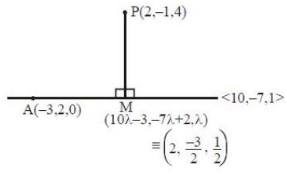
The length of the perpendicular from the point $(2, -1, 4)$ on the straight line, $\frac{{x + 3}}{{10}} = \frac{{y - 2}}{{ - 7}} = \frac{z}{1}$ is
AnswerCorrect option: D. greater than $3$ but less than $4$
d
Now, $\overline{M P} \cdot(10 \hat{i}-7 \hat{j}+\hat{k})=0$
$\Rightarrow \quad \lambda=\frac{1}{2}$
$\therefore $ Length of perpendicular
$(=P M)=\sqrt{0+\frac{1}{4}+\frac{49}{4}}$
$=\sqrt{\frac{50}{4}}=\sqrt{\frac{25}{4}}=\frac{5}{\sqrt{2}}$
which is greater than 3 but less than 4
View full question & answer→MCQ 1421 Mark
If a point $R (4, y, z)$ lies on the line segment joining the points $P (2, -3, 4)$ and $Q (8, 0, 10)$, then the distance of $R$ from the origin is
- A
$\sqrt {53}$
- B
$6$
- ✓
$2\sqrt {14}$
- D
$2\sqrt {21}$
AnswerCorrect option: C. $2\sqrt {14}$
c
$\text { Equation of } \mathrm{PQ} \text { is } \frac{x-2}{6}=\frac{y+3}{3}=\frac{z-4}{6}$
$\mathrm{R}(4, \mathrm{y}, \mathrm{z}) \text { lies on this }$
$\Rightarrow \frac{1}{3}=\frac{y+3}{3}=\frac{z-4}{6}$
$\Rightarrow \mathrm{R}(4,-2,6)$
$\mathrm{QR}=\sqrt{16+4+36}=2 \sqrt{14}$
View full question & answer→MCQ 1431 Mark
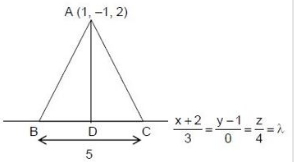
The vertices $B$ and $C$ of a $\Delta ABC$ lie on the line, $\frac{{x + 2}}{3} = \frac{{y - 1}}{0} = \frac{z}{4}$ such that $BC = 5\, units$. Then the area (in $sq. units$) of this triangle, given that the point $A\, (1, -1, 2)$ is
- A
$2\sqrt {34} $
- ✓
$\sqrt {34} $
- C
$6$
- D
$5\sqrt {17} $
AnswerCorrect option: B. $\sqrt {34} $
b
Let any point on given line is $D(3 \lambda-2,1,4 \lambda)$
Now $A D \perp B C$
$\mathrm{D} \mathrm{R}$ of $BC$
$\Rightarrow a_{1}=3, b_{1}=0, c_{1}=y$
$D \cdot R,$ of $A D$
$\Rightarrow a_{2}=3 \lambda-3, b_{2}=2, c_{2}=4 \lambda-2$
$\Rightarrow a_{1} a_{2}+b_{1} b_{2}+c_{1} c_{2}=0$
$\Rightarrow 3(3 \lambda-3)+0+4(4 \lambda-2)=0$
$25 \lambda=17$
$\Rightarrow \lambda=\frac{17}{25}$
$\mathrm{Co}-$ ordinate of point $\mathrm{D}$
$\left(\frac{1}{25}, 1, \frac{68}{25}\right)$
$\mathrm{AD}=\sqrt{\frac{576}{625}+4+\frac{324}{25}}=\frac{2}{5} \sqrt{34}$
Area of $\Delta \mathrm{ABC}=\frac{1}{2} \times \mathrm{BC} \times \mathrm{AD}$
$=\frac{1}{2} \times 5 \times \frac{2}{6} \sqrt{34}$
$=\sqrt{34}$
View full question & answer→MCQ 1441 Mark
If the angle between the lines, $\frac{x}{2} = \frac{y}{2} = \frac{z}{1}$ and $\frac{{5 - x}}{{ - 2}} = \frac{{7y - 14}}{p} = \frac{{z - 3}}{4}$ is ${\cos ^{ - 1}}\,\left( {\frac{2}{3}} \right),$ then $p$ is equal to
- A
$ - \frac{7}{4}$
- B
$\frac{2}{7}$
- C
$ - \frac{4}{7}$
- ✓
$\frac{7}{2}$
AnswerCorrect option: D. $\frac{7}{2}$
d
Let $\theta$ be the angle between the two lines Here direction cosines of
$\frac{x}{2}=\frac{y}{2}=\frac{z}{1}$ are $2,2,1$
Also second line can be written as:
$\frac{{\frac{{x - 5}}{2} = \frac{{y - 2}}{P} = \frac{{ - 3}}{4}}}{7}$
$\therefore $ its direction cosines are $2 . \frac{P}{7} .4$
$\text { Also, } \cos \theta=\frac{2}{3} \quad \text { (Given) }$
$\therefore \cos \theta = | - \frac{{{a_1}{a_2} + {b_1}{b_2} + {c_1}{c_2}}}{{\sqrt {a_1^2 + b_1^2 + c_1^2} \sqrt {a_2^2 + b_2^2 + c_2^2} }}$
$ \Rightarrow \frac{2}{3} = \frac{{2 \times 2 + \left( {2 \times \begin{array}{*{20}{l}}
P\\
7
\end{array}} \right) + (1 \times 4)}}{{\sqrt {{2^2} + {2^2} + {1^2}} \sqrt {{2^2} + \frac{{{P^2}}}{{49}}} + {4^2}}}$
${=\frac{4+\frac{2 P}{7}+4}{3 \times \sqrt{2^{2}+\frac{P^{2}}{49}+4^{2}}}} $
${\Rightarrow\left(4+\frac{P}{7}\right)^{2}=20+\frac{P^{2}}{49}} $
${\Rightarrow 16+\frac{8 P}{7}+\frac{P^{2}}{49}=20+\frac{P^{2}}{49}} $
${\Rightarrow \frac{8 P}{7}-4 \Rightarrow P=\frac{7}{2}}$
View full question & answer→MCQ 1451 Mark
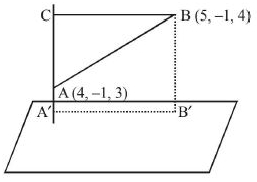
The length of the projection of the line segment joining the point $\left( {5, - 1,4} \right)$ and $\left( {4, - 1,3} \right)$ on the plane $x + y + z = 7$ is :
- A
$\frac{2}{3}$
- B
$\frac{1}{3}$
- ✓
$\sqrt {\frac{2}{3}} $
- D
$\frac{2}{{\sqrt 3 }}$
AnswerCorrect option: C. $\sqrt {\frac{2}{3}} $
c
$A C=\overrightarrow{A B} \cdot \hat{A C}=(\hat{i}+\hat{k}) \cdot \frac{(\hat{i}+\hat{j}+\hat{k})}{\sqrt{3}}=\frac{2}{\sqrt{3}}$
Now, $A^{\prime} B^{\prime}=B C=\sqrt{A B^{2}-A C^{2}}=\sqrt{2-\frac{4}{3}}=\sqrt{\frac{2}{3}}$
Length of projection $=\sqrt{\frac{2}{3}}$
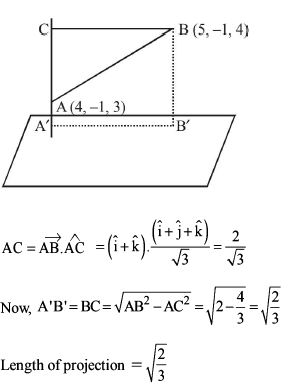
View full question & answer→MCQ 1461 Mark
An angle between the lines whose direction cosines are given by the equations, $l+ 3m + 5n\, = 0$ and $5lm -2mn + 6nl = 0$ , is
- A
${\cos ^{ - 1}}\left( {\frac{1}{8}} \right)$
- ✓
${\cos ^{ - 1}}\left( {\frac{1}{6}} \right)$
- C
${\cos ^{ - 1}}\left( {\frac{1}{3}} \right)$
- D
${\cos ^{ - 1}}\left( {\frac{1}{4}} \right)$
AnswerCorrect option: B. ${\cos ^{ - 1}}\left( {\frac{1}{6}} \right)$
b
Given
$l+3 m+5 n=0$ ....$(1)$
and $5 l m-2 m n+6 n l=0$ .....$(2)$
From eq. $( 1 )$ we have $l=-3 m-5 n$
Put the value of $l$ in eq. $(2),$ we get;
$5(-3 m-5 n) m-2 m n+6 n(-3 m-5 n)=0$
$\Rightarrow 15 m^{2}+45 m n+30 n^{2}=0$
$\Rightarrow m^{2}+3 m n+2 n^{2}=0$
$\Rightarrow m^{2}+2 m n+m n+2 n^{2}=0$
$\Rightarrow(m+n)(m+2 n)=0$
$\therefore m=-n$ or $m=-2 n$
For $m=-n, l=-2 n$
And for $m=-2 n, l=n$
$\therefore(l, m, n)=(-2 n,-n, n)$ Or $(l, m, n)$
$=(n,-2 n, n)$
$\Rightarrow(l, m, n)=(-2,-1,1)$ Or $(l, m, n)$
$=(1,-2,1)$
Therefore, angle between the lines is given as:
$\cos (\theta)=\frac{(-2)(1)+(-1) \cdot(-2)+(1)(1)}{\sqrt{6} \cdot \sqrt{6}}$
$\Rightarrow \cos (\theta)=\frac{1}{6} \Rightarrow \theta=\cos ^{-1}\left(\frac{1}{6}\right)$
View full question & answer→MCQ 1471 Mark
The number of distinct real values of $\lambda $ on for which the lines $\frac{{x - 1}}{1} = \frac{{y - 2}}{2} = \frac{{z + 3}}{{{\lambda ^2}}}$ and $\frac{{x - 3}}{1} = \frac{{y - 2}}{{{\lambda ^2}}} = \frac{{z - 1}}{2}$ are coplanar is
Answerc
Lines are coplanar
$\left| {\begin{array}{*{20}{c}}
{3 - 1}&{2 - 2}&{1 - \left( { - 3} \right)}\\
1&2&{{\lambda ^2}}\\
1&{{\lambda ^2}}&2
\end{array}} \right| = 0$
$ \Rightarrow \left| {\begin{array}{*{20}{c}}
2&0&4\\
1&2&{{\lambda ^2}}\\
1&{{\lambda ^2}}&2
\end{array}} \right. = 0$
$\Rightarrow 2\left(4-\lambda^{4}\right)+4\left(\lambda^{2}-2\right)=0$
$\Rightarrow 4-\lambda^{4}+2 \lambda^{2}-4=0$
$\Rightarrow \lambda^{2}\left(\lambda^{2}-2\right)=0$
$\Rightarrow \lambda=0, \sqrt{2},-\sqrt{2}$
View full question & answer→MCQ 1481 Mark
The shortest distance between the $z-$ axis and the line $x + y + 2z - 3\, = 0 \,= 2x + 3y + 4z - 4$, is
Answerb
Theequation of anyplane passing through given line is $(x+y+2 z-3)+\lambda(2 x+3 y+4 z-4)=0$
$\Rightarrow(1+2 \lambda) x+(1+3 \lambda) y+(2+4 \lambda) z-(3+4 \lambda)=0$
If this plane is parallel to z-axis then normal to the plane will be perpendicular to z-axis.
$\therefore$ $(1+2 \lambda)(0)+(1+3 \lambda)(0)+(2+4 \lambda)(1)=0$
$\lambda=-\frac{1}{2}$
Thus, Required plane is
$(x+y+2 z-3)-\frac{1}{2}(2 x+3 y+4 z-4)=0$
$\Rightarrow y+2=0$
$\therefore \mathrm{S} . \mathrm{D}=\frac{2}{\sqrt{(1)^{2}}}=2$
View full question & answer→MCQ 1491 Mark
The angle between the lines whose direction cosines satisfy the equations $l + m + n = 0$ and ${l^2} = {m^2} + {n^2}$ is
- A
$\frac{\pi }{6}$
- B
$\frac{\pi }{2}$
- ✓
$\frac{\pi }{3}$
- D
$\frac{\pi }{4}$
AnswerCorrect option: C. $\frac{\pi }{3}$
c
We have, $l + m + n = 0,{l^2} + {m^2} - {n^2} = 0.$
Eliminationg $n$ from both the equations, we have
${l^2} + {m^2} - {\left( {l + m} \right)^2} = 0$
$ \Rightarrow {l^2} + {m^2} - {l^2} - {m^2} - 2ml = 0$
$ \Rightarrow 2lm = 0$
$ \Rightarrow lm = 0$
$ \Rightarrow l = 0\,\,\,\,or\,\,\,m = 0$
If $l=0$, we have $m+n=0$ and ${m^2} - {n^2} = 0$
$ \Rightarrow l = 0,m = \lambda ,n = - \lambda $
If $m=0$, we have $l+m=0$ and ${l^2} - {m^2} = 0$
$ \Rightarrow l = - \lambda ,m = 0,n = \lambda $
So, the vector parallel to these given lines
are $\vec a = \hat j - \hat k\,$ and $\,\,\vec b = - \hat i + \hat k$
If angle between the lines is $'\theta ',$ then
$\cos \theta = \frac{{\left| {\vec a.\vec b} \right|}}{{\left| {\vec a} \right|\left| {\vec b} \right|}} = \frac{1}{{\sqrt 2 .\sqrt 2 }}$
$ \Rightarrow \cos \theta = \frac{1}{2}$
$\therefore \theta = \frac{\pi }{3}$
View full question & answer→MCQ 1501 Mark
A line in the $3-$ dimensional space makes an angle $\theta \left( {0 < \theta \le \frac{\pi }{2}} \right)$ with both the $x$ and $y$ axes. Then the set ofall values of $\theta $ is the interval
- A
$\left( {0,\frac{\pi }{4}} \right]$
- B
$\left[ {\frac{\pi }{6},\frac{\pi }{3}} \right]$
- ✓
$\left[ {\frac{\pi }{4},\frac{\pi }{2}} \right]$
- D
$\left( {\frac{\pi }{3},\frac{\pi }{2}} \right]$
AnswerCorrect option: C. $\left[ {\frac{\pi }{4},\frac{\pi }{2}} \right]$
c
It makes $\theta$ with $x$ and $y$ -axes.
$l=\cos \theta, m=\cos \theta, n=\cos (\pi-2 \theta)$
we have $l^{2}+m^{2}+n^{2}=1$
$\Rightarrow \cos ^{2} \theta+\cos ^{2} \theta+\cos ^{2}(\pi-2 \theta)=1$
$\Rightarrow 2 \cos ^{2} \theta+(-\cos 2 \theta)^{2}=1$
$\Rightarrow 2 \cos ^{2} \theta-1+\cos ^{2} 2 \theta=0$
$\Rightarrow \cos 2 \theta-[1+\cos 2 \theta]=0$
$ \Rightarrow \cos 2\theta = 0\,\,or\,\cos 2\theta = - 1$
$\Rightarrow 2 \theta=\pi / 2$ or $2 \theta=\pi$
$\Rightarrow \theta=\pi / 4$ or $\theta=\frac{\pi}{2}$
$\Rightarrow \theta=\left[\frac{\pi}{4}, \frac{\pi}{2}\right]$
View full question & answer→