MCQ 1511 Mark
The area (in sq. units) of the region bounded by the curve $x^2 = 4y$ and the straight line $x = 4y - 2$ is
Answerb
$x^{2}=4 y$ $. . . .(1)$
$x+2=4 y$ .......$(2)$
Solve $( 1)$ and $( 2)$
$x+2=x^{2}$
$\Rightarrow x^{2}-x-2=0$
$\Rightarrow(x-2)(x+1)=0 $
$\Rightarrow x=2,-1$
Area $ = \int\limits_{ - 1}^2 {\left( {\frac{{x + 2}}{4} - \frac{{{x^2}}}{4}} \right)dx} $
$=\frac{1}{4}\left[\frac{x^{2}}{2}+2 x-\frac{x^{3}}{3}\right]_{-1}^{2}$
$=\frac{1}{4}\left[\left(2+4-\frac{8}{3}\right)-\left(\frac{1}{2}-2+\frac{1}{3}\right)\right]$
$=\frac{1}{4}\left[\frac{10}{3}-\frac{3-12+2}{6}\right]=\frac{1}{4}\left[\frac{10}{3}+\frac{7}{6}\right]$
$=\frac{1}{4} \times \frac{27}{6}=\frac{9}{8}$
View full question & answer→MCQ 1521 Mark
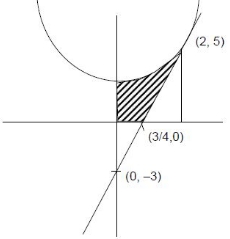
The area (in sq. units) in the first quadrant bounded by the parabola, $y = x^2 +1$, the tangent to it at the point $(2, 5)$ and the coordinate axes is
- A
$\frac{8}{3}$
- ✓
$\frac{37}{24}$
- C
$\frac{187}{24}$
- D
$\frac{14}{3}$
AnswerCorrect option: B. $\frac{37}{24}$
b
Equation of tangent at $(2,5)$ is $\frac{y+5}{2}=x(2)+1$
or $y=4 x-3$
Required Area $ = \int\limits_0^2 {\left( {{x^2} + 1} \right)} dx - \frac{1}{2}\left( {2 - \frac{3}{4}} \right) \cdot (5)$
$\left.=\frac{x^{3}}{3}+x\right]_{0}^{2}-\frac{25}{8}$
$=\frac{8}{3}-\frac{9}{8}=\frac{37}{24}$
View full question & answer→MCQ 1531 Mark
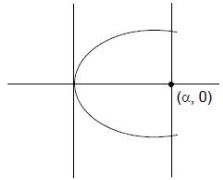
Let $S\left( \alpha \right) = \left\{ {\left( {x,y} \right):{y^2} \leq x,0 \leq \alpha } \right\}$ and $A(\alpha )$ is area of the regions $S(\alpha )$. If for a $\lambda ,0 < \lambda < 4,A (\lambda ) : A\left( 4 \right)\,=\,2:5$ then $\lambda $ equals
- A
$4{\left( {\frac{2}{5}} \right)^{\frac{1}{3}}}$
- B
$2{\left( {\frac{2}{5}} \right)^{\frac{1}{3}}}$
- ✓
$4{\left( {\frac{4}{25}} \right)^{\frac{1}{3}}}$
- D
$2{\left( {\frac{4}{25}} \right)^{\frac{1}{3}}}$
AnswerCorrect option: C. $4{\left( {\frac{4}{25}} \right)^{\frac{1}{3}}}$
c
$S\left( \lambda \right) = 2\int\limits_0^\lambda {\sqrt x dx = \frac{4}{3}} {\lambda ^{3/2}}$
$\frac{S(\lambda)}{S(4)}=\frac{2}{5} \Rightarrow \frac{\lambda^{3 / 2}}{4^{3 / 2}}=\frac{2}{5}$
$\Rightarrow \lambda=4\left(\frac{4}{25}\right)^{1 / 3}$
View full question & answer→MCQ 1541 Mark
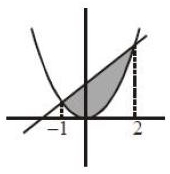
The area (in sq. units) of the region $A\,\, = \,\left\{ {\left( {x\,,\,y} \right)\,:\,{x^2}\, \le \,y\, \le \,x + 2} \right\}$ is
- A
$\frac {31}{6}$
- B
$\frac {13}{6}$
- ✓
$\frac {9}{2}$
- D
$\frac {10}{3}$
AnswerCorrect option: C. $\frac {9}{2}$
c
$x^{2} \leq y \leq x+2$
$x^{2}=y ; y=x+2$
$x^{2}=x+2$
$x^{2}-x-2=0$
$(x-2)(x-1)=0$
$x=2,-1$
Area $ = \int\limits_{ - 1}^2 {(x + 2) - } {x^2}dx = \frac{9}{2}$
View full question & answer→MCQ 1551 Mark
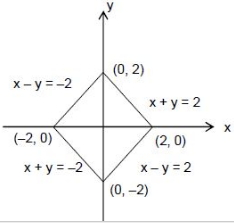
The region represented by $\left| {x - y} \right| \leq 2$ and $\left| {x + y} \right| \leq 2$ is bounded by a
- A
rhombus of area $8\sqrt 2$ sq. units
- B
square of area $16$ sq. units
- C
rhombus of side length $2$ units
- ✓
square of side length $2\sqrt 2$ units
AnswerCorrect option: D. square of side length $2\sqrt 2$ units
d
Shown figre is square with side length $2\sqrt 2 $
View full question & answer→MCQ 1561 Mark
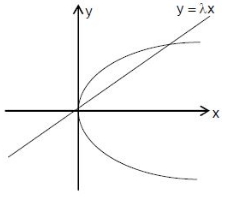
If the area (in sq. units) bounded by the parabola $y^2 =4\lambda x$ and the line $y = \lambda x$, $\lambda > 0$, is $\frac{1}{9}$, then $\lambda $ is equal to
- A
$48$
- B
$4\sqrt 3$
- C
$2\sqrt 6$
- ✓
$24$
Answerd
$y^{2}=4 \lambda x$ and $y=\lambda x$
$\lambda^{2} x^{2}=4 \lambda x$
$x=0$ and $x=\frac{4}{\lambda}$
Area $ = \int\limits_0^{4\lambda } {(\sqrt {4\lambda x} - \lambda x)} dx = \frac{1}{9}$
$ \Rightarrow 2\sqrt \lambda \times \left( {\frac{{{x^{3/2}}}}{{3/2}}} \right)_0^{4/\lambda } - \lambda \left( {\frac{{{x^2}}}{2}} \right)_0^{4/\lambda } = \frac{1}{9}$
$\frac{4}{3} \sqrt{\lambda} \times\left(2^{2}\right)^{3 / 4} \frac{x}{\lambda^{3 / 2}}-\frac{x}{2} \times \frac{16}{\lambda}=\frac{1}{9}$
$\Rightarrow \frac{32}{3 \lambda}-\frac{8}{\lambda}=\frac{1}{9}$
$\Rightarrow \frac{8}{3 \lambda}=\frac{1}{9}$
$\lambda=24$
View full question & answer→MCQ 1571 Mark
Let $I = \int_a^b {\left( {{x^4} - 2{x^2}} \right)dx} $. If $I$ is minimum then the ordered pair $(a, b)$ is
- A
$\left( {0,\sqrt 2 } \right)$
- B
$\left( { - \sqrt 2 ,0} \right)$
- C
$\left( {\sqrt 2 , - \sqrt 2 } \right)$
- ✓
$\left( {-\sqrt 2 , \sqrt 2 } \right)$
AnswerCorrect option: D. $\left( {-\sqrt 2 , \sqrt 2 } \right)$
d
$\int\limits_a^b {\left( {{x^4} - 2{x^2}} \right)dx} $
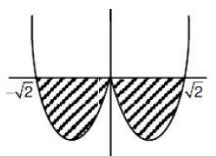
From figure min area is $(-\sqrt{2}, \sqrt{2})$
View full question & answer→MCQ 1581 Mark
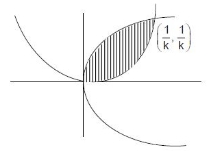
If the area enclosed between the curves $y = kx^2$ and $x = ky^2, (k > 0)$, is $1$ square unit. Then $k$ is
- A
$\frac{{\sqrt 3 }}{2}$
- ✓
$\frac{1}{{\sqrt 3 }}$
- C
$\sqrt 3 $
- D
$\frac{2}{{\sqrt 3 }}$
AnswerCorrect option: B. $\frac{1}{{\sqrt 3 }}$
b
$y=k x^{2}, x=k y^{2}$
$\Rightarrow x=k\left(k^{2} x^{4}\right) $
$\Rightarrow x=0$ or $x^{3}=\left(\frac{1}{k}\right)^{3}$
$ \Rightarrow x=\frac{1}{k}, 0$
Point of intersection are
$\left(\frac{1}{\mathrm{k}}, \frac{1}{\mathrm{k}}\right)$ and $(0,0)$
Area $\int\limits_0^{1/k} {\left( {\sqrt {\frac{x}{k}} - k{x^\prime }} \right)dx} = 1$
$ \Rightarrow {\left( {\frac{1}{{\sqrt k }}\frac{{{x^{3/2}}}}{{3/2}} - \frac{{k{x^2}}}{3}} \right)^{1/k}}$
$=1 \Rightarrow \frac{2}{3 k^{2}}=1$
$ \Rightarrow k^{2}=\frac{1}{3}$
$k=\frac{1}{\sqrt{3}}$
View full question & answer→MCQ 1591 Mark
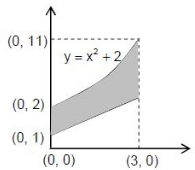
The area (in sq. units) of the region bounded by the parabola, $y = x^2 + 2$ and the lines, $y = x + 1, x = 0$ and $x = 3$, is
- A
$\frac{15}{4}$
- B
$\frac{21}{2}$
- C
$\frac{17}{4}$
- ✓
$\frac{15}{2}$
AnswerCorrect option: D. $\frac{15}{2}$
d
Required area
$\int\limits_0^3 {\left( {\left( {{x^2} + 2} \right) - (x + 1)} \right)} dx$
$ = \int\limits_0^3 {\left( {{x^2} - x + 1} \right)dx = \frac{{15}}{2}} $
View full question & answer→MCQ 1601 Mark
The area (in sq. units) of the region $A = \left\{ {\left( {x,y} \right)\, \in R \times R|0 \le x \le 3,\,0 \le y \le 4|,\,y \le {x^2} + 3x} \right\}$ is
- A
$\frac{{26}}{3}$
- ✓
$\frac{{59}}{6}$
- C
$\frac{{53}}{6}$
- D
$8$
AnswerCorrect option: B. $\frac{{59}}{6}$
b
Required Area
$ = \int\limits_0^1 {\left( {{x^2} + 3x} \right)dx + } $ Area of
rectangle PQRS
$=\frac{11}{6}+8=\frac{59}{6}$
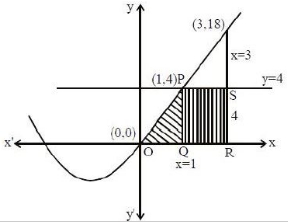
View full question & answer→MCQ 1611 Mark
The area (in $sq. units$) of the region $A = \left\{ {\left( {x,y} \right):\frac{{{y^2}}}{2} \le x \le y + 4} \right\}$ is
- A
$\frac{{53}}{3}$
- ✓
$18$
- C
$30$
- D
$16$
Answerb
$y^{2}=2 x$ ...$(1)$
and $x-y-4=0$ ....$(2)$
solving $( 1)$ and $( 2)$
$(x-y)^{2}=2 x$
$\Rightarrow x^{2}-10 x+16=0$
$\Rightarrow x=8,2$ and $y=4,-2$
$A = \int\limits_{ - 2}^4 {\left( {y + 4 - \frac{{{y^2}}}{2}} \right)dy} $
$A=\left(\frac{y^{2}}{4}+4 y-\frac{y^{3}}{6}\right)_{-2}^{4}$
$A=\left(4+16-\frac{64}{6}\right)-\left(1-8+\frac{8}{6}\right)=18$
View full question & answer→MCQ 1621 Mark
The area(in sq. units) of the region bounded by the curves $y = 2^x$ and $y = |x +1|$ in the first quadrant is
- A
$\frac {3}{2}$
- B
${\log _e}\,2\, + \,\frac{3}{2}$
- ✓
$\frac{3}{2} - \frac{1}{{{{\log }_e}\,2}}$
- D
$\frac {1}{2}$
AnswerCorrect option: C. $\frac{3}{2} - \frac{1}{{{{\log }_e}\,2}}$
c
Required Area
$\int\limits_0^1 {\left( {(x + 1) - {2^x}} \right)} dx$
$=\left(\frac{x^{2}}{2}+x-\frac{2^{x}}{\ln 2}\right)_{0}^{1}$
$=\left(\frac{1}{2}+1-\frac{2}{\ln 2}\right)-\left(0+0-\frac{1}{\ln 2}\right)$
$=\frac{3}{2}-\frac{1}{\ln 2}$
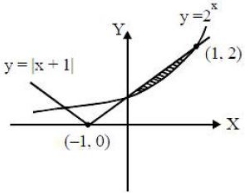
View full question & answer→MCQ 1631 Mark
If the area (in $sq. units$) of the region $\left\{ {\left( {x,y} \right):{y^2} \le 4x,x + y \le 1,x \ge 0,y \ge 0} \right\}$ is $a\sqrt 2 + b$, then $a -b$ is equal to
- A
$\frac{{10}}{3}$
- ✓
$6$
- C
$\frac{{8}}{3}$
- D
$-\frac{{2}}{3}$
Answerb
$\left\{(x, y): y^{2} \leq 4 x, x+y \leq 1, x \geq 0, y \geq 0\right\}$
$A\int\limits_0^{3 - 2\sqrt 2 } {2\sqrt x dx + \frac{1}{2}(1 - (3 - 2\sqrt 2 ))(1 - (3 - 2\sqrt 2 ))} $
$=\frac{2\left[x^{3 / 2}\right]_{0}^{3-2 \sqrt{2}}}{3 / 2}+\frac{1}{2}(2 \sqrt{2}-2)(2 \sqrt{2}-2)$
$=\frac{8 \sqrt{2}}{3}+\left(-\frac{10}{3}\right)$
$a=\frac{8}{3}, b=-\frac{10}{3}$
$a-b=6$
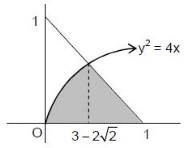
View full question & answer→MCQ 1641 Mark
Let $g\left( x \right) = \cos {x^2},f\left( x \right) = \sqrt x $ and $\alpha ,\beta (\alpha < \beta )$ be the roots of the quadratic equation $18{x^2} - 9\pi x + {\pi ^2} = 0$. Then the area (in sq. units) bounded by the curve $y = \left( {gof} \right)\left( x \right)$ and the lines $x = \alpha ,x = \beta $ and $y = 0$ is :
- A
$\frac{1}{2}\left( {\sqrt 3 + 1} \right)$
- B
$\frac{1}{2}\left( {\sqrt 3 - \sqrt 2 } \right)\;\;\;\;$
- C
$\frac{1}{2}\left( {\sqrt 2 - 1} \right)\;$
- ✓
$\frac{1}{2}\left( {\sqrt 3 - 1} \right)$
AnswerCorrect option: D. $\frac{1}{2}\left( {\sqrt 3 - 1} \right)$
d
(4) Here, $18 x^{2}-9 \pi x+\pi^{2}=0$
$\Rightarrow(3 x-\pi)(6 x-\pi)=0$
$\Rightarrow \quad \alpha=\frac{\pi}{6}, \beta=\frac{\pi}{3}$
$\quad$ Also, $\operatorname{gof}(x)=\cos x$
$\therefore \quad$Req. area $ = \int\limits_{\pi /6}^{\pi /3} {\cos xdx = } \frac{{\sqrt 3 - 1}}{2}$
View full question & answer→MCQ 1651 Mark
The area (in sq. units) of the region $\left\{ {x \in R:x \ge } \right.0,\,y \ge 0,\,y \ge x - 2\,and\,y \le \sqrt x \} \,,\,$ is
- A
$\frac{{13}}{3}$
- ✓
$\frac{{10}}{3}$
- C
$\frac{{5}}{3}$
- D
$\frac{{8}}{3}$
AnswerCorrect option: B. $\frac{{10}}{3}$
b
The intersection point of $y=x-2$ and
$y=\sqrt{x}$ is $(4,2)$
Therequiredarea
$=\int_{0}^{4} \sqrt{x} d x-\frac{1}{2} \times 2 \times 2$
$=\frac{16}{3}-2=\frac{10}{3}$
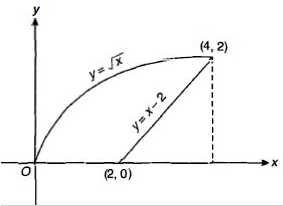
View full question & answer→MCQ 1661 Mark
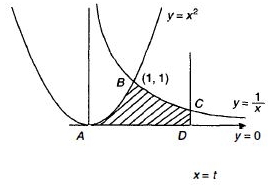
If the area of the region bounded by the curves, $y = {x^2}\,,\,y = \frac{1}{x}$ and the lines $y = 0$ and $x = t (t > 1 )$ is $1\,sq. unit$ , then $t$ is equal to
- A
$\frac {4}{3}$
- ✓
$e^{2/3}$
- C
$\frac {3}{2}$
- D
$e^{3/2}$
AnswerCorrect option: B. $e^{2/3}$
b
The intersection point of
$y=x^{2}$ and $y=\frac{1}{x}$ is $(1,1)$
Area bounded by the curves is the region $\mathrm{ABCDA}$ is given as:
${\rm{ Area }} = \int_0^1 {{x^2}} dx + \int_1^t {\frac{1}{x}} dx$
$ = \left[ {\frac{{{x^3}}}{3}} \right]_0^1 + \left[ {\ln (x)_1^t} \right]$
$ = \frac{1}{3} + \ln (t)$
$\because$ area $=1$
$\Rightarrow \frac{1}{3}+\ln (t)=1 \quad \Rightarrow \ln (t)=\frac{2}{3} \Rightarrow t=e^{\frac{2}{3}}$
View full question & answer→MCQ 1671 Mark
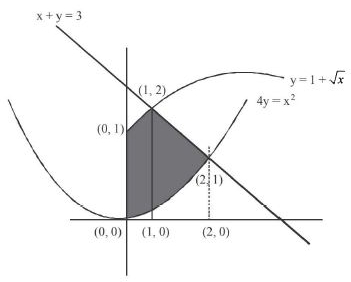
The area (in sq. units ) of the region $\{ \left( {x,y} \right):x \ge 0,x + y \le 3,{x^2} \le 4y$ and $y \le 1 + \sqrt x \;\} $ is . . .
- ✓
$\frac{5}{2}$
- B
$\frac{{59}}{{12}}$
- C
$\frac{3}{2}\;$
- D
$\frac{7}{3}$
AnswerCorrect option: A. $\frac{5}{2}$
a
Area of shaded region
$ = \int\limits_0^1 {(1 + \sqrt x )dx} + \int\limits_1^2 {(3 - x)dx - \int\limits_0^2 {\frac{{{x^2}}}{4}dx} } $
$\left. {\left. { = x]_0^1 + \left. {\frac{{{x^{\frac{3}{2}}}}}{{\frac{3}{2}}}} \right]_0^1 + 3x} \right]_1^2 - \left. {\frac{{{x^2}}}{2}} \right]_{\kern 1pt} ^2 - \frac{{{x^3}}}{{12}}} \right]_0^2 = \frac{5}{2}$ sq.units
View full question & answer→MCQ 1681 Mark
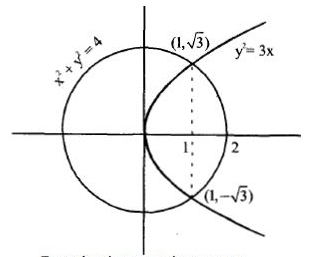
The area (in sq. units) of the smaller portion enclosed between the curves, $x^2 + y^2 = 4$ and $y^2 =3x$, is
- A
$\frac{1}{{2\sqrt 3 }} + \frac{\pi }{3}$
- B
$\frac{1}{{\sqrt 3 }} + \frac{{2\pi }}{3}$
- C
$\frac{1}{{2\sqrt 3 }} + \frac{{2\pi }}{3}$
- ✓
$\frac{1}{{\sqrt 3 }} + \frac{{4\pi }}{3}$
AnswerCorrect option: D. $\frac{1}{{\sqrt 3 }} + \frac{{4\pi }}{3}$
d
From the given equations, we get;
$x^{2}+3 x-4=0$
$ \Rightarrow $ $(x+4)(x-1)=0$
$x=-4, x=1$
when $x=1, y=\sqrt{3}$
$\therefore $ req. area $=$
$\left( {\int\limits_0^1 {\sqrt 3 } } \right.\left. { \cdot \sqrt x dx + \int\limits_1^2 {\sqrt {4 - {x^2}} } \cdot dx} \right) \times 2$
$\left( {\sqrt 3 \left. {\left. {\left( {\frac{{{x^{3/2}}}}{{3/2}}} \right.} \right)_0^1 + \left( {\frac{x}{2}\sqrt {4 - {x^2}} + 2{{\sin }^{ - 1}}\frac{x}{2}} \right)_1^2} \right)} \right. \times 2$
$ = \left( {\sqrt 3 \left( {\frac{2}{3}} \right) + \left\{ {2 \cdot \frac{\pi }{2} - \left( {\frac{{\sqrt 3 }}{2} + \frac{\pi }{3}} \right)} \right\}} \right) \times 2$
$ = \left( {\frac{2}{{\sqrt 3 }} - \frac{{\sqrt 3 }}{2} + \frac{{2\pi }}{3}} \right) \times 2$
$ = \left( {\frac{1}{{2\sqrt 3 }} + \frac{{2\pi }}{3}} \right) \times 2$
$ = \frac{1}{{\sqrt 3 }} + \frac{{4\pi }}{3}$
View full question & answer→MCQ 1691 Mark
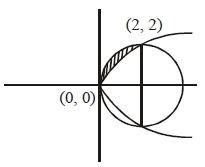
The area (in sq. units) of the region $\{(x,y):y^2 \geq 2x\,and\,x^2+y^2 \leq 4x,x \geq 0,y \leq 0 \}$ is
AnswerCorrect option: D. $\;\pi - \frac{8}{3}$
d
$ = \frac{{\pi {{\left( 2 \right)}^2}}}{4} - \sqrt 2 \int\limits_0^2 {\sqrt x dx} $
$=\pi-\sqrt{2} \cdot \frac{2}{3} 2 \sqrt{2}$
$=\pi-8 / 3$
View full question & answer→MCQ 1701 Mark
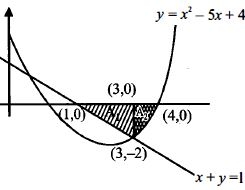
The area (in sq. units) of the region described by $A = \{ (x,y)|y \ge {x^2} - 5x + 4,\,x + y \ge 1,\,y \le 0\} $ is
- ✓
$\frac {19}{6}$
- B
$\frac {17}{6}$
- C
$\frac {7}{2}$
- D
$\frac {13}{6}$
AnswerCorrect option: A. $\frac {19}{6}$
a
Required area $=A_{1}+A_{2}$
$=\frac{1}{2} \times 2 \times 2+\left|\int_{3}^{4}\left(x^{2}-5 x+4\right) d x\right|$
$=2+\frac{7}{6}=\frac{19}{6}$ sq units
View full question & answer→MCQ 1711 Mark
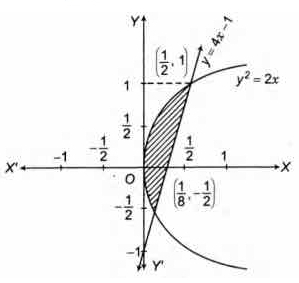
The area (in sq. units) of the region described by $\{(x,y):$${y^2} \le 2x \,and\,y \ge 4x - 1$$\}$ is
- ✓
$\frac{9}{{32}}$
- B
$\frac{7}{{32}}$
- C
$\frac{5}{{64}}$
- D
$\frac{{15}}{{64}}$
AnswerCorrect option: A. $\frac{9}{{32}}$
a
Given region is $(x, y): y^{2} \leq 2 x$ and $y \geq 4 x-1$ $y^{2} \leq 2 x$ repressents a region inside the persbole
$y^{2}-2 x \quad \dots(i)$
and $y \geq 4 x-1$ represents a region to the left of the line
$y=4 x-1 \quad \ldots \ldots(ii)$
The point of intersection of the curves $(i)$ and $(ii)$ is
$(4 x-1)^{2}-2 x \Rightarrow 16 x^{2}+1-8 x=2 x$
$\Rightarrow 16 x^{2}-10 x+11=0 \Rightarrow x=\frac{1}{2}, \frac{1}{8}$
So, the points where these curves intersect are $\left(\frac{1}{2}, 1\right)$ and $\left(\frac{1}{8}, \frac{1}{2}\right)$
$\therefore$ Required area $ = \int\limits_{ - \frac{1}{2}}^1 {\left( {\frac{{y + 1}}{4} - \frac{{{y^2}}}{2}} \right)dy} $
$=\frac{1}{4}\left(\frac{y^{2}}{2}+y\right)_{-1 / 2}^{-1}-\frac{1}{6}\left(y^{3}\right)_{-1 / 2}^{1}$
$=\frac{1}{4}\left\{\left(\frac{1}{2}+1\right)-\left(\frac{1}{8}-\frac{1}{2}\right)\right\}-\frac{1}{6}\left(1+\frac{1}{8}\right)$
$=\frac{1}{4}\left\{\frac{3}{2}+\frac{3}{8}\right\}-\frac{1}{6}\left\{\frac{9}{8}\right\}$
$\begin{aligned}=\frac{1}{4} & \times \frac{15}{8}-\frac{3}{16} \\ &=\frac{9}{32} \text { sq units } \end{aligned}$
View full question & answer→MCQ 1721 Mark
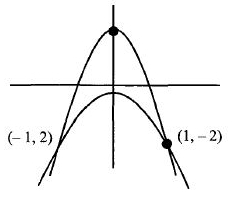
The area (in square units) of the region bounded by the curves $y + 2x^2 = 0$ and $y + 3x^2 = 1$ , is equal to
- A
$\frac {3}{5}$
- B
$\frac {1}{3}$
- ✓
$\frac {4}{3}$
- D
$\frac {3}{4}$
AnswerCorrect option: C. $\frac {4}{3}$
c
Solving
$y=2 x^{2}=0$
$y=3 x^{2}=1$
Point of intersection $(1,-2)$ and $(-1,-2)$
Area $ = 2\int\limits_0^1 {\left( {\left( {1 - 3{x^2}} \right) - \left( { - 2{x^2}} \right)dx} \right)} $
$ = 2\int\limits_0^1 {\left( {1 - {x^2}dx} \right) = 2\left( {x - \frac{{{x^3}}}{3}} \right)_0^1 = \frac{4}{3}} $
View full question & answer→MCQ 1731 Mark
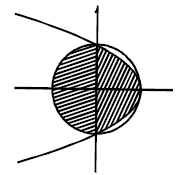
The area of the region described by $A=\{(x,y):x^2 + y^2 \le 1\,and\,y^2 \le 1-x \}$ is
- A
$\frac{\pi }{2} - \frac{2}{3}$
- B
$\frac{\pi }{2} + \frac{2}{3}$
- ✓
$\frac{\pi }{2} + \frac{4}{3}$
- D
$\;\frac{\pi }{2} - \frac{4}{3}$
AnswerCorrect option: C. $\frac{\pi }{2} + \frac{4}{3}$
c
$A_{1}=2\left|\int_{0}^{1} \sqrt{1-x}\right| d x$
$A_{1}=2\left|\int_{1}^{0} 2 t^{2} d t\right|$
$A_{1}=4 \cdot \frac{1}{3}$
$\boxed{Area = \frac{\pi }{2} + \frac{4}{3}}$
View full question & answer→MCQ 1741 Mark
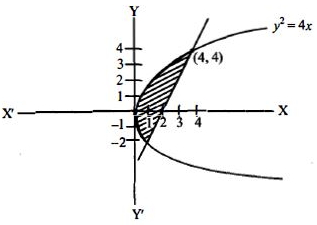
Let $A = \left\{ {\left( {x,y} \right):{y^2} \le 4x,y - 2x \ge - 4} \right\}$ .The area of the region $A$ is
Answerb
$=\left|\int_{2}^{4}\left(\frac{y+4}{2}\right) d y\right|-\int_{-2}^{4} \frac{y^{2}}{4} d y$
$ = \left. {\frac{1}{2}\left[ {\frac{{{y^2}}}{2} + 4y} \right]_{ - 2}^4} \right| - \left| {\frac{1}{4}\left[ {\frac{{{y^3}}}{3}} \right]_{ - 2}^4} \right.$
$=\left|\frac{1}{2}[\{8+16\}-\{2-8\}]\right|-\left|\frac{1}{4}\left\{\frac{64}{3}+\frac{8}{3}\right\}\right|$
$=15-6=9$ sq units
View full question & answer→MCQ 1751 Mark
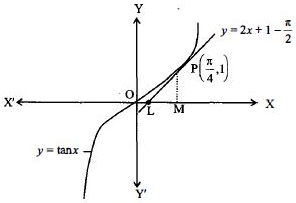
The area of the region above the $x-$ axis bounded by the curve $y\, = tan\, x$, $0 \leq x \leq \frac{\pi }{2}$ and the tangent to the curve at $x\, = \frac{\pi}{4}$ is
- ✓
$\frac{1}{2}\left( {\log \,2 - \frac{1}{2}} \right)$
- B
$\frac{1}{2}\left( {\log \,2 + \frac{1}{2}} \right)$
- C
$\frac{1}{2}\left( {1 - \log \,2} \right)$
- D
$\frac{1}{2}\left( {1 + \log \,2} \right)$
AnswerCorrect option: A. $\frac{1}{2}\left( {\log \,2 - \frac{1}{2}} \right)$
a
The given curve is $y=\tan x \quad \ldots(1)$
when $x=\frac{\pi}{4}, y=1$
Equation of tangent at $P$ is
$y-1=\left(\sec ^{2} \frac{\pi}{4}\right)\left(x-\frac{\pi}{4}\right)$
or $y=2 x+1-\frac{\pi}{2}$ .....$(2)$
Area of shaded region
$=$ area of $\mathrm{OPMO}-a r(\Delta \mathrm{PLM})$
$=\int_{0}^{\frac{\pi}{4}} \tan x d x-\frac{1}{2}(\mathrm{OM}-\mathrm{OL}) \mathrm{PM}$
$ = \left[ {\left. {\log \sec x\frac{{\frac{\pi }{4}}}{0}} \right] - \frac{1}{2}\left\{ {\frac{\pi }{4} - \frac{{\pi - 2}}{4}} \right\} \times 1} \right.$
$=\frac{1}{2}\left[\log 2-\frac{1}{2}\right]$ sq unit
View full question & answer→MCQ 1761 Mark
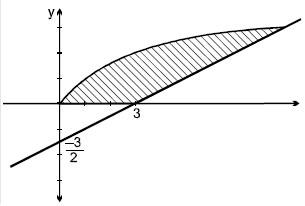
The area (in square units) bounded by the curves $y = \sqrt x $ and $2y - x + 3 = 0$ and $X-$ axis and lying in the first quadrant is :
- ✓
$9$
- B
$36$
- C
$18$
- D
$\frac{{27}}{4}$
Answera
$y = \sqrt x \,\,\,\,\,\,\,\,\,\,\,\,\,\,\,\,....\left( 1 \right)$
${\rm{ and }}\quad 2y - x + 3 = 0\,\,\,\,\,\,\,\,\,\,.....\left( 2 \right)$
On solving both $y=-1,3$
Required area $ = \int\limits_0^3 {\left\{ {(2y + 3) - {y^2}} \right\}dy} $
$=y^{2}+3 y-\left.\frac{y^{3}}{3}\right|_{0} ^{3} $
${=9+9-9}$
${=9}$
View full question & answer→MCQ 1771 Mark
The area of the region (in sq. units), in the first quadrant bounded by the parabola $y = 9x^2$ and the lines $x = 0,y = 1$ and $y = 4,$ is
- A
$7/9$
- B
$14/3$
- C
$7/3$
- ✓
$14/9$
AnswerCorrect option: D. $14/9$
d
Required area $ = \int\limits_{y = 1}^4 {\sqrt {\frac{y}{9}} dy} $
$ = \frac{1}{3}\int\limits_{y = 1}^4 {{y^{1/2}}dy = \frac{1}{3} \times \frac{2}{3}} \left( {{y^{3/2}}} \right)_1^4$
$=\frac{2}{9}\left[\left(4^{1 / 2}\right)^{3}-\left(1^{1 / 2}\right)^{3}\right]=\frac{2}{9}[8-1]$
$=\frac{2}{9} \times 7=\frac{14}{9} \mathrm{sq.~units.}$
View full question & answer→MCQ 1781 Mark
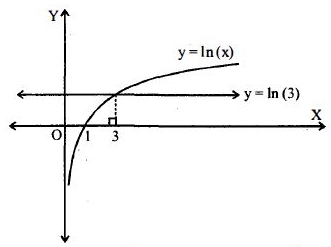
The area bounded by the curve $y = ln\, (x)$ and the lines $y = 0, y = ln\, (3)$ and $x = 0$ is equal to
- A
$3$
- B
$3\, ln\, (3) -2$
- C
$3\, ln\, (3) +2$
- ✓
$2$
Answerd
To find the point of intersection of curves
$ y=\ln (x) \text { and } y=\ln (3),$
$ \text { put } \ln (x)=\ln (3) $
$ \Rightarrow \ln (x)-\ln (3)=0$
$ \Rightarrow \ln (x)-\ln (3)=\ln (1) $
$ \Rightarrow \frac{x}{3}=1, \Rightarrow x=3 $
Required area $ = \int\limits_0^3 {\ln } \left( 3 \right)dx - \int\limits_1^3 {\ln } \left( x \right)dx$
$=[x \ln (3)]_{0}^{3}-\left[x \ln (x)-x_{1}^{3}\right]=2$
View full question & answer→MCQ 1791 Mark
The area under the curve $y = \left| {\cos \,x - \sin \,x} \right|$ , $0 \leq x \leq\frac{\pi }{2}$, and above $x-$ axis is
- A
$2\sqrt 2 $
- ✓
$2\sqrt 2 - 2$
- C
$2\sqrt 2 + 2$
- D
$0$
AnswerCorrect option: B. $2\sqrt 2 - 2$
b
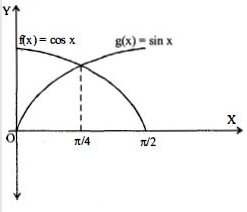
$y = \left| {\cos x - \sin x} \right|$
Required area $ = 2\int\limits_0^{\pi /4} {(\cos x - \sin x)dx} $
$ = 2\left[ {\sin x + \cos x_0^{\pi /4}} \right]$
$=2\left[\frac{2}{\sqrt{2}}-1\right]$
$=(2 \sqrt{2}-2)$ sq. units
View full question & answer→MCQ 1801 Mark
Let $f:\left[ { - 2,3} \right] \to \left[ {0,\infty } \right)$ be a continuous function such that $f(1-x) = f(x)$ for all $x \in \left[ { - 2,3} \right]$ . If $R_1$ is the numerical value of the area of the region bounded by $y =f (x), x = -2, x = 3$ and the axis of $x$ and ${R_2} = \int\limits_{ - 2}^3 {x\,f\left( x \right)} dx$ , then
- A
$3R _1= 2R_2$
- B
$2R _1= 3R_2$
- C
$R _1= R_2$
- ✓
$R _1= 2R_2$
AnswerCorrect option: D. $R _1= 2R_2$
d
We have
${{\rm{R}}_2} = \int\limits_{ - 2}^3 {xf(x)dx} $
$ = \int\limits_{ - 2}^3 {(1 - x)f(1 - x)dx} $
$\left[ {{\rm{Using}}\int\limits_a^b {f\left( x \right)dx} = \int\limits_a^b {f\left( {a + b - x} \right)dx} } \right]$
$ \Rightarrow {{\rm{R}}_2} = \int\limits_{ - 2}^3 {(1 - x)f\left( x \right)dx} $
$(\because f(x)=f(1-x) \text { on }[-2,3])$
$\therefore {{\rm{R}}_2} + {R^2} = \int\limits_{ - 2}^3 {xf\left( x \right)dx + } \int\limits_{ - 2}^3 {(1 - x)f\left( x \right)dx} $
$ = \int\limits_{ - 2}^3 {f\left( x \right)dx = {R_1}} $
$\Rightarrow 2 \mathrm{R}_{2}=\mathrm{R}_{1}$
View full question & answer→MCQ 1811 Mark
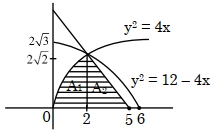
Let $S=\left\{(x, y) \in R \times R : x \geq 0, y \geq 0, y^2 \leq 4 x, y^2 \leq 12-2 x\right.$ and $\left.3 y+\sqrt{8} x \leq 5 \sqrt{8}\right\}$. If the area of the region $S$ is $\alpha \sqrt{2}$, then $\alpha$ is equal to
- A
$\frac{17}{2}$
- ✓
$\frac{17}{3}$
- C
$\frac{17}{4}$
- D
$\frac{17}{5}$
AnswerCorrect option: B. $\frac{17}{3}$
b
Point of intersection of all curves is $(2,2 \sqrt{2})$
$\text { Area }= A _1+ A _2$
$\alpha \sqrt{2}=\int_0^2 2 \sqrt{ x } dx +\frac{1}{2} \times 3 \times 2 \sqrt{2}$
$\alpha \sqrt{2}=2\left[\frac{ x ^{\frac{3}{2}}}{\frac{3}{2}}\right]_0^2+3 \sqrt{2}$
$\alpha \sqrt{2}=\frac{17 \sqrt{2}}{3}$
$\alpha=\frac{17}{3}$
View full question & answer→MCQ 1821 Mark
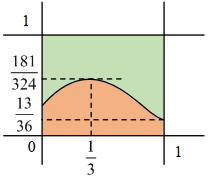
Let $f:[0,1] \rightarrow[0,1]$ be the function defined by $f(x)=\frac{x^5}{3}-x^2+\frac{5}{9} x+\frac{17}{36}$. Consider the square region $S=[0,1] \times[0,1]$. Let $G=\{(x, y) \in S: y>f(x)\}$ be called the green region and $R=\{(x, y) \in S$ : $\mathrm{y}<\mathrm{f}(\mathrm{x})\}$ be called the red region. Let $\mathrm{L}_{\mathrm{h}}=\{(\mathrm{x}, \mathrm{h}) \in \mathrm{S}: \mathrm{x} \in[0,1]\}$ be the horizontal line drawn at a height $\mathrm{h} \in[0,1]$. Then which of the following statements is(are) ture?
($A$) There exists an $\mathrm{h} \in\left[\frac{1}{4}, \frac{2}{3}\right]$ such that the area of the green region above the line $\mathrm{L}_{\mathrm{h}}$ equals the area of the green region below the line $\mathrm{L}_{\mathrm{h}}$
($B$) There exists an $\mathrm{h} \in\left[\frac{1}{4}, \frac{2}{3}\right]$ such that the area of the red region above the line $\mathrm{L}_{\mathrm{h}}$ equals the area of the red region below the line $\mathrm{L}_h$
($C$) There exists an $\mathrm{h} \in\left[\frac{1}{4}, \frac{2}{3}\right]$ such that the area of the green region above the line $\mathrm{L}_{\mathrm{h}}$ equals the area of the red region below the line $L_h$
($D$) There exists an $\mathrm{h} \in\left[\frac{1}{4}, \frac{2}{3}\right]$ such that the area of the red region above the line $\mathrm{L}_{\mathrm{h}}$ equals the area of the green region below the line $\mathrm{L}_{\mathrm{h}}$
- A
$C,D$
- B
$B,C$
- C
$B,C,A$
- ✓
$B,C,D$
AnswerCorrect option: D. $B,C,D$
d
$f(x)=\frac{x^3}{3}-x^2+\frac{5 x}{9}+\frac{17}{36}$
$f^{\prime}(x)=x^2-2 x+\frac{5}{9}$
$f^{\prime}(x)=0 \text { at } x=\frac{1}{3} \text { in }[0,1]$
$A_R=\text { Area of Red region }$
$A_G=\text { Area of Green region }$
$A_R=\int_0^1 f(x) d x=\frac{1}{2}$
$\text { Total area }=1$
$\Rightarrow A_G=\frac{1}{2}$
$\int_0^1 f(x) d x=\frac{1}{2}$
$A_G=A_R$
$f(0)=\frac{17}{36}$
$f(1)=\frac{13}{36} \approx 0.36$
$f\left(\frac{1}{3}\right)=\frac{181}{324} \approx 0.558$
($A$) Correct when $\mathrm{h}=\frac{3}{4}$ but $\mathrm{h} \in\left[\frac{1}{4}, \frac{2}{3}\right]$
$\Rightarrow(A)$ is incorrect
($B$) Correct when $\mathrm{h}=\frac{1}{4}$
$\Rightarrow(B)$ is correct
($C$) When $\mathrm{h}=\frac{181}{324}, \mathrm{~A}_{\mathrm{R}}=\frac{1}{2}, \mathrm{~A}_{\mathrm{G}}<\frac{1}{2}$
$\mathrm{h}=\frac{13}{36}, \mathrm{~A}_{\mathrm{R}}<\frac{1}{2}, \mathrm{~A}_{\mathrm{G}}=\frac{1}{2}$
$\Rightarrow A_R=A_G$ for some $h \in\left(\frac{13}{36}, \frac{181}{324}\right)$
$\Rightarrow(C)$ is correct
($D$) Option ($D$) is remaining coloured part of option ($C$), hence option ($D$) is also correct.
View full question & answer→MCQ 1831 Mark
Consider the functions $f, g: R \rightarrow R$ defined by
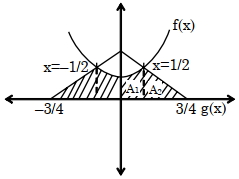
$f(x)=x^2+\frac{5}{12}$ and $g(x)=\left\{\begin{array}{cc}2\left(1-\frac{4|x|}{3}\right), & |x| \leq \frac{3}{4} \\ 0, & |x|>\frac{3}{4}\end{array}\right.$
If $\alpha$ is the area of the region
$\left\{( x , y ) \in R \times R :| x | \leq \frac{3}{4}, 0 \leq y \leq \min \{f( x ), g( x )\}\right\},$
then the value of $9 \alpha$ is. . . . . .
Answerd
$x^2+\frac{5}{12}=\frac{2-8 x}{3}$
$x^2+\frac{8 x}{3}+\frac{5}{12}-2=0$
$\begin{array}{l}12 x^2+32 x -19=0 \\ 12 x ^2+38 x -6 x -19=0 \\ 2 x (6 x +19)-1(6 x +19)=0 \\ (6 x +19)(2 x -1)=0 \\ x =\frac{1}{2} \\ \alpha=2 A _1+ A _2 \\ \alpha=2\left(\int_0^{1 / 2} x ^2+\frac{5}{12} dx +\frac{1}{2} \times \frac{1}{4} \times \frac{2}{3}\right) \\ \Rightarrow \alpha=2\left[\left(\frac{ x ^3}{3}+\frac{5 x }{12}\right)_0^{1 / 2}+\frac{1}{12}\right] \\ \Rightarrow \alpha=2\left[\frac{1}{24}+\frac{5}{24}+\frac{1}{12}\right] \\ \Rightarrow \alpha=2\left[\frac{1+5+2}{24}\right] \Rightarrow \alpha=2 \times \frac{8}{24} \Rightarrow 9 \alpha=9 \times \frac{8}{12} \\ \Rightarrow 9 \alpha=6\end{array}$
View full question & answer→MCQ 1841 Mark
The area of the region $\left\{(x, y): 0 \leq x \leq \frac{9}{4}, \quad 0 \leq y \leq 1, \quad x \geq 3 y, \quad x+y \geq 2\right\}$ is
- ✓
$\frac{11}{32}$
- B
$\frac{35}{96}$
- C
$\frac{37}{96}$
- D
$\frac{13}{32}$
AnswerCorrect option: A. $\frac{11}{32}$
a
$x + y -2=0$
$P \left(\frac{3}{2}, \frac{1}{2}\right) ; Q (2,0) ; R \left(\frac{9}{4}, 0\right) ; S \left(\frac{9}{4}, \frac{3}{4}\right)$
Area $=\frac{1}{2}|| \begin{array}{ll}\frac{3}{2} & \frac{1}{2} \\ 2 & 0\end{array}|+| \begin{array}{ll}2 & 0 \\ \frac{9}{4} & 0\end{array}|+| \begin{array}{ll}\frac{9}{4} & 0 \\ \frac{9}{4} & \frac{3}{4}\end{array}|+| \begin{array}{ll}\frac{9}{4} & \frac{3}{4} \\ \frac{3}{2} & \frac{1}{2}\end{array}||$
$=\frac{1}{2}\left|(0-1)+(0-0)+\left(\frac{27}{16}-0\right)+\left(\frac{9}{8}-\frac{9}{8}\right)\right|=\frac{11}{32}$
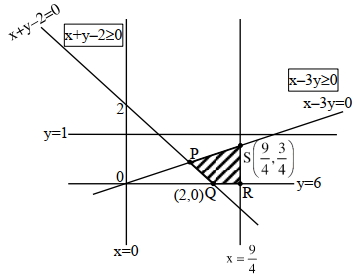
View full question & answer→MCQ 1851 Mark
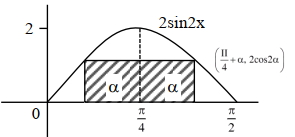
Consider all rectangles lying in the region
$\left\{( x , y ) \in R \times R : 0 \leq x \leq \frac{\pi}{2} \text { and } 0 \leq y \leq 2 \sin (2 x )\right\}$
and having one side on the $x$-axis. The area of the rectangle which has the maximum perimeter among all such rectangles, is
- A
$\frac{3 \pi}{2}$
- B
$\pi$
- ✓
$\frac{\pi}{2 \sqrt{3}}$
- D
$\frac{\pi \sqrt{3}}{2}$
AnswerCorrect option: C. $\frac{\pi}{2 \sqrt{3}}$
c
Perimeter$=2(2 \alpha+2 \cos 2 \alpha)$
$P =4(\alpha+\cos 2 \alpha)$
$\frac{ dP }{ d \alpha}=4(1-2 \sin 2 \alpha)=0$
$\sin 2 \alpha=\frac{1}{2}$
$2 \alpha=\frac{\pi}{6}, \frac{5 \pi}{6}$
$\frac{ d ^2 P }{ d \alpha^2}=-4 \cos 2 \alpha$
$\text { for maximum } \alpha=\frac{\pi}{12}$
$\text { Area }=(2 \alpha)(2 \cos 2 \alpha)$
$\quad=\frac{\pi}{6} \times 2 \times \frac{\sqrt{3}}{2}=\frac{\pi}{2 \sqrt{3}}$
View full question & answer→MCQ 1861 Mark
Let the functions $f: R \rightarrow R$ and $g : R \rightarrow R$ be defined by
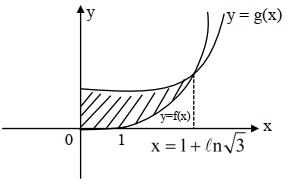
$f(x)=e^{x-1}-e^{-|x-1|} \text { and } g(x)=\frac{1}{2}\left(e^{x-1}+e^{1-x}\right) \text {. }$ Then the area of the region in the first quadrant bounded by the curves $y=f(x), y=g(x)$ and $x=0$ is
- ✓
$(2-\sqrt{3})+\frac{1}{2}\left(e-e^{-1}\right)$
- B
$(2+\sqrt{3})+\frac{1}{2}\left( e - e ^{-1}\right)$
- C
$(2-\sqrt{3})+\frac{1}{2}\left(e+e^{-1}\right)$
- D
$(2+\sqrt{3})+\frac{1}{2}\left(e+e^{-1}\right)$
AnswerCorrect option: A. $(2-\sqrt{3})+\frac{1}{2}\left(e-e^{-1}\right)$
a
Here
$\begin{array}{l}f(x)=\left\{\begin{array}{cc}0 & x \leq 1 \\ e^{x-1}-e^{1-x} & x \geq 1\end{array}\right. \\ \& g(x)=\frac{1}{2}\left(e^{x-1}+e^{1-x}\right)\end{array}$
$\begin{array}{l}\text { solve } f(x) \& g(x) \Rightarrow x=1+\ell n \sqrt{3} \\ \text { So bounded area }=\int_0^1 \frac{1}{2}\left(e^{x-1}+e^{1-x}\right) d x+\int_1^{1+(n \sqrt{3}} \frac{1}{2}\left(e^{x-1}+e^{1-x}\right)-\left(e^{x-1}+e^{1-x}\right) d x \\ =\frac{1}{2}\left[e^{x-1}-e^{1-x}\right]_0^1+\left[-\frac{1}{2} e^{x-1}-\frac{3}{2} e^{1-x}\right]_1^{1+(n \sqrt{3}} \\ =\frac{1}{2}\left[e-\frac{1}{e}\right]+\left[\left(-\frac{\sqrt{3}}{2}-\frac{\sqrt{3}}{2}\right)+2\right]=2-\sqrt{3}+\frac{1}{2}\left(e-\frac{1}{e}\right)\end{array}$
View full question & answer→MCQ 1871 Mark
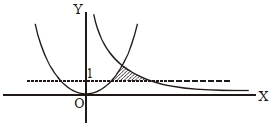
The area of the region $\left\{(x, y): x y \leq 8,1 \leq y \leq x^2\right\}$ is
- A
$8 \log _e 2-\frac{14}{3}$
- ✓
$16 \log _e 2-\frac{14}{3}$
- C
$16 \log _e 2-6$
- D
$8 \log _e 2-\frac{7}{3}$
AnswerCorrect option: B. $16 \log _e 2-\frac{14}{3}$
b
For intersection, $\frac{8}{y}=\sqrt{y} \Rightarrow y=4$
Hence, required area $= \int_1^4\left(\frac{8}{y}-\sqrt{ y }\right) dy$
$ =\left[8 \operatorname{lny}-\frac{2}{3} y ^{3 / 2}\right]_1^4=16 \ln 2-\frac{14}{3}$
View full question & answer→MCQ 1881 Mark
Let $f:[0, \infty) \rightarrow R$ be a continuous function such that $f(x)=1-2 x+\int_0^x e^{x-t} f(t) d t$ for all $x \in[0, \infty)$. Then, which of the following statement (s) is (are) $TRUE$?
$(A)$ The curve $y=f(x)$ passes through the point $(1,2)$
$(B)$ The curve $y=f(x)$ passes through the point $(2,-1)$
$(C)$ The area of the region $\left\{(x, y) \in[0,1] \times R: f(x) \leq y \leq \sqrt{1-x^2}\right\}$ is $\frac{\pi-2}{4}$
$(D)$ The area of the region $\left\{(x, y) \in[0,1] \times R: f(x) \leq y \leq \sqrt{1-x^2}\right\}$ is $\frac{\pi-1}{4}$
- A
$A,B$
- B
$A,C$
- ✓
$B,C$
- D
$A,B,C$
Answerc
$e^{-x} f(x)=(1-2 x) e^{-x}+\int_0^x e^{-t} f(t) d t$
$diff.\quad e^{-x} f^{\prime}(x)-e^{-x} f(x)=-(1-2 x) e^{-x}-2 e^{-x}+e^{-x} f(x)$
$f^{\prime}(x)-2 f(x)=-3+2 x$
$I.F.=e^{-2 x}$
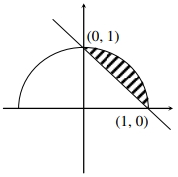
Soln. $y \cdot e^{-2 x}=C+\int e^{-2 x}(2 x-3) d x$ $=C+2 \int e ^{-2 x } \cdot xdx -3 \cdot \int e ^{-2 x } dx$ $=C+2\left[\frac{e^{-2 x}}{-2} x-\frac{e^{-2 x}}{4}\right]+\frac{3}{2} e^{-2 x}$ $y=C \cdot e^{2 x}-x-\frac{1}{2}+\frac{3}{2}$
View full question & answer→MCQ 1891 Mark
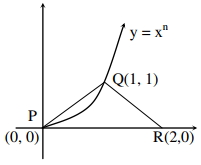
A farmer $F _1$ has a land in the shape of a triangle with vertices at $P (0,0), Q (1,1)$ and $R (2$, $0)$. From this land, a neighbouring farmer $F_2$ takes away the region which lies between the side $PQ$ and a curve of the form $y = x ^{ n }( n >1)$. If the area of the region taken away by the farmer $F_2$ by the farmer $F_2$ is eaxtly $30 \%$ of the area of $\triangle P Q R$, then the value of $n$ is. . . . . .
Answerc
$\int_0^1\left(x-x^n\right) d x=\frac{3}{10}$
$\left.\frac{x^2}{2}\right|_0 ^1-\left.\frac{x^{n+1}}{n+1}\right|_0 ^1=\frac{3}{10}$
$\frac{1}{2}-\frac{1}{n+1}=\frac{3}{10}$
$\frac{1}{n+1}=\frac{1}{2}-\frac{3}{10}$
$n+1=5$
$n=4$
View full question & answer→MCQ 1901 Mark
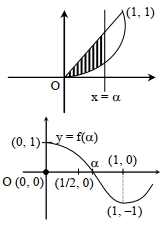
If the line $x=\alpha$ divides the area of region $R=\left\{(x, y) \in \mathrm{R}^2: x^3 \leq y \leq x, 0 \leq x \leq 1\right\}$ into two equal parts, then $[A]$ $0<\alpha \leq \frac{1}{2}$ $[B]$ $\frac{1}{2}<\alpha<1$ $[C]$ $2 \alpha^4-4 \alpha^2+1=0$ $[D]$ $\alpha^4+4 \alpha^2-1=0$
- ✓
$B,C$
- B
$B,D$
- C
$B,A$
- D
$B,C,D$
Answera
$\frac{1}{2}\left(\int_0^1\left(x-x^3\right) d x\right)=\int_0^a\left(x-x^3\right) d x$
(image)
$\frac{1}{8}=\left|\frac{x^2}{2}-\frac{x^4}{4}\right|_0^\alpha$
(image)
$\frac{1}{2}=2 \alpha^2-\alpha^4$
$2 \alpha^4-4 \alpha^2+1=0$
$f(\alpha)=2 \alpha^4-4 \alpha^2+1$
View full question & answer→MCQ 1911 Mark
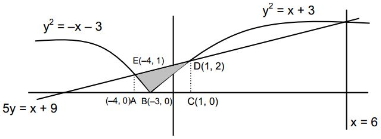
Area of the region $\left\{(x, y) \in \mathbb{R}^2: y \geq \sqrt{|x+3|}, 5 y \leq x+9 \leq 15\right\}$ is equal to
- A
$\frac{1}{6}$
- B
$\frac{4}{3}$
- ✓
$\frac{3}{2}$
- D
$\frac{5}{3}$
AnswerCorrect option: C. $\frac{3}{2}$
c
$\text { Area } ABE \text { (under parabola) }=\int_{-4}^{-3} \sqrt{- x -3} dx =\frac{2}{3}$
$\text { Area } BCD \text { (under parabola) }=\int_{-3}^1 \sqrt{ x +3} dx =\frac{16}{3}$
$\text { Area of trapezium } ACDE =\frac{1}{2}(1+2)_5=\frac{15}{2}$
$\text { Required area }=\frac{15}{2}-\frac{16}{3}-\frac{2}{3}=\frac{3}{2}$
View full question & answer→MCQ 1921 Mark
The area enclosed by the curves $y=\sin x+\cos x$ and $y=|\cos x-\sin x|$ over the interval $\left[0, \frac{\pi}{2}\right]$ is
- A
$4(\sqrt{2}-1)$
- ✓
$2 \sqrt{2}(\sqrt{2}-1)$
- C
$2(\sqrt{2}+1)$
- D
$2 \sqrt{2}(\sqrt{2}+1)$
AnswerCorrect option: B. $2 \sqrt{2}(\sqrt{2}-1)$
b
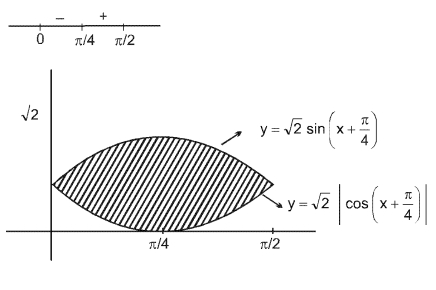
Given $y=\sin x+\cos x \quad x \in[0, \pi / 2]$
$\frac{d y}{d x}=\cos x-\sin x$
$y=|\cos x-\sin x|=\left[\begin{array}{cc}\cos x-\sin x \quad x \in[0, \pi / 4] \\ \sin x-\cos x \quad x \in[\pi / 4, \pi / 2]\end{array}\right.$ $Image$
required area $=\int_0^{\pi / 4}\left|(\sin x+\cos x)-(\cos x-\sin x) d d x+\int_{\pi / 4}^{\pi / 2}\right| 2 \cos x \mid d x$
$=\int_0^{\pi / 4}|2 \sin x| d x+\int_{\pi / 4}^{\pi / 2}|2 \cos x| d x$
$=2(-\cos x)_0^{\pi / 4}+2(\sin x)_{\pi / 4}^{\pi / 2} $ $Image$
$=2\left[-\frac{1}{\sqrt{2}}+1+1-\frac{1}{\sqrt{2}}\right]$
$=2\left(2-\frac{2}{\sqrt{2}}\right) $
$=2(2-\sqrt{2}) $
$=4-2 \sqrt{2} $
$=2 \sqrt{2}(\sqrt{2}-1)$
View full question & answer→MCQ 1931 Mark
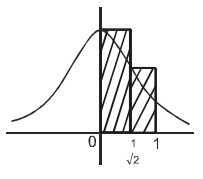
If $S$ be the area of the region enclosed by $y=e^{-x^2}, y=0, x=0$, and $x=1$. Then
$(A)$ $S \geq \frac{1}{ e }$ $(B)$ $S \geq 1-\frac{1}{ e }$
$(C)$ $S \leq \frac{1}{4}\left(1+\frac{1}{\sqrt{e}}\right)$ $(D)$ $S \leq \frac{1}{\sqrt{2}}+\frac{1}{\sqrt{e}}\left(1-\frac{1}{\sqrt{2}}\right)$
- A
$(A,B,C)$
- ✓
$(A,B,D)$
- C
$(A,C,D)$
- D
$(B,C,D)$
AnswerCorrect option: B. $(A,B,D)$
b
$I=\int_0^1 e^{-x^2} d x $
$-x^2 \leq 0 $
$e ^{- x ^2} \leq 1 $
$\int_0^1 e^{-x^2} d x \leq 1 $
$x^2 \leq x \Rightarrow-x^2 \geq-x \Rightarrow e^{-x^2} \geq e^{-x} $
$\Rightarrow I \geq \int_0^1 e^{-x} d x $
$\geq-\left(e^{-x}\right)_0^1 $
$\geq-\left(\frac{1}{e}-1\right) $
$I \geq 1-\frac{1}{e} \Rightarrow(B)$ is correct
Since If $I \geq 1-\frac{1}{e} \Rightarrow I>\frac{1}{e} \quad \Rightarrow(A)$ is correct
$1 < \frac{1}{\sqrt{2}} \times 1+\frac{1}{\sqrt{ e }} \times\left(1-\frac{1}{\sqrt{2}}\right)$
View full question & answer→MCQ 1941 Mark
Let $f:[-1,2] \rightarrow[0, \infty)$ be a continuous function such that $f(x)=f(1-x)$ for all $x \in[-1,2]$. Let $R_1=\int_{-1}^2 x f(x) d x$, and $R_2$ be the area of the region bounded by $y=f(x), x=-1, x=2$, and the $x$-axis. Then
- A
$R_1=2 R_2$
- B
$R_1=3 R_2$
- ✓
$2 R_1=R_2$
- D
$3 R_1=R_2$
AnswerCorrect option: C. $2 R_1=R_2$
c
$R_1=\int_{-1}^2 x f(x) d x=\int_{-1}^2(2-1-x) f(2-1-x) d x$
$=\int_{-1}^2(1-x) f(1-x) d x$
$=\int_{-1}^2(1-x) f(x) d x$
Hence $2 R_1=\int_{-1}^2 f(x) d x=R_2$.
View full question & answer→MCQ 1951 Mark
The straight line $2 x-3 y=1$ divides the circular region $x^2+y^2 \leq 6$ into two parts. If
$S=\left\{\left(2, \frac{3}{4}\right),\left(\frac{5}{2}, \frac{3}{4}\right),\left(\frac{1}{4},-\frac{1}{4}\right),\left(\frac{1}{8}, \frac{1}{4}\right)\right\},$ then the number of point(s) in $S$ lying inside the smaller part is
Answerb
$x^2+y^2 \leq 6$
$L: 2 x-3 y-1=0$
$L(0,0)=0-0-1 < 0$
$2 h-3 k-1 < 0$
$\left(2, \frac{3}{4}\right)$
$S: 4+\frac{9}{16}-6 < 0$
$L: 2 \cdot 2-3 \cdot \frac{3}{4}-1 > 0$
$\left(\frac{5}{2}, \frac{3}{4}\right)$
$S: \frac{25}{4}+\frac{9}{16} > 6$
$L: o$
$\left(\frac{1}{4},-\frac{1}{4}\right)$
$S < 0$
$L: \frac{1}{2}+\frac{3}{4}-1 > 0$
$\left(\frac{1}{8}, \frac{1}{4}\right)$
$S < 0$
$L: \frac{1}{4}-\frac{3}{4}-1 < 0$
View full question & answer→MCQ 1961 Mark
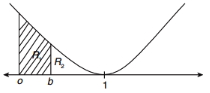
Let the straight line $x=b$ divide the area enclosed by $y=(1-x)^2, y=0$, and $x=0$ into two parts $R_1(0 \leq x \leq b)$ and $R_2(b \leq x \leq 1)$ such that $R_1-R_2=\frac{1}{4}$. Then $b$ equals
- A
$\frac{3}{4}$
- ✓
$\frac{1}{2}$
- C
$\frac{1}{3}$
- D
$\frac{1}{4}$
AnswerCorrect option: B. $\frac{1}{2}$
b
$\int_0^b(1-x)^2 d x-\int_b^1(1-x)^2 d x=\frac{1}{4}$
$\Rightarrow\left[\frac{(x-1)^3}{3}\right]_0^b-\left[\frac{(x-1)^3}{3}\right]_b^1=\frac{1}{4}$
$\Rightarrow \frac{(b-1)^3}{3}+\frac{1}{3}-\left(0-\frac{(b-1)^3}{3}\right)=\frac{1}{4}$
$\Rightarrow \frac{2(b-1)^3}{3}=-\frac{1}{12}$
$\Rightarrow(b-1)^3=-\frac{1}{8} \Rightarrow b=\frac{1}{2}$
View full question & answer→MCQ 1971 Mark
Consider the polynomial $f(x)=1+2 x+3 x^2+4 x^3$. Let $s$ be the sum of all distinct real roots of $f(x)$ and let $t=|s|$.
$1.$ The real number $s$ lies in the interval
$(A)$ $\left(-\frac{1}{4}, 0\right)$ $(B)$ $\left(-11,-\frac{3}{4}\right)$
$(C)$ $\left(-\frac{3}{4},-\frac{1}{2}\right)$ $(D)$ $\left(0, \frac{1}{4}\right)$
$2.$ The area bounded by the curve $y=f(x)$ and the lines $x=0, y=0$ and $x=t$, lies in the interval
$(A)$ $\left(\frac{3}{4}, 3\right)$ $(B)$ $\left(\frac{21}{64}, \frac{11}{16}\right)$
$(C)$ $(9,10)$ $(D)$ $\left(0, \frac{21}{64}\right)$
$3.$ The function $f^{\prime}(x)$ is
$(A)$ increasing in $\left(-t,-\frac{1}{4}\right)$ and decreasing in $\left(-\frac{1}{4}, t\right)$
$(B)$ decreasing in $\left(-t,-\frac{1}{4}\right)$ and increasing in $\left(-\frac{1}{4}, t\right)$
$(C)$ increasing in (-t, t) $(D)$ decreasing in ( $-\mathrm{t}, \mathrm{t})$
Give the answer question $1,2$ and $3.$
- ✓
$(C,A,B)$
- B
$(A,B,C)$
- C
$(A,B,D)$
- D
$(B,C,A)$
AnswerCorrect option: A. $(C,A,B)$
a
$1.$ Since, $f\left(-\frac{1}{2}\right) \cdot f\left(-\frac{3}{4}\right)<0 \Rightarrow \mathrm{S}$ lie in $\left(-\frac{3}{4},-\frac{1}{2}\right)$.
$2.$ $ -\frac{3}{4}$
$ \frac{1}{2}$
$ \int_0^{1 / 2}\left(4 x^3+3 x^2+2 x+1\right) d x<\text { area }<\int_0^{3 / 4}\left(4 x^3+3 x^2+2 x+1\right) d x $
$ {\left[x^4+x^3+x^2+x\right]_0^{1 / 2}<\text { area }<\left[x^4+x^3+x^2+x\right]_0^{3 / 4}} $
$ \frac{1}{16}+\frac{1}{8}+\frac{1}{4}+\frac{1}{2}<\text { area }<\frac{81}{256}+\frac{27}{64}+\frac{9}{16}+\frac{3}{4} $
$ \frac{15}{16}<\text { area }<\frac{525}{256} .$
$3.$ $\mathrm{f}^{\prime \prime}(\mathrm{x})=2[12 x+3]=0 \Rightarrow \mathrm{x}=-1 / 4 \text {. }$
View full question & answer→MCQ 1981 Mark
Area of the region bounded by the curve $y=e^x$ and lines $x=0$ and $y=e$ is
$(A)$ $e-1$ $(B)$ $\int_1^e \ln (e+1-y) d y$ $(C)$ $e-\int_0^1 e^x d x$ $(D)$ $\int_1^r \ln y d y$
- A
$(A,B,C)$
- B
$(B,A,C)$
- C
$(B,D,A)$
- ✓
$(B,C,D)$
AnswerCorrect option: D. $(B,C,D)$
View full question & answer→MCQ 1991 Mark
The area of the region between the curves $y=\sqrt{\frac{1+\sin x}{\cos x}}$ and $y=\sqrt{\frac{1-\sin x}{\cos x}}$ bounded by the lines $x=0$ and $x=\frac{\pi}{4}$ is
- A
$\int_0^{\sqrt{2}-1} \frac{t}{\left(1+\mathrm{t}^2\right) \sqrt{1-\mathrm{t}^2}} \mathrm{dt}$
- ✓
$\int_0^{\sqrt{2}-1} \frac{4 t}{\left(1+t^2\right) \sqrt{1-t^2}} d t$
- C
$\int_0^{\sqrt{2}+1} \frac{4 t}{\left(1+\mathrm{t}^2\right) \sqrt{1-\mathrm{t}^2}} \mathrm{dt}$
- D
$\int_0^{\sqrt{2}+1} \frac{t}{\left(1+\mathrm{t}^2\right) \sqrt{1-\mathrm{t}^2}} d t$
AnswerCorrect option: B. $\int_0^{\sqrt{2}-1} \frac{4 t}{\left(1+t^2\right) \sqrt{1-t^2}} d t$
b
$ \int_0^{\pi / 4}\left(\sqrt{\frac{1+\sin x}{\cos x}}-\sqrt{\frac{1-\sin x}{\cos x}}\right) d x $
$ =\int_0^{\pi / 4}\left(\sqrt{\frac{1+\tan \frac{x}{2}}{1-\tan \frac{x}{2}}}-\sqrt{\frac{1-\tan \frac{x}{2}}{1+\tan \frac{x}{2}}}\right) d x=\int \frac{\left(1+\tan \frac{x}{2}\right)-\left(1-\tan \frac{x}{2}\right)}{\sqrt{1-\tan ^2 \frac{x}{2}}} d x $
$ =\int_0^{\pi / 4} \frac{2 \tan \frac{x}{2}}{\sqrt{1-\tan ^2 \frac{x}{2}}} d x=\int_0^{\sqrt{2}-1} \frac{4 t}{\left(1+t^2\right) \sqrt{1-t^2}} d t \text { as } \tan \frac{x}{2}=t .$
View full question & answer→MCQ 2001 Mark
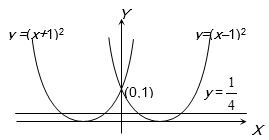
The area bounded by the curve $y = {(x + 1)^2},\,y = {(x - 1)^2}$ and the line $y = \frac{1}{4}$ is
Answerd
(d) Required area $\left. { = 2\left| {\int_{1/4}^1 {(\sqrt y - 1)\;dy} } \right.} \right|$,
(From the symmetry)
On solving, we get required area $ = \frac{1}{3}$ sq. unit.
View full question & answer→