MCQ 1011 Mark
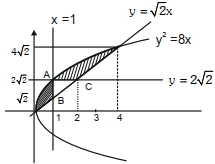
The area enclosed by $y ^{2}=8 x$ and $y=\sqrt{2} x$ that lies outside the triangle formed by $y=\sqrt{2} x, x=$ $1, y=2 \sqrt{2}$, is equal to
- A
$\frac{16 \sqrt{2}}{6}$
- B
$\frac{11 \sqrt{2}}{6}$
- ✓
$\frac{13 \sqrt{2}}{6}$
- D
$\frac{5 \sqrt{2}}{6}$
AnswerCorrect option: C. $\frac{13 \sqrt{2}}{6}$
c
Area of $\Delta ABC =\frac{1}{2}(\sqrt{2}) \cdot 1=\frac{\sqrt{2}}{2}$
So required Area $=\int_{0}^{4}(\sqrt{8 x}-\sqrt{2} x) d x-\frac{\sqrt{2}}{2}$
$=\frac{32 \sqrt{2}}{3}-8 \sqrt{2}-\frac{\sqrt{2}}{2}=\frac{13 \sqrt{2}}{6}$
View full question & answer→MCQ 1021 Mark
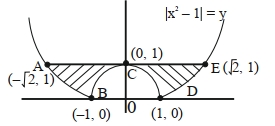
The area bounded by the curves $y=\left|x^{2}-1\right|$ and $y=1$ is.
- A
$\frac{2}{3}(\sqrt{2}+1)$
- B
$\frac{4}{3}(\sqrt{2}-1)$
- C
$2(\sqrt{2}-1)$
- ✓
$\frac{8}{3}(\sqrt{2}-1)$
AnswerCorrect option: D. $\frac{8}{3}(\sqrt{2}-1)$
d
Area $=$ ABCDEA
$=2\left(\int_{0}^{1}\left(1-\left(1-x^{2}\right)\right) d x+\int_{1}^{\sqrt{2}}\left(1-\left(x^{2}-1\right)\right) d x\right)$
$=\frac{8}{3}(\sqrt{2}-1)$
View full question & answer→MCQ 1031 Mark
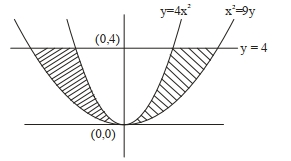
The area of the region enclosed by $y \leq 4 x^{2}, x^{2} \leq 9 y$ and $y \leq 4$, is equal tọ
- A
$\frac{40}{3}$
- B
$\frac{56}{3}$
- C
$\frac{112}{3}$
- ✓
$\frac{80}{3}$
AnswerCorrect option: D. $\frac{80}{3}$
d
$\Delta=2 \cdot \int_{0}^{4}\left(3 \sqrt{y}-\frac{\sqrt{y}}{2}\right) d y$
$=2 \cdot \int_{0}^{4} \frac{5}{2} \sqrt{y} d y=\frac{80}{3}$
View full question & answer→MCQ 1041 Mark
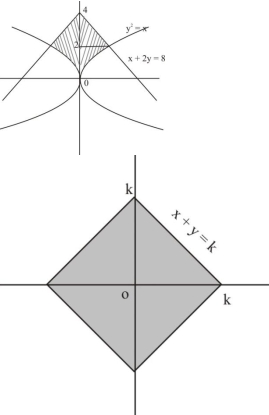
Let $A_{1}=\left\{(x, y):|x| \leq y^{2},|x|+2 y \leq 8\right\}$ and $A_{2}=\{(x, y):|x|+|y| \leq k\}$. If $27$ (Area $\left.A _{1}\right)=5$ (Area $A _{2}$ ), then $k$ is equal to
Answera
$A_{1}=\left\{(x, y):|x| \leq y^{2},|x|+2 y \leq 8\right\}$ and
$A_{2}=\{(x, y):|x|+|y| \leq k\} \text {. }$
area $\left(A_{1}\right)=2\left[\int\limits_{0}^{2} y^{2} d y+\int\limits_{2}^{4}(8-2 y) d y\right]$
$=2\left[\left(\frac{y^{3}}{3}\right)_{0}^{2}+\left(8 y-y^{2}\right)_{2}^{4}\right]$
$\operatorname{area}\left(A_{1}\right)=2 \times \frac{20}{3}=\frac{40}{3}$
Area $\left( A _{2}\right)=4 \times \frac{1}{2} k^{2}$
Area $\left( A _{2}\right)=2 k^{2}$
Now
$27\left(\right.$ Area $\left.A _{1}\right)=5\left(\right.$ Area $\left.A _{2}\right)$
$9 \times 4=k^{2}$
$k =6$
View full question & answer→MCQ 1051 Mark
Let the locus of the centre $(\alpha, \beta), \beta>0$, of the circle which touches the circle $x ^{2}+( y -1)^{2}=1$ externally and also touches the $x$-axis be $L$. Then the area bounded by $L$ and the line $y =4$ is.
- A
$\frac{32 \sqrt{2}}{3}$
- B
$\frac{40 \sqrt{2}}{3}$
- ✓
$\frac{64}{3}$
- D
$\frac{32}{3}$
AnswerCorrect option: C. $\frac{64}{3}$
c
$(\alpha-0)^{2}+(\beta-1)^{2}=(\beta+1)^{2}$
$\alpha^{2}=4\,\beta$
$x ^{2}=4\,y$
$A =2 \int_{0}^{4}\left(4-\frac{ x ^{2}}{4}\right) dx =\frac{64}{3}$
View full question & answer→MCQ 1061 Mark
The odd natural number $a,$ such that the area of the region bounded by $y =1, y =3, x =0, x = y ^{a}$ is $\frac{364}{3}$, equal to.
Answerb
$A=\int_{1}^{3} y^{a} \cdot d y=\left.\frac{y^{a+1}}{a+1}\right|_{1} ^{3}=\frac{364}{3}$
$a =5$
View full question & answer→MCQ 1071 Mark
Let a curve $y = y ( x )$ pass through the point $(3,3)$ and the area of the region under this curve, above the $x$-axis and between the abscissae $3$ and $x(>3)$ be $\left(\frac{y}{x}\right)^{3}$. If this curve also passes through the point $(\alpha, 6 \sqrt{10})$ in the first quadrant, then $\alpha$ is equal to $........$
Answerc
$x^{4}=3 y x \cdot y^{\prime}-3 y^{2}$
$3 x y \frac{d y}{d x}=3 y^{2}+x^{4}$
Put $y ^{2}= t , y \frac{ dy }{ dx }=\frac{1}{2} \frac{ dt }{ dx }$
$\frac{ dt }{ dx }-\frac{2}{ x } t =\frac{2}{3} x ^{3}$
$\therefore \frac{ t }{ x ^{2}}=\frac{ x ^{2}}{3}+ C$
$\frac{ y ^{2}}{ x ^{2}}=\frac{ x ^{2}}{3}-2$
Put $(3,3), C=-2$
$\therefore \frac{y^{2}}{x^{2}}=\frac{x^{2}}{3}-2$
$3 y^{2}=x^{4}-6 x^{2}$
$x^{4}-6 x^{2}=1080$
$\therefore x =6$
View full question & answer→MCQ 1081 Mark
The area (in sq. units) of the region enclosed between the parabola $y ^{2}=2 x$ and the line $x + y =4$ is
Answerb
$x=4-y$
$y^{2}=2(4-y)$
$y^{2}=8-2 y$
$y^{2}+2 y-8=0$
$y=-4, y=2$
$x=8, x=2$
$\int_{-4}^{2}\left[(4-y)-\frac{y^{2}}{2}\right] d y$
$=\left[4 y-\frac{y^{2}}{2}-\frac{y^{3}}{6}\right]_{-4}^{2}$
$=8-2-\frac{8}{6}+16+\frac{16}{2}-\frac{64}{6}$
$=22+8-\frac{72}{6}$
$=30-12=18$
View full question & answer→MCQ 1091 Mark
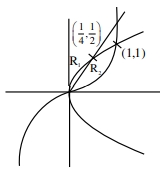
Let $S$ be the region bounded by the curves $y=x^{3}$ and $y ^{2}= x$. The curve $y =2| x |$ divides $S$ into two regions of areas $R_{1}$ and $R_{2}$.
If $\max \left\{R_{1}, R_{2}\right\}=R_{2}$, then $\frac{R_{2}}{R_{1}}$ is equal to
Answera
$S=\int_{0}^{1} \sqrt{x}-x^{3}$
$=\left[\frac{2 x^{3 / 2}}{3}-\frac{x^{4}}{4}\right]_{1}^{0}$
$=\frac{5}{12}$
$R_{1}=\int_{0}^{1 / 4}(\sqrt{x}-2 x) d x$
$=\left[\frac{2 x^{3 / 2}}{3}-x^{2}\right]_{0}^{1 / 4}=\frac{1}{48}$
$\therefore R_{2}=\frac{19}{48}$
So, $\frac{R_{2}}{R_{1}}=19$
View full question & answer→MCQ 1101 Mark
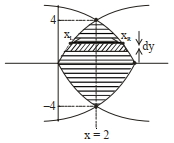
The area of the region bounded by $y^{2}=8 x$ and $y^{2}=16(3-x)$ is equal to
- A
$\frac{32}{3}$
- B
$\frac{40}{3}$
- ✓
$16$
- D
$19$
Answerc
finding their intersection $pts$
$y^{2}=8 x\; and\; y^{2}=-16(x-3)$
$8 x=-16 x+48$
$24 x=48$
$x=2 ; y=\pm 4$
Required Area
$=2 \cdot \int \limits_{0}^{4}({3-\frac{y^{2}}{16}}-{\frac{y^{2}}{8}}) d y$
$=2\left(3 y-\frac{y^{3}}{3 \times 16}-\frac{y^{3}}{3 \times 8}\right)_{0}^{4}$
$=2\left(3 \times 4-\frac{4 \times 4 \times 4}{3 \times 16}-\frac{4 \times 4 \times 4 \times 2}{3 \times 8 \times 2}\right)$
$=2\left(12-\frac{4}{3}-\frac{8}{3}\right)=2 \times 12\left(1-\frac{1}{3}\right)=2 \times 12 \times \frac{2}{3}=16$
View full question & answer→MCQ 1111 Mark
The area bounded by the curve $y=\left|x^{2}-9\right|$ and the line $y=3$ is
- A
$4(2 \sqrt{3}+\sqrt{6}-4)$
- B
$4(4 \sqrt{3}+\sqrt{6}-4)$
- ✓
$8(4 \sqrt{3}+2 \sqrt{6}-9)$
- D
$8(4 \sqrt{3}+\sqrt{6}-9)$
AnswerCorrect option: C. $8(4 \sqrt{3}+2 \sqrt{6}-9)$
c
Area of shaded region
$=2 \int_{0}^{3}(\sqrt{9+y}-\sqrt{9-y}) d y+2 \int_{3}^{9}(\sqrt{9-y}) d y$
$=2\left[\int_{0}^{3}(9+y)^{1 / 2} d y-\int_{0}^{3}(9-y)^{1 / 2} d y+\int_{3}^{9}(9-y)^{1 / 2} d y\right]$
$=2\left[\frac{2}{3}\left[(9+y)^{3 / 2}\right]_{0}^{3}+\frac{2}{3}\left[(9-y)^{3 / 2}\right]_{0}^{3}-\frac{2}{3}\left[(9-y)^{3 / 2}\right]_{3}^{9}\right]$
$=\frac{4}{3}[12 \sqrt{12}-27+6 \sqrt{6}-27-(0-6 \sqrt{6})]$
$=\frac{4}{3}[24 \sqrt{3}+12 \sqrt{6}-54]$
$=8(4 \sqrt{3}+2 \sqrt{6}-9)$
View full question & answer→MCQ 1121 Mark
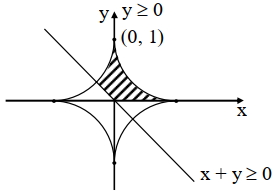
If the area of the region $\left\{( x , y ): x ^{\frac{2}{3}}+ y ^{\frac{2}{3}} \leq 1 x + y \geq 0, y \geq 0\right\}$ is $A$, then $\frac{256 A }{\pi}$
Answerc
$A =\frac{3}{2} \int\limits_{0}^{1}\left(1- x ^{2 / 3}\right)^{3 / 2} dx$
Let $x=\sin ^{3} \theta$
$A =\frac{3}{2} \int\limits_{0}^{\pi / 2}\left(1-\sin ^{2} \theta\right)^{3 / 2} \cdot 3 \sin ^{2} \theta \cos \theta d \theta$
$=\frac{3}{2} \int\limits_{0}^{\pi / 2} 3 \sin ^{2} \theta \cos ^{4} \theta d \theta$
$=\frac{9}{2} \int\limits_{0}^{\pi / 2} \sin ^{2} \theta \cos ^{4} \theta d \theta$
$A =\frac{9}{2} \times \frac{1.3 .1}{(2+4)(4)(2)} \cdot \frac{\pi}{2}$
$\Rightarrow A =\frac{9 \pi}{64} \Rightarrow \frac{64 A }{\pi}=9$
$\Rightarrow \frac{256 A }{\pi}=36 \text { Ans. }$
View full question & answer→MCQ 1131 Mark
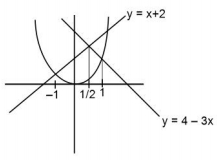
The area of the region given by $A=\left\{(x, y): x^{2} \leq y \leq \min \{x+2,4-3 x\}\right\}$ is.
- A
$\frac{31}{8}$
- ✓
$\frac{17}{6}$
- C
$\frac{19}{6}$
- D
$\frac{27}{8}$
AnswerCorrect option: B. $\frac{17}{6}$
b
$A=\int_{-1}^{\frac{1}{2}}\left(x+2-x^{2}\right) d x+\int_{\frac{1}{2}}^{1}\left(4-3 x-x^{2}\right) d x=\frac{17}{6}$
View full question & answer→MCQ 1141 Mark
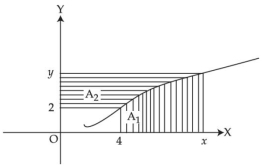
Consider a curve $y=y(x)$ in the first quadrant as shown in the figure. Let the area $A_{1}$ is twice the area $A _{2}$. Then the normal to the curve perpendicular to the line $2 x -12 y =15$ does NOT pass through the point.
- A
$(6,21)$
- B
$(8,9)$
- ✓
$(10,4)$
- D
$(12,15)$
AnswerCorrect option: C. $(10,4)$
c
Given that $A _{1}=2 A _{2}$
from the graph $A _{1}+ A _{2}= xy -8$
$\frac{3}{2} A _{1}= xy -8$
$A _{1}=\frac{2}{3} xy -\frac{16}{3}$
$\int_{4}^{ x } f ( x ) dx =\frac{2}{3} xy -\frac{16}{3}$
$f ( x )=\frac{2}{3}\left( x \frac{ d y}{ dx }+ y \right)$
$\frac{2}{3} x \frac{d y}{d x}=\frac{y}{3}$
$2 \int \frac{d y}{y}=\int \frac{d x}{x}$
$2 \ell n n =\ell nx +\ell nc$
$y ^{2}= cx$
As $f(4)=2 \Rightarrow c=1$
so $y^{2}=x$
slope of normal $=-6$
$y=-6(x)-\frac{1}{2}(-6)-\frac{1}{4}(-6)^{3}$
$y =-6 x +3+54$
$y +6 x =57$
Now check options and $(C)$ will not satisfy.
View full question & answer→MCQ 1151 Mark
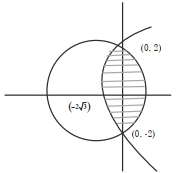
The area of the smaller region enclosed by the curves $y ^{2}=8 x +4$ and $x^{2}+y^{2}+4 \sqrt{3} x-4=0$ is equal to.
- A
$\frac{1}{3}(2-12 \sqrt{3}+8 \pi)$
- B
$\frac{1}{3}(2-12 \sqrt{3}+6 \pi)$
- ✓
$\frac{1}{3}(4-12 \sqrt{3}+8 \pi)$
- D
$\frac{1}{3}(4-12 \sqrt{3}+6 \pi)$
AnswerCorrect option: C. $\frac{1}{3}(4-12 \sqrt{3}+8 \pi)$
c
$x^{2}+y^{2}+4 \sqrt{3} x-4=0$
$y^{2}=8 x+4$
Point of intersections are $(0,2)\,and\, (0,-2)$
Both are symmetric about $x$-axis
Area $=2 \int_{0}^{2}\left(\sqrt{16-y^{2}}-2 \sqrt{3}\right)-\left(\frac{y^{2}-4}{8}\right)$ dy
On solving Area $=\frac{1}{3}[8 \pi+4-12 \sqrt{3}]$
View full question & answer→MCQ 1161 Mark
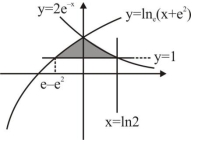
The area enclosed by the curves $y=\log _{ t }\left( x + e ^{2}\right)$, $x=\log _{ e }\left(\frac{2}{ y }\right)$ and $x =\log _{ e } 2$, above the line $y =1$ is.
- A
$2+e-\log _{e} 2$
- ✓
$1+e-\log _{e} 2$
- C
$e -\log _{ e } 2$
- D
$1+\log _{ e } 2$
AnswerCorrect option: B. $1+e-\log _{e} 2$
b
Required area is $=\int_{0-0^{2}}^{0} \ln \left( x + e ^{2}\right)-1 dx +\int_{0}^{\ln 2} 2 e ^{- x }-1 dx =1+ e -\operatorname{\ell n} 2$
View full question & answer→MCQ 1171 Mark
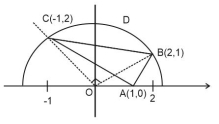
The area of the region $\left\{(x, y):|x-1| \leq y \leq \sqrt{5-x^{2}}\right\}$ is equal to.
- A
$\frac{5}{2} \sin ^{-1}\left(\frac{3}{5}\right)-\frac{1}{2}$
- B
$\frac{5 \pi}{4}-\frac{3}{2}$
- C
$\frac{3 \pi}{4}+\frac{3}{2}$
- ✓
$\frac{5 \pi}{4}-\frac{1}{2}$
AnswerCorrect option: D. $\frac{5 \pi}{4}-\frac{1}{2}$
d
$| x -1|< y <\sqrt{5- x ^{2}}$
$\text { When }| x -1|=\sqrt{5- x ^{2}}$
$( x -1)^{2}=5- x ^{2}$
$x ^{2}- x -2=0$
$x =2,-1$
Required Area $=$ Area of $\triangle ABC +$ Area of region $BCD$
$=\frac{1}{2}\left|\begin{array}{ccc}1 & 0 & 1 \\ 2 & 1 & 1 \\ -1 & 2 & 1\end{array}\right|+\frac{\pi}{4}(\sqrt{5})^{2}-\frac{1}{2}(\sqrt{5})^{2}$
$=\frac{5 \pi}{4}-\frac{1}{2}$
View full question & answer→MCQ 1181 Mark
The area of the bounded region enclosed by the curve $y=3-\left|x-\frac{1}{2}\right|-|x+1|$ and the $x-$axis is
- A
$\frac{9}{4}$
- B
$\frac{45}{16}$
- ✓
$\frac{27}{8}$
- D
$\frac{63}{16}$
AnswerCorrect option: C. $\frac{27}{8}$
c
$y =\left\{\begin{array}{ll}3+( x +1)+\left( x -\frac{1}{2}\right), & x <-1 \\ 3-( x +1)+\left( x -\frac{1}{2}\right), & -1 \leq x<\frac{1}{2} \\ 3-( x +1)-\left( x -\frac{1}{2}\right), & \frac{1}{2} \leq x \end{array}\right.$
$y =\left\{\begin{array}{ll}\frac{7}{2}+2 x , & x <-1 \\ \frac{3}{2}, & -1 \leq x<\frac{1}{2} \\ \frac{5}{2}-2 x , & \frac{1}{2} \leq x \end{array}\right.$
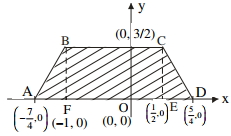
Area bounded $=$ ar $ABF +$ ar $BCEF +$ ar $CDE$
$=\frac{1}{2}\left(\frac{3}{4}\right)\left(\frac{3}{2}\right)+\left(\frac{3}{2}\right)\left(\frac{3}{2}\right)+\frac{1}{2}\left(\frac{3}{4}\right)\left(\frac{3}{2}\right)$
$=\frac{27}{8} \text { sq. units. }$
View full question & answer→MCQ 1191 Mark
The area of the region $S=\left\{(x, y): 3 x^{2} \leq 4 y \leq 6 x+24\right\} \text { is }...... \,.$
Answerc
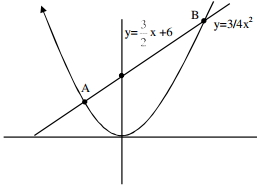
For $A \,\&\, B$
$3 x^{2}=6 x+24 \Rightarrow x^{2}-2 x-8=0$
$\Rightarrow x=-2,4$
$\text { Area }=\int_{-2}^{4}\left(\frac{3}{2} x+6-\frac{3}{4} x^{2}\right) \,d x$
$=\left[\frac{3 x^{2}}{4}+6 x-\frac{x^{3}}{4}\right]_{-2}^{4}=27$
View full question & answer→MCQ 1201 Mark
The area, enclosed by the curves $y=\sin x+\cos x$ and $\mathrm{y}=|\cos \mathrm{x}-\sin \mathrm{x}|$ and the lines $\mathrm{x}=0, \mathrm{x}=\frac{\pi}{2}$ is:
- ✓
$2 \sqrt{2}(\sqrt{2}-1)$
- B
$2(\sqrt{2}+1)$
- C
$4(\sqrt{2}-1)$
- D
$2 \sqrt{2}(\sqrt{2}+1)$
AnswerCorrect option: A. $2 \sqrt{2}(\sqrt{2}-1)$
a
$\mathrm{A}=\int_{0}^{\pi / 2}((\sin \mathrm{x}+\cos \mathrm{x})-|\cos \mathrm{x}-\sin \mathrm{x}|) \mathrm{dx}$
$\mathrm{A}=\int_{0}^{\pi / 2}((\sin \mathrm{x}+\cos \mathrm{x})-(\cos \mathrm{x}-\sin \mathrm{x})) \mathrm{dx}$
$+\int_{\pi / 4}^{\pi / 2}((\sin \mathrm{x}+\cos \mathrm{x})-(\sin \mathrm{x}-\cos \mathrm{x})) \mathrm{dx}$
$\mathrm{A}=2 \int_{0}^{\pi / 2} \sin \mathrm{xdx}+2 \int_{\pi / 4}^{\pi / 2} \cos \mathrm{xdx}$
$\mathrm{A}=-2\left(\frac{1}{\sqrt{2}}-1\right)+2\left(1-\frac{1}{\sqrt{2}}\right)$
$\mathrm{A}=4-2 \sqrt{2}=2 \sqrt{2}(\sqrt{2}-1)$
View full question & answer→MCQ 1211 Mark
The area of the region bounded by $y-x=2$ and $x^{2}=y$ is equal to :
- A
$\frac{4}{3}$
- ✓
$\frac{9}{2}$
- C
$\frac{16}{3}$
- D
$\frac{2}{3}$
AnswerCorrect option: B. $\frac{9}{2}$
b
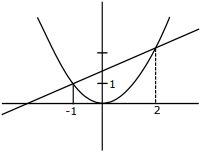
$y-x=2, x^{2}=y$
Now, $x^{2}=2+x$
$\Rightarrow x^{2}-x-2=0$
$\Rightarrow(x+1)(x-2)=0$
$\text { Area }=\int_{-1}^{2}\left(2+x-x^{2}\right)$
$=\left|2 x+\frac{x^{2}}{2}-\frac{x^{3}}{3}\right|_{-1}^{2}$
$=\left(4+2-\frac{8}{3}\right)-\left(-2+\frac{1}{2}+\frac{1}{3}\right)$
$=6-3+2-\frac{1}{2}=\frac{9}{2}$
View full question & answer→MCQ 1221 Mark
If the line $y=m x$ bisects the area enclosed by the lines $x=0, y=0, x=\frac{3}{2}$ and the curve $\mathrm{y}=1+4 \mathrm{x}-\mathrm{x}^{2}$, then $12 \mathrm{~m}$ is equal to ..... .
Answerd
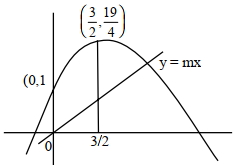
Total area $=\int_{0}^{3 / 2}\left(1+4 x-x^{2}\right) \,d x$
$=x+2 x^{2}-\left.\frac{x^{3}}{3}\right|_{0} ^{3 / 2}=\frac{39}{8}$
$\ \,\frac{39}{16}=\frac{1}{2} \cdot \frac{3}{2} \cdot \frac{3}{2} \,m$
$\Rightarrow 3\, m=\frac{13}{2} \Rightarrow 12 \,m=26$
View full question & answer→MCQ 1231 Mark
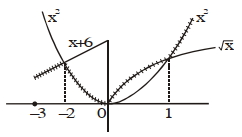
Let $f :[-3,1] \rightarrow R$ be given as
$f(x)=\left\{\begin{array}{ll} \min \left\{(x+6), x^{2}\right\}, & -3 \leq x \leq 0 \\ \max \left\{\sqrt{x}, x^{2}\right\}, & 0 \leq x \leq 1 \end{array}\right.$
If the area bounded by $y = f ( x )$ and $x$ -axis is $A,$ then the value of $6 A$ is equal to ....... .
Answerb
$f:[-3,1] \rightarrow R$
$f ( x )=\left\{\begin{array}{ll}\min \left\{( x +6), x ^{2}\right\} & ,-3 \leq x \leq 0 \\ \max \left\{\sqrt{ x }, x ^{2}\right\} & , 0 \leq x \leq 1\end{array}\right.$
area bounded by $y = f ( x )$ and $x$ -axis
$=\int_{-3}^{-2}(x+6) d x+\int_{-2}^{0} x^{2} d x+\int_{0}^{1} \sqrt{x} d x$
$A =\frac{41}{6}$
$6 A =41$
View full question & answer→MCQ 1241 Mark
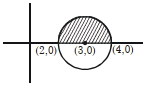
The area bounded by the curve $4 y^{2}=x^{2}(4-x)(x-2)$ is equal to ...... .
- A
$\frac{\pi}{8}$
- B
$\frac{3 \pi}{8}$
- ✓
$\frac{3 \pi}{2}$
- D
$\frac{\pi}{16}$
AnswerCorrect option: C. $\frac{3 \pi}{2}$
c
$4 y^{2}=x^{2}(4-x)(x-2)$
$|y|=\frac{|x|}{2} \sqrt{(4-x)(x-2)}$
$\Rightarrow y_{1}=\frac{x}{2} \sqrt{(4-x)(x-2)}$
and $y_{2}=\frac{-x}{2} \sqrt{(4-x)(x-2)}$
$D : x \in[2,4]$
Required Area
$=\int_{2}^{4}\left( y _{1}- y _{2}\right) dx =\int_{2}^{4} x \sqrt{(4- x )( x -2)} dx....(1)$
Applying $\int_{a}^{b} f(x) d x=\int_{a}^{b} f(a+b-x) d x$
Area $=\int_{2}^{4}(6-x) \sqrt{(4-x)(x-2)} d x....(2)$
$(1)+(2)$
$2 A=6 \int_{2}^{4} \sqrt{(4-x)(x-2)} d x$
$A=3 \int_{2}^{4} \sqrt{1-(x-3)^{2}} d x$
$A=3 \cdot \frac{\pi}{2} \cdot 1^{2}=\frac{3 \pi}{2}$
View full question & answer→MCQ 1251 Mark
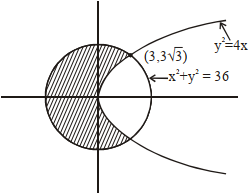
The area (in sq. units) of the part of the circle $x ^{2}+ y ^{2}=36$ which is outside the parabola $y ^{2}=9 x ,$ is
- A
$24 \pi+3 \sqrt{3}$
- B
$12 \pi-3 \sqrt{3}$
- ✓
$24 \pi-3 \sqrt{3}$
- D
$12 \pi+3 \sqrt{3}$
AnswerCorrect option: C. $24 \pi-3 \sqrt{3}$
c
Required area
$=\pi \times(6)^{2}-2 \int_{0}^{3} \sqrt{9} x d x-\int_{3}^{6} \sqrt{36-x^{2}} d x$
$=36 \pi-12 \sqrt{3}-2\left(\frac{ x }{2} \sqrt{36- x ^{2}}+18 \sin ^{-1} \frac{ x }{6}\right)_{3}^{6}$
$=36 \pi-12 \sqrt{3}-2\left(9 \pi-3 \pi-\frac{9 \sqrt{3}}{2}\right)$
$=24 \pi-3 \sqrt{3}$
View full question & answer→MCQ 1261 Mark
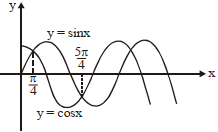
The graphs of sine and cosine functions, intersect each other at a number of points and between two consecutive points of intersection, the two graphs enclose the same area $A$. Then $A ^{4}$ is equal to ............
Answera
$A=\int_{\pi / 4}^{5 \pi / 4}(\sin x-\cos x) d x$
$=\left.(-\cos x-\sin x)\right|_{\pi / 4} ^{5 \pi / 4}$
$=\left(-\left(\frac{-1}{\sqrt{2}}\right)-\left(\frac{-1}{\sqrt{2}}\right)\right)-\left(-\left(\frac{1}{\sqrt{2}}\right)-\left(\frac{1}{\sqrt{2}}\right)\right)$
$\Rightarrow A=\frac{2}{\sqrt{2}}+\frac{2}{\sqrt{2}}=2 \sqrt{2}$
$\Rightarrow A^{4}=(2 \sqrt{2})^{4}=16 \times 4=64$
View full question & answer→MCQ 1271 Mark
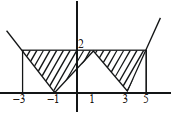
The area bounded by the lines $y=\| x-1|-2 |$ is
Answerb
Question is incomplete it should be area bounded by $y=|x-1|-2 \mid$ and $y=2$
Area $=2\left(\frac{1}{2} \cdot 4.2\right)$
View full question & answer→MCQ 1281 Mark
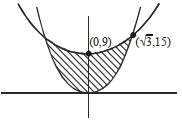
The area of the region :
$R =\left\{( x , y ): 5 x ^{2} \leq y \leq 2 x ^{2}+9\right\}$ is ........ $square\, units$
- A
$11 \sqrt{3}$
- ✓
$12 \sqrt{3}$
- C
$9 \sqrt{3}$
- D
$6 \sqrt{3}$
AnswerCorrect option: B. $12 \sqrt{3}$
b
Required area $=2 \int_{0}^{\sqrt{3}}\left(2 x ^{2}+9-5 x ^{2}\right) dx$
$=2\left[9 x - x ^{3}\right]_{0}^{\sqrt{3}}$
$=2[9 \sqrt{3}-3 \sqrt{3}]=12 \sqrt{3}$
View full question & answer→MCQ 1291 Mark
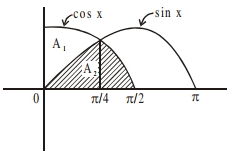
Let $A _{1}$ be the area of the region bounded by the curves $y =\sin x , y =\cos x$ and $y$ -axis in the first quadrant. Also, let $A _{2}$ be the area of the region bounded by the curves $y=\sin x$ $y =\cos x , x$ -axis and $x =\frac{\pi}{2}$ in the first quadrant. Then ..... .
- ✓
$A _{1}: A _{2}=1: \sqrt{2}$ and $A _{1}+ A _{2}=1$
- B
$A _{1}= A _{2}$ and $A _{1}+ A _{2}=\sqrt{2}$
- C
$2 A _{1}= A _{2}$ and $A _{1}+ A _{2}=1+\sqrt{2}$
- D
$A _{1}: A _{2}=1: 2$ and $A _{1}+ A _{2}=1$
AnswerCorrect option: A. $A _{1}: A _{2}=1: \sqrt{2}$ and $A _{1}+ A _{2}=1$
a
$A _{1}=\int_{0}^{\pi / 4}(\cos x -\sin x ) d x$
$A _{1}=(\sin x +\cos x )_{0}^{\pi / 4}=\sqrt{2}-1$
$A _{2}=\int_{0}^{\pi / 4} \sin x d x +\int_{\pi / 4}^{\pi / 2} \cos x dx$
$=(-\cos x)_{0}^{\pi / 4}+(\sin x)_{\pi / 4}^{\pi / 2}$
$A_{2}=\sqrt{2}(\sqrt{2}-1)$
$A_{1}: A_{2}=1: \sqrt{2}, A_{1}+A_{2}=1$
View full question & answer→MCQ 1301 Mark
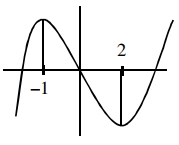
Let $a$ and $\mathrm{b}$ respectively be the points of local maximum and local minimum of the function $f(x)=2 x^{3}-3 x^{2}-12 x .$ If $A$ is the total area of the region bounded by $\mathrm{y}=\mathrm{f}(\mathrm{x})$, the $\mathrm{x}$-axis and the lines $x=a$ and $x=b$, then $4 A$ is equal to ..... .
Answerc
$f^{\prime}(x)=6 x^{2}-6 x-12=6(x-2)(x+1)$
$\text { Point }=(2,-20)\, \& \,(-1,7)$
$A=\int_{-1}^{0}\left(2 x^{3}-3 x^{2}-12 x\right)\, d x+\int_{0}^{2}\left(12 x+3 x^{2}-2 x^{3}\right)\, d x$
$A=\left(\frac{x^{4}}{2}-x^{3}-6 x^{2}\right)_{-1}^{0}+\left(6 x^{2}+x^{3}-\frac{x^{4}}{2}\right)_{0}^{2}$
$4 A=114$
View full question & answer→MCQ 1311 Mark
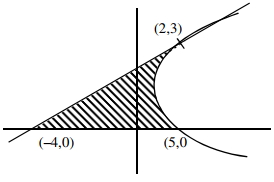
The area of the region bounded by the parabola $(y-2)^{2}=(x-1)$, the tangent to it at the point whose ordinate is $3$ and the $\mathrm{x}$-axis is :
Answera
$y=3 \Rightarrow x=2$
Point is $(2,3)$
Diff. w.r.t $\mathrm{x}$
$2(y-2) y^{\prime}=1$
$\Rightarrow y^{\prime}=\frac{1}{2(y-2)}$
$\Rightarrow y_{(2,3)}^{\prime}=\frac{1}{2}$
$\Rightarrow \frac{y-3}{x-2}=\frac{1}{2} \Rightarrow x-2 y+4=0$
$\text { Area }=\int_{0}^{3}\left((y-2)^{2}+1-(2 y-4)\right) d y$
$=9\, \text { sq. units }$
View full question & answer→MCQ 1321 Mark
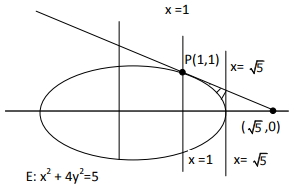
Let $T$ be the tangent to the ellipse $E: x^{2}+4 y^{2}=5$ at the point $P(1,1)$. If the area of the region bounded by the tangent $T$, ellipse $E$, lines $x=1$ and $x=\sqrt{5}$ is $\alpha \sqrt{5}+\beta+\gamma \cos ^{-1}\left(\frac{1}{\sqrt{5}}\right)$, then $|\alpha+\beta+\gamma|$ is equal to $....$
AnswerCorrect option: A. $1.25$
a
Tangent at $\mathrm{P}: \mathrm{x}+4 \mathrm{y}=5$
Required Area
$=\int_{1}^{\sqrt{5}}\left(\frac{5-x}{4}-\frac{\sqrt{5-x^{2}}}{2}\right) \,d x$
$=\left[\frac{5 x}{4}-\frac{x^{2}}{8}-\frac{x}{4} \sqrt{5-x^{2}}-\frac{5}{2} \sin ^{-1} \frac{x}{\sqrt{5}}\right]_{1}^{\sqrt{5}}$
$=\frac{5}{4} \sqrt{5}-\frac{5}{4}-\frac{5}{4} \cos ^{-1}\left(\frac{1}{\sqrt{5}}\right)$
It we assume $\alpha, \beta, \gamma_{\prime} \in Q$ (Not given in question)
then $\alpha=\frac{5}{4}, \beta=-\frac{5}{4} \& \gamma=-\frac{5}{4}$
$|\alpha+\beta+\gamma|=1.25$
View full question & answer→MCQ 1331 Mark
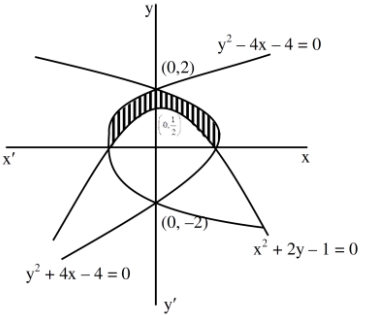
The area (in $sq.\, units$) of the region bounded by the curves $x^{2}+2 y-1=0, y^{2}+4 x-4=0$ and $y^{2}-4 x-$ $4=0$, in the upper half plane is $....$
Answerb
Required Area (shaded)
$=2\left[\int_{0}^{2}\left(\frac{4-y^{2}}{4}\right) \,d y-\int_{0}^{1}\left(\frac{1-x^{2}}{2}\right) \,d x\right]$
$=2\left[\frac{4}{3}-\frac{1}{3}\right]=(2)$
View full question & answer→MCQ 1341 Mark
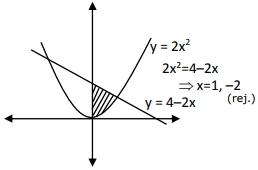
The area (in $sq. \,units$) of the region, given by the set $\left\{(x, y) \in R \times R \mid x \geq 0,2 x^{2} \leq y \leq 4-2 x\right\}$ is:
- ✓
$\frac{7}{3}$
- B
$\frac{13}{3}$
- C
$\frac{17}{3}$
- D
$\frac{8}{3}$
AnswerCorrect option: A. $\frac{7}{3}$
a
Required area $=\int_{0}^{1}\left(4-2 x-2 s^{2}\right) d x=4 x-x^{2}-\left.\frac{2 x^{3}}{3}\right|_{0} ^{1}$
$=4-1-\frac{2}{3}=\frac{7}{3}$
View full question & answer→MCQ 1351 Mark
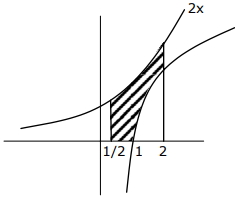
If the area of the bounded region
$R=\left\{(x, y): \max \left\{0, \log _{e} x\right\} \leq y \leq 2^{x}, \frac{1}{2} \leq x \leq 2\right\}$
is, $\alpha\left(\log _{e} 2\right)^{-1}+\beta\left(\log _{e} 2\right)+\gamma$, then the value of $(\alpha+\beta-2 \gamma)^{2}$ is equal to:
Answerd
$\mathrm{R}\left\{(x, y): \max \left(0, \log _{e} x\right) \leq y \leq 2^{x}, \frac{1}{2} \leq x \leq 2\right\}$
$\int_{\frac{1}{2}}^{2} 2^{x} \,d x-\int_{1}^{2} \ln x\, d x$
$\Rightarrow\left[\frac{2^{x}}{\ln 2}\right]_{1 / 2}^{2}-[x \ln x-x]_{1}^{2}$
$\Rightarrow \frac{\left(2^{2}\right)-2^{1 / 2}}{\log _{e} 2}-(2 \ln 2-1)$
$\therefore \alpha=2^{2}-\sqrt{2}, \beta=-2, \gamma=1$
$\Rightarrow(\alpha+\beta-2 \gamma)^{2}$
$\Rightarrow\left(2^{2}-\sqrt{2}-2-2\right)^{2}$
$\Rightarrow(\sqrt{2})^{2}=2$
View full question & answer→MCQ 1361 Mark
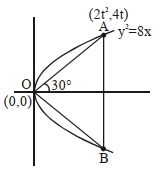
The area (in sq. units) of an equilateral triangle inscribed in the parabola $\mathrm{y}^{2}=8 \mathrm{x},$ with one of its vertices on the vertex of this parabola, is
- A
$64 \sqrt{3}$
- B
$256 \sqrt{3}$
- ✓
$192 \sqrt{3}$
- D
$128 \sqrt{3}$
AnswerCorrect option: C. $192 \sqrt{3}$
c
$\tan 30^{\circ}=\frac{4 \mathrm{t}}{2 \mathrm{t}^{2}}=\frac{2}{\mathrm{t}} \Rightarrow \mathrm{t}=2 \sqrt{3}$
$\mathrm{AB}=8 \mathrm{t}=16 \sqrt{3}$
Area $=256.3 \cdot \frac{\sqrt{3}}{4}=192 \sqrt{3}$
View full question & answer→MCQ 1371 Mark
$\int \limits_{-\pi}^{\pi}|\pi-| x || d x$ is equal to :
- ✓
$\pi^{2}$
- B
$2 \pi^{2}$
- C
$\sqrt{2} \pi^{2}$
- D
$\frac{\pi^{2}}{2}$
AnswerCorrect option: A. $\pi^{2}$
a
$\int_{-\pi}^{\pi}|\pi-| x || d x =2 \int_{0}^{\pi}|\pi- x | d x$
$=2 \int_{0}^{\pi}(\pi- x ) d x$
$=2\left[\pi x -\frac{ x ^{2}}{2}\right]_{0}^{\pi}=\pi^{2}$
View full question & answer→MCQ 1381 Mark
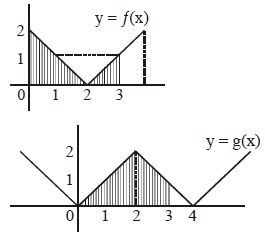
Let $f ( x )= |x -2|$ and $g ( x )= f ( f ( x )), x \in[0,4]$ Then $\int \limits_{0}^{3}(g(x)-f(x)) d x$ is equal to
- A
$\frac{3}{2}$
- B
$0$
- C
$\frac{1}{2}$
- ✓
$1$
Answerd
$\int_{0}^{3} g ( x )- f ( x )=\int_{0}^{3}|| x -2|-2| d x -\int_{0}^{3}| x -2| d x$
$=\left(\frac{1}{2} \times 2 \times 2+1+\frac{1}{2} \times 1 \times 1\right)-\left(\frac{1}{2} \times 2 \times 2+\frac{1}{2} \times 1 \times 1\right)$
$=\left(2+1+\frac{1}{2}\right)-\left(2+\frac{1}{2}\right)=1$
View full question & answer→MCQ 1391 Mark
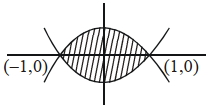
The area (in sq. units) of the region enclosed by the curves $y=x^{2}-1$ and $y=1-x^{2}$ is equal to
- A
$\frac{4}{3}$
- ✓
$\frac{8}{3}$
- C
$\frac{16}{3}$
- D
$\frac{7}{2}$
AnswerCorrect option: B. $\frac{8}{3}$
b
$y=x^{2}-1$ and $y=1-x^{2}$
$A=\int_{-1}^{1}\left(\left(1-x^{2}\right)-\left(x^{2}-1\right)\right) d x$
$A=\int_{-1}^{1}\left(2-2 x^{2}\right) d x=4 \int_{0}^{1}\left(1-x^{2}\right) d x$
$A=4\left(x-\frac{x^{3}}{3}\right)_{0}^{1}=4\left(\frac{2}{3}\right)=\frac{8}{3}$
View full question & answer→MCQ 1401 Mark
The area (in sq. units) of the region
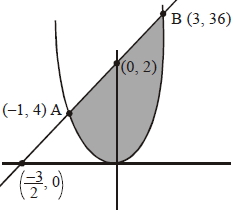
$\left\{(\mathrm{x}, \mathrm{y}) \in \mathrm{R}^{2} | 4 \mathrm{x}^{2} \leq \mathrm{y} \leq 8 \mathrm{x}+12\right)$ is
- A
$\frac{127}{3}$
- B
$\frac{125}{3}$
- C
$\frac{124}{3}$
- ✓
$\frac{128}{3}$
AnswerCorrect option: D. $\frac{128}{3}$
d
$4 x^{2}-y \leq 0$ and $8 x-y+12 \geq 0$
On solving $y=4 x^{2}$
and $\quad y=8 x+12$
We get $A(-1,4)\;and\; B(3,36)$
Required area $=$ area of the shaded region
$=\int_{-1}^{3}\left(8 x+12-4 x^{2}\right) d x=\frac{128}{3}$
View full question & answer→MCQ 1411 Mark
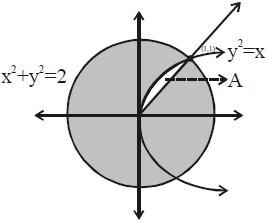
The area of the region, enclosed by the circle $\mathrm{x}^{2}+\mathrm{y}^{2}=2$ which is not common to the region bounded by the parabola $y^{2}=x$ and the straight line $\mathrm{y}=\mathrm{x},$ is
- A
$\frac{1}{3}(12 \pi-1)$
- ✓
$\frac{1}{6}(12 \pi-1)$
- C
$\frac{1}{6}(24 \pi-1)$
- D
$\frac{1}{3}(6 \pi-1)$
AnswerCorrect option: B. $\frac{1}{6}(12 \pi-1)$
b
$A=\int_{0}^{1}(\sqrt{x}-x) d x$
$=\left[\frac{2}{3} x^{3 / 2}-\frac{x^{2}}{2}\right]_{0}^{1}=\frac{1}{6}$
Required Area : $\pi r^{2}-\frac{1}{6}=\frac{1}{6}(12 \pi-1)$
View full question & answer→MCQ 1421 Mark
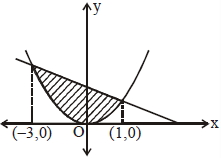
The area (in sq. units) of the region $\left\{(\mathrm{x}, \mathrm{y}) \in \mathrm{R}^{2}: \mathrm{x}^{2} \leq \mathrm{y} \leq 3-2 \mathrm{x}\right\},$ is
- A
$\frac{29}{3}$
- B
$\frac{31}{3}$
- C
$\frac{34}{3}$
- ✓
$\frac{32}{3}$
AnswerCorrect option: D. $\frac{32}{3}$
d
Area $=\int_{-3}^{1}\left(3-2 x-x^{2}\right) d x=\frac{32}{3}$
View full question & answer→MCQ 1431 Mark
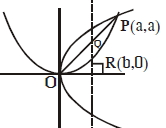
For $a>0,$ let the curves $C_{1}: y^{2}=a x$ and $\mathrm{C}_{2}: \mathrm{x}^{2}=$ ay intersect at origin $\mathrm{O}$ and a point $\mathrm{P}$ Let the line $\mathrm{x}=\mathrm{b}(0<\mathrm{b}<\mathrm{a})$ intersect the chord $OP$ and the $\mathrm{x}$ -axis at points $\mathrm{Q}$ and $\mathrm{R}$, respectively. If the line $x=b$ bisects the area bounded by the curves, $\mathrm{C}_{1}$ and $\mathrm{C}_{2},$ and the area of $\Delta \mathrm{OQR}=\frac{1}{2},$ then '$a$' satisfies the equation
- ✓
$x^{6}-12 x^{3}+4=0$
- B
$x^{6}-12 x^{3}-4=0$
- C
$x^{6}+6 x^{3}-4=0$
- D
$x^{6}-6 x^{3}+4=0$
AnswerCorrect option: A. $x^{6}-12 x^{3}+4=0$
a
$\int_{0}^{b}\left(\sqrt{a x}-\frac{x^{2}}{a}\right) d x=\frac{1}{2} \times \frac{16\left(\frac{a}{4}\right)\left(\frac{a}{4}\right)}{3}$
$\Rightarrow\left[\frac{2 \sqrt{a}}{3} x^{3 / 2}-\frac{x^{3}}{3 a}\right]_{0}^{b}=\frac{a^{2}}{6}$
$\Rightarrow \frac{2 \sqrt{a}}{3} b^{3 / 2}-\frac{b^{3}}{3 a}=\frac{a^{2}}{6}$
Also, $\frac{1}{2} \times b^{2}=\frac{1}{2}$$ \Rightarrow b=1$
so, $\frac{2 \sqrt{a}}{3}-\frac{1}{3 a}=\frac{a^{2}}{6} $$\Rightarrow a^{3}-4 a^{3 / 2}+2=0$
$\Rightarrow a^{6}+4 a^{3}+4=16 a^{3}$$ \Rightarrow a^{6}-12 a^{3}+4=0$
View full question & answer→MCQ 1441 Mark
Given : $f(x)=\left\{\begin{array}{ccc}{x} & {,} & {0 \leq x < \frac{1}{2}} \\ {\frac{1}{2}} & {,} & {x=\frac{1}{2}} \\ {1-x} & {,} & {\frac{1}{2} < x \leq 1}\end{array}\right.$
and $g(x)=\left(x-\frac{1}{2}\right)^{2}, x \in R .$ Then the area (in sq. units) of the region bounded by the curves, $y=f(x)$ and $y=g(x)$ between the lines, $2 \mathrm{x}=1$ and $2 \mathrm{x}=\sqrt{3},$ is
- A
$\frac{1}{3}+\frac{\sqrt{3}}{4}$
- ✓
$\frac{\sqrt{3}}{4}-\frac{1}{3}$
- C
$\frac{1}{2}+\frac{\sqrt{3}}{4}$
- D
$\frac{1}{2}-\frac{\sqrt{3}}{4}$
AnswerCorrect option: B. $\frac{\sqrt{3}}{4}-\frac{1}{3}$
b
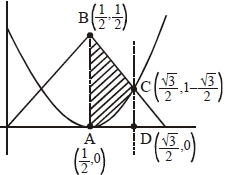
Required area $=$ Area of trepezium ABCD -
Area of parabola between $x=\frac{1}{2}$ and $ x=\frac{\sqrt{3}}{2}$
$A=\frac{1}{2}\left(\frac{\sqrt{3}}{2}-\frac{1}{2}\right)\left(\frac{1}{2}+1-\frac{\sqrt{3}}{2}\right)-\int_{1 / 2}^{\sqrt{3} / 2}\left(x-\frac{1}{2}\right)^{2} d x$$=\frac{\sqrt{3}}{4}-\frac{1}{3}$
View full question & answer→MCQ 1451 Mark
Consider a region $\mathrm{R}=\left\{(\mathrm{x}, \mathrm{y}) \in \mathrm{R}^{2}: \mathrm{x}^{2} \leq \mathrm{y} \leq 2 \mathrm{x}\right\}$ If a line $\mathrm{y}=\alpha$ divides the area of region $\mathrm{R}$ into two equal parts, then which of the following is true?
- A
$\alpha^{3}-6 \alpha^{2}+16=0$
- B
$3 \alpha^{2}-8 \alpha+8=0$
- C
$\alpha^{3}-6 \alpha^{3 / 2}-16=0$
- ✓
$3 \alpha^{2}-8 \alpha^{3 / 2}+8=0$
AnswerCorrect option: D. $3 \alpha^{2}-8 \alpha^{3 / 2}+8=0$
d
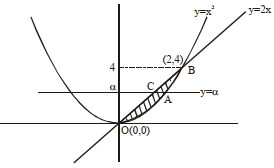
$\mathrm{y} \geq \mathrm{x}^{2} \Rightarrow$ upper region of $\mathrm{y}=\mathrm{x}^{2}$
$\mathrm{y} \leq 2 \mathrm{x} \Rightarrow$ lower region of $\mathrm{y}=2 \mathrm{x}$
According to ques, area of $\mathrm{OABC}=2$ area of
$\mathrm{OAC}$
$\Rightarrow \int_{0}^{4}\left(\sqrt{\mathrm{y}}-\frac{\mathrm{y}}{2}\right) \mathrm{dy}=2 \int_{0}^{\alpha}\left(\sqrt{\mathrm{y}}-\frac{\mathrm{y}}{2}\right) \cdot \mathrm{dy}$
$\Rightarrow \frac{4}{3}=2\left[\frac{2}{3} \alpha^{3 / 2}-\frac{1}{4} \cdot \alpha^{2}\right]$
$\Rightarrow\left[3 \alpha^{2}-8 \alpha^{3 / 2}+8=0\right.$
View full question & answer→MCQ 1461 Mark
The area (in sq. units) of the region $\left\{(x, y): 0 \leq y \leq x^{2}+1,0 \leq y \leq x+1\right.$ $\left.\frac{1}{2} \leq x \leq 2\right\}$ is
- A
$\frac{79}{16}$
- B
$\frac{23}{6}$
- ✓
$\frac{79}{24}$
- D
$\frac{23}{16}$
AnswerCorrect option: C. $\frac{79}{24}$
c
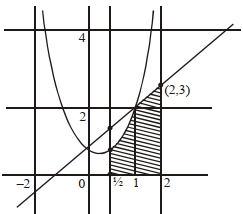
$0 \leq y \leq x^{2}+1,0 \leq y \leq x+1, \frac{1}{2} \leq x \leq 2$
Required area $=\int_{1 / 2}^{1}\left(x^{2}+1\right) d x+\frac{1}{2}(2+3) \times 1$
$=\frac{19}{24}+\frac{5}{2}=\frac{79}{24}$
View full question & answer→MCQ 1471 Mark
The area (in sq. units) of the region $A=\{(x, y):(x-1)[x] \leq y \leq 2 \sqrt{x}, 0 \leq x \leq 2\}$ where $[t]$ denotes the greatest integer function, is
AnswerCorrect option: A. $\frac{8}{3} \sqrt{2}-\frac{1}{2}$
a
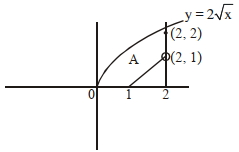
$( x -1)[ x ] \leq y \leq 2 \sqrt{ x }, \quad 0 \leq x \leq 2$
Draw $y =2 \sqrt{ x } \Rightarrow y ^{2}=4 x \quad x \geq 0$
$y =( x -1)[ x ]=\left\{\begin{array}{c}0 \quad, 0 \leq x <1 \\ x -1,1 \leq x <2 \\ 2, \quad x =2\end{array}\right.$
$A=\int_{0}^{2} 2 \sqrt{x} d x-\frac{1}{2} 1 \cdot 1$
$A=2 \cdot\left[\frac{x^{3 / 2}}{(3 / 2)}\right]_{0}^{2}-\frac{1}{2}=\frac{8 \sqrt{2}}{3}-\frac{1}{2}$
View full question & answer→MCQ 1481 Mark
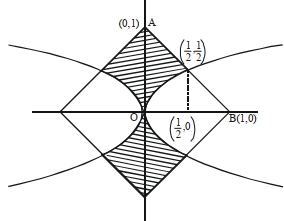
The area (in sq. units) of the region $A=\{(x, y)$ $\left.:|x|+|y| \leq 1,2 y^{2} \geq|x|\right\}$ is
- A
$\frac{1}{6}$
- B
$\frac{1}{3}$
- C
$\frac{7}{6}$
- ✓
$\frac{5}{6}$
AnswerCorrect option: D. $\frac{5}{6}$
d
$|x|+|y| \leq 1$
$2 y^{2} \geq|x|$
For point of intersection $x+y=1 \Rightarrow x=1-y$
$y^{2}=\frac{x}{2} \Rightarrow 2 y^{2}=x$
$2 y^{2}=1-y \Rightarrow 2 y^{2}+y-1=0$
$(2 y-1)(y+1)=0$
$y=\frac{1}{2}$ or -1
Now Area of $\Delta OAB =\frac{1}{2} \times 1 \times 1=\frac{1}{2}$
Area of Region $R _{1}=\frac{1}{2} \times \frac{1}{2} \times \frac{1}{2}=\frac{1}{8}$
Area of Region $R _{2}=\frac{1}{\sqrt{2}} \int_{0}^{\frac{1}{2}} \sqrt{ x } dx =\frac{1}{6}$
Now area of shaded region in first quadrant $=$ Area of $\Delta O AB - R _{1}- R _{2}$
$=\frac{1}{2}-\left(\frac{1}{6}\right)-\left(\frac{1}{8}\right)=\frac{5}{24}$
So required area $=4\left(\frac{5}{24}\right)=\frac{5}{6}$
View full question & answer→MCQ 1491 Mark
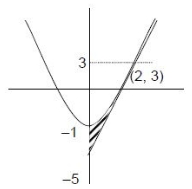
The area (in sq. units) bounded by the parabola $y = x^2 -1$, the tangent at the point $(2, 3)$ into it and the $y -$ axis is
- ✓
$\frac{8}{3}$
- B
$\frac{32}{3}$
- C
$\frac{53}{3}$
- D
$\frac{14}{3}$
AnswerCorrect option: A. $\frac{8}{3}$
a
Area $ = \int\limits_{ - 5}^3 x dy - \int\limits_{ - 1}^3 {xdy} $
$ = \int\limits_{ - 5}^3 {\left( {\frac{{y + 5}}{4}} \right)} - \int\limits_{ - 1}^3 {\sqrt {y + 1} dy} $
$=\left|\frac{\frac{y^{2}}{2}+5 y}{4}\right|_{-5}^{3}-\left|\frac{2}{3}(y+1)^{3 / 2}\right|_{-1}^{3}$
$ = \left| {\frac{{\left( {\frac{9}{2} + 15} \right) - \left( {\frac{{25}}{2} - 25} \right)}}{4}} \right| = |\frac{{16}}{3}| = \frac{8}{3}$
View full question & answer→MCQ 1501 Mark
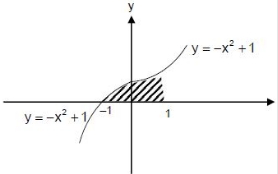
The area of the region $A\,\{ \,(x,y)\,\,:\,\,0\,\, \le \,y\, \le \,x\,\left| x \right|\, + \,1$ and $ - \,1\, \le \,x\, \le \,1\,\} $ in sq. units, is
- A
$\frac {2}{3}$
- B
$\frac {1}{3}$
- ✓
$2$
- D
$\frac {4}{3}$
Answerc
The graph is a follows
$\int\limits_{ - 1}^0 {\left( { - {x^2} + 1} \right)dx + \int\limits_0^1 {\left( {{x^2} + 1} \right)dx = 2} } $
View full question & answer→