Question 2015 Marks
Find the distance of the point (-1, -5, -10) from the point of intersection of the line $\vec{\text{r}}=(2\hat{\text{i}}-\hat{\text{j}}+2\hat{\text{k}})+\lambda(3\hat{\text{i}}+4\hat{\text{j}}+2\hat{\text{k}})$ and the plane $\vec{\text{r}}\cdot(\hat{\text{i}}-\hat{\text{j}}+\hat{\text{k}})=5.$
AnswerThe given equation of the line is
$\vec{\text{r}}=(2\hat{\text{i}}-\hat{\text{j}}+2\hat{\text{k}})+\lambda(3\hat{\text{i}}+4\hat{\text{j}}+2\hat{\text{k}})$
$\Rightarrow\vec{\text{r}}=(2+3\lambda)\hat{\text{i}}+(-1+4\lambda)\hat{\text{j}}+(2+2\lambda)\hat{\text{k}}$
The coordinates of any point on this line are of the form
$(2+3\lambda)\hat{\text{i}}+(-1+4\lambda)\hat{\text{j}}+(2+2\lambda)\hat{\text{k}}$
or $(2+3\lambda,-1+4\lambda,2+2\lambda)$
Since this point lies on the plane $\vec{\text{r}}\cdot(\hat{\text{i}}-\hat{\text{j}}+\hat{\text{k}})=5,$
$\Big[(2+3\lambda)\hat{\text{i}}+(-1+4\lambda)\hat{\text{j}}+(2+2\lambda)\hat{\text{k}}\Big]\cdot(\hat{\text{i}}-\hat{\text{j}}+\hat{\text{k}})=5$
$\Rightarrow2+3\lambda+1-4\lambda+2+2\lambda-5=0$
$\Rightarrow\lambda=0$
So, the coordinates of the point are
$(2+3\lambda,-1+4\lambda,2+2\lambda)$
$=(2+0,-1+0,2+0)$
$=(2,-1,2)$
Distance between (2, -1, 2) and (-1, -5, -10)
$=\sqrt{(-1-2)^2+(-5+1)^2+(-10-2)^2}$
$=\sqrt{9+16+144}$
$=13\text{ units}$
View full question & answer→Question 2025 Marks
Find the angle between the line joining the points (3, -4, -2) and (12, 2, 0) and the plane 3x - y + z = 1.
AnswerIt is given that the line passes through A(3, -4, -2) and B(12, 2, 0)
So, $\vec{\text{b}}=\overrightarrow{\text{AB}}=\overrightarrow{\text{OB}}-\overrightarrow{\text{OA}}$
$=12\hat{\text{i}}+2\hat{\text{j}}+0\hat{\text{k}}-(3\hat{\text{i}}-4\hat{\text{j}}-2\hat{\text{k}})$
$=9\hat{\text{i}}+6\hat{\text{j}}+2\hat{\text{k}}$
The given line is parallel to the vector $\vec{\text{b}}=9\hat{\text{i}}+6\hat{\text{j}}+2\hat{\text{k}}$ and the given plane is normal to the vector $\vec{\text{n}}=3\hat{\text{i}}-\hat{\text{j}}+\hat{\text{k}}$
We know that the angle $\theta$ between the line and the plane is given by
$\sin\theta=\frac{\vec{\text{b}}\cdot\vec{\text{n}}}{|\vec{\text{b}}||\vec{\text{n}}|}$
$=\frac{(9\hat{\text{i}}+6\hat{\text{j}}+2\hat{\text{k}})\cdot(3\hat{\text{i}}-\hat{\text{j}}+\hat{\text{k}})}{|9\hat{\text{i}}+6\hat{\text{j}}+2\hat{\text{k}}||3\hat{\text{i}}-\hat{\text{j}}+\hat{\text{k}}|}$
$=\frac{27-6+2}{\sqrt{81+36+4}\sqrt{9+1+1}}=\frac{23}{11\sqrt{11}}$
$\theta=\sin^{-1}\Big(\frac{23}{11\sqrt{11}}\Big)$
View full question & answer→Question 2035 Marks
If the points (1, 1, p) and (-3, 0, 1) be equidistant from the plane $\vec{\text{r}}\Big(3\hat{\text{i}}+4\hat{\text{j}}-12\hat{\text{k}}\Big)+13=0,$ then find the value of p.
AnswerEquation of the given plane is $\vec{\text{r}}\Big(3\hat{\text{i}}+4\hat{\text{j}}-12\hat{\text{k}}\Big)+13=0$
$\Rightarrow\ \ \Big(\text{x}\hat{\text{i}}+\text{y}\hat{\text{j}}+\text{z}\hat{\text{k}}\Big).\Big(3\hat{\text{i}}+4\hat{\text{j}}-12\hat{\text{k}}\Big)+13=0$
$\Big[\because\ \vec{\text{r}}=\text{Position vector of any point (x, y, z) on the plane }\text{x}\hat{\text{i}}+\text{y}\hat{\text{j}}+\text{z}\hat{\text{k}}\Big]$
⇒ 3x + 4y - 12z + 13 = 0 ....(i)
Also, the point (1, 1, p) and (-3, 0, 1) are equidistance from plane (i)
⇒ (Perpendicular) distance of point (1, 1, p) from plane (i) = Distance of point (-3, 0, 1) from plane (i)
$\Rightarrow\ \ \ \frac{|3(1)+4(1)-12(\text{p})+13|}{\sqrt{9+16+144}}=\frac{|3(-3)+4(0)-12(1)+13|}{\sqrt{9+16+144}}$
$\Rightarrow\ \ \ \frac{|3+4-12\text{p}+13|}{13}=\frac{|-9-12+13|}{13}$
⇒ |20 - 12p| = |-8|
$\Rightarrow\ \ 20-12\text{p}=\pm8\ \ \ [\because\ \text{If }|\text{x}|=\text{a, a}\geq0,\ \text{then x}=\pm\text{a}]$
| Taking positive sign, |
20 - 12p = 8 |
⇒ |
-12p = -12 |
⇒ |
p = 1 |
| Taking negative sign, |
20 - 12p = -8 |
⇒ |
-12p = -28 |
⇒ |
$\text{p}=\frac{-28}{-12}=\frac{7}{3}$ |
Hence, the values of p are $1\ \text{or}\ \frac{7}{3}.$ View full question & answer→Question 2045 Marks
Find the vector equations of the following planes in scalar product form $(\vec{\text{r}}\cdot\vec{\text{n}}=\text{d}):$
$\vec{\text{r}}=(\hat{\text{i}}+\hat{\text{j}})+\lambda(\hat{\text{i}}+2\hat{\text{j}}-\hat{\text{k}})+\mu(-\hat{\text{i}}+\hat{\text{j}}-2\hat{\text{k}})$
AnswerGiven, equation of plane,
$\vec{\text{r}}=(\hat{\text{i}}+\hat{\text{j}})+\lambda(\hat{\text{i}}+2\hat{\text{j}}-\hat{\text{k}})+\mu(-\hat{\text{i}}+\hat{\text{j}}-2\hat{\text{k}})$
We know that, $\vec{\text{r}}=\vec{\text{a}}+\lambda\vec{\text{b}}+\mu\vec{\text{c}}$ represent a plane passing through a point having position vector $\vec{\text{a}}$ and parallel to vectors $\vec{\text{b}}$ and $\vec{\text{c}}.$
Here, $\vec{\text{a}}=\hat{\text{i}}+\hat{\text{j}},\vec{\text{b}}=\hat{\text{i}}+2\hat{\text{j}}-\hat{\text{k}},\vec{\text{c}}=-\hat{\text{i}}+\hat{\text{j}}-2\hat{\text{k}}$
The given plane is perpendicular to a vector
$\vec{\text{n}}=\vec{\text{b}}\times\vec{\text{c}}$
$=\begin{vmatrix}\hat{\text{i}}&\hat{\text{j}}&\hat{\text{k}}\\1&2&-1\\-1&1&-2\end{vmatrix}$
$=\hat{\text{i}}(-4+1)-\hat{\text{j}}(-2-1)+\hat{\text{k}}(1+2)$
$=-3\hat{\text{i}}+3\hat{\text{j}}+3\hat{\text{k}}$
We know that, the equation of plane in scalar product form is given by,
$\vec{\text{r}}\cdot\vec{\text{n}}=\vec{\text{a}}\cdot\vec{\text{n}}$
$\vec{\text{r}}\cdot(-3\hat{\text{i}}+3\hat{\text{j}}+3\hat{\text{k}})=(\hat{\text{i}}+\hat{\text{j}})(-3\hat{\text{i}}+3\hat{\text{j}}+3\hat{\text{k}})$
$\vec{\text{r}}\cdot(-3\hat{\text{i}}+3\hat{\text{j}}+3\hat{\text{k}})=(-1)(-3)+(1)(3)+(0)+(3)$
$\vec{\text{r}}\cdot(-3\hat{\text{i}}+3\hat{\text{j}}+3\hat{\text{k}})=-3+3$
$\vec{\text{r}}\cdot(-3\hat{\text{i}}+3\hat{\text{j}}+3\hat{\text{k}})=0$
Dividing by 3, we get
$\vec{\text{r}}\cdot(-\hat{\text{i}}+\hat{\text{j}}+\hat{\text{k}})=0$
Equation in required form is,
$\vec{\text{r}}\cdot(-\hat{\text{i}}+\hat{\text{j}}+\hat{\text{k}})=0$
View full question & answer→Question 2055 Marks
Find the vector equation of the plane passing through the points (1, 1, -1), (6, 4, -5) and (-4, -2, 3).
AnswerLet P(1, 1, -1), Q(6, 4, -5) and R(-4, -2, 3) be three points on a plane having position vectors $\vec{\text{p}},\vec{\text{q}}$ and $\vec{\text{s}}$ respectively. Then the vectors $\overrightarrow{\text{PQ}}$ and $\overrightarrow{\text{PR}}$ are in the same plane.
Therefore, $\overrightarrow{\text{PQ}}\times\overrightarrow{\text{PR}}$ is a vector perpendicular to the plane.
Let $\vec{\text{n}}=\overrightarrow{\text{PQ}}\times\overrightarrow{\text{PR}}$
$\overrightarrow{\text{PQ}}=(6-1)\hat{\text{i}}+(4-1)\hat{\text{j}}+(-5-(-1))\hat{\text{k}}$
$\Rightarrow\overrightarrow{\text{PQ}}=5\hat{\text{i}}+3\hat{\text{j}}-4\hat{\text{k}}$
Similarly,
$\Rightarrow\overrightarrow{\text{PR}}=(-4-1)\hat{\text{i}}+(-2-1)\hat{\text{j}}+(3-(-1))\hat{\text{k}}$
$\Rightarrow\overrightarrow{\text{PR}}=-5\hat{\text{i}}-3\hat{\text{j}}+4\hat{\text{k}}$
Thus,
Here, $\overrightarrow{\text{PQ}}=-\overrightarrow{\text{PR}}$
Therefore, the given points are collinear.
Thus, $\vec{\text{n}}=\text{a}\hat{\text{i}}+\text{b}\hat{\text{j}}+\text{c}\hat{\text{k}}$ where, 5a + 3b - 4c = 0
The plane passes through the point P with position vector $\vec{\text{p}}=\hat{\text{i}}+\hat{\text{j}}-\hat{\text{k}}$
Thus, its vector equation is,
$\big\{\vec{\text{r}}-(\hat{\text{i}}+\hat{\text{j}}-\hat{\text{k}})\big\}\cdot(\text{a}\hat{\text{i}}+\text{b}\hat{\text{j}}+\text{c}\hat{\text{k}})=0$ Where, 5x + 3b - 4c = 0
View full question & answer→Question 2065 Marks
$\text{Let } \vec{\text a} = \hat{\text{i}} + \hat{\text{j}} + \hat{\text{k}}, \vec{\text{b}} = \hat{\text{i}} \text{ and } \vec{\text{c}} = \text{c}_{1} \hat{\text{i}} + \text{c}_{2} \hat{\text{j}} + \text{c}_{3} \hat{\text{k}}, \text{then}$
- Let $c_1 = 1$ and $c_2 = 2$, find $c_3$ which makes $\vec{\text{a}}, \vec{\text{b}} \text{ and }\vec{\text{c}} \text{ coplanar.}$
- If $c_2 = –1$ and $c_3 = 1$, show that no value of $c_1$ can make $\vec{\text{a}}, \vec{\text{b}} \text{ and } \vec{\text{c}} \text{ coplanar}.$
Answer$[\vec{\text{a}} \text{ }\vec{\text{b}} \text{ } \vec{\text{c}}] = \begin{vmatrix} 1 & 1 & 1 \\ 1 & 0 & 0 \\ \text{c}_{1} & \text{c}_{2} & \text{c}_{3} \end{vmatrix} = \text{c}_{2} - \text{c}_{3}$
- $\text{c}_{1} = 1, \text{ c}_{2} = 2$
$[\vec{\text{a}} \text{ }\vec{\text{b}} \text{ } \vec{\text{c}}] = 2 - \text{c}_{3}$
$\therefore \vec{\text{a}}, \text{ }\vec{\text{b}}, \text{ } \vec{\text{c}} \text{ are coplanar} [\vec{\text{a}} \text{ }\vec{\text{b}} \text{ } \vec{\text{c}}] = 0 \Rightarrow \text{c}_{3} = 2$
- $\text{c}_{2} = -1, \text{c}_{3} = 1$
$[\vec{\text{a}} \text{ }\vec{\text{b}} \text{ } \vec{\text{c}}] = \text{c}_{2} - \text{c}_{3} = -2 \neq 0$
$\Rightarrow \text{No value of }\text{c}_{1} \text{can make }\vec{\text{a}}, \text{ }\vec{\text{b}}, \text{ } \vec{\text{c}} \text{ coplanar}.$ View full question & answer→Question 2075 Marks
Determine whether the following pair of lines intersect or not:
$\vec{\text{r}}=\big(\hat{\text{i}}-\hat{\text{j}}\big)+\lambda\big(2\hat{\text{i}}+\hat{\text{k}}\big)$ and $\vec{\text{r}}=\big(2\hat{\text{i}}-\hat{\text{j}}\big)+\mu\big(\hat{\text{i}}+\hat{\text{j}}-\hat{\text{k}}\big)$
AnswerGiven equation of lines are
$\vec{\text{r}}=\big(\hat{\text{i}}-\hat{\text{j}}\big)+\lambda\big(2\hat{\text{i}}+\hat{\text{k}}\big)$ and $\vec{\text{r}}=\big(2\hat{\text{i}}-\hat{\text{j}}\big)+\mu\big(\hat{\text{i}}+\hat{\text{j}}-\hat{\text{k}}\big)$
If these lines intersect each other, there must be some common point, So, we must have $\lambda$ and $\mu$ such that
$\big(\hat{\text{i}}-\hat{\text{j}}\big)+\lambda\big(2\hat{\text{i}}+\hat{\text{k}}\big)=\big(2\hat{\text{i}}-\hat{\text{j}}\big)+\mu\big(\hat{\text{i}}+\hat{\text{j}}-\hat{\text{k}}\big)$
$(1+2\lambda)\hat{\text{i}}-\hat{\text{j}}+\lambda\hat{\text{k}}=(2+\mu)\hat{\text{i}}+(-1+\mu)\hat{\text{j}}-\mu\hat{\text{k}}$
Equation the cofficients of $\hat{\text{i}},\hat{\text{j}}$ and $\hat{\text{k}},$
$1+2\lambda=2+\mu\Rightarrow2\lambda-\mu=1\dots(1)$
$-1=-1+\mu\Rightarrow\mu=0\dots(2)$
$\lambda=-\mu\Rightarrow\lambda=0\dots(3)$
Put value of $\lambda$ and $\mu$ in equation (1),
$2\lambda=\mu=1$
$2(0)-(0)=1$
$0=1$
$\text{LHS}\neq\text{RHS}$
Since, the values of $\lambda$ and $\mu$ form equation (2) and (3) dose not satisfy equation (1),
Hence, given lines do not intersect each other.
View full question & answer→Question 2085 Marks
Find the length and the foot of perpendicular from the poin $\Big(1,\frac{3}{2},2\Big)$ to the plane 2x - 2y + 4z + 5 = 0.
AnswerEquation of the given plane is 2x - 2y + 4z + 5 = 0 .....(i)
Thus, normal to the plane is $\vec{\text{n}}=2\hat{\text{i}}-2\hat{\text{j}}+4\hat{\text{k}}$
So, the equation of line through $\Big(1,\frac{3}{2},2\Big)$ and parallel to n is given by
$\frac{\text{x}-1}{2}=\frac{\text{y}-\frac{3}{2}}{-2}=\frac{\text{z}-2}{4}=\lambda$
Thus any point on thus line is $\Big(\text{x}=2\lambda+1,\text{y}=-2\lambda+\frac{3}{2},\text{z}=4\lambda+2\Big)$
If this point lies on the given plane, then
$2(2\lambda+1)-2\Big(-2\lambda+\frac{3}{2}\Big)+4(4\lambda+2)+5=0$ [Using Eq. (i)]
$\Rightarrow4\lambda+2+4\lambda-3+16\lambda+8+5=0$
$\Rightarrow24\lambda=-12$
$\Rightarrow\lambda=\frac{-1}{2}$
$\therefore$ Required foot of perpendicular
$=\Big[2\times\Big(\frac{-1}{2}\Big)+1,-2\times\Big(\frac{-1}{2}\Big)+\frac{3}{2},4\times\Big(\frac{-1}{2}\Big)+2\Big]$ i.e., $\Big(0,\frac{5}{2},0\Big)$
$\therefore$ Required length of perpendicular
$=\sqrt{(1-0)^2+\Big(\frac{3}{2}-\frac{5}{2}\Big)^2+(2-0)^2}$
$=\sqrt{1+1+1}$
$=\sqrt{6}\text{ units}$
View full question & answer→Question 2095 Marks
Find the equation of the plane which contains two parallel lines $\frac{\text{x}-4}{1}=\frac{\text{y}-3}{-4}=\frac{\text{z}-2}{5}$ and $\frac{\text{x}-3}{1}=\frac{\text{y}+2}{-4}=\frac{\text{z}}{5}.$
AnswerWe know that the equation of the plane containing two parallel lines $\frac{\text{x}-\text{x}_1}{\text{a}}=\frac{\text{y}-\text{y}_1}{\text{b}}=\frac{\text{z}-\text{z}_1}{\text{c}}$ and $\frac{\text{x}-\text{x}_2}{\text{a}}=\frac{\text{y}-\text{y}_2}{\text{b}}=\frac{\text{z}-\text{z}_2}{\text{c}}$ is
$\begin{vmatrix}\text{x}-\text{x}_1&\text{y}-\text{y}_1&\text{z}-\text{z}_1\\\text{x}_2-\text{x}_1&\text{y}_2-\text{y}_1&\text{z}_2-\text{z}_1\\\text{a}&\text{b}&\text{c} \end{vmatrix}=0$
Here, $\text{x}_1=4,\text{ y}_1=3,\text{ z}_1=2,\text{ x}_2=3,\text{ y}_2=-2,\text{ z}_2=0$
$\text{l}_1=1,\text{ m}_1=-4,\text{ n}_1=5,\text{ l}_2=1,\text{ m}+2=-4,\text{ n}_2=5$
Now, $\begin{vmatrix}\text{x}-4&\text{y}-3&\text{z}-2\\3-4&-2-3&0-2\\1&-4&5 \end{vmatrix}=0$
$\Rightarrow\begin{vmatrix}\text{x}-4&\text{y}-3&\text{z}-2\\3-4&-2-3&0-2\\1&-4&5 \end{vmatrix}=0$
$\Rightarrow-33(\text{x}-4)+3(\text{y}-3)+9(\text{z}-2)=0$
$\Rightarrow11(\text{x}-4)-(\text{y}-3)-3(\text{z}-2)=0$
$\Rightarrow11\text{x}-\text{y}-3\text{z}=35$
View full question & answer→Question 2105 Marks
Find the distance between the point (7, 2, 4) and the plane determined by the points A(2, 5, -3), B(-2, -3, 5) nad C(5, 3, -3).
AnswerThe given points are A(2, 5, -3), B(-2, -3, -3). The equation of the plane ABC is given by
$\begin{vmatrix}\text{x}-\text{x}_1&\text{y}-\text{y}_1&\text{z}-\text{z}_1\\\text{x}_2-\text{x}_1&\text{y}_2-\text{y}_1&\text{z}_2-\text{z}_1\\\text{x}_3-\text{x}_1&\text{y}_3-\text{y}_1&\text{z}_3-\text{z}_1\end{vmatrix}=0$
$\Rightarrow\begin{vmatrix}\text{x}-2&\text{y}-5&\text{z}-(-3)\\-2-2&-3-5&5-(-3)\\5-2&3-5&-3-(-3)\end{vmatrix}=0$
$\Rightarrow\begin{vmatrix}\text{x}-2&\text{y}-5&\text{z}+3\\-4&-8&8\\3&-2&0\end{vmatrix}=0$
$\Rightarrow\begin{vmatrix}\text{x}-2&\text{y}-5&\text{z}+3\\1&2&-2\\3&-2&0\end{vmatrix}=0$
$\Rightarrow-4(\text{x}-2)-6(\text{y}-5)-8(\text{z}+3)=0$
$\Rightarrow2(\text{x}-2)+3(\text{y}-5)+4(\text{z}+3)=0$
$\Rightarrow2\text{x}+3\text{y}+4\text{z}-7=0$
Distance between the point (7, 2, 4) and the plane 2x + 3y + 4z - 7 = 0
Distance between the point (7, 2, 4) to the plane 2x + 3y + 4z - 7 = 0
$=\bigg|\frac{2\times7+3\times2+4\times4-7}{\sqrt{2^2+3^2+4^2}}\bigg|$
$=\bigg|\frac{14+16-16-7}{\sqrt{4+9+16}}\bigg|$
$=\Big|\frac{29}{\sqrt{29}}\Big|$
$=\sqrt{29}\text{ units}$
Thus, the required distance between the given point is $\sqrt{29}\text{ units}.$
View full question & answer→Question 2115 Marks
Find the angle between the following pairs of lines:$\frac{\text{x}-5}{1}=\frac{2\text{y}+6}{-2}=\frac{\text{z}-3}{1}$ and $\frac{\text{x}-2}{3}=\frac{\text{y}+1}{4}=\frac{\text{z}-6}{5}$
Answer$\frac{\text{x}-5}{1}=\frac{2\text{y}+6}{-2}=\frac{\text{z}-3}{1}$ and $\frac{\text{x}-2}{3}=\frac{\text{y}+1}{4}=\frac{\text{z}-6}{5}$The equation of the given lines can be re-written as
$\frac{\text{x}-5}{1}=\frac{\text{y}+3}{-1}=\frac{\text{z}-3}{1}$ and $\frac{\text{x}-2}{3}=\frac{\text{y}+1}{4}=\frac{\text{z}-6}{5}$
Let $\vec{\text{b}}_1$ and $\vec{\text{b}}_2$ be vectors parallel to the given lines.
Now,
$\vec{\text{b}}_1=\hat{\text{i}}-\hat{\text{j}}+\hat{\text{k}}$
$\vec{\text{b}}_2=3\hat{\text{i}}+4\hat{\text{j}}+5\hat{\text{k}}$
If $\theta$ is the angle between the given lines, then
$\cos\theta=\frac{\vec{\text{b}}_1.\vec{\text{b}}_2}{\big|\vec{\text{b}}_1\big|\big|\vec{\text{b}}_2\big|}$
$=\frac{\big(\hat{\text{i}}-\hat{\text{j}}+\hat{\text{k}}\big).\big(3\hat{\text{i}}+4\hat{\text{j}}+5\hat{\text{k}}\big)}{\sqrt{1^2+(-1)^2+1^2}\sqrt{3^2+4^2+5^2}}$
$=\frac{3-4+5}{\sqrt{3}\sqrt{50}}$
$=\frac{4}{5\sqrt{6}}$
$\Rightarrow\theta=\cos^{-1}\Big(\frac{4}{5\sqrt{6}}\Big)$
View full question & answer→Question 2125 Marks
If the coordinates of the points $A, B, C,$ are $(1, 2, 3), (4, 5, 6), (-4, 3, -6)$ and $(2, 9, 2)$, then find the angle between $AB$ and $CD.$
AnswerThe given points are $A(1, 2, 3), B(4, 5, 6), C(-4, 3, -6)$ and $D(2, 9, 2).$
We know that the direction ratios of the line joining the points $(x_1, y_1, z_1)$ and $(x_2, y_2, z_2)$ are $x_2 x_1, y_2 y_1, z_2 z_1$.
$2$ The direction ratios of $AB$ are $(4 - 1), (5 - 2), (7 - 3),i.e. (3, 3, 4).$
The direction ratios of $CD$ are $[2(-4)], (9 - 3), [2(-6)]$, i.e. $6, 6, 8$.Let, $\theta$ be the angle between $AB$ and $CD.$
We have, $\text{a}_1=3, \text{c}_1=3, \text{c}_1=4$
$\text{a}_2=6, \text{c}_2=6, \text{c}_2=8$
$\therefore\cos\theta=\frac{\text{a}_1\text{a}_2+\text{b}_1\text{b}_2+\text{c}_1\text{c}_2}{\sqrt{\text{a}_1^2+\text{b}_1^2+\text{c}_1^2}\sqrt{\text{a}_2^2+\text{b}_2^2+\text{c}_2^2}}$
$=\frac{18+18+32}{\sqrt{9+9+16}\sqrt{36+36+64}}=\frac{68}{68}$
$=1$
$\Rightarrow\theta=0^\circ$
Thus, the angle between $AB$ and $CD$ measures $0^\circ$.
View full question & answer→Question 2135 Marks
Find the equation of the plane that contains the line of intersection of the planes $\vec{\text{r}}\cdot(\hat{\text{i}}+2\hat{\text{j}}+3\hat{\text{k}})-4=0$ and $\vec{\text{r}}\cdot(2\hat{\text{i}}+\hat{\text{j}}-\hat{\text{k}})+5=0$ and which is perpendicular to the plane $\vec{\text{r}}\cdot(5\hat{\text{i}}+3\hat{\text{j}}-6\hat{\text{k}})+8=0.$
AnswerThe equation of the plane passing through the line of intersection of the given planes is
$\vec{\text{r}}\cdot(\hat{\text{i}}+2\hat{\text{j}}+3\hat{\text{k}})-4+\lambda\Big[\vec{\text{r}}\cdot(2\hat{\text{i}}+\hat{\text{j}}-\hat{\text{k}})+5\Big]=0$
$\vec{\text{r}}\cdot\Big[(1+2\lambda)\hat{\text{i}}+(2+\lambda)\hat{\text{j}}+(3-\lambda)\hat{\text{k}}\Big]-4+5\lambda=0\ ...(\text{i})$
The plane is perpendicular to $\vec{\text{r}}(5\hat{\text{i}}+3\hat{\text{j}}-6\hat{\text{k}})+8=0$ So,
$5(1+2\lambda)+3(2+\lambda)-6(3-\lambda)=0$ (Because $a_1a_2 + b_1b_2 + c_1c_2= 0$)
$\Rightarrow5+10\lambda+6+3\lambda-18+6\lambda=0$
$\Rightarrow19\lambda-7=0$
$\Rightarrow\lambda=\frac{7}{19}$
Substituting this in (i) we get
$\vec{\text{r}}\cdot\Big[\Big(1+2\Big(\frac{7}{19}\Big)\Big)\hat{\text{i}}+\Big(2+\frac{7}{19}\Big)\hat{\text{j}}+\Big(3-\frac{7}{19}\Big)\hat{\text{k}}\Big]-4+5\Big(\frac{7}{19}\Big)=0$
$\Rightarrow\vec{\text{r}}(33\hat{\text{i}}+45\hat{\text{j}}+50\hat{\text{k}})-41=0$
$\Rightarrow(\text{x}\hat{\text{i}}+\text{y}\hat{\text{j}}+\text{z}\hat{\text{k}})\cdot(33\hat{\text{i}}+45\hat{\text{j}}+50\hat{\text{k}})-41=0$
$\Rightarrow33\text{x}+45\text{y}+50\text{z}-41=0$
View full question & answer→Question 2145 Marks
Find the vector equation of a line which is parallel to the vector $2\hat{\text{i}}-\hat{\text{j}}+3\hat{\text{k}}$ and which passes through the point (5, -2, 4). Also, reduce it to cartesian from.
AnswerWe know that, vector equation of line passing through a fixed point $\vec{\text{a}}$ and paralel to vector $\vec{\text{b}}$ is $\vec{\text{r}}=\vec{\text{a}}+\lambda\vec{\text{b}},$ where $\lambda$ is scalar Here, $\vec{\text{b}}=2\hat{\text{i}}-\hat{\text{j}}+3\hat{\text{k}}$ and $\vec{\text{a}}=5\hat{\text{i}}-2\hat{\text{j}}+4\hat{\text{k}}$ So, rquation of required line is $\vec{\text{r}}=\vec{\text{a}}+\lambda\vec{\text{b}}$ $\vec{\text{r}}=\big(5\hat{\text{i}}-2\hat{\text{j}}+4\hat{\text{k}}\big)+\lambda\big(2\hat{\text{i}}-\hat{\text{j}}+3\hat{\text{k}}\big)$ Put $\vec{\text{r}}=\text{x}\hat{\text{i}}+\text{y}\hat{\text{j}}+\text{z}\hat{\text{k}},$ so $\big(\text{x}\hat{\text{i}}+\text{y}\hat{\text{j}}+\text{z}\hat{\text{k}}\big)=(5+2\lambda)\hat{\text{i}}+(-2-\lambda)\hat{\text{j}}+(4+3\lambda)\hat{\text{k}}$ Comparing the cofficients of $\hat{\text{i}},\hat{\text{j}},\hat{\text{k}}$ so $\text{x}=5+2\lambda,\text{y}=-2-\lambda,\text{z}=4+3\lambda$ $\Rightarrow\frac{\text{x}-5}{2}=\lambda,\frac{\text{y}+2}{-0}=\lambda,\frac{\text{z}-4}{3}=\lambda$ Cortesian form of equation of the line is,$\frac{\text{x}-5}{5}=\frac{\text{y}+2}{-0}=\frac{\text{z}-4}{3}$
View full question & answer→Question 2155 Marks
Find the shortest distance between the lines given by $\vec{\text{r}}=(8+3\lambda)\hat{\text{i}}-(9-16\lambda)\hat{\text{j}}+(10+7\lambda)\hat{\text{k}}$ and $\vec{\text{r}}=15\hat{\text{i}}+29\hat{\text{j}}+5\hat{\text{k}}+\mu(3\hat{\text{i}}+8\hat{\text{j}}-5\hat{\text{k}}).$
AnswerWe have $\vec{\text{r}}=(8+3\lambda)\hat{\text{i}}-(9-16\lambda)\hat{\text{j}}+(10+7\lambda)\hat{\text{k}}$
$=8\hat{\text{i}}-9\hat{\text{j}}+10\hat{\text{k}}+\lambda(3\hat{\text{i}}-16\hat{\text{j}}+7\hat{\text{k}})$
$\Rightarrow\vec{\text{a}}_1=8\hat{\text{i}}-9\hat{\text{j}}+10\hat{\text{k}}$ and $\vec{\text{b}}_1=3\hat{\text{i}}-16\hat{\text{j}}+7\hat{\text{k}}\ ......(\text{i})$
Also $\vec{\text{r}}=15\hat{\text{i}}+29\hat{\text{j}}+5\hat{\text{k}}+\mu(3\hat{\text{i}}+8\hat{\text{j}}-5\hat{\text{k}})$
$\Rightarrow\vec{\text{a}}_2=15\hat{\text{i}}+29\hat{\text{j}}+5\hat{\text{k}}$ and $\vec{\text{b}}_2=3\hat{\text{i}}+8\hat{\text{j}}-5\hat{\text{k}}\ .....(\text{ii})$
Now, shortest distance between two lines is given by $\Bigg|\frac{(\vec{\text{b}}_1\times\vec{\text{b}_2})\cdot(\vec{\text{a}}_1-\vec{\text{a}_2})}{(\vec{\text{b}}_1\times\vec{\text{b}_2})}\Bigg| $
$\therefore\ \vec{\text{b}}_1\times\vec{\text{b}_2}=\begin{vmatrix}\hat{\text{i}}&\hat{\text{j}}&\hat{\text{k}} \\3&-16&7\\3&8&-5 \end{vmatrix}$
$=\hat{\text{i}}(80-56)-\hat{\text{j}}(-15-21)+\hat{\text{k}}(24+48)$
$=24\hat{\text{i}}+36\hat{\text{j}}+72\hat{\text{k}}$
$\Rightarrow|\vec{\text{b}_1}\times\vec{\text{b}_2}|=\sqrt{24^2+36^2+72^2}$
$=12\sqrt{2^2+3^2+72^2}=84$
Now $(\vec{\text{a}}_2-\vec{\text{a}}_1)=(15-8)\hat{\text{i}}+(29+9)\hat{\text{j}}+(5-10)\hat{\text{k}}$
$=7\hat{\text{i}}+38\hat{\text{j}}-5\hat{\text{k}}$
$\therefore$ Shortest distance $=\Bigg|\frac{(24\hat{\text{i}}+36\hat{\text{j}}+72\vec{\text{k}})\cdot(7\hat{\text{i}}+38\hat{\text{j}}-5\vec{\text{k}})}{84}\Bigg|$
$=\Bigg|\frac{(24\hat{\text{i}}+36\hat{\text{j}}+72\vec{\text{k}})\cdot(7\hat{\text{i}}+38\hat{\text{j}}-5\vec{\text{k}})}{7}\Bigg|$
$\Big|\frac{14+114-30}{7}\Big|=14$
View full question & answer→Question 2165 Marks
The cartesian equation of a line are $3x + 1 = 6y - 2 =1 - z$. Find the fixed point through which it passes, its direction ratios and also its vector equation.
AnswerGiven equation of line is,
3x + 1 = 6y - 2 = 1 - z
Dividing all by 6,
$\frac{3\text{x}+1}{6}=\frac{6\text{y}-2}{6}=\frac{1-\text{z}}{6}$
$\Rightarrow\frac{3\text{x}}{6}+\frac{1}{6}=\frac{6\text{y}}{6}-\frac{2}{6}=\frac{1}{6}-\frac{\text{z}}{6}$
$\Rightarrow\frac{1}2{}\text{x}+\frac{1}{6}=\text{y}-\frac{1}{3}=-\frac{\text{z}}{6}+\frac{1}{6}$
$\Rightarrow\frac{1}{2}\Big(\text{x}+\frac{1}{3}\Big)=1\Big(\text{y}-\frac{1}{3}\Big)=+\frac{1}{6}(\text{z}-1)$
$\Rightarrow\frac{\text{x}\frac{1}{3}}{2}=\frac{\text{y}-\frac{1}{3}}{1}=\frac{\text{z}-1}{-6}=\lambda\text{ (say)}\dots(1)$
Comparing it with equation of line passing through $(x_1, y_1, z_1)$ and direction ratios a, b, c,
$\frac{\text{x}-\text{x}_1}{\text{a}}=\frac{\text{y}-\text{y}_1}{\text{b}}=\frac{\text{z}-\text{z}_1}{\text{c}}$
$\Rightarrow\big(\text{x}_1,\text{y}_1,\text{z}_1\big)=\Big(-\frac{1}{3},\frac{1}{3},1\Big)$
$\text{a}=2,\text{b}=1,-6$
So, direction ratios of the line are = 2, 1, -6
From equation (1),
$\text{x}=\Big(2\lambda-\frac{1}{3}\Big),\text{y}=\Big(\lambda+\frac{1}{3}\Big),\text{z}=(-6\lambda+1)$
So, vector equation of the given line is,
$\text{x}\hat{\text{i}}+\text{y}\hat{\text{j}}+\text{z}\hat{\text{k}}=\Big(2\lambda-\frac{1}{3}\Big)\hat{\text{i}}+\Big(\lambda+\frac{1}{3}\Big)\hat{\text{j}}+(-6\lambda+1)\hat{\text{k}}$
$\vec{\text{r}}=\Big(-\frac{1}{3}\hat{\text{i}}+\frac{1}{3}\hat{\text{j}}+\hat{\text{k}}\Big)+\lambda\big(2\hat{\text{i}}+\hat{\text{j}}-6\hat{\text{k}}\big)$
View full question & answer→Question 2175 Marks
Show that the line $\frac{\text{x}+3}{-3}=\frac{\text{y}-1}{1}=\frac{\text{z}-5}{5}$ and $\frac{\text{x}+1}{-1}=\frac{\text{y}-2}{2}=\frac{\text{z}-5}{5}$ are coplanar. Hence, find the equation of the plane containing these lines.
AnswerThe lines $\frac{\text{x}-\text{x}_1}{\text{a}_1}=\frac{\text{y}-\text{y}_1}{\text{b}_1}=\frac{\text{z}-\text{z}_1}{\text{c}_1}$ and $\frac{\text{x}-\text{x}_2}{\text{a}_2}=\frac{\text{y}-\text{y}_2}{\text{b}_2}=\frac{\text{z}-\text{z}_2}{\text{c}_2}$ are coplanar if
$\begin{vmatrix}\text{x}_2-\text{x}_1&\text{y}_2-\text{y}_1&\text{z}_2-\text{z}_1\\\text{a}_1&\text{b}_1&\text{c}_1\\\text{a}_2&\text{b}_2&\text{c}_2\end{vmatrix}=0$
The given lines are $\frac{\text{x}+3}{-3}=\frac{\text{y}-1}{1}=\frac{\text{z}-5}{5}$ and $\frac{\text{x}+1}{-1}=\frac{\text{y}-2}{2}=\frac{\text{z}-5}{5}$
Now, $\begin{vmatrix}-1-(-3)&2-1&5-5\\-3&1&5\\-1&2&5\end{vmatrix}=\begin{vmatrix}2&1&0\\-3&1&5\\-1&2&5\end{vmatrix}$
$=2(5-10)-1(-15+15)+0=-10+10+0=0$
So, the given lines are coplanar.
The equation of the containing the given lines is
$\begin{vmatrix}\text{x}-(-3)&\text{y}-1&\text{z}-5\\-3&1&5\\-1&2&5\end{vmatrix}=0$
$\Rightarrow\begin{vmatrix}\text{x}+3&\text{y}-1&\text{z}-5\\-3&1&5\\-1&2&5\end{vmatrix}=0$
$\Rightarrow(\text{x}+3)(5-10)-(\text{y}-1)(-15+5)+(\text{z}-5)(-6+1)=0$
$\Rightarrow-5(\text{x}+3)+10(\text{y}-1)-5(\text{z}-5)=0$
$\Rightarrow\text{x}-2\text{y}+\text{z}=0$
Thus, the equation of the containing the given lines is x - 2y + z = 0.
View full question & answer→Question 2185 Marks
Find the equation of the line passing through the points $(-1, 2, 1)$ and parallel to the line $\frac{2\text{x}-1}{4}=\frac{3\text{y}+5}{4}=\frac{2-\text{z}}{3}.$
AnswerWe know that, equation of a line passing through $(x_1, y_1, z_1)$ and direction ratios are a, b, c is given by
$\frac{\text{x}-\text{x}_1}{\text{a}}=\frac{\text{y}-\text{y}_1}{\text{b}}=\frac{\text{z}-\text{z}_1}{\text{c}}$
Here, $(x_1, y_1, z_1) =(-1, 2, 1)$
and required line is parallel to the given line
$\frac{2\text{x}-1}{4}=\frac{3\text{y}+5}{2}=\frac{2-\text{z}}{3}$
$\Rightarrow\frac{\text{x}-\frac{1}{2}}{2}=\frac{\text{y}+\frac{5}{3}}{\frac{2}{3}}=\frac{\text{z}-2}{-3}$
⇒ Diraction ratios of the required line are proportional to $2,\frac{2}{3},-3$
$\Rightarrow\text{a}=2\lambda,\text{b}=\frac{2}{3}\lambda,\text{c}=-3\lambda$
So, required equation of the line using eqoation (1),
$\frac{\text{x}+1}{2\lambda}=\frac{\text{y}-2}{\frac{2}{3}\lambda}=\frac{\text{z}-1}{-3\lambda}$
$\frac{\text{x}+1}{2}=\frac{\text{y}-2}{\frac{2}{3}}=\frac{\text{z}-1}{-3}$
View full question & answer→Question 2195 Marks
$\overrightarrow{\text{AB}}=3\hat{\text{i}}-\hat{\text{j}}+\hat{\text{k}}$ and $\overrightarrow{\text{CD}}=-3\hat{\text{i}}+2\hat{\text{j}}+4\hat{\text{k}}$ are two vectors. The position vectors of the points A and C are $6\hat{\text{i}}+7\hat{\text{j}}+4\hat{\text{k}}$ and $-9\hat{\text{j}}+2\hat{\text{k}},$ respectively. Find the position vector of a point P on the line AB and a point Q on the line CD such that $\overrightarrow{\text{PQ}}$ is perpendicular to $\overrightarrow{\text{AB}}$ and $\overrightarrow{\text{CD}}$ both.
AnswerWe have $\overrightarrow{\text{AB}}=3\hat{\text{i}}-\hat{\text{j}}+\hat{\text{k}}$ and $\overrightarrow{\text{CD}}=-3\hat{\text{i}}+2\hat{\text{j}}+4\hat{\text{k}}$
Also, the position vectors of A and C are $6\hat{\text{i}}+7\hat{\text{j}}+4\hat{\text{k}}$ and $-9\hat{\text{j}}+2\hat{\text{k}},$ respectively.
Since, $\overrightarrow{\text{PQ}}$ is perpendicular to both $\overrightarrow{\text{AB}}$ and $\overrightarrow{\text{CD}}.$
So, P and Q will be foot of perpendicular to both the liens through A abd C.
Now, equation of the through C and parallel to the vector $\overrightarrow{\text{CD}}$ is given by
$\vec{\text{r}}=(6\hat{\text{i}}+7\hat{\text{j}}+4\hat{\text{k}})+\lambda(3\hat{\text{i}}-\hat{\text{j}}-\hat{\text{k}})\ ....(\text{i})$
and the line throught c and parallel to the vector $\overrightarrow{\text{CD}}$ is given by
$\vec{\text{r}}=-9\hat{\text{j}}+2\hat{\text{k}}+\mu(-3\hat{\text{i}}+2\hat{\text{j}}+4\hat{\text{k}})\ ......(\text{ii})$
Let $\text{P}(6+3\lambda,7-\lambda,4+\lambda)$ is any point on the first line and Q be any point on second line is given by $(-3\mu,-9+2\mu,2+4\mu).$
$\therefore\overrightarrow{\text{PQ}}=(-3\mu-6-3\lambda)\hat{\text{i}}-(2\mu+\lambda-16)\hat{\text{j}}+(4\mu-\lambda-2)\hat{\text{k}}$
If $\overrightarrow{\text{PQ}}$ is perpendiculas to the first line, then
$3(-3\mu-6-3\lambda)-(2\mu+\lambda-16)+(4\mu-\lambda-2)=0$
$\Rightarrow-7\mu-11\lambda-4=0\ .....(\text{iii})$
If $\overrightarrow{\text{PQ}}$ is perpendiculas to the second line, then
$-3(-3\mu-6-3\lambda)+2(2\mu+\lambda-16)+4(4\mu-\lambda-2)=0$
$\Rightarrow29\mu+7\lambda-22=0$
On solving Eqs. (iii) and (iv), we get
$\mu=1$ and $\lambda=-1$
$\therefore\overrightarrow{\text{OP}}=3\hat{\text{i}}+8\hat{\text{j}}+3\hat{\text{k}}$ [from (i)]
and $\overrightarrow{\text{OP}}=-3\hat{\text{i}}-7\hat{\text{j}}+6\hat{\text{k}}$ [from (ii)]
View full question & answer→Question 2205 Marks
Show that the points $(1, 1, 1)$ and $(-3, 0, 1)$ are equidistant from the plane $3x + 4y - 12z + 13 = 0$.
AnswerWe know that the distance of the point $(x_1, y_1, z_1)$ from the plane $ax + by + cz + d = 0$ is given by
$\text{D}=\frac{\text{ax}_1+\text{by}_1+\text{cz}_1+\text{d}}{\sqrt{\text{a}^2+\text{b}^2+\text{c}^2}}\ ...(\text{i})$
Let $D_1$ be the distance of the point $(1, 1, 1)$ from plane $3x + 4y - 12z + 13 = 0$,
So, using (i) we get
$\text{D}_1=\Bigg|\frac{(3)(1)+(4)(1)-12(1)+(13)}{\sqrt{(3)^2+(4)^2+(-12)^2}}\Bigg|$
$=\Big|\frac{3+4-12+13}{\sqrt{9+16+144}}\Big|$
$=\Big|\frac{8}{\sqrt{169}}\Big|$
$\text{D}_1=\frac{8}{13}\text{ units}\ ...(\text{ii})$
Let $D_1$ be the distance of the point $(-3, 0, 1)$ from plane $3x + 4y - 12z + 13 = 0$,
So, using equation (i)
$\text{D}_2=\Bigg|\frac{(3)(-3)+(4)(0)-12(1)+(13)}{\sqrt{(3)^2+(4)^2+(-12)^2}}\Bigg|$
$=\Big|\frac{-9+0-12+13}{\sqrt{9+4+144}}\Big|$
$=\Big|-\frac{8}{\sqrt{169}}\Big|$
$\text{D}_2=\frac{8}{13}\text{ units}\ ...(\text{iii})$
Hence, from equation (ii) and (iii)
$\text{D}_1=\text{D}_2$
View full question & answer→Question 2215 Marks
Show that the three lines with direction cosines $\frac{12}{13},\frac{-3}{13},\frac{-4}{13},\frac{4}{13},\frac{12}{13},\frac{3}{13},\frac{3}{13},\frac{-4}{13},\frac{12}{13}$ are mutually perpendicular.
Answerlet $\text{l}_1=\frac{12}{13},\text{m}_1=-\frac{3}{13},\text{n}_1=-\frac{4}{13}$
$\text{l}_2=\frac{4}{13},\text{m}_2=\frac{12}{13},\text{n}_2=\frac{3}{13}$
$\text{l}_3=\frac{3}{13},\text{m}_3=-\frac{4}{13},\text{n}_3=\frac{12}{13}$
$\text{l}_1\text{l}_2+\text{m}_1\text{m}_2+\text{n}_1\text{n}_2$
$=\frac{12}{13}\times\frac{4}{13}+\big(-\frac{3}{13}\big)\times\frac{12}{13}+\big(-\frac{4}{13}\big)\times\frac{3}{13}$
$=\frac{48-36-13}{169}=0$
$\text{l}_2\text{l}_3+\text{m}_2\text{m}_3+\text{n}_2\text{n}_3$
$=\frac{4}{13}\times\frac{3}{13}+\frac{12}{13}\times\Big(-\frac{4}{13}\Big)+\frac{3}{13}\times\frac{12}{13}$
$=\frac{12-48+36}{169}=0$
$\text{l}_1\text{l}_3+\text{m}_1\text{m}_3+\text{n}_1\text{n}_3$
$=\frac{12}{13}\times\frac{3}{13}+\Big(-\frac{3}{13}\Big)\times\Big(-\frac{4}{13}\Big)+\Big(-\frac{4}{13}\Big)\times\frac{12}{13}$
$=\frac{36+12-48}{169}=0$
$\therefore$ The lines are mutually perpendicular.
View full question & answer→Question 2225 Marks
Find the direction cosines of the lines, connected by the relations: $l + m + n = 0$ and $\frac{2}{\text{m}}+\frac{2}{\text{n}}-\text{mn}=0$.
AnswerGiven:
$l + m + n = 0 ......(1)$
$2lm + 2ln + nm = 0 ......(2)$
From (1), we get
$l = m - n$
Substituting $l = -m - n$ in $(2)$, we get
$2(-m - n) m + 2(-m - n)n - mn = 0$
$\Rightarrow -2m^2 - 2mn - 2mn - 2n^2 - mn = 0$
$\Rightarrow 2m^2 + 2n^2 + 5mn = 0$
$\Rightarrow (m + 2n) (2m + n) = 0$
$\Rightarrow\text{m}=-2\text{n},-\frac{\text{n}}{2}$
If m = -2n, then from (1), we get l = n.
If $\text{m}=-\frac{\text{n}}{2},$ then from (1), we get $\text{l}=-\frac{\text{n}}{2}.$
Thus, the direction ratios of the two lines are proportional to n, - 2n, n and$-\frac{\text{n}}{2},-\frac{\text{n}}{2},\text{n},\text{i}.\text{e}.1,-2, 1$and $-\frac{1}{2},-\frac{1}{2},1$
Hence, their direction cosines are
$\pm\frac{1}{\sqrt{6}},\pm\frac{-2}{\sqrt{6}},\pm\frac{1}{\sqrt{6}}$
$\pm\frac{-1}{\sqrt{6}},\pm\frac{-1}{\sqrt{6}},\pm\frac{2}{\sqrt{6}}$.
View full question & answer→Question 2235 Marks
Find the angle between the lines whose direction ratios are proportional to a, b, c and b - c, c - a, a - b.
AnswerGiven, that the direction ratios of lines are proportional to a, b, c and b - c, c - a, a - b.
Let, $\vec{\text{x}}$ and $\vec{\text{y}}$ be the vector parallel to these lines respectively, so
$\vec{\text{x}}=\text{a}\hat{\text{i}}+\text{b}\hat{\text{j}}+\text{c}\hat{\text{k}}$
And, $\vec{\text{y}}=(\text{b}-\text{c})\hat{\text{i}}+(\text{c}-\text{a})\hat{\text{j}}+(\text{a}-\text{b})\hat{\text{k}}$
Let, $\theta$ be the angle between $\vec{\text{x}}$ and $\vec{\text{y}}$, so,
$\cos\theta=\frac{\vec{\text{x}}\times\vec{\text{y}}}{\big|\vec{\text{x}}\big|\big|\vec{\text{y}}\big|}$
$=\frac{(\text{a}\hat{\text{i}}+\text{b}\hat{\text{j}}+\text{c}\hat{\text{k}})[(\text{b}-\text{c})\hat{\text{i}}+(\text{c}-\text{a})\hat{\text{j}}+(\text{a}-\text{b})\hat{\text{k}}]}{\sqrt{\text{a}^2+\text{b}^2+\text{c}^2}\sqrt{{(\text{b}-\text{c})^2+(\text{c}-\text{a})^2+(\text{a}-\text{b})^2}}}$
$=\frac{(\text{a})(\text{b}-\text{c})+\text{b}(\text{c}-\text{a})+\text{c}(\text{a}-\text{b})}{\sqrt{\text{a}^2+\text{b}^2+\text{c}^2\sqrt{\text{b}^2+\text{c}^2-2\text{bc}+\text{c}^2+\text{a}^2-2\text{ac}+\text{a}^2+\text{b}^2-2\text{ab}}}}$
$\cos\theta=\frac{\text{ab}-\text{ac}+\text{bc}-\text{ba}+\text{ca}-\text{bc}}{\sqrt{\text{a}^2+\text{b}^2+\text{c}^2}\sqrt{2\text{a}^2+2\text{b}^2+2\text{c}^2-2\text{ab}-2\text{bc}-2\text{ca}}}$
$\cos\theta=0$
$\theta=\cos^{-1}(0)$
$\theta=\frac{\pi}{2}$
Angle between the lines $=\frac{\pi}{2}$
View full question & answer→Question 2245 Marks
Show that the lines $\frac{\text{x}+1}{-3}=\frac{\text{y}-3}{2}=\frac{\text{z}+2}{1}$ and $\frac{\text{x}}{1}=\frac{\text{y}-7}{-3}=\frac{\text{z}+7}{2}$ are coplanar. Also, find the equation of the plane containing them.
AnswerWe know that lines $\frac{\text{x}-\text{x}_1}{\text{l}_1}=\frac{\text{y}-\text{y}_1}{\text{m}_1}=\frac{\text{z}-\text{z}_1}{\text{n}_1}$ and $\frac{\text{x}-\text{x}_2}{\text{l}_2}=\frac{\text{y}-\text{y}_2}{\text{m}_2}=\frac{\text{z}-\text{z}_2}{\text{n}_2}$ are coplanar if
$\begin{vmatrix}\text{x}_2-\text{x}_1&\text{y}_2-\text{y}_1&\text{z}_2-\text{z}_1\\\text{l}_1&\text{m}_1&\text{n}_1\\\text{l}_2&\text{m}_2&\text{n}_2\end{vmatrix}=0$
And equation of plane containing them is
$\begin{vmatrix}\text{x}-\text{x}_1&\text{y}-\text{y}_1&\text{z}-\text{z}_1\\\text{l}_1&\text{m}_1&\text{n}_1\\\text{l}_2&\text{m}_2&\text{n}_2\end{vmatrix}=0$
Here, equation of lines are
$\frac{\text{x}+1}{-3}=\frac{\text{y}-3}{2}=\frac{\text{z}+2}{1}$ and $\frac{\text{x}}{1}=\frac{\text{y}-7}{-3}=\frac{\text{z}+7}{2}$
So, $\text{x}_1=-1,\text{ y}_1=3,\text{ z}_1=-2,\text{ l}_1=-3,\text{ m}_1=2,\text{ n}_1=1$
$\text{x}_2=0,\text{ y}_2=7,\text{ z}_2=-7,\text{ l}_2=1,\text{ m}_1=-3,\text{ n}_1=2$
So, $\begin{vmatrix}\text{x}_2-\text{x}_1&\text{y}_2-\text{y}_1&\text{z}_2-\text{z}_1\\\text{l}_1&\text{m}_1&\text{n}_1\\\text{l}_2&\text{m}_2&\text{n}_2 \end{vmatrix}=0$
$=\begin{vmatrix}0+1&7-3&-7+2\\-3&2&1\\1&-3&2\end{vmatrix}$
$=\begin{vmatrix}1&4&-5\\-3&2&1\\1&-3&2\end{vmatrix}$
$=1(4+3)-4(6-1)-5(9-2)$
$=7+28-35$
$=0$
So, lines are coplanar.
Equation of plane containing line is
$\begin{vmatrix}\text{x}+1&\text{y}-3&\text{z}+2\\-3&2&1\\1&-3&2\end{vmatrix}=0$
$(\text{x}+1)(4+3)-(\text{y}-3)(-6-1)+(\text{z}+2)(9-2)=0$
$7\text{x}+7+7\text{y}-21+7\text{z}+14=0$
$7\text{x}+7\text{y}+7\text{z}=0$
View full question & answer→Question 2255 Marks
Find the vector equation for the line which passes through the point (1, 2, 3) and parallel to the vector $\hat{\text{i}}-2\hat{\text{j}}+3\hat{\text{k}}.$ Reduce the corresponding equation in cartesian form.
AnswerWe know that the vector equation of a line passing through a point with position vector $\vec{\text{a}}$ and parallel to the vector $\vec{\text{b}}$ is $\vec{\text{r}}=\vec{\text{a}}+\lambda\vec{\text{b}}.$
Here,
$\vec{\text{a}}=\hat{\text{i}}+2\hat{\text{j}}+3\hat{\text{k}}$
$\vec{\text{b}}=\hat{\text{i}}-2\hat{\text{j}}+3\hat{\text{k}}$
vector equation of the required line is
$\vec{\text{r}}=\big(\hat{\text{i}}+2\hat{\text{j}}+3\hat{\text{k}}\big)+\lambda\big(\hat{\text{i}}+2\hat{\text{j}}+3\hat{\text{k}}\big)$
Here, $\lambda$ is a parameter.
Reducing (1) to cartesian form, we get
$\text{x}\hat{\text{i}}+\text{y}\hat{\text{i}}+\text{z}\hat{\text{k}}=\big(\hat{\text{i}}+2\hat{\text{j}}+3\hat{\text{k}}\big)+\lambda\big(\hat{\text{i}}-2\hat{\text{j}}+3\hat{\text{k}}\big)$ $\big[\text{putting }\vec{\text{r}}=\text{x}\hat{\text{i}}+\text{y}\hat{\text{j}}+\text{z}\hat{\text{k}} \text{ in }(1)\big]$
$\Rightarrow\text{x}\hat{\text{i}}+\text{y}\hat{\text{j}}+\text{z}\hat{\text{k}}=(1+\lambda)\hat{\text{i}}+(2-2\lambda)\hat{\text{j}}+(3+3\lambda)\hat{\text{k}}$
Comparing the cofficients of $\hat{\text{i}},\hat{\text{j}}$ and $\hat{\text{k}},$ we get
$\text{x}=1+\lambda,\text{y}=2-2\lambda,\text{z}=3+3\lambda$
$\Rightarrow\text{x}-1=\lambda,\frac{\text{y}-2}{-2}=\lambda,\frac{\text{z}-3}{3}=\lambda$
$\Rightarrow\frac{\text{x}-1}{1}=\frac{\text{y}-2}{-2}=\frac{\text{z}-3}{3}=\lambda$
Hence, the cartesian form of (1) is
$\frac{\text{x}-1}{1}=\frac{\text{y}-2}{-2}=\frac{\text{z}-3}{3}$
View full question & answer→Question 2265 Marks
Show that the normal vector to the plane 2x + 2y + 2z = 3 is equally inclined to the coordinate axes.
AnswerGiven, equation of plane is,
2x + 2y + 2z = 3
$(\text{x}\hat{\text{i}}+\text{y}\hat{\text{j}}+\text{z}\hat{\text{k}})(2\hat{\text{i}}+2\hat{\text{j}}+2\hat{\text{k}})=3$
$\vec{\text{r}}\cdot(2\hat{\text{i}}+2\hat{\text{j}}+2\hat{\text{k}})=3$
$\vec{\text{r}}\cdot\vec{\text{n}}=\vec{\text{d}}$
Normal to the plane $\vec{\text{n}}=2\hat{\text{i}}+2\hat{\text{j}}+2\hat{\text{k}}$
Direction ratio of $\vec{\text{n}}=2,2,2$
Direction cosine of $\vec{\text{n}}=\frac{2}{|\vec{\text{n}}|},\frac{2}{|\vec{\text{n}}|},\frac{2}{|\vec{\text{n}}|}$
$|\vec{\text{n}}|=\sqrt{(2)^2+(2)^2+(2)^2}$
$=\sqrt{4+4+4}$
$=\sqrt{12}$
$|\vec{\text{n}}|=2\sqrt{3}$
Direction cosine of $|\vec{\text{n}}|=\frac{2}{2\sqrt{3}},\frac{2}{2\sqrt{3}},\frac{ 2}{ 2\sqrt{3}}$
$=\frac{1}{\sqrt{3}},\frac{1}{\sqrt{3}},\frac{1}{\sqrt{3}}$
So, $\text{l}=\frac{1}{\sqrt{3}},\text{ m}=\frac{1}{\sqrt{3}},\text{ n}=\frac{1}{\sqrt{3}}$
Let $\alpha,\beta,\gamma$ be the angle that normal $\vec{\text{n}}$ makes with the coordinate axes respectively.
$\text{l}=\cos\alpha=\frac{1}{\sqrt{3}}$
$\alpha=\cos^{-1}\Big(\frac{1}{\sqrt{3}}\Big)\ ...(\text{i})$
$\text{m}=\cos\beta=\frac{1}{\sqrt{3}}$
$\beta=\cos^{-1}\Big(\frac{1}{\sqrt{3}}\Big)$
$\text{n}=\cos\gamma=\frac{1}{\sqrt{3}}$
$\gamma=\cos^{-1}\Big(\frac{1}{\sqrt{3}}\Big)\ ...(\text{ii})$
From equation (i), (ii), (iii),
$\alpha=\beta=\gamma$
So, normal to the plane, $\vec{\text{n}}$ is equally inclined with the coordinate axes.
View full question & answer→Question 2275 Marks
Find the distance of a point (2, 4, –1) from the line $\frac{\text{x}+5}{1}+\frac{\text{y}+3}{4}+\frac{\text{z}-6}{-9}.$
AnswerFind the distance of a point (2, 4, -1) from the line $\frac{\text{x}+5}{1}+\frac{\text{y}+3}{4}+\frac{\text{z}-6}{-9}=\lambda$
$\Rightarrow\text{x}=\lambda-5,\text{y}=4\lambda-3,\text{z}=6-9\lambda$
Let the coordinates of L be $(\lambda-5,4\lambda-3,6-9\lambda),$ then Dr’s of PL are $(\lambda-7,4\lambda-7,7-9\lambda).$
Also, the direction ratios of given line are proportional to 1, 4, -9.
Since, P L is perpendicular to the given line.
$\therefore(\lambda-7)\cdot1+(4\lambda-7)\cdot4+(7-9\lambda)\cdot(-9)=0$
$\Rightarrow\lambda-7+16\lambda-28+81\lambda-63=0$
$\Rightarrow98\lambda=98$
$\Rightarrow\lambda=1$
So, the coordinates of L are (-4, 1, -3).
$\therefore$ Requires distance, $\text{PL}=\sqrt{(-4-2)^2+(1-4)^2+(-3+1)^2}$
$=\sqrt{36+9+4}$
$=7\text{ units}$
View full question & answer→Question 2285 Marks
Find the equations of the two lines through the origin which intersect the line $\frac{\text{x}-3}{2}-\frac{\text{y}-3}{1}=\frac{\text{z}}{1}$ at angles of $\frac{\pi}{3}$ each.
AnswerGiven Equation of the line is, $\frac{\text{x}-3}{2}-\frac{\text{y}-3}{1}=\frac{\text{z}}{1}=\lambda$
So, direction ratios of the line are $(2, 1, 1) = (a_1, b_1, c_1)$
Any point on the given line is $\text{P}(2\lambda+3,\lambda+3,\lambda)$
So, direction ratios of OP are:
$(2'\lambda+3,\lambda+3,\lambda)=(\text{a}_2,\text{b}_2,\text{c}_2)$
Now, angle between given line and OP is $\frac{\pi}{3}.$
$\because\cos\frac{\pi}{3}=\frac{\text{a}_1\text{a}_2+\text{b}_1\text{b}_1+\text{c}_1\text{c}_1}{\sqrt{\text{a}^2_1+\text{b}^2_1+\text{c}^2_1}\sqrt{\text{a}^2_1+\text{b}^2_1+\text{c}^2_1}}$
$\therefore\cos\frac{\pi}{3}=\frac{(4\lambda+6)+(\lambda+3)+(\lambda)}{\sqrt{6}\sqrt{(2\lambda+3)^2+(\lambda+3)^2+\lambda^2}}$
$\Rightarrow\frac{1}{2}=\frac{6\lambda+9}{\sqrt{6}\sqrt{(4\lambda^2+9+12\lambda+\lambda^2+9+6\lambda+\lambda^2)}}$
$\Rightarrow\frac{\sqrt{6}}{2}=\frac{6\lambda+9}{\sqrt{6\lambda^2+18\lambda+18}}$
$\Rightarrow6\sqrt{(\lambda^2+3\lambda+3)}=2(6\lambda+9)$
$\Rightarrow36(\lambda^2+3\lambda+3)=36(4\lambda^2+9+12\lambda)$
$\Rightarrow\lambda^2+3\lambda+3=4\lambda^2+9+12\lambda$
$\Rightarrow3\lambda^2+9\lambda+6=0$
$\Rightarrow\lambda^2+3\lambda+2=0$
$\Rightarrow\lambda(\lambda+2)+1(\lambda+2)=0$
$\Rightarrow(\lambda+1)(\lambda+2)=0$
$\Rightarrow\lambda=-1-2$
So, the directions cosines are 1, 2, -1 and -1, 1, -2.
Also, both the required lines pass through origin.
So, the equations of required lines are $\frac{\text{x}}{1}=\frac{\text{y}}{2}=\frac{\text{z}}{-1}$ and $\frac{\text{x}}{-1}=\frac{\text{y}}{1}=\frac{\text{z}}{-2}.$
View full question & answer→Question 2295 Marks
Determine the equation of the line passing through the points (1, 2, -4) and perpendicular to the lines $\frac{\text{x}-8}{8}=\frac{\text{y}+9}{-16}=\frac{\text{z}-10}{7}$ and $\frac{\text{x}-15}{3}=\frac{\text{y}-29}{8}=\frac{\text{z}-5}{-5}.$
AnswerWe have
$\frac{\text{x}-8}{8}=\frac{\text{y}+9}{-16}=\frac{\text{z}-10}{7}$
$\frac{\text{x}-15}{3}=\frac{\text{y}-29}{8}=\frac{\text{z}-5}{-5}$
Let:
$\vec{\text{b}}_1=8\hat{\text{i}}-16\hat{\text{j}}+7\hat{\text{k}}$
$\vec{\text{b}}_2=3\hat{\text{i}}+8\hat{\text{j}}-5\hat{\text{k}}$
Since the required line is perpendicular to the lines parallel to the vectors
$\vec{\text{b}}_1=8\hat{\text{i}}-16\hat{\text{j}}+7\hat{\text{k}}$ and $\vec{\text{b}}_2=3\hat{\text{i}}+8\hat{\text{j}}-5\hat{\text{k}}$
it is parallel to the vector $\vec{\text{b}}=\vec{\text{b}}_1\times\vec{\text{b}}_2$
Now,
$\vec{\text{b}}=\vec{\text{b}}_1\times\vec{\text{b}}_2$
$=\begin{vmatrix}\hat{\text{i}}&\hat{\text{j}}&\hat{\text{k}}\\8&-16&7\\3&8&-5\end{vmatrix}$
$=24\hat{\text{i}}+61\hat{\text{j}}+112\hat{\text{k}}$
The direction of the required line are proportional to 24, 81, 112.
The equation of the required line passing through the point (1, 2, -4) and having direction ratios proportional to 24, 61, 112 is $\frac{\text{x}-1}{24}=\frac{\text{y}-2}{61}=\frac{\text{z}+4}{112}$
View full question & answer→Question 2305 Marks
Find the coordinates of the foot of the perpendicular and the perpendicular distance of the point P(3, 2, 1) from the plane 2x – y + z + 1 = 0. Find also, the image of the point in the plane.
Answer
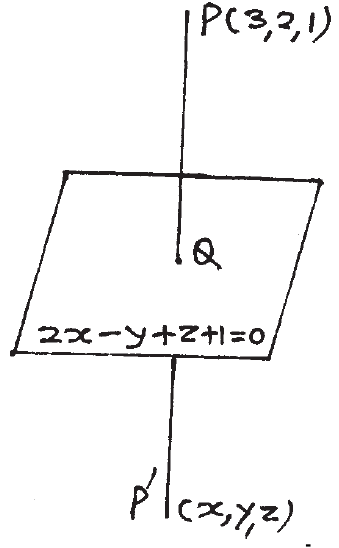 Let Q be the foot of perpendicular from P to the plane
$\therefore\text{Equation of PQ is }\frac{\text{x - 3}}{2}=\frac{\text{y - 2}}{-1}=\frac{\text{z - 1}}{1}$
Any point on this line is $(2\lambda+3,-\lambda+2,\lambda+1)$
If this point is Q, then it must satisfy the equation of plane
$\therefore2(2\lambda+3)-(-\lambda+2)+(\lambda+1)+1=0$
$\Rightarrow\lambda=-1$
$\therefore$ coordinates of foot of perpendiculare are Q (1, 3, 0)
Perpendicular distance = PQ = $\sqrt{4+1+1}=\sqrt{6}\text{ units}$
Let P' (x, y, z) be the image, then $\frac{\text{x + 3}}{2}=1,\frac{\text{y + 2}}{2}=3, \frac{\text{z + 1}}{2}=0$
$\therefore \text{P' is }(-1, 4, -1)$. View full question & answer→Question 2315 Marks
Find the vector equation of the plane passing through the point (3, 4, 2) and (7, 0, 6) and perpendicular to the plane 2x - 5y - 15 = 0. Also, show that the plane thus obtaines contains the line
AnswerLet the equation of the plane be $\frac{\text{x}}{\text{a}}+\frac{\text{y}}{\text{b}}+\frac{\text{z}}{\text{c}}=1\ ...(\text{i})$
Plane is passing through (3, 4, 2) and (7, 0, 6)
$\frac{3}{\text{a}}+\frac{4}{\text{b}}+\frac{2}{\text{c}}=1$
$\frac{7}{\text{a}}+\frac{0}{\text{b}}+\frac{6}{\text{c}}=1$
Required plane is perpendicular to 2x - 5y - 15 = 0
$\frac{2}{\text{a}}+\frac{-5}{\text{b}}+\frac{0}{\text{c}}=0$
$\Rightarrow2\text{b}=5\text{a}$
$\therefore\text{ b}=2.5\text{a}$
$\frac{3}{\text{a}}+\frac{4}{\text{2.5a}}+\frac{2}{\text{c}}=1$
$\frac{7}{\text{a}}+\frac{6}{\text{b}}=1$
Solving the above 2 equations,
$\text{a}=3.4=\frac{17}{5},\text{ b}=8.5=\frac{17}{2}$ and $\text{c}=\frac{-34}{6}=-\frac{17}{3}$
Substituting the values in (i)
$\frac{\text{x}}{\frac{17}{5}}+\frac{\text{y}}{\frac{17}{2}}+\frac{\text{z}}{-\frac{17}{3}}=1$
$\Rightarrow\frac{5\text{x}}{17}+\frac{2\text{y}}{17}-\frac{3\text{z}}{17}=1$
$\Rightarrow2\text{x}+2\text{y}-3\text{z}=17$
$\Rightarrow(\text{x}\hat{\text{i}}+\text{y}\hat{\text{j}}+\text{z}\hat{\text{k}})\cdot(5\hat{\text{i}}+2\hat{\text{j}}-3\hat{\text{k}})=17$
$\Rightarrow\vec{\text{r}}\cdot(5\hat{\text{i}}+2\hat{\text{j}}-3\hat{\text{k}})=17$
Vector equation of the plane is $\vec{\text{r}}\cdot(5\hat{\text{i}}+2\hat{\text{j}}-3\hat{\text{k}})=17$
The line passes through B(1, 3, -2)
5(1) + 2(3) - 3(-2) = 17
The point B lies on the plane.
$\therefore$ The line $\vec{\text{r}}=\hat{\text{i}}+3\hat{\text{j}}-2\hat{\text{k}}+\lambda(\hat{\text{i}}-\hat{\text{j}}+\hat{\text{k}})$ lies on the plane $\vec{\text{r}}\cdot(5\hat{\text{i}}+2\hat{\text{j}}-3\hat{\text{k}})=17$
View full question & answer→Question 2325 Marks
Find the shortest distance between the following pairs of lines whose cartesian equation are:
$\frac{\text{x}-1}{2}=\frac{\text{y}-2}{3}=\frac{\text{z}-3}{4}$ and $\frac{\text{x}-2}{3}=\frac{\text{y}-3}{4}=\frac{\text{z}-5}{5}$
AnswerThe equation of the given are
$\frac{\text{x}-1}{2}=\frac{\text{y}-2}{3}=\frac{\text{z}-3}{4}\dots(1)$
$\frac{\text{x}-2}{3}=\frac{\text{y}-3}{4}=\frac{\text{z}-5}{5}\dots(2)$
Since line (1) passes through the point (1, 2, 3) and has direction ratios proportional to 2, 3, 4, its vector equation is
$\vec{\text{r}}=\vec{\text{a}}_1+\lambda\vec{\text{b}}_1$
Here,
$\vec{\text{a}}_1=\hat{\text{i}}+2\hat{\text{j}}+3\hat{\text{k}}$
$\vec{\text{b}}_1=2\hat{\text{i}}+3\hat{\text{j}}+4\hat{\text{k}}$
Also, line (2) passes through the point (2, 3, 5) and has direction ratios proportional to 3, 4, 5.
Its vector equation is
$\vec{\text{a}}_2-\vec{\text{a}}_1=\hat{\text{i}}+\hat{\text{j}}+2\hat{\text{k}}$
and $\vec{\text{b}}_1\times\vec{\text{b}}_2=\begin{vmatrix}\hat{\text{i}}&\hat{\text{j}}&\hat{\text{k}}\\2&3&4\\3&4&5\end{vmatrix}$
$=-\hat{\text{i}}+2\hat{\text{j}}+\hat{\text{k}}$
$\Rightarrow\big|\vec{\text{b}}_1\times\vec{\text{b}}_2\Big|=\sqrt{(-1)^2+2^2+(-1)^2}$
$=\sqrt{1+4+1}$
$=\sqrt{6}$
and $\big(\vec{\text{a}}_2-\vec{\text{a}}_1\big).\big(\vec{\text{b}}_1\times\vec{\text{b}}_2\big)=\big(\hat{\text{i}}+\hat{\text{j}}+2\hat{\text{k}}\big).\big(-\hat{\text{i}}+2\hat{\text{j}}-\hat{\text{k}}\big)$
$=-1+2-2$
$=-1$
Now,
The shortest distance between the lines $\vec{\text{r}}=\vec{\text{a}}_1+\lambda\vec{\text{b}}_1$ and $\vec{\text{r}}=\vec{\text{a}}_2+\mu\vec{\text{b}}_2$ is given by
$\text{d}=\Bigg|\frac{\big(\vec{\text{a}}_2-\vec{\text{a}}_1\big).\big(\vec{\text{b}}_1\times\vec{\text{b}}_2\big)}{\big|\vec{\text{b}}_1\times\vec{\text{b}}_2\big|}\Bigg|$
$=\Big|\frac{-1}{\sqrt{6}}\Big|$
$=\frac{1}{\sqrt{6}}$
View full question & answer→Question 2335 Marks
By computing the shortest distance determine whether the following pairs of lines intersect or not:
$\vec{\text{r}}=\big(\hat{\text{i}}+\hat{\text{j}}-\hat{\text{k}}\big)+\lambda\big(3\hat{\text{i}}-\hat{\text{j}}\big)$ and $\vec{\text{r}}=\big(4\hat{\text{i}}-\hat{\text{k}}\big)+\mu\big(2\hat{\text{i}}+3\hat{\text{k}}\big)$
AnswerGiven equations of lines are,
$\vec{\text{r}}=\big(\hat{\text{i}}+\hat{\text{j}}-\hat{\text{k}}\big)+\lambda\big(3\hat{\text{i}}-\hat{\text{j}}\big)$
$\Rightarrow\vec{\text{a}}_1=\big(\hat{\text{i}}+\hat{\text{j}}-\hat{\text{k}}\big),\vec{\text{b}}_1=\big(3\hat{\text{i}}-\hat{\text{j}}\big)$
and, $\vec{\text{r}}=\big(4\hat{\text{i}}-\hat{\text{k}}\big)+\mu\big(2\hat{\text{i}}+3\hat{\text{k}}\big)$
$\Rightarrow\vec{\text{a}}_2=\big(4\hat{\text{i}}-\hat{\text{k}}\big),\vec{\text{b}}_2=\big(2\hat{\text{i}}+3\hat{\text{k}}\big)$
We know that, shortest distance between lines $\vec{\text{r}}=\vec{\text{a}}_1+\lambda\vec{\text{b}}_1$ and $\vec{\text{r}}=\vec{\text{a}}_2+\lambda\vec{\text{b}}_2$ is given by
$\text{S.D.}=\Bigg|\frac{\big(\vec{\text{a}}_2-\vec{\text{a}}_1\big).\big(\vec{\text{b}}_1\times\vec{\text{b}}_2\big)}{\big|\vec{\text{b}}_1\times\vec{\text{b}}_2\big|}\Bigg|\dots(1)$
$\big(\vec{\text{a}}_2-\vec{\text{a}}_1\big)=\big(4\hat{\text{i}}-\hat{\text{k}}\big)-\big(\hat{\text{i}}+\hat{\text{j}}-\hat{\text{k}}\big)$
$=4\hat{\text{i}}-\hat{\text{k}}-\hat{\text{i}}-\hat{\text{j}}+\hat{\text{k}}$
$=3\hat{\text{i}}-\hat{\text{j}}$
$\vec{\text{b}}_1\times\vec{\text{b}}_2=\begin{vmatrix}\hat{\text{i}}&\hat{\text{j}}&\hat{\text{k}}\\3&-1&0\\2&0&3 \end{vmatrix}$
$=\hat{\text{i}}(-3-0)-\hat{\text{j}}(9-0)+\hat{\text{k}}(0+2)$
$=-3\hat{\text{i}}-9\hat{\text{j}}+2\hat{\text{k}}$
$\big|\vec{\text{b}}_1\times\vec{\text{b}}_2\big|=\sqrt{(-3)^2+(-9)^2+(2)^2}$
$\big|\vec{\text{b}}_1\times\vec{\text{b}}_2\big|=\sqrt{9+81+4}$
$=\sqrt{94}$
$\big(\vec{\text{a}}_2-\vec{\text{a}}_1\big).\big(\vec{\text{b}}_1\times\vec{\text{b}}_2\big)=\big(3\hat{\text{i}}-\hat{\text{j}}\big)\big(-3\hat{\text{i}}-9\hat{\text{j}}+2\hat{\text{k}}\big)$
$=(3)(-3)+(-1)(-9)+(0)(2)$
$=-9+9+0$
$=0$
Using $\big(\vec{\text{a}}_2-\vec{\text{a}}_1\big).\big(\vec{\text{b}}_1\times\vec{\text{b}}_2\big)$ and $\big|\vec{\text{b}}_1\times\vec{\text{b}}_2\big|$ in equation (1) to get shortest distance between given lines, so
$\text{S.D.}=\Big|\frac{0}{\sqrt{94}}\Big|$
$\text{S.D.}=0$
Since, shortest distance between the given lines is not zero, so lines are intersecting.
View full question & answer→Question 2345 Marks
Find the shortest distance between the following pairs of lines whose vector equation are:
$\vec{\text{r}}=\big(\hat{\text{i}}+\hat{\text{j}}\big)+\lambda\big(2\hat{\text{i}}-\hat{\text{j}}+\hat{\text{k}}\big)$ and $\vec{\text{r}}=2\hat{\text{i}}+\hat{\text{j}}-\hat{\text{k}}+\mu\big(3\hat{\text{i}}-5\hat{\text{j}}+2\hat{\text{k}}\big)$
Answer$\vec{\text{r}}=\big(\hat{\text{i}}+\hat{\text{j}}\big)+\lambda\big(2\hat{\text{i}}-\hat{\text{j}}+\hat{\text{k}}\big)$ and $\vec{\text{r}}=2\hat{\text{i}}+\hat{\text{j}}-\hat{\text{k}}+\mu\big(3\hat{\text{i}}-5\hat{\text{j}}+2\hat{\text{k}}\big)$
Comparing the given equations with the equations $\vec{\text{r}}=\vec{\text{a}}_1+\lambda\vec{\text{b}}_1$ and $\vec{\text{r}}=\vec{\text{a}}_2+\mu\vec{\text{b}}_2,$ we get
$\vec{\text{a}}_1=\hat{\text{i}}+\hat{\text{j}}$
$\vec{\text{a}}_2=2\hat{\text{i}}+\hat{\text{j}}-\hat{\text{k}}$
$\vec{\text{b}}_1=2\hat{\text{i}}-\hat{\text{j}}+\hat{\text{k}}$
$\vec{\text{b}}_2=3\hat{\text{i}}-5\hat{\text{j}}+2\hat{\text{k}}$
$\therefore\vec{\text{a}}_2-\vec{\text{a}}_1=\hat{\text{i}}-\hat{\text{k}}$
and $\vec{\text{b}}_1\times\vec{\text{b}}_2=\begin{vmatrix}\hat{\text{i}}&\hat{\text{j}}&\hat{\text{k}}\\2&-1&1\\3&-5&2\end{vmatrix}$
$=3\hat{\text{i}}-\hat{\text{j}}-7\hat{\text{k}}$
$\Rightarrow\big|\vec{\text{b}}_1\times\vec{\text{b}}_2\big|=\sqrt{3^2+(-1)^2+(-7)^2}{}$
$=\sqrt{9+1+49}$
$=\sqrt{59}$
$\big(\vec{\text{a}}_2-\vec{\text{a}}_1\big).\big(\vec{\text{b}}_1\times\vec{\text{b}}_2\big)=\big(\hat{\text{i}}-\hat{\text{k}}\big).\big(3\hat{\text{i}}-\hat{\text{j}}-7\hat{\text{k}}\big)$
$=3+7$
$=10$
The shaortest distance between the lines $\vec{\text{r}}=\vec{\text{a}}_1+\lambda\vec{\text{b}}_1$ and $\vec{\text{r}}=\vec{\text{a}}_2+\mu\vec{\text{b}}_2$ is given by
$\text{d}=\Bigg|\frac{\big(\vec{\text{a}}_2-\vec{\text{a}}_1\big).\big(\vec{\text{b}}_1\times\vec{\text{b}}_2\big)}{\big|\vec{\text{b}}_1\times\vec{\text{b}}_2\big|}\Bigg|$
$=\Big|\frac{10}{\sqrt{59}}\Big|$
$=\frac{10}{\sqrt{59}}$
View full question & answer→Question 2355 Marks
Find the equation of the plane passing through the point (-1, 3, 2) and perpendicular to each of the planes $\text{x + 2y +3z = 5 and 3x + 3y + z} = 0$
Answer$\text{Let} \overrightarrow{a} = -\hat{\text{i}} + 3\hat{\text{j}} + 2\hat{\text{k}}$
Plane is perpendicular to the planes $\text{x + 2y + 3z = 5 and 3x + 3y + z = 0} $
$\therefore \text{normal to the plane is} \bigg( \hat{\text{i}} + 2\hat{\text{j}} + 3\hat{\text{k}}\bigg) \times \bigg(3{\text{i}} + 3\hat{\text j} + \hat{\text{k}}\bigg )$
$ = -7\hat{\text{i}} + 8\hat{\text{j}} - 3\hat{\text{k}}\text{ or } 7\hat{\text{i}} - 8\hat{\text{j}} + 3\hat{\text{k}}$
$\therefore \text{Equation of plane is}$
$\overrightarrow{r}. \bigg(7\hat{\text{i}} - 8\hat{\text{j}} + 3\hat{\text{k}}\bigg) = \bigg( \hat{\text{-i}} + 3\hat{\text{j}} + 2\hat{\text{k}}\bigg). \bigg(7\hat{\text{i}} - 8\hat{\text{j}} + 3\hat{\text{k}}\bigg) =- 25$
$\text{or 7x - 8y + 3z + 25 = 0}$
View full question & answer→Question 2365 Marks
Find the length and the foot ofo perpendicular from the point $\Big(1,\frac{3}{2},2\Big)$ to the plane 2x - 2y + 4z + 5 = 0
AnswerLet M be the foot of the perpendicular from $\text{P}\Big(1,\frac{3}{2},2\Big)$ on the plane 2x - 2y + 4z + 5 = 0
Then, PM is the normal to the plane. So, its directions rations are proportional to 2, -2, 4.
Since PM passes through $\text{P}\Big(1,\frac{3}{2},2\Big)$, therefore, its equation is
$\frac{\text{x}-1}{2}=\frac{\text{y}-\frac{3}{2}}{-2}=\frac{\text{z}-2}{4}=\lambda\text{ (say)}$
Let the coordinates of M be $\Big(2\lambda+1,-2\lambda+\frac{3}{2},4\lambda+2\Big).$
Now, M lies on the plane 2x - 2y + 4z + 5 = 0.
$\therefore\ 2(2\lambda+1)-2\Big(-2\lambda+\frac{3}{2}\Big)+4(4\lambda+2)+5=0$
$\Rightarrow 24\lambda+12=0$
$\Rightarrow \lambda=-\frac{1}{2}$
So, the coordinates of M are $\Big(2\times\Big(-\frac{1}{2}\big)+1,-2\times\Big(-\frac{1}{2}\Big)+\frac{3}{2},4\times\Big(-\frac{1}{2}\Big)+2\Big)$ or $\Big(0,\frac{5}{2},0\Big)$
Thus, the coordinates of the foot of the perpendicular are $\Big(0,\frac{5}{2},0\Big).$
Now,
$\text{PM}=\sqrt{(1-0)^2+\Big(\frac{3}{2}-\frac{5}{2}\Big)^2+(2-0)^2}$
$=\sqrt{1+1+4}$
$=\sqrt{6}$
Thus, the length of the perpendicular from the given point to the plane is $\sqrt{6}$ units.
View full question & answer→Question 2375 Marks
If lines $\frac{x - 1}{2} = \frac{y + 1}{3} = \frac{z - 1}{4} \text{and} \frac{x - 3}{1} = \frac{y - k}{2} = \frac{z}{1}$ intersect, then find the value of k and hence find the equation of the plane containing these lines.
AnswerAny point on line $\frac{\text{x} - 1}{2} = \frac{\text{y} + 1}{3} = \frac{\text{z} - 1}{4} \text{is} ( 2\lambda + 1, 3\lambda - 1, 4\lambda + 1)$
$\therefore \frac{2\lambda + 1 - 3}{1} = \frac{3\lambda - 1 - \text{k}}{2} = \frac{4\lambda + 1}{1} \Rightarrow \lambda = -\frac{3}{2}, \text{hence k} = \frac{9}{2}$
Eqn. of plane containing three lines is
$\begin{vmatrix} \text{x - 1} & \text{y + 1} & \text{z - 1} \\ 2 & 3 & 4 \\ 1 & 2 & 1 \end{vmatrix} = 0 $
$\Rightarrow \text{-5 ( x - 1) + 2 (y + 1) + 1 (z - 1) = 0}$
$\text{i.e 5x - 2y - z - 6 = 0}$
View full question & answer→Question 2385 Marks
Find the position vector of the foot of perpendicular and the perpendicular distance from the point P with position vector $2\hat{i} + 3\hat{j} + 4\hat{k}$ to the plane $\overrightarrow{\text{r}}. (2\hat{i} + \hat{j} + 3\hat{k}) - 26 = 0.$ Also find image of P in the plane.
AnswerLine through ‘P’ and perpendicular to plane is:
$\overrightarrow{\text{r}} = (2\hat{\text{i}} + 3\hat{\text{j}} + 4\hat{\text{k}}) + \lambda(2\hat{\text{i}} + \hat{\text{j}} + 3\hat{\text{k}})$
General point on line is: $\overrightarrow{\text{r}} = (2 + 2\lambda) \hat{\text{i}} + (3 + \lambda) \hat{\text{j}} + (4 + 3\lambda) \hat{\text{k}}$
For some $\lambda \in \text{R}, \overrightarrow{\text{r}}$ is the foot of perpendicular, say Q, from P to the plane, since it lies on plane
$\therefore[(2 + 2\lambda)\text{i} + (3 +\lambda) \hat{\text{j}} + (4 + 3\lambda) \hat{\text{k}}]. (2\hat{\text{i}} + \hat{\text{j}} + 3\hat{\text{k}}) - 26 = 0$
$\Rightarrow 4 + 4\lambda + 3 + \lambda + 12 + 9\lambda - 26 = 0 \Rightarrow \lambda = \frac{1}{2}$
$\therefore$ Foot of perpendicular is Q $\bigg(3\hat{\text{i}} + \frac{7}{2}\hat{\text{j}} + \frac{11}{2}\hat{\text{k}}\bigg)$
let P' $(\text{a}\hat{\text{i}} + \text{b}\hat{\text{j}} + \text{c}\hat{\text{k}})$ be the image of P in the plane Q is mid point of PP'
$\therefore \text{Q}\bigg(\frac{\text{a} + 2}{2}\hat{\text{i}} + \frac{\text{b + 3}}{2}\hat{\text{j}} + \frac{\text{c + 4}}{2}\hat{\text{k}}\bigg) = \text{Q}\bigg(3\hat{\text{i}} + \frac{7}{2} \hat{\text{j}} + \frac{11}{2}\hat{\text{k}}\bigg) $
$\Rightarrow\frac{\text{a + 2}}{2} = 3, \frac{\text{b + 3}}{2} = \frac{7}{2}, \frac{\text{c + 4}}{2} = \frac{11}{2}\Rightarrow\text{a = 4, b = 4, c = 7}\therefore\text{P'} (4\hat{\text{i}} + 4\hat{\text{j}} + 7\hat{\text{k}})$
Perpendicular distance of P from plane = $\text{PQ} =\sqrt{(2 - 3)^{2} + \bigg(3 - \frac{7}{2}\bigg)^{2} + \bigg(4 - \frac{11}{2}\bigg)^{2}} = \sqrt\frac{7}{2}$
View full question & answer→Question 2395 Marks
Find the shortest distance between the following pairs of lines whose vector equation are:
$\vec{\text{r}}=(\lambda-1)\hat{\text{i}}+(\lambda+1)\hat{\text{j}}-(1+\lambda)\hat{\text{k}}$ and $\vec{\text{r}}=(1-\mu)\hat{\text{i}}+(2\mu-1)\hat{\text{j}}+(\mu+2)\hat{\text{k}}$
Answer$\vec{\text{r}}=(\lambda-1)\hat{\text{i}}+(\lambda+1)\hat{\text{j}}-(1+\lambda)\hat{\text{k}}$ and $\vec{\text{r}}=(1-\mu)\hat{\text{i}}+(2\mu-1)\hat{\text{j}}+(\mu+2)\hat{\text{k}}$
The vector equation of the given lines can be re-written as
$\vec{\text{r}}=-\hat{\text{i}}+\hat{\text{j}}-\hat{\text{k}}+\lambda\big(\hat{\text{i}}+\hat{\text{j}}-\hat{\text{k}}\big)$ and $\vec{\text{r}}=\hat{\text{i}}-\hat{\text{j}}+2\hat{\text{k}}+\mu\big(-\hat{\text{i}}+2\hat{\text{j}}+\hat{\text{k}}\big)$
Comparing the given equation with the equations $\vec{\text{r}}=\vec{\text{a}}_1+\lambda\vec{\text{b}}_1$ and $\vec{\text{r}}=\vec{\text{a}}_2+\mu\vec{\text{b}}_2$ we get
$\vec{\text{a}}_1=-\hat{\text{i}}+\hat{\text{j}}-\hat{\text{k}}$
$\vec{\text{a}}_2=\hat{\text{i}}-\hat{\text{j}}+2\hat{\text{k}}$
$\vec{\text{b}}_1=\hat{\text{i}}+\hat{\text{j}}-\hat{\text{k}}$
$\vec{\text{b}}_2=-\hat{\text{i}}+2\hat{\text{j}}+\hat{\text{k}}$
$\therefore\vec{\text{a}}_2-\vec{\text{a}}_1=2\hat{\text{i}}-2\hat{\text{j}}+3\hat{\text{k}}$
and $\vec{\text{b}}_1\times\vec{\text{b}}_2=\begin{vmatrix}\hat{\text{i}}&\hat{\text{J}}&\hat{\text{k}}\\1&1&-1\\-1&2&1 \end{vmatrix}$
$=3\hat{\text{i}}+3\hat{\text{k}}$
$\Rightarrow\big|\vec{\text{b}}_1\times\vec{\text{b}}_2\big|=\sqrt{3^2+3^2}$
$=\sqrt{9+9}$
$=3\sqrt{2}$
$\big(\vec{\text{a}}_2-\vec{\text{a}}_1\big).\big(\vec{\text{b}}_1\times\vec{\text{b}}_2\big)=\big(2\hat{\text{i}}-2\hat{\text{j}}+3\hat{\text{k}}\big).\big(3\hat{\text{i}}+3\hat{\text{k}}\big)$
$=6+9$
$=15$
The shoetest distance between the line $\vec{\text{r}}=\vec{\text{a}}_1+\lambda\vec{\text{b}}_1$ and $\vec{\text{r}}=\vec{\text{a}}_2+\mu\vec{\text{b}}_2$ is given by
$\text{d}=\Bigg|\frac{\big(\vec{\text{a}}_2-\vec{\text{a}}_1\big).\big(\vec{\text{b}}_1\times\vec{\text{b}}_2\big)}{\big|\vec{\text{b}}_1\times\vec{\text{b}}_2\big|}\Bigg|$
$=\Big|\frac{15}{3\sqrt{2}}\Big|$
$=\frac{5}{\sqrt{2}}$
View full question & answer→Question 2405 Marks
Find the equation of the plane through the line of intersection of the planes $\vec{\text{r}}\cdot(\hat{\text{i}}+3\hat{\text{j}})+6=0$ and $\vec{\text{r}}\cdot(3\hat{\text{i}}-\hat{\text{j}}-4\hat{\text{k}})=0,$ which is at a unit distance from the origin.
AnswerThe equation of the plane passing through the line intersection of the given planes is,
$\vec{\text{r}}\cdot(\hat{\text{i}}+3\hat{\text{j}})+6+\lambda\big(\vec{\text{r}}\cdot(3\hat{\text{i}}-\hat{\text{j}}-4\hat{\text{k}})\big)$
$\vec{\text{r}}\cdot\Big[(1+3\lambda)\hat{\text{i}}+(3-\lambda)\hat{\text{j}}-4\lambda\hat{\text{k}}\Big]+6=0\ ...(\text{i})$
$\vec{\text{r}}\cdot\Big[(1+3\lambda)\hat{\text{i}}+(3-\lambda)\hat{\text{j}}-4\lambda\hat{\text{k}}\Big]=-6$
$\vec{\text{r}}\cdot\Big[(-1-3\lambda)\hat{\text{i}}+(\lambda-3)\hat{\text{j}}-4\lambda\hat{\text{k}}\Big]=6$
Dividing both sides by $\sqrt{(-1-3\lambda^2)+(\lambda-3)^2+16\lambda^2},$ we get
$\vec{\text{r}}\cdot\frac{\Big[-1-3\lambda)\hat{\text{i}}+(\lambda-3)\hat{\text{j}}-4\lambda\hat{\text{k}}\Big]}{\sqrt{(-1-3\lambda^2)+(\lambda-3)^2+16\lambda^2}}=\frac{6}{\sqrt{(-1-3\lambda^2)+(\lambda-3)^2+16\lambda^2}}$
Which is the normal form of plane (i), where
The perpendicular distance of plane (i) from the origin
$=\frac{6}{\sqrt{(-1-3\lambda^2)+(\lambda-3)^2+16\lambda^2}}$
$\Rightarrow1=\frac{6}{\sqrt{(-1-3\lambda^2)+(\lambda-3)^2+16\lambda^2}}\text{ (Given})$
$\Rightarrow\sqrt{(-1-3\lambda^2)+(\lambda-3)^2+16\lambda^2}=6$
$\Rightarrow1+9\lambda^2+6\lambda+\lambda^2+9-6\lambda+16\lambda^2=36$
$\Rightarrow26\lambda^2-26=0$
$\Rightarrow\lambda^2=1$
$\Rightarrow\lambda=1,-1$
Case 1: Substituting $\lambda=1$ in (i) we get
$\vec{\text{r}}\cdot\Big[4\hat{\text{i}}+2\hat{\text{j}}-4\hat{\text{k}}\Big]+6=0$
Case 2: Substituting $\lambda=-1$ in (i) we get
$\vec{\text{r}}\cdot\Big[-2\hat{\text{i}}+4\hat{\text{j}}+4\hat{\text{k}}\Big]+6=0$
View full question & answer→Question 2415 Marks
By computing the shortest distance determine whether the following pairs of lines intersect or not:3
$\frac{\text{x}-5}{4}=\frac{\text{y}-7}{-5}=\frac{\text{z}+3}{-5}$ and $\frac{\text{x}-8}{7}=\frac{\text{y}-7}{1}=\frac{\text{z}-5}{3}$
AnswerGiven lines are ,
$\frac{\text{x}-5}{4}=\frac{\text{y}-7}{-5}=\frac{\text{z}+3}{-5}=\lambda$ (say)
$\Rightarrow\text{x}=4\lambda+5,\text{y}=-5\lambda+7,\text{z}=-5\lambda-3$
$\Rightarrow\vec{\text{r}}=\text{x}\hat{\text{i}}+\text{y}\hat{\text{j}}+\text{z}\hat{\text{k}}$
$=(4\lambda+5)\hat{\text{i}}+(-5\lambda+7)\hat{\text{j}}+(-5\lambda-3)\hat{\text{k}}$
$\vec{\text{r}}=\big(5\hat{\text{i}}+7\hat{\text{j}}-3\hat{\text{k}}\big)+\lambda\big(4\hat{\text{i}}-5\hat{\text{j}}-5\hat{\text{k}}\big)$
$\Rightarrow\vec{\text{a}}_1=\big(5\hat{\text{i}}+7\hat{\text{j}}-3\hat{\text{k}}\big),\vec{\text{b}}_1=\big(4\hat{\text{i}}-5\hat{\text{j}}-5\hat{\text{k}}\big)$
and, $\frac{\text{x}-8}{7}=\frac{\text{y}-7}{1}=\frac{\text{z}-5}{3}=\mu$ (say)
$\Rightarrow\text{x}=7\mu+8,\text{y}=\mu+7,3\mu+5$
$\Rightarrow\vec{\text{r}}=\text{x}\hat{\text{i}}+\text{y}\hat{\text{j}}+\text{z}\hat{\text{k}}$
$=(7\mu+8)\hat{\text{i}}+(\mu+7)\hat{\text{j}}+(3\mu+5)\hat{\text{k}}$
$\vec{\text{r}}=\big(8\hat{\text{i}}+7\hat{\text{j}}+5\hat{\text{k}}\big)+\mu\big(7\hat{\text{i}}+\hat{\text{j}}+3\hat{\text{k}}\big)$
$\Rightarrow\vec{\text{a}}=\big(8\hat{\text{i}}+7\hat{\text{j}}+5\hat{\text{k}}\big),\vec{\text{b}}_2=\big(7\hat{\text{i}}+\hat{\text{j}}+3\hat{\text{k}}\big)$
we know that, shortest distance between lines $\vec{\text{r}}=\vec{\text{a}}_1+\lambda\vec{\text{b}}_1$ and $\vec{\text{r}}=\vec{\text{a}}_2+\lambda\vec{\text{b}}_2$ is given by
$\text{S.D.}=\Bigg|\frac{\big(\vec{\text{a}}_2-\vec{\text{a}}_1\big).\big(\vec{\text{b}}_1\times\vec{\text{b}}_2\big)}{\big|\vec{\text{b}}_1\times\vec{\text{b}}_2\big|}\Bigg|\dots(1)$
$\big(\vec{\text{a}}_2-\vec{\text{a}}_1\big)=\big(8\hat{\text{i}}+7\hat{\text{j}}+5\hat{\text{k}}\big)-\big(5\hat{\text{i}}+7\hat{\text{j}}-3\hat{\text{k}}\big)$
$=8\hat{\text{i}}+7\hat{\text{j}}+5\hat{\text{k}}-5\hat{\text{i}}-7\hat{\text{j}}+3\hat{\text{k}}$
$=3\hat{\text{i}}+8\hat{\text{k}}$
$\vec{\text{b}}_1\times\vec{\text{b}}_2=\begin{vmatrix}\hat{\text{i}}&\hat{\text{j}}&\hat{\text{k}}\\4&-5&-5\\7&1&3 \end{vmatrix}$
$=\hat{\text{i}}(-15+5)-\hat{\text{j}}(12+35)+\hat{\text{k}}(4+35)$
$=-10\hat{\text{i}}-47\hat{\text{j}}+39\hat{\text{k}}$
$\big(\vec{\text{a}}_2-\vec{\text{a}}_1\big)\big(\vec{\text{b}}_1\times\vec{\text{b}}_2\big)=\big(3\hat{\text{i}}+8\hat{\text{k}}\big)\big(-10\hat{\text{i}}-47\hat{\text{j}}+39\hat{\text{k}}\big)$
$=(3)(-10)+(0)(-4)+(8)(39)$
$=-30+312$
$=282$
Using equation (1) to get the shortest distance between the given lines, so
$\text{S.D.}=\Bigg|\frac{282}{\big|\vec{\text{b}}_1\times\vec{\text{b}}_2\big|}\Bigg|$
$\text{S.D.}\neq0$
Since, the shortest distance between given lines is not equal to zero, so Given lines are not intersecting.
View full question & answer→Question 2425 Marks
Find the equatoion of the plane passing through the points $(2, 2, 1)$ and $(9, 3, 6)$ and perpendicular to the plane $2x + 6y + 6z = 1.$
AnswerWe know that, equation of plane passing through the point $(x_1, y_1, z_1)$ is given by,
$a(x - x_1) + b(y - y_1) + c(z - z_1) = 0$
Here, the plane is pasing through $(2, 2, 1)$
$a(x - 2) + b(y - 2) + c(z - 1) = 0 ....(i)$
It is also passing through (9, 3, 6), so it must satisfy the equation (i),
$a(9 - 2) + b(3 - 2) + c(6 - 1) = 0$
$7a + b + 5c = 0 ....(ii)$
We know that, plane $a_1x + b_1y + c_1z + d_1 = 0 $ and $a_2x + b_2y + c_2z + d_2 = 0$ are perpendicular if
$a_1a_2 + b_1b_2 + c_1c_2= 0 ....(iii)$
Given that, plane (i) is perpendicular to plane
$2x + 6y + 6z = 1 ....(iv)$
Using plane (i), (iv) in equation (iii),
$a_1a_2 + b_1b_2 + c_1c_2= 0$
$(a)(2) + (b)(6) + (c)(6) = 0$
$2a + 6b + 6c = 0 ....(v)$
Solving (ii) and (v) by cross-multiplication,
$\frac{\text{a}}{(1)(6)-(5)(6)}=\frac{\text{b}}{(2)(5)-(7)(6)}=\frac{\text{c}}{(7)(6)-(2)(1)}$
$\frac{\text{a}}{6-30}=\frac{\text{b}}{10-42}=\frac{\text{c}}{42-2}$
$\frac{\text{a}}{-24}=\frac{\text{b}}{-32}=\frac{\text{c}}{40}=\lambda(\text{say})$
$\text{a}=-24\lambda,\text{b}=-32\lambda,\text{c}=40\lambda$
Put a, b, c in equation (i),
$\text{a}(\text{x}-2)+\text{b}(\text{y}-2)+\text{c}(\text{z}-1)=0$
$(-24\lambda)(\text{x}-2)+(-32\lambda)(\text{y}-2)+(40\lambda)(\text{z}-1)=0$
$-24\lambda\text{x}+48\lambda-32\lambda\text{y}+64\lambda+40\lambda\text{z}-40\lambda=0$
$-24\lambda\text{x}-32\lambda\text{y}+40\lambda\text{z}+72\lambda=0$
Dividing by $(-8\lambda),$
$3x + 4y - 5z - 9 = 0$
Equation of required plane is,
$3x + 4y - 5z = 9$
View full question & answer→Question 2435 Marks
Write the vector equation of the following lines and hence determine the distance between them $\frac{\text{x}-1}{2}=\frac{\text{y}-2}{3}=\frac{\text{z}+4}{6}$ and $\frac{\text{x}-3}{4}=\frac{\text{y}-3}{6}=\frac{\text{z}+5}{12}$
AnswerWe have
$\frac{\text{x}-1}{2}=\frac{\text{y}-2}{3}=\frac{\text{z}+4}{6}$
$\frac{\text{x}-3}{4}=\frac{\text{y}-3}{6}=\frac{\text{z}+5}{12}$
Since the first line passes line passes through the point (1, 2, -4) and has direction ratios proportional to 2, 3, 6, its vector equation is
$\vec{\text{r}}=\vec{\text{a}}_1+\lambda\vec{\text{b}}_1\dots(1)$
$\Rightarrow\vec{\text{r}}=\hat{\text{i}}+2\hat{\text{j}}+\lambda\big(2\hat{\text{i}}+3\hat{\text{j}}+6\hat{\text{k}}\big)$
Also, the second line passes through the point (3, 3, -5) and has directional to 4, 6, 12.
Its vector equation is
$\vec{\text{r}}=\vec{\text{a}}_2+\mu\vec{\text{b}}_2\dots(2)$
$\Rightarrow\vec{\text{r}}=3\hat{\text{i}}+3\hat{\text{j}}-5\hat{\text{k}}+\mu\big(4\hat{\text{i}}+6\hat{\text{j}}+12\hat{\text{k}}\big)$
$\Rightarrow\vec{\text{r}}=3\hat{\text{i}}+3\hat{\text{j}}-5\hat{\text{k}}+2\mu\big(2\hat{\text{i}}+3\hat{\text{j}}+6\hat{\text{k}}\big)$
These two lines pass through the points having position vectors
$\vec{\text{a}}_1=\hat{\text{i}}+2\hat{\text{j}}-4\hat{\text{k}}$ and $\vec{\text{a}}_2=3\hat{\text{i}}+3\hat{\text{j}}-5\hat{\text{k}}$ and are parallel to the vector $\vec{\text{b}}=2\hat{\text{i}}+3\hat{\text{j}}+6\hat{\text{k}}.$
Now,
$\vec{\text{a}}_2-\vec{\text{a}}_1=2\hat{\text{i}}+\hat{\text{j}}-\hat{\text{k}}$
and
$\big(\vec{\text{a}}_2-\vec{\text{a}}_1\big)\times\vec{\text{b}}=\big(2\hat{\text{i}}+\hat{\text{j}}-\hat{\text{k}}\big)\times\big(2\hat{\text{i}}+3\hat{\text{j}}+6\hat{\text{k}}\big)$
$=\begin{vmatrix}\hat{\text{i}}&\hat{\text{j}}&\hat{\text{k}}\\2&1&-1\\2&3&6 \end{vmatrix}$
$=9\hat{\text{i}}-14\hat{\text{j}}+4\hat{\text{k}}$
$\Rightarrow\big|\big(\vec{\text{a}}_2-\vec{\text{a}}_1\big)\times\vec{\text{b}}\big|=\sqrt{9^2+(-14)^2+4^2}$
$=\sqrt{81+196+16}$
$=\sqrt{293}$
and $\big|\vec{\text{b}}\big|=\sqrt{2^2+3^2+6^2}$
$=\sqrt{4+9+36}$
$=7$
The shortest distance between the two lines is given by
$\frac{\big|\big(\vec{\text{a}}_2-\vec{\text{a}}_1\big)\times\vec{\text{b}}\big|}{\big|\vec{\text{b}}\big|}=\frac{\sqrt{293}}{7}\text{ units}$
View full question & answer→Question 2445 Marks
Find the equation of the plane passing through the line of intersection of the planes $2x - y = 0$ and $3z - y= 0$ and perpendicular to the plane $4x + 5y - 3z = 8.$
AnswerWe know that, equation of a plane passing through the line of intersection of $a_1x + b_1y + c_1z + d_1 = 0$ and $a_2x + b_2y + c_2z + d_2 = 0$ is given by,
$(\text{a}_1\text{x}+\text{b}_1\text{y}+\text{c}_1\text{z}+\text{d}_1)+\lambda(\text{a}_2\text{x}+\text{b}_2\text{y}+\text{c}_2\text{z}+\text{d}_2)=0$
So, equation of plane passing through the line of intersection of plane $2x - y = 0$ and $3z - y = 0$ is,
$(2\text{x}-\text{y})+\lambda(3\text{z}-\text{y})=0$
$2\text{x}-\text{y}+3\lambda\text{z}-\lambda\text{y}=0$
$\text{x}(2)+\text{y}(-1-\lambda)+\text{z}(3\lambda)=0\ ...(\text{i})$
We know that, two planes are perpendicular if,
$\text{a}_1\text{a}_2+\text{b}_1\text{b}_2+\text{c}_1\text{c}_2=0\ ...(\text{ii})$
Given, plane (i) is parpendicular to plane
$4\text{x}+5\text{y}-3\text{z}=8\ ...(\text{iii})$
Using (i) and (iii) in equation (ii),
$(2)(4)+(-1-\lambda)(5)+(3\lambda)(-3)=0$
$8-5-5\lambda-9\lambda=0$
$3-14\lambda=0$
$\lambda=\frac{3}{14}$
Put the value of $\lambda$ in equation (i),
$2\text{x}+\text{y}(-1-\lambda)+\text{z}(3\lambda)=0$
$2\text{x}+\text{y}\Big(-1-\frac{3}{14}\Big)+3\text{z}\Big(\frac{3}{14}\Big)=0$
$2\text{x}+\text{y}\Big(\frac{-14-3}{14}\Big)+\frac{9\text{z}}{14}=0$
$2\text{x}+\text{y}\Big(-\frac{17}{14}\Big)+\frac{9\text{z}}{14}=0$
Multiplying with 14, we get
$28x - 17y + 9z = 0$
Equation of required plane is,
$28x - 17y + 9z = 0$
View full question & answer→Question 2455 Marks
Find the position vector of the foot of perpendicular and the perpendicular distance from the point P with position vector $2\hat{i} + 3\hat{j} + 4\hat{k}$ to the plane $\overrightarrow{\text{r}}. (2\hat{i} + \hat{j} + 3\hat{k}) - 26 = 0.$ Also find image of P in the plane.
AnswerLine through ‘P’ and perpendicular to plane is:
$\overrightarrow{\text{r}} = (2\hat{\text{i}} + 3\hat{\text{j}} + 4\hat{\text{k}}) + \lambda(2\hat{\text{i}} + \hat{\text{j}} + 3\hat{\text{k}})$
General point on line is: $\overrightarrow{\text{r}} = (2 + 2\lambda) \hat{\text{i}} + (3 + \lambda) \hat{\text{j}} + (4 + 3\lambda) \hat{\text{k}}$
For some $\lambda \in \text{R}, \overrightarrow{\text{r}}$ is the foot of perpendicular, say Q, from P to the plane, since it lies on plane
$\therefore[(2 + 2\lambda)\text{i} + (3 +\lambda) \hat{\text{j}} + (4 + 3\lambda) \hat{\text{k}}]. (2\hat{\text{i}} + \hat{\text{j}} + 3\hat{\text{k}}) - 26 = 0$
$\Rightarrow 4 + 4\lambda + 3 + \lambda + 12 + 9\lambda - 26 = 0 \Rightarrow \lambda = \frac{1}{2}$
$\therefore$ Foot of perpendicular is Q $\bigg(3\hat{\text{i}} + \frac{7}{2}\hat{\text{j}} + \frac{11}{2}\hat{\text{k}}\bigg)$
let P' $(\text{a}\hat{\text{i}} + \text{b}\hat{\text{j}} + \text{c}\hat{\text{k}})$ be the image of P in the plane Q is mid point of PP'
$\therefore \text{Q}\bigg(\frac{\text{a} + 2}{2}\hat{\text{i}} + \frac{\text{b + 3}}{2}\hat{\text{j}} + \frac{\text{c + 4}}{2}\hat{\text{k}}\bigg) = \text{Q}\bigg(3\hat{\text{i}} + \frac{7}{2} \hat{\text{j}} + \frac{11}{2}\hat{\text{k}}\bigg) $
$\Rightarrow\frac{\text{a + 2}}{2} = 3, \frac{\text{b + 3}}{2} = \frac{7}{2}, \frac{\text{c + 4}}{2} = \frac{11}{2}\Rightarrow\text{a = 4, b = 4, c = 7}\therefore\text{P'} (4\hat{\text{i}} + 4\hat{\text{j}} + 7\hat{\text{k}})$
Perpendicular distance of P from plane = $\text{PQ} =\sqrt{(2 - 3)^{2} + \bigg(3 - \frac{7}{2}\bigg)^{2} + \bigg(4 - \frac{11}{2}\bigg)^{2}} = \sqrt\frac{7}{2}$
View full question & answer→Question 2465 Marks
By computing the shortest distance determine whether the following pairs of lines intersect or not:
$\frac{\text{x}-1}{2}=\frac{\text{y}+1}{3}=\text{z}$ and $\frac{\text{x}+1}{5}=\frac{\text{y}-2}{1};\text{z}=2$
AnswerGiven equations of lines are,
$\frac{\text{x}-1}{2}=\frac{\text{y}+1}{3}=\frac{\text{z}}{1}=\lambda$ (say)
$\Rightarrow\text{x}=2\lambda+1,\text{y}=3\lambda-1,\text{z}=\lambda$
$\Rightarrow\vec{\text{r}}=\text{x}\hat{\text{i}}+\text{y}\hat{\text{j}}+\text{z}\hat{\text{k}}$
$=\big(2\lambda+1\big)\hat{\text{i}}+(3\lambda-1)\hat{\text{j}}+(\lambda)\hat{\text{k}}$
$\vec{\text{r}}=\big(\hat{\text{i}}-\hat{\text{j}}\big)+\lambda\big(2\hat{\text{i}}+3\hat{\text{j}}+\hat{\text{k}}\big)$
$\Rightarrow\vec{\text{a}}_1=\big(\hat{\text{i}}-\hat{\text{j}}\big),\vec{\text{b}}_1=\big(2\hat{\text{i}}+3\hat{\text{j}}+\hat{\text{k}}\big)$
and, $\frac{\text{x}+1}{5}=\frac{\text{y}-2}{1}=\mu\text{ (say) },\text{z}=2$
$\Rightarrow\text{x}=5\mu-1,\text{y}=\mu+2,\text{z}=2$
$\Rightarrow\vec{\text{r}}=\text{x}\hat{\text{i}}+\text{y}\hat{\text{j}}+\text{z}\hat{\text{k}}$
$=(5\mu-1)\hat{\text{i}}+(\mu+2)\hat{\text{j}}+2\hat{\text{k}}$
$\vec{\text{r}}=\big(-\hat{\text{i}}+2\hat{\text{j}}+2\hat{\text{k}}\big)+\mu\big(5\hat{\text{i}}+\hat{\text{j}}\big)$
$\Rightarrow\vec{\text{a}}_2=\big(-\hat{\text{i}}+2\hat{\text{j}}+2\hat{\text{k}}\big),\vec{\text{}b}_2=\big(5\hat{\text{i}}+\hat{\text{j}}\big)$
we know that, the shortest distance between $\vec{\text{r}}=\vec{\text{a}}_1+\lambda\vec{\text{b}}_1$ and $\vec{\text{r}}=\vec{\text{a}}_2+\lambda\vec{\text{b}}_2$ is given by
$\text{S.D.}=\Bigg|\frac{\big(\vec{\text{a}}_2-\vec{\text{a}}_1\big).\big(\vec{\text{b}}_1\times\vec{\text{b}}_2\big)}{\big|\vec{\text{b}}_1\times\vec{\text{b}}_2\big|}\Bigg|\dots(1)$
$\big(\vec{\text{a}}_2-\vec{\text{a}}_1\big)=\big(-\hat{\text{i}}+2\hat{\text{j}}+2\hat{\text{k}}\big)-\big(\hat{\text{i}}-\hat{\text{j}}\big)$
$=-\hat{\text{i}}+2\hat{\text{j}}+2\hat{\text{k}}-\hat{\text{i}}+\hat{\text{j}}$
$=-2\hat{\text{i}}+3\hat{\text{j}}+2\hat{\text{k}}$
$\vec{\text{b}}_1\times\vec{\text{b}}_2=\begin{vmatrix}\hat{\text{i}}&\hat{\text{j}}&\hat{\text{k}}\\2&3&1\\5&1&0 \end{vmatrix}$
$=\hat{\text{i}}(0-1)-\hat{\text{j}}(0-5)+\hat{\text{k}}(2+15)$
$\vec{\text{b}}_1\times\vec{\text{b}}_2=-\hat{\text{i}}+5\hat{\text{j}}-13\hat{\text{k}}$
$\big(\vec{\text{a}}_2-\vec{\text{a}}_1\big)\big(\vec{\text{b}}_1\times\vec{\text{b}}_2\big)=\big(-2\hat{\text{i}}+3\hat{\text{j}}+2\hat{\text{k}}\big)\big(-\hat{\text{i}}+5\hat{\text{j}}-13\hat{\text{k}}\big)$
$=(-2)(-1)+(3)(5)+(2)(-13)$
$=-9$
$\big|\vec{\text{b}}_1\times\vec{\text{b}}_2\big|=\sqrt{(-1)^2+(5)^2+(-13)^2}$
$=\sqrt{1+25+169}$
$=\sqrt{195}$
Substituting the value of $\big(\vec{\text{a}}_2-\vec{\text{a}}_1\big).\big(\vec{\text{b}}_1\times\vec{\text{b}}_2\big)$ and $\big|\vec{\text{b}}_1\times\vec{\text{b}}_2\big|$ in equation (1) to get shortest distance between given lines, so
$\text{S.D.}=\Big|\frac{-9}{\sqrt{195}}\Big|$
$=\frac{9}{\sqrt{195}}\text{ units}$
View full question & answer→Question 2475 Marks
Find the equation of the plane that is perpendicular to the plane $5x + 3y + 6z + 8 = 0$ and which contains the line of intersection of the planes $x + 2y + 3z - 4 = 0, 2x + y - z + 5 = 0$.
AnswerWe know that, equation of plane passing through the line of intersection of planes $a_1x + b_1y + c_1z + d_1 = 0$ and $a_2x + b_2y + c_2z + d_2 = 0$ is given by,
$(\text{a}_1\text{x}+\text{b}_1\text{y}+\text{c}_1\text{z}+\text{d}_1)+\lambda(\text{a}_2\text{x}+\text{b}_2\text{y}+\text{c}_2\text{z}+\text{d}_2)=0$
So, equation of plane passing through the line of intersection of given two planes is x + 2y + 3z - 4 = 0 and 2x + y - z + 5 = 0 is given by,
$(\text{x}+2\text{y}+3\text{z}-4)+\lambda(2\text{x}+\text{y}-\text{z}+5)=0$
$\text{x}(1+2\lambda)+\text{y}(2+\lambda)+\text{z}(3-\lambda)+4+5\lambda=0\ ...(\text{i})$
We know that two planes are perpendicular if
$\text{a}_1\text{a}_2+\text{b}_1\text{b}_2+\text{c}_1\text{c}_2=0\ ...(\text{ii})$
Given that plane (i) is perpendicular to plane,
$5\text{x}+3\text{y}+6\text{z}+8=0\ ...(\text{iii})$
Using (i) and (iii) in equation (ii),
$(5)(1+2\lambda)+(3)(2+\lambda)+(6)(3-\lambda)=0$
$5+10\lambda+6+3\lambda+18-6\lambda=0$
$29+7\lambda=0$
$7\lambda=-29$
$\lambda=-\frac{29}{7}$
Put the value of $\lambda$ in equation (i),
$\text{x}(1+2\lambda)+\text{y}(2+\lambda)+\text{z}(3-\lambda)-4+5\lambda=0$
$\text{x}\Big(1-\frac{58}{7}\Big)+\text{y}\Big(2-\frac{29}{7}\Big)+\text{z}\Big(3+\frac{29}{7}\Big)-4-\frac{145}{7}=0$
$\text{x}\Big(\frac{7-58}{7}\Big)+\text{y}\Big(\frac{14-29}{7}\Big)+\text{z}\Big(\frac{21+29}{7}\Big)\frac{-28-145}{7}=0$
$\text{x}\Big(-\frac{51}{7}\Big)+\text{y}\Big(-\frac{15}{7}\Big)+\text{z}\Big(\frac{50}{7}\Big)-\frac{173}{7}=0$
View full question & answer→Question 2485 Marks
Find the image of the point with position vector $3\hat{\text{i}}+\hat{\text{j}}+2\hat{\text{k}}$ in the plane $\vec{\text{r}}. (2\hat{\text{i}}-\hat{\text{j}}+\hat{\text{k}})=4.$ Also, find the position vectors of the foot of the prependicular and the equation of the perpendicular line through $3\hat{\text{i}}+\hat{\text{j}}+2\hat{\text{k}}.$
AnswerLet Q be the image the point $\text{P}(3\hat{\text{i}}+\hat{\text{j}}+2\hat{\text{k}})$ in the plane $\vec{\text{r}}.(2\hat{\text{i}}-\hat{\text{j}}+\hat{\text{k}})=4$
Since PQ passes through P and is normal to the given plane, it is parallel to the normal vector $2\hat{\text{i}}-\hat{\text{j}}+\hat{\text{k}}$. So, the equation of PQ is
$\vec{\text{r}}=\big(3\hat{\text{i}}+\hat{\text{j}}+2\hat{\text{k}}\big)+\lambda\big(2\hat{\text{i}}-\hat{\text{j}}+\hat{\text{k}}\big)$
As Q lies on PQ, let the position vector of Q be $(3+2\lambda)\hat{\text{i}}+(1-\lambda)\hat{\text{j}}+(2+\lambda)\hat{\text{k}}.$
$=\frac{\Big[(3+2\lambda)\hat{\text{i}}+(1-\lambda)\hat{\text{j}}+(2+\lambda)\hat{\text{k}}\Big]+\Big[3\hat{\text{i}}+\hat{\text{j}}+2\hat{\text{k}}\Big]}{2}$
$=\frac{(6+2\lambda)\hat{\text{i}}+(2-\lambda)\hat{\text{j}}+(4+\lambda)\hat{\text{k}}}{2}$
$=(3+\lambda)\hat{\text{i}}+\Big(1-\frac{\lambda}{2}\Big)\hat{\text{j}}+\Big(2+\frac{\lambda}{2}\Big)\hat{\text{k}}$
Since R lies in the plane $\vec{\text{r}}.\big(2\hat{\text{i}}-\hat{\text{j}}+\hat{\text{k}}\big)=4$
$=\Big[(3+\lambda)\hat{\text{i}}+\Big(1-\frac{\lambda}{2}\Big)\hat{\text{j}}+\Big(2+\frac{\lambda}{2}\Big)\hat{\text{k}}\Big].\Big(2\hat{\text{i}}-\hat{\text{j}}+\hat{\text{k}}\Big)=4$
$\Rightarrow 6+2\lambda-1+\frac{\lambda}{2}+2+\frac{\lambda}{2}=4$
$\Rightarrow 7+2\lambda+\frac{\lambda}{2}+\frac{\lambda}{2}=4$
$\Rightarrow 14+6\lambda=8$
$\Rightarrow 6\lambda=8-14$
$\Rightarrow \lambda=-1$
Putting $\lambda=-1$ in Q, we get
$\text{Q}=(3+2(-1))\hat{\text{i}}+(1-(-1))\hat{\text{j}}+(2+(-1))\hat{\text{k}}$
$=\hat{\text{i}}+2\hat{\text{j}}+\hat{\text{h}}$ or (1, 2, 1)
Therefore, by putting $\lambda=-1$ in R, we get
$\text{R}=(3+(-1))\hat{\text{i}}+\Big(1-\frac{(-1)}{2}\Big)\hat{\text{j}}+\Big(2+\frac{(-1)}{2}\Big)\hat{\text{k}}$
$=2\hat{\text{i}}+\frac{3}{2}\hat{\text{j}}+\frac{3}{2}\hat{\text{k}}$
View full question & answer→Question 2495 Marks
Find the equation of the plane passing through the line of intersection of the planes $2x - 7y + 4z = 0, 3x - 5y + 4z + 11 = 0$ and the point $(-2, 1, 3).$
AnswerWe know that, equation of a plane passing through the line of intersection of two planes $a_1x + b_1y + c_1z + d_1 = 0$ and $a_2x + b_2y + c_2z + d_2 = 0$ is given by
$(\text{a}_1\text{x}+\text{b}_1\text{y}+\text{c}_1\text{z}+\text{d}_1)+\lambda(\text{a}_2\text{x}+\text{b}_2\text{y}+\text{c}_2\text{z}+\text{d}_2)=0$
Given, equation of plane is,
$2x - 7y + 4z - 3 = 0$ and
$3x - 5y + 4z + 11 = 0$
So, equation of plane passing through the line of intersection of given two planes is,
$(-2)(2+3\lambda)+(1)(-7-5\lambda)+(3)(4+4\lambda)-3+11\lambda=0$
$-4-6\lambda-7-5\lambda+12+12\lambda-3+11\lambda=0$
$-2+12\lambda=0$
$12\lambda=2$
$\lambda=\frac{2}{12}$
$\lambda=\frac{1}{6}$
Put $\lambda$ in equation (i),
$\text{x}(2+3\lambda)+\text{y}(-7+5\lambda)+\text{z}(4+4\lambda)-3+11\lambda=0$
$\text{x}\Big(2+\frac{3}{6}\Big)+\text{y}\Big(-7-\frac{5}{6}\Big)+\text{z}\Big(4+\frac{4}{6}\Big)-3+\frac{11}{6}=0$
$\text{x}\Big(\frac{12+3}{6}\Big)+\text{y}\Big(\frac{-42-5}{6}\Big)+\text{z}\Big(\frac{24+4}{6}\Big)-\frac{18+11}{6}=0$
$\frac{15}{6}\text{x}-\frac{47}{6}\text{y}+\frac{28}{6}\text{z}-\frac{7}{6}=0$
Multiplying by 6, we get
$15x - 47y + 28z - 7 = 0$
Therefore, equation of required plane is,
$15x - 47y + 28z = 7$
View full question & answer→Question 2505 Marks
The vector equations of two lines are:$\overrightarrow{r} = \hat{i} +2\hat{j} +3\hat{k} +\lambda (\hat{i}-3\hat{j} +2\hat{k}) \text{and} \overrightarrow{r} = 4\hat{i} +5\hat{j} +6\hat{k} + \mu (2\hat{i}-3\hat{j} +\hat{k})$
Find the shortest distance between the above lines.
Answer$\text{Here} \overrightarrow{a}_{1} = \hat{i} + 2\hat{j} + 3\hat{k}, \overrightarrow{b}_{1} = \hat{i} - 3\hat{j} + 2\hat{k}$$\overrightarrow{a}_{2} = 4\hat{i} + 5\hat{j} + 6\hat{k}, \overrightarrow{b}_{2} = 2\hat{i} + 3\hat{j} + \hat{k}$
$\therefore \overrightarrow{a}_{2} - \overrightarrow{a}_{1} = 3\hat{i} + 3\hat{j} +3\hat{k}$
$\overrightarrow{b}_{1} \times\overrightarrow{b}_{2} = \begin{vmatrix} \hat{i} & \hat{j} & \hat{k} \\ 1 & -3 & 2 \\ 2 & 3 & 1 \end{vmatrix} = -9\hat{i} + 3\hat{j} + 9\hat{k} $
$\therefore \begin{vmatrix} \overrightarrow{b}_{1}\times&\overrightarrow{b}_{2}\end{vmatrix} = {\sqrt{9^{2} + 3^{2} +9^{2}}} = \sqrt{171} $
$\therefore \text{Shorted distance d is given by}$
$d=\Bigg| \frac{\big(\overrightarrow{b_{1}}\times\overrightarrow{b_{1}}\big).{\big(\overrightarrow{a_{2}} - \overrightarrow{a_{1}}\big)}}{\big|\overrightarrow{b_{1}}\times\overrightarrow{b_{1}}\big|}\Bigg|$
$= \bigg|\frac{-27 + 9 + 27}{\sqrt{171}}\bigg|=\frac{9}{\sqrt{171}} =\frac{3}{\sqrt{19}}$
View full question & answer→