MCQ 4511 Mark
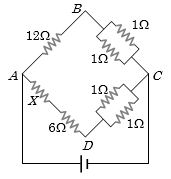
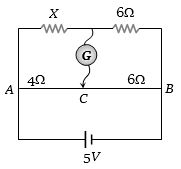
For what value of unknown resistance $X$, the potential difference between $B$ and $D$ will be zero in the circuit shown in the figure ............... $\Omega$
Answerb
For balanced Wheatstone bridge $\frac{P}{Q} = \frac{R}{S}$
$ \Rightarrow $ $\frac{{12}}{{(1/2)}} = \frac{{x + 6}}{{(1/2)}}$ $ \Rightarrow $ $x = 6\,\Omega $
View full question & answer→MCQ 4521 Mark
An unknown resistance $R_1$ is connected in series with a resistance of $10 \,\Omega$. This combinations is connected to one gap of a meter bridge while a resistance $R_2$ is connected in the other gap. The balance point is at $50\, cm$. Now, when the $10 \,\Omega$ resistance is removed the balance point shifts to $40\, cm$. The value of $R_1$ is (in $ohm$)
Answerc
For first balancing condition $\frac{{10 + {R_1}}}{{{R_2}}} = \frac{{50}}{{50}}$
$ \Rightarrow $ ${R_2} = 10 + {R_1}$.
For second balancing condition
$\frac{{{R_1}}}{{{R_2}}} = \frac{{40}}{{60}}$ $ \Rightarrow $ $\frac{{{R_1}}}{{10 + {R_1}}} = \frac{2}{3}$
$ \Rightarrow $ ${R_1} = 20\,\Omega $
View full question & answer→MCQ 4531 Mark
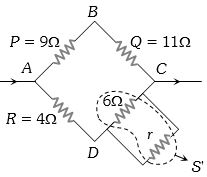
In Wheatstone's bridge $P = 9\, ohm$, $Q = 11\, ohm$, $R = 4\,ohm$ and $S = 6\,ohm$. How much resistance must be put in parallel to the resistance $S$ to balance the bridge ............... $ohm$
- A
$24$
- B
$\frac{{44}}{9}$
- ✓
$26.4$
- D
$18.7$
AnswerCorrect option: C. $26.4$
c
$\frac{P}{Q} = \frac{R}{{S'}}$ (For balancing bridge)
$ \Rightarrow $ $S' = \frac{{4 \times 11}}{9} = \frac{{44}}{9}$
$ \Rightarrow $ $\frac{1}{{S'}} = \frac{1}{r} + \frac{1}{6}$
$ \Rightarrow $ $\frac{9}{{44}} - \frac{1}{6} = \frac{1}{r}$
$ \Rightarrow $ $r = \frac{{132}}{5} = 26.4\,\Omega $
View full question & answer→MCQ 4541 Mark
Which is a wrong statement
- A
The Wheatstone bridge is most sensitive when all the four resistances are of the same order
- ✓
In a balanced Wheatstone bridge, interchanging the positions of galvanometer and cell affects the balance of the bridge
- C
Kirchhoff's first law (for currents meeting at a junction in an electric circuit) expresses the conservation of charge
- D
The rheostat can be used as a potential divider
AnswerCorrect option: B. In a balanced Wheatstone bridge, interchanging the positions of galvanometer and cell affects the balance of the bridge
b
(b)In balanced Wheatstone bridge, the arms of galvanometer and cell can be interchanged without affecting the balance of the bridge.
View full question & answer→MCQ 4551 Mark
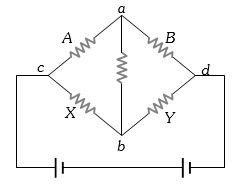
In the Wheatstone's bridge (shown in figure) $X = Y$ and $A > B$. The direction of the current between ab will be
AnswerCorrect option: B. From $b$ to $a$
b
In the part $c\, b\, d$,
${V_c} - {V_b} = {V_b} - {V_d}$ $ \Rightarrow $ ${V_b} = \frac{{{V_c} + {V_d}}}{2}$
In the part $c\, a\, d$
${V_c} - {V_a} > {V_a} - {V_d}$ $ \Rightarrow $ $\frac{{{V_c} + {V_d}}}{2} > {V_a}$ $ \Rightarrow $ ${V_b} > {V_a}$
View full question & answer→MCQ 4561 Mark
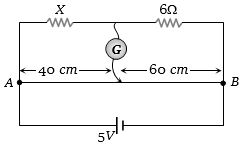
In the circuit shown, a meter bridge is in its balanced state. The meter bridge wire has a resistance $0.1\, ohm/cm$. The value of unknown resistance $X$ and the current drawn from the battery of negligible resistance is
- A
$6 \,\Omega$, $5\, amp$
- B
$10 \,\Omega$, $0.1\, amp$
- ✓
$4 \,\Omega$, $1.0 \,amp$
- D
$12 \,\Omega$, $0.5\, amp$
AnswerCorrect option: C. $4 \,\Omega$, $1.0 \,amp$
c
(c) Resistance of the part $AC$
${R_{AC}} = 0.1 \times 40 = 4\,\Omega $ and ${R_{CB}} = 0.1 \times 60 = 6\,\Omega $
In balanced condition $\frac{X}{6} = \frac{4}{6} \Rightarrow X = 4\,\Omega $
Equivalent resistance ${R_{eq}} = 5\,\Omega $ so current drawn from battery $i = \frac{5}{5} = 1\,A$.
View full question & answer→MCQ 4571 Mark
Resistance in the two gaps of a meter bridge are $10\, ohm$ and $30\, ohm$ respectively. If the resistances are interchanged the balance point shifts by.............. $cm$
- A
$33.3$
- B
$66.67$
- C
$25$
- ✓
$50$
Answerd
(d)$S = \left( {\frac{{100 - l}}{l}} \right).R$
Initially, $30 = \left( {\frac{{100 - l}}{l}} \right) \times 10 \Rightarrow l = 25\,cm$
Finally, $10 = \left( {\frac{{100 - l}}{l}} \right) \times 30 \Rightarrow l = 75\,cm$
So, shift = $50\,cm.$
View full question & answer→MCQ 4581 Mark
If the balance point is obtained at the $35^{th} cm$ in a meter bridge the resistances in the left and right gaps are in the ratio of
- ✓
$7 : 13$
- B
$13 : 7$
- C
$9 : 11$
- D
$11 : 9$
AnswerCorrect option: A. $7 : 13$
a
(a) Using Wheatstone principle $\frac{P}{Q} = \frac{R}{S} = \frac{R}{{100 - l}}$
$ = \frac{{35}}{{100 - 35}} = \frac{{35}}{{65}} = \frac{7}{{13}}$
View full question & answer→MCQ 4591 Mark
ln a balanced wheat stone bridge, current in the galvanometer is zero. It remains zero when:
$[1]$ battery emf is increased
$[2]$ all resistances are increased by $10\,ohms$
$[3]$ all resistances are made five times
$[4]$ the battery and the galvanometer are interchanged
- A
only $[1]$ is correct
- B
$[1], [2]$ and $[3]$ are correct
- ✓
$[1], [3]$ and $[4]$ are correct
- D
$[1]$ and $[3]$ are correct
AnswerCorrect option: C. $[1], [3]$ and $[4]$ are correct
c
For wheatstone bridge,
It is independent of emf Let $r=K R$
$\Rightarrow \mathrm{r}_{1} \mathrm{r}_{4}=\mathrm{K}^{2}\left(\mathrm{R}_{1} \mathrm{R}_{4}\right)=\mathrm{K}^{2}\left(\mathrm{R}_{2} \mathrm{R}_{3}\right)=\mathrm{r}_{2} \mathrm{r}_{3}$
So it is still balance Even if battery and galvanometer are interchanged, still it is balanced. $(1)$ $(3),$ $(4)$ are true, hence.
View full question & answer→MCQ 4601 Mark
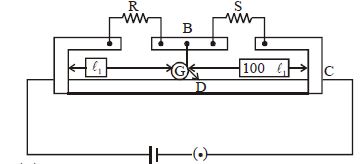
In a meter bridge the point $D$ is neutral point as shown in the figure.
- A
The meter bridge can have no other neutral point for this set of resistances
- B
When the jockey contacts a point on meter wire left of $D$, current flows to $B$ from the wire
- ✓
When the jockey contacts a point on the meter wire to the right of $D$, current flows from $B$ to the wire through galvanometer
- D
When $R$ is increased, the neutral point shifts to left
AnswerCorrect option: C. When the jockey contacts a point on the meter wire to the right of $D$, current flows from $B$ to the wire through galvanometer
View full question & answer→MCQ 4611 Mark
A student obtained following observations in an experiment of meter bridge to find the unknown resistance of the circuit The most accurate value of unknown resistance is ............ $\Omega$
| S.No. |
$R$ |
$l$ |
$100-l$ |
$S = \left( {\frac{{100 - l}}{l}} \right)R$ |
| $1$ |
$20\,\Omega $ |
$43$ |
$57$ |
$26.51\,\Omega $ |
| $2$ |
$30\,\Omega $ |
$51$ |
$49$ |
$28.82\,\Omega $ |
| $3$ |
$40\,\Omega $ |
$59$ |
$41$ |
$27.80\,\Omega $ |
| $4$ |
$60\,\Omega $ |
$70$ |
$30$ |
$25.71\,\Omega $ |
- A
$26.51$
- ✓
$28.82$
- C
$27.80$
- D
$25.71$
AnswerCorrect option: B. $28.82$
View full question & answer→MCQ 4621 Mark
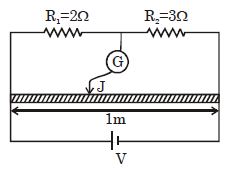
In a meter bridge experiment, initially the jockey is at null point. Now resistance $R_1$ $\&$ $R_2$ is interchanged. Shift in the position of jockey is ................ $cm$
Answera
Initially $\frac{\mathrm{R}_{1}}{\mathrm{R}_{2}}=\frac{2}{3}=\frac{\ell}{100-\ell} \Rightarrow \ell=40 \mathrm{\,cm}$
Now $\frac{\mathrm{R}_{2}}{\mathrm{R}_{1}}=\frac{3}{2}=\frac{\ell}{100-\ell} \Rightarrow \ell=60 \mathrm{\,cm}$
shift $=20 \mathrm{\,cm}$
View full question & answer→MCQ 4631 Mark
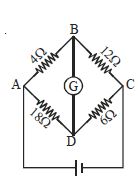
In the following diagram the wheat stone bridge is balanced when we interchange the resistances of
- A
$4\,\Omega $ and $6\,\Omega $
- B
$18\,\Omega $ and $12\,\Omega $
- C
$4\,\Omega $ and $18\,\Omega $
- ✓
$18\,\Omega $ and $6\,\Omega $
AnswerCorrect option: D. $18\,\Omega $ and $6\,\Omega $
View full question & answer→MCQ 4641 Mark
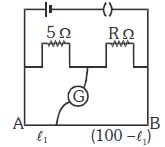
The resistance in the two arms of a meter bridge are $5\,\Omega $ and $R\,\Omega $, respectively. When the resistance $R$ is shunted with an equal resistance, the new balance point is at $1.6\, l_1$. The resistance $‘R’$ is ................. $\Omega$
Answerb
$\frac{5}{\mathrm{R}}=\frac{\ell_{1}}{100-\ell_{1}}$ and $\frac{5}{\mathrm{R} / 2}=\frac{1.6 \ell_{1}}{100-1.6 \ell_{1}}$
$\Rightarrow \mathrm{R}=15\, \Omega$
View full question & answer→MCQ 4651 Mark
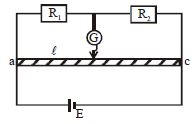
Fig. shows rough sketch of meter bridge. $(G)$ deflects zero at length $\ell \, cm$. Now $R_1$ and $R_2$ are interchanged then balancing length increases by $25\, cm$. Find $R_1/R_2$
- ✓
$\frac{3}{5}$
- B
$\frac{2}{5}$
- C
$\frac{2}{3}$
- D
$\frac{5}{2}$
AnswerCorrect option: A. $\frac{3}{5}$
a
$\frac{\mathrm{R}_{1}}{\mathrm{R}_{2}}=\frac{\ell}{100-\ell}$ and $\frac{\mathrm{R}_{2}}{\mathrm{R}_{1}}=\frac{\ell+25}{75-\ell}$
So $\frac{\ell}{100-\ell}=\frac{\ell+25}{75-\ell}$ or $\ell=\frac{75}{2} \mathrm{\,cm}$
View full question & answer→MCQ 4661 Mark
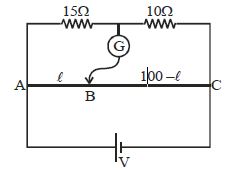
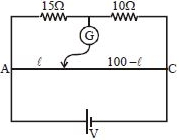
In the meter bridge shown, the length $AB$ for which the deflection in galvanometer is zero will be ............. $cm$
Answerd
$\frac{\mathrm{R}_{1}}{\mathrm{R}_{2}}=\frac{\ell}{100-\ell}$
$\Rightarrow \frac{15}{10}=\frac{\ell}{100-\ell}$
$\Rightarrow \ell=60 \mathrm{\,cm}$
View full question & answer→MCQ 4671 Mark
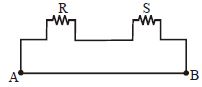
In a meter bridge, the null point is found at a distance of $25\, cm$ from $A$ . If now a resistance of $10\,\Omega $ is connected in parallel with $S$, the null point occurs at mid point of $AB$. The value of $R$ is .............. $\Omega$
- ✓
$6.67$
- B
$1.67$
- C
$2.67$
- D
$4.67$
AnswerCorrect option: A. $6.67$
a
Case $-$ $1$
$\frac{\mathrm{S}}{\mathrm{R}}=\frac{75}{25}\left(\frac{100-\ell}{\ell}\right)$
$\frac{S}{R}=3$
$S=3 \,R$ .......$(1)$
Case $-$ $2$
$\frac{S \times 10}{(S+10) R}=\frac{50}{50}$
$\mathrm{S} \times 10=(\mathrm{S}+10) \mathrm{R}$
$3 \mathrm{R} \times 10=(3 \mathrm{R}+10) \mathrm{R}$
$30=3 R+10$
$3 \mathrm{R}=20$
$R=\frac{20}{3}=6.67 \mathrm{\,ohm}$
View full question & answer→MCQ 4681 Mark
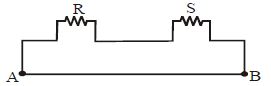
In a meter bridge, the null point is found at a distance of $25\, cm$ from $A$. If now a resistance of $10\,\Omega $ is connected in parallel with $S$, the null point occurs at mid point of $AB$. The value of $R$ is ................. $\Omega$
- ✓
$6.67$
- B
$1.67$
- C
$2.67$
- D
$4.67$
AnswerCorrect option: A. $6.67$
View full question & answer→MCQ 4691 Mark
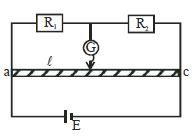
Fig. shows rough sketch of meter bridge. $(G)$ deflects zero at length $l\, cm$. Now $R_1$ and $R_2$ are interchanged then balancing length increases by $25\, cm$. Find $R_1/R_2$
- ✓
$\frac{3}{5}$
- B
$\frac{2}{5}$
- C
$\frac{2}{3}$
- D
$\frac{5}{2}$
AnswerCorrect option: A. $\frac{3}{5}$
a
$\frac{\mathrm{R}_{1}}{\mathrm{R}_{2}}=\frac{\ell}{100-\ell}$ and $\frac{\mathrm{R}_{2}}{\mathrm{R}_{1}}=\frac{\ell+25}{75-\ell}$
So $\frac{\ell}{100-\ell}=\frac{\ell+25}{75-\ell}$ or $\ell=\frac{75}{2} \mathrm{\,cm}$
View full question & answer→MCQ 4701 Mark
The potential gradient along the length of a uniform wire is $10\,volt/metre$. $B$ and $C$ are the two points at $30\,cm$ and $60\,cm$ point on a meter scale fitted along the wire. The potential difference between $B$ and $C$ will be ............. $volt$
Answera
Potential gradient $=$ Change in voltage per unit length
$10 = \frac{{{V_2} - {V_1}}}{{30/100}} \Rightarrow {V_2} - {V_1} = 3\,volt$
View full question & answer→MCQ 4711 Mark
A Daniel cell is balanced on $125\,cm$ length of a potentiometer wire. Now the cell is short-circuited by a resistance $2\, ohm$ and the balance is obtained at $100\,cm$. The internal resistance of the Daniel cell is .............. $ohm$
- ✓
$0.5$
- B
$1.5$
- C
$1.25$
- D
$0.8$
Answera
(a) $r = \left( {\frac{{{l_1} - {l_2}}}{{{l_2}}}} \right)\,R = \left( {\frac{{25}}{{100}}} \right)\,2 = 0.5\,\Omega $
View full question & answer→MCQ 4721 Mark
Two cells when connected in series are balanced on $8\;m$ on a potentiometer. If the cells are connected with polarities of one of the cell is reversed, they balance on $2\,m$. The ratio of $e.m.f.$'s of the two cells is
Answerb
(b) $\frac{{{E_1}}}{{{E_2}}} = \frac{{{l_1} + {l_2}}}{{{l_1} - {l_2}}} = \frac{{(8 + 2)}}{{(8 - 2)}} = \frac{5}{3}$
View full question & answer→MCQ 4731 Mark
In a potentiometer circuit there is a cell of $e.m.f.$ $2\, volt$, a resistance of $5\, ohm$ and a wire of uniform thickness of length $1000\, cm$ and resistance $15\, ohm$. The potential gradient in the wire is
- A
$\frac{1}{{500}}\,V/cm$
- ✓
$\frac{3}{{2000}}\,V/cm$
- C
$\frac{3}{{5000}}\,V/cm$
- D
$\frac{1}{{1000}}\,V/cm$
AnswerCorrect option: B. $\frac{3}{{2000}}\,V/cm$
b
Potential gradient $x = \frac{V}{L} = \frac{{iR}}{L}$
$ \Rightarrow $ $x = \frac{2}{{(15 + 5)}} \times \frac{{15}}{{10}} = \frac{3}{{2000}}\,volt/cm$
View full question & answer→MCQ 4741 Mark
In an experiment to measure the internal resistance of a cell by potentiometer, it is found that the balance point is at a length of $2\,m$ when the cell is shunted by a $5\,\Omega $ resistance; and is at a length of $3\,m$ when the cell is shunted by a $10\,\Omega $ resistance. The internal resistance of the cell is, then ................ $\Omega $
Answerb
$r = \left( {\frac{{{l_1} - {l_2}}}{{{l_2}}}} \right) \times R'$$ = \left( {\frac{{{l_1} - 2}}{2}} \right) \times 5$ ... $(i)$
and $r = \left( {\frac{{{l_1} - 3}}{3}} \right) \times 10$ ... $(ii)$
On solving $(i)$ and $(ii)$
$r = 10 \,\Omega$
View full question & answer→MCQ 4751 Mark
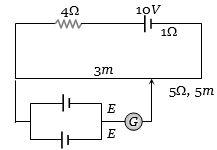
A resistance of $4\,\Omega $ and a wire of length $5\,m$ and resistance $5\,\Omega $ are joined in series and connected to a cell of $e.m.f.$ $10\, V$ and internal resistance $1\,\Omega $. A parallel combination of two identical cells is balanced across $300\, cm$ of the wire. The $e.m.f.$ $E$ of each cell is ........... $V$
Answerb
$E = x\,l = \frac{V}{l} = \frac{{iR}}{L} \times l$
$E = \frac{e}{{(R + {R_h} + r)}} \times \frac{R}{L} \times l$
$E = \frac{{10}}{{(5 + 4 + 1)}} \times \frac{5}{5} \times 3 = 3\,V$
View full question & answer→MCQ 4761 Mark
The resistivity of a potentiometer wire is $40 \times {10^{ - 8}}\,ohm - m$ and its area of cross-section is $8 \times {10^{ - 6}}\,{m^2}$. If $0.2\, amp$ current is flowing through the wire, the potential gradient will be
AnswerCorrect option: A. ${10^{ - 2}}\,volt/m$
a
Potential gradient $ = \frac{V}{L} = \frac{{iR}}{L} = \frac{{i\rho L}}{{AL}} = \frac{{i\rho }}{A}$
$ = \frac{{0.2 \times 40 \times {{10}^{ - 8}}}}{{8 \times {{10}^{ - 6}}}} = {10^{ - 2}}\,V/m$
View full question & answer→MCQ 4771 Mark
A potentiometer wire has length $10\, m$ and resistance $20\,\Omega $. A $2. 5\, V$ battery of negligible internal resistance is connected across the wire with an $80\,\Omega $ series resistance. The potential gradient on the wire will be
- ✓
$5 \times {10^{ - 5}}\,V/mm$
- B
$2.5 \times {10^{ - 4}}\,V/cm$
- C
$0.62 \times {10^{ - 4}}\,V/mm$
- D
$1 \times {10^{ - 5}}\,V/mm$
AnswerCorrect option: A. $5 \times {10^{ - 5}}\,V/mm$
a
(a)Potential gradient $x = \frac{e}{{(R + {R_h} + r)}} \cdot \frac{R}{L}$
$ \Rightarrow $ $x = \frac{{2.5}}{{(20 + 80 + 0)}} \times \frac{{20}}{{10}} = 5 \times {10^{ - 5}}\frac{V}{{mm}}$
View full question & answer→MCQ 4781 Mark
In a potentiometer experiment, the galvanometer shows no deflection when a cell is connected across $60\, cm$ of the potentiometer wire. If the cell is shunted by a resistance of $6\,\Omega $, the balance is obtained across $50\, cm$ of the wire. The internal resistance of the cell is .............. $\Omega $
Answerc
(c) $r = \frac{{({l_1} - {l_2})}}{{{l_2}}} \times R' = \left( {\frac{{60 - 50}}{{50}}} \right) \times 6 = 1.2\,\Omega $
View full question & answer→MCQ 4791 Mark
The resistance of $10\, metre$ long potentiometer wire is $1\,ohm/meter$. A cell of $e.m.f.$ $2.2\, volts$ and a high resistance box are connected in series to this wire. The value of resistance taken from resistance box for getting potential gradient of $2.2\, millivolt/metre$ will be ............... $\Omega $
- A
$790$
- B
$810$
- ✓
$990$
- D
$1000$
Answerc
(c) Potential gradient $x = \frac{V}{L} = \frac{e}{{(R + {R_h} + r)}} \cdot \frac{R}{L}$
$ \Rightarrow $ $2.2 \times {10^{ - 3}} = \frac{{2.2}}{{(10 + {R_h})}} \times 1$
$ \Rightarrow $ $R' = 990\,\Omega $
View full question & answer→MCQ 4801 Mark
We have a galvanometer of resistance $25\,\Omega $. It is shunted by a $2.5\,\Omega $ wire. The part of total current that flows through the galvanometer is given as
- ✓
$\frac{I}{{{I_0}}} = \frac{1}{{11}}$
- B
$\frac{I}{{{I_0}}} = \frac{1}{{10}}$
- C
$\frac{I}{{{I_0}}} = \frac{3}{{11}}$
- D
$\frac{I}{{{I_0}}} = \frac{4}{{11}}$
AnswerCorrect option: A. $\frac{I}{{{I_0}}} = \frac{1}{{11}}$
a
(a) $\frac{i}{{{i_g}}} = \frac{{G + S}}{S}$
$ \Rightarrow $ $\frac{{{i_g}}}{i} = \frac{S}{{G + S}} = \frac{{2.5}}{{27.5}} = \frac{1}{{11}}$
View full question & answer→MCQ 4811 Mark
A potentiometer wire of length $1\,m$ and resistance $10\,\Omega$ is connected in series with a cell of $emf$ $2\,V$ with internal resistance $1 \,\Omega$ and a resistance box including a resistance $R$. If potential difference between the ends of the wire is $1\, mV$, the value of $R$ is ............. $\Omega $
- A
$20000$
- ✓
$19989$
- C
$10000$
- D
$9989$
AnswerCorrect option: B. $19989$
b
(b) $V = i.R{\rm{. }} = \frac{e}{{(R + {R_h} + r)}}\,.\,R \Rightarrow {10^{ - 3}} = \frac{2}{{(10 + R + r)}} \times 10$
$ \Rightarrow $ $R$$ = 19,989\,\Omega $.
View full question & answer→MCQ 4821 Mark
In the given figure, battery $E $ is balanced on $55\, cm$ length of potentiometer wire but when a resistance of $10 \,\Omega$ is connected in parallel with the battery then it balances on $50\, cm$ length of the potentiometer wire then internal resistance $r$ of the battery is ............. $\Omega $
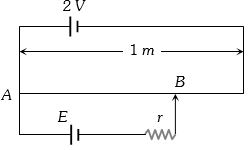
Answera
(a) $r = \left( {\frac{{{l_1} - {l_2}}}{{{l_2}}}} \right) \times R'$$ \Rightarrow r = \left( {\frac{{55 - 50}}{{50}}} \right) \times 10 = 1\,\Omega $.
View full question & answer→MCQ 4831 Mark
A potentiometer having the potential gradient of $2\, mV/cm$ is used to measure the difference of potential across a resistance of $10 \,\Omega$. If a length of $50\, cm$ of the potentiometer wire is required to get the null point, the current passing through the $10 \,\Omega$ resistor is (in $mA$)
Answerd
(d) $V = xl \Rightarrow iR = xl$
$ \Rightarrow \,\,\,i \times 10 = \left( {\frac{{2 \times {{10}^{ - 3}}}}{{{{10}^{ - 2}}}}} \right) \times 50 \times {10^{ - 2}} = 0.1$
$ \Rightarrow \,\,\,\,i = 10 \times {10^{ - 3}}A = 10\,mA$.
View full question & answer→MCQ 4841 Mark
$AB$ is a potentiometer wire of length $100\, cm$ and its resistance is $10 \,\Omega$. It is connected in series with a resistance $R = 40 \,\Omega$ and a battery of $e.m.f.$ $2 \,V$ and negligible internal resistance. If a source of unknown $e.m.f.$ $E$ is balanced by $40\, cm$ length of the potentiometer wire, the value of $E$ is ................. $V$
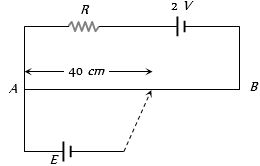
- A
$0.8 $
- B
$1.6$
- C
$0.08$
- ✓
$0.16$
AnswerCorrect option: D. $0.16$
d
(d) $E = \frac{e}{{(R + {R_h} + r)}}\,\frac{R}{L} \times l$$ = \frac{2}{{(10 + 40 + 0)}} \times \frac{{10}}{1} \times 0.4 = 0.16\,V$.
View full question & answer→MCQ 4851 Mark
In a potentiometer experiment two cells of $e.m.f.$ $E_1$ and $E_2$ are used in series and in conjunction and the balancing length is found to be $58\, cm$ of the wire. If the polarity of $E_2$ is reversed, then the balancing length becomes $29\, cm$. The ratio $\frac{{{E_1}}}{{{E_2}}}$ of the $e.m.f.$ of the two cells is
Answerc
(c) $\frac{{{E_1}}}{{{E_2}}} = \frac{{{l_1} + {l_2}}}{{{l_1} - {l_2}}} = \frac{{58 + 29}}{{58 - 29}} = \frac{3}{1}$
View full question & answer→MCQ 4861 Mark
A wire of length $100\, cm$ is connected to a cell of $emf$ $2\, V$ and negligible internal resistance. The resistance of the wire is $3\, \,\Omega$. The additional resistance required to produce a potential drop of $1$ milli volt per cm is ............... $\Omega $
Answerc
(c) Potential gradient $x = \frac{e}{{(R + {R_h} + r)}}.\frac{R}{L}$
$ \Rightarrow \,\,\,\,\,\,\frac{{{{10}^{ - 3}}}}{{{{10}^{ - 2}}}} = \frac{2}{{(3 + {R_h} + 0)}} \times \frac{3}{1} \Rightarrow {R_h} = 57\,\Omega $.
View full question & answer→MCQ 4871 Mark
A $10\, m$ long wire of $20\,\Omega$ resistance is connected with a battery of $3\, volt$ $e.m.f.$ (negligible internal resistance) and a $10 \,\Omega$ resistance is joined to it is series. Potential gradient along wire in volt per meter is
- A
$0.02$
- B
$0.3$
- ✓
$0.2$
- D
$1.3$
Answerc
(c) Potential gradient $x = \frac{e}{{(R + {R_h} + r)}}.\frac{R}{L}$
$ = \frac{3}{{(20 + 10 + 0)}} \times \frac{{20}}{{10}} = 0.2$
View full question & answer→MCQ 4881 Mark
A potentiometer has uniform potential gradient across it. Two cells connected in series $(i)$ to support each other and $(ii)$ to oppose each other are balanced over $6\,m$ and $2\,m$ respectively on the potentiometer wire. The $e.m.f.$’s of the cells are in the ratio of
Answerd
(d) $\frac{{{E_1}}}{{{E_2}}} = \frac{{{l_1} + {l_2}}}{{{l_1} - {l_2}}} = \frac{{(6 + 2)}}{{(6 - 2)}} = \frac{2}{1}$
View full question & answer→MCQ 4891 Mark
A cell of internal resistance $3\, ohm$ and $emf$ $10\, volt$ is connected to a uniform wire of length $500 \,cm$ and resistance $3\, ohm$. The potential gradient in the wire is .............. $mV/cm$
Answerb
(b) Potential gradient = $\frac{{e.R}}{{(R + r).L}}$= $\frac{{10 \times 3}}{{(3 + 3) \times 5}}$.
$ = 1V/m = 10\,mV/cm.$
View full question & answer→MCQ 4901 Mark
Resistance of $100\, cm$ long potentiometer wire is $10 \,\Omega$, it is connected to a battery ($2\, volt$) and a resistance $R$ in series. A source of $10\, mV$ gives null point at $40\, cm$ length, then external resistance $R$ is ........... $\Omega $
- A
$490$
- ✓
$790 $
- C
$590 $
- D
$990$
AnswerCorrect option: B. $790 $
b
(b) $E = \frac{e}{{(R + {R_h} + r)}}.\frac{R}{L} \times l$
$ \Rightarrow 10 \times {10^{ - 3}} = \frac{2}{{(10 + R + 0)}} \times \frac{{10}}{1} \times 0.4$ $ \Rightarrow $ $R = 790 $ $\Omega$
View full question & answer→MCQ 4911 Mark
In given figure, the potentiometer wire $AB$ has a resistance of $5$ $\Omega$ and length $10\, m$. The balancing length $AM$ for the $emf$ of $0.4\, V$ is ............... $m$
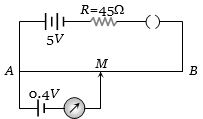
Answerd
(d) $E = \frac{e}{{(R + {R_h} + r)}}.\frac{R}{L} \times l$$ \Rightarrow $ $0.4 = \frac{5}{{(5 + 45 + 0)}} \times \frac{5}{{10}} \times l$
$ \Rightarrow $ $l = 8\, m$
View full question & answer→MCQ 4921 Mark
With a potentiometer null point were obtained at $140\, cm$ and $180\, cm$ with cells of $emf$ $1.1 \,V$ and one unknown $X\, volts$. Unknown $emf$ is .............. $V$
- A
$1.1$
- B
$1.8$
- C
$2.4$
- ✓
$1.41$
AnswerCorrect option: D. $1.41$
d
(d) $E = \frac{V}{l}$; $E $ is constant (volt. gradient).
$ \Rightarrow $ $\frac{{{V_1}}}{{{l_1}}} = \frac{{{V_2}}}{{{l_2}}}$
$ \Rightarrow $ $\frac{{1.1}}{{140}} = \frac{V}{{180}}$
$ \Rightarrow $ $V = \frac{{180 \times 1.1}}{{140}} = 1.41\,V$
$V = \frac{{180 \times 1.1}}{{140}} = 1.41\,V$
View full question & answer→MCQ 4931 Mark
Potentiometer wire of length $1 \,m$ is connected in series with $490\,\Omega $ resistance and $2\,V$ battery. If $0.2\, mV/cm $ is the potential gradient, then resistance of the potentiometer wire is ................ $\Omega$
Answera
(a) Potential gradient $x = \frac{e}{{(R + {R_h} + r)}}.\frac{R}{L}$
$ \Rightarrow $ $\frac{{0.2 \times {{10}^{ - 3}}}}{{{{10}^{ - 2}}}} = \frac{2}{{(R + 490 + 0)}} \times \frac{R}{1}$ $ \Rightarrow $ $R = 4.9 \,\Omega$.
View full question & answer→MCQ 4941 Mark
Figure shows a simple potentiometer circuit for measuring a small $e.m.f$. produced by a thermocouple. The meter wire $PQ$ has a resistance $5 \,\Omega$ and the driver cell has an e.m.f. of $2\, V$. If a balance point is obtained $0.600\, m$ along $PQ$ when measuring an e.m.f. of $6.00\, mV$, what is the value of resistance $R$ ............... $\Omega$
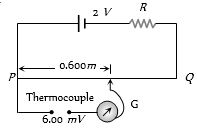
AnswerCorrect option: A. $995 $
a
(a) The voltage per unit light of the metre wire $PQ$ is $\left( {\frac{{6.00\,mV}}{{0.600\,m}}} \right)$ i.e. $10\,mV/m$.
Hence potential difference across the metre wire is $10\,mV{\rm{/}}m \times 1\,m = 10\,mV$.
The current drawn from the driver cell is $i = \frac{{10\,mV}}{{5\,\Omega }} = 2\,mA$.
The resistance $R = \frac{{(2\,V - 10\,mV)}}{{2\,mA}} = \frac{{1990\,mV}}{{2\,mA}} = 995\;\Omega $.
View full question & answer→MCQ 4951 Mark
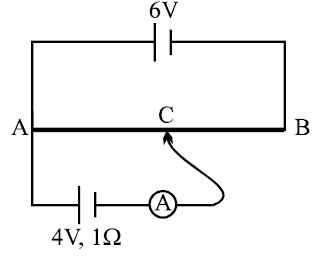
$A \,6 \,V$ battery of negligible internal resistance is connected across a uniform wire of length $1\, m$. The positive terminal of another battery of emf $4\,V$ and internal resistance $1\, \Omega$ is joined to the point $A$ as shown in figure. The ammeter shows zero deflection when the jockey touches the wire at the point $C$. The $AC$ is equal to
- ✓
$2/3\, m$
- B
$1/3\, m$
- C
$3/5\, m$
- D
$1/2\, m$
AnswerCorrect option: A. $2/3\, m$
a
$x=\frac{6}{1} v / m \Rightarrow 6 \times l_{A C}=4$
$l_{A C}=\frac{2}{3} m$
View full question & answer→MCQ 4961 Mark
$A$ potentiometer wire has length $10\, m$ and resistance $10\,\Omega$ . It is connected to a battery of $EMF$ $11\, volt$ and internal resistance $1\, \Omega$ , then the potential gradient in the wire is ............... $V/m$
Answerb
Total resistance $=10+1=11 \Omega$
Current in the circuit $=\frac{11}{11}=1 A$
Potential across the wire $=$ current $\times$ resistance $=10 \mathrm{V}$
since, Potential gradient is equal to potential per meter
Potential Gradient $=\frac{10}{10}=1 V / m$
View full question & answer→MCQ 4971 Mark
An ammeter $A$ of finite resistance, and a resistor $R$ are joined in series to an ideal cell $C$. $A$ potentiometer $P$ is joined in parallel to $R$. The ammeter reading is $I_0$ and the potentiometer reading is $V_0$. $P$ is now replaced by a voltmeter of finite resistance. The ammeter reading now is $I$ and the voltmeter reading is $V$.

- ✓
$I > I_0, V < V_0$
- B
$I > I_0, V = V_0$
- C
$I = I_0, V < V_0$
- D
$I < I_0, V =V_0$
AnswerCorrect option: A. $I > I_0, V < V_0$
a
The potentiometer is almost an ideal voltmeter, hence the resistance of potentiometer is infinity.
current through potentiometer is very small, it does not draw any current from circuitwhen the potentiometer is replaced by voltmeter of finite resistance, the current through voltmeter is more than that of potentiometer. It means voltmeter draws some current from circuit.
hence $I > I 0$
Also $\mathrm{V}=I \mathrm{R}$ thus, $\mathrm{V} < \mathrm{Vo}$
View full question & answer→MCQ 4981 Mark
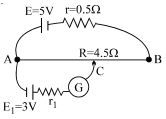
In the given potentiometer circuit length of the wire $AB$ is $3\, m$ and resistance is $R = 4.5 \, \Omega$ . The length $AC$ for no deflection in galvanometer is
- A
$2\, m$
- B
$1.8\, m$
- C
dependent on $r_1$
- ✓
Answerd
since cell connected in secondary circuit is in wrong way so we will not get balancing point.
View full question & answer→MCQ 4991 Mark
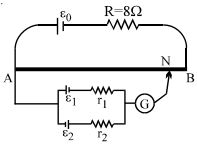
$A$ battery of $\mathrm{emf}$ $E_0 = 12\, V$ is connected across a $4\,m$ long uniform wire having resistance $4\,\Omega /m$. The cells of small $\mathrm{emfs}$ $\varepsilon_1 = 2\,V$ and $\varepsilon_2 = 4\,V$ having internal resistance $2\Omega$ and $6\Omega$ respectively, are connected as shown in the figure. If galvanometer shows no deflection at the point $N$, the distance of point $N$ from the point $A$ is equal to
- A
$\frac{1}{6}\, m$
- B
$\frac{1}{3}\, m$
- ✓
$25\, cm$
- D
$50\, cm$
AnswerCorrect option: C. $25\, cm$
c
$E_{e q}=\frac{E_{2} r_{2}-E_{2} r_{1}}{r_{1}+r_{2}}=\frac{2 \times 6-4 \times 2}{6+2}=\frac{1}{2}$ volt
At balancing length $l$
$E_{e q}=\frac{E_{0}}{R+16} \times 4 \lim p l i e s \frac{1}{2}=\frac{12}{8+16} \times 4 \times l$
$l=25 c m$
View full question & answer→MCQ 5001 Mark
In a potentiometer arrangement. $E_1$ is the cell establishing current in primary circuit. $E_2$ is the cell to be measured. $AB$ is the potentiometer wire and $G$ is a galvanometer. Which of the following are the essential condition for balance to be obtained.
- A
The $\mathrm{emf}$ of $E_1$ must be greater than the $\mathrm{emf}$ of $E_2.$
- B
Either the positive terminals of both $E_1$ and $E_2$ or the negative terminals of both $E_1$ and $E_2$ must be joined to one end of potentiometer wire.
- C
The positive terminals of $E_1$ and $E_2$ must be joined to one end of potentiometer wire.
- ✓
Both $(A)$ and $(B)$
AnswerCorrect option: D. Both $(A)$ and $(B)$
View full question & answer→