Questions · Page 9 of 34

M.C.Q (1 Marks)

MCQ 4011 Mark
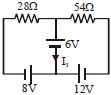
Consider the circuit shown in the figure. The current $I_3$ is equal to
  • A
    $5\,amp$
  • B
    $3\,amp$
  • C
    $-3\,amp$
  • $-5/6\,amp$
Answer
Correct option: D.
$-5/6\,amp$
d

View full question & answer
MCQ 4021 Mark
In the figure shown, if the internal resistance of the battery is $1\, ohm$, the reading of the ammeter will be ............... $A$
  • $2$
  • B
    $1$
  • C
    $3$
  • D
    $4$
Answer
Correct option: A.
$2$
a
$R_{\text {net }}=\frac{6 \times 3}{6+3}+1=3\, \Omega$

$I_{\text {net }}=\frac{9}{3}=3 \mathrm{\,A}$

$\mathrm{T.P.D.}$ of cell $=\mathrm{E}-$ $\mathrm{Ir}$ $=9-3 \times 1=6 \mathrm{\,V}$

reading of ameter $=\frac{6}{3}=2 \mathrm{\,A}$
View full question & answer
MCQ 4031 Mark
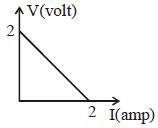
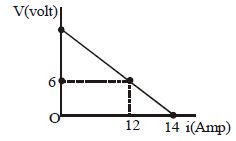
Potential difference across a cell and current through a cell is shown in graph. A battery consists of such identical $40$ cells. Max current supplied by the battery through a load of $2.5\,\Omega $ equal to .............. $A$
  • A
    $20$
  • B
    $12$
  • $4$
  • D
    $15$
Answer
Correct option: C.
$4$
c
$\varepsilon=2$ $\mathrm{volt},$ $\mathrm{r}=1 \,\Omega$

$m n=40$

Current is maximum

$\mathrm{R}=\frac{\mathrm{nr}}{\mathrm{m}} \Rightarrow 2.5=\frac{\mathrm{n}}{\mathrm{m}} 1$

$\mathrm{n}=\mathrm{m}(2.5)$

$m=4, n=10$

$I=\frac{10 E}{5}=4 \,A$
View full question & answer
MCQ 4041 Mark
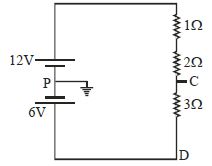
$10\, Cells$, each of $emf$ $'E'$ and internal resistance $'r'$, are connected in series to a variable external resistance. Figure shows the variation of terminal potential difference of their combination with the current drawn from the combination.$Emf$ of each cell is ................ $V$
  • A
    $1.6$
  • B
    $3.6$
  • C
    $1.4$
  • $4.2$
Answer
Correct option: D.
$4.2$
d
$6=10 \mathrm{\,E}-12(10 \mathrm{\,r})$               ..........$(1)$

$0=10 \mathrm{\,E}-14(10 \mathrm{\,r})$               ..........$(2)$

So, $6=10 \mathrm{\,E}-12\left[10 \times \frac{\mathrm{E}}{14}\right]$

$E=\frac{42}{10}=4.2 \mathrm{\,V}$
View full question & answer
MCQ 4051 Mark
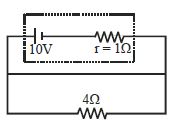
Find potential at point $C$ and $D$
  • A
    $V_C = 6\,V$ ; $V_D = 9\,V$
  • $V_C = 9\,V$ ; $V_D = 6\,V$
  • C
    $V_C = -9\,V$ ; $V_D = -6\,V$
  • D
    $V_C = -6\,V$ ; $V_D = -9\,V$
Answer
Correct option: B.
$V_C = 9\,V$ ; $V_D = 6\,V$
b
$I=\frac{12-6}{3+3}=\frac{6}{6}=1 A$

$\frac{v_C-v_D}{3} =1$

$v_C=3+v_D=3+6$

$v_C=9\,V$
View full question & answer
MCQ 4061 Mark
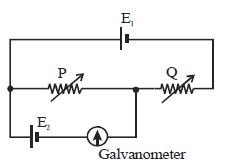
Potential difference across the terminals of the battery shown in figure is .................... $V$ ($r =$ internal resistance of battery)
  • A
    $8$
  • B
    $10$
  • C
    $6$
  • $0$
Answer
Correct option: D.
$0$
d
As battery is short circuited

$\mathrm{I}=\frac{\mathrm{E}}{r}=\frac{10}{1}=10 \mathrm{A}$

$v=E-I r$

$V=10-10 \times 1$

$V=0$
View full question & answer
MCQ 4071 Mark
Two cells of $e.m.f.$ $s\, E_1$ and $E_2$ and of negligible internal resistances are connected with two variable resistors as shown in Fig. When the galvanometer shows no deflection, the values of the resistances are $P$ and $Q$. What is the value of the ratio $E_2/E_1$ ?
  • A
    $\frac{P}{Q}$
  • $\frac{P}{{P + Q}}$
  • C
    $\frac{Q}{{P + Q}}$
  • D
    $\frac{{P + Q}}{P}$
Answer
Correct option: B.
$\frac{P}{{P + Q}}$
b
Potential difference $\mathrm{V}_{\mathrm{P}}$ across $\mathrm{P}$ as determined

from $\mathrm{E}_{1}$ is given by $\mathrm{V}_{\mathrm{P}}=\left(\frac{\mathrm{E}_{1}}{\mathrm{P}+\mathrm{Q}}\right) \mathrm{P}.$

Also, $\mathrm{V}_{\mathrm{P}}=\mathrm{E}_{2}$. Therefore,

$\mathrm{E}_{2}=\mathrm{E}_{1}\left(\frac{\mathrm{P}}{\mathrm{P}+\mathrm{Q}}\right) \Rightarrow \frac{\mathrm{E}_{2}}{\mathrm{E}_{1}}=\frac{\mathrm{P}}{\mathrm{P}+\mathrm{Q}}$

View full question & answer
MCQ 4081 Mark
$32$ cells, each of $emf$ $3V$, are connected in series and kept in a box. Externally, the combination shows an $emf$ of $84\, V$. The number of cells reversed in the combination is 
  • A
    $0$
  • $2$
  • C
    $4$
  • D
    $8$
Answer
Correct option: B.
$2$
b
Let $\mathrm{m}$ cells be in reverse

$(n-2 \,m) \varepsilon=84$

$(32-2 \,m) 3=84$

$4=2 \,m \Rightarrow m=2$
View full question & answer
MCQ 4091 Mark
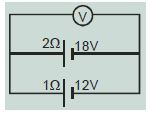
Two batteries, one of $emf$ $18\, volts$ and internal resistance $2\,\Omega $ and the other of $emf$ $12\, volt$ and internal resistance $1\,\Omega $, are connected as shown. The voltmeter $V$ will record a reading of .............. $\mathrm{volt}$
  • A
    $18$
  • B
    $30$
  • $14$
  • D
    $15$
Answer
Correct option: C.
$14$
c
$ \mathrm{E}_{\mathrm{net}} =\frac{\mathrm{E}_{1} \mathrm{r}_{2}+\mathrm{E}_{2} \mathrm{r}_{1}}{\mathrm{r}_{1}+\mathrm{r}_{2}} $

$=\frac{(18 \times 1)+(12 \times 2)}{(2+1)}$

$ \mathrm{E}_{\mathrm{net}} =\frac{18+24}{3}=\frac{42}{3}=14 \mathrm{\,volt} $
View full question & answer
MCQ 4101 Mark
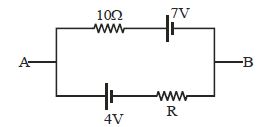
In the following circuit if $V_A -V_B = 6\,V$ then the value of resistance $R$ (in $ohm$) is ............... $\Omega$
  • A
    $5$
  • B
    $10$
  • C
    $15$
  • $20$
Answer
Correct option: D.
$20$
d
$\mathrm{V}_{\mathrm{AB}}=\frac{7 / 10+4 / \mathrm{R}}{1 / 10+1 / \mathrm{R}}$

$\mathrm{R}=20\, \Omega$

View full question & answer
MCQ 4111 Mark
A battery of internal resistance one ohm and $emf$ $3\,volt$ sends a current through $1\,metre$ of uniform wire of resistance $5\,\Omega $. The pole of the cell of $emf$ $1.4\,volt$ are connected to two points on the wire so that no current passes through this cell. Then, the potential gradient of the wire is
  • A
    $2.5\,volt$
  • $2.5\,volt/metre$
  • C
    $3\,volt/metre$
  • D
    $1.5\,volt/metre$
Answer
Correct option: B.
$2.5\,volt/metre$
b
Current through the wire of $5$ $\mathrm{ohm}$

$=\frac{\mathrm{E}}{\mathrm{r}+\mathrm{R}}=\frac{3}{1+5}=0.5 \mathrm{\,A}$

Potential cifference actioss the wire of $5 \Omega=0.5 \times 5=2.5 \mathrm{\,V}$

Length of wire $=1 \mathrm{\,m}$

$\therefore $ Potential gradient $=2.5 \mathrm{\,V} / \mathrm{m}$
View full question & answer
MCQ 4121 Mark
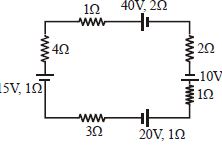
Find the current in the loop.
  • A
    $2/3\, A$
  • B
    $5/3\, A$
  • $7/3\, A$
  • D
    None
Answer
Correct option: C.
$7/3\, A$
c
Let the current in the loop is $\mathrm{I}$.

then $I = \frac{{{E_{net}}}}{{{R_{net}}}} = \frac{{60 - 25}}{{15}} = \frac{{35}}{{15}} = \frac{7}{3}\,{\mkern 1mu} A$

View full question & answer
MCQ 4131 Mark
When a current of $2\, A$ flows in a battery from negative to positive terminal, the potential difference across it is $12\, V$. If a current of $3\, A$ flows in the opposite direction potential difference across the terminals of the battery is $15\, V$, the $emf$ of the battery is ............... $\mathrm{V}$
  • A
    $12.6$
  • $13.2$
  • C
    $13.5$
  • D
    $14$
Answer
Correct option: B.
$13.2$
b
$\mathrm{T} . \mathrm{P.D.}=\mathrm{E}-\mathrm{I} \mathrm{r} \Rightarrow 12=\mathrm{E}-2 \mathrm{r}$      ..........$(1)$

$\mathrm{T.P.D.}=\mathrm{E}+\mathrm{Ir} \Rightarrow 15=\mathrm{E}+3 \mathrm{r} $          .........$(2)$

Solve ${\rm{e}}{{\rm{q}}^n}$ $(1)$ and $(2)$

View full question & answer
MCQ 4141 Mark
A cell sends a current through a resistance $R$ for time $t$. Now the same cell sends current through another resistance $r$ for the same time. If same amount of heat is developed in both the resistance, then the internal resistance of cell is
  • A
    $\frac{(R+r)}{2}$
  • B
    $\frac{(R-r)}{2}$
  • C
    $\frac{(R r)}{2}$
  • $\sqrt{(R r)}$
Answer
Correct option: D.
$\sqrt{(R r)}$
d
(d)

$H_1=\frac{E^2 R}{\left(R+r_1\right)^2}$

$H_2=\frac{E^2 R}{\left(r+r_1\right)^2}$

$\frac{R}{\left(R+r_1\right)^2}=\frac{r}{\left(r+r_1\right)^2}$

$\frac{r+r_1}{R+r_1}=\frac{\sqrt{r}}{\sqrt{R}}$

$\sqrt{R} r_1+r \sqrt{R}=\sqrt{r} r_1+R \sqrt{r}$

$r_1(\sqrt{R}-\sqrt{r})=\sqrt{R r}(\sqrt{R}-\sqrt{r})$

$r_1=\sqrt{R r}$

View full question & answer
MCQ 4151 Mark
Thousand cells of same emf $E$ and same internal resistance $r$ are connected in series in same order without an external resistance. The potential drop across $399$ cells is found to be ......... $E$
  • $0$
  • B
    $399$
  • C
    $601$
  • D
    $1000$
Answer
Correct option: A.
$0$
a
(a)

Current through the circuit $i=\frac{1000 E}{1000 r}=\frac{E}{r}$

Potential drop across one cell $=E-i r=E-\left(\frac{E}{r}\right) r=0$

$\Rightarrow$ For $399$ cells, total potential drop is zero

View full question & answer
MCQ 4161 Mark
Two batteries of different $e.m.f.'s$ and internal resistance connected in series with each other and with an external load resistor. The current is $3.0 \,A$. When the polarity of one battery is reversed, the current becomes $1.0 \,A$. The ratio of the $e.m.f.'s$ of the two batteries is ............
  • A
    $2.5$
  • $2$
  • C
    $1.5$
  • D
    $1$
Answer
Correct option: B.
$2$
b
(b)

$3=\frac{E_1+E_2}{R+r_1+r_2}$

$1=\frac{E_1-E_2}{R+r_1+r_2}$

$3=\frac{E_1+E_2}{E_1-E_2}$

$2=\frac{E_1}{E_2}$

View full question & answer
MCQ 4171 Mark
There are a large number of cells available, each marked $(6 \,V , 0.5 \,\Omega)$ to be used to supply current to a device of resistance $0.75 \,\Omega$, requiring $24 \,A$ current. How should the cells be arranged, so that power is transmitted to the load using minimum number of cells?
  • A
    Six rows, each containing four cells
  • Four rows, each containing six cells
  • C
    Four rows, each containing four cells
  • D
    Six rows, each containing six cells
Answer
Correct option: B.
Four rows, each containing six cells
b
(b)

$E=6 \,V$

$r=0.5 \,\Omega$

$R=0.75 \,\Omega$

$i=24 \,\Omega$

$S(0.5)=P(0.75)$

$2 \,s=3 p$

$i=\frac{P S E}{S r+P R}$

$24=\frac{P\left(\frac{3}{2} P\right) 6}{15 P}$

$P=4$ rows

$S=6$ cells
View full question & answer
MCQ 4181 Mark
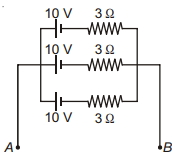
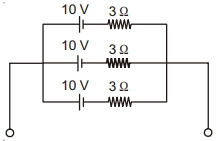
Three identical cells are connected in parallel across $A B$. Net emf across $A B$ is .......... $V$
  • $10$
  • B
    $30$
  • C
    $15$
  • D
    $12$
Answer
Correct option: A.
$10$
a
(a)

$E_{\text {net }}=\frac{\frac{10}{3}+\frac{10}{3}+\frac{10}{3}}{\frac{1}{3}+\frac{1}{3}+\frac{1}{3}}=10$ volt
View full question & answer
MCQ 4191 Mark
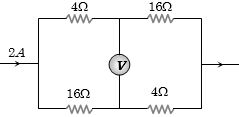
In the circuit shown below, The reading of the voltmeter $V$ is ...........
  • $12$
  • B
    $8$
  • C
    $20$
  • D
    $16$
Answer
Correct option: A.
$12$
a
(a) In the following circuit potential difference between
$C$ and $A$ is ${V_C} - {V_A} = 1 \times 4 = 4$ ……$(i)$
$C$ and $B$ is ${V_C} - {V_B} = 1 \times 16 = 16$ ……$(ii)$
On solving equations $(i)$ and $(ii)$ we get
${V_A} - {V_B} = 12\,V$.
View full question & answer
MCQ 4201 Mark
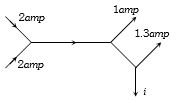
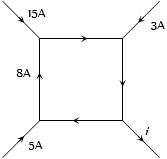
The figure below shows currents in a part of electric circuit. The current $i$ is ............. $amp$
  • $1.7$
  • B
    $3.7$
  • C
    $1.3$
  • D
    $1$
Answer
Correct option: A.
$1.7$
a
According to Kirchhoff's first law

At junction $A$, ${i_{AB}} = 2 + 2 = 4\,A$

At junction $B$, ${i_{AB}} = {i_{BC}} - 1 = 3\,A$

At junction $C$, $i = {i_{BC}} - 1.3 = 3 - 1.3 = 1.7\,A$
View full question & answer
MCQ 4211 Mark
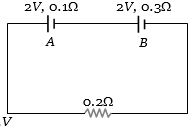
The internal resistances of two cells shown are $0.1\,\Omega $ and $0.3\,\Omega $. If $R = 0.2\,\Omega $, the potential difference across the cell
  • $B$ will be zero
  • B
    $A$ will be zero
  • C
    $A$ and $B$ will be $2\,V$
  • D
    $A$ will be $ > 2\,V$ and $B$ will be $ < 2\,V$
Answer
Correct option: A.
$B$ will be zero
a
 Applying Kirchhoff law

$(2 + 2) = (0.1 + 0.3 + 0.2)i$ $ \Rightarrow $ $i = \frac{{20}}{3}\,A$

Hence potential difference across $A$

$ = 2 - 0.1 \times \frac{{20}}{3} = \frac{4}{3}\,V$ (less than $2\,V$)

Potential difference across $B = 2 - 0.3 \times \frac{{20}}{3} = 0$
View full question & answer
MCQ 4221 Mark
The figure shows a network of currents. The magnitude of currents is shown here. The current $i$ will be ................. $A$
  • A
    $3 $
  • B
    $13$
  • $23$
  • D
    $-3$
Answer
Correct option: C.
$23$
c
(c) By Kirchhoff's current law.
View full question & answer
MCQ 4231 Mark
In the circuit element given here, if the potential at point $B$, $V_B = 0$, then the potentials of $A$ and $D$ are given as
  • A
    ${V_A} = - 1.5\,V,\,{V_D} = + 2\,V$
  • B
    ${V_A} = + 1.5\,V,\,{V_D} = + 2\,V$
  • C
    ${V_A} = + 1.5\,V,\,{V_D} = + 0.5\,V$
  • ${V_A} = + 1.5\,V,\,{V_D} = - 0.5\,V$
Answer
Correct option: D.
${V_A} = + 1.5\,V,\,{V_D} = - 0.5\,V$
d
 Potential difference between $A$ and $B$

${V_A} - {V_B} = 1 \times 1.5$

$ \Rightarrow \,\,\,{V_A} - 0 = 1.5\,V \Rightarrow {V_A} = 1.5\,V$

Potential difference between $B$ and $C$

${V_B} - {V_C} = 1 \times 2.5 = 2.5\,V$

$ \Rightarrow 0 - {V_C} = 2.5\,V \Rightarrow {V_C} = - 2.5\,V$

Potential difference between $C$ and $D$

${V_C} - {V_D} = - 2V$$ \Rightarrow \,\,\, - 2.5 - {V_D} = - 2 \Rightarrow \,{V_D} = - 0.5\,V.$

View full question & answer
MCQ 4241 Mark
The figure here shows a portion of a circuit. What are the magnitude and direction of the current i in the lower right-hand wire .................... $A$
  • A
    $7$
  • $8 $
  • C
    $6$
  • D
    $2$
Answer
Correct option: B.
$8 $
b
(b) By using Kirchoff's junction law as shown below.
View full question & answer
MCQ 4251 Mark
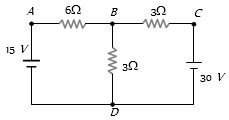
In the circuit shown in figure, find the current through the branch $BD$ ............. $A$
  • $5$
  • B
    $0$
  • C
    $3$
  • D
    $4$
Answer
Correct option: A.
$5$
a
The current in the circuit are assumed as shown in the fig.

Applying $KVL$ along the loop $ABDA$, we get

$-6i_1 -3 i_2 + 15 = 0$   or   $2i_1 + i_2 = 5$  …..  $(i)$

Applying $KVL$ along the loop $BCDB$, we get

$-3(i_1 -i_2) -30 + 3i_2 = 0$   or   $-i_1 + 2i_2 = 10$  …..  $(ii)$

Solving equation $(i)$ and $(ii)$ for $i_2$, we get $i_2 = 5\, A$.
View full question & answer
MCQ 4261 Mark
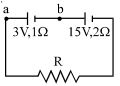
Two batteries one of the $\mathrm{emf}$ $3\,V$, internal resistance $1$ ohm and the other of $\mathrm{emf}$ $15\, V$, internal resistance $2$ $\mathrm{ohm}$ are connected in series with a resistance $R$ as shown. If the potential difference between $a$ and $b$ is zero the resistance of $R$ in $\mathrm{ohm}$ is
  • A
    $5$
  • B
    $7$
  • $3$
  • D
    $1$
Answer
Correct option: C.
$3$
c
Let the current $I$ will flow in the anticlockwise direction.

By $KVL,$ $15+3=(1+2+R) I$ or $I=\frac{18}{3+R}$

Here, $V_{a b}=0$

or $3-1 I=0$

or $3=I=\frac{18}{3+R}$

or $R=3 \Omega$
View full question & answer
MCQ 4271 Mark
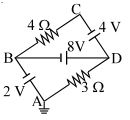
The figure shows a network of resistances in which the point $A$ is earthed. The point which has the least potential is
  • A
    $A$
  • $B$
  • C
    $C$
  • D
    $D$
Answer
Correct option: B.
$B$
b
View full question & answer
MCQ 4281 Mark
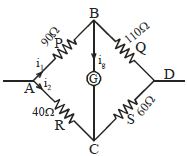
In a Wheatstone bridge, $P = 90\,\Omega $, $Q = 110\,\Omega $ , $R = 40\,\Omega $ and $S = 60\,\Omega $  and a cell of $4\,V\,emf$. Then the potential difference between the diagonal along which a galvanometer is connected is ............. $V$
  • A
    $0$
  • $0.2$
  • C
    $0.5$
  • D
    $1$
Answer
Correct option: B.
$0.2$
b
$\mathrm{V}_{\mathrm{A}}-\mathrm{V}_{\mathrm{B}}=\mathrm{V}_{\mathrm{AB}}=\frac{4}{90+110} \times 90=\frac{9}{5}$            ............$(i)$

$\mathrm{V}_{\mathrm{A}}-\mathrm{V}_{\mathrm{C}}=\mathrm{V}_{\mathrm{AC}}=\frac{4}{40+60} \times 40=\frac{8}{5}$         .........$(ii)$

eq. $(i)$ $-$ eq. $(ii)$

$\Rightarrow \mathrm{V}_{\mathrm{c}}-\mathrm{V}_{\mathrm{B}}=\frac{9}{5}-\frac{8}{5}=\frac{1}{5}=0.2 \mathrm{\,V}$
View full question & answer
MCQ 4291 Mark
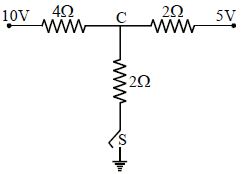
As the switch $S$ is closed in the circuit shown in figure, current passed through it is ............. 
  • A
    $0$
  • B
    $1$
  • $2$
  • D
    $1.6$
Answer
Correct option: C.
$2$
c
Let $\mathrm{V}$ be the potential at $\mathrm{C}.$

Using Kirchhoff's first law, $ \mathrm{i}_{1}+\mathrm{i}_{2}=\mathrm{i}_{3}$

$\frac{10-V}{4}+\frac{5-V}{2}=\frac{V-0}{2}$

$\Rightarrow \mathrm{V}=4 \mathrm{\,V}$

$\therefore \mathrm{i}_{3}=\frac{\mathrm{V}-0}{2}=\frac{4-0}{2}=2 \mathrm{\,A}$
View full question & answer
MCQ 4301 Mark
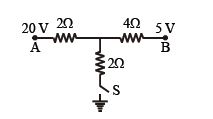
As the switch $S$ is closed in the circuit shown in figure, current passing through it is ................ $\mathrm{A}$
  • $4.5$
  • B
    $6$
  • C
    $3$
  • D
    $0$
Answer
Correct option: A.
$4.5$
a
By $\mathrm{KCL},$ $\quad \mathrm{I}_{1}+\mathrm{I}_{2}+\mathrm{I}_{3}=0$

$\Rightarrow \frac{\mathrm{V}-20}{2}+\frac{\mathrm{V}-5}{4}+\frac{\mathrm{V}-0}{2}=0$

$\Rightarrow \mathrm{V}=9 \mathrm{\,Volt}$

Therefore $\mathrm{I}_{3}=\frac{\mathrm{V}}{2}=\frac{9}{2}=4.5 \mathrm{\,A}$
View full question & answer
MCQ 4311 Mark
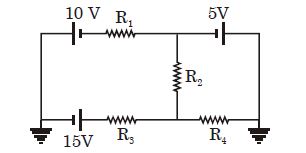
In the circuit shown, current through $R_2$ is zero. If $R_4 = 2\,\Omega $ and $R_3 = 4\,\Omega $ , current through $R_3$ will be ................. $\mathrm{A}$
  • A
    $1.5$
  • $5$
  • C
    $3.15$
  • D
    $3.5$
Answer
Correct option: B.
$5$
b
Current through $\mathrm{R}_{3}=\frac{15-(-5)}{4}=5 \mathrm{\,A}$
View full question & answer
MCQ 4321 Mark
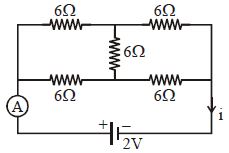
Reading of ammeter in ampere for the following circuit is
  • A
    $33$
  • B
    $3.3$
  • $0.33$
  • D
    $0$
Answer
Correct option: C.
$0.33$
c
Applying Kirchhoffs law

for loop $ABCDEA:$ $2 i_{1}+2\left(i_{1}+i_{2}\right)=2 \Rightarrow 2 i_{1}+i_{2}=1 \ldots . .(1)$

for loop $HCDFGH:$ $2\left(i_{1}+i_{2}\right)+2 i_{2}=2 \Rightarrow i_{1}+2 i_{2}=1 \ldots . .(2)$

From $(1)$ and $(2),$ $i_{1}+2\left(1-2 i_{1}\right)=1$ or $-3 i_{1}=-1 \Rightarrow i_{1}=1 / 3 A$

and $i_{2}=1-2(1 / 3)=1 / 3 A$
View full question & answer
MCQ 4331 Mark
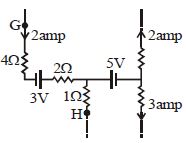
In the part of a circuit shown in the figure, the potential difference $(V_G -V_H)$ between points $G$ and $H$ will be ............... $V$
  • $6$
  • B
    $15$
  • C
    $7$
  • D
    $3$
Answer
Correct option: A.
$6$
a
Current through $\mathrm{H}=5-2=3 \mathrm{\,A}$

$\mathrm{V}_{\mathrm{G}}-\mathrm{V}_{\mathrm{H}}=4 \times 2-3+2 \times 2-3 \times 1$

$=8-3+4-3=6 \mathrm{\,V}$

View full question & answer
MCQ 4341 Mark
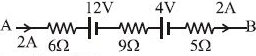
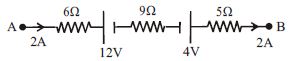
The potential difference between $A$ and $B$ in the Figure is ................. $V$
  • A
    $24$
  • B
    $14$
  • C
    $32$
  • $48$
Answer
Correct option: D.
$48$
d
Applying $\mathrm{KVI}$

$\mathrm{V}_{\mathrm{A}}-12-12-18+4-10=\mathrm{V}_{\mathrm{B}}$

$\Rightarrow \mathrm{V}_{\mathrm{A}}-\mathrm{V}_{\mathrm{B}}=48 \mathrm{\,V}$
View full question & answer
MCQ 4351 Mark
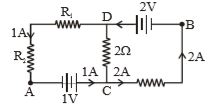
In the circuit shown below, if the potential at point $A$ is taken to be zero, the potential at point $B$ is .............. $V$
  • $+1$
  • B
    $-1$
  • C
    $+2$
  • D
    $-2$
Answer
Correct option: A.
$+1$
a
$\mathrm{V}_{\mathrm{B}}-\mathrm{V}_{\mathrm{A}}=\left(\mathrm{V}_{\mathrm{B}}-\mathrm{V}_{\mathrm{D}}\right)+\left(\mathrm{V}_{\mathrm{D}}-\mathrm{V}_{\mathrm{C}}\right)+\left(\mathrm{V}_{\mathrm{C}}-\mathrm{V}_{\mathrm{A}}\right)$

$=-2+2+1=+1$ $\mathrm{volt}$

View full question & answer
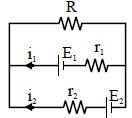
MCQ 4361 Mark
See the electrical circuit shown in the adjoining figure. Which of the following equation is a correct equation for it
  • A
    $E_2 -i_2r_2 -E_1 -i_1r_1 = 0$
  • B
    $-E_2 -(i_1 + i_2)R + i_2r_2 = 0$
  • C
    $E_1 -(i_1 + i_2)R + i_1r_1 = 0$
  • $E_1 -(i_1 + i_2)R -i_1r_1 = 0$
Answer
Correct option: D.
$E_1 -(i_1 + i_2)R -i_1r_1 = 0$
d
Applying Kirchhoff's equation to the loop $\mathrm{ABFE},$ 

$-\left(\mathrm{i}_{1}+\mathrm{i}_{2}\right) \mathrm{R}-\mathrm{i}_{1} \mathrm{r}_{1}+\mathrm{E}_{1}=0$

or $\mathrm{E}_{1}-\left(\mathrm{i}_{1}+\mathrm{i}_{2}\right) \mathrm{R}-\mathrm{i}_{1} \mathrm{r}_{1}=0$
View full question & answer
MCQ 4371 Mark
The potential difference between $A$ and $B$ in the Figure is .............. $V$
  • A
    $24$
  • B
    $14$
  • C
    $32$
  • $48$
Answer
Correct option: D.
$48$
d
$V_A -20\times2 -12 + 4 = V_B$
$V_A -V_B = 48\, V$
View full question & answer
MCQ 4381 Mark
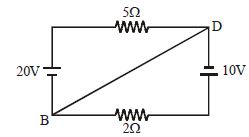
Calculate the current in wire $BD$ ................ $A$
  • A
    $0$
  • $1$
  • C
    $2$
  • D
    $5$
Answer
Correct option: B.
$1$
b
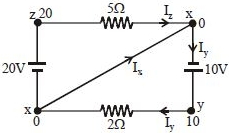
Taking potential of point $\mathrm{x}$ is zero potential of $\mathrm{y}$ would be $10$ while of $\mathrm{z}$ would be $20 .$ Current will flow from hight to low potential.

$I_{y}=\frac{10-0}{2}=5 \,A$

$I_{2}=\frac{20-0}{5}=4 \,A$

applying $\mathrm{KCL}$ at $\mathrm{X}$

$I_{z}+I_{x}=I_{y}$

$4+I_{x}=I_{y}=5$

$ \Rightarrow \boxed{{{\text{r}}_{\text{x}}} = 1\,{\text{A}}}$
View full question & answer
MCQ 4391 Mark
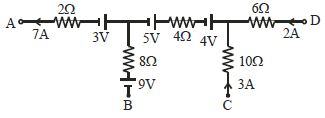
In a portion of some large electrical network, curents in certain branches are known as shown in figure The value of $V_A -V_C$ is ............... $V$
  • A
    $76$
  • $-76$
  • C
    $-58$
  • D
    $-52$
Answer
Correct option: B.
$-76$
b
View full question & answer
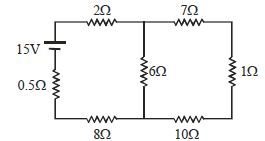
MCQ 4401 Mark
The current from the battery in the given circuit is ................ $A$
  • $1$
  • B
    $1.5$
  • C
    $2$
  • D
    $3$
Answer
Correct option: A.
$1$
a
According to figure,

Applying Kirchhoffs law in mash $(I)$

$2 i_1+6 i_1-6 i_2+8 i_1+0.5 i_1-15=0$

$16.5 i_1-6 i_2=15 \ldots . \text { (I) }$

Applying Kirchhoff's law in mash $(II)$

$7 i _2+ i _2+10 i _2+6 i _2-6 i _1=0$

$24 i _2-6 i _1=0$

$4 i _2- i _1=0$

$i _1=4 i _2 \ldots \ldots \text { (II) }$

After solving of equation $(I)$ and $(II)$

Then,

$16.5 \times 4 i _2-6 i _2=15$

$66 i _2-6 i _2=15$

$60 i _2=15$

$i _2=\frac{1}{4} A$

Now put the value of $i_2$ in equation $(I)$

$i_1=4 i_2$

$i_1=4 \times \frac{1}{4}$

$i_1=1\,\,A$

Now, the current from the battery in the circuit is $1\,\,A$.
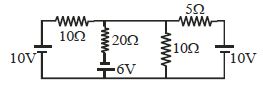
View full question & answer
MCQ 4411 Mark
The value of current through $20\,\Omega $ resistor is .................. $A$
  • A
    $1.2$
  • B
    $0.3$
  • $0.6$
  • D
    $1.8$
Answer
Correct option: C.
$0.6$
c
Let the potential of common point is $\mathrm{O}$ and potential of all other points are as shown in figure

$\frac{x-10}{10}+\frac{x+6}{20}+\frac{x}{10}+\frac{x-10}{5}=0$

$\Rightarrow \mathrm{x}=6 \mathrm{\,V} \quad \therefore 1_{20\, \Omega}=\frac{6+6}{20}=0.6 \mathrm{\,A}$
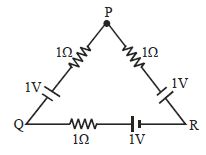
View full question & answer
MCQ 4421 Mark
In given circuit find potential difference between $P$ and $Q$ .................. $V$
  • $0$
  • B
    $1$
  • C
    $2$
  • D
    $\frac{2}{3}$
Answer
Correct option: A.
$0$
a
$\mathrm{I}=\frac{3}{3}=1 \mathrm{\,A},$ from kirchoff's rule

$\mathrm{V}_{\mathrm{P}}+1-1=\mathrm{V}_{\mathrm{Q}}$

$\mathrm{V}_{\mathrm{P}}-\mathrm{V}_{\mathrm{Q}}=0$
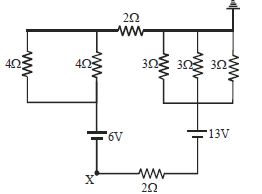
View full question & answer
MCQ 4431 Mark
Find potential at point $'x'$ in given circuit ............... $V$
  • A
    $10$
  • $-10$
  • C
    $-11$
  • D
    $-9$
Answer
Correct option: B.
$-10$
b
$I=\frac{7}{7}=1 \,A$

from kirchoff's rule

$\mathrm{V}_{\mathrm{x}}+6+2+2=0 \quad \Rightarrow \quad \mathrm{V}_{x}=-10$ $\mathrm{volt}$
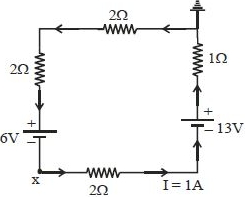
View full question & answer
MCQ 4441 Mark
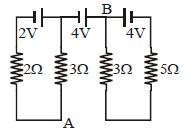
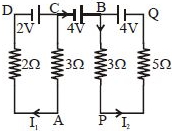
In the given circuit calculate potential difference between $A$ and $B$ ............... $\mathrm{V}$
  • A
    $-5.8$
  • B
    $-4.6$
  • C
    $-5.8$
  • $-5.2$
Answer
Correct option: D.
$-5.2$
d
$\mathrm{K.V}$ $\mathrm{.L.}$ on left mesh

${2-3 \mathrm{I}_{1}-2 \mathrm{I}_{1}=0} $

${\mathrm{I}_{1}=0.4 \mathrm{\,amp}}$

$\mathrm{K.V.L.}$ on right mesh

$4-3 I_{2}-5 I_{2}=0$

$\mathrm{I}_{2}=0.5 \mathrm{\,amp}$

Potential difference between $A $ and $ B$

${\mathrm{V}_{\mathrm{A}}+3 \mathrm{I}_{1}+4=\mathrm{V}_{\mathrm{B}}} $

${\mathrm{V}_{\mathrm{A}}-\mathrm{V}_{\mathrm{B}}=-3(\mathrm{O} .4)-4=-5.2 \mathrm{\,V}}$
View full question & answer
MCQ 4451 Mark
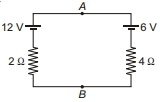
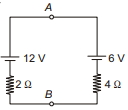
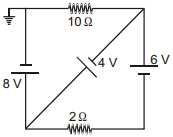
Potential difference across $A B$ i.e., $V_A-V_B$ is ......... $V$
  • $10$
  • B
    $8$
  • C
    $6$
  • D
    $0$
Answer
Correct option: A.
$10$
a
(a)

$6=6 i$

$i=1 A$

$\Delta V=6+4$

$\Delta V=10$
View full question & answer
MCQ 4461 Mark
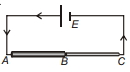
In the circuit shown in figure, all cells are ideal. The current through $2 \,\Omega$ resistor is ............ $A$
  • $5$
  • B
    $1$
  • C
    $0.2$
  • D
    $0$
Answer
Correct option: A.
$5$
a
(a)

$V_A-4-6=V_B$

$V_A-V_B=w$

$10=i(2)$

$i=5 \,A$
View full question & answer
MCQ 4471 Mark
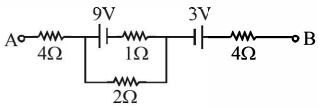
In the following diagram, the lengths of wires $A B$ and $B C$ are equal, but the radius of wire $A B$ is double that of $B C$. The ratio of potential gradient on wires $A B$ and on $B C$ will be (wires are made of same material)
  • A
    $4: 1$
  • $1: 4$
  • C
    $2: 1$
  • D
    $1: 1$
Answer
Correct option: B.
$1: 4$
b
(b)

$=\frac{R}{4}$

$i=\frac{4 E}{5 R}$

$\Delta V_1=\frac{E}{5}$

$\Delta V_2=\frac{4 E}{5}$

$\Delta V_1=\Delta V_2$

$=1: 4$
View full question & answer
MCQ 4481 Mark
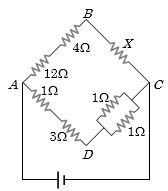
In the circuit shown in figure potential difference between points A and $B$ is $16\,V$. the current passing through $2 \Omega$ resistance will be $...........\,A$
  • A
    $2.5$
  • $3.5$
  • C
    $4.0$
  • D
    $0$
Answer
Correct option: B.
$3.5$
b
(b)

$\therefore 4 i _1+2\left( i _1+ i _2\right)-3+4 i _1=16\, V$

Using Kirchhoff's second law in the closed loop we have

$9-i_2-2\left(i_1+i_2\right)=0$

Solving equations $(i)$ and $(ii)$, we get $i _1=1.5 A ^{\text {and } i _2}=2 A$

$\therefore$ current through $2 W$ resistor $=2+1.5=3.5\,A$.
View full question & answer
MCQ 4491 Mark
In the circuit shown in the adjoining figure, the current between $B$ and $D$ is zero, the unknown resistance is of ................ $\Omega$
  • A
    $4$
  • $2$
  • C
    $3$
  • D
    $\mathrm{emf}.$ of a cell is required to find the value of $X$
Answer
Correct option: B.
$2$
b
(b) By balanced Wheatstone bridge condition $\frac{{16}}{X} = \frac{4}{{0.5}}$

$ \Rightarrow $  $X = \frac{8}{4} = 2\,\Omega $
View full question & answer
MCQ 4501 Mark
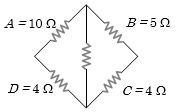
In a typical Wheatstone network, the resistances in cyclic order are $A = 10 \,\Omega $, $B = 5 \,\Omega $, $C = 4 \,\Omega $ and $D = 4 \,\Omega $ for the bridge to be balanced
  • $10 \,\Omega $ should be connected in parallel with $A$
  • B
    $10 \,\Omega $ should be connected in series with $A$
  • C
    $5 \,\Omega $ should be connected in series with $B$
  • D
    $5 \,\Omega $ should be connected in parallel with $B$
Answer
Correct option: A.
$10 \,\Omega $ should be connected in parallel with $A$
a
For a balance Wheatstone bridge.

$\frac{A}{B} = \frac{D}{C} \Rightarrow \frac{{10}}{5} \ne \frac{4}{4}$ (Unbalanced)

$\frac{{A'}}{B} = \frac{D}{C} \Rightarrow \frac{{A'}}{5} = \frac{4}{4}$$ \Rightarrow $ $A' = 5\,\Omega $

$A'$ $(5\,\Omega )$ is obtained by connecting a $10\,\Omega $ resistance in parallel with $A$.

View full question & answer