MCQ
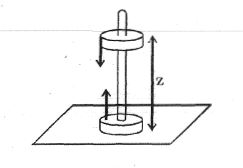
A donut-shaped permanent magnet (magnetization parallel to the axis) can slide frictionlessly on a vertical rod. Treat the magnets as  dipoles with mass $m_d$ and dipole moment $M$ . When we put two back to back magnets on the rod the upper one will float. At what height $z$ does it float?
  • A
    ${\left[ {\frac{{2{\mu _0}{M^2}}}{{3\pi {m_d}g}}} \right]^{1/4}}$
  • B
    ${\left[ {\frac{{6{\mu _0}{M^2}}}{{\pi {m_d}g}}} \right]^{1/4}}$
  • ${\left[ {\frac{{3{\mu _0}{M^2}}}{{2\pi {m_d}g}}} \right]^{1/4}}$
  • D
    ${\left[ {\frac{{{\mu _0}{M^2}}}{{6\pi {m_d}g}}} \right]^{1/4}}$
Answer

Correct option: C.
${\left[ {\frac{{3{\mu _0}{M^2}}}{{2\pi {m_d}g}}} \right]^{1/4}}$
c
Force between two magnetic dipoles parallel to each. $=\vec{\mathrm{F}}_{\mathrm{ab}}=\frac{3 \mu_{0}}{2 \pi r^{4}}\left(\vec{\mathrm{m}}_{\mathrm{e}} \overrightarrow{\mathrm{m}}_{\mathrm{b}}\right) \hat{\mathrm{r}}$

$|\overrightarrow{\mathrm{F}}|=\mathrm{mg}$

$\therefore \frac{3 \mu_{0}}{2 \pi r^{4}}\left(\mathrm{m}_{\mathrm{b}} \mathrm{m}_{\mathrm{a}}\right)=\mathrm{mg}$

$r=\left(\frac{3 \mu_{0} m^{2}}{2 \pi m g}\right)^{1 / 4}$

Need a full question paper?

Generate a complete, print-ready paper with questions like this in minutes — across 16+ boards, with answer keys.

Start Generating Free

Similar questions

Consider the following statements $\mathrm{A}$ and $\mathrm{B}$ and identify the correct answer:

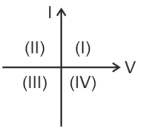
$A$. For a solar-cell, the $I-V$ characteristics lies in the $IV$ quadrant of the given graph.

$B$. In a reverse biased $p n$ junction diode, the current measured in $(\mu \mathrm{A})$, is due to majority charge carriers.

In series $LCR$ circuit, the capacitance is changed from $\mathrm{C}$ to $4 \mathrm{C}$. To keep the resonance frequency unchanged, the new inductance should be :
The kinetic energy of electron in the first Bohr orbit of the hydrogen atom is
Which is not true with respect to the cathode rays
Two resistors $400\, \Omega$ and $800\, \Omega$ are connected in series across a $6 V$ battery. The potential difference measured by a voltmeter of $10\, k \Omega$ across $400\, \Omega$ resistor is close to$....V$
Consider the following statements ( $X$ and $Y$ stand for two different elements):

$(I)$ ${ }_{32}^{65} X$ and ${ }_{33}^{65} Y$ are isotopes.

$(II)$ ${ }_{42}^{86} X$ and ${ }_{42}^{85} Y$ are isotopes.

$(III)$ ${ }_{85}^{174} X$ and ${ }_{88}^{177} Y$ have the same number of neutrons.

$(IV)$ ${ }_{92}^{235} X$ and ${ }_{94}^{235} Y$ are isobars.

Which of the above statements are correct?

An example of a diamagnetic substance is
A stream of a positively charged particles having $\frac{ q }{ m }=2 \times 10^{11} \frac{ C }{ kg }$ and velocity $\overrightarrow{ v }_0=3 \times 10^7 \hat{ i ~ m} / s$ is deflected by an electric field $1.8 \hat{ j } kV / m$. The electric field exists in a region of $10 cm$ along $x$ direction. Due to the electric field, the deflection of the charge particles in the $y$ direction is $...........mm$
Given below are two statements.

Statement $I$ : Electric potential is constant within and at the surface of each conductor.

Statement $II$ : Electric field just outside a charged conductor is perpendicular to the surface of the conductor at every point.

In the light of the above statements, choose the most appropriate answer from the options give below.

The given graph represents $V-I$ characteristic for a semiconductor device. Which of the following statement is correct?