MCQ 511 Mark
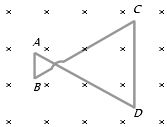
A conducting wire frame is placed in a magnetic field which is directed into the paper. The magnetic field is increasing at a constant rate. The directions of induced current in wires $AB$ and $CD$ are
- ✓
$B$ to $A$ and $D$ to $C$
- B
$A$ to $B$ and $C$ to $D$
- C
$A$ to $B$ and $D$ to $C$
- D
$B$ to $A$ and $C$ to $D$
AnswerCorrect option: A. $B$ to $A$ and $D$ to $C$
a
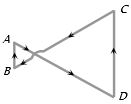
(a) Inward magnetic field $(×)$ increasing. Therefore, induced current in both the loops should be anticlockwise. But as the area of loop on right side is more, induced emf in this will be more compared to the left side loop $\left( {e = - \frac{{d\phi }}{{dt}} = - A.\frac{{dB}}{{dt}}} \right)$. Therefore net current in the complete loop will be in a direction shown below. Hence only option $(a)$ is correct.
View full question & answer→MCQ 521 Mark
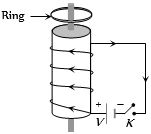
A conducting ring is placed around the core of an electromagnet as shown in fig. When key $K$ is pressed, the ring
- A
- B
Is attracted towards the electromagnet
- ✓
- D
Answerc
(c) When key $k$ is pressed, current through the electromagnet start increasing i.e. flux linked with ring increases which produces repulsion effect.
View full question & answer→MCQ 531 Mark
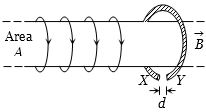
A highly conducting ring of radius $R$ is perpendicular to and concentric with the axis of a long solenoid as shown in fig. The ring has a narrow gap of width d in its circumference. The solenoid has cross sectional area A and a uniform internal field of magnitude $B_0$. Now beginning at $t = 0$, the solenoid current is steadily increased to so that the field magnitude at any time t is given by $B(t)$ = $B_0$ + $\alpha$t where $\alpha > 0$. Assuming that no charge can flow across the gap, the end of ring which has excess of positive charge and the magnitude of induced $e.m.f$. in the ring are respectively
AnswerCorrect option: A. $X, \,A$ $\alpha$
a
(a) Since the current is increasing, so inward magnetic flux linked with the ring also increasing (as viewed from left side). Hence induced current in the ring is anticlockwise, so end $x$ will be positive.
Induced emf $|e| = A\frac{{dB}}{{dt}} = A\frac{d}{{dt}}({B_o} + \alpha t)$
$ \Rightarrow |e| = A\alpha $
View full question & answer→MCQ 541 Mark
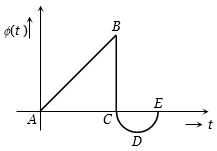
The graph Shows the variation in magnetic flux $\phi (t)$ with time through a coil. Which of the statements given below is not correct
- A
There is a change in the direction as well as magnitude of the induced emf between $B $ and $D$
- B
The magnitude of the induced emf is maximum between $B$ and $C$
- C
There is a change in the direction as well as magnitude of induced emf between $A$ and $C$
- ✓
The induced emf is zero at $B$
AnswerCorrect option: D. The induced emf is zero at $B$
d
(d) At $B$, flux is maximum, so from $|e| = \frac{{d\phi }}{{dt}}$ at $B$ $|e| = 0$
View full question & answer→MCQ 551 Mark
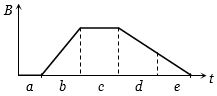
The graph gives the magnitude $B(t)$ of a uniform magnetic field that exists throughout a conducting loop, perpendicular to the plane of the loop. Rank the five regions of the graph according to the magnitude of the emf induced in the loop, greatest first
- A
$b > (d = e) < (a = c)$
- ✓
$b > (d = e) > (a = c)$
- C
$b < d < e < c < a$
- D
$b > (a = c) > (d = e)$
AnswerCorrect option: B. $b > (d = e) > (a = c)$
b
(b)Induced emf $e = A\frac{{dB}}{{dt}}$
i.e. $e \propto \frac{{dB}}{{dt}}$ (= slope of $B -t $ graph)
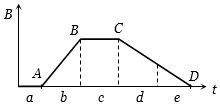
In the given graph slope of $AB >$ slope of $CD$, slope in the ‘$a$’ region = slope in the ‘$c$’ region = $0$, slope in the $‘d$’ region = slope in the ‘$e$’ region $ \ne 0$. That’s why $b > (d = e) > (a = c)$
View full question & answer→MCQ 561 Mark
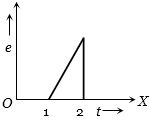
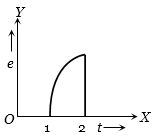
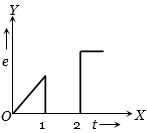
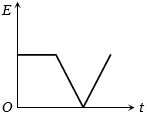
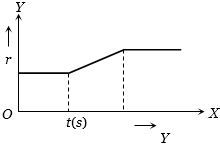
A flexible wire bent in the form of a circle is placed in a uniform magnetic field perpendicular to the plane of the coil. The radius of the coil changes as shown in figure. The graph of induced emf in the coil is represented by
Answerb
(b ) $\phi = BA$$ = B \times \pi {r^2}$
$\therefore \phi \propto {r^2} \Rightarrow \phi = k{r^2}$ ( $k = constant$)
$\therefore e = \frac{{d\phi }}{{dt}} = k.2r\frac{{dr}}{{dt}}$
From $0 -1$, $r$ is constant, $\frac{{dr}}{{dt}} = 0$ hence, $e = 0$
From $1 -2$, $r = \alpha t,$ $\frac{{dr}}{{dt}} = \alpha $ hence $e \propto r$==> $e \propto t$
From $2 -3$, again $r$ is constant, $\frac{{dr}}{{dt}} = 0$ hence $e = 0$
View full question & answer→MCQ 571 Mark
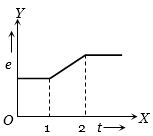
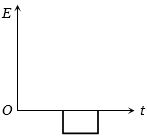
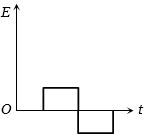
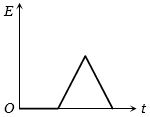
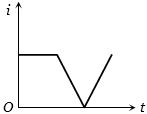
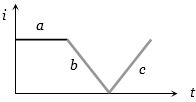
The current $i$ in an induction coil varies with time $t$ according to the graph shownin figure. Which of the following graphs shows the induced emf $(E$) in the coil with time
Answerc
(c) Emf induces during ‘$a$’ = $0$
emf induced during ‘$b$’ is constant throughout emf induced during ‘$c$’ is constant throughout magnitude of emf induced during ‘$b$’ is equal to the magnitude of emf induced during ‘$c$’. But the direction opposite.
View full question & answer→MCQ 581 Mark
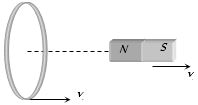
A circular coil and a bar magnet placed near by are made to move in the same direction. The coil covers a distance of $1\, m$ in $0.5\, sec$ and the magnet a distance of $2\, m$ in $1\, sec$. The induced emf produced in the coil.....$V$
- ✓
$0$
- B
$1$
- C
$0.5$
- D
Cannot be determined from the given information
Answera
(a) Speed of the magnet
${v_1} = \frac{2}{1} = 2\,m/s$
Speed of the coil
${v_2} = \frac{1}{{0.5}} = 2\,m/s$
Relative speed between coil and magnet is zero, so there is no induced emf in the coil.
View full question & answer→MCQ 591 Mark
A small coil is introduced between the poles of an electromagnet so that its axis coincides with the magnetic field direction. The number of turns is $n$ and the cross sectional area of the coil is $A$. When the coil turns through $180^o$ about its diameter, the charge flowing through the coil is $Q$. The total resistance of the circuit is $R$. What is the magnitude of the magnetic induction
- A
$\frac{{QR}}{{nA}}$
- B
$\frac{{2QR}}{{nA}}$
- C
$\frac{{Qn}}{{2RA}}$
- ✓
$\frac{{QR}}{{2nA}}$
AnswerCorrect option: D. $\frac{{QR}}{{2nA}}$
d
(d) Induced charge $Q = - \frac{{NBA}}{R}(\cos {\theta _2} - \cos {\theta _1})$
$ = - \frac{{NBA}}{R}(\cos {180^o} - \cos {0^o})$ ==> $B = \frac{{QR}}{{2NA}}$
View full question & answer→MCQ 601 Mark
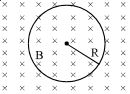
$a$ conducting loop of radius $R$ is present in a uniform magnetic field $B$ perpendicular the plane of the ring. If radius $R$ varies as a function of time $‘t’$, as $R = R_0+ t$. The $e.m.f$ induced in the loop is
- A
$2\pi (R_0 + t)B$ clockwise
- B
$\pi (R_0 + t)B$ clockwise
- ✓
$2\pi (R_0 + t)B$ anticlockwise
- D
AnswerCorrect option: C. $2\pi (R_0 + t)B$ anticlockwise
c
Given $R=\left(R_{0}\right)+t$
$A=\pi R^{2}=\pi\left(R_{0}+t\right)^{2}, \frac{d A}{d t}=2 \pi\left(R_{0}+t\right)$
therefore, emf induced in the loop is
$e=B \frac{d A}{d t}=2 \pi\left(R_{0}+t\right) B$
since area is increasing, induced emf is in anticlockwise sense to oppose the chang in flux.
View full question & answer→MCQ 611 Mark
A square wire loop of $10.0\, cm$ side lies at right angles to a uniform magnetic field of $20\,T$. A $\,10\, V$ light bulb is in a series with the loop as shown in the fig. The magnetic field is decreasing steadily to zero over a time interval $\Delta t$. The bulb will shine with full brightness if $\Delta t$ is equal to.......$ms$
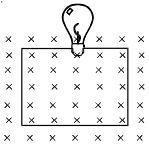
Answera
$e=-\frac{\Delta \phi}{\Delta t}=\frac{\phi_{i}-\phi_{f}}{\Delta t}$
$\delta t=\frac{\phi_{i}-\phi_{f}}{e}=\frac{B A-0}{e}=\frac{20 \times 10^{-2}}{10}$
$=20 \times 10^{-3} \mathrm{sec}=20 \mathrm{ms}$
View full question & answer→MCQ 621 Mark
$A$ closed planar wire loop of area $A$ and arbitrary shape is placed in a uniform magnetic field of magnitude $B$, with its plane perpendicular to magnetic field. The resistance of the wire loop is $R$. The loop is now turned upside down by $180^o$ so that its plane again becomes perpendicular to the magnetic field. The total charge that must have flowed through the wire ring in the process is
- A
$< AB/R$
- B
$= AB/R$
- ✓
$= 2AB/R$
- D
AnswerCorrect option: C. $= 2AB/R$
c
induced emf $=\frac{d(f l u x)}{d t}=R \frac{d q}{d t}$
$\Rightarrow \Delta q=\frac{\Delta(f l u x)}{R}=\frac{2 B A}{R}$
View full question & answer→MCQ 631 Mark
A square coil $ABCD$ is placed in $x-y$ plane with its centre at origin. $A$ long straight wire, passing through origin, carries a current in negative $z$ -direction. Current in this wire increases with time. The induced current in the coil is :
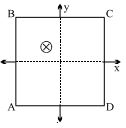
Answerc
As magnetic field lines due to current carrying wire is along the surface and hence,
$\phi=\overrightarrow{ B } \cdot \overrightarrow{ A }= BA \cos 90^{\circ}=0$
View full question & answer→MCQ 641 Mark
A vertical bar magnet is dropped from position on the axis ofafixed metallic coil as shown in fig $- I$. In fig $- II$ the magnet is fixed and horizontal coil is dropped. The acceleration of the magnet and coil are $a_1$ and $a_2$ respectively then
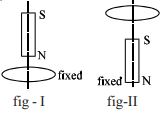
- A
$a_1 > g , a_2 > g$
- B
$a_1 > g , a_2 < g$
- ✓
$a_1 < g , a_2 < g$
- D
$a_1 < g , a_2 > g$
AnswerCorrect option: C. $a_1 < g , a_2 < g$
c
When a bar magnet is dropped across a current carrying coil, emf is induced in the coil. emf appears as pulses when the bar magnet enters the loop and exits the loop. Induced emf is equal in magnitude to rate of change of magnetic flux but sign of emf is opposite to sign of flux change if flux increases emf is negative and if the flux decreases then emf is positive. when the bar magnet enters there is a change in magnetic flux across the coil and flux increases hence induced emf is negative. Similarly when the bar magnet its, induce emf is positive. when the bar magnet is fully inside there will not be any flux change and no induced emf in the coil When the bar magnet enters emf induced in the coil and creates induced current and induced magnetic field. This induced magnetic field opposes the magnetic filed of bar magnet and reduces the falling speed of bar magnet. Due to this bar magnet entrance will present more time with coil and we get longer pulse. When bar magnet leaves this slowing effect is reduced and speed of falling magnet will be more. Hence at the time of exit the pulse length of induced emf is shorter.
View full question & answer→MCQ 651 Mark
Two identical conductors $P$ and $Q$ are placed on two frictionless rails $R$ and $S$ in a uniform magnetic field directed into the plane. If $P$ is moved in the direction shown in figure with a constant speed then rod $Q$
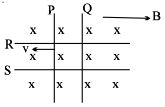
- ✓
will be attracted towards $P$
- B
will be repelled away from $P$
- C
- D
may be repelled or attracted towards $P$
AnswerCorrect option: A. will be attracted towards $P$
a
From Lenz's law if one rod is moved away from the second rod then the secon rod will be attrected towards the first rod so as oppose the change influx.
View full question & answer→MCQ 661 Mark
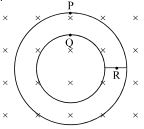
Figure shown plane figure made of $a$ conductor located in $a$ magnetic field along the inward normal to the plane of the figure. The magnetic field starts diminishing. Then the induced current
Answerd
Induce field will be in the form of concentrice circle having orientation clockwise since at $P$ and $Q$ there in a close path so induce current will be clockwise.
View full question & answer→MCQ 671 Mark
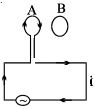
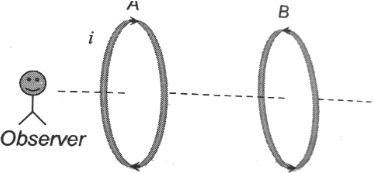
Two circular coils $A$ and $B$ are facing each other as shown in figure. The current $i$ through $A$ can be altered
- ✓
there will be repulsion between $A$ and $B$ if $i$ is increased
- B
there will be attraction between $A$ and $B$ if $i$ is increased
- C
there will be neither attraction nor repulsion when $i$ is changed
- D
attraction or repulsion between $A$ and $B$ depends on the direction of current. It does not depend whether the current is increased or decreased.
AnswerCorrect option: A. there will be repulsion between $A$ and $B$ if $i$ is increased
a
with rise in current in coil $A$ flux through $B$ increases. According to Lenz's law repulsion occures between $A$ and $B$.
View full question & answer→MCQ 681 Mark
$A$ bar magnet is moved along the axis of copper ring placed far away from the magnet. Looking from the side of the magnet, an anticlockwise current is found to be induced in the ring. Which of the following may be true?
- A
The south pole faces the ring and the magnet moves towards it.
- B
The north pole faces the ring and the magnet moves towards it.
- C
The south pole faces the ring and the magnet moves away from it.
- ✓
Both $(B)$ and $(C)$
AnswerCorrect option: D. Both $(B)$ and $(C)$
d
When magnet is moving towards the ring, as the current flows in anticlockwise direction when seen from magnet, a magnetic field directed towards the magnet from the ring is observed.
By Lenz's law this field is to oppose the movement of the magnet towards the ring.
Therefore the $N$-pole should be facing the ring, as only then will the induced field by the ring will oppose the movement of the approaching magnet. Therefore, the north pole faces the ring and the magnet moves towards it and the south pole faces the ring and the magnet moves away from it.
View full question & answer→MCQ 691 Mark
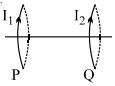
Two circular coils $P$ and $Q$ are fixed coaxially and carry currents $I_1 $ and $I_2$ respectively
- A
if $I_2 = 0$ and $P$ moves towards $Q, a$ current in the samedirection as $I_1$ is induced in $Q$
- B
if $I_1 = 0$ and $Q$ moves towards $P, a$ current in the opposite direction to that of $I_2$ isinduced in $P.$
- C
when $I_1 \ne 0$ and $I_2 \ne 0$ are in opposite directions then the coils tends to move apart.
- ✓
Both $(B)$ and $(C)$
AnswerCorrect option: D. Both $(B)$ and $(C)$
View full question & answer→MCQ 701 Mark
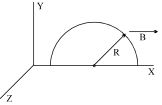
$A$ semicircle conducting ring of radius $R$ is placed in the $xy$ plane, as shown in the figure. $A$ uniform magnetic field is set up along the $x$ -axis. No $emf$, will be induced in the ring. if
- A
it moves along the $x$ -axis
- B
it moves along the $y$ -axis
- C
it moves along the $z$ -axis
- ✓
Answerd
emf induced (by lenz's law)
$E=\frac{-d \phi}{d t}$
$E=\frac{-d}{d t}(B A)=-B \frac{d}{d t}(A)-A \frac{d}{d t}(B)$
either magnetic field or area must be changed w.r.t. time to generate emf, and here the magnetic field and plane of ring are parallel thus no emf induced in either situation.
View full question & answer→MCQ 711 Mark
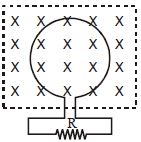
The magnetic flux passing perpendicular to the plane of the coil and directed into the paper is varying according to the relation.
$\phi = 3t^2 + 2t + 3$
where $\phi$ is in milliwebers and $t$ is in seconds. Then the magnitude of $emf$ induced in the loop when $t = 2$ second is ......$mV$
Answerc
The induced $emf$
${\mathrm{E}=-\mathrm{d} \phi / \mathrm{dt}} $
${=-\frac{\mathrm{d}}{\mathrm{dt}}\left(3 \mathrm{t}^{2}+2 \mathrm{t}+3\right) \times 10^{-3}}$
(because given flux is in $\mathrm{mWb}$ ). Thus
$E=(-6 t-2) \times 10^{-3}$
at $t=2$ $sec,$
${\mathrm{E}=(-6 \times 2-2) \times 10^{-3}} $
${=-14 \mathrm{\,mV}}$
View full question & answer→MCQ 721 Mark
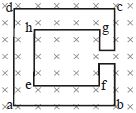
Two square wire frames $abcd$ and $efgh$ are placed in uniformly decreasing magnetic field as shown in figure. The direction of induced current in both the loops is
- A
- B
- C
Anticlockwise, Anticlockwise
- ✓
Answerd
According to Lenz's law the direction of induced current in the coil in such a way that it always opposes the cause by which it is produced. so in given diagram magnetic field in decreasing so direction of current in such that it increase the field so in outer loop current is in clockwise direction, and in inner loop current is in anticlockwise direction.
View full question & answer→MCQ 731 Mark
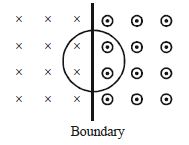
A space consists of two uniform magnetic fields, as shown. A conducting circular loop is placed symmetrically at the boundary
- A
If loop is moved towards right current is initially anticlockwise
- ✓
If loop is moved towards left current is initially anticlockwise
- C
If loop is moved towards right current is zero initially only
- D
Current will always be zero irrespective of direction of motion and time.
AnswerCorrect option: B. If loop is moved towards left current is initially anticlockwise
b
If loop moves towards right outward flux increases, so according to Faraday's law, current flow will oppose this change & direction of current will be clockwise.
If loop moves towards left then, inward flux increases, so to oppose this change, current direction will be anticlockwise.
View full question & answer→MCQ 741 Mark
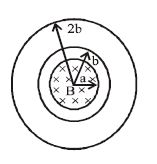
A uniform magnetic field $B$ that is perpendicular to the plane of the page now passes through the loops, as shown. The field is confined to a region of radius $a$ , where $a < b$ , and is changing at a constant rate. The induced emf in the wire loop of radius $b$ is $\varepsilon $. What is the induced emf in the wire loop of radius $2b$
- A
$0$
- ✓
$\varepsilon $
- C
$\frac{\varepsilon }{2}$
- D
$2\varepsilon $
AnswerCorrect option: B. $\varepsilon $
b
Flux linked with both loops is same, so emf induced is same for both loops.
View full question & answer→MCQ 751 Mark
Statement $-1$ : When a magnet is made to fall freely through a closed coil, its acceleration is always less than acceleration due to gravity.
and
Statement $-2$ : Current induced in the coil opposes the motion of the magnet, as per Lenz's law.
- ✓
Statement $-1$ is true, Statement $-2$ is true; Statement $-2$ is a correct explanation for Statement $-1$
- B
Statement $-1$ is true, Statement $-2$ is true, Statement $-2$ is $NOT$ a correct explanation for Statement $-1$
- C
Statement $-1$ is True, Statement $-2$ is False
- D
Statement $-1$ is False, Statement $-2$ is True
AnswerCorrect option: A. Statement $-1$ is true, Statement $-2$ is true; Statement $-2$ is a correct explanation for Statement $-1$
View full question & answer→MCQ 761 Mark
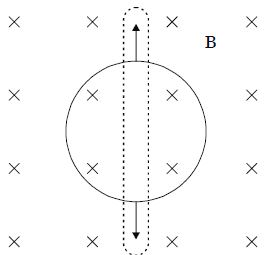
A flexible circular loop $20\ cm$ in diameter lies in a magnetic field of magnitude $B = 1$ Tesla, directed into the plane of page as shown. The loop is pulled at the points indicated by the arrows forming a loop of zero area in $0.314\ sec$ . The average emf induced in the loop is.....$V$
Answera
$\mathrm{emf}=\frac{\Delta \phi}{\Delta \mathrm{t}}=\frac{\pi(0.1)^{2} \times \mathrm{B}}{0.314}=0.1 \mathrm{\,v}$
View full question & answer→MCQ 771 Mark
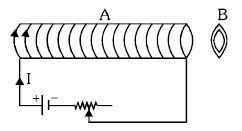
An aluminium ring $B$ faces an electromagnet $A$. The current $I$ through $A$ can be altered. Then which of the following statement is correct
- A
If $I$ decreases $A$ will repel $B$
- B
Whether $I$ increases or decreases, $B$ will not experience any force
- ✓
If $I$ increases, $A$ will repel $B$
- D
If $I$ increases, $A$ will attract $B$
AnswerCorrect option: C. If $I$ increases, $A$ will repel $B$
c
View full question & answer→MCQ 781 Mark
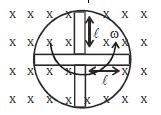
A conducting wheel in which there are four rods of lengthe $l$ as shown in figure is rotating with angular velocity $\omega $ in a uniform magnetic field $B$. The induced potential difference between its centre and rim will be
- A
$2B\omega {l^2}$
- B
$\sqrt {Bl^2 \omega }$
- C
$\frac{Bl \omega }{2}$
- ✓
$\frac{Bl^2 \omega }{2}$
AnswerCorrect option: D. $\frac{Bl^2 \omega }{2}$
d
Key Points Applying induced emf is equal to change of flux with respect to time. According to question, Induced emf $=\frac{\text { Change in flux }}{\text { Time }}=\frac{B \cdot A}{T}$ $\in=\frac{B \times \pi l^{2}}{T}\left[\text { Area } A=\pi l^{2}\right]$
Frequency $v=\frac{1}{T}=\frac{\omega}{2 \pi}$
$\mathrm{So}, \in=\frac{B \times \pi l^{2} \times \omega}{2 \pi}$
$=\frac{B \omega l^{2}}{2}$
View full question & answer→MCQ 791 Mark
A vertical bar magnet is dropped from the shown position on the axis of a fixed metallic coil as shown in fig $- I$. In fig $- II$ the magnet is fixed and horizontal coil is dropped. The acceleration of the magnet and coil are $a_1$ and $a_2$ respectively then
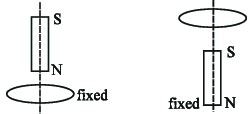
- A
$a_1 > g , a_2 > g$
- B
$a_1 > g , a_2 < g$
- ✓
$a_1 < g , a_2 < g$
- D
$a_1 < g , a_2 > g$
AnswerCorrect option: C. $a_1 < g , a_2 < g$
View full question & answer→MCQ 801 Mark
Two coils of self inductance $100\,mH$ and $400\,mH$ are placed very close to each other. Find the maximum mutual inductance between the two when $8\,A$ current passes through them.......$mH$
- ✓
$200$
- B
$300$
- C
$100$
- D
$100\sqrt 2$
Answera
$M \le \sqrt {{L_1}{L_2}} \Rightarrow {M_{\max }} = \sqrt {{L_1}{L_2}} = 200\,mH$
View full question & answer→MCQ 811 Mark
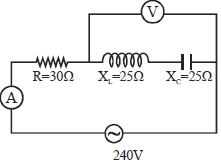
A coil has an area of $0.05\,m^2$ and it has $800\,turns$. It is placed perpendicularly in a magnetic field of strength $4 \times 10^{-5}\,Wb/m^2$, it is rotated through $90^o$ in $0.1\, second$. The average emf induced in the coil is ........... $V.$
- A
$0.056$
- B
$0.046$
- C
$0.026$
- ✓
$0.016$
AnswerCorrect option: D. $0.016$
d
$\mathrm{e}=-\frac{\Delta \phi}{\Delta \mathrm{t}}=-\frac{\phi_{2}-\phi_{1}}{\Delta \mathrm{t}}=-\frac{0-\mathrm{nAB}}{\Delta \mathrm{t}}$
$=+\frac{800 \times 0.05 \times 4 \times 10^{-5}}{0.1}=1600 \times 10^{-5}=0.016 \mathrm{\,V}$
View full question & answer→MCQ 821 Mark
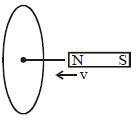
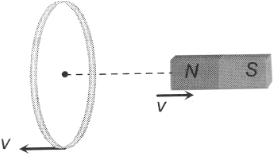
In the given figure, the magnet is moved towards the coil with speed $'v'$ and induced $emf$ is $'e'$. If magnet and coil recede away from one another each moving with speed $'v'$, the induced $emf$ in the coil will be
- A
$e$
- ✓
$2e$
- C
$\frac{e}{2}$
- D
$4e$
Answerb
$\left(\frac{d \varphi}{d t}\right)_{\text {in first case }}=e$
$\left(\frac{d \varphi}{d t}\right)_{\text {relative velocity2v }}=2\left(\frac{d \varphi}{d t}\right)_{\text {1case }}=2 e$
View full question & answer→MCQ 831 Mark
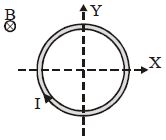
A conducting loop carrying a current $I$ is placed in a uniform magnetic field pointing into the plane of the paper as shown. The loop will have a tendency to
- A
- ✓
- C
Move towards $+ve\, x-$ axis
- D
Move towards $-ve\, x-$ axis
Answerb
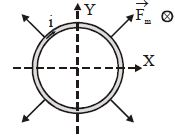
Net force on a current carrying loop in uniform magnetic field is zero. Hence the loop can't translate. So, options $(C)$ and $(D)$ are wrong From Fleming's left hand rule we can see that if magnetic field is perpendicular to paper inwards and current in the loop is clockwise (as shown) the magnetic force $\vec F_m$ on each element of the loop is radially outwards, or the loops will have a tendency to expand
View full question & answer→MCQ 841 Mark
An air cored solenoid with length $20\, cm$, area of cross section $20\, cm^2$ and number of turns $400$ carries a current $2\, A$. The current is suddenly switched off within $10^{-3}\,s$. The average back $emf$ induced across the ends of the open switch in the circuit is (ignore the variation in magnetic field near the ends of the solenoid)........$ V$
Answerb
Here, $\ell=20 \mathrm{\,cm}=20 \times 10^{-2} \mathrm{\,m}$
$A=20 \mathrm{\,cm}^{2}=20 \times 10^{-4} \mathrm{\,m}^{2}$
$\mathrm{N}=400, \mathrm{I}_{1}=2 \mathrm{A}, \mathrm{I}_{2}=0, \mathrm{dt}=10^{-3} \mathrm{\,s}$
As $\varepsilon=\frac{\mathrm{d} \phi}{\mathrm{dt}}=\frac{\mathrm{d}(\mathrm{BAN})}{\mathrm{dt}}$
$=\frac{\mu_{0} \mathrm{Nd} \mathrm{I} \mathrm{AN}}{\ell \mathrm{dt}} \quad\left(\because \mathrm{B}=\frac{\mu_{0} \mathrm{NI}}{\ell}\right)$
$=\frac{\mu_{0} \mathrm{N}\left(\mathrm{I}_{1}-\mathrm{I}_{2}\right) \mathrm{AN}}{(\mathrm{dt}}$
$=\frac{4 \pi \times 10^{-7} \times(400)^{2} \times 2 \times 20 \times 10^{-4}}{20 \times 10^{-2} \times 10^{-3}}=4 \mathrm{\,V}$
View full question & answer→MCQ 851 Mark
An $e.m.f.$ of $15\,volt$ is applied in a circuit containing $5\,henry$ inductance and $10\,ohm$ resistance. The ratio of the currents at time $t \to \infty$ and at $t = 1\,second$ is
AnswerCorrect option: B. $\frac{{{e^{2}}}}{{{e^{2}} - 1}}$
b
Induced $emf$ will not remain constant in circular and elliptical loops.
View full question & answer→MCQ 861 Mark
A bar magnet is moved along the axis of a copper ring placed far away from the magnet. Looking from the side of the magnet, an anticlockwise current is found to be induced in the ring. Which of the following may be true
- A
The south pole faces the ring and the magnet moves towards it
- ✓
The north pole faces the ring and the magnet moves towards it
- C
The north pole faces the ring and the magnet moves away from it
- D
AnswerCorrect option: B. The north pole faces the ring and the magnet moves towards it
b
When magnet is moving towards the ring, as the current flows in anti-clockwise direction when seen from magnet, a magnetic field directed towards the magnet. from the ring is observed.
By Lenz's law this field is to oppose the movement of the magnet towards the ring. Therefore the N-pole should be facing the ring, as only then will the induced field by the ring will oppose the movement of the approaching magnet.
Therefore, the north pole faces the ring and the magnet moves towards it and the south pole faces the ring and the magnet moves away from it.
View full question & answer→MCQ 871 Mark
Radius of a circular loop placed in a perpendicular uniform magnetic field is increasing at a constant rate of $r_0 ms ^{-1}$. If at any instant radius of the loop is $r$, then emf induced in the loop at that instant will be
- A
$-2 B r_0$
- B
$-2 B \pi r$
- C
$-B \pi r_0 r$
- ✓
$-2 B \pi r_0 r$
AnswerCorrect option: D. $-2 B \pi r_0 r$
d
(d)
$\frac{d r}{d t}=r_0 \Rightarrow \phi=B \pi r^2$
$\varepsilon=\frac{-d \phi}{d t}=-B \pi(2 r) \frac{d r}{d t}$
$\varepsilon=-2 \pi B r r_0$
View full question & answer→MCQ 881 Mark
The magnetic flux through a stationary loop with resistance $R$ varies during interval of time $T$ as $\phi=a t(T-t)$. The heat generated during this time neglecting the inductance of loop will be
- ✓
$\frac{a^2 T^3}{3 R}$
- B
$\frac{a^2 T^2}{3 R}$
- C
$\frac{a^2 T}{3 R}$
- D
$\frac{a^3 T^2}{3 R}$
AnswerCorrect option: A. $\frac{a^2 T^3}{3 R}$
a
(a)
$\phi=a t(T-t)=a T t-a t^2$
$\varepsilon=-\frac{d \phi}{d t}=-(a T-2 a t)$
$P=-\frac{\varepsilon^2}{R}=\frac{(a T-2 a t)^2}{R}$
$H=\int \limits_0^T P d t=\int \limits_0^T \frac{(a T-2 a t)^2}{R}$
$=\frac{a^2 T^3}{3 R}$
View full question & answer→MCQ 891 Mark
A short-circuited coil is placed in a time-varying magnetic field. Electrical power is dissipated due to the current induced in the coil. If the number of turns were to be quadrupled and the wire radius halved, the electric power dissipated would be .............
Answerb
(b)
$\varepsilon=n B \pi r^2 \frac{d B}{d t}$
$\varepsilon^{\prime}=4 n B \pi\left(\frac{r}{2}\right)^2 \frac{d B}{d t}$
$\varepsilon^{\prime}=n B \pi r^2 \frac{d B}{d t}=\varepsilon$
$P^{\prime}=\frac{\left(\varepsilon^{\prime}\right)^2}{R}=\frac{\varepsilon^2}{R}$
View full question & answer→MCQ 901 Mark
A coil and a bulb are connected in series with a $12 \,volt$ direct current source. A soft iron core is now inserted in the coil. Then
- ✓
The intensity of the bulb remains the same
- B
The intensity of the bulb decreases
- C
The intensity of the bulb increases
- D
AnswerCorrect option: A. The intensity of the bulb remains the same
a
(a)
Intensity of bulb remains the same because source is $D C$, so steady state current will be independent of the inductance of the inductor for $D C$ circuit,
$i_{\text {stoady }}=\frac{E_{\text {source }}}{R_{\text {bubb }}}$
View full question & answer→MCQ 911 Mark
A coil is suspended in a uniform magnetic field. with the plane of the coil parallel to the magnetio lines of force. When a current is passed through the coil it starts oscillating; It is very difficult to stop. But if an aluminium plate is placed near to the coil, it stops. This is due to :
- A
developement of air current when the plate is placed
- B
induction of electrical charge on the plate
- C
shielding of magnetic lines of force as aluminium is a paramagnetic material.
- ✓
electromagnetic induction in the aluminium plate giving rise to electromagnetio damping
AnswerCorrect option: D. electromagnetic induction in the aluminium plate giving rise to electromagnetio damping
d
(d)
Because of the Lenz's law of conservation of energy.
View full question & answer→MCQ 921 Mark
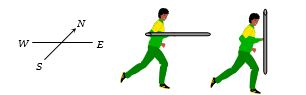
A player with $3$ m long iron rod runs towards east with a speed of $30$ km/hr. Horizontal component of earth's magnetic field is $4 \times {10^{ - 5}}Wb/{m^2}$. If he is running with rod in horizontal and vertical positions, then the potential difference induced between the two ends of the rod in two cases will be
- A
Zero in vertical position and $1 \times {10^{ - 3}}V$ in horizontal position
- B
$1 \times {10^{ - 3}}V$ in both cases
- C
- ✓
$1 \times {10^{ - 3}}V$ in vertical position and zero is horizontal position
AnswerCorrect option: D. $1 \times {10^{ - 3}}V$ in vertical position and zero is horizontal position
d
(b)If player is running with rod in vertical position towards east, then rod cuts the magnetic field of earth perpendicularly (magnetic field of earth is south to north).
Hence Maximum emf induced is
$e = Bvl = 4 \times {10^{ - 5}} \times \frac{{30 \times 1000}}{{3600}} \times 3 = 1 \times {10^{ - 3}}volt$
When he is running with rod in horizontal position, no field is cut by the rod, so e = 0.
View full question & answer→MCQ 931 Mark
A rod of length $20$ cm is rotating with angular speed of $100$ rps in a magnetic field of strength $0.5$ T about it’s one end. What is the potential difference between two ends of the rod.......$V$
- A
$2.28$
- B
$4.28$
- ✓
$6.28$
- D
$2.5$
AnswerCorrect option: C. $6.28$
c
(c) $e = \frac{1}{2}B{l^2}\omega = B{l^2}\pi \nu $
$ \Rightarrow e = 0.5{(20 \times {10^{ - 2}})^2} \times 3.14 \times 100 = 6.28\;V$
View full question & answer→MCQ 941 Mark
A circular metal plate of radius $R$ is rotating with a uniform angular velocity $w $ with its plane perpendicular to a uniform magnetic field $B$. Then the emf developed between the centre and the rim of the plate is
- A
$\pi \omega B{R^2}$
- B
$\omega B{R^2}$
- C
$\pi \omega B{R^2}/2$
- ✓
$\omega B{R^2}/2$
AnswerCorrect option: D. $\omega B{R^2}/2$
d
(d) considering any radius line $r$
Taking on element as thrown
we write $d \varepsilon=B l v \quad(\varepsilon H F)$
Now $l=d x v=w x$
$\int d \varepsilon=B w \int_{0}^{r} x d x$
$\varepsilon=\frac{B w r^{2}}{2}$
View full question & answer→MCQ 951 Mark
The magnitude of the earth’s magnetic field at a place is ${B_0}$ and the angle of dip is $\delta $. A horizontal conductor of length $l$ lying along the magnetic north-south moves eastwards with a velocity $v$. The emf induced across the conductor is
- A
- ✓
${B_0}l\,v\sin \delta $
- C
${B_0}l\,v$
- D
${B_0}l\,v\cos \delta $
AnswerCorrect option: B. ${B_0}l\,v\sin \delta $
b
(b) When a conductor lying along the magnetic north-south, moves eastwards it will cut vertical component of ${B_0}$. So induced $emf$
$e = v{B_V}l$$ = v({B_0}\sin \delta \,l)$$ = {B_0}l\,v\sin \delta $.
View full question & answer→MCQ 961 Mark
At a place the value of horizontal component of the earth's magnetic field H is $3 \times {10^{ - 5}}\,Weber/{m^2}$. A metallic rod $AB$ of length $2 \,m$ placed in east-west direction, having the end $A$ towards east, falls vertically downward with a constant velocity of $50 \,m/s$. Which end of the rod becomes positively charged and what is the value of induced potential difference between the two ends
- A
End A, $3 \times {10^{ - 3}}\,mV$
- ✓
End $A$, $3\, mV$
- C
End $B$, $3 \times {10^{ - 3}}\,mV$
- D
End $B$, $3 \,mV$
AnswerCorrect option: B. End $A$, $3\, mV$
b
(b) Induced potential difference between two ends
$ = Blv = {B_H}lv$ $ = 3 \times {10^{ - 5}} \times 2 \times 50 = 30 \times {10^{ - 3}}volt = 3\,millivolt$
.
By Fleming's right hand rule, end $A$ becomes positively charged.
View full question & answer→MCQ 971 Mark
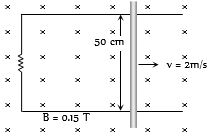
As shown in the figure a metal rod makes contact and complete the circuit. The circuit is perpendicular to the magnetic field with $B = 0.15\,tesla.$ If the resistance is $3\,\Omega $, force needed to move the rod as indicated with a constant speed of $2m/sec$ is
- ✓
$3.75 \times {10^{ - 3}}\,N$
- B
$3.75 \times {10^{ - 2}}\,N$
- C
$3.75 \times {10^2}\,N$
- D
$3.75 \times {10^{ - 4}}N$
AnswerCorrect option: A. $3.75 \times {10^{ - 3}}\,N$
a
(a) Induced current in the circuit $i = \frac{{Bvl}}{R}$
Magnetic force acting on the wire ${F_m} = Bil = B\left( {\frac{{Bvl}}{R}} \right)\;l$
$ \Rightarrow {F_m} = \frac{{{B^2}v{l^2}}}{R}$ External force needed to move the rod with constant velocity
$({F_m}) = \frac{{{B^2}v{l^2}}}{R} = \frac{{{{(0.15)}^2} \times (2) \times {{(0.5)}^2}}}{3}$$ = 3.75 \times {10^{ - 3}}N$
View full question & answer→MCQ 981 Mark
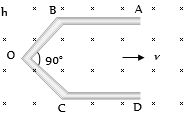
A conductor $ABOCD$ moves along its bisector with a velocity of $1\, m/s$ through a perpendicular magnetic field of $1$ $wb/m^2$, as shown in fig. If all the four sides are of $1\,m$ length each, then the induced emf between points $A$ and $D$ is......$volt$
AnswerCorrect option: B. $1.41$
b
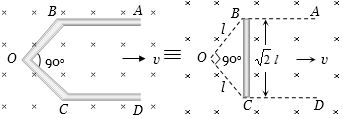
(b) There is no induced emf in the part $AB$ and $CD$ because they are moving along their length while emf induced between $B$ and $C$ i.e. between $A$ and $D$ can be calculated as follows
Induced emf between $B$ and $C$ = Induced emf between $A$ and $B$ = $Bv(\sqrt 2 \,l) = 1 \times 1 \times 1 \times \sqrt 2 = 1.41\,volt.$
View full question & answer→MCQ 991 Mark
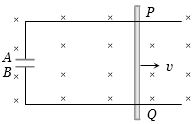
A conducting rod $PQ$ of length $L = \,1.0 \,m$ is moving with a uniform speed $v = 2 \,m/s$ in a uniform magnetic field $B = 4.0\,T$ directed into the paper. A capacitor of capacity $C = 10\, \mu$F is connected as shown in figure. Then
- ✓
$q_A = \,+ 80\pi\,C$ and $qB =\,-80$ $\pi\,C$
- B
$q_A =-80\pi\,C\, and \,qB = + 80 \pi\,C$
- C
$q_A$ =$ 0$ = $qB$
- D
Charge stored in the capacitor increases exponentially with time
AnswerCorrect option: A. $q_A = \,+ 80\pi\,C$ and $qB =\,-80$ $\pi\,C$
a
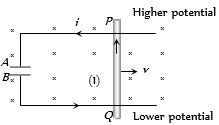
(a) $Q = \,CV = \,C \,(Bvl) = \,10 × \,10-\,6 × \,4 × \,2 ×\,1 \,= 80$ $\mu\,C$
According to Fleming's right hand rule induced current flows from $Q$ to $P$. Hence $P$ is at higher potential and $Q$ is at lower potential. Therefore A is positively charged and $B$ is negatively charged.
View full question & answer→MCQ 1001 Mark
A conducting rod $AC$ of length $4l$ is rotated about a point $O$ in a uniform magnetic field $\vec B$ directed into the paper.$ AO = l$ and $OC = 3l$. Then
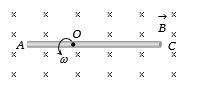
- A
${V_A} - {V_O} = \frac{{B\omega {l^2}}}{2}$
- B
${V_O} - {V_C} = \frac{7}{2}B\omega {l^2}$
- ✓
${V_A} - {V_C} = 4B\omega {l^2}$
- D
${V_C} - {V_O} = \frac{9}{2}B\omega {l^2}$
AnswerCorrect option: C. ${V_A} - {V_C} = 4B\omega {l^2}$
c
(c) By using $e = \frac{1}{2}B{l^2}\omega $
For part $AO$ ; ${e_{OA}} = {e_O} - {e_A} = \frac{1}{2}B{l^2}\omega $
For part $OC$; ${e_{OC}} = {e_O} - {e_C} = \frac{1}{2}B{(3l)^2}\omega $
$\therefore {e_A} - {e_C} = 4\;B{l^2}\omega $
View full question & answer→