Questions · Page 6 of 11

M.C.Q (1 Marks)

MCQ 2511 Mark
If two + 5 D lenses are mounted at some distance apart, the equivalent power will always be negative if the distance is
  •  Greater than 40 cm
  • B
     Equal to 40 cm
  • C
     Equal to 10 cm
  • D
     Less than 10 cm
Answer
Correct option: A.
 Greater than 40 cm
 Greater than 40 cm
View full question & answer
MCQ 2521 Mark
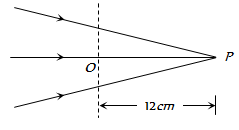
Figure given below shows a beam of light converging at point P. When a convex lens of focal length 16 cm is introduced in the path of the beam at a place O shown by dotted line such that OP becomes the axis of the lens, the beam converges at a distance x from the lens. The value x will be equal to
  • A
    12 cm
  • B
    24 cm
  • C
    36 cm
  • 48 cm
Answer
Correct option: D.
48 cm
(d) 48 cm
View full question & answer
MCQ 2531 Mark
A thin lens made of glass of refractive index m = 1.5 has a focal length equal to 12 cm in air. It is now immersed in water $\left(\mu=\frac{4}{3}\right)$. Its new focal length is
  • 48 cm
  • B
    36 cm
  • C
    24 cm
  • D
    12 cm
Answer
Correct option: A.
48 cm
(a) 48 cm
View full question & answer
MCQ 2541 Mark
The unit of focal power of a lens is
  • A
     Watt
  • B
    Horse power
  •  Dioptre
  • D
     Lux
Answer
Correct option: C.
 Dioptre
 Dioptre
View full question & answer
MCQ 2551 Mark
A convex lens of focal length 25 cm and a concave lens of focal length 10 cm are joined together. The power of the combination will be
  • A
     – 16 D
  • B
     + 16 D
  •  – 6 D
  • D
     + 6 D
Answer
Correct option: C.
 – 6 D
 – 6 D
View full question & answer
MCQ 2561 Mark
A convex lens forms a real image of an object for its two different positions on a screen. If height of the image in both the cases be 8 cm and 2 cm, then height of the object is
 
  • A
    16 cm
  • B
     8 cm
  •  4 cm
  • D
     2 cm
Answer
Correct option: C.
 4 cm
4 cm
View full question & answer
MCQ 2571 Mark
The combination of a convex lens (f = 18 cm) and a thin concave lens (f = 9 cm) is
  •  A concave lens (f = 18 cm)
  • B
    A convex lens (f = 18 cm)
  • C
    A convex lens (f = 6 cm)
  • D
    A concave lens (f = 6 cm)
Answer
Correct option: A.
 A concave lens (f = 18 cm)
 A concave lens (f = 18 cm)
View full question & answer
MCQ 2581 Mark
An object has image thrice of its original size when kept at 8 cm and 16 cm from a convex lens. Focal length of the lens is
  • A
     8 cm
  • B
    16 cm
  • Between 8 cm and 16 cm
  • D
    Less than 8 cm
Answer
Correct option: C.
Between 8 cm and 16 cm
View full question & answer
MCQ 2591 Mark
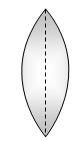
A convex lens has a focal length f. It is cut into two parts along the dotted line as shown in the figure. The focal length of each part will be
  • A
    $\frac{\mathrm{f}}{2}$
  • B
    f
  • C
    $\frac{3}{2} \mathrm{f}$
  • 2f
Answer
Correct option: D.
2f
(d) 2f
View full question & answer
MCQ 2601 Mark
The focal length of a convex lens is 10 cm and its refractive index is 1.5. If the radius of curvature of one surface is 7.5 cm, the radius of curvature of the second surface will be
  • A
    7.5 cm
  • 15.0 cm
  • C
    75 cm
  • D
    5.0 cm
Answer
Correct option: B.
15.0 cm
 15.0 cm
View full question & answer
MCQ 2611 Mark
In a plano-convex lens the radius of curvature of the convex lens is 10 cm. If the plane side is polished, then the focal length will be (Refractive index = 1.5)
  • A
    10.5 cm
  • 10 cm
  • C
    5.5 cm
  • D
    5 cm
Answer
Correct option: B.
10 cm
10 cm
View full question & answer
MCQ 2621 Mark
We combined a convex lens of focal length $f_1$ and concave lens of focal lengths $f_2$ and their combined focal length was $F.$ The combination of these lenses will behave like a concave lens, if
  • $ \mathrm{f}_1 > \mathrm{f}_2 $
  • B
    $ \mathrm{f}_1 < \mathrm{f}_2 $
  • C
    $ \mathrm{f}_1 = \mathrm{f}_2 $
  • D
    $ \mathrm{f}_1 \leq \mathrm{f}_2$
Answer
Correct option: A.
$ \mathrm{f}_1 > \mathrm{f}_2 $
View full question & answer
MCQ 2631 Mark
A candle placed 25 cm from a lens, forms an image on a screen placed 75 cm on the other end of the lens. The focal length and type of the lens should be
  • + 18.75 cm and convex lens
  • B
    – 18.75 cm and concave lens
  • C
    + 20.25 cm and convex lens
  • D
    – 20.25 cm and concave lens
Answer
Correct option: A.
+ 18.75 cm and convex lens
 + 18.75 cm and convex lens
View full question & answer
MCQ 2641 Mark
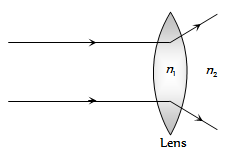
The relation between $n_1$ and $n_2$, if behaviour of light rays is as shown in figure is
  • A
    $n_1 \gg n_2$
  • $n _2 > n _1$
  • C
    $n _1 > n _2$
  • D
    $n _1= n _2$
Answer
Correct option: B.
$n _2 > n _1$
(b) $n _2> n _1$
View full question & answer
MCQ 2651 Mark
Chromatic aberration of lens can be corrected by
  • A
    Reducing its aperature
  • B
    Proper polishing of its two surfaces
  • Suitably combining it with another lens
  • D
    Providing different suitable curvature to its two surfaces
Answer
Correct option: C.
Suitably combining it with another lens
 Suitably combining it with another lens
View full question & answer
MCQ 2661 Mark
The distance between an object and the screen is 100 cm. A lens produces an image on the screen when placed at either of the positions 40 cm apart. The power of the lens is
  • A
    ≈ 3 dioptres
  • ≈ 5 dioptres
  • C
    ≈ 7 diopters
  • D
    ≈ 9 diopters
Answer
Correct option: B.
≈ 5 dioptres
  ≈ 5 dioptres
View full question & answer
MCQ 2671 Mark
An object is placed first at infinity and then at 20 cm from the object side focal plane of the convex lens. The two images thus formed are 5 cm apart. The focal length of the lens is
  • A
    5 cm
  • 10 cm
  • C
    15 cm
  • D
    20 cm
Answer
Correct option: B.
10 cm
 10 cm
View full question & answer
MCQ 2681 Mark
A thin lens made of glass of refractive index 1.5 has a front surface + 11 D power and back surface – 6 D. If this lens is submerged in a liquid of refractive index 1.6, the resulting power of the lens is
  • A
    – 0.5 D
  • B
    + 0.5 D
  • – 0.625 D
  • D
    + 0.625 D
Answer
Correct option: C.
– 0.625 D
 – 0.625 D
View full question & answer
MCQ 2691 Mark
A convex lens has 9 cm focal length and a concave lens has – 18 cm focal length. The focal length of the combination in contact will be
  • A
    9 cm
  • B
    – 18 cm
  • C
    – 9 cm
  • 18 cm
Answer
Correct option: D.
18 cm
 18 cm
View full question & answer
MCQ 2701 Mark
A lens which has focal length of 4 cm and refractive index of 1.4 is immersed in a liquid of refractive index 1.6, then the focal length will be
  • – 12.8 cm
  • B
    32 cm
  • C
    12.8 cm
  • D
    – 32 cm
Answer
Correct option: A.
– 12.8 cm
  – 12.8 cm
View full question & answer
MCQ 2711 Mark
A lens of focal power 0.5 D is
  • A
    A convex lens of focal length 0.5 m
  • B
    A concave lens of focal length 0.5 m
  • A convex lens of focal length 2 m
  • D
    A concave lens of focal length 2 m
Answer
Correct option: C.
A convex lens of focal length 2 m
  A convex lens of focal length 2 m
View full question & answer
MCQ 2721 Mark
A double convex lens of glass of m = 1.5 has radius of curvature of each of its surface is 0.2 m. The power of the lens is
  • A
    + 10 dioptres
  • B
    – 10 dioptres
  • C
    – 5 dioptres
  • +5 dioptres
Answer
Correct option: D.
+5 dioptres
 +5 dioptres
View full question & answer
MCQ 2731 Mark
A convex lens of power + 6D is placed in contact with a concave lens of power – 4D. What is the nature and focal length of the combination
  • A
    Concave, 25 cm
  • Convex, 50 cm
  • C
    Concave, 20 cm
  • D
    Convex, 100 cm
Answer
Correct option: B.
Convex, 50 cm
 Convex, 50 cm
View full question & answer
MCQ 2741 Mark
A convex lens is used to form real image of an object on a screen. It is observed that even when the positions of the object and that screen are fixed there are two positions of the lens to form real images. If the heights of the images are 4 cm and 9 cm respectively, the height of the object is
  • A
    2.25 cm
  • 6.00 cm
  • C
    6.50 cm
  • D
    36.00 cm
Answer
Correct option: B.
6.00 cm
 6.00 cm
View full question & answer
MCQ 2751 Mark
A concave lens of focal length 20 cm placed in contact with a plane mirror acts as a
  • Convex mirror of focal length 10 cm
  • B
    Concave mirror of focal length 40 cm
  • C
    Concave mirror of focal length 60 cm
  • D
    Concave mirror of focal length 10 cm
Answer
Correct option: A.
Convex mirror of focal length 10 cm
 Convex mirror of focal length 10 cm
View full question & answer
MCQ 2761 Mark
A substance is behaving as convex lens in air and concave in water, then its refractive index is
  • A
    Smaller than air
  • B
    Greater than both air and water
  • Greater than air but less than water
  • D
    Almost equal to water
Answer
Correct option: C.
Greater than air but less than water
 Greater than air but less than water
View full question & answer
MCQ 2771 Mark
Two thin lenses whose powers are +2D and –4D respectively combine, then the power of combination is
  • – 2D
  • B
    + 2D
  • C
    – 4D
  • D
    + 4D
Answer
Correct option: A.
– 2D
  – 2D
View full question & answer
MCQ 2781 Mark
A convex lens of focal length f produces an image $\frac{1}{ n }$ times than that of the size of the object. The distance of the object from the lens is
  • A
     nf
  • B
      $\frac{ f }{ n }$
  •   $(n+1) f$
  • D
      $(n-1) f$
Answer
Correct option: C.
  $(n+1) f$
 (n + 1)f
View full question & answer
MCQ 2791 Mark
If a lens is cut into two pieces perpendicular to the principal axis and only one part is used, the intensity of the image
  • Remains same
  • B
    $\frac {1}{2}$ times
  • C
    2 times
  • D
    Infinite
Answer
Correct option: A.
Remains same
(a) Remains same
View full question & answer
MCQ 2801 Mark
$f_v$ and $f_r$ are the focal lengths of a convex lens for violet and red light respectively and $F_v$ and $F_r$ are the focal lengths of a concave lens for violet and red light respectively, then
  • A
    $f _{ v } < f _{ r }$ and $F _{ v } > F _{ r }$
  • $f _{ v } < f _{ R }$ and $F _{ v } < F _{ r }$
  • C
    $f_c > f_r$ and $F_v > F_r$
  • D
    $f_v > f_r$ and $F_v < F_r$
Answer
Correct option: B.
$f _{ v } < f _{ R }$ and $F _{ v } < F _{ r }$
(b) $f _{ v }< f _{ R }$ and $F _{ v }< F _{ r }$
View full question & answer
MCQ 2811 Mark
If a convex lens of focal length 80 cm and a concave lens of focal length 50 cm are combined together, what will be their resulting power
  • A
    + 6.5D
  • B
    – 6.5 D
  • C
    + 7.5 D
  • – 0.75 D
Answer
Correct option: D.
– 0.75 D
 – 0.75 D
View full question & answer
MCQ 2821 Mark
Focal length of a convex lens of refractive index 1.5 is 2 cm. Focal length of lens when immersed in a liquid of refractive index of 1.25 will be
  • A
    10 cm
  • B
    2.5 cm
  • 5 cm
  • D
    7.5 cm
Answer
Correct option: C.
5 cm
 5 cm
View full question & answer
MCQ 2831 Mark
Focal length of a converging lens in air is R. If it is dipped in water of refractive index 1.33, then its focal length will be around (Refractive index of lens material is 1.5)
  • A
    R
  • B
    2R
  • 4R
  • D
    R / 2
Answer
Correct option: C.
4R
 4R
View full question & answer
MCQ 2841 Mark
The focal length of a combination of lenses formed with lenses having powers of + 2.50 D and – 3.75 D will be
  • A
    – 20 cm
  • B
    – 40 cm
  • C
    – 60 cm
  • – 80 cm
Answer
Correct option: D.
– 80 cm
 – 80 cm
View full question & answer
MCQ 2851 Mark
A convex lens
  • Converges light rays
  • B
    Diverges light rays
  • C
    Form real images always
  • D
    Always forms virtual images
Answer
Correct option: A.
Converges light rays
View full question & answer
MCQ 2861 Mark
A biconvex lens with equal radii curvature has refractive index 1.6 and focal length 10 cm. Its radius of curvature will be
  • A
    20 cm
  • B
    16 cm
  • C
    10 cm
  • 12 cm
Answer
Correct option: D.
12 cm
12 cm
View full question & answer
MCQ 2871 Mark
A achromatic combination is made with a lens of focal length f and dispersive power ω with a lens having dispersive power of 2ω. The focal length of second will be
  • A
    2f
  • B
    f/2
  • C
    -f/2
  • – 2 f
Answer
Correct option: D.
– 2 f
– 2 f
View full question & answer
MCQ 2881 Mark
The image distance of an object placed 10 cm in front of a thin lens of focal length + 5 cm is
  • A
     6.5 cm
  • B
    8.0 cm
  • C
    9.5 cm
  • 10.0 cm
Answer
Correct option: D.
10.0 cm
10.0 cm
View full question & answer
MCQ 2891 Mark
An achromatic combination of lenses is formed by joining
  • A
    2 convex lenses
  • B
    2 concave lenses
  • 1 convex lens and 1 concave lens
  • D
    Convex lens and plane mirror
Answer
Correct option: C.
1 convex lens and 1 concave lens
View full question & answer
MCQ 2901 Mark
A combination of two thin lenses with focal lengths $f_1$ and $f_2$ respectively forms an image of distant object at distance 60 cm when lenses are in contact. The position of this image shifts by 30 cm towards the combination when two lenses are separated by 10 cm . The corresponding values of $f_1$ and $f_2$ are
  • A
    30 cm,-60 cm
  • 20 cm, -30 cm
  • C
    15 cm, -20 cm
  • D
    12 cm, - 15 cm
Answer
Correct option: B.
20 cm, -30 cm
(b) 20 cm, -30 cm
View full question & answer
MCQ 2911 Mark
A double convex lens is made of glass of refractive index 1.5. If its focal length is 30 cm, then radius of curvature of each of its curved surface is
  • A
    10 cm
  • B
    15 cm
  • C
    18 cm
  • None of these
Answer
Correct option: D.
None of these
None of these
View full question & answer
MCQ 2921 Mark
A convex lens of focal length 0.5 m and concave lens of focal length 1 m are combined. The power of the resulting lens will be
  • 1 D
  • B
    – 1 D
  • C
    0.5 D
  • D
    - 0.5 D
Answer
Correct option: A.
1 D
 1 D
View full question & answer
MCQ 2931 Mark
A concave lens of glass, refractive index 1.5, has both surfaces of same radius of curvature R. On immersion in a medium of refractive index 1.75, it will behave as a
  • Convergent lens of focal length 3.5 R
  • B
    Convergent lens of focal length 3.0 R
  • C
    Divergent lens of focal length 3.5 R
  • D
    Divergent lens of focal length 3.0 R
Answer
Correct option: A.
Convergent lens of focal length 3.5 R
View full question & answer
MCQ 2941 Mark
A plane convex lens is made of refractive index 1.6. The radius of curvature of the curved surface is 60 cm. The focal length of the lens is
  • A
    50 cm
  • 100 cm
  • C
    200 cm
  • D
    400 cm
Answer
Correct option: B.
100 cm
100 cm
View full question & answer
MCQ 2951 Mark
A symmetric double convex lens is cut in two equal parts by a plane perpendicular to the principal axis. If the power of the original lens was 4 D, the power of a cut lens will be
  • 2 D
  • B
    3 D
  • C
    4 D
  • D
    5 D
Answer
Correct option: A.
2 D
 2 D
View full question & answer
MCQ 2961 Mark
An object of height 1.5 cm is placed on the axis of a convex lens of focal length 25 cm. A real image is formed at a distance of 75 cm from the lens. The size of the image will be
  • A
    4.5 cm
  • 3.0 cm
  • C
    0.75 cm
  • D
    0.5 cm
Answer
Correct option: B.
3.0 cm
 3.0 cm
View full question & answer
MCQ 2971 Mark
An equiconvex lens of glass of focal length 0.1 metre is cut along a plane perpendicular to principle axis into two equal parts. The ratio of focal length of new lenses formed is
  • 1 : 1
  • B
    1 : 2
  • C
    2 : 1
  • D
    $2: \frac{1}{2}$
Answer
Correct option: A.
1 : 1
(a) 1 : 1
View full question & answer
MCQ 2981 Mark
The plane surface of a plano-convex lens of focal length f is silvered. It will behave as
  • A
      Plane mirror
  • B
      Convex mirror of focal length 2F
  •    Concave mirror of focal length f/2
  • D
     None of the above
Answer
Correct option: C.
   Concave mirror of focal length f/2
 Concave mirror of focal length f/2
View full question & answer
MCQ 2991 Mark
The dispersive powers of glasses of lenses used in an achromatic pair are in the ratio 5 : 3. If the focal length of the concave lens is 15 cm, then the nature and focal length of the other lens would be
  • Convex, 9 cm
  • B
    Concave, 9 cm
  • C
    Convex, 25 cm
  • D
    Concave, 25 cm
Answer
Correct option: A.
Convex, 9 cm
 Convex, 9 cm
View full question & answer
MCQ 3001 Mark
Two lenses have focal lengths $f_1$ and $f_2$ and their dispersive powers are $\omega_1$ and $\omega_2$ respectively. They will together form an achromatic combination if
  • A
    $\omega_1 f_1=\omega_2 f_2$
  • $\omega_1 f_2+\omega_2 f_1=0$
  • C
    $\omega_1+f_1=\omega_2+f_2$
  • D
    $\omega_1-f_1=\omega_2-f_2$
Answer
Correct option: B.
$\omega_1 f_2+\omega_2 f_1=0$
(b) $\omega_1 f_2+\omega_2 f_1=0$
View full question & answer