Question types

India, That is Bharat question types

181 questions across 11 question groups — pick any mix to generate a Social Studies paper with step-by-step answer keys.

181
Questions
11
Question groups
5
Question types
Sample Questions

India, That is Bharat questions

One sample from each question group in this chapter. Select any group above to see the full set with answer keys.
Q 1M.C.Q1 Mark
When was the term ‘Hindustan’ first used in a Persian inscription?
  • A
    1,800 years ago
  • B
    2,500 years ago
  • C
    500 years ago
  • D
    1,000 years ago
View full solution
Q 3M.C.Q1 Mark
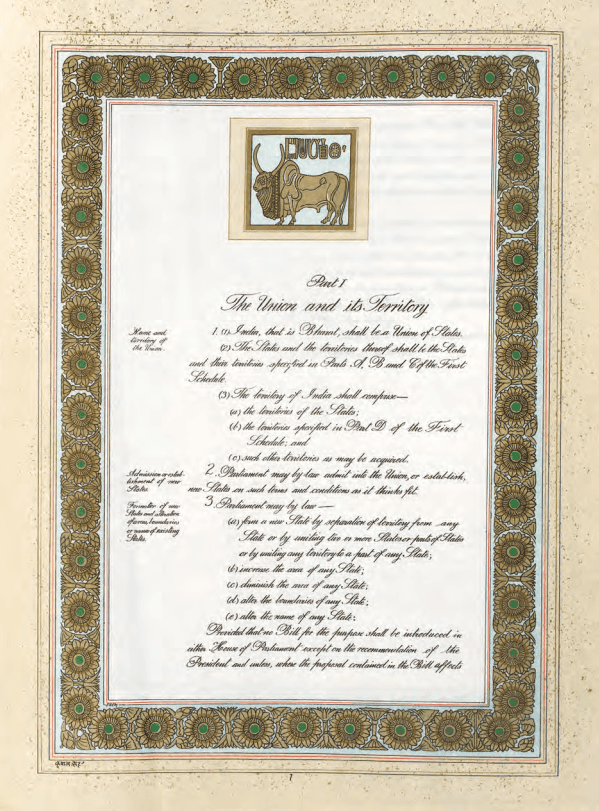
Which part of the Indian Constitution mentions the phrase ‘India, that is Bharat’?
  • A
    The preamble
  • B
    The first article
  • C
    The appendix
  • D
    The second article
View full solution
Q 4M.C.Q1 Mark
Which emperor is known to have used the term ‘Jambudvipa’ in inscriptions?
  • A
    Ashoka
  • B
    Chandragupta
  • C
    Harsha
  • D
    Arjuna
View full solution
Q 5M.C.Q1 Mark
Which of the following words was NOT used by the Chinese lo refer to India?
  • A
    Tianzhu
  • B
    sindhu
  • C
    Yintu
  • D
    Yindu
View full solution
If you were born some 2,000 years ago and had the chance to name our country, what name or names might you have chosen, and why? Use your imagination!
View full solution
Why did people travel to India from various parts of the world in ancient times? What could be their motivations in undertaking such long journeys?(Hint: There could be at least four or five motivations)
View full solution
Imagine you are a traveller in ancient India. Write a story about your journey across the Indian sub-continent, mentioning the different regions you visit.
View full solution
Read the source given below and answer the questions that follows.
But when do we come across a name for the entire Indian sub-continent? Because ancient Indian texts are difficult to date, this is not an easy question to answer. The Mahabharata uses the terms
‘Bharatavarsha’ and ‘Jambudvipa’, and scholars generally agree that this long poem was written from a few centuries BCE onward.
The first term, ‘Bharatavarsha’, clearly extends to the entire Subcontinent, and the text includes the names of numerous rivers and peoples. ‘Bharatavarsha’ means ‘the country of the Bharatas’. ‘Bharata’ is a name that first appears in the Rigveda, where it refers to one of the main Vedic groups of people. In later literature, several kings named ‘Bharata’ are mentioned.

(i) What are the challenges faced by the scholars in determining when the Indian sub-continent was first referred to by a single name ?
(ii) How does the term ‘Bharatavarsha’ contribute to our understanding of ancient Indian geography and identity ?
(iii) What significance does the name ‘Bharata’ hold in ancient Indian literature and how does its evolution reflect the development of Indian identity ?
View full solution
Read the source given below and answer the questions that follow.
It is interesting to note that different parts of the country adopted a similar definition for India. For instance, a poem of ancient Tamil literature, from about 2,000 years ago, praises a king whose name is known “from [Cape] Kumari in the South, from the great mountain in the North, from the oceans on the East and on the West…”
You can now recognise ‘the great mountain in the North’, and it should not be difficult to identify ‘Cape Kumari’. It looks like ancient Indians knew their geography well!

(i) What value is reflected in the ancient Tamil poem’s description of the king’s realm ?
(a) Military conquest
(b) Geographical unity
(c) Cultural diversity
(d) Economic prosperity

(ii) What does the poem reveal about ancient Indian culture’s attitude towards geography ?
(a) Indifference to geographical boundaries
(b) Importance of trade routes
(c) Value of geographical knowledge
(d) Focus on religious sites

(iii) What cultural value is showcased in the poem’s praise of the king’s widespread recognition ?
(a) Regionalism
(b) National pride
(c) Religious tolerance
(d) Social hierarchy

(iv) What does the ancient Tamil literature indicate about the knowledge of geography in ancient India ?
(a) Ancient Indians had limited geographical knowledge.
(b) Ancient Indians had a detailed and accurate understanding of their geography.
(c) Ancient Indians were unaware of their geographical boundaries.
(d) Ancient Indians confused the locations of various geographical features.
View full solution
The most popular reference to a geographical area being described as Bharat is in the Vishnu Purana- “Uttaram yat samudrasya, Himadreschaiva dakshinam, varsham tad Bharatam nama Bharati yatra santatih”, meaning, the country that lies to the north of the ocean and to the south of the snowy mountains is called Bharata as there dwell the descendants of Bharat. In Hindu scriptures Bharatvarsha is identified as part of a larger geographical entity called Jambudweepa.
Bharata, whose descendants were said to be living in a particular area in Vishnu Purana, is commonly thought to be King Bharata, the son of Dushyant and Shakuntala, and an ancestor of Kauravas and Pandavas. That also explains the name of the ‘Mahabharata’ which chronicles the war between Bharata’s descendants. In the Vedas, Bharata is the name of a tribe. King Sudasa of the Bharata tribe fights a war against the Puru tribe of which the Bharta tribe was a part. Later, Kuru dynasty emerged from the Bharata lineage in which King Bharata was born.
Q.1. What is the geographical location of Bharat, according to the Vishnu Purana?
(a) North of the snowy mountains and south of the ocean.
(b) North of the ocean and south of the snowy mountains.
(c) East of the snowy mountains and west of the ocean. 
(d) West of the snowy mountains and east of the ocean.
Q.2. The term ‘Bharatavarsha’ was mentioned in which ancient text?
(a) Rig Veda $\quad$ (b) Mahabharata $\quad$ (c) Vishnu Purana $\quad$ (d) None of these
Q.3. In Hindu scriptures, Bharatvarsha is identified as a part of which larger geographical entity?
(a) Jambudweepa $\quad$ (b) Aryavarta $\quad$ (c) Indraprastha $\quad$ (d) Bharata
Q.4. In Vishnu Puaran, who is commonly thought to be the ‘Bharata’?
(a) A Vedic sage $\quad$ (b) An ancient tribe 
(c) A king from the Kuril dynasty $\quad$ (d) The son of Dushyant and Shakuntala
View full solution
It is interesting to note that different parts of the country adopted a similar definition for India. For instance, a poem of ancient Tamil literature, from about 2,000 years ago, praises a king whose name Is known “from [Cape] Kumari in the south, from the great mountain in the north, from the oceans on the east and on the west..” You can now recognise The great mountain in the north’, and it should not be difficult to identify ‘Cape Kumari’. It looks like ancient Indians knew their geography well!
Q.1. Which geographical feature is referred to as ‘the great mountain in the north’, in the Tamil Poem?
(a) The Himalayas $\quad$ (b) The Vindhya Range 
(c) The Satpura $\quad$ (d) The Karakoram
Q.2. What does ‘Cape Kumari’ refer to in the Tamil poem?
(a) Karnataka $\quad$ (b) Kerala $\quad$ (c) Coimbatore $\quad$ (d) Kanyakumari
Q.3. ‘Ocean on the east’ most likely refers to which of the following?
(a) Indian Ocean $\quad$ (b) Bay of Bengal $\quad$ (c) Arabian Sea $\quad$ (d) Mediterranean Sea
Q.4. What can be inferred from the ancient Tamil poem mentioned in the passage?
(a) It solely mentions religious sentiments
(b) It demonstrates the grammar of Tamil literature.
(c) It highlights a clear understanding of India’s vast geography in the past.
(d) It tells about the ruling dynasties of South India.
View full solution

Column A

Column B

(1) Sapta Sindhava

(i) Island of the fruit of the Jamun tree

(2) Bharatavarsha

(ii) Land of the seven rivers

(3) Jambudvipa

(iii) The Indian subcontinent

(4) Hind

(iv) Persian name for India

View full solution

Column A

Column B

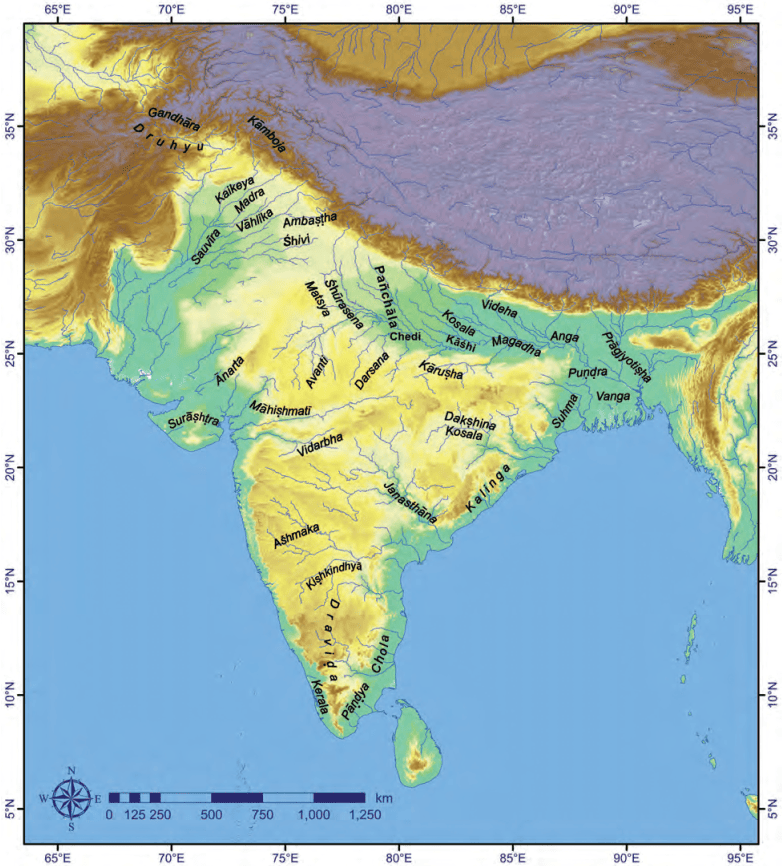
1. Kashmira

(a) Parts of Bengal

2. Kurukshetra

(b) More or less today’s Kashmir

3. Vanga

(c) Roughly today’s Assam

4. Pragjyotisha

(d) Parts of Haryana today

View full solution
List IList II
A. Kashmira1. Parts of Bengal
B. Kurukshetra2. Parts of Haryana
C. Vanga3. Roughly today’s Assam
D. Pragjyotisha4. More or less today’s Kashmir
 
View full solution
Assertion: Chinese speakers refer to India as ‘Yintu’ or’Yindu’.
Reason: The Chinese name for India ‘Yintu’ or ‘Yindu’ is derived from the word ‘Sindhu’.
  • A
    Both Assertion (A) and Reason (R) are true, and Reason (R) is the correct explanation of Assertion (A).
  • B
    Both Assertion (A) and Reason (R) are true, but Reason (R) is not the correct explanation of Assertion (A).
  • C
    Assertion (A) is true, but Reason (R) is false.
  • D
    Assertion (A) is false, but Reason (R) is true.
View full solution
Assertion: Emperor Ashoka used the name ‘Jambudvipa’ to describe the whole of India.
Reason: ‘Jambudvipa’ was used to describe present-day India, Bangladesh, Pakistan, as well as parts of Afghanistan.
  • A
    Both Assertion (A) and Reason (R) are true, and Reason (R) is the correct explanation of Assertion (A).
  • B
    Both Assertion (A) and Reason (R) are true, but Reason (R) is not the correct explanation of Assertion (A).
  • C
    Assertion (A) is true, but Reason (R) is false.
  • D
    Assertion (A) is false, but Reason (R) is true.
View full solution
Assertion: The name ‘Bharat’ is of recent origin.
Reason: In South India, India is referred to as ‘Bharatam’.
  • A
    Both Assertion (A) and Reason (R) are true, and Reason (R) is the correct explanation of Assertion (A).
  • B
    Both Assertion (A) and Reason (R) are true, but Reason (R) is not the correct explanation of Assertion (A).
  • C
    Assertion (A) is true, but Reason (R) is false.
  • D
    Assertion (A) is false, but Reason (R) is true.
View full solution
Assertion (A): The term ‘Hindustan’ was first used about 1,800 years ago.
Reason (R):It was used by most invaders of India to describe the Indian Subcontinent.
  • Both (A) and (R) are true and (R) is the correct explanation of (A).
  • B
    Both (A) and (R) are true but (R) is not the correct explanation of (A).
  • C
    (A) is correct but (R) is wrong.
  • D
    (A) is wrong but (R) is correct.

Answer: A.

View full solution
Assertion (A): Xuanzang visited India in the 7th century CE.
Reason (R):He traveled to India to collect Buddhist texts and meet scholars.
  • Both (A) and (R) are true and (R) is the correct explanation of (A).
  • B
    Both (A) and (R) are true but (R) is not the correct explanation of (A).
  • C
    (A) is correct but (R) is wrong.
  • D
    (A) is wrong but (R) is correct.

Answer: A.

View full solution

Generate a India, That is Bharat paper free

Pick question groups from the list above, set marks and difficulty, and export a branded PDF with step-by-step answer keys. First 3 chapters free — no signup.

Download App