Question
Comment on the geographical understanding of ancient Indians.

Answer

Ancient Indians possessed a clear understanding of their country’s geography, as evident from texts like the Rigveda, Mahabharata and Vishnu Purana. These texts describe the region’s boundaries, rivers, and mountains, showcasing a comprehensive knowledge of the sub-continent’s geography."
The Rigveda mentions ‘Sapta Sindhava’, highlighting the significance of rivers in shaping India’s identity. The ancient Indians’ geographical understanding was not limited to physical features; they also recognised the cultural and regional diversity within the sub-continent.
The Mahabharata mentions various regions, such as Kashmira, Kurukshetra and Vanga, demonstrating an awareness of India’s complex geography. This understanding reflects a sophisticated appreciation of the sub-continent’s ecological, cultural and political landscape.
Additionally, ancient Indians recognised the strategic importance of geographical features, such as the Himalayas and the Indian Ocean, in shaping the sub-continent’s climate, trade and cultural exchange.

Need a full question paper?

Generate a complete, print-ready paper with questions like this in minutes — across 16+ boards, with answer keys.
Start Generating Free

Similar questions

Do you grow the cereals you have listed in answer no.7? If yes, draw a chart to show’ the stages in growing them. If not, draw a chart to show how these cereals reach you from the farmers who grow them.
Rehana's house was the closest and they ran and told her mother what had happened. Rehana's mother said, "I don't really know these things in great detail but I do know that it is the Municipal Corporation of the city that takes care of replacing lights. The best person to ask would be Yasmin Khala. She just retired from the Municipal Corporation. Go and ask her, and Rehana come back home soon."
Yasmin Khala lived in the same lane and she and Rehana's mother were good friends. The children ran to Khala's house and when she opened the door they began to tell her what had happened all at once! When they asked about the street light, Yasmin Khala laughed and said, "There is no one person that you can pay the money to. There is a big organisation called the Municipal Corporation that takes care of street lights, garbage collection, water supply, keeping the streets and the market clean."
"I've heard about the Municipal Corporation. They've put up signs around the city to inform people about Malaria," said Mala.
"Yes, you are quite right. The Municipal Corporation is also responsible for ensuring that diseases do not break out in the city. It also runs schools, hospitals, and dispensaries. And makes gardens and maintains them," said Yasmin Khala. Then she added, "Our city Pune is a big city and so here it is called a Municipal Corporation. In smaller towns, it is called a Municipal Council."
List at least four different tasks that the Municipality does :
Look at the pictures given below and write about the picture.
Image
Image
Image
Image
Match the following statements in a way that challenges stereotypes :
a. Two surgeons were sitting down to lunch when one of them made a call on the mobile phone1. suffers from chronic asthma
b. The boy who won the drawing competition went to the dias2. to become an astronaut which she did.
c. One of the fastest athletes in the world3. to speak with her daughter who had just returned from school.
d. She was not that well-off but had a dream4. on a wheelchair to collect his prize.
Several poor people in the city work as domestic servants as well as work for the Corporation, keeping the city clean. Yet the slums in which they live are quite filthy. This is because these slums seldom have any water and sanitation facilities. The reason often given by the Municipal Corporation is that the land in which the poor have set up their homes does not belong to them and that slum-dwellers do not pay taxes. However, people living in middle-class neighborhoods pay very little in taxes compared to the amount of money the corporation spends on them in setting up parks, street lighting facilities, regular garbage collection etc. Also as you read in this chapter, the property taxes collected by the Municipality makes up only 25-30 percent of its money.
Why do you think it is important that the Corporation should spend more money on slum localities ? Why is it important that the Municipal Corporation provide the poor in the city with the same facilities that the rich get ?
What is the primary sector? How is it different from the secondary sector? Give two examples.
Choose another region in India and do a similar study of the historical and geographical factors that influence the diversity found there. Are these historical and geographical factors connected to each other? How?
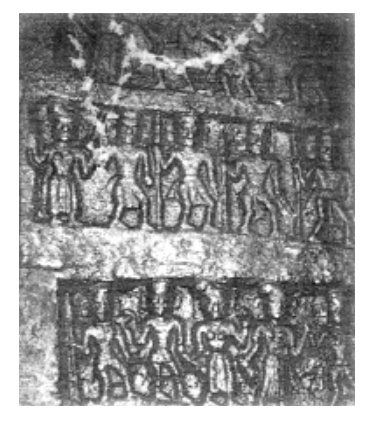
Look at the picture of a carved stone and answer the following questions.
Image
(a) Whom do these five figures shown in the picture represent ?
(b) In which part of India was this carved stone found ?
(c) How is this carved stone related to the tribal culture of that area ?
(d) What conclusion did the anthropologist K.S. Singh draw from such carved stones and the folklores ?
An Event Box :
The city of Surat had a plague scare in 1994. Surat was one of the dirtiest cities in India. Houses, hotels and restaurants would dump their garbage into the nearest drain or street which made it very difficult for sweepers to collect and transfer the garbage into selected dumps. In addition to this, the Municipal Council did not collect the garbage as often as it should have and this led to the situation getting worse. The plague spreads through the air and people who have the disease have to he isolated. In Surat, several people lost their lives, and over 300,000 deserted the town. The scare of the plague ensured that the municipal council completely cleaned up the city. To this date, Surat continues to remain the second cleanest city in India after Chandigarh.
1. Do you know when and how often garbage gets collected in your neighbourhood ?
2. Do you think it is the same for all neighbourhoods in the city ? Why not ? Discuss.
Read the following source and answer the questions that follow.
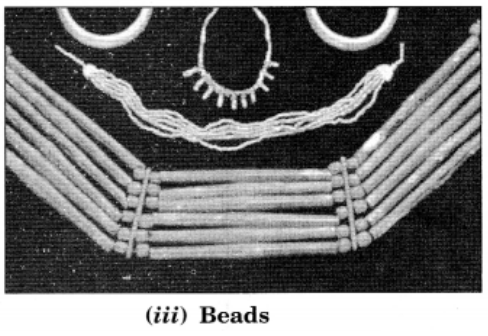
The Harappans were engaged in active trade, not only within their own civilisation (other cities nearby or far away), but with other civilisations and cultures within and outside India. They exported ornaments, timber, some objects of daily use, probably also gold and cotton and possibly some food items. The most favoured ornaments were beads of carnelian, a reddish semi precious stone found mostly in Gujarat. What the Harappans imported in exchange of the exported goods is not so clear. It probably included copper, since this metal was not so common back home.

To conduct such a trade, they used land routes and rivers, and the sea for more distant destinations this is the first intensive maritime activity in India. Indeed, quite a few Harappan settlements are located in the coastal regions of Gujarat and Sindh. Lothal, a small settlement in Gujarat. Harappan beads of carnelian beads excavated at Susa (present-day Iran).

(i) What does the evidence of Harappan carnellan beads found at Susa suggest about their trade activities ?
(a) The Harappans used carnelian beads only for local decoration.
(b) The Harappans had trade connections extending beyond the Indian sub-continent.
(c) Susa was a Harappan city known for bead-making.
(d) Carnelian was imported by the Harappans from Susa.

(ii) Why is the large basin found in Lothal significant in understanding Harappan trade practices ?
(a) It was used as a water reservoir for agricultural purposes.
(b) It indicates that Lothal was primarily a fishing village.
(c) It was likely a dockyard used for receiving and sending goods via boats.
(d) It was a ceremonial site for religious rituals.

(iii) What can be inferred about the Harappans’ expertise in working with materials like shell and carnelian ?
(a) They were only able to work with soft, easily shaped materials.
(b) They developed advanced techniques to handle hard and precious materials.
(c) Their crafts were limited to basic tools and implements.
(d) They imported all of their ornaments from other civilisations.

(iv) Which aspect of the Harappan civilisation indicates the beginning of maritime activities in India ?
(a) The construction of large temples.
(b) The crafting of ivory combs found in Oman.
(c) The presence of coastal settlements and a dockyard at Lothal.
(d) The development of inland water reservoirs.