Question types

India’s Cultural Roots question types

135 questions across 9 question groups — pick any mix to generate a Social Studies paper with step-by-step answer keys.

135
Questions
9
Question groups
5
Question types
Sample Questions

India’s Cultural Roots questions

One sample from each question group in this chapter. Select any group above to see the full set with answer keys.

Q 2M.C.Q1 Mark
Consider the following statements. Choose the option that correctly describes the interaction between folk, tribal traditions, and leading schools of thought in Indian culture.
(i) Folk and tribal traditions were isolated and did not influence mainstream beliefs.
(ii) There was constant interaction, with deities, concepts, and rituals being exchanged freely.
(iii) Tribal beliefs were eradicated by the leading schools of thought.
(iv) Leading schools of thought rejected any influence from folk and tribal traditions.
  • A
    Only (i) and (ii)
  • Only (ii)
  • C
    Only (iv)
  • D
    None of these

Answer: B.

View full solution
Q 3M.C.Q1 Mark
The Vedic hymns were composed by which of the following groups?
  • A
    Rishis (male seers)
  • B
    Rishikas (female seers)
  • Both (a) and (b)
  • D
    Neither (a) nor (b)

Answer: C.

View full solution
Q 5M.C.Q1 Mark
The Vedic texts were primarily transmitted through which method?
  • A
    Written manuscripts
  • Oral recitation
  • C
    Carvings on stones
  • D
    Illustrated scrolls

Answer: B.

View full solution
Consider and discuss in class Andre Beteille's thought
"The thousands of castes and tribes on the Indian sub-continent have influenced each other in their religious beliefs and practices since the beginning of history and before that the tribal religions have been influenced by Hinduism is widely accepted, but it is equally true that Hinduism, not only in its formative phase but throughout its evolution, has been influenced by tribal religions."
View full solution
Do you know the term for a society where people select their leaders? How do you think people can benefit from such a situation? What could happen if they live under leaders that they did not choose? Write your thoughts in a paragraph of 100-150 words.(Hint: Think back to what you're learning in the theme 'Governance and Democracy'!)
View full solution
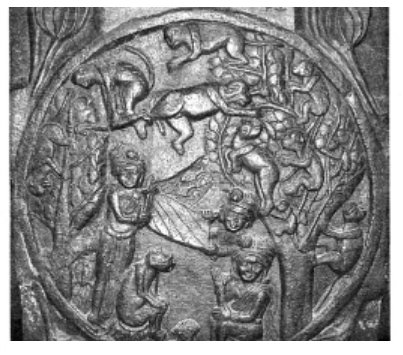
Look at this stone panel found at Bharhut in Madhya Pradesh that depicts the story of the monkey-king. Read the story of the monkey king in the book and answer the following questions.
Image

(a) This story has been taken from the _________.
(b) In this story Buddha has been shown as the _________.
(c) The monkey king had instructed that no fruit from that tree should escape. Why was this instruction given by the king ?
(d) How did the monkey-king save his other monkeys from the soldiers of the king ?
View full solution
Column AColumn B
(1) Mahavira(i) Sarnath
(2) Enlightenment of Buddha(ii) Lichchhavis
(3) First sermon of Buddha(iii) Kushinara
(4) Rules of Sangha(iv) Bodh Gaya
(5) Death of Buddha(v) Powerful Tsunami
 
View full solution
Column AColumn B
1. Rig Veda(a) Rituals and ceremonies
2. Yajur Veda(b) Hymns and prayers
3. Sama Veda(c) Magic and everyday rituals
4. Atharva Veda(d) Chants and melodies
 
View full solution
Assertion (A) The Charvaka school believed in life after death.
Reason ( R ) Charvaka taught that the material world is the only thing that exists.
  • A
    Both A and R are true and R is the correct explanation of A
  • B
    Both A and R are true, but R is not the correct explanation of A
  • A is false, but R is true
  • D
    A is true, but R is false

Answer: C.

View full solution
Assertion (A) The Todas of the Nilgiris avoid pointing to their sacred peaks with a finger.
Reason (R) They consider these peaks as residences of gods or goddesses.
  • Both A and R are true and R is the correct explanation of A
  • B
    Both A and R are true, but R is not the correct explanation of A
  • C
    A is false, but R is true
  • D
    A is true, but R is false

Answer: A.

View full solution
Assertion (A) Tribal and Hindu belief systems have enriched each other through interactions.
Reason (R) They share many similar concepts, including the worship of natural elements and deities.
  • Both A and R are true and R is the correct explanation of A
  • B
    Both A and R are true, but R is not the correct explanation of A
  • C
    A is false, but R is true
  • D
    A is true, but R is false

Answer: A.

View full solution
Assertion: The Vedic hymns were composed by rishis and rishikas in an early form of the Sanskrit language.
Reason: The hymns were addressed in poetical form to many deities (gods or goddesses).
  • Both Assertion (A) and Reason (R) are true, and Reason (R) is the correct explanation of Assertion (A).
  • B
    Both Assertion (A) and Reason (R) are true, but Reason (R) is not the correct explanation of Assertion (A).
  • C
    Assertion (A) is true, but Reason (R) is false.
  • D
    Assertion (A) is false, but Reason (R) is true.

Answer: A.

View full solution
Assertion: The Bhikkhus and Bhikhunnis spread the teachings of Buddhism to other parts of India Reason: The Bhikkhus used to roam around and ask for food.
  • A
    Both Assertion (A) and Reason (R) are true, and Reason (R) is the correct explanation of Assertion (A).
  • Both Assertion (A) and Reason (R) are true, but Reason (R) is not the correct explanation of Assertion (A).
  • C
    Assertion (A) is true, but Reason (R) is false.
  • D
    Assertion (A) is false, but Reason (R) is true.

Answer: B.

View full solution

Generate a India’s Cultural Roots paper free

Pick question groups from the list above, set marks and difficulty, and export a branded PDF with step-by-step answer keys. First 3 chapters free — no signup.

Download App