Question
What are the Vedas? What is their message?

Answer

The Vedas are a collection of ancient sacred texts that form the foundation of Hinduism. They are written in Sanskrit and are considered the oldest and most authoritative scriptures in Hindu religious tradition. The term "Veda" means "knowledge" or "wisdom." There are four Vedas:
1. Rigveda : The oldest of the Vedas, it consists of hymns dedicated to various deities.
2. Samaveda : It consists mainly of verses that are meant to be sung rather than recited.
3. Yajurveda : Contains prose mantras used in ritual offerings.
4. Atharvaveda : It includes a diverse range of topics, including remedies for physical and mental ailments.
Teachings of Vedas: Vedas provide a guideline on living a righteous life, including virtues like truthfulness, charity, and respect for all living beings. They emphasize the unity of the individual soul (Atma) with the universal soul (Brahma). They uphold one's duty and living in harmony with the cosmic order. They advocate for a balanced life that includes fulfilling material needs while also striving for spiritual growth. They provide a comprehensive framework for understanding the universe, human existence, and the relationship between the divine and the mortal.

Need a full question paper?

Generate a complete, print-ready paper with questions like this in minutes — across 16+ boards, with answer keys.

Start Generating Free

Similar questions

Discuss the three main economic sectors and their roles in the economy. Provide examples of activities within each sector and explain how they contribute to the overall economic system.
Read the following paragraph and answer the questions that follows.
Early humans faced many challenges from nature and lived in bands or groups to help each other. They were constantly seeking shelter and food, and were mainly hunters and gatherers; this means that they relied on hunting and collecting edible plants and fruits for their survival.

Our early ancestors also had certain beliefs about the natural elements and possibly also some notion of afterlife. These groups lived in temporary camps, rock shelters or caves, and communicated with each other using languages that are now lost. They used fire and started making objects that made their lives easier, like improved stone axes and blades, arrowheads and other tools.

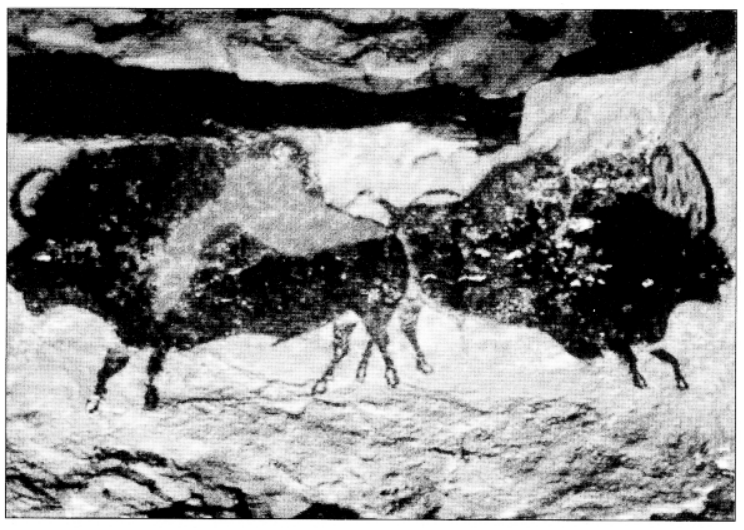
Aspects of their life are visible in rock paintings found in hundreds of caves all over the world. Some of those paintings depict simple figures or a few symbols; others are more detailed and represent scenes with animals or humans. In time, these early humans learned to make simple ornaments such as stone or shell beads, pendants made of animal teeth, and sometimes exchanged them with other groups.

(i) What might be the reason early humans lived in groups or bands rather than alone ?
(a) To establish permanent settlements
(b) To ensure better protection and cooperation in finding food and shelter
(c) To develop complex languages
(d) To practice agriculture

(ii) What might have been the purpose of the rock paintings created by early humans ?
(a) To decorate their living spaces
(b) To record their daily activities, beliefs or significant events
(c) To serve as blueprints for construction
(d) To document agricultural techniques

(iii) Why is it likely that early humans began to improve tools such as stone axes and blades ?
(a) They had access to better materials over time
(b) Improved tools made hunting and gathering more efficient
(c) They were influenced by other cultures
(d) They needed to build permanent homes

(iv) The early humans used to do painting on their rock caves. What could be the possible reasons for this activity ?
(a) They wanted to beautify their walls
(b) They draw to mark the sign of authority
(c) They draw to make sure animals stay away from their shelters
(d) They used to draw to mark the ceremonies, gathering or their achievements
What arc the similarities ana and the the Panchayati Raj system in rural areas urban local bodies?
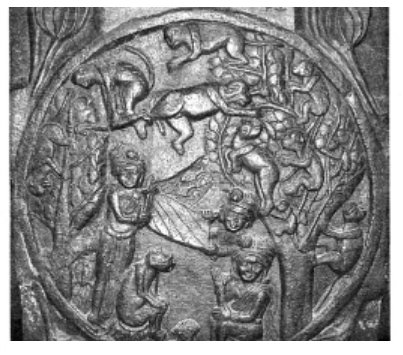
Look at this stone panel found at Bharhut in Madhya Pradesh that depicts the story of the monkey-king. Read the story of the monkey king in the book and answer the following questions.
Image

(a) This story has been taken from the _________.
(b) In this story Buddha has been shown as the _________.
(c) The monkey king had instructed that no fruit from that tree should escape. Why was this instruction given by the king ?
(d) How did the monkey-king save his other monkeys from the soldiers of the king ?
“The Panchayati Raj system works at three levels – the village, the block, and the district. This system allows for local governance and ensures that development plans and resources are managed efficiently. The Gram Panchayat, being the base level, directly interacts with the villagers, addressing their immediate needs and concerns. Above the Gram Panchayat is the Panchayat Samiti, which coordinates between multiple Gram Panchayats, and at the top is the Zila Parishad, which oversees district-level administration.”

1. What are the three levels of the Panchayati Raj system ?
2. What role does the Panchayat Samiti play in the Panchayati Raj system ?
3. How does the Zila Parishad contribute to local governance ?
4. Why is the Gram Panchayat considered the base level of the Panchayati Raj system ?
Describe different type of vegetation found in India.
Look at the picture and answer the following questions
Image

(a) Which famous site is it ?
(b) Where is it located- place and the state ?
(c) Why were so many caves cut from the rock ?
(d) How are these caves related to Hinduism, Buddhism and Jainism ?
Discuss the importance of women’s participation in Panchayati Raj institutions and provide examples of successful female leaders in this system.
In the given world’s map carefully mark the following.
(i) Oceans : Pacific Ocean, Atlantic Ocean, Indian Ocean, Arctic Ocean
(ii) Continents : Asia, Europe, Africa, North America, South America, Australia and Antarctica.
Write a note on Oceans.