Question types

Landforms and Life question types

166 questions across 11 question groups — pick any mix to generate a Social Studies paper with step-by-step answer keys.

166
Questions
11
Question groups
5
Question types
Sample Questions

Landforms and Life questions

One sample from each question group in this chapter. Select any group above to see the full set with answer keys.
Q 1M.C.Q1 Mark
Skiing, hiking, mountaineering and paragliding are the examples of sports.
  • A
    mountain
  • B
    water
  • C
    desert
  • D
    beach
View full solution
Q 2M.C.Q1 Mark
A type of forest that grows in mountainous regions is called .
  • A
    Deciduous forest
  • B
    Evergreen forest
  • C
    Montane forest
  • D
    Mangrove forest
View full solution
Q 3M.C.Q1 Mark
Rain, snow and hail are the most common forms of .
  • A
    precipitation
  • B
    evaporation
  • C
    condensation
  • D
    transpiration
View full solution
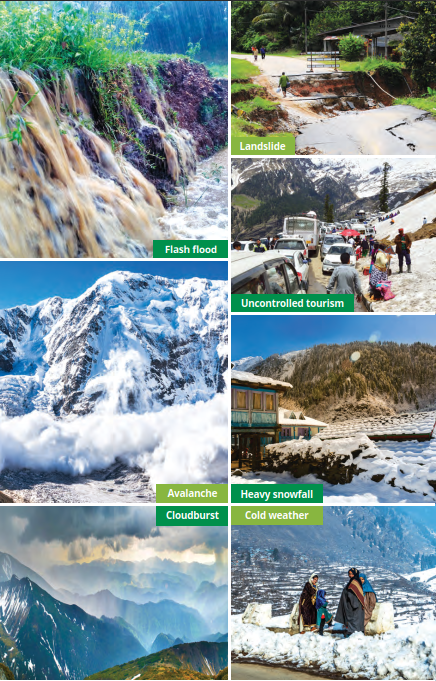
The images given below depict a few challenges that people living in the mountains may face. Discuss them in groups in the class and write one paragraph on each. Also discuss why, despite many such challenges, people still choose to live in the mountains.
Image
View full solution
Read the following paragraph and answer the questions that follow Mountains with tall and sharp peaks, like the Himalayas, are relatively ‘young’, which means that they were formed recently in the Earth’s history-but that is still millions of years ago! Shorter and more rounded mountains and hills, like the Aravalli Range, are much older and have been rounded by erosion. Sometimes, as with the Himalayas, upliftment as well as erosion continue to this day.

(i) Himalayas are tall and have sharp peaks because they are _________.
(a) ancient mountains
(b) young mountains
(c) eroded hills
(d) coastal ranges

(ii) The Aravalli Range is an example of old mountain because of _________.
(a) tall and sharp
(b) recently formed
(c) erosion
(d) continually uplifting

(iii) The statement “some mountains of the world, like the Himalayas, are still growing in height implies that these mountains are
(a) Eroding rapidly
(b) Forming new valleys
(c) Experiencing upliftment
(d) Located in coastal regions

(iv) The erosion affects the appearance of older mountain ranges like the Aravalli Range by
(a) making them taller
(b) sharpening their peaks
(c) making them shorter and more rounded
(d) adding volcanic features
View full solution

There are seven countries that share land boundaries with India. India shares its water borders with Sri Lanka and Maldives. Sri Lanka is separated from India by the Palk Strait. India is a vast country. For administrative purposes, the country is divided into 28 States and 8 Union Territories. Delhi is the national capital. The states have been formed mainly on the basis of languages. India is marked by a diversity of physical features such as mountains, plateaus, plains, coasts and islands. Standing as sentinels in the north are the lofty snow-capped Himalayas. Himalaya means The abode of snow7. The Himalayan mountains are divided into three main parallel ranges. The northernmost is the Great Himalaya or Himadri. The world’s highest peaks are located in this range. Middle Himalaya or Himachal lies to the south of Himadri. Many popular hill stations are situated here. The Shiwalik is the southernmost range. The Northern Indian plains lie to the south of the Himalayas. They are generally level and flat. These are formed by the alluvial deposits laid down by the rivers- the Indus, the Ganga, the Brahmaputra and their tributaries. These river plains provide fertile land for cultivation. That is the reason for a high concentration of population in these plains. In the western part of India lies the Great Indian desert. It is a dry, hot and sandy stretch of land. It has very little vegetation. To the south of northern plains lies the Peninsular plateau. It is triangular in shape. The relief is highly uneven.
This is a region with numerous hill ranges and valleys. Aravali hills, one of the oldest ranges of the world, border it on the north-west side. The Vindhyas and the Satpuras are the important ranges. The rivers Narmada and Tapi flow through these ranges. These are west flowing rivers that drain into the Arabian Sea. The Western Ghats or Sahyadris border the plateau in the west and the Eastern Ghats provide the eastern boundary. While the Western Ghats are almost continuous, the Eastern Ghats are broken and uneven. The plateau is rich in minerals like coal and iron-ore. To the west of the Western Ghats and the east of Eastern Ghats lie the coastal plains. The western coastal plains are very narrow. The eastern coastal plains are much broader. There are a number of east flowing rivers. The rivers Mahanadi, Godavari, Krishna and Kaveri drain into the Bay of Bengal. These rivers have formed fertile deltas at their mouth. The Sunderban delta is formed where the Ganga and Brahmaputra flow into the Bay of Bengal. Two groups of islands also form part of India. Lakshadweep Islands are located in the Arabian Sea. These are coral islands located off the coast of Kerala. The Andaman and the Nicobar Islands lie to the southeast of the Indian mainland in the Bay of Bengal. Tsunami is a huge sea wave generated due to an earthquake on the sea floor.
Q.1. The Himalaya is located in which direction?
(a) East $\quad$ (b) West $\quad$ (c) North $\quad$ (d) South
Q.2. Where does the peninsular plateau lie?
(a) In the eastern part of India $\quad$ (b) In the western part of India
(c) In the northern part of India $\quad$ (d) In the southern part of India
Q.3. Where do the rivers Mahanadi, Godavari, Krishna and Kaveri drain?
(a) Western Ghats $\quad$ (b) Lakshadweep $\quad$ (c) Bay of Bengal $\quad$ (d) None of these
Q.4. Aravalli hill is located in which state?
(a) Rajasthan $\quad$ (b) Maharashtra $\quad$ (c) Tamil Nadu $\quad$ (d) None of these

View full solution
India is a country of vast geographical expanse. In the north, it is bound by the lofty Himalayas. The Arabian Sea in the west, the Bay of Bengal in the east and the Indian Ocean in the south, wash the shores of the Indian peninsula. India has an area of about 3.28 million km. The north-south extent from Ladakh to Kanyakumari is about 3,200 km. And the east-west extent from Arunachal Pradesh to Kuchchh is about 2,900 km. The lofty mountains, the Great Indian Desert, the Northern Plains, the uneven plateau surface and the coasts and islands present a diversity of landforms. There is a great variety in the climate, vegetation, wildlife as well as in the language and culture. In this diversity, we find the unity that is reflected in traditions that bind us as one nation. India has a population of more than 120 crores since the year 2011. It is the second most populous country of the world after China. India is located in the Northern Hemisphere. The Tropic of Cancer $\left(23^{\circ} 30 / N \right)$ passes almost halfway through the country. From south to north, main land of India extends between $8^{\circ} 4^{\prime} N$ and $37^{\circ} 6 N$ latitudes. From west to east, India extends between $68^{\circ} 7^{\prime} E$ and $97^{\circ} 25^{\prime} E$ longitudes. If we divide the world into eastern and western hemispheres, which hemisphere would India belong to? Due to great longitudinal extent of about $29^{\circ}$, there could be wide differences in local time of places located at two extreme points of India. As such, the difference between these two points would be of about two hours. As you have learnt earlier, the local time changes by four minutes for every one degree of longitude. The Sun rises about two hours earlier in the east (Arunachal Pradesh) than in the west (Gujarat). You have already read earlier, why the local time of longitude of $82^{\circ} 30^{\prime} E$ has been taken as the Indian Standard Time. This meridian or longitude is also termed as the Standard Meridian of India.
Q.1. India has an area of:
(a) 3.28 million sq.km. $\quad$ (b) 2.58 million sq.km.
(c) 1.32 million sq.km. $\quad$ (d) None of these
Q.2. Which type of variety of landform is found in India?
(a) Mountain $\quad$ (b) Desert $\quad$ (c) Plain and Plateau $\quad$ (d) All of these
Q.3. India’s vast varieties is/are:
(a) Climate $\quad$ (b) Vegetation and wildlife
(c) Language and culture $\quad$ (d) All of the above
Q.4. Which is the second most populous country of the world after China?
(a) Australia $\quad$ (b) New Zealand $\quad$ (c) Sri Lanka $\quad$ (d) India
View full solution

Column A

Column B

Q.1. Deccan plateau

(i) Meghalaya

Q.2. African Plateau

(ii) Confluence

Q.3. Victoria Falls

(iii) Gold and diamond mining

Q.4. Cherrapunji plateau

(iv) Volcanic activity

Q.5. The meeting point of two or more rivers

(v) Zambezi river

View full solution

Column A

Column B

Q.1. Mount Everest

(a) Andes

Q.2. Anamudi

(b) Africa

Q.3. Mount Aconcagua

(c) South India

Q.4. Mount Kilimanjaro

(d) Alps

Q.5. Mont Blanc

(e) Himalayas

View full solution
Match words in pairs :
Mount EverestAfrica
raftingroof of the world
camelsrice fields
plateaudesert
Gangetic plainsriver
waterwayGanga
Mount Kilimanjarotributary
Yamunaclimbing
View full solution
List IList II
A. Himalayas1. Delta region known for its mangrove forests
B. Western Ghats2. Ancient fold mountains in North-West India
C. Indo-Gangetic Plains3. Mountain range running parallel to the western coast of India
D. Sundarbans4. Fertile plain formed by major Indian rivers
E. Aravalli Range5. Young fold mountains in northern India
 
View full solution
List IList II
A. Mountains1. Landform with a flat surface that rises above the surrounding land
B. Plateaus2. Low-lying landform, often fertile and suitable for agriculture
C. Plains3. Elevated landform with steep slopes and a narrow summit
 
View full solution
Assertion: A plateau is a landform that rises up from the surrounding land and has a more or less flat surface; some of its sides are often steep slopes.
Reason: The height of plateaus can vary from a few hundred metres to several thousand metres.
  • A
    Both Assertion (A) and Reason (R) are true, and Reason (R) is the correct explanation of Assertion (A).
  • B
    Both Assertion (A) and Reason (R) are true, but Reason (R) is not the correct explanation of Assertion (A).
  • C
    Assertion (A) is true, but Reason (R) is false.
  • D
    Assertion (A) is false, but Reason (R) is true.
View full solution
Assertion: The mountain terrain is usually rugged or rough, and has steep slopes.
Reason: In many mountainous regions of the world, herding is the preferred occupation over agriculture.
  • A
    Both Assertion (A) and Reason (R) are true, and Reason (R) is the correct explanation of Assertion (A).
  • B
    Both Assertion (A) and Reason (R) are true, but Reason (R) is not the correct explanation of Assertion (A).
  • C
    Assertion (A) is true, but Reason (R) is false.
  • D
    Assertion (A) is false, but Reason (R) is true.
View full solution
Assertion: Mountain regions are thinly populated.
Reason: Mountains have a rugged terrain and harsh climate.
  • A
    Both (A) and (R) are true and (R) is the correct explanation of (A).
  • B
    Both (A) and (R) are true but (R) is not the correct explanation of (A).
  • (A) is correct but (R) is wrong.
  • D
    (A) is wrong but (R) is correct.

Answer: C.

View full solution
Assertion (A): Montane forests are found at lower altitudes.
Reason (R): Montane forests are home to conifer trees.
  • A
    Both (A) and (R) are true and (R) is the correct explanation of (A).
  • B
    Both (A) and (R) are true but (R) is not the correct explanation of (A).
  • C
    (A) is correct but (R) is wrong.
  • (A) is wrong but (R) is correct.

Answer: D.

View full solution
Assertion (A): The Tibetan Plateau is called the ‘Roof of the World.’
Reason (R): It has an average altitude of 4,500 meters.
  • Both (A) and (R) are true and (R) is the correct explanation of (A).
  • B
    Both (A) and (R) are true but (R) is not the correct explanation of (A).
  • C
    (A) is correct but (R) is wrong.
  • D
    (A) is wrong but (R) is correct.

Answer: A.

View full solution

Generate a Landforms and Life paper free

Pick question groups from the list above, set marks and difficulty, and export a branded PDF with step-by-step answer keys. First 3 chapters free — no signup.

Download App