MCQ 511 Mark
The average age of husband, wife and their child $3$ years ago was $27$ years and that of wife and the child $5$ years ago was $20$ years. The present age of the husband is:
- A
$35$ years
- ✓
$40$ years
- C
$50$ years
- D
AnswerCorrect option: B. $40$ years
Sum of the present ages of husband, wife and child $= (27 \times 3 + 3 \times 3)$ years $= 90$ years.
sum of the present ages of wife and child $= (20 \times 2 + 5 \times 2)$ years $= 50$ years.
$\therefore$ husbands present age $= (90 - 50) = 40$ years.
View full question & answer→MCQ 521 Mark
If the average marks of three batches of $55, 60$ and $45,$ students respectively is $50, 55$ and $60,$ then what are the average marks of all the students?
- A
$43.5879$
- B
$65.7824$
- ✓
$54.6875$
- D
$34.2278$
AnswerCorrect option: C. $54.6875$
Total marks of first batch $= 55 \times 50 = 2750$
total marks of second batch $= 60 \times 55 = 3300$
total marks of third batch $= 45 \times 60 = 2700$
total number of students in three batch $= 55 + 60 + 45 = 160$
$\therefore$ average marks of all the students $ = \frac{2750+3300+2700}{160} = \frac{8750}{160} = 54.6875$
View full question & answer→MCQ 531 Mark
The range of the data $: 21, 6, 17, 18, 12, 8, 4, 13$ is:
AnswerHere,
Highest observation $= 21$
Lowest observation $= 4$
Range = Highest observation - Lowest observation
$= 21 - 4 = 17$
View full question & answer→MCQ 541 Mark
There are $10$ cards numbered from $1$ to $10.$ A card is drawn randomly. The probability of getting an even numbered card is:
- A
$\frac{1}{10}$
- B
$\frac{1}{5}$
- ✓
$\frac{1}{2}$
- D
$\frac{2}{5}$
AnswerCorrect option: C. $\frac{1}{2}$
The number on the cards are $1, 2, 3, 4, 5, 6, 7, 8, 9, 10,$
The even numbers on the cards are $2, 4, 6, 8, 10,$
$\therefore $ Probability of getting an even numbered card $=\frac{\text{Number of even numbered card}}{\text{Number of cards with numbers from 1 to 10}}=\frac{5}{10}=\frac{1}{2}$
Hence, the correct option is $(c).$
View full question & answer→MCQ 551 Mark
The average of $0.3, 0.03$ and $0.003$ is $......$
AnswerCorrect option: C. $0.111$
$\text{Average} = \frac{0.3+0.03+0.003}{3}$
$ = \frac{0.333}{3} = 0.111$
View full question & answer→MCQ 561 Mark
The mean of $10$ observations is $15.$ If one observation $15$ is added, then the new mean is:
AnswerSum of $10$ observations $= 10 × 15 = 150$
Sum of $11$ observations $= 150 + 15 = 165$
Number observations $= 11$
Mean of $11$ observations $= \frac{165}{11}=15$
Thus, the new mean is $15$
Hence, the correct option is $(d).$
View full question & answer→MCQ 571 Mark
The mean of the distribution, in which the values of $X$ are $1, 2 ,...,$ n the frequency of each being unity is:
AnswerCorrect option: C. $\frac{(\text{n+1})}{2}$
Required mean $ = \frac{1+2+3+ ......... +}{\text{n}}$
$ = \frac{\text{n}}{2} = \frac{(2+(\text{n-1}).(1)}{2} = \frac{{\text{n}}+{1}}{2}$
View full question & answer→MCQ 581 Mark
AnswerCorrect option: D. Computed by summing all the data values and dividing the sum by the number of items
$\text{mean} = \frac{\text{Total of sample values}}{\text{sample size}}$
View full question & answer→MCQ 591 Mark
A dice is rolled. The probability of getting an even prime is:
- ✓
$\frac{1}{6}$
- B
$\frac{1}{3}$
- C
$\frac{1}{2}$
- D
$\frac{5}{6}$
AnswerCorrect option: A. $\frac{1}{6}$
The possible numbers on a dice are $1, 2, 3, 4, 5, 6.$
There is only one even prime number which is $2.$
$\therefore$ Probability of getting an even prime $ =\frac{\text{Number of even prime numbers}}{\text{Number of all possible outcomes on the dice}}=\frac{1}{6}$
Hence, the correct option is $(a).$
View full question & answer→MCQ 601 Mark
The median of the data $9, 12, 11, 10, 8, 9, 11$ is:
Answer Arranging the given data in increasing order, we get
$8, 9, 9, 10, 11, 11, 12$
As the number of observations is odd $(7),$ the median is the middle term which is $10$
Hence, the correct option is $(a).$
View full question & answer→MCQ 611 Mark
The average (arithmetic mean) of a particular set of seven numbers is $12.$ When one of the numbers is replaced by the number $6,$ the average of the set increases to $15.$ What is the number that was replaced$?$
AnswerThe average of a set of numbers is the sum of the numbers divided by the number of numbers
i.e. average $ = \frac{\text{Sum of all 7 number}}{\text{No. of number(N)}}$
Sum of all $7$ numbers $=$ average $ ×N = 12 × 7 = 84$
Similarly, the sum of the new set of numbers is $= 15 × 7 = 105$
Now, suppose that the seven numbers are $a, b, c, d, e, f, g$ and the g gets replaced by $6.$
Then we have, $a + b + c + d + e + f + g = 84 ....... (1)$
$⇒ a + b + c + d + e + f + 6 = 105$
$⇒ a + b + c + d + e + f = 99 ....... (2)$
Plugging the vlaue from $(2)$ in $(1),$ we get $99 + g = 84 g = -15$
$\therefore$ the number that was replaced was $-15.$
View full question & answer→MCQ 621 Mark
$M= 1, 2, 3, 4, 5, 6, 7.$
Each number in set $N$ is generated by dividing each number in set $M$ by $2.$ Calculate the arithmetic mean of numbers in $N:$
- A
$1$
- B
$\frac{3}{2}$
- C
$\frac{7}{4}$
- ✓
$2$
AnswerGiven,
$M = 1, 2, 3, 4, 5, 6, 7$ Each number in set $N$ is generated by dividing each number in set M by $2$
$N = 0.5, 1, 1.5, 2, 2.5, 3, 3.5$ Arithmetic mean of numbers of set N is
$ = \frac{0.5+1+1.5+2+2.5+3+3.5}{7} = \frac{14}{7} = {2}$
View full question & answer→MCQ 631 Mark
The mean of $x, y, z$ is y, then $x + z =$
Answer The question tells us that the mean of $x, y$ and $z$ is $y.$
$\text{i.e.} = \frac{\text{x+y+z}}{3} = \text{y}$
$\text{i.e.} = \text{x+z} = 2\text{y}$
View full question & answer→MCQ 641 Mark
The class mark of the class $90 - 120$ is:
Answer$\text{class marks} = \frac{\text{upperlimit + lower limit}}{2}\Rightarrow \frac{120+90}{2} = \frac{210}{2} = {105}$
View full question & answer→MCQ 651 Mark
The weights of $9$ apples are $50, 60, 65, 62, 67, 70, 64, 45, 48$ grams. Their mean weight is:
- A
$60.5$ gram
- B
$60$ gram
- ✓
$59$ gram
- D
$62$ gram
AnswerCorrect option: C. $59$ gram
Given weights of $9$ apples are $50, 60, 65, 62, 67, 70, 64, 45, 48$ grams.
then total weight of $9$ apples $= 50 + 60 + 65 + 62 + 67 + 70 + 64 + 45 + 48 = 531$
then mean $ = \frac{531}{9} = {59}{\text{ gram}}$
View full question & answer→MCQ 661 Mark
The mean of first seven even natural numbers is:
AnswerThe first seven even natural numbers are: $2, 4, 6, 8, 10, 12, 14$
$\text{Mean}=\frac{\text{Sum of observations}}{\text{Number of observations}}$
$=\frac{2+4+6+8+10+12+14}{7}$
$=\frac{56}{7}$
$=8$
Thus, the mean of first seven even natural number is $8$
Hence, the correct option is $(b).$
View full question & answer→MCQ 671 Mark
The median of $11$ observations is $10.$ The number of possible observations in the data which are less than $10$ is:
Answer Median divides the data into two equal parts. Since, the number of observations is $11,$ so after arranging in increasing or decreasing order, the number of observations to the left of the median is five.
Thus, the required number of observations is $5$
Hence, the correct option is $(a).$
View full question & answer→MCQ 681 Mark
Khilona earned scores of $97, 73$ and $88$ respectively in her first three examinations. If she scored $80$ in the fourth examination, then her average score will be:
- A
Increased by $1$
- B
Increased by $1.5$
- C
Decreased by $1$
- ✓
Decreased by $1.5$
AnswerCorrect option: D. Decreased by $1.5$
$\text{Average score}=\frac{\text{Sum of scores in all exams}}{\text{Total number of exams}}$
$\therefore$ Average score in first three examination $=\frac{97+73+88}{3}=\frac{258}{3}=86$
Also, average score in four examination $=\frac{97+73+88+80}{4}=\frac{338}{4}=84.5$
Hence, average score is decreased by $(86 - 84.5) = 1.5$
View full question & answer→MCQ 691 Mark
The marks obtained by a student of class $X$ in first and second unit test are $35$ and $21$ respectively. Find the minimum marks he should get in the annual examination to have an average of at least $30$ marks:
- A
$x ≤ 34$
- ✓
$x ≥ 34$
- C
$x > 34$
- D
$x < 34$
AnswerCorrect option: B. $x ≥ 34$
Let the marks for annual marks be $x.$
Given: - Marks of first unit test $= 35$
Marks of second unit test $= 21$ average of $3$ marks $= 30$
$\Rightarrow \frac{{\text{x}} + { 35 } +{ 21 }} {3} = {30}$
$\Rightarrow x + 35 + 21 = 90$
$\Rightarrow x + 56$
$\Rightarrow x = 34$ Marks he should get is $x = 34$
View full question & answer→MCQ 701 Mark
The heights (in cm) of $8$ girls of a class are $140, 142, 135, 133, 137, 150, 148$ and $138$ respectively. Find the mean height of these girls:
- A
$137.375$
- B
$139.375$
- ✓
$140.375$
- D
$143.375$
AnswerCorrect option: C. $140.375$
Mean is the average of the values of the data set. Given the height of the girls are
$140, 142, 135, 133, 137, 150, 148, 138$ The total number of girls is $8$
$\therefore$ mean $ = \frac{140+142+135+133+137+150+148+138}{8}$
$\Rightarrow $ mean $ = \frac{1123}{8} = {140.375}$
View full question & answer→MCQ 711 Mark
When $10$ is subtracted from each of the given observation, the mean is reduced by $60\%.$ If $5$ is added to all the given observation, then what will be the mean$?$
AnswerLet the mean be $\bar{\text{x}}$ According to the question,
$\bar{\text{x}} - {10} = {60}{\text{%}} \text{ of } \bar{\text{ x}}$
$\bar{\text{x}} = {25}$
Now, each observation is increased by $5.$
$\therefore$ New mean $ = \bar{\text{x}}+5$
$= 25 + 5 = 30.$
View full question & answer→MCQ 721 Mark
The number of trees in different parks of a city are $33, 38, 48, 33, 34, 34, 33$ and $24.$ The mode of this data is:
AnswerWe have, $33, 38, 48, 33, 34, 34, 33$ and $24.$
On arranging the data in ascending order, we get $24, 33, 33, 33, 34, 34, 38$ and $48.$
Here, $33$ occurs more frequently, i.e. $3$ times.
Mode of data $= 33$
Note: Mode is the observation that occurs most frequently in the data.
View full question & answer→MCQ 731 Mark
The mean of ten items is $x$ and if each item is increased by $4,$ then its mean will be $........$
- ✓
$x + 4$
- B
$4x$
- C
$10x$
- D
$10 + x$
AnswerCorrect option: A. $x + 4$
We know $x$
Thus $= 10x$ If each term is increased by $4,$ new sum $=$ sum $+ 10 × 4$
new sum $= 10x + 40$ New mean
$ = \frac{{10}{\text{x}}+{40}}{10}$ new mean $= x + 4$
View full question & answer→MCQ 741 Mark
The mean of the following natural numbers $1, 2, 3 ...... 10$ is:
Answer Mean $ = \frac{1 + 2 + 3 + 4 + 5 + 6 + 7 + 8 + 9 + 10}{10} = {5.5}$
View full question & answer→MCQ 751 Mark
If the average of $3, 4,$ and $x$ is $2,$ then find $x:$
AnswerGiven, the average of $3, 4,$ and $x$ is $2$
we have to find $x$
$\Rightarrow \frac{{3+4+}{\text{x}}}{3} = 2$
$\Rightarrow{7}+{\text{x}} = {6}$
$\text{x} = -{1}$
View full question & answer→MCQ 761 Mark
If the mode of $22, 21, 23, 24, 21, 20, 23, 26, x$ and $26$ is $23,$ then $x =$
AnswerArranging the numbers $22, 21, 23, 24, 21, 20, 23, 26$ and $26$ in increasing order, we get
$20, 21, 21, 22, 23, 23, 24, 26, 26$
Here, the frequencies $21, 23$ and $24$ is $2$
So, for $23$ to be the mode of the data, the value of $x$ should be $23$
Hence, the correct option is $(c).$
View full question & answer→MCQ 771 Mark
The mean of first five prime numbers is:
AnswerThe first five prime numbers are: $2, 3, 5, 7, 11$
$\text{Mean}=\frac{\text{Sum of observations}}{\text{Number of observations}}$
$=\frac{2+3+5+7+11}{5}$
$=\frac{28}{5}$
$=5.6$
Thus, the mean of first five prime number is $5.6$
Hence, the correct option is $(a).$
View full question & answer→MCQ 781 Mark
The mean of first six multiples of $5$ is:
- A
$3.5$
- B
$18.5$
- ✓
$17.5$
- D
$30$
AnswerCorrect option: C. $17.5$
The first six multiples of $5$ are: $5, 10, 15, 20, 25, 30$
$\text{Mean}=\frac{\text{Sum of observations}}{\text{Number of observations}}$
$=\frac{5+10+15+20+25+30}{6}$
$=\frac{105}{6}$
$=17.5$
Thus, the mean of first six multiples of $5$ is $17.5$
Hence, the correct option is $(c).$
View full question & answer→MCQ 791 Mark
$2, 10, m, 12, 4$
A group of $5$ integers is shown above. If the average (arithmetic mean) of the numbers is equal to $m,$ find the value of $m:$
Answer We know the average of a group of numbers is the sum of the numbers divided by the number of numbers,
we can make an equation:
$\Rightarrow \frac{{2+10+}{\text{m}}{+12+4}}{5} = {\text{m}}$
$\Rightarrow{28}+\text{m} = {5}{\text{m}}$
$\Rightarrow {\text{m}} - {5}{\text{m}} = -{28}$
$\Rightarrow -{4}{\text{m}} = -{28}$
$\Rightarrow{\text{m}} = {7}$
View full question & answer→MCQ 801 Mark
If the mean of $x$ and $\frac{1}{\text{x}}$ is $M,$ then the mean of $x^2$ and $\frac{1}{\text{x}^{2}}$ is:
- A
$m^2$
- B
$\frac{\text{m}^{2}}{4}$
- ✓
$2m^2 - 1$
- D
$2m^2+ 1$
AnswerCorrect option: C. $2m^2 - 1$
C. $2m^2 -1$
View full question & answer→MCQ 811 Mark
The mean of $a, b, c, d$ and $e$ is $28.$ If the mean of $a, c$ and $e$ is $24,$ what is the mean of $b$ and $d?$
Answer$\frac{{\text{a}} + {\text{b}} + {\text{c}} + {\text{d}} + {\text{e}}}{5} = {28}$
$\frac{{\text{a}} + {\text{c}} + {\text{e}}}{3} = 24$
$\frac{{\text{b + }}{\text{d}}} {2} = ?\Rightarrow\text{a} + {\text{b}} + {\text{c}} + {\text{d}}+{\text{e}} = {140}$
$ = \text{a} + {\text{c}}+ {\text{e}} = 72$
$\Rightarrow\text{b} + {\text{d}} = {68}$
$\therefore \frac{{\text{b}} + {\text{d}}}{2} = {34}$
View full question & answer→MCQ 821 Mark
The mean of the first $n$ natural numbers is:
AnswerCorrect option: B. $\frac{\text{n+1}}{2}$
We know that sum of first $n$ natural numbers is $\frac{\text{n}({\text{n+1})}}{2}$
So mean of the first $n$ natural numbers
$ = \frac{\text{sum of natural numbers}}{\text{number}} $
$=\frac{ \text{n}({\text{n}}+{1})}{{2}{\text{n}}} $
$=\frac{ ({\text{n}}+{1})}{{2}}$
View full question & answer→MCQ 831 Mark
The mean of $5$ numbers is $20.$ If one number is excluded their mean is $15.$ Then the excluded number is:
Answer$\frac{\text{Sum}}{\text{Total}} = {20}$
$\frac{\text{Sum}}{5}= {20}$
Sum $= 100$
Let no. excluded be $x$
$\frac{\text{New sum}}{\text{Total}} = {15}$
New Sum $= 60$
Excluded $N = 100 - 60 = 40$
View full question & answer→MCQ 841 Mark
Mean of $14, 17, 11, 13, 26, 21, 31$ and $19:$
AnswerSum of number $= 152$
Required mean $ = \frac{152}{8} = {19}$
View full question & answer→MCQ 851 Mark
In a monthly test the marks obtained in mathematics by $16$ students of a class are as follows
$0, 0, 2, 2, 3, 3, 3, 4, 5, 5, 5, 5, 6, 6, 7, 8$
The arithmetic mean of the marks obtained is:
AnswerSince mean $ = \frac{0+0+2+2+3+3+3+4+5+5+5+5+6+6+7+8+}{16}$
$\Rightarrow $ mean $ = \frac{64}{16}$
$\Rightarrow $ mean $ = {4}$
View full question & answer→MCQ 861 Mark
Find the mean of $31, 45, 84, 23, 67:$
AnswerGiven data $31, 45, 84, 23, 67$ the sum of observations $31 + 45 + 84 + 23 + 67 = 240$
the mean $\frac{240}{5} = {48}$
View full question & answer→MCQ 871 Mark
The mean of the series $a, a + d, a + 2d, .... ,a + 2nd$ is:
- A
$a + (n - 1)d$
- ✓
$a + nd$
- C
$a + (n + 1)d$
- D
AnswerCorrect option: B. $a + nd$
Required mean $ =\frac{ \text{a+}(\text{a+d})+(\text{a+2d})+ ..... +{(\text{a+2nd}})}{\text{2n+1}}$
$ = \frac{{\text{2n+1}}}{2} = \frac{{\text{2a}+(\text{2n+1}-1)\text{d}}}{\text{2n+1}} = \text{a + nd}$
View full question & answer→MCQ 881 Mark
Find the mean of $16, 29, 60, 18, 27:$
AnswerThe given data is $16, 29, 60, 18, 27$ the sum of observations is $16 + 29 + 60 + 18 + 27 = 150$
the mean is given as $\frac{150}{5} = {30}$
View full question & answer→MCQ 891 Mark
A dice is tossed $80$ times and number $5$ is obtained $14$ times. The probability of not getting the number $5$ is:
- A
$\frac{7}{40}$
- B
$\frac{7}{80}$
- ✓
$\frac{33}{40}$
- D
AnswerCorrect option: C. $\frac{33}{40}$
Probability of getting $5=\frac{14}{80}=\frac{7}{40}$
Therefore
Probability of not getting $5=1-\frac{7}{40}=\frac{33}{40}$
Hence, the correct option is $(c).$
View full question & answer→MCQ 901 Mark
Let $x, y, z$ be three observations. The mean of these observations is:
- A
$\frac{\text{x}\times\text{y}\times\text{z}}{3}$
- ✓
$\frac{\text{x}+\text{y}+\text{z}}{3}$
- C
$\frac{\text{x}-\text{y}-\text{z}}{3}$
- D
$\frac{\text{x}\times\text{y}+\text{z}}{3}$
AnswerCorrect option: B. $\frac{\text{x}+\text{y}+\text{z}}{3}$
Here $x, y$ and $z$ be three observations.
We know that, $\text{Mean}=\frac{\text{Sum of observations}}{\text{Number of observations}}$
$=\frac{\text{x+y+z}}{3}$
View full question & answer→MCQ 911 Mark
Some integers are marked on a board. What is the range of these integers$?$
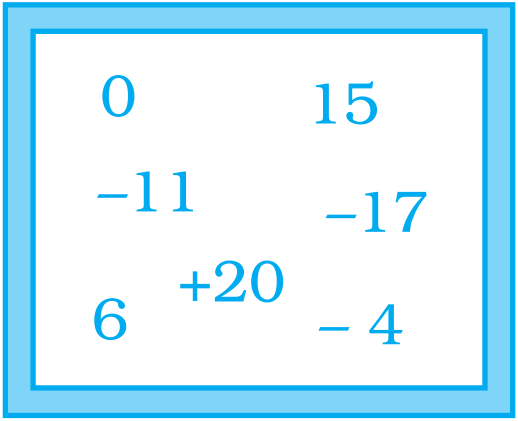
Answer Here, highest observation $= +20$ and lowest observation $= -17$
As we know,
Range $=$ Highest observation $–$ Lowest observation $= +20 - (-17) = 20 + 17 = 37$
View full question & answer→MCQ 921 Mark
The average age of a group of eight is same as it was $3$ years ago, when a young member is substituted for an old member the incoming member is younger to the outgoing member by:
- A
$11$ years
- ✓
$24$ years
- C
$28$ years
- D
$16$ years
AnswerCorrect option: B. $24$ years
$24$ years
View full question & answer→MCQ 931 Mark
The mode of the unimodular data $7, 8, 9, 8, 9, 10, 9, 10, 11, 10, 11, 12$ and $x$ is $10.$ The value of $x$ is:
Answer Arranging the data in ascending order, we get
$7, 8, 8, 9, 9, 9, 10, 10, 10, 10, 11, 11, 12$
Here, $10$ has the maximum frequency $(4)$
Hence, the correct option is $(a).$
View full question & answer→MCQ 941 Mark
The arithmetic mean of $6, 10, x$ and $12$ is $8$ The value of $x$ is:
Answer $\text{A.M} = \frac{\sum\text{x}}{\text{n}}\Rightarrow{8} = \frac{6+10+{\text{x}}+12}{4}$
$\Rightarrow{32} = {6+10} + {\text{x}} + {12} \Rightarrow = {32}-{28}$
$\Rightarrow{\text{x}} = {4}$
View full question & answer→MCQ 951 Mark
$\frac{\text{N(E)}}{\text{N(S)}}$ is the formula of:
Answer Probability of occurrence of event $E$ is $P(E) = \frac{\text{N(E)}}{\text{N(S)}}$
Where $n(E)$ is no. of cases favorable to event $E$ and $n(S)$ is total no. of cases.
View full question & answer→MCQ 961 Mark
The average of $2, 4, 6, 8, 10$ is:
Answer $\text{Average} = \frac{2+4+6+8+10}{5} = {6}$
View full question & answer→MCQ 971 Mark
The mean of $p, q$ and $r$ is same as the mean of $q, 2r$ and $s.$ Then which of the following is correct$?$
- A
$p = q = r$
- B
$q = r = s$
- C
$q = r$
- ✓
$p = r + s$
AnswerCorrect option: D. $p = r + s$
Mean of $p, q$ and $r =$ Mean of $q, 2r$ and $s$
$\frac{\text{p+q+r}}{3}=\frac{\text{q+2r+8}}{3}$
$\Rightarrow\text{p + q + r}=\text{q + 2r }+8$
$\Rightarrow\text{p}=\text{r + s}$
Hence, the correct option is $(d).$
View full question & answer→MCQ 981 Mark
The mean weight of $21$ students is $21\ kg.$ If a student weighing $21\ kg$ is removed from the group, then the mean of of the remaining students is:
- A
$20\ kg$
- ✓
$21\ kg$
- C
$19\ kg$
- D
$18\ kg$
AnswerCorrect option: B. $21\ kg$
Mean weight $= 21\ kg$
Number of students $= 21$
Sum of weights of $21$ students $= 21 × 21 = 441$
Sum of weights of $20$ students left $= 441 - 21 = 420$
Mean of remaining students $=\frac{420}{20}=21\text{kg}$
Hence, the correct option is $(b).$
View full question & answer→MCQ 991 Mark
Find the mean of $35, 34, 25, 52, 27, 23, 24, 36:$
Answer Given data $35, 34, 25, 52, 27, 23, 24, 36$ No of observations $8$ sum of observations $35 + 34 + 25 + 52 + 27 + 23 + 24 + 36 = 256$
Mean is $\frac{256}{8} = {8}$
View full question & answer→MCQ 1001 Mark
There are $100$ cards numbered from $1$ to $100$ in a box. If a card is drawn from the box and the probability of an event is $\frac{1}{2},$ then the number of favourable cases to the event is:
Answer Here, $\frac{50}{100}=\frac{1}{2}$
So, if the the probability of an event is $\frac{1}{2},$ then the number of favourable cases has to be $50.$
Hence, the correct option is $(d).$
View full question & answer→