MCQ 511 Mark
Mark $(\checkmark)$ against the correct answer in the following:
$1.02 ÷ 6 = ?$
AnswerCorrect option: B. $0.17$
$1.02\div6=\frac{1.02}{6}=0.17$
View full question & answer→MCQ 521 Mark
Multilplication of numbers $ 0.25 \times0.4$ can be represented as
- A
$ \frac{1}{100}$
- ✓
$ \frac{1}{10}$
- C
$ \frac{1}{20}$
- D
AnswerCorrect option: B. $ \frac{1}{10}$
$ 0.25\times0.4$
$=\frac{25}{100}\times\frac{4}{10}$
$=\frac{100}{100 \times 10}$
$=\frac{1}{10}$
View full question & answer→MCQ 531 Mark
What is $13.73$ rounded to the nearest tenth?
- A
$13.0$
- ✓
$13.7$
- C
$13.8$
- D
$14.0$
AnswerCorrect option: B. $13.7$
To round $13.73$ to nearest tenth means to round the numbers so you only have one digit in the fractional part.
So, If the last digit in the fractional part of $13.73$ is less than $5,$ then we simply remove the last the digit of fractional part.
So the correct answer will be $13.7.$
View full question & answer→MCQ 541 Mark
What should be subtracted from $0.1$ to get $0.06?$
AnswerCorrect option: B. $0.04$
The decimal which should be subtracted from $0.1$ to get $0.06$ can be obtained by subtracting $0.06$ from $0.1$
Converting given decimals into like decimals, we have $0.10$ and $0.06$
Now,
$= 0.10 - 0.06$
$= 0.04$
$\therefore$ Required decimal $= 0.1 - 0.06$
$= 0.04$
View full question & answer→MCQ 551 Mark
The place value of $2$ in the number $15.526$ is
- A
$20$
- B
$2$
- C
$ \frac{2}{10}$
- ✓
$ \frac{2}{100}$
AnswerCorrect option: D. $ \frac{2}{100}$
Given decimal number is $15.526$
In this, $2$ lies on one-hundredth place.
$\therefore$Place value of $ \text{2}=\frac{2}{100} =0.02$
View full question & answer→MCQ 561 Mark
Reciprocal of $ \text{2}\frac{1}{4}$
- A
$ -\frac{9}{4}$
- B
$ -\frac{4}{9}$
- C
$ \frac{9}{4}$
- ✓
$ \frac{4}{9}$
AnswerCorrect option: D. $ \frac{4}{9}$
Since it is a mixed fraction.. it can be written as $\frac{9}{4}...$ then the reciprocal of $\frac{9}{4}$ is $ \frac{4}{9}.$
View full question & answer→MCQ 571 Mark
If $\frac{1}{\text k}=\frac{1}{3} + \frac{1}{4}$ then the value of $K$ is:
- ✓
$ \text{1}\frac{5}{7}$
- B
$ \text{2}\frac{5}{7}$
- C
$ \text{3}\frac{5}{7}$
- D
$ \text{4}\frac{5}{12}$
AnswerCorrect option: A. $ \text{1}\frac{5}{7}$
$ \frac{1}{\text{k}} = \frac{1}{3} + \frac{1}{4}$ Multiply by $k,$
$\therefore 1=\frac{\text{k}}{3}+\frac{\text{k}}{4}\Rightarrow12=4\text{k}+3\text{k}$
$\Rightarrow7\text{k} =12\text{k}\Rightarrow\text{1}\frac{5}{7}$
View full question & answer→MCQ 581 Mark
Mark $(\checkmark)$ against the correct answer in the following:
$5kg\ 6g = ?$
- A
$5.0006\ kg$
- B
$5.06\ kg$
- ✓
$5.006\ kg$
- D
$5.6\ kg$
AnswerCorrect option: C. $5.006\ kg$
$=5\text{kg }6\text{g}=5$
$\frac{6}{1000}\text{kg}=5.006\text{kg}$
View full question & answer→MCQ 591 Mark
Convert $ \frac{13}{7}$ into a mixed fraction.
- ✓
$ \text{1}\frac{6}{7}$
- B
$ \text{2}\frac{3}{7}$
- C
$ \text{3}\frac{0}{7}$
- D
$ \text{3}\frac{5}{7}$
AnswerCorrect option: A. $ \text{1}\frac{6}{7}$
Divide $13$ by $7$.
The quotient is $1$ and remainder is $6.$
$ ∴ \frac{13}{7}=\text{1}\frac{6}{7} $
View full question & answer→MCQ 601 Mark
Which of the following is$/$ are improper fraction$(s)?$
- ✓
$ \frac{21}{20}$
- B
$ \frac{23}{24}$
- C
$ \frac{14}{15}$
- D
AnswerCorrect option: A. $ \frac{21}{20}$
$ \frac{21}{20}$
View full question & answer→MCQ 611 Mark
Product of $ \frac{11}{12}\times\frac{16}{4}\times\frac{9}{16}$ is equal to
- ✓
$ \text{2}\frac{1}{16}$
- B
$ \frac{3}{4}$
- C
$ \frac{2}{8}$
- D
$ \frac{9}{6}$
AnswerCorrect option: A. $ \text{2}\frac{1}{16}$
Given, $ \frac{11}{12}\times\frac{16}{4}\times\frac{9}{16}$
$=\frac{11}{12}\times4\times\frac{9}{16}$
$ \rightarrow \frac{11}{3}\times\frac{9}{16}$
$ \rightarrow \text{11}\times\frac{3}{16}$
$=\frac{33}{16}$
$=\text{2}\frac{1}{16}$
View full question & answer→MCQ 621 Mark
Arrange in ascending order:
$256.36, 256.56, 256.26,256.46$
- A
$256.36, 256.56, 256.26,256.46$
- B
$256.26, 256.56, 256.36,256.46$
- C
$256.36, 256.46, 256.26,256.56$
- ✓
$256.26, 256.36, 256.46,256.56$
AnswerCorrect option: D. $256.26, 256.36, 256.46,256.56$
$ 256.36,256.56,256.26,256.46$
As integral part of all the numbers is same $(256),$ we compare them by fractional part, greater the fractional part, greater is the number. In ascending order$,256.26,256.36,256.46,256.56$
View full question & answer→MCQ 631 Mark
In the numeration system with base $5,$ counting is as follows $: 1, 2, 3, 4, 10, 11, 12, 13, 14, 20 ,$____. The number whose description in the decimal system is $69,$ when described in the base $5$ system, is a number with:
- A
- B
Two non-consecutive digits
- ✓
- D
Three non-consecutive digits
Answer$ 69=2.5^2+3.5 + 4.1={234}_5 ($that is,$ 234$ in the base $5$ system$).$
View full question & answer→MCQ 641 Mark
Simplification of the fraction $ \text{2}\frac{1}{3}$ gives
- A
$ \frac{5}{6}$
- B
$ \frac{9}{3}$
- C
$ \frac{2}{3}$
- ✓
$ \frac{7}{3}$
AnswerCorrect option: D. $ \frac{7}{3}$
$ \text{2}\frac{1}{3} = \frac{3\times 2+ 1}{3} = \frac{7}{3}$
View full question & answer→MCQ 651 Mark
Mark $(\checkmark)$ against the correct answer in the following:
Which of the following is an irreducible fraction?
- A
$\frac{105}{112}$
- B
$\frac{66}{77}$
- ✓
$\frac{46}{63}$
- D
$\frac{51}{85}$
AnswerCorrect option: C. $\frac{46}{63}$
A fraction$\frac{\text{a}}{\text{b}}$ is said to be irreducible or in its lowest terms if the $HCF$ of $a$ and $b$ is $1$
$46 = 2 \times 23 \times 1$
$63 = 3 \times 3 \times 21 \times 1$
Clearly, the $HCF$ of $46$ and $63$ is $1.$
Hence$\frac{46}{63}$ is an irreducible fraction.
View full question & answer→MCQ 661 Mark
$0.012 × 0.15 =$
- A
$0.8$
- B
$0.08$
- C
$0.008$
- ✓
$0.0018$
AnswerCorrect option: D. $0.0018$
We have,
$12 \times 15 = 180$
It can be seen that the sum of the decimals in the given decimals is $3 + 2 = 5$
So, the product must contain $5$ places of decimals.
$\therefore 0.012 \times 0.015$$= 0.00180$
$= 0.0018$
View full question & answer→MCQ 671 Mark
Fraction for $0.004$ is:
- A
$\frac{4}{100}$
- ✓
$\frac{4}{1000}$
- C
$\frac{04}{10}$
- D
$\frac{4}{10}$
AnswerCorrect option: B. $\frac{4}{1000}$
$0.004=\frac{0.004}{1}$
Here, we have three numbers after decimal point.
So, we multiply by both numerator and denominator by $1000.$
$=\frac{0.004\times1000 }{1\times 1000}$
$=\frac{4}{1000}$
$\therefore$ Fraction for $0.004$ is $\frac{4}{1000}$
View full question & answer→MCQ 681 Mark
By what number $4\frac{3}{5}$ be multiplied to get $2\frac{3}{7}?$
- A
$\frac{391}{35}$
- B
$\frac{85}{91}$
- C
$\frac{91}{85}$
- ✓
AnswerProduct of two numbers $=2\frac{3}{7}=\frac{17}{7}$
One of the numbers $=4\frac{3}{5}=\frac{23}{5}$
$\therefore$ Other number $=$ Product of two numbers $\div$ One of the numbers
$=\frac{17}{7}\div\frac{23}{5}$
$=\frac{17}{7}\times\frac{5}{23}$
$=\frac{17\times5}{7\times23}$
$=\frac{85}{161}$
View full question & answer→MCQ 691 Mark
Mark $(\checkmark)$ against the correct answer in the following:
Lalit reads a book for $1\frac{3}{4}\text{ hours}$ every day and reads the entire book in $6$ days. How many hours does he take to read the entire book?
- ✓
$10\frac{1}{2}\text{ hours}$
- B
$9\frac{1}{2}\text{ hours}$
- C
$7\frac{1}{2}\text{ hours}$
- D
$11\frac{1}{2}\text{ hours}$
AnswerCorrect option: A. $10\frac{1}{2}\text{ hours}$
In one day, he reads $=1\frac{3}{4}=\frac{7}{4}\text{ hours}$
and in $6$ days he will read $=\frac{7}{4}\times6=\frac{21}{2}\text{ hours}$
$=10\frac{1}{2}\text{ hours}.$
View full question & answer→MCQ 701 Mark
Mark $(\checkmark)$ against the correct answer in the following:
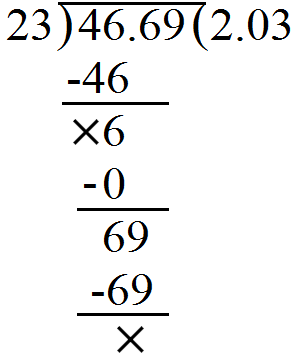
$4.669 ÷ 2.3 = ?$
AnswerCorrect option: B. $2.03$
$4.669\div2.3=\Big(\frac{4.669}{2.3}\Big)$
$=\Big(\frac{4.669\times10}{2.3\times10}\Big)=\Big(\frac{46.69}{23}\Big)=2.03$
View full question & answer→MCQ 711 Mark
Mark $(\checkmark)$ against the correct answer in the following: By what number should $2\frac{3}{5}$ be multiplied to get $1\frac{6}{7}?$
- A
$1\frac{5}{7}$
- ✓
$\frac{5}{7}$
- C
$1\frac{1}{7}$
- D
$\frac{1}{7}$
AnswerCorrect option: B. $\frac{5}{7}$
$\because$ Product $=1\frac{6}{7}=\frac{13}{7}$
One number $=2\frac{3}{5}=\frac{13}{5}$
$\therefore$ Second required number $=\frac{13}{7}\div\frac{13}{5}=\frac{13}{7}\times\frac{5}{13}=\frac{5}{7}$
View full question & answer→MCQ 721 Mark
Which fraction is equal to $4.4?$
- A
$ \frac{4}{10}$
- ✓
$ \frac{44}{10}$
- C
$ \frac{4}{100}$
- D
$ \frac{44}{100}$
AnswerCorrect option: B. $ \frac{44}{10}$
The first decimal digit from the decimal point is the tenth. $4.4$ has $4$ on the ones, after decimal point on the tenths is $4$ tenths.
$4.4$ is the sum of $4$ and $4/10$ or $44/10.$ So option $B$ is the correct answer.
View full question & answer→MCQ 731 Mark
Which one of the following is the correct statement$?$
- A
$\frac{3}{4}<\frac{2}{3}<\frac{12}{5}$
- ✓
$\frac{2}{3}<\frac{3}{4}<\frac{12}{15}$
- C
$\frac{2}{3}<\frac{12}{15}<\frac{3}{4}$
- D
$\frac{12}{15}<\frac{2}{3}<\frac{3}{4}$
AnswerCorrect option: B. $\frac{2}{3}<\frac{3}{4}<\frac{12}{15}$
Consider the fractions $\frac{3}{4},\frac{2}{3}$ and $\frac{12}{15}$
$LCM$ of $4, 3$ and $15 = 60$
Firstly, convert the fractions into equivalent fractions with denominator $60$
$\Rightarrow\frac{3}{4}=\frac{3\times15}{4\times15}=\frac{45}{60}$
$\Rightarrow\frac{2}{3}=\frac{2\times20}{3\times20}=\frac{40}{60}$
$\Rightarrow\frac{12}{15}=\frac{12\times4}{15\times4}=\frac{48}{60}$
Now,
$40<45<48$
$\therefore\ \frac{40}{60}<\frac{45}{60}<\frac{48}{60}$
$\frac{2}{3}<\frac{3}{4}<\frac{12}{15}$
View full question & answer→MCQ 741 Mark
Place value of $9$ in $7,92,83,456$
- A
$9,000$
- B
$9$
- ✓
$90,00,000$
- D
$90,000$
AnswerCorrect option: C. $90,00,000$
Place Value Definition: It is the value of the digit with reference to its position in the number. For example, $238$ has $2$ hundred, $3$ tens and $8$ ones. Therefore ans is $90,00,000$
View full question & answer→MCQ 751 Mark
The value of $ \frac{(0.96)^3 - (0.1)^3}{(0.90)^2 + (0.096) + 0.01}$ is
- ✓
$0.86$
- B
$1.06$
- C
$0.95$
- D
$0.97$
AnswerCorrect option: A. $0.86$
$ \Rightarrow\frac{(0.96)^3-{(0.1)^3}}{(0.96)^2+(0.096) + 0.01}$
$\Rightarrow\frac{(0.96-0.1)[(0.96)^2+(0.96 \times 0.1 + (0.1)^2]}{(0.96)^2 + (0.096) + (0.01)]} $
$ \Rightarrow\frac{0.86[(0.96)^2 + (0.096 + (0.01)]}{[(0.96)^2 + (0.096) + (0.01)]}$
$ \Rightarrow{ 0.86}$
View full question & answer→MCQ 761 Mark
$36.2 =........$
- A
$\frac{362}{10}$
- ✓
$\text36\frac{2}{10}$
- C
$\frac{360}{100}$
- D
$\frac{36}{10}$
AnswerCorrect option: B. $\text36\frac{2}{10}$
$=36.2$
$\Rightarrow36+ 0.2$
$= \frac{362}{10}$
$=\text{36}\frac{2}{10}$
View full question & answer→MCQ 771 Mark
Mark $(\checkmark)$ against the correct answer in the following:
$89.1 ÷ 2.2 = ?$
- ✓
$40.5$
- B
$4.05$
- C
$41$
- D
$41.5$
AnswerCorrect option: A. $40.5$
$89.1\div2.2=\frac{89.1}{2.2}$
$=\frac{891\times10}{22\times10}=\frac{81}{2}=40.5$
View full question & answer→MCQ 781 Mark
The smallest of the fractions $\frac{2}{3},\frac{4}{7},\frac{8}{11}$ and $\frac{5}{9}$ is:
- A
$\frac{2}{3}$
- B
$\frac{4}{7}$
- C
$\frac{8}{11}$
- ✓
$\frac{5}{9}$
AnswerCorrect option: D. $\frac{5}{9}$
Consider the fractions $\frac{2}{3},\frac{4}{7},\frac{8}{11}$ and $\frac{5}{9}$
$LCM$ of $3, 7, 9$ and $11 = 693$
Firstly, convert the fractions into equivalent fractions with denominator $693$
$\Rightarrow\frac{2}{3}=\frac{2\times231}{3\times231}=\frac{462}{693}$
$\Rightarrow\frac{4}{7}=\frac{4\times99}{7\times99}=\frac{396}{693}$
$\Rightarrow\frac{8}{11}=\frac{8\times63}{11\times63}=\frac{504}{693}$
$\Rightarrow\frac{5}{9}=\frac{5\times77}{9\times77}=\frac{385}{693}$
Now,
$385<396<462<504$
$\therefore\ \frac{385}{693}<\frac{396}{693}<\frac{462}{693}<\frac{504}{693}$
$\Rightarrow\frac{5}{9}<\frac{4}{7}<\frac{2}{3}<\frac{8}{11}$
Thus, the smallest of the given fractions is $\frac{5}{9}$
View full question & answer→MCQ 791 Mark
Mark $(\checkmark)$ against the correct answer in the following:
Which of the following is a vulgar fraction?
- A
$\frac{7}{10}$
- B
$\frac{19}{100}$
- C
$3\frac{3}{10}$
- ✓
$\frac{5}{8}$
AnswerCorrect option: D. $\frac{5}{8}$
$\frac{5}{8}$ is a vulgar fraction, because its denominator is other than $10, 100, 1000,$ etc.
View full question & answer→MCQ 801 Mark
The product of $7$ and $6\frac{3}{4}$ is:
- A
$42\frac{1}{4}$
- ✓
$47\frac{1}{4}$
- C
$42\frac{3}{4}$
- D
$47\frac{3}{4}$
AnswerCorrect option: B. $47\frac{1}{4}$
Given, $7\times6\frac{3}{4}$
$\because\ 6\frac{3}{4}=\frac{(6\times4+3)}{4}=\frac{24+3}{4}=\frac{27}{4}$
$\therefore7\times6\frac{3}{4}=7\times\frac{27}{4}=\frac{189}{4}=47\frac{1}{4}$
Hence, the product of $7$ and $6\frac{3}{4}\ \text{is}\ 47\frac{1}{4}$
View full question & answer→MCQ 811 Mark
$\frac{2}{5}\times5\frac{1}{5}$ is equal to:
- A
$\frac{26}{25}$
- ✓
$\frac{52}{25}$
- C
$\frac{2}{5}$
- D
$6$
AnswerCorrect option: B. $\frac{52}{25}$
Given, $\frac{2}{5}\times5\frac{1}{5}$
$\because5\frac{1}{5}=\frac{(5\times5)+1}{5}$
$=\frac{25+1}{5}$
$=\frac{26}{5}$
$\therefore\frac{2}{5}\times5\frac{1}{5}\times\frac{26}{5}$
$=\frac{52}{25}$
View full question & answer→MCQ 821 Mark
The recurring decimal $1.\overline{263}...$ in a fraction form is equal to.
- A
$\frac{1262}{90}$
- B
$\frac{1262}{99}$
- ✓
$\frac{1262}{999}$
- D
$\text{None of these}$
AnswerCorrect option: C. $\frac{1262}{999}$
Let $x = 1.263263263 [$we multiply it by $1000]$
Here $3$ digits are repeated
$1000x = 1263.263263.....$
$x = 1.263263...$
$999x = 1262$
$\Rightarrow\text{x}=\frac{1262}{999}$
The recurring decimal $1.263$ in a fraction form is equal to $\frac{1262}{999}$
View full question & answer→MCQ 831 Mark
Which of the following fractions is more than one$-$thrid?
- A
$\frac{23}{70}$
- B
$\frac{205}{819}$
- ✓
$\frac{26}{75}$
- D
$\frac{118}{335}$
AnswerCorrect option: C. $\frac{26}{75}$
$\frac{26}{75}$
View full question & answer→MCQ 841 Mark
Mark $(\checkmark)$ against the correct answer in the following:
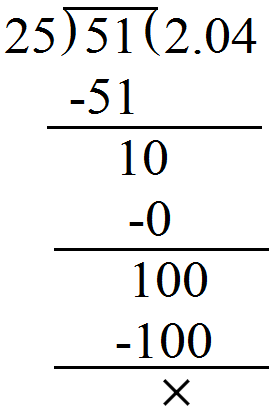
$2\frac{1}{25}=?$
AnswerCorrect option: B. $2.04$
$2\frac{1}{25}=\frac{51}{25}=2.04$
View full question & answer→MCQ 851 Mark
Mark $(\checkmark)$ against the correct answer in the following: $\Big(3\frac{1}{4}-2\frac{1}{3}\Big)=?$
- A
$1\frac{1}{12}$
- B
$\frac{1}{12}$
- C
$1\frac{1}{11}$
- ✓
$\frac{11}{12}$
AnswerCorrect option: D. $\frac{11}{12}$
$\because3\frac{1}{4}-2\frac{1}{3}$
$=\frac{13}{4}-\frac{7}{3}$
$=\frac{39-28}{12}$
$=\frac{11}{12}$
View full question & answer→MCQ 861 Mark
How many digits will be there to the right of the decimal point in the product of $95.75$ and $0.2554?$
Answer$ 95.75 \times0.2554=24.45455$
Sum of decimal places $= 7$
Since the last digit to the extreme right will be zero $( $since $5\times 4=20),$
so there will be $5$ significant digits to the right of the decimal point.
View full question & answer→MCQ 871 Mark
Which of the following fractions lies between $\frac{2}{3}$ and $\frac{5}{7}?$
- A
$\frac{3}{4}$
- B
$\frac{4}{5}$
- C
$\frac{5}{6}$
- ✓
$\text{None of these}.$
AnswerCorrect option: D. $\text{None of these}.$
Consider the fractions $\frac{2}{3},\frac{5}{7},\frac{3}{4}$ and $\frac{5}{6}$
$LCM$ of $3, 4, 5, 6$ and $7 = 420$
Firstly, convert the fractions into equivalent fractions with denominator $420$
$\Rightarrow\frac{2}{3}=\frac{2\times140}{3\times140}=\frac{280}{420}$
$\Rightarrow\frac{5}{7}=\frac{5\times60}{7\times60}=\frac{300}{420}$
$\Rightarrow\frac{3}{4}=\frac{3\times105}{4\times105 }=\frac{315}{420}$
$\Rightarrow\frac{4}{5}=\frac{4\times84}{5\times84}=\frac{336}{420}$
$\Rightarrow\frac{5}{6}=\frac{5\times70}{6\times70}=\frac{350}{420}$
Now,
$280<300<315<336<350$
$\therefore\ \frac{280}{420}<\frac{300}{420}<\frac{315}{420}<\frac{336}{420}<\frac{350}{420}$
$\Rightarrow\frac{2}{3}<\frac{5}{7}<\frac{3}{4}<\frac{4}{5}<\frac{5}{6}$
Thus, none of the fractions $\frac{3}{4},\frac{4}{5},\frac{5}{6}$ lies between the fractions $\frac{2}{3}$ and $\frac{5}{7}$
View full question & answer→MCQ 881 Mark
Mark $(\checkmark)$ against the correct answer in the following:
Which of the following is a vulgar fraction?
- A
$\frac{3}{10}$
- B
$\frac{13}{10}$
- ✓
$\frac{10}{3}$
- D
AnswerCorrect option: C. $\frac{10}{3}$
Denominator in $(a)$ and $(b)$ is $10$ these are decimal fractions But denominator of $(c)$ is $3\frac{10}{3}$ is a vulgar fraction.
View full question & answer→MCQ 891 Mark
Convert it into decimal: $\frac{3}{10}=...........$
AnswerConverting fraction to decimal $=\frac{3}{10}=0.3$
View full question & answer→MCQ 901 Mark
Mark $(\checkmark)$ against the correct answer in the following:
$1.1 \times 0.1 \times 0.01$
- A
$0.011$
- ✓
$0.0011$
- C
$0.11$
- D
AnswerCorrect option: B. $0.0011$
$ 1.1 \times .1 \times .01 = 0.0011$
View full question & answer→MCQ 911 Mark
The recurring decimal $1.\overline{263}...$ in a fraction form is equa to:
- A
$\frac{1262}{90}$
- B
$\frac{1262}{99}$
- ✓
$\frac{1262}{999}$
- D
$\text{None of these}$
AnswerCorrect option: C. $\frac{1262}{999}$
Let $x = 1.263263263 [$we multiply it by $1000]$
Here $3$ digits are repeated
$1000x = 1263.263263.....$
$x = 1.263263....$
$999x = 1262$
$\Rightarrow\text{x}=\frac{1262}{999}$
The recurring decimal $1.263$ in a fraction form is equal to $\frac{1262}{999}.$
View full question & answer→MCQ 921 Mark
Which $3$ has greater place value $64.363?$
AnswerCorrect option: A. $3$ at one tenth place.
$64.363$
There are two $3s$ in this number, one at one-tenth place and other at one-thousandth place.
$ \Rightarrow$ Place values of $3$ at one tenth place at one hundredth place is $ =3\times{0.1}={0.3}$ and $ \text{3}\times{0.001}=0.003$
$ \therefore$3 at one tenth place has greater value.
View full question & answer→MCQ 931 Mark
Example of improper fraction is $.......$
- A
$ \frac{2}{3}$
- B
$ \frac{1}{2}$
- ✓
$ \frac{23}{22}$
- D
$ \frac{11}{15}$
AnswerCorrect option: C. $ \frac{23}{22}$
When the numerator is greater than the denominator, it is called an improper fraction.
So only $ \frac{23}{22}$ is an improper fraction.
Hence, the answer is $ \frac{23}{22}.$
View full question & answer→MCQ 941 Mark
The sum of place value of digit $2$ in the number $21.236$ is
AnswerCorrect option: B. $20.2$
$21.236$
There are two $2s$ in this number, one at Tens place and other at one-tenth place.
$\Rightarrow$ Place values of $ 2=2\times{10}$ and $ 2\times{0.1}$
Sum $ =20+0.2=20.2$
View full question & answer→MCQ 951 Mark
$5\frac{1}{6}\div\frac{9}{2}$ is equal to:
- A
$\frac{31}{6}$
- B
$\frac{1}{27}$
- C
$5\frac{1}{27}$
- ✓
$\frac{27}{31}$
AnswerCorrect option: D. $\frac{27}{31}$
Given, $5\frac{1}{6}+\frac{9}{2}$
$\because5\frac{1}{6}=\frac{(5\times6)+1}{6}=\frac{30+1}{6}=\frac{31}{6}$
$\big[\because$ reciprocal of $\frac{9}{2}=\frac{2}{9}\big]$
$\therefore5\frac{1}{6}+\frac{9}{2}=\frac{31}{6}\times\frac{2}{9}=\frac{31}{27}$
View full question & answer→MCQ 961 Mark
$0.43$ is rational and it can be written as ..........
- ✓
$ \frac{43}{100}$
- B
$ \frac{43}{10}$
- C
$ \frac{4}{3}$
- D
$ \frac{34}{10}$
AnswerCorrect option: A. $ \frac{43}{100}$
$ 0.43=\frac{43}{100} ($As it is expressed a fraction.$)$
View full question & answer→MCQ 971 Mark
Mark $(\checkmark)$ against the correct answer in the following:
What should be added to $3.07$ to get $3.5?$
- A
$0.57$
- B
$0.34$
- ✓
$0.43$
- D
$0.02$
AnswerCorrect option: C. $0.43$
$3.5 - 3.07 = 3.50 - 3.07 = 0.43$
View full question & answer→MCQ 981 Mark
Mark $(\checkmark)$ against the correct answer in the following: A car runs $9\ km$ using $1$ litre of petrol. How much distance will it cover in $3\frac{2}{3}$ litres of petrol?
AnswerCorrect option: B. $33\ \text{km}$
Distance covered by the car on
$3\frac{2}{3}$ liter of petrol $=\Big(9\times3\frac{2}{3}\Big)\ \text{km}$
$=\Big(9\times\frac{11}{3}\Big)\ \text{km}$
$=(3\times11)\ \text{km}$
$=33\ \text{km}$
View full question & answer→MCQ 991 Mark
The smallest possible decimal fraction upto three decimal places is:
- A
$0.101$
- B
$0.111$
- C
$0.001$
- ✓
$0.011$
AnswerCorrect option: D. $0.011$
The smallest possible decimal fraction upto three decimal places $= \frac{1}{1000}=.001$
View full question & answer→MCQ 1001 Mark
The product of $3$ and $4\frac{2}{5}$ is:
- A
$17\frac{2}{5}$
- B
$\frac{24}{5}$
- ✓
$13\frac{1}{5}$
- D
$5\frac{1}{13}$
AnswerCorrect option: C. $13\frac{1}{5}$
Given, $3\times4\frac{2}{5}$
$\because4\frac{2}{5}=\frac{(4\times5)+2}{5}=\frac{22}{5}$
$\therefore3\times4\frac{2}{5}=3\times\frac{22}{5}=\frac{66}{5}=13\frac{1}{5}$
Hence, the product of $3$ and $4\frac{2}{5}\ \text{is}\ 13\frac{1}{5}$
View full question & answer→