Question 513 Marks
A racetrack is in the form of a ring whose inner circumference is $528m$ and the outer circumference is $616m$. Find the width of the track.
AnswerLet the inner and outer radii of the track be $r$ metres and $R$ metres, respectively.
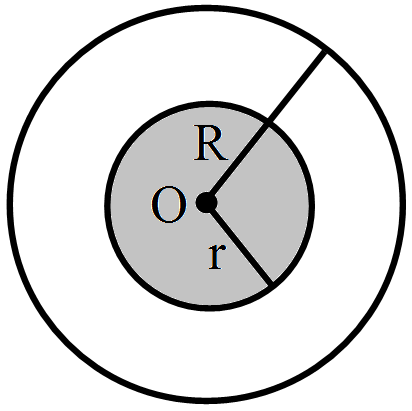
Then, $2\pi\text{r}=528$
$2\pi\text{R}=616$
$\Rightarrow2\times\frac{22}{7}\times\text{r}=528$
$2\times\frac{22}{7}\times\text{R}=616$
$\Rightarrow\text{r}=\Big(528\times\frac{7}{44}\Big)=84$
$\text{R}=\Big(616\times\frac{7}{44}\Big)=98$
$\Rightarrow (R - r) = (98 - 84)m = 14m$
Hence, the width of the track is $14m.$ View full question & answer→Question 523 Marks
How long will a man take to make a round of a circular field of radius $21m$, cycling at the speed of $8km/h?$
AnswerRadius of the circular field, r = 21m Circumference $=2\pi\text{r}$
$=2\times\frac{22}{7}\times21\text{m}=132\text{m}$
Speed of cyclist $= 8km/hr = 8000m/hr$
$\therefore$ Time taken for making one round $=\frac{132\times60}{8000}$
$[60$minutes $= 1hr]$
$=\frac{99}{100}\text{minutes}$
$=\frac{99}{100}\times60\sec.$
$=\frac{594}{10}=59.4\text{ seconds}$
View full question & answer→Question 533 Marks
The base of a parallelogram is twice its height. If the area of the parallelogram is $512cm^2$. find the base and the height.
AnswerLet the height of the parallelogram be $x cm .$
Then, the base of the parallelogram will be $2 xcm .$
It is given that the area of the parallelogram is $512 \mathrm{~cm}^2$.
Area of a parallelogram $=$ Base $\times$ Height
$\therefore 512 \mathrm{~cm}^2=2 \mathrm{x} \times \mathrm{x}$
$512 \mathrm{~cm}^2=2 \mathrm{x}^2$
$\Rightarrow \mathrm{x}^2=\left(\frac{512}{2}\right) \mathrm{cm}^2=256 \mathrm{~cm}^2$
$\Rightarrow \mathrm{x}^2=(16 \mathrm{~cm})^2$
$\Rightarrow \mathrm{x}=16 \mathrm{~cm}$
$\therefore \text { Base }=2 \mathrm{x}=2 \times 16$
$=32 \mathrm{~cm}$
Height $=x=16 \mathrm{~cm}$
View full question & answer→Question 543 Marks
In the given figure, $ABCD$ is a rectangle in which $AB = 40\ cm$ and $BC = 25\ cm$. If $P, Q, R, S$ be the midpoints of $AB, BC, CD$ and $DA$ respectively, find the area of the shaded region.
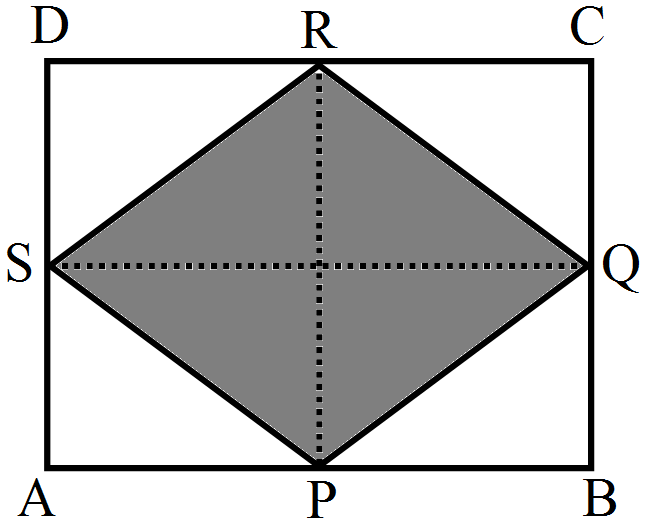
AnswerIn the fig. $ABCD$ is a rectangle in which $AB = 40cm, BC = 25cm.$
$P, Q, R$ and $S$ and the mid points of sides, $PQ, QR, RS$ and $SP$
respectively Then $PQRS$ is a rhombus.
Now, join $PR $and $QS$. $PR = BC = 25cm$ and $QS = AB = 40cm$
Area of PQRS $=\frac{1}{2}\times\text{PR}\times\text{QS}$
$=\frac{1}{2}\times25\times40=500\text{cm}^2$
View full question & answer→Question 553 Marks
The length and breadth of a rectangular piece of land are in the ratio of $5 : 3$. If the total cost of fencing it at $Rs 24$ per metre is $Rs 9600$, find its length and breadth.
AnswerRatio in length and breadth of a rectangular piece of land $= 5 : 3$
Cost of fencing $= Rs. 9600$ and rate $= Rs. 24$ per m
Perimeter $=\frac{9600}{24}=400\text{m}$
Let length $= 5x$
Then breadth $= 3x$
Perimeter $= 2(l + b) $
$\Rightarrow 400 = 2(5x + 3x) $
$\Rightarrow 400 = 2 \times 8x = 16x$
$ \Rightarrow 16x = 400 $
$\Rightarrow x = 25$
Length of the land $= 5x = 5 \times 25 = 125m$ and
width $= 3x = 3 \times 25 = 75m$
View full question & answer→Question 563 Marks
The area of a circle is $616cm^2$. Find its circumference.
AnswerArea of the circle $=616\text{cm}^2$
$\therefore\text{Radius (r)}=\sqrt{\frac{\text{Area}}{\pi}}=\frac{616\times7}{22}$
$=\sqrt{28\times7}=\sqrt{196}=14\text{cm}$
$\therefore$ Circumference $=2\pi\text{r}=2\times\frac{22}{7}\times14\text{cm}$
$=88\text{cm}$
View full question & answer→Question 573 Marks
A rectangular ground is $90m$ long and $32m$ broad. In the middle of the ground there is a circular tank of radius $14$ metres. Find the cost of turfing the remaining portion at the rate of $Rs 50$ per square metre.
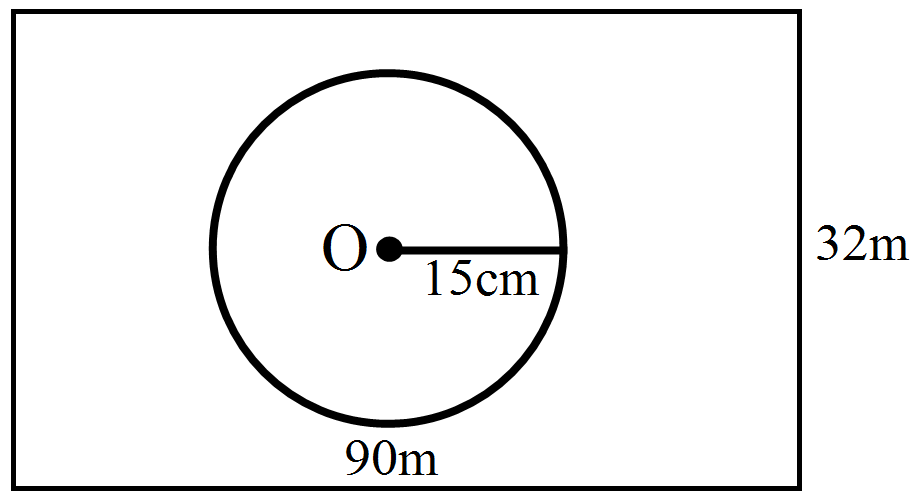
AnswerArea of the rectangular ground $=90 \mathrm{~m} \times 32 \mathrm{~m}=(90 \times 32) \mathrm{m}^2=2880 \mathrm{~m}^2$
Given:
Radius of the circular tank $(r)=14 m$
$\therefore$ Area covered by the circular tank $=\pi \mathrm{r}^2=\left(\frac{22}{7} \times 14 \times 14\right) \mathrm{m}^2$
$=616 \mathrm{~m}^2$
$\therefore$ Remaining portion of the rectangular ground for turfing $=$ (Area of the rectangular ground - Area covered by the circular tank)
$=(2880-616) m^2=2264 m^2$
Rate of turfing $= Rs 50$ per sq. metre
$\therefore$ Total cost of turfing the remaining ground $=$ Rs $(50 \times 2264)=$ Rs $1,13,200$
View full question & answer→Question 583 Marks
Each side of a square flower bed is $2m$ $80\ cm$ long. It is extended by digging a strip $30\ cm$ wide all around it. Find the area of the enlarged flower bed and also the increase in the area of the flower bed.
AnswerEach side of square bed $(\mathrm{a})=2 \mathrm{~m} ~80 \mathrm{~cm}=2.8 \mathrm{~m}$
Width of strip $=30 \mathrm{~cm}$
Outer side $(A)=2.8 \mathrm{~m}+2 \times 30 \mathrm{~cm}=2.8+0.6=3.4 \mathrm{~m}$
Outer area $=(3.4 \mathrm{~m})^2=11.56 \mathrm{~m}^2$
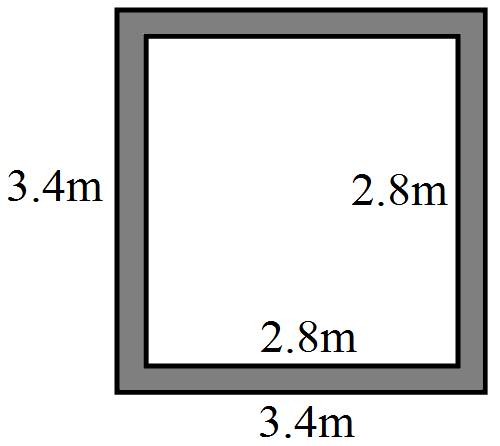
Inner area $=(2.8)^2=7.84 \mathrm{~m}^2$
Area of increased bed flower $=11.56-7.84=3.72 \mathrm{~m}^2$ View full question & answer→Question 593 Marks
A wire in the form of a rectangle $18.7\ cm$ long and $14.3\ cm$ wide is reshaped and bent into the form of a circle. Find the radius of the circle so formed.
AnswerLength of the wire = Perimeter of the rectangle $= 2(l + b) = 2 \times (18.7 + 14.3)cm = 66cm$
Let the wire be bent into the form of a circle of radius $r \ cm$.
Circumference of the circle $= 66cm$
$\Rightarrow2\pi\text{r}=66$
$\Rightarrow\Big(2\times\frac{22}7{}\times\text{r}\Big)=66$
$\Rightarrow\text{r}=\Big(\frac{66\times7}{2\times22}\Big)\text{cm}=10.5\text{cm}$
Hence, the radius of the circle formed is $10.5\ cm.$
View full question & answer→Question 603 Marks
The area of the $4$ walls of a room is $77m^2$. The length and breadth of the room are $7.5m$ and $3.5m$ respectively. Find the height of the room.
AnswerArea of 4 walls of a room $=77 \mathrm{~m}^2$
Length of room $(l)=7.5 \mathrm{~m}$
and breadth $(b)=3.5 \mathrm{~m}$
Let h be the height,
then area of four walls $=2(l+b) h$
$\Rightarrow 2(7.5+3.5) \mathrm{h}=77$
$\Rightarrow 2 \times 11 \times \mathrm{h}=77$
$\Rightarrow \mathrm{~h}=\frac{77}{2 \times 11}$
Height of room $=3.5 \mathrm{~m}$
View full question & answer→Question 613 Marks
The base of an isosceles triangle is $48\ cm$ and one of its equal sides is $30\ cm$. Find the area of the triangle.
AnswerIn isosceles $\triangle\text{ABC}$ Base BC $=48\text{cm}$ and $AB = AC =30\text{cm}$ Let $\text{AD}\perp\text{BC}$ 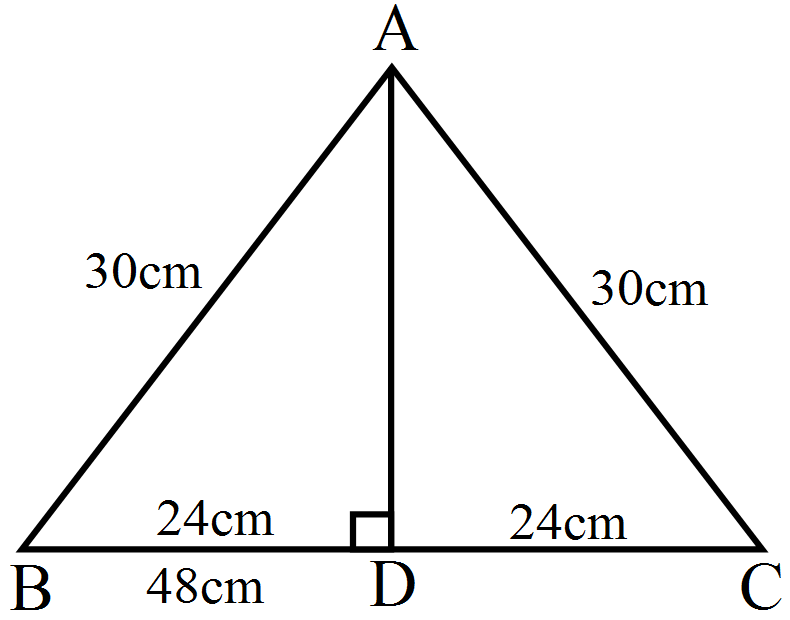
Then $\text{BD = DC}=\frac{48}{2}=24\text{cm}$ In right $\triangle\text{ABD},$
$\text{AB}^2=\text{AD}^2+\text{BD}^2$ (Pythagoras Theorem)
$\Rightarrow(30)^2=(24)^2+(\text{AD})^2$
$\Rightarrow900=576+\text{AD}^2$
$\Rightarrow\text{AD}^2=900-576=324=(18)^2$
$\therefore\text{AD}=18\text{cm}$
Now, area of triangle $=\frac{\text{Base}\times\text{Altitude}}{2}$
$=\frac{48\times18}{2}=432\text{cm}^2$ View full question & answer→Question 623 Marks
The area of a square field is $\frac{1}{2}$ hectare. Find the length of its diagonal in metres. Hint: $1$ hectare = $10000m^2$.
AnswerArea of the square $=\Big\{\frac{1}{2}\times(\text{Diagonal})^2\Big\}\text{sq. units}$
Given:
Area of the square field $=\frac{1}{2}$ hectare
$=\Big(\frac{1}2{}\times10000\Big)\text{m}^2=5000\text{m}^2$ [since $1$ hectare = $10000m^2$]
Diagonal of the square $=\sqrt{2\times\text{Area of the square}}$
$=\big(\sqrt{2\times5000}\big)\text{m}=100\text{m}$
$\therefore$ Length of the diagonal of the square field $= 100m$
View full question & answer→Question 633 Marks
Find the cost of carpeting a room $13m$ by $9m$ with a carpet of width $75\ cm$ at the rate of $Rs 105$ per metre.
AnswerLength of a room $=13 \mathrm{~m}$
Breadth $=9 \mathrm{~m}$
Area of floor $=\mathrm{l} \times \mathrm{b}=13 \times 9 \mathrm{~m}^2=117 \mathrm{~m}^2$
or area of carpet $=117 \mathrm{~m}^2$
Width $=75 \mathrm{~cm}=\frac{75}{100}=\frac{3}{4} \mathrm{~m}$
Length of carpet $=$ Area $\div$ Width
$=117 \div \frac{3}{4}$
$=117 \times \frac{4}{3} \mathrm{~m}$
$=39 \times 4=156 \mathrm{~m}$
Rate $=$ Rs. 105 per m
Total cost $=$ Rs. $156 \times 105= Rs. 16380$
View full question & answer→Question 643 Marks
A rectangular lawn is $30m$ by $20m$. It has two roads each $2m$ wide running in the middle of it, one parallel to the length and the other parallel to the breadth. Find the area of the roads.
AnswerLet $A B C D$ be the rectangular park
EFGH and IJKL are the two rectangular roads with width $2 m .$
Length of the rectangular park $A D=30 \mathrm{~cm}$
Breadth of the rectangular park $C D=20 \mathrm{~cm}$
Area of the road $\mathrm{EFGH}=30 \mathrm{~m} \times 2 \mathrm{~m}=60 \mathrm{~m}^2$
Area of the road $\mathrm{IJKL}=20 \mathrm{~m} \times 2 \mathrm{~m}=40 \mathrm{~m}^2$
Clearly, area of MNOP is common to the two roads.
Area of MNOP $=2 \mathrm{~m} \times 2 \mathrm{~m}=4 \mathrm{~m}^2$
Area of the roads $=$ Area $($ EFGH $)+$ Area $($ IJKL $)-$ Area $(M N O P)$ $=(60+40) m^2-4 m^2=96 m^2$
View full question & answer→Question 653 Marks
In a parallelogram $ABCD, AB = 18\ cm, BC = 12\ cm$. $\text{AL}\perp\text{DC}$ and $\text{AM}\perp\text{BC}.$
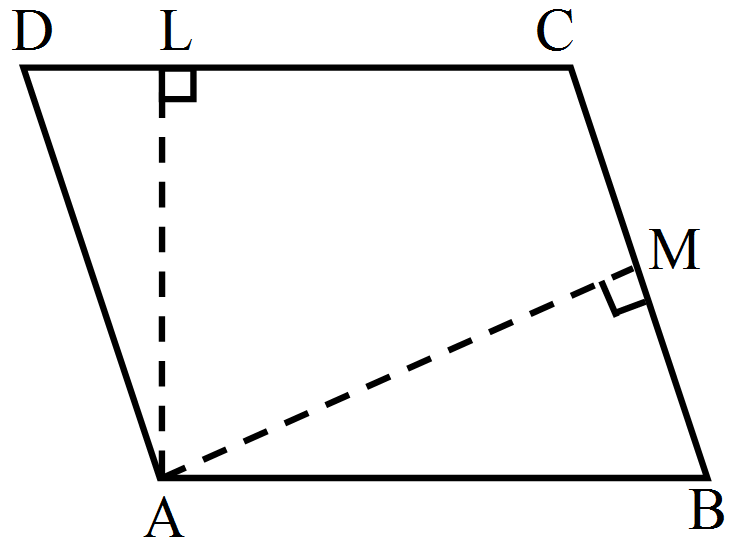
If $AL = 6.4cm$, find the length of $AM.$ Answer$\text { Base, } A B=18 \mathrm{~cm}$
$\text { Height, } A L=6.4 \mathrm{~cm}$
$\therefore \text { Area of the parallelogram } A B C D=\text { Base } \times \text { Height }$
$=(18 \mathrm{~cm} \times 6.4 \mathrm{~cm})=115.2 \mathrm{~cm}^2 \ldots \text { (i) }$
Now, taking BC as the base:
Area of the parallelogram $A B C D=$ Base $\times$ Height
$=(12 \mathrm{~cm} \times \mathrm{AM}) \ldots \text { (ii) }$
From equation (i) and (ii):
$12 \mathrm{~cm} \times \mathrm{AM}=115.2 \mathrm{~cm}^2$
$\Rightarrow \mathrm{AM}=\left(\frac{115.2}{12}\right) \mathrm{cm}$
$=9.6 \mathrm{~cm}$
View full question & answer→Question 663 Marks
Find the area of a right triangle having base $= 24\ cm$ and hypotenuse $= 25\ cm.$
AnswerConsider $\triangle \mathrm{ABC}$ Here, $\angle \mathrm{B}=90^{\circ}$
$\mathrm{AB}=24 \mathrm{~cm}$
$\mathrm{AC}=25 \mathrm{~cm}$
Now, $\mathrm{AB}^2+\mathrm{BC}^2=\mathrm{AC}^2$
$\mathrm{BC}^2=\mathrm{AC}^2-\mathrm{AB}^2=\left(25^2-24^2\right)=(625-576)=49$
$\mathrm{BC}=(\sqrt{49}) \mathrm{cm}=7 \mathrm{~cm}$
Area of $\triangle \mathrm{ABC}=\frac{1}{2} \times \mathrm{BC} \times \mathrm{AB}$ squints
$=\frac{1}{2} \times 7 \times 24 \mathrm{~cm}^2=84 \mathrm{~cm}^2$
Hence, area of the right angled triangle is $84 \mathrm{~cm}^2$.
View full question & answer→Question 673 Marks
The area of a rhombus is $441cm^2$ and its height is $17.5\ cm$. Find the length of each side of the rhombus.
AnswerGiven:
Height of the rhombus $=17.5 \mathrm{~cm}$
Area of the rhombus $=441 \mathrm{~cm}^2$
We know:
Area of a rhombus $=$ Base $\times$ Height
$\therefore$ Base of the rhombus $=\frac{\text { Area }}{\text { Height }}$
$=\left(\frac{441}{17.5}\right) \mathrm{cm}=25.2 \mathrm{~cm}$
Hence, each side of a rhombus is $25.2 cm .$
View full question & answer→Question 683 Marks
The area of a square is $16200m^2$. Find the length of its diagonal.
AnswerWe know:
Area of a square $=\Big\{\frac{1}{2}\times(\text{Diagonal})^2\Big\}\text{sq. units}$
Diagonal of the square $=\sqrt{2\times\text{Area of square}}\text{ units}$
$=\big(\sqrt{2\times16200}\big)\text{m}=180\text{m}$
$\therefore$ Length of the diagonal of the square $= 180m$
View full question & answer→Question 693 Marks
Find the distance covered by the wheel of a bus in $2000$ rotations if the diameter of the wheel is $98\ cm.$
AnswerIt may be noted that in one rotation, the bus covers a distance equal to the circumference of the wheel.
Now, diameter of the wheel $= 98cm$
$\therefore$ Circumference of the wheel $=\pi\text{d}=\Big(\frac{22}{7}\times98\Big)\text{cm}=308\text{cm}$
Thus, the bus travels $308cm$ in one rotation.
$\therefore$ Distance covered by the bus in $2000$ rotations $= (308 \times 2000)cm = 616000cm = 6160m$ [since $1m = 100cm]$
View full question & answer→Question 703 Marks
The circumference of a circle is $35.2m.$ Find its area.
AnswerLet the radius of the circle be $r m$.
Then, its circumference will be $(2\pi\text{r})\text{m}$
$\therefore(2\pi\text{r})=35.2$
$\Rightarrow\Big(2\times\frac{22}{7}\times\text{r}\Big)=35.2$
$\Rightarrow\text{r}=\Big(\frac{35.2\times7}{2\times22}\Big)=5.6$
$\therefore$ Area of the circle $=\pi\text{r}^2$
$=\Big(\frac{22}{7}\times5.6\times5.6\Big)\text{m}^2=98.56\text{m}^2$
View full question & answer→Question 713 Marks
The cost of carpeting a room $15m$ long with a carpet of width $75cm$ at $Rs 80$ per metre is $Rs 19200$. Find the width of the room.
AnswerCost of carpeting a room $= Rs. 19200$
Rate $= Rs. 80$ per m
Length of carpet $=\frac{19200}{80}\text{m}=240\text{m}$
Width of carpet $=75\text{cm}=\frac{75}{100}=\frac{3}{4}\text{m}$
Area of carpet $=240\times\frac{3}{4}=180\text{m}^2$
Length of a room $=15\text{m}$
Width $=\frac{\text{Area}}{\text{Length}}$
$=\frac{180}{15}=12\text{m}$
View full question & answer→Question 723 Marks
A wire in a circular shape of radius $28\ cm$. If it is bent in the form of a square, what will be the area of the square formed?
AnswerRadius of circular wire $=28 \mathrm{~m}$
Circumference $=2 \pi \mathrm{r}=2 \times \frac{22}{7} \times 28 \mathrm{~cm}=176 \mathrm{~cm}$
Perimeter of the square formed by this wire $=176 \mathrm{~cm}$
Side $(a)=\frac{176}{4}=44 \mathrm{~cm}$
Area of square so formed $=a^2=(44)^2 \mathrm{~cm}^2=1936 \mathrm{~cm}^2$
View full question & answer→Question 733 Marks
Find the area of the triangle in which $a = 52m, b = 56cm, c = 60cm.$
Answer$a = 52m, b = 56cm, c = 60cm$
$\text{s}=\frac{\text{a + b + c}}{2}$
$=\frac{52+56+60}{2}=\frac{168}{2}=84$
$\therefore\text{Area}=\sqrt{\text{s(s}-\text{a})\text{(s}-\text{b})\text{(s}-\text{c})}$
$=\sqrt{84(84-52)(84-56)(84-60)}$
$=\sqrt{84\times32\times28\times24}$
$=\sqrt{2\times2\times3\times7\times2\times2\times2\times2\times2\times2\times2\times7\times2\times2\times2\times3}$
$=2\times2\times2\times2\times2\times2\times3\times7=1344\text{cm}^2$
View full question & answer→Question 743 Marks
The area of right triangular region is $129.5 \mathrm{~cm}^2$. If one of the sides containing the right angle is $14.8cm$, find the other one.
AnswerArea of the right angled triangle = $129.5 \mathrm{~cm}^2$
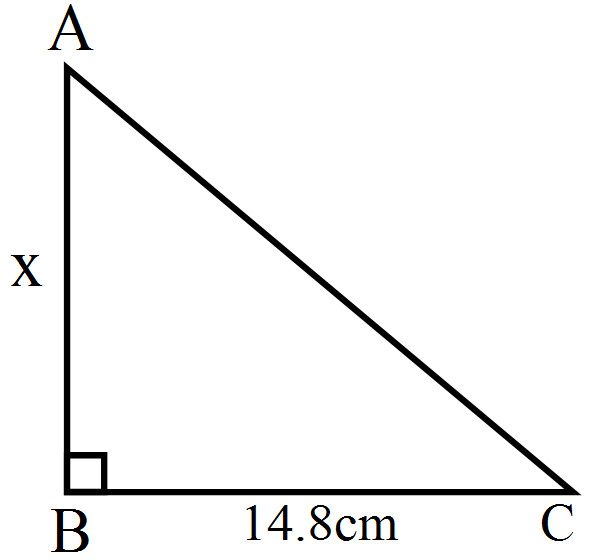
Base (one side) $= 14.8cm$
$\therefore$ Altitude (second side)
$=\frac{\text{Area}\times2}{\text{Base}}$
$=\frac{129.5\times2}{14.8}$
$=\frac{1295\times2\times100}{100\times148}=17.5\text{cm}$ View full question & answer→Question 753 Marks
Find the area of the triangle in which $a = 13m, b = 14m, c = 15m.$
Answer$a = 13m, b = 14m, c = 15m$
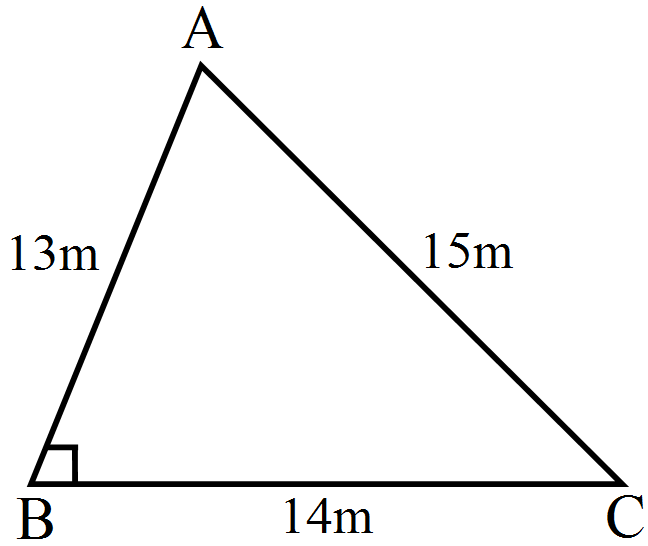
$\therefore\text{s}=\frac{\text{a + b + c}}{2}$
$=\frac{13+14+15}{2}=\frac{42}{2}=21$
$\therefore\text{Area}=\sqrt{\text{s(s}-\text{a})\text{(s}-\text{b})\text{(s}-\text{c})}$
$=\sqrt{21(21-13)(21-14)(21-15)}$
$=\sqrt{21\times8\times7\times6}=\sqrt{7056}=84\text{cm}^2$ View full question & answer→Question 763 Marks
The area of the $4$ walls of a room is $168m^2$. The breadth and height of the room are $10m$ and $4m$ respectively. Find the length of the room.
AnswerArea of 4 walls of a room $=168 \mathrm{~m}^2$
Breadth of the room (b) $=10 \mathrm{~m}$
and height $(h)=4 \mathrm{~m}$.
Let I be the length of room
$2(l+b) h=168$
$\Rightarrow 2(l+10) \times 4=168$
$\Rightarrow 1+10=\frac{168}{2 \times 4}=21$
$\Rightarrow l=21-10=11 \mathrm{~m}$
Length of the room $=11 \mathrm{~m}$
View full question & answer→Question 773 Marks
The ratio of the radii of two circle is $5 : 3$. Find the ratio of their circumferences.
AnswerLet the radii of the given circles be $5 x$ and $3 x$, respectively.
Let their circumferences be $\mathrm{C}_1$ and $\mathrm{C}_2$, respectively.
$\mathrm{C}_1=2 \times \pi \times 5 \mathrm{x}=10 \pi \mathrm{x}$
$\mathrm{C}_2=2 \times \pi \times 3 \mathrm{x}=6 \pi \mathrm{x}$
$\therefore \frac{\mathrm{C}_1}{\mathrm{C}_2}=\frac{10 \pi \mathrm{x}}{6 \pi \mathrm{x}}=\frac{5}{3}$
$\Rightarrow \mathrm{C}_1: \mathrm{C}_2=5: 3$
Hence, the ratio of the circumference of the given circle is $5: 3$.
View full question & answer→Question 783 Marks
A rectangular grassy plot is $75m$ long and $60m$ broad. If has path of width $2m$ all around it on the inside. Find the area of the path and cost and of constructing it at $Rs 125$ per $m^2$.
AnswerOuter length of plot $(L) = 75m$ and breadth $(B) = 60m$ Width of path inside $= 2m$
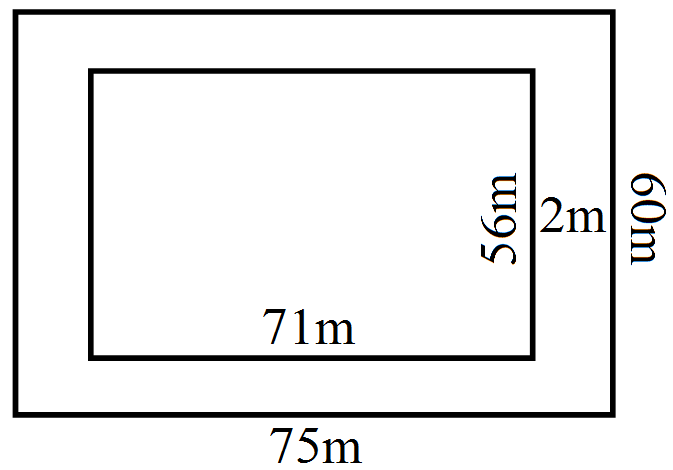
Inner length $(l)=75-2 \times 2=75-4=71 \mathrm{~m}$
and width (b) $=60-2 \times 2=60-4=56 \mathrm{~m}$
Area of the path $=\mathrm{L} \times \mathrm{B}-\mathrm{l} \times \mathrm{b}=(75 \times 60-71 \times 56) \mathrm{m}^2=4500-3976=524 \mathrm{~m}^2$
Rate of constructing it $= Rs. 125$ per $\mathrm{m}^2$
Total cost $=$ Rs. $524 \times 125=$ Rs. 65500 View full question & answer→Question 793 Marks
One circle has radius of $98\ cm$ and a second concentric circle has a radius of $1m \ 26\ cm$. How much longer is the circumference of the second circle than that of the first?
AnswerWe know that the concentric circles are circles that form within each other, around a common centre point.
Radius of the inner circle, $r = 98cm$
$\therefore$ Circumference of the inner circle $=2\pi\text{r}$
$=\Big(2\times\frac{22}{7}\times98\Big)\text{cm}=616\text{cm}$
Radius of the outer circle, $R = 1m 26cm = 126cm$ [since $1m = 100cm]$
$\therefore$ Circumference of the outer circle $=2\pi\text{R}$
$=\Big(2\times\frac{22}{7}\times126\Big)\text{cm}=792\text{cm}$
$\therefore$ Difference in the lengths of the circumference of the circles $= (792 - 616)\ cm = 176\ cm$
Hence, the circumference of the second circle is $176\ cm$ larger than that of the first circle.
View full question & answer→Question 803 Marks
The base of a triangular field is three times its height. If the cost of cultivating the field at $Rs \ 1080$ per hectare is $Rs \ 14580$, find its base and height.
AnswerTotal cost of cultivating the field $= Rs. 14580$
Rate of cultivating the field $= Rs. 1080$ per hectare
Area of the field $=\Big(\frac{\text{Total cost}}{\text{Rate per hectare}}\Big)\text{hectare}$
$=\Big(\frac{14580}{1080}\Big)\text{hectare}$
$=(13.5 \times 10000) \mathrm{m}^2=135000 \mathrm{~m}^2\left[\right.$ Since $1$ hectare $\left.=10000 \mathrm{~m}^2\right]$
Let the height of the filde be $x m.$
Then, its base will be $3x m.$
Area of the filde $=\Big(\frac{1}{2}\times3\text{x}\times\text{x}\Big)\text{m}^2=\Big(\frac{3\text{x}^2}{2}\Big)\text{m}^2$
$\therefore\Big(\frac{3\text{x}^2}{2}\Big)=135000$
$\Rightarrow\text{x}^2=\Big(135000\times\frac{2}{3}\Big)=90000$
$\Rightarrow\text{x}=\sqrt{90000}=300$
$\therefore\text{Base}=(3\times300)=900\text{m}$
$\text{Height}=300\text{m}$
View full question & answer→Question 813 Marks
Find the length of the largest pole that can be placed in a hall $10m$ long, $10m$ wide and $5m$ high.
AnswerLength of hall $(l) = 10m$
Breadth $(b) = 10m$
and height $(h) = 5m$
Longest pole which can be placed in it
$=\sqrt{\text{l}^2+\text{b}^2+\text{h}^2}$
$=\sqrt{(10)^2+(10)^2+(5)^2}=\sqrt{100+100+25}\text{m}$
$=\sqrt{225}=15\text{m}$
View full question & answer→Question 823 Marks
One side of a right-angled triangular scarf is $80\ cm$ and its longest side is $1m$. Find its cost at the rate of $Rs. 250$ per $m^2$.
AnswerOne side $BC$ of a right triangular scarf $= 80\ cm$
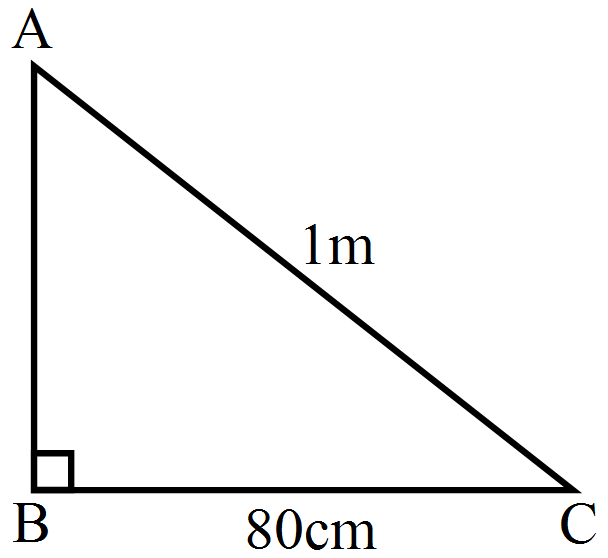
and longest side $\mathrm{AC}=1 \mathrm{~m}=100 \mathrm{~cm}$
By Pythagoras Theorem,
$A C^2=A B^2+B C^2$
$\Rightarrow(100)^2=A B^2+(80)^2$
$\Rightarrow 10000=A B^2+6400$
$\Rightarrow A B^2=10000-6400$
$\Rightarrow A B^2=3600=(60)^2$
$\Rightarrow A B=60$
Second side $=60 \mathrm{~cm}$
Area of the scarf $=\frac{1}{2} \times \mathbf{b} \times \mathbf{h}$
$=\frac{1}{2} \times 80 \times 60 \mathrm{~cm}^2=2400 \mathrm{~cm}^2$
Rate of cost $= Rs. 250$ per $\mathrm{m}^2$
Total cost $=\frac{2400}{100 \times 100} \times 250= Rs. 60$ View full question & answer→Question 833 Marks
The area of a square plot is $6084m^2$. Find the length of the wire which can go four times along the boundary of the plot.
AnswerArea of the square plot $=6084\text{m}^2$
Side of the square plot $=(\sqrt{\text{Area}})$
$=(\sqrt{6084})\text{m}$
$=(\sqrt{78\times78})\text{m}=78\text{m}$
$\therefore$ Perimeter of the square plot $= 4 \times $ side $= (4 \times 78)m = 312m$
312m wire is needed to go along the boundary of the square plot once.
Required length of the wire that can go four times along the boundary $= 4 \times $ Perimeter of the square plot
$= (4 \times 312)m = 1248m$
View full question & answer→Question 843 Marks
The radius of the wheel of a car is $35\ cm$. How many revolutions will it make to travel $33\ km?$
AnswerRadius of the wheel $= 35\ cm$
Circumference of the wheel $=2\pi$
$=\Big(2\times\frac{22}{7}\times35\Big)\text{cm}=(44\times5)\text{cm}$
$=220\text{cm}$
Distance covered by the wheel in $1$ revolution $=\Big(\frac{11}{5}\Big)\text{m}$
Now, $\Big(\frac{11}{5}\Big)\text{m}$ is covered by the car in $1$ revolution.
Thus, $(33 \times 1000)m$ will be covered by the car in $\Big(1\times\frac{5}{11}\times33\times1000\Big)$ revolutions,
i.e. $15000$ revolutions.
$\therefore$ Required number of revolutions $= 15000$
View full question & answer→Question 853 Marks
The length and breadth of a rectangular park are in the ratio $5 : 2. A 2.5-m$-wide path running all around the outside of the aprk has an area of $305m^2$. Find the dimensions of the park.
Answer$\text { Ratio in length and breadth of a park }=5: 2$
$\text { Width of path outside it }=2.5 \mathrm{~m}$
$\text { Area of path }=305 \mathrm{~m}^2$
$\text { Let Inner length }(\mathrm{l})=5 \mathrm{x}$
$\text { and breadth }(\mathrm{b})=2 \mathrm{x}$
$\text { Outer length }(\mathrm{L})=5 \mathrm{x}+2 \times 2.5=(5 \mathrm{x}+5) \mathrm{m}$
$\text { Width }(B)=2 \mathrm{x}+2 \times 2.5=(2 \mathrm{x}+5) \mathrm{m}$
$\text { Area of path }=0 \mathrm{uter} \text { area - Inner area }$
$\Rightarrow(5 \mathrm{x}+5)(2 \mathrm{x}+5)-5 \mathrm{x} \times 2 \mathrm{x}=305$
$\Rightarrow 10 \mathrm{x}^2+10 \mathrm{x}+25 \mathrm{x}+25-10 \mathrm{x}^2=305$
$\Rightarrow 35 \mathrm{x}=305-25=280$
$\Rightarrow \mathrm{x}=8$
$\text { Length of park }=5 \mathrm{x}=5 \times 8=40 \mathrm{~m}$
$\text { and breadth }=2 \mathrm{x}=2 \times 8=16 \mathrm{~m}$
$\text { Dimensions of park }=40 \mathrm{~m} \text { by } 16 \mathrm{~m}$
View full question & answer→Question 863 Marks
The circumference of a circle is $264\ cm$. Find its area.
AnswerLet the radius of the circle be $r cm.$
Circumference $=(2\pi\text{r})\text{cm}$
$\therefore(2\pi\text{r})=264$
$\Rightarrow\Big(2\times\frac{22}{7}\times\text{r}\Big)=264$
$\Rightarrow\text{r}=\Big(\frac{264\times7}{2\times22}\Big)=42$
$\therefore$ Area of the circle $=\pi\text{r}^2$
$=\Big(\frac{22}{7}\times42\times42\Big)\text{cm}^2$
$=5544\text{cm}^2$
View full question & answer→Question 873 Marks
The height of a parallelogram is one-third of its base. If the area of the parallelogram is $108cm^2$, find its base and height.
AnswerLet the base of the parallelogram be $x cm .$
Then, the height of the parallelogram will be $\frac{1}{3} \mathrm{x} \mathrm{cm}$.
It is given that the area of the parallelogram is $108 \mathrm{~cm}^2$.
Area of a parallelogram $=$ Base $\times$ Height
$\therefore 108 \mathrm{~cm}^2=\mathrm{x} \times \frac{1}{3} \mathrm{x}$
$108 \mathrm{~cm}^2=\frac{1}{3} \mathrm{x}^2$
$\Rightarrow \mathrm{x}^2=(108 \times 3) \mathrm{cm}^2=324 \mathrm{~cm}^2$
$\Rightarrow \mathrm{x}^2=(18 \mathrm{~cm})^2$
$\Rightarrow \mathrm{x}=18 \mathrm{~cm}$
$\therefore \text { Base }=\mathrm{x}=18 \mathrm{~cm}$
$\text { Height }=\frac{1}{3} \mathrm{x}=\left(\frac{1}{3} \times 18\right) \mathrm{cm}$
$=6 \mathrm{~cm}$
View full question & answer→