Question 13 Marks
Find the area ofa recta[gular plot, one side of whtch is $48m$ and lts diagonal is so $m.$
AnswerLength of rectangular plot $(l) = 48m$ and its diagonal $= 50m$
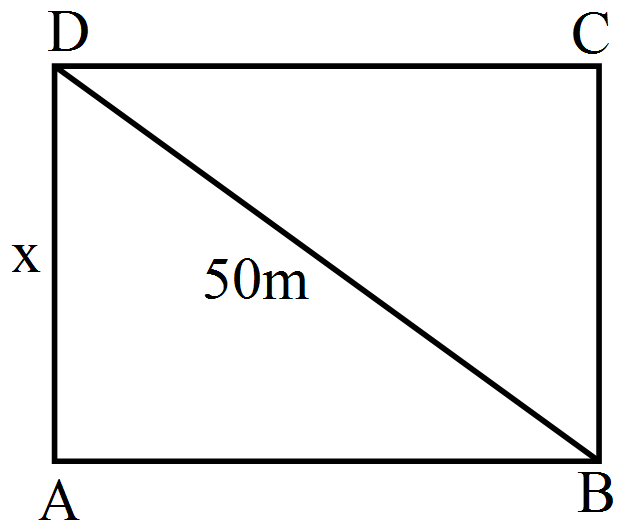
$\therefore$ Second side $(b) =\sqrt{50^2-48^2}$
$=\sqrt{2500-2304}$
$=\sqrt{196}=14\text{m}$
$\therefore\text{Area l}\times\text{b}$
$=48\times14=672\text{m}^2$ View full question & answer→Question 23 Marks
Find the area of a right triangle whose base is $1.2m$ and hypotenuse $3.7m.$
AnswerIn right angled $\triangle\text{ABC},$ Base $BC = 1.2m$
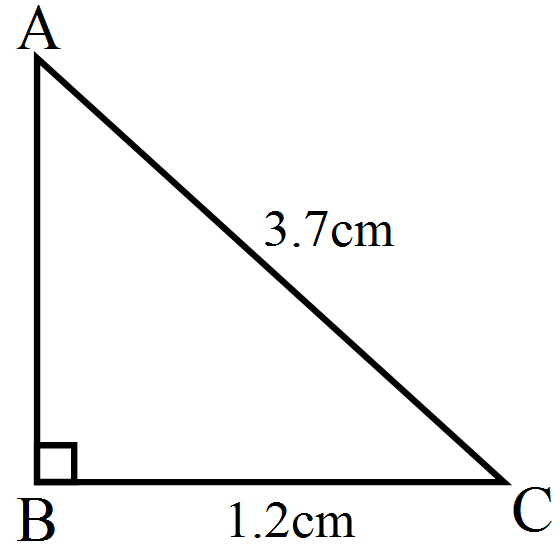
and hypotenuse $AC =3.7 m$
But $A C^2=A B^2+B C^2$ (Pythagoras Theorem)
$\Rightarrow(3.7)^2=A B^2+(1.2)^2$
$\Rightarrow 13.69=A B^2+1.44$
$\Rightarrow A B^2=13.69-1.44$
$\Rightarrow A B^2=12.25=(3.5)^2$
$\Rightarrow A B=3.5 m$
Now, area of $\triangle ABC =\frac{1}{2} \times$ Base $\times$ Altitude
$=\frac{1}{2} \times 1.2 \times 3.5 m^2=2.1 m^2$ View full question & answer→Question 33 Marks
A diagonal of a quadrilateral is $26\ cm$ and the perpendiculars drawn to it from the opposite vertices are $12.8\ cm$ and $11.2\ cm$. Find the area of the quadrilateral.
AnswerIn quadrilateral $ABCD$, diagonal $AC = 26cm$
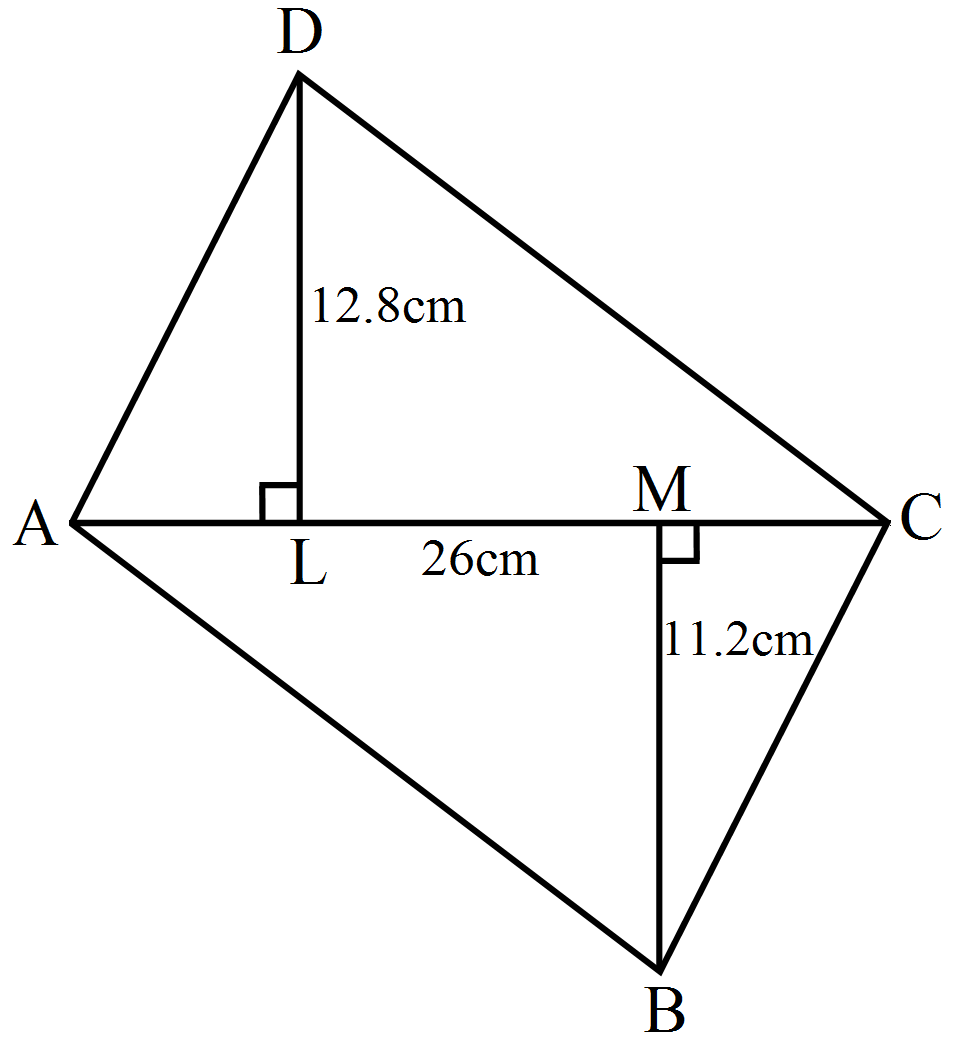
and perpendiculars $DL = 12.8\ cm, BM = 11.2\ cm$
Area of quadrilateral $ABCD =\frac{1}{2}(\text{Sum of perpendicular)}\times\text{diagonal})$
$=\frac{1}{2}(12.8+11.2)\times26\text{cm}^2$
$=\frac{1}{2}\times24\times26=312\text{cm}^2$ View full question & answer→Question 43 Marks
A room is $9m$ by $8m$ by $6.5m$. It has one door of dimensions $(2m \times 1.5m)$ and four windows each of dimensions $(1.5m \times 1m)$. Find the cost of painting the walls at $Rs 50$ per $m^2$.
Answer$\text { Length }=9 \mathrm{~m} ; \text { Breadth }=8 \mathrm{~m}$
$\text { Height }=6.5 \mathrm{~m}$
Area of the four walls $=\{2(1+b) \times h\}$ sq. units
$=\{2(9+8) \times 6.5\} \mathrm{m}^2=\{34 \times 6.5) \mathrm{m}^2=221 \mathrm{~m}^2$
Area of one door $=(2 \times 1.5) \mathrm{m}^2=3 \mathrm{~m}^2$
Area of one window $=(1.5 \times 1) \mathrm{m}^2=1.5 \mathrm{~m}^2$
Area of four windows $=(4 \times 1.5) \mathrm{m}^2=6 \mathrm{~m}^2$
Total area of one door and four windows $=(3+6) \mathrm{m}^2=9 \mathrm{~m}^2$
Area to be painted $=(221-9) \mathrm{m}^2=212 \mathrm{~m}^2$
Rate of painting $=$ Rs 50 per $\mathrm{m}^2$
Total cost of painting $=\operatorname{Rs}(212 \times 50)=\operatorname{Rs} 10,600$
View full question & answer→Question 53 Marks
A $115$-m-long and $64-m$-broad lawn has two roads at right angles, one $2m$ wide, running parallel to its length, and the other $2.5m$ wide, running parallel to its breadth. Find the cost of gravelling the roads at $Rs 60$ per $m^2$.
AnswerLength of lawn $(\mathrm{l})=115 \mathrm{~m}$
and breadth $(b)=64 \mathrm{~m}$
Width of road parallel to length $=2 \mathrm{~m}$
and width of road parallel to breadth $=2.5 \mathrm{~m}$
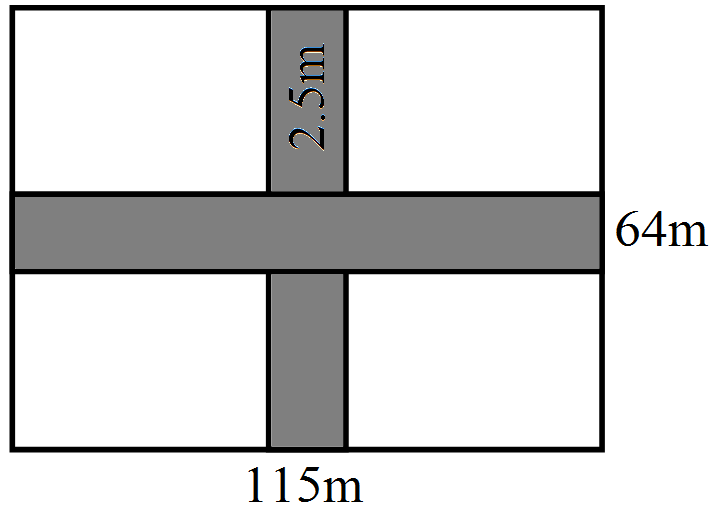
$\text { Area of roads }=(115 \times 2+64 \times 2.5-2 \times 2.5) \mathrm{m}^2$
$=(230+160-5) \mathrm{m}^2=(390-5) \mathrm{m}^2=385 \mathrm{~m}^2$
$\text { Cost of gravelling = Rs. } 60 \mathrm{~m}^2$
$\text { Total cost }=\text { Rs. } 60 \times 385=\text { Rs. } 23100$ View full question & answer→Question 63 Marks
The area of a rhombus is equal to the area of a triangle whose base and the corresponding height are $24.8\ cm$ and $16.5\ cm$ respectively. If one of the diagonals of the rhombus is $22\ cm$, find the lenght of the other diagonal.
AnswerArea of a triangle $=\frac{1}2{}\times\text{Base}\times\text{Height}$
$=\Big(\frac{1}{2}\times24.8\times16.5\Big)\text{cm}^2=204.6\text{cm}^2$
Given: Area of the rhombus = Area of the triangle Area of the rhombus = $204.6\text{cm}^2$
Area of the rhombus $=\frac{1}2{}\times\text{(Product of the diagonals)}$
Given: Length of one diagonal $= 22\ cm$
$\therefore$ Length of the other diagonal $=\Big(\frac{204.6\times4}{22}\Big)\text{cm}$
$=18.6\text{cm}$
View full question & answer→Question 73 Marks
The area of a parallelogram is $3385m^2$. If its altitude is twice the corresponding base, find the base and the altitude.
AnswerLet the base of the parallelogram be $x \mathrm{~m}$.
The, the altitude of the parallelogram will be $2 \times \mathrm{m}$.
It is given that the area of the parallelogram is $338 \mathrm{~m}^2$.
Area of a parallelogram $=$ Base $\times$ Altitude
$\Rightarrow 338=x \times 2 x$
$\Rightarrow 338=2 x^2$
$\Rightarrow x^2=169 \mathrm{~m}^2$
$\Rightarrow x=13 \mathrm{~m}$
Base $=x m=13 m$
Altitude $=2 \times \mathrm{m}=(2 \times 13) \mathrm{m}=26 \mathrm{~m}$
View full question & answer→Question 83 Marks
In the following figures, find the area of the shaded region. 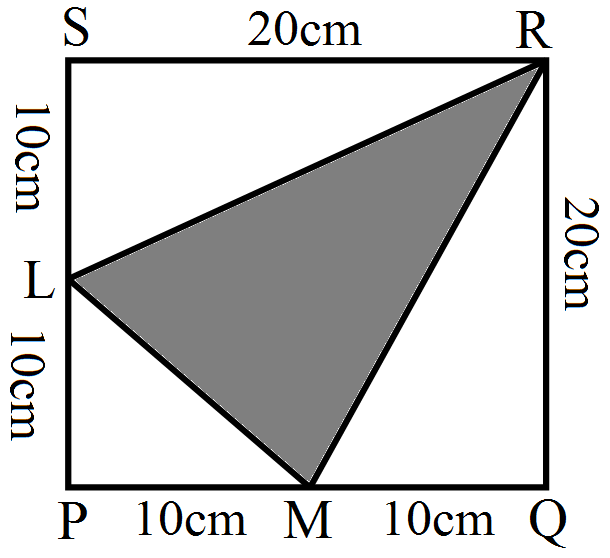
Answer Side of square = 20cm
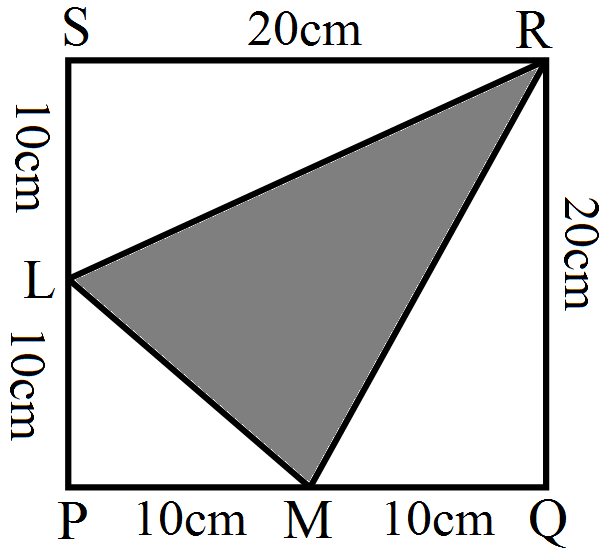
Area of square $=\text{a}^2=(20)^2=400\text{cm}^2$
Area of right $\triangle\text{LPM}=\frac{1}{2}\times10\times10\text{cm}^2=50\text{cm}^2$
Area of right $\triangle\text{RMQ}=\frac{1}{2}\times10\times20=100\text{cm}^2$
and area of right $=\triangle\text{RSL}=\frac{1}{2}\times20\times10=100\text{cm}^2$
Area of shaded region $=400-(50+100+100)\text{cm}^2$
$=400-250=150\text{cm}^2$
View full question & answer→Question 93 Marks
The adjacent sides of a parallelogram are $15\ cm$ and $8\ cm$. If the distance between the longer sides is $4\ cm$, find the distance between the shorter sides.
Answer$ABCD$ is a parallelogram with side $AB$ of length $15\ cm$ and the corresponding altitude $AE$ of length $4\ cm$.
The adjacent side $AD$ is of length $8\ cm$ and the corresponding altitude is $CF.$
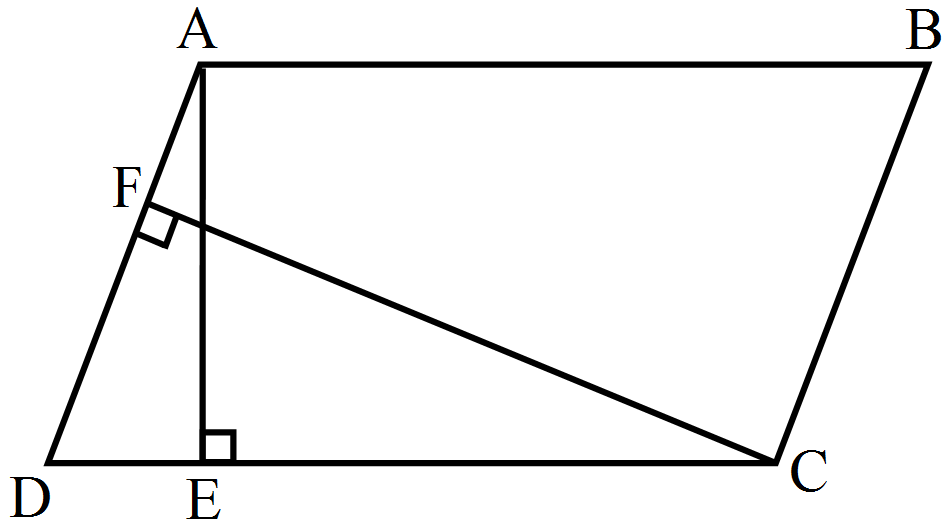
Area of a parallelogram = Base $\times $ Height
We have two altitudes and two corresponding bases.
$\therefore AD \times CF = AB \times AE$
$ \Rightarrow 8cm \times CF = 15cm \times 4cm$
$\Rightarrow\text{CF}=\Big(\frac{15\times4}{8}\big)\text{cm}=7.5\text{cm}$
Hence, the distance between the shorter sides is $7.5cm.$ View full question & answer→Question 103 Marks
Calculate the area of the shaded region in each of the figures given below:
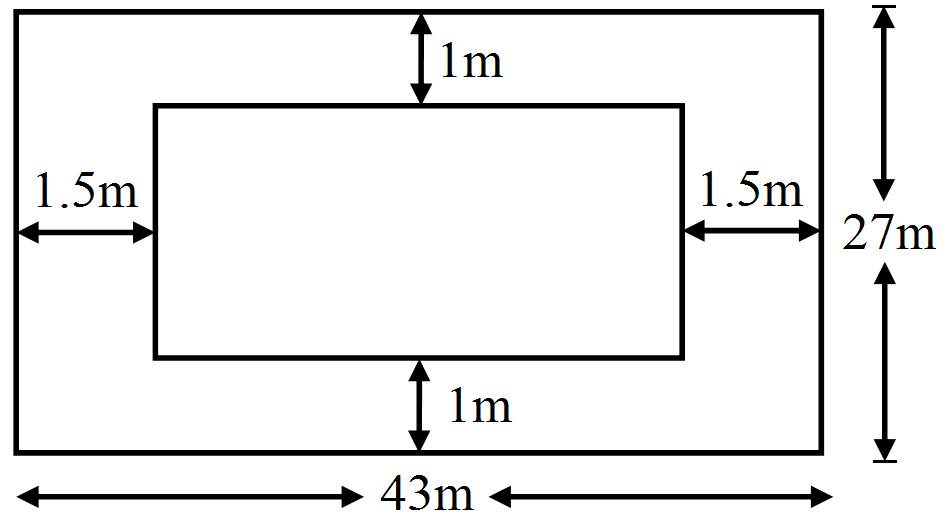
AnswerOuter length $=43 \mathrm{~m}$
and breadth $=27 \mathrm{~m}$
Area $=43 \times 27=1161 \mathrm{~m}^2$
Inner length $=43-2 \times 1.5=43-3=40 \mathrm{~m}$
and breadth $=27-2 \times 1=27-2=25 \mathrm{~m}$
Inner area $=40 \times 25=1000 \mathrm{~m}^2$
Area of shaded portion $=1161-1000=161 \mathrm{~m}^2$
View full question & answer→Question 113 Marks
A square lawn has a $2-m$-wide path surrounding it. If the area of the path is $136m^2$, find the area of the lawn.
AnswerLet $A B C D$ be the square lawn
and PQRS be the outer boundary of the square path
Let one side of the lawn $(A B)$ be $\times m$
Area of the square lawn $=\mathrm{x}^2$
Length $P Q=(x m+2 m+2 m)=(x+4) m$
Area of PQRS $=(x+4)^2=\left(x^2+8 x+16\right) m^2$
Now, Area of the path $=$ Area of PQRS - Area of the square lawn
$\Rightarrow 136=x^2+8 x+16 x-x^2$
$\Rightarrow 136=8 x+16$
$\Rightarrow 136-16=8 x$
$\Rightarrow 120=8 x$
$\Rightarrow x=15$
Side of the laws $=15 \mathrm{~m}$
Area of the lawn $=(\text { Side })^2=(15 m)^2=225 m^2$
View full question & answer→Question 123 Marks
In the given figure, $ABCD$ is a rectangle with length $= 36m$ and breadth $= 24m$. In $\triangle\text{ADE},\text{EF}\perp\text{AD}$ and $EF = 15\ m$. Calculate the area of the shaded region.
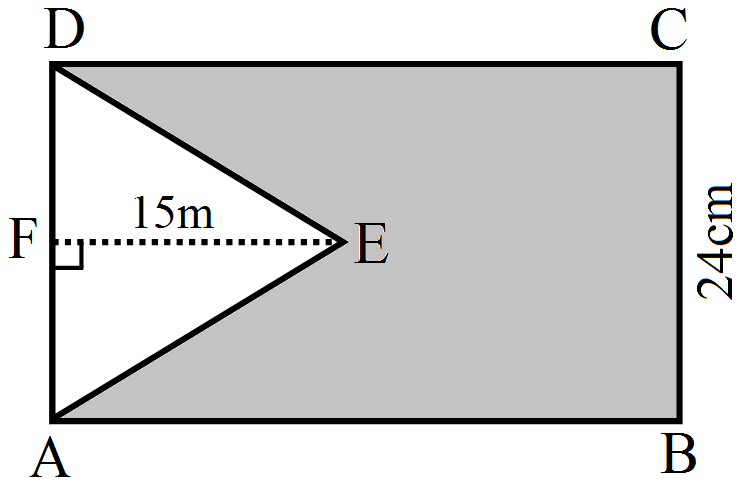
Answer$A B C D$ is a rectangle in which $A B=36 m$
and $B C=24 m$
In $\triangle AED$,
$EF =15 m$
$A D=B C=24 m$
Now area of rectangle $A B C D=l \times b$
$=36 \times 24 cm^2=864 cm^2$
Area of $\triangle AED =\frac{1}{2} \times AD \times EF$
$=\frac{1}{2} \times 24 \times 15 cm^2=180 cm^2$
Area of shaded portion $=864-180=684 m^2$
View full question & answer→Question 133 Marks
In the given figure, all steps are $0.5m$ high. Find the area of the shaded region.
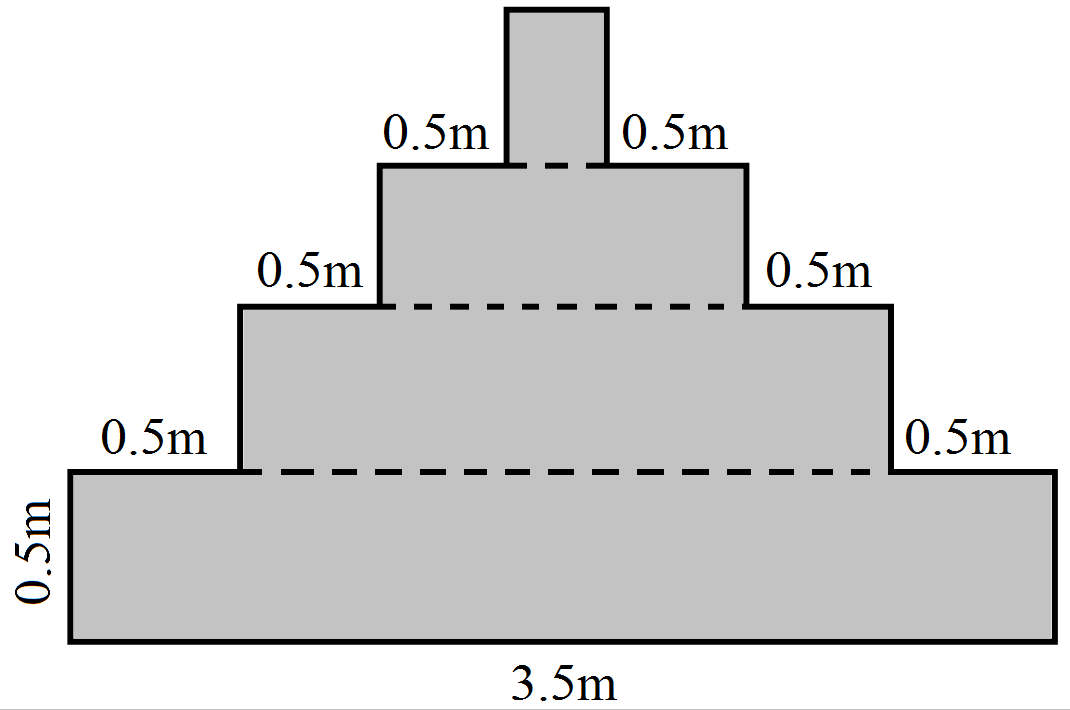
AnswerDividing the figure an shown
Area of rectangle I$=3.5 \times 0.5 \mathrm{~m}^2=1.75 \mathrm{~m}^2$
Area of rectangle II $=(3.5-2 \times 0.5) \times 0.5=(3.5-1) \times 0.5=2.5 \times 0.5=1.25 \mathrm{~m}^2$
Area of rectangle III $=(2.5-1) \times 0.5=1.5 \times 0.5=0.75 \mathrm{~m}^2$
Area of rectangle IV $=(1.5-1.0) \times 0.5 \times 0.5=0.25 \mathrm{~m}^2$
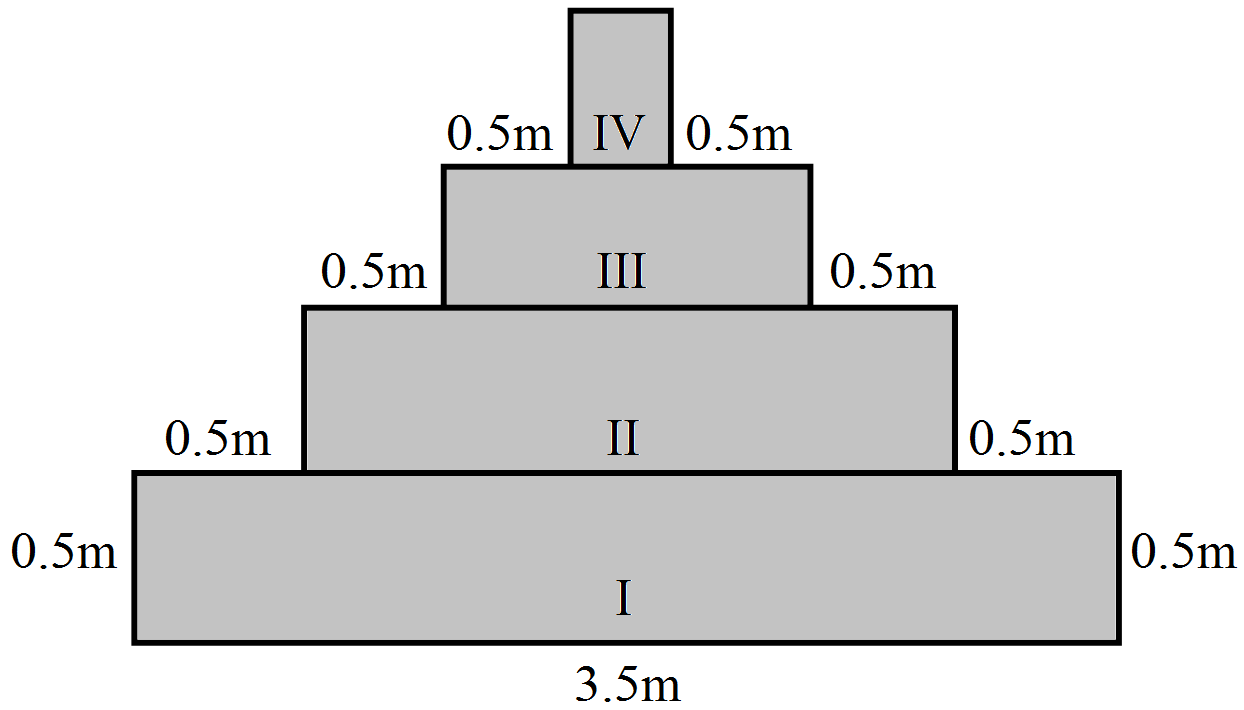
Total area of shaded portion $=(1.75+1.25+0.75+0.25) \mathrm{m}^2=4 \mathrm{~m}^2$ View full question & answer→Question 143 Marks
The legs of a right triangle are in the ratio $3 : 4$ and its area is $1014cm^2$. Find the lengths of its legs.
AnswerLegs of a right angled triangle $=3: 4$
Let one leg (base) $=3 x$
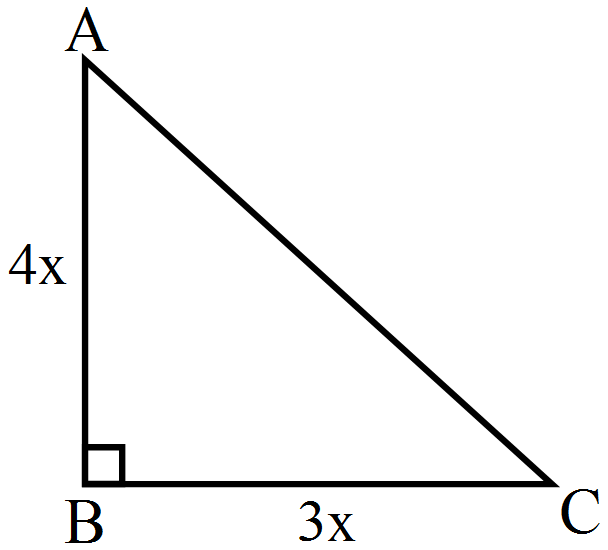
Then second leg (altitude) $=4 x$
$\text { Area }=\frac{1}{2} \times \text { Base } \times \text { Altitude }$
$=\frac{1}{2} \times 3 \mathrm{x} \times 4 \mathrm{x}=6 \mathrm{x}^2$
$6 \mathrm{x}^2=1014$
$=\mathrm{x}^2=\frac{1014}{6}=169=(13)^2$
$\mathrm{x}=13$
one leg $^{\prime}($ Base $)=3 \mathrm{x}=3 \times 13=39 \mathrm{~cm}$
and second leg (altitude) $=4 \mathrm{x}=4 \times 13=52 \mathrm{~cm}$ View full question & answer→Question 153 Marks
Find the area of the triangle in which $a = 91m, b = 98m, c = 105m.$
Answer$a = 91m, b = 98m, c = 105m$
$\therefore\text{s}=\frac{\text{a + b + c}}{2}$
$=\frac{91+98+105}{2}=\frac{294}{2}=147$
$\therefore\text{Area}=\sqrt{\text{s(s}-\text{a})\text{(s}-\text{b})\text{(s}-\text{c})}$
$=\sqrt{147(147-91)(147-98)(147-105)}$
$=\sqrt{147\times56\times49\times42}$
$=\sqrt{7\times7\times3\times7\times2\times2\times2\times7\times7\times7\times2\times3}$
$=2\times2\times3\times7\times7\times7\times=4116\text{m}^2$
View full question & answer→Question 163 Marks
A wire is looped in the form of a circle of radius $35\ cm$. If it is rebent in the form of a square, what will be the length of each side of the square?
AnswerIt is given that the radius of the circle is $35\ cm.$
Length of the wire = Circumference of the circle
$\Rightarrow $ Circumference of the circle $=2\pi\text{r}=\Big(2\times\frac{22}{7}\times35\Big)\text{cm}=220\text{cm}$
Let the wire be bent into the form of a square of side a cm.
Perimeter of the square $= 220cm$
$\Rightarrow 4a = 220$
$\Rightarrow\text{a}=\Big(\frac{220}{4}\Big)\text{cm}=55\text{cm}$
Hence, each side of the square will be 55cm.
View full question & answer→Question 173 Marks
The diameter of the wheel of a cycle is $70\ cm.$ How far will it go in $250$ revolutions?
AnswerIt may be noted that in one revolution, the cycle covers a distance equal to the circumference of the wheel.
Diameter of the wheel $= 70cm$
$\therefore$ Circumference of the wheel $=\pi\text{d}=\Big(\frac{22}{7}\times70\Big)\text{cm}=220\text{cm}$
Thus, the cycle covers $220cm$ in one revolution.
$\therefore$ Distance covered by the cycle in $250$ revolutions $= (220 \times 250)cm = 55000cm = 550m$ [since $1m = 100cm]$
Hence, the cycle will cover $550m$ in $250$ revolutions.
View full question & answer→Question 183 Marks
The circumference of a circle exceeds its diameter by $30\ cm$. Find the radius of the circle.
Answer(Circumference) - (Diameter) $= 30\ cm$
$\therefore(2\pi\text{r}-2\text{r})=30$
$\Rightarrow2\text{r}(\pi-1)=30$
$\Rightarrow2\text{r}\Big(\frac{22}{7}-1\Big)=30$
$\Rightarrow2\text{r}\times\frac{15}{7}=30$
$\Rightarrow\text{r}=\Big(30\times\frac{7}{30}\Big)=7$
$\therefore$ Radius of the given circle $= 7\ cm$
View full question & answer→Question 193 Marks
A verandah is $40m$ long and $15m$ broad. It is to be paved with stones, each measuring $6$ dm by $5$ dm. Find the number of stones required.
AnswerLength of verandah $(l) = 40m$ Breadth $(b) = 15m$
Area $= l \times b = 40 \times 15 = 600m^2$
Length of one stone $=6\text{dm}=\frac{6}{10}\text{m}$
and breadth $=5\text{dm}=\frac{5}{10}\text{m}$
Area of one stone $=\frac{6}{10}\times\frac{5}{10}$
$=\frac{30}{100}=\frac{3}{10}\text{m}^2$
$\therefore$ Number of stones
$=\frac{\text{Total area of verandah}}{\text{area of one stone}}$
$=\frac{600}{\frac{3}{10}}=\frac{600\times10}{3}$
$=2000$
View full question & answer→Question 203 Marks
A rectangular sheet of acrylic is $34\ cm$ by $24\ cm$. From it, $64$ circular buttons, each of diameter $3.5\ cm$, have been cut out. Find the area of the remaining sheet.
AnswerLength of rectangular sheet $(1)=34 \mathrm{~cm}$
and breadth $(b)=24 \mathrm{~cm}$
Area $=l \times b=34 \times 24 \mathrm{~cm}^2=816 \mathrm{~cm}^2$
Diameter of one button $=3.5 \mathrm{~cm}$
Radius $(r)=\frac{3.5}{2} \mathrm{~cm}$
and area of one button $=\pi \mathrm{r}^2$
$=\frac{22}{7} \times \frac{3.5}{2} \times \frac{3.5}{2} \mathrm{~cm}^2$
$=9.625 \mathrm{~cm}$
Area of 64 buttons $=9.625 \times 64 \mathrm{~cm}^2=616 \mathrm{~cm}^2$
Area of remaining sheet $=816-616=200 \mathrm{~cm}^2$
View full question & answer→Question 213 Marks
Find the area of a rhombus, the lengths of whose diagonals are: $8\ dm \ 5\ cm$ and $5\ dm \ 6\ cm.$
AnswerLength of one diagonal $= 8dm 5cm = (8 \times 10 + 5)cm = 85cm$ [since $1dm = 10cm]$
Length of the other diagonal $= 5dm 6cm = (5 \times 10 + 6)cm = 56cm$
$\therefore$ Area of the rhombus $=\frac{1}{2}\times\text{(Product of the diagonals)}$
$=\Big(\frac{1}{2}\times85\times56\Big)\text{cm}^2$$=2380\text{cm}^2$
View full question & answer→Question 223 Marks
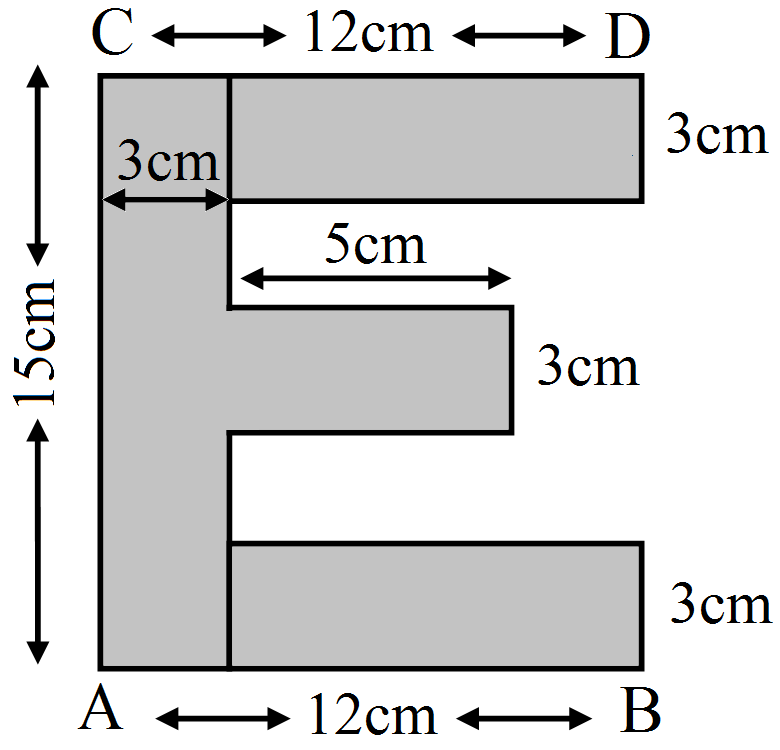
Calculate the area of the shaded region in each of the figures given below. Fig. $(ii)$ has uniform width of $3cm$ and it is given that $AB = CD.$
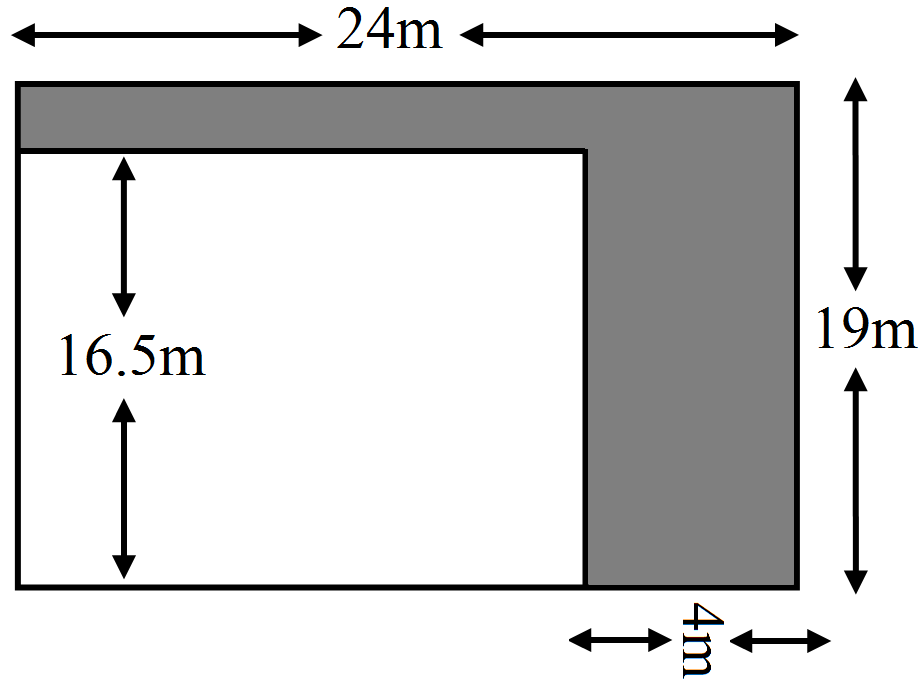
Answeri. Outer length $=24 \mathrm{~m}$
and breadth $=19 \mathrm{~m}$
Area $=24 \times 19=456 \mathrm{~m}^2$
Length of unshaded portion $=24-4=20 \mathrm{~m}$
and breadth $=16.5 \mathrm{~m}$
Area of unshaded portion $=20 \times 16.5 \mathrm{~m}^2=330.0 \mathrm{~m}^2$
Area of shaded portion $=456-330=126 \mathrm{~m}^2$
ii. Dividing the figure an shown
Area of rectangle I$=15 \times 3 \mathrm{~cm}^2=45 \mathrm{~cm}^2$
Area of rectangle II $=(12-3) \times 3=9 \times 3=27 \mathrm{~cm}^2$
Area of rectangle III $=5 \times 3=15 \mathrm{~cm}^2$
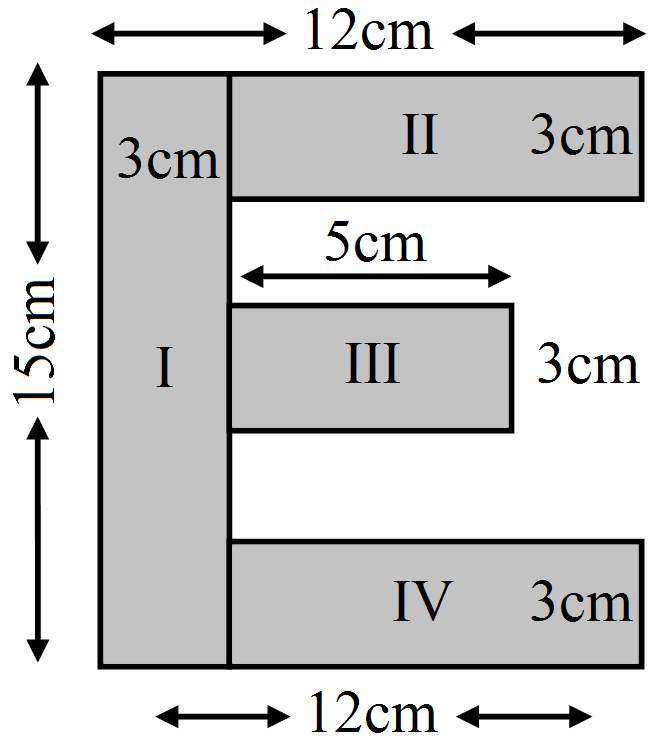
and area of rectangle IV $=(12-3) \times 3=9 \times 3=27 \mathrm{~cm}^2$
Total area of shaded portion $=45+27+15+27=114 \mathrm{~cm}^2$ View full question & answer→Question 233 Marks
A horse is tethered to one corner of a rectangular field, $60m$ by $40m$, by a rope $14m$ long. On how much area can the horse graze?
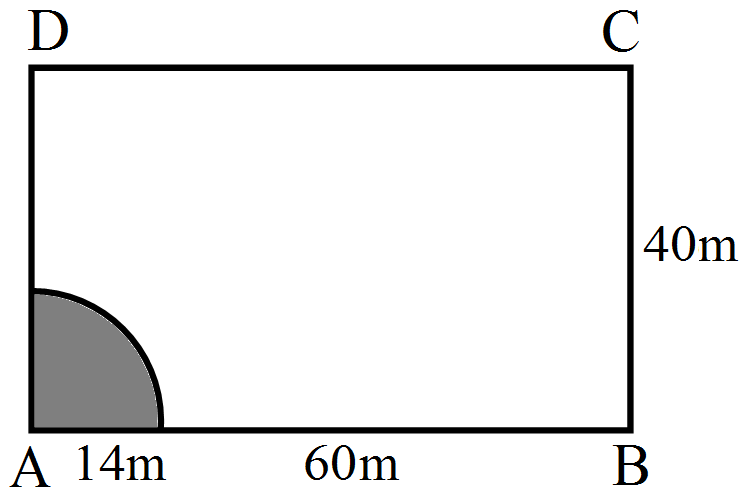
AnswerLength of field $= 60m$ and
breadth $= 40m$
Length of rope $= 14m$
Area covered by the horse $=\frac{1}{4}$ of
area of circle $=\frac{1}{4}\times\pi\text{r}^2$
$=\frac{1}{4}\times\frac{22}{7}\times14\times14=154\text{cm}^2$
View full question & answer→Question 243 Marks
Calculate the area of the shaded region in each of the figures given below:
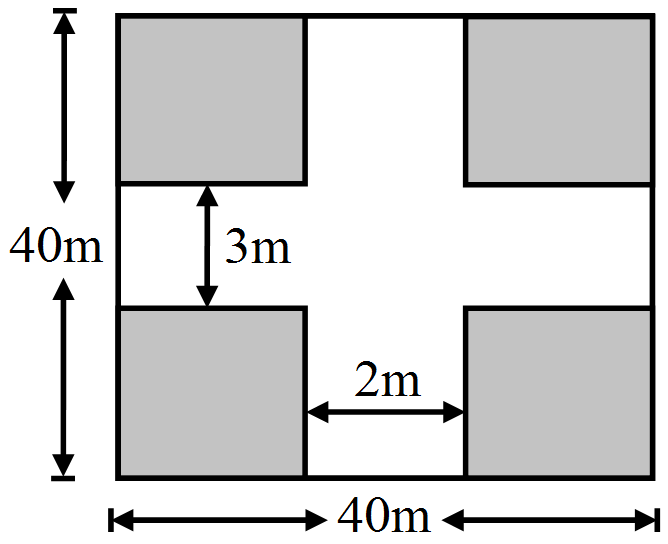
AnswerSide of square $(a)=40 \mathrm{~m}$
Area $=(a)^2=40 \times 40=1600 \mathrm{~m}^2$
Area of larger road $=40 \times 3=120 \mathrm{~m}^2$
and area of shorter road $=40 \times 2=80 \mathrm{~m}^2$
Area of roads $=(120+80)-3 \times 2=200-6=194 m^2$
Area of shaded portion $=(1600-194) \mathrm{m}^2=1406 \mathrm{~m}^2$
View full question & answer→Question 253 Marks
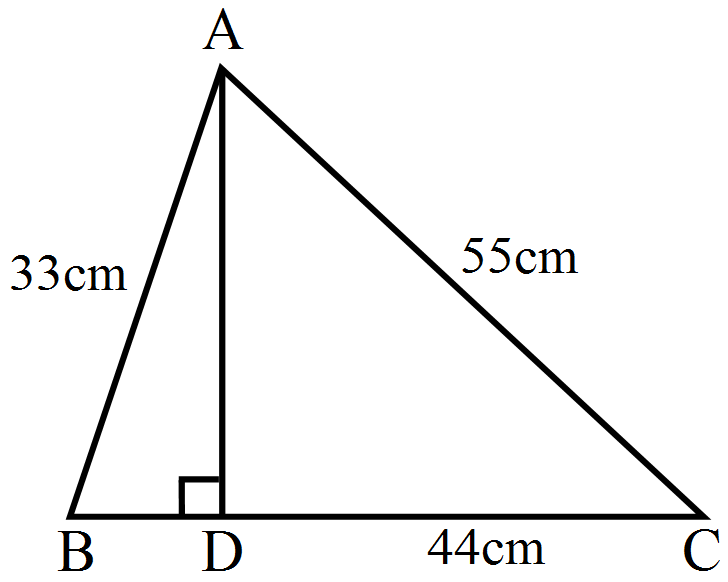
The lengths of the sides of a triangle are $33\ cm, 44\ cm$ and $55$ respectively. Find the area of the triangle and hence find the height corresponding to the side measuring $44\ cm.$
AnswerLet $a =33\ cm, b = 44\ cm, c = 55\ cm$
$\therefore\text{s}=\frac{\text{a + b + c}}{2}$ $=\frac{33+44+55}{2}$ $=\frac{132}{2}=66$
$\therefore\text{Area}=\sqrt{\text{s(s}-\text{a})(\text{s}-\text{b})(\text{s}-\text{c})}$
$=\sqrt{66(66-33)(66-44)(66-55)}$
$=\sqrt{66\times33\times22\times11}$
$=\sqrt{2\times3\times11\times3\times11\times2\times11\times11}$
$=2\times3\times11\times11=726\text{cm}^2$
Let base $=44\text{cm}$ then height $=\frac{\text{Area}\times2}{\text{Base}}$
$=\frac{726\times2}{44}$
$=33\text{cm}$ View full question & answer→Question 263 Marks
The, area of a rectangular field is $3584m^2$ and its length is $64m$. A boy runs around the fleld at the rate of $6km/h$. How long will he take to go $5$ times around it?
AnswerArea of rectangular field = $3584m^2$ Length $= 64m$
Area $= 3584$
Breadth $=\frac{\text{Area}}{\text{Length}}$
$=\frac{3584}{64}=56\text{m}$
Now perimeter $= 2(l + b) = 2(64 + 56)m = 2 \times 120 = 240m$
Distance covered in $5$ rounds $= 240 \times 5 = 1200m$
Speed $= 6km/h$
Time take $=\frac{1200}{1000}\times\frac{60}{6}=12\text{ minutes}$ ($1$ hour $= 60$ minutes)
View full question & answer→Question 273 Marks
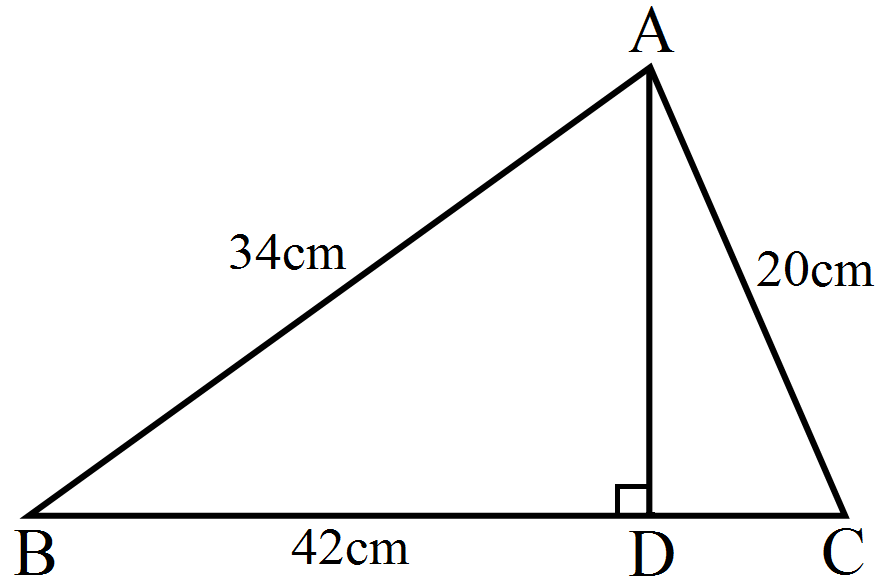
The sides of a triangle are $42\ cm, 34\ cm$ and $20\ cm$. Calculate its area and the length of the height on the longest side.
AnswerLet $a = 42\ cm, b = 34\ cm, c = 20\ cm$
$\therefore\text{s}=\frac{\text{a + b + c}}{2}$
$=\frac{42+34+20}{2}$
$=\frac{96}{2}=48$
$\therefore\text{Area}=\sqrt{\text{s(s}-\text{a})\text{(s}-\text{b})\text{(s}-\text{c})}$
$=\sqrt{48(48-42)(48-34)(48-20)}$
$=\sqrt{48\times6\times14\times28}$
$=\sqrt{2\times2\times2\times2\times3\times3\times2\times2\times7\times7\times2\times2}$
$=2\times2\times2\times2\times3\times7=336\text{cm}^2$ Longest side (Base) $=42\text{cm}$
$\therefore$ Height on longest side $=\frac{\text{Area}\times2}{\text{Base}}$
$=\frac{336\times2}{42}\text{cm}=16\text{cm}$ View full question & answer→Question 283 Marks
Find the area of quadrilateral $ABCD$ in which diagonal $BD = 24\ cm$. $\text{AL}\perp\text{BD}$ and $\text{\ cm}\perp\text{BD}$ such that $AL = 5\ cm$ and $\ cm = 8\ cm.$
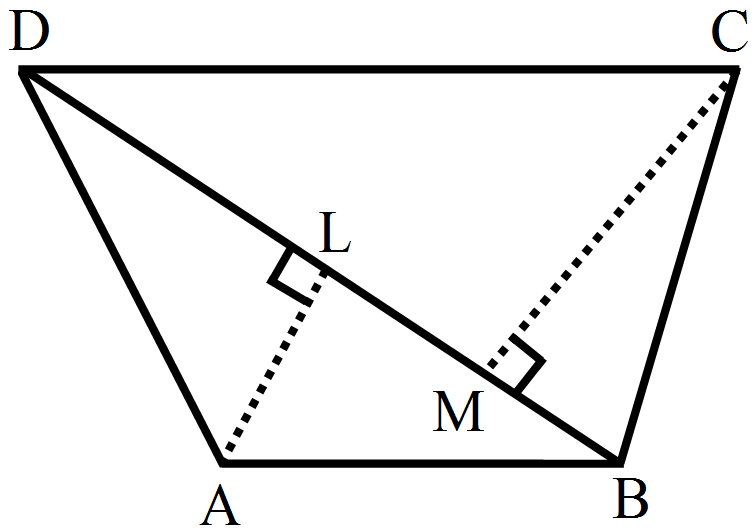
AnswerIn the quadrilateral $ABCD BD = 24\ cm$
$\text{AL}\perp\text{BD}$ and $\text{CM}\perp\text{BD}$
$AL = 5cm$ and $CM = 8cm$
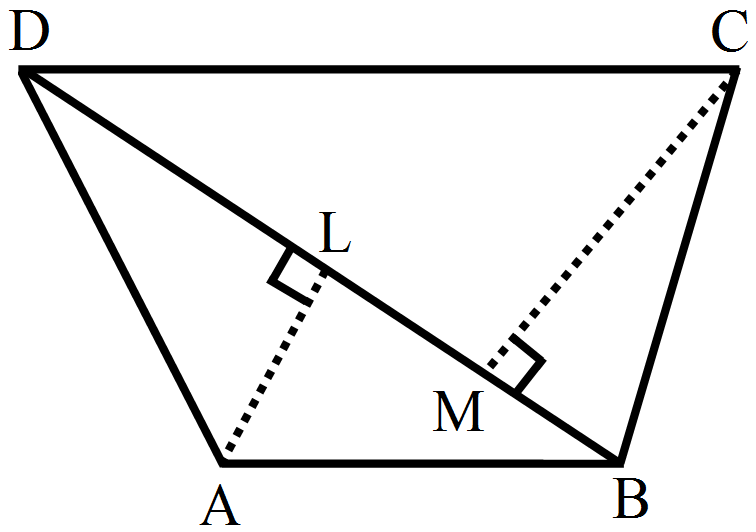
Now area of $\triangle\text{ABD}=\frac{1}{2}\text{bh}$
$=\frac{1}{2}\times\text{BD}\times\text{AL}=\frac{1}{2}\times24\times5\text{cm}^2$
$=60\text{cm}^2$ and area of $\triangle\text{CBD}=\frac{1}{2}\text{BD}\times\text{CM}$
$=\frac{1}{2}\times24\times8\text{cm}^2=96\text{cm}^2$
$\therefore$ Total area of quadrilateral $ABCD =60+96=156\text{cm}^2$ View full question & answer→Question 293 Marks
A rectangular field is $50m$ by $40m$. It has two roads through its centre, running parallel to its sides. The width of the longer and the shorter roads are $2m$ and $2.5-m$-respectively. Find the area of the roads and the area of the remaining portion of the field.
AnswerLength of field $(l) = 50m$ and breadth $(b) = 40m$
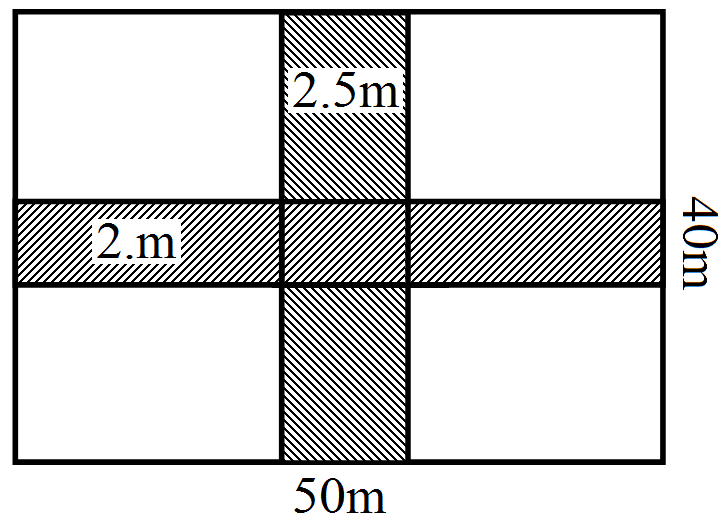
Width of road parallel to length $=2 \mathrm{~m}$
and width of road parallel to breadth $=2.5 \mathrm{~m}$
Area of roads $=50 \times 2+40 \times 2.5-2.5 \times 2=(100+100-5) \mathrm{m}^2=195 \mathrm{~m}^2$
and area of remaining portion $=50 \times 40-195=2000-195=1805 \mathrm{~m}^2$ View full question & answer→Question 303 Marks
A piece of wire is bent in the shape of an equilateral triangle each of whose sides measures $8.8\ cm$. This wire is rebent to form a circular ring. What is the diameter of the ring?
AnswerLength of the wire = Perimeter of the equilateral triangle $= 3 \times $ Side of the equilateral triangle $= (3 \times 8.8)cm = 26.4cm$
Let the wire be bent into the form of a circle of radius $r cm.$
Circumference of the circle $= 26.4cm$
$\Rightarrow2\pi\text{r}=26.4$
$\Rightarrow2\times\frac{22}{7}\times\text{r}=26.4$
$\Rightarrow\text{r}\Big(\frac{26.4\times7}{2\times22}\Big)\text{cm}=4.2\text{cm}$
$\therefore$ Diameter $= 2r = (2 \times 4.2)cm = 8.4cm$
Hence, the diameter of the ring is $8.4cm.$
View full question & answer→Question 313 Marks
The area of four walls of a room is $120m^2$. If the length of the room is twice its breadth and the height is $4m$, find the area of the floor.
Answer$\text { Area of } 4 \text { walls }=120 \mathrm{~m}^2$
$\text { Height }(\mathrm{h})=4 \mathrm{~m}$
$\text { Let breadth }(b)=x$
$\text { and length }(\mathrm{l})=2 \mathrm{x}$
$\text { Area of } 4 \text { walls }=2(l+\mathrm{h}) \times \mathrm{h}$
$=2(2 \mathrm{x}+\mathrm{x}) \times 4=8 \times 3 \mathrm{x}=24 \mathrm{x}$
$24 \mathrm{x}=120$
$\mathrm{x}=\frac{120}{24}=5$
$\text { Length of room }=2 \mathrm{x}=2 \times 5=10 \mathrm{~m}$
$\text { and breadth }=x=5 \mathrm{~m}$
$\text { Area of floor }=l \times \mathrm{b}=10 \times 5=50 \mathrm{~m}^2$
View full question & answer→Question 323 Marks
The sides of a rectangular park are in the ratio $4 : 3$. If its area is $1728m^2$, find the cost of fencing it at $₹ 30$ per metre.
Answer$\text { Ratio in the sides of a rectangle }=4: 3$
$\text { Area }=1728 \mathrm{~cm}^2$
$\text { Let length }=4 \mathrm{x}$
$\text { then breadth }=3 \mathrm{x}$
$\text { Area }=1 \times \mathrm{b}$
$1728=4 \mathrm{x} \times 3 \mathrm{x}$
$\Rightarrow 12 \mathrm{x}^2=1728$
$\Rightarrow \mathrm{x}^2=144=(12)^2$
$\Rightarrow \mathrm{x}=12$
$\text { Length }=4 \mathrm{x}=4 \times 12=48 \mathrm{~m}$
$\text { and breadth }=3 \mathrm{~m}=3 \times 12=36 \mathrm{~m}$
$\text { Now perimeter }=2(\mathrm{l}+\mathrm{b})=2(48+36) \mathrm{m}=2 \times 84=168 \mathrm{~m}$
$\text { Rate of fencing }=\text { Rs. } 30 \text { per metre }$
$\text { Total cost }=168 \times 30=\text { Rs. } 5040$
View full question & answer→Question 333 Marks
A rhombus has the same perimeter as the circumference of a circle. If each side of the rhombus measures $33\ cm$, find the radius of the circle.
AnswerCircumference of the circle = Perimeter of the rhombus $= 4 \times $
Side of the rhombus $= (4 \times 33)cm = 132cm$
$\therefore$ Circumference of the circle $= 132cm$
$\Rightarrow2\pi\text{r}=132$
$\Rightarrow2\times\frac{22}{7}\times\text{r}=132$
$\Rightarrow\text{r}=\Big(\frac{132\times7}{2\times22}\Big)\text{cm}=21\text{cm}$
Hence, the radius of the circle is $21cm.$
View full question & answer→Question 343 Marks
A wire is in the shape of a square of side $10\ cm$. If the wire is rebent into a rectangle of length $12\ cm$, find its breadth. Which figure encloses more area and by how much?
AnswerSide of a square wire $=10 \mathrm{~cm}$
Perimeter $=4 \mathrm{a}=4 \times 10 \mathrm{~cm}=40 \mathrm{~cm}$
or perimeter of rectangle $=40 \mathrm{~cm}$
Length of rectangle $=12 \mathrm{~cm}$
Breadth $=\frac{40}{2}-12=20-12=8 \mathrm{~cm}$
Now area of square $=a^2=(10)^2=100 \mathrm{~cm}^2$
and area of rectangle $=\mathrm{I} \times \mathrm{b}=12 \times 8=96 \mathrm{~cm}^2$
Difference in areas $=100-96=4 \mathrm{~cm}^2$
Square has $4 \mathrm{~cm}^2$ more area.
View full question & answer→Question 353 Marks
The area of a circle is $1381m^2$. Find its circumference.
AnswerArea of a circle $=1386\text{m}^2$
$\therefore\text{Radius (r)}=\sqrt{\frac{\text{Area}}{\pi}}=\sqrt{\frac{1386\times7}{22}}\text{m}$
$=\sqrt{441}=21\text{m}$
$\therefore\text{Circumference}=2\pi\text{r}=2\times\frac{22}{7}\times21\text{m}$
$=132\text{m}$
View full question & answer→Question 363 Marks
The sides of a triangle are in the ratio $13 : 14 : 15$ and its perimeter is $84\ cm$. Find the area of the triangle.
AnswerPerimeter of the triangle $= 84\ cm$
Ratio in side $= 13 : 14 : 15$
Sum of ratios $= 13 + 14 + 15 = 42$
Let then first side $=\frac{84\times13}{42}=26\text{cm}$
Second side $=\frac{84\times14}{42}=28\text{cm}$
Third side $=\frac{84\times15}{42}=30\text{cm}$
Now $\text{s}=\frac{\text{a + b + c}}{2}$
$=\frac{84}{2}=42$
$\therefore\text{Area}=\sqrt{\text{s(s}-\text{a})\text{(s}-\text{b})\text{(s}-\text{c})}$
$=\sqrt{42(42-26)(42-28)(42-30)}$
$=\sqrt{42\times16\times14\times12}$
$=\sqrt{2\times3\times7\times2\times2\times2\times2\times2\times7\times2\times2\times3}$
$=2\times2\times2\times2\times3\times7=336\text{cm}^2$
View full question & answer→Question 373 Marks
A steel wire when bent in the form of a square encloses an area of $121cm^2$. The same wire is bent in the form of a circle. find the area of the circle.
AnswerLet a be one side of the square.
$\text { Area of the square }=121 \mathrm{~cm}^2 \text { (given) }$
$\Rightarrow a^2=121$
$\Rightarrow a=11 \mathrm{~cm}(\text { since } 11 \times 11=121)$
$\text { Perimeter of the square }=4 \times \text { side }=4 \mathrm{a}=(4 \times 11) \mathrm{cm}=44 \mathrm{~cm}$
Length of the wire $=$ Perimeter of the square
$=44 \mathrm{~cm}$
The wire is bent in the form of a circle.
Circumference of a circle $=$ Length of the wire
$\therefore$ Circumference of a circle $=44 \mathrm{~cm}$
$\Rightarrow 2 \pi \mathrm{r}=44$
$\Rightarrow\left(2 \times \frac{22}{7} \times \mathrm{r}\right)=44$
$\Rightarrow \mathrm{r}=\left(\frac{44 \times 7}{2 \times 22}\right)=7 \mathrm{~cm}$
$\therefore$ Area of the circle $=\pi r^2$
$=\left(\frac{22}{7} \times 7 \times 7\right) \mathrm{cm}^2$
$=154 \mathrm{~cm}^2$
View full question & answer→Question 383 Marks
In the given figure, four equal circles are described about the four corners of a square so that each circle touches two of the circle as shown in the figure. find the area of the shaded region, each side of the square measuring $14\ cm.$
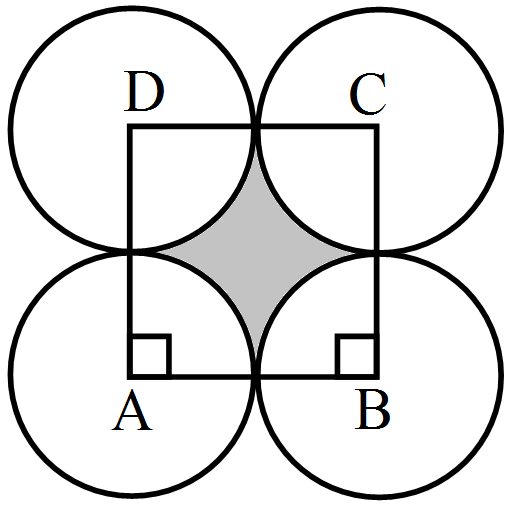
AnswerEach side of square $=14 \mathrm{~cm}$
Area of square $=a^2=14 \times 14=196 \mathrm{~cm}^2$
Radius of each circle at each corner of square $=\frac{14}{2}=7 \mathrm{~cm}$
$\therefore$ Area of the quadrant $=\frac{1}{4} \times \pi \mathrm{r}^2$
$=\frac{1}{4} \times \frac{22}{7} \times 7 \times 7=\frac{77}{2} \mathrm{~cm}^2$
and Area of $4$ quadrant $=\frac{77}{2} \times 4$
$=154 \mathrm{~cm}^2$
Area of shaded portion $=$ Area of square - area of $4$ quadrants
$=196-154=42 \mathrm{~cm}^2$
View full question & answer→Question 393 Marks
A room is $8.5m$ long, $6.5m$ broad and $3.4m$ high. It has two doors, each measuring ($1.5m$ by $1m$) and two windows, each measuring $(2m$ by $1m).$ Find the cost of painting its four walls at $Rs 160$ per $m^2$.
Answer$\text { Length of a room }(\mathrm{l})=8.5 \mathrm{~m}$
$\text { Breadth }(\mathrm{b})=6.5 \mathrm{~m}$
$\text { and height }(\mathrm{h})=3.4 \mathrm{~m}$
$\text { Area of four walls }=2(\mathrm{l}+\mathrm{b}) \times \mathrm{h}$
$=2(8.5+6.5) \times 3.4 \mathrm{~m}^2$
$=2 \times 15 \times 3.4 \mathrm{~m}^2$
$=30 \times 3.4=102.0 \mathrm{~m}^2$
Area of two doors of size $1.5 \mathrm{~m} \times 1 \mathrm{~m}=2 \times 1.5 \times 1 \mathrm{~m}=3 \mathrm{~m}^2$
and area of two windows of size $2 \mathrm{~m} \times 1 \mathrm{~m}=2 \times 2 \times 1=4 \mathrm{~m}^2$
Area of remaining portion $=102-(3+4)=102-7 \mathrm{~m}^2=95 \mathrm{~m}^2$
Rate of painting $=$ Rs. 160 per $\mathrm{m}^2$
Total cost $=$ Rs. $160 \times 95=$ Rs. 15200
View full question & answer→Question 403 Marks
Find the area of a rhombus, the lengths of whose diagonals are: $16\ cm$ and $28\ cm.$
AnswerLength of one diagonal $= 16\ cm$
Length of the other diagonal $= 28\ cm$
$\therefore$ Area of the rhombus $=\frac{1}{2}\times(\text{Product of the diagonals)}$ $=\Big(\frac{1}{2}\times16\times28\Big)\text{cm}^2=224\text{cm}^2$
View full question & answer→Question 413 Marks
one slde of a parallelogram ts $l8 \ cm$ long and lts area ls $153 \mathrm{~cm}^2$. Ftnd the distance of the glven slde from lts opposlte side.
AnswerBase of the parallelogram $= 18\ cm$
Area of the parallelogram = $153 \mathrm{~cm}^2$
$\therefore$ Area of the parallelogram = Base $\times $ Height
$\Rightarrow\text{Height}=\frac{\text{Area of the parallelogram}}{\text{Base}}$
$=\Big(\frac{153}{18}\Big)\text{cm}=8.5\text{cm}$
Hence, the distance of the given side from its opposite side is $8.5\ cm.$
View full question & answer→Question 423 Marks
Find the radius of a circle whose area is $616cm^2$.
AnswerLet the radius of the circle be $r cm$
Area $=(\pi\text{r}^2)\text{cm}^2$
$\pi\text{r}^2=616$
$\Rightarrow\frac{22}{7}\times\text{r}\times\text{r}=616$
$\Rightarrow\text{r}^2=\Big(\frac{616\times7}{22}\Big)=196$
$\Rightarrow\text{r}=\sqrt{196}=14\text{cm}$
Hence, the radius of he given circle is $14\ cm.$
View full question & answer→Question 433 Marks
Find the area of a rectangular plot on side of which is $48m$ and its diagonal $50m.$
AnswerWe know that all the angles of a rectangle are $90^{\circ}$ and the diagonal divides the rectangle into two right angled triangles.
So, one side of the triangle will be $48 m$ and the diagonal, which is $50 m$ , will be the hypotenuse.
According to Pythagoras theorem:
$(\text { Hypotenuse })^2=(\text { Base })^2+(\text { Perpendicular })^2$
Perpendicular $=\sqrt{(\text { Hypotenuse })^2-(\text { Base })^2}$
Perpendicular $=\sqrt{(50)^2-(48)^2}$
$\therefore$ Other side of the rectangular plot $=14 \mathrm{~m}$
$\therefore$ Area of the rectangular plot $=48 \mathrm{~m} \times 14 \mathrm{~m}=672 \mathrm{~m}^2$
Hence, the area of a rectangular plot is $672 \mathrm{~m}^2$.
View full question & answer→Question 443 Marks
The area of a rhombus is $119cm^2$ and its perimeter is $56\ cm$. Find its height.
AnswerPerimeter of the rhombus $=56 \mathrm{~cm}$
Area of the rhombus $=119 \mathrm{~cm}^2$
Side of the rhombus $=\frac{\text { perimeter }}{4}=\left(\frac{56}{4}\right) \mathrm{cm}=14 \mathrm{~cm}$
Area of a rhombus $=$ Base $\times$ Height
$\therefore$ Height of the rhombus $=\frac{\text { Area }}{\text { Base }}$
$=\left(\frac{119}{14}\right) \mathrm{cm}$
$=8.5 \mathrm{~cm}$
View full question & answer→Question 453 Marks
A godown is $50m$ long, $40m$ broad and $10m$ high. Find the cost of whitewashing its four walls and ceiling at $Rs 20$ per square metre.
Answer$\text { Length of go down }(I)=50 \mathrm{~m}$
$\text { Breadth }(\mathrm{b})=40 \mathrm{~m}$
$\text { and height }(\mathrm{h})=10 \mathrm{~m}$
$\text { Area of } 4 \text { walls }=2(\mathrm{l}+\mathrm{b}) \times \mathrm{h}$
$=2(50+40) \times 10 \mathrm{~m}$
$=2 \times 90 \times 10=1800 \mathrm{~m}^2$
$\text { and area of ceiling }=1 \times \mathrm{b}=50 \times 40=2000 \mathrm{~m}^2$
$\text { Total area of walls and ceiling }=1800+2000=3800 \mathrm{~m}^2$
$\text { Rate of whitewashing }=\text { Rs. } 20 \text { per } \mathrm{m}^2$
$\text { Total cost }=\text { Rs. } 20 \times 3800=\text { Rs. } 76000$
View full question & answer→Question 463 Marks
In the following figures, find the area of the shaded region.
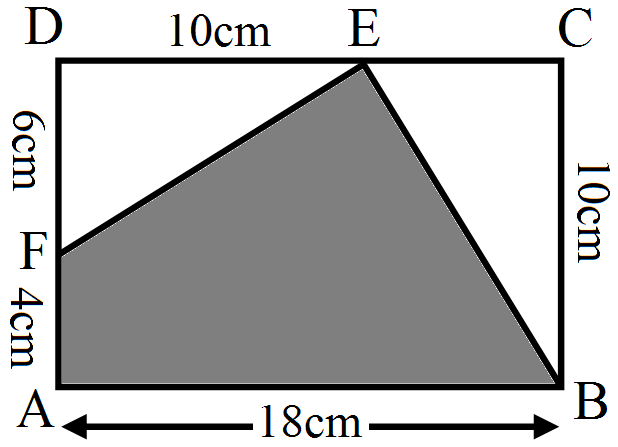
AnswerLength of rectangle $(l) = 18\ cm$ and
breadth $(b) = 10\ cm$
Area $= l × b = 18 × 10 = 180cm^2$
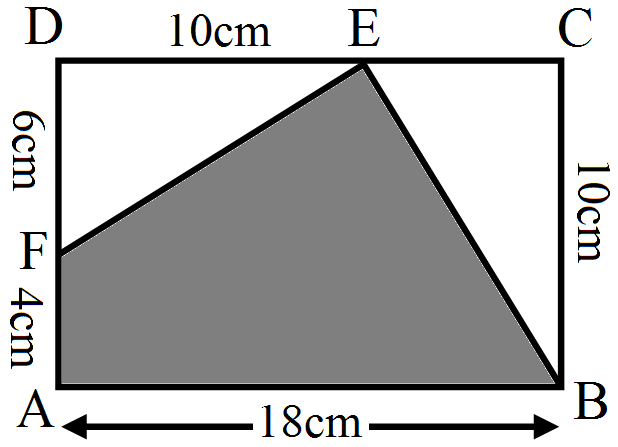
Area of right $\triangle\text{EBC}=\frac{1}{2}\times10\times8=40\text{cm}^2$ and
area of right $\triangle\text{EDF}=\frac{1}{2}\times10\times6=30\text{cm}^2$
Area of shaded region $=180-(40+30)=180-70=110\text{cm}^2$ View full question & answer→Question 473 Marks
The area of a rhombus is $148.8cm^2$. If one of its diagonals is $19.2\ cm,$ find the length of the other diagonal.
AnswerArea of a rhombus $=\frac{1}{2} \times$ (Product of the diagonals)
Given:
Length of one diagonal $=19.2 \mathrm{~cm}$
Area of the rhombus $=148.8 \mathrm{~cm}^2$
$\therefore$ Length of the other diagonal $=\left(\frac{148.8 \times 8}{19.2}\right) \mathrm{cm}=15.5 \mathrm{~cm}$
View full question & answer→Question 483 Marks
A room $9.5m$ long and $6m$ wide is surrounded by a $1.25-m-$ long verandah. Calculate cost of cementing the floor of this verandah at $Rs 80$ per $m^2$.
Answer$\text { Length' of room }(\mathrm{l})=9.5 \mathrm{~m}$
$\text { Breadth }(\mathrm{b})=6 \mathrm{~m}$
$\text { Width of outer verandah }=1.25 \mathrm{~m}$
$\text { Outer length }(\mathrm{L})=9.5+2 \times 1.25=9.5+2.5=12.0 \mathrm{~m}$
$\text { and breadth }(B)=6+2 \times 1.25=6+2.5=8.5 \mathrm{~m}$
$\text { Area of verandah }=\text { Outer area }- \text { Inner area }=\mathrm{L} \times \mathrm{B}-\mathrm{l} \times \mathrm{b}$
$=(12.0 \times 8.5-9.5 \times 6) \mathrm{m}^2-(102.0-57.0) \mathrm{m}^2=45 \mathrm{~m}^2$
$\text { Rate of cementing }=\text { Rs. } 15 \text { per } \mathrm{m}^2$
$\text { Total cost }=\text { Rs. } 80 \times 45=\text { Rs. } 3600$
View full question & answer→Question 493 Marks
A square lawn is surrounded by a path $2.5m$ wide. If the area of the path is $165m^2$, find the area of the lawn.
AnswerArea of path $=165 \mathrm{~m}^2$
Width of path $=2.5 \mathrm{~m}$.
Let side of square lawn $=\mathrm{x} \mathrm{m}$.
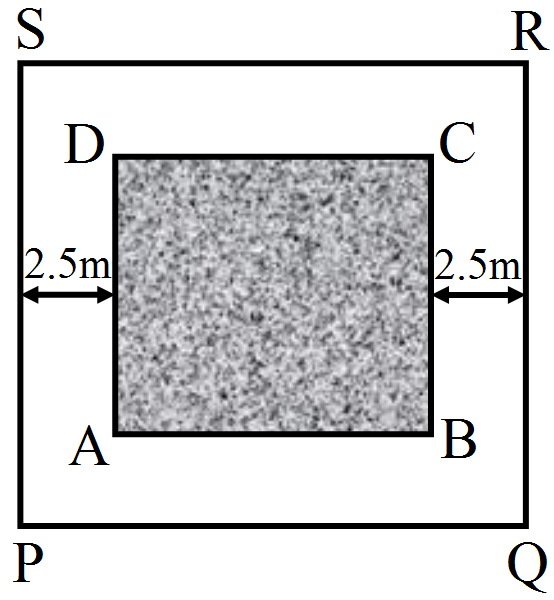
Outer side $=x+2 \times 2.5=(x+5) m$
Area of path $=(x+5) 2-x^2$
$\Rightarrow \mathrm{x}^2+10 \mathrm{x}+25-\mathrm{x}^2=165$
$\Rightarrow 10 x=165-25=140$
$\Rightarrow \mathrm{x}=\frac{140}{10}=14 \mathrm{~m}$
Side of lawn $=14 \mathrm{~m}$
and area of lawn $=(14)^2 \mathrm{~m}^2=196 \mathrm{~m}^2$ View full question & answer→Question 503 Marks
A rectangular lawn $70m$ by $50m$ has two roads, each $5m$ wide, running through its middle, one parallel to its length and the other parallel to its breadth. Find the cost of constructing the roads at $Rs 120$ per $m^2$.
AnswerLength of lawn $(l)=70 \mathrm{~m}$
Breadth (b) $=50 \mathrm{~m}$
Width of crossing roads $=5 \mathrm{~m}$
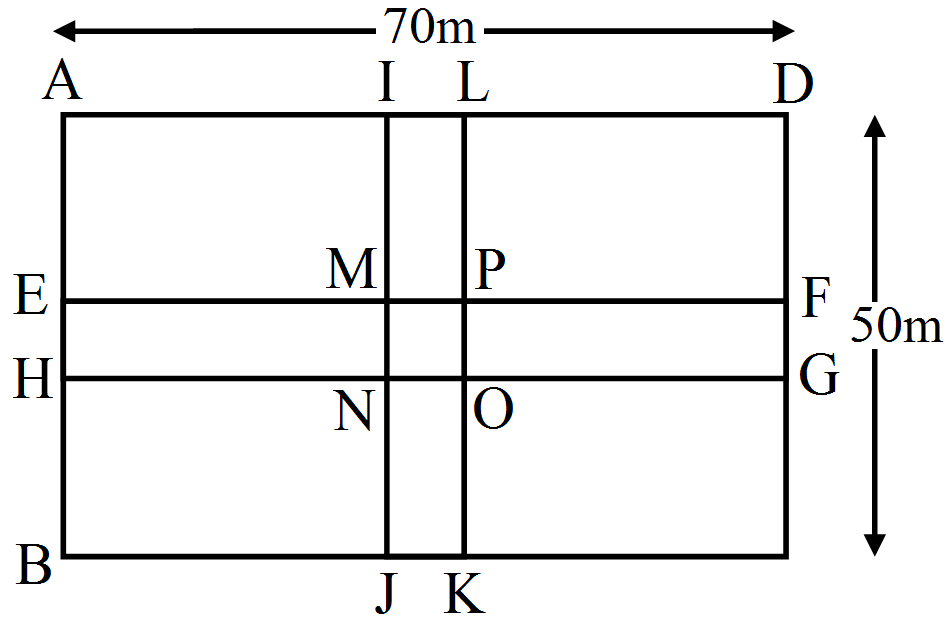
Area of roads $=70 \times 5+50 \times 5-(5)^2$
$=350+250-(5)^2$
$=600-25=575 \mathrm{~m}^2$
Cost of constructing $=$ Rs. 120 per $\mathrm{m}^2$
Total cost Rs. $120 \times 575= Rs. 69000$ View full question & answer→