- ✓Uniform motion
- BNon$-$uniform motion
- CCombination of uniform and non $-$ uniform motion
- DNeither uniform nor non$-$uniform motion
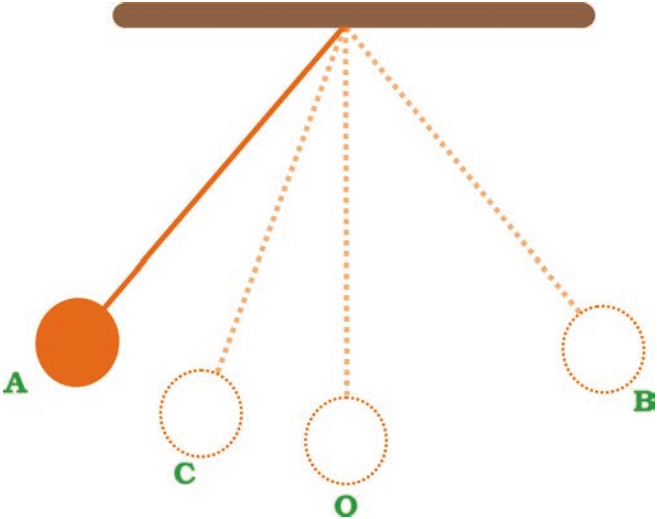
The time period of pendulum is $0.625.$
Boojho Home to school to again home
From home to school distance is $3\ km$ time taken is
$30\text{min}=\big(\frac{30}{60}\big)\text{hour}=0.5\text{hour}$
And in returning from school to home time taken
$20\text{min}=\big(\frac{20}{60}\big)\text{hour}=0.33\text{hour}$
$\text{Average speed}=\frac{\text{Total distance}}{\text{time taken}}$
$=\frac{(3+3)}{(0.5+0.33)}\text{km/ h}$
$=7.2\text{km/ h}$
$1$ week $= 7$days
$= 7$days $\times 24hrs/ day \times 60min/ hr \times 60sec/ min$
$= 604800s$
Case I
Speed of the car $= 40 km/h$
Time taken $= 15$ min $=\frac{15}{60}=0.25\text{h}$
$\text{Speed}=\frac{\text{Distance covered}}{\text{Time taken}}$
Distance covered, d1 = Speed $\times $ Time taken $= 40 \times 0.25 = 10km$
Case II
Speed of the car = 60km/h
Time taken $= 15$ min $=\frac{15}{60}=0.25\text{h}$
$\text{Speed}=\frac{\text{Distance covered}}{\text{Time taken}}$
Distance covered, d2 = Speed \times Time taken $= 60 \times 0.25 = 15km$
Total distance covered by the car, $d = d1 + d2 = 10 + 15 = 25km$
Therefore, the total distance covered by the car is 25km.
If the particle moves with constant velocity,
$\text{Velocity v}=\frac{\triangle\text{x}}{\triangle\text{t}}=\text{constant}$
Thus for equal time intervals, the distance traveled must be equal.
The distance traveled by object in option $C$ remains the same for each interval and is equal to $\triangle\text{x}=4\text{m}-2\text{m}=2\text{m}.$
Given, total distance $= 3 + 3 = 6\ km,$
Total time $= 30 + 20 = 50\min$
$=\frac{50}{60}\text{h}$
$\text{Average speed}=\frac{\text{Total distance}}{\text{Total time taken}}$
$=\frac{6}{\frac{50}{60}}$
$=\frac{6}{50}\times60$ $\big[\because1\text{h}=60\text{min}\big]$
$=7.2\text{km/h}$
The standard unit of length is meter $(‘m’).$

An earth complete one revolution around the sun in a year.