Questions

SHORT ANSWER QUESTIONS(3 Mark)

🎯

Test yourself on this topic

27 questions · timed · auto-graded

Question 13 Marks
How earthquakes are measured?
Answer
An earthquake is measured with a machine called a seismograph. The magnitude of the earthquake is measured on the Richter scale. An earthquake of 2.0 or less can be felt only a little. An earthquake over 5.0 can cause damage from things falling. A 6.0 or higher magnitude is considered very strong and 7.0 is classified as a major earthquake.
View full question & answer
Question 23 Marks
What are ox bow lakes?
Answer
Due to continuous erosion and deposition along the sides of the meander, the ends of the meander loop come closer and closer which in some time cuts off from the river and forms a cut-off lake, called an ox-bow lake.
View full question & answer
Question 33 Marks
Write a short note on earthquake preparedness.
Answer
Although earthquakes cannot be predicted, the impact can certainly be minimised if we keep the following points in mind.
Safe Spot: Take shelter during an earthquake under a kitchen counter, table or desk, against an inside corner or wall.
Stay Away from: Fire places, areas around chimneys, windows that shatter including mirrors and picture frames.
Be Prepared: Spread awareness amongst our friends and family members and face any disaster confidently.
View full question & answer
Question 43 Marks
How a delta is formed?
Answer
As the river approaches the sea, the speed of the flowing water decreases and the river begins to break up into a number of streams called distributaries. The river becomes so slow that it begins to deposit its load. Each distributary forms its own mouth. The collection of sediments from all the mouths forms a delta.
View full question & answer
Question 53 Marks
Examine the preparedness required during an earthquake.
Answer
During earthquake we should take the following measures:-
  1. Safe spot:- We should take shelter under a kitchen counter, table or desk, against an inside corner or wall.
  2. Stay away from:- Fire places, areas around chimney and windows that it may include mirrors and picture frames.
  3. Be prepared:- Spread awareness, amongst your friends and family members to face any disasters confidently.
View full question & answer
Question 63 Marks
How are flood plains formed?
Answer
When river overflows its banks, it flood off its neighbouring areas which deposits layers of fine soil and othermaterial called sediments along its banks. This leads to the formation of a flat fertile floodplain.
View full question & answer
Question 73 Marks
How man is also responsible for earth quake?
Answer
Officially, there is such an area of research devoted to man made earth quake. Geologist and seismologist agree that humans can induce earthquake in five major ways of fluid injection into the earth, fluid extraction from the earthmining, nuclear testing and through the construction of dams and reservoirs. In fact, there are officially recorded instances of earth quake caused by human activity.
View full question & answer
Question 83 Marks
Examine the movements of earthquake.
Answer
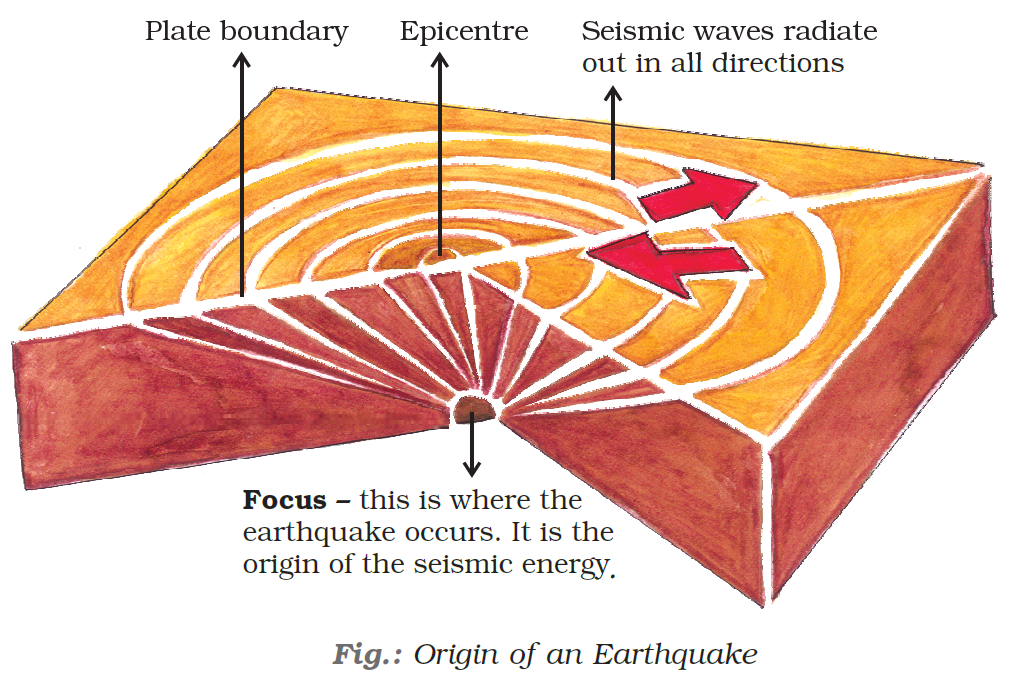
  1. When lithosphere plates move, the surface of the earth vibrates. This vibration is called earthquake.
  2. The place in the crust where the movement starts is called the focus.
  3. Vibration travels outside towards epicentre as waves.
  4. The place on the surface above the focus is called the epicentre.
  5. The strength of earthquake decreases away from the centre.
View full question & answer
Question 93 Marks
Explain the work of ice.
Answer
Glaciers are “rivers” of ice which too erode the landscape by bulldozing soil and stones to expose the solid rock below. Glaciers carve out deep hollows. As the ice melts they get filled up with water and become beautiful lakes in the mountains. The material carried by the glacier such as rocks big and small, sand and silt gets deposited. These deposits form glacial moraines.
View full question & answer
Question 103 Marks
Mention the work of ice.
Answer
Glaciers are rivers of ice which erode the landscape by destroying soil and stones to expose the solid rock below. Glaciers carve out deep hollows. As the ice melts they get filled up with water and become beautiful lakes in the mountains. The material carried by the glacier such as rocks big and small, sand and silt gets deposited. These deposits form glacial moraines.
View full question & answer
Question 113 Marks
Explain the process of formation of a delta.
Answer
As the river approaches the sea, the speed of the following water decreases and the river beings to break up into a number of streams called distributaries. The river becomes so slow it beings to deposit its load. Each distributary forms its own mouth. The collection of sediments from all the mouth forms a delta.
View full question & answer
Question 123 Marks
What are the two processes which continuously wear away the landscape? Explain them.
Answer
The Processes of landscape is continuously worn away by two processes.They are as follow:
  • Weathering and erosion.
  • Weathering is the breaking up of rocks on the earth's surface.
  • Erosion is the wearing away of the landscape by different agents like water, wind and ice.
  • The eroded material is carried away or transported by water, wind etc.
  • They deposit material eventually.
  • This process of erosion and deposition creates different landforms on the surface of the earth.
View full question & answer
Question 133 Marks
Examine the features formed due to work of sea waves.
Answer
The features formed due to the formation of sea waves are:-
  1. Sea caves:- The erosion and deposition of sea waves gives rise to coastal landforms. Sea waves continuously strike at the rocks. Cracks develop over time and they become larger and wider. Thus, hollow-like caves are formed on the rocks. They are called sea caves.
  2. Arches:- Deposition of sea waves form cavities which become bigger and bigger. Gradually only the roof of the cave remains, leading to the formation of sea arches.
  3. Stacks:- Erosion breaks the roof and only walls are left. These wall-like features are called stacks.
  4. Sea cliff:- The steep rocky coast rising almost vertically above sea water is called sea cliff.
View full question & answer
Question 143 Marks
Sea caves are turned into stacks. Give reason.
Answer
Sea waves continuously strike at the rocks. Cracks develop. Over time they become larger and wider. Thus, hollow like caves are formed on the rocks. They are called sea caves. As these cavities become bigger and bigger only the roof of the caves remain, thus forming sea arches. Further, erosion breaks the roof and only walls are left. These walls like features are called stacks.
View full question & answer
Question 153 Marks
Give an account of earthquake preparedness.
Answer
Earthquake is a natural calamity which we cannot stop. But we can minimise its impact if we are prepared before-hand.
During an earthquake, we should shift to some safe spot. We should hide under a kitchen counter, table or desk against an inside comer or wall. We should stay away from fire places, areas around chimneys, windows that shelter including mirrors and picture frames. Moreover, we should spread awareness amongst our friends and family members.
View full question & answer
Question 163 Marks
Write a short note on work of wind.
Answer
  1. An active agent of erosion and deposition in the deserts is wind. In deserts we see rocks in the shape of a mushroom, commonly called mushroom rocks. Winds erode the lower section of the rock more than the upper part. Therefore, such rocks have narrower base and wider top.
  2. When the wind blows, it lifts and transports sand from one place to another. When it stops blowing the sand falls and gets deposited in low hill – like structures. These are called sand dunes.
  3. When the grains of sand are very fine and light, the wind can carry it over very long distances. When such sand is deposited in large areas, it is called loess. Large deposits of loess are found in China.
View full question & answer
Question 173 Marks
Describe the work of ice.
Answer
Work of Ice:
  • Glaciers are "rivers" of ice.
  • They too erode the landscape by bulldozing soil and stones to expose the solid rock below.
  • Glaciers carve out deep hollows.
  • As the ice melts they get filled up with water and become beautiful lakes in the mountains.
  • The material carried by the glacier like big and small rocks, sand, silt gets deposited.
  • These deport from glacial moraines.
View full question & answer
Question 183 Marks
Examine the work of ice.
Answer
  1. Glaciers are rivers of ice which too erode the landscape by bulldozing soil and stones to expose the solid rocks below.
  2. They carve out deep hollows.
  3. As the ice melts, they get filled up with water to form beautiful lakes in the mountains.
  4. The material carried by the glaciers like big and small rocks, sand and silt gets deposited.
  5. These deposits form glacial moraines.
View full question & answer
Question 193 Marks
What is earthquake? What are some common earthquake prediction methods?
Answer
When the lithospheric plates move, the surface of the earth vibrates. The vibrations can travel all round the earth. These vibrations are called earthquakes. Some common earthquake prediction methods include studying animal behaviour, fish in the ponds get agitated, snakes come to the surface.
View full question & answer
Question 203 Marks
How do earth movements cause changes on the earth’s crust?
Answer
  1. The movements of lithospheric plates cause changes on the surface of the earth.
  2. The earth movements are divided on the basis of forces which cause them.
  3. The forces which act on the interior of the earth are called endogenic force.
  4. The forces that work on the surface of the earth are called exogenic forces.
View full question & answer
Question 213 Marks
Explain Earthquake preparedness.
Answer
Earthquake Preparedness:When an earthquake strikes we should do the following:
  • We should be in a safe spot like: under a kitchen counter, table or desk.
  • We should stand against an inside comer or wall.
  • We should stay away from fire places, areas around chimneys, windows that shatter including mirrors and picture frames.
  • We should be prepared by arousing awareness amongst our friends and family members.
  • We should face any disaster confidently.
NOTES: Case Study Bhuj Earthquake:
  • An earthquake measuring 6.9 on richter scale hits Bhuj in Gujarat.
  • Schools worst affected.
  • Communication water power supply affected.
  • Hundreds of fire started.
  • Emergency declared and CM appeals for help.
View full question & answer
Question 223 Marks
What are earthquakes? Define focus and epicentre.
Answer
Earthquake:
  • When the lithosphere plates move, the surface of the earth vibrates.
  • The vibrations travel all around the earth.
  • These vibrations are called earthquake.
Focus: The place or point in the crust where the movement starts is called Focus.
Epicentre: The place or the surface above the focus is called Epicentre.
  • Vibrations travel outwards from the epicentre as waves.
  • Greatest damage occurs closest to the epicentre.
  • The strength of the earthquake decreases, going away from the centre.
View full question & answer
Question 233 Marks
Give an account of the work of wind.
Answer
Work pi Wind:An active agent of erosion and deposition in the deserts is wind.
In deserts there are numerous rocks with a shape of a mushroom.
  • They are commonly called mushroom rocks.
  • Winds erode the lower section of the rock more than the upper part.
  • Such rocks have narrower base and wider top.
When the wind blows, it lifts and transports sand from one place to another.
  • When it stops blowing, the sand falls and gets deposited in low hill like structures.
  • These are called sand dunes.
When the grains of sand are very fine and light, the wind carries it over very long distances.
  • When such a sand is deposited in large areas, they are called loess. Large deposits of loess are found in China.
View full question & answer
Question 243 Marks
What is seismograph? How is the magnitude of earthquake measured?
Answer
  • An earthquake is measured with a machine.
  • It is called a seismograph.
The magnitude of the earthquake is measured on Richter scale.
  • An earthquake of 2.0 or less is felt only a little.
  • An earthquake over 5.0 causes damage from things falling.
  • A 6.0 or higher magnitude is considered very strong and 7.0 is classified as a major earthquake.
View full question & answer
Question 253 Marks
Describe the features by the river during its middle course.
Answer
As the river enters the plain it twists and turns forming large bends known as meanders. due to continuous loop come closer and closer. In due course of time the meander loop cuts off from the river and forms a cut-off lake, also called an ox-bow lake. At times the river overflows its banks. This leads to the flooding of the neighbouring areas. as it floods, it deposits layers of fine soil and other material called sediments along its banks. This leads to the formation of a flat floodplain. The raised banks are called laves.
View full question & answer
Question 263 Marks
Explain the two process due to which landscape is continuously worn away.
Answer
The landscape is being continuously worn away by two processes - Weathering and erosion. Weathering is the breaking up to the rocks on the earth's surface. It happens due to the physical, chemical and biological action by temperature, rainwater living organisms etc. That cause cracks and chip off the rock surface into smaller fragments. Erosion is the wearing away of the lansdscape by different agents like water, wind and ice. These agents transport the weathered material away from parent rock and deposit it to other places causing different landforms.
View full question & answer
Question 273 Marks
Give an account of some common earthquake prediction methods adopted locally by people.
Answer
Some of the common earthquake prediction methods adopted locally by people are:
  • Wild animal behaviour.
  • Agitated fish in the ponds.
  • Snakes coming out to the surface from their holes.
  • Animals trying to untie themselves and run away.
  • Birds leaving their nests and beginning to chatter loudly.
  • Aborigines beginning to run to higher grounds.
View full question & answer
SHORT ANSWER QUESTIONS(3 Mark) - Social Studies STD 7 Questions - Vidyadip