Questions · Page 3 of 5

M.C.Q

MCQ 1011 Mark
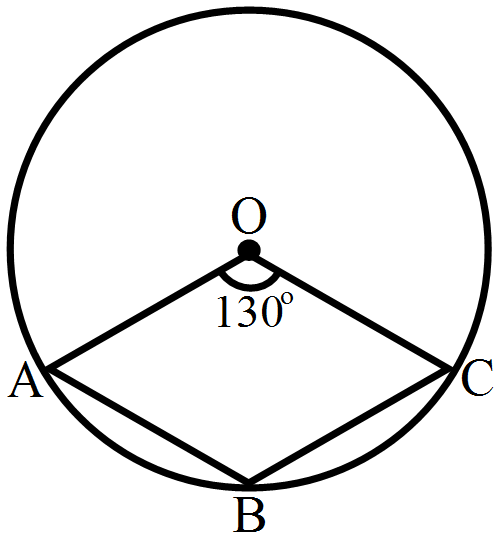
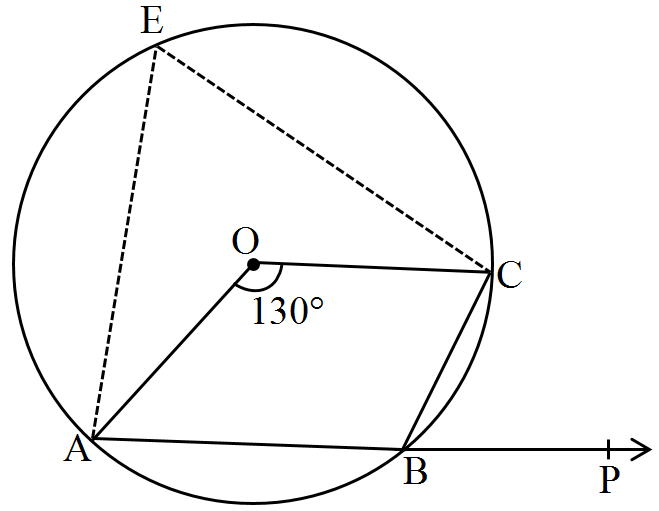
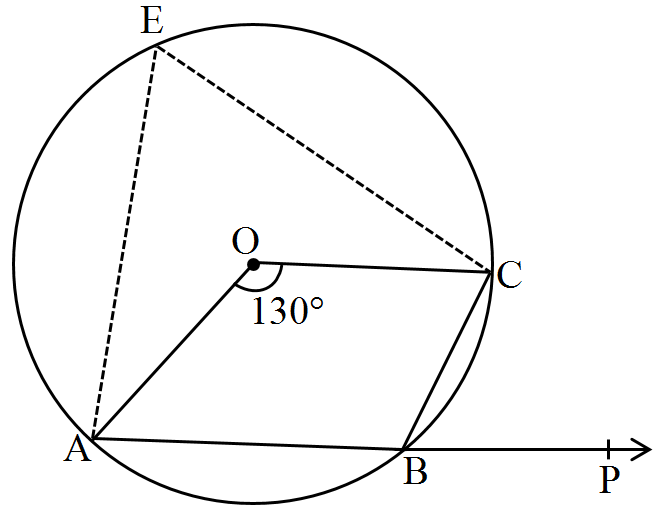
Arc $ABC$ subtends an angle of $130^\circ $ at the centre $O$ of the circle. $AB$ is extended to $P.$ Then $\angle\text{CBP}$ equals:
  • A
    $130^\circ$
  • B
    $60^\circ$
  • C
    $70^\circ$
  • $65^\circ$
Answer
Correct option: D.
$65^\circ$

$\angle\text{AEC}=\frac{130^\circ}{2}=65^\circ$
$\angle\text{CBP}=180^\circ-\angle\text{ABC}$
$=180^\circ-(180^\circ-\angle\text{AEC})$
$=\angle\text{AEC}$
View full question & answer
MCQ 1021 Mark
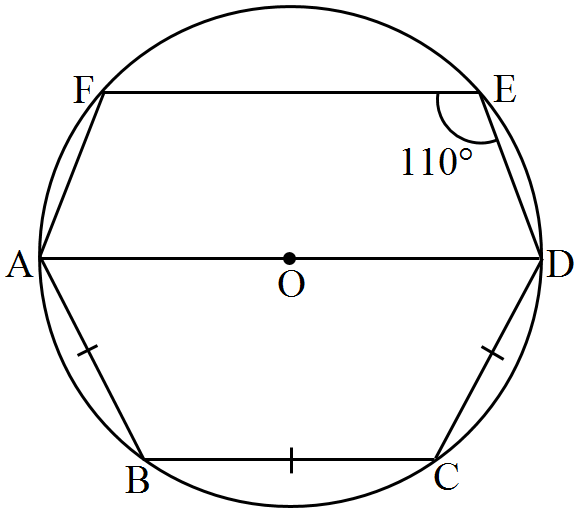
In the given figure, $AD$ is a diameter of the circle with centre $O.$ Chords $AB, BC$ and $CD$ are equal. If $\angle\text{DEF}=110^\circ,$ then $\angle\text{FAB}$ is equal to:
  • $130^\circ$
  • B
    $110^\circ$
  • C
    $140^\circ$
  • D
    $120^\circ$
Answer
Correct option: A.
$130^\circ$


Here, given $AB = BC = CD$
Now, equal chords subtend equal angles at centre. So, $\angle\text{AOC}=\angle\text{BOC}=\angle\text{COD}$
Also, they lie in straight line so, $\angle\text{AOC}+\angle\text{BOC}+\angle\text{COD}=180^\circ$
$\angle\text{AOB}=\angle\text{BOC}=\angle\text{COD}=60^\circ$
In $\triangle\text{AOB}$
$\text{AO}=\text{OB},\angle\text{OAB}=\angle\text{OBA}$
Since, $\angle\text{AOB}=60^\circ,\angle\text{OAB}=\angle\text{OBA}=60^\circ$
Now, $\angle\text{DOE}=\angle\text{AOB}=60^\circ$ (vertically opposite angle)
In $\triangle\text{DOE},\text{OD}=\text{OE}$ (radius)
so, $\angle\text{ODE}=\angle\text{OED}$
$\triangle\text{DOE},\angle\text{DOE}+\angle\text{ODE}+\angle\text{OED}=180^\circ$
$2\angle\text{ODE}=\angle\text{OED}=180-60=120^\circ$
$\angle\text{ODE}=\angle\text{OED}=60^\circ$
given was, $\angle\text{DEF}=110^\circ,$ so, $\angle\text{OEF}=110-60=50^\circ$
Now, in $\triangle\text{EOF}\ \text{OE}=\text{OF}$
so, $\angle\text{OEF}=\angle\text{OFE}=50^\circ$
In, $\triangle\text{EOF}\ \angle\text{FOE}=180-(50+50)=80^\circ$
Now, $\angle\text{DOE}+\angle\text{FOE}+\angle\text{AOF}=180^\circ$ (All lie on same straight line)
So, $\angle\text{AOF}=180-(80+60)=40^\circ$
Now, in $\triangle\text{AOF}\ \text{AO}=\text{FO}$
SO, $\angle\text{OFA}=\angle\text{OAF}$
In $\triangle\text{AOF},2\angle\text{OAF}+\angle\text{FOA}=180^\circ$
$2\angle\text{OAF}+\angle\text{FOA}=180^\circ$
$\angle\text{OAF}=90-20=70^\circ$
So, $\angle\text{FAB}=\angle\text{FAO}+\angle\text{OAB}$
$=70^\circ+60^\circ=130^\circ$
View full question & answer
MCQ 1031 Mark
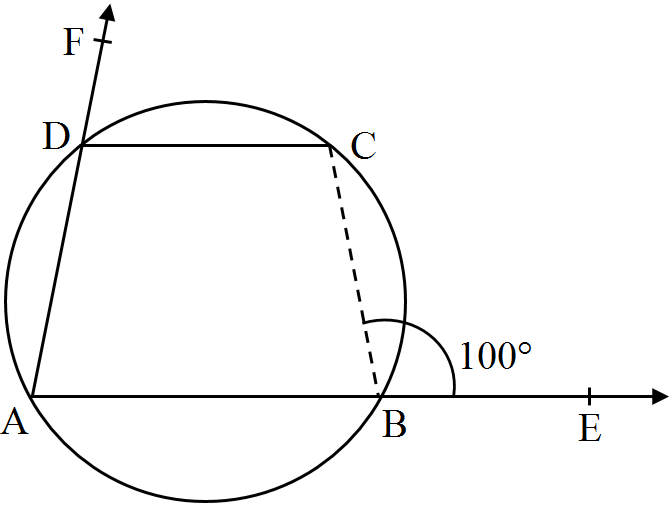
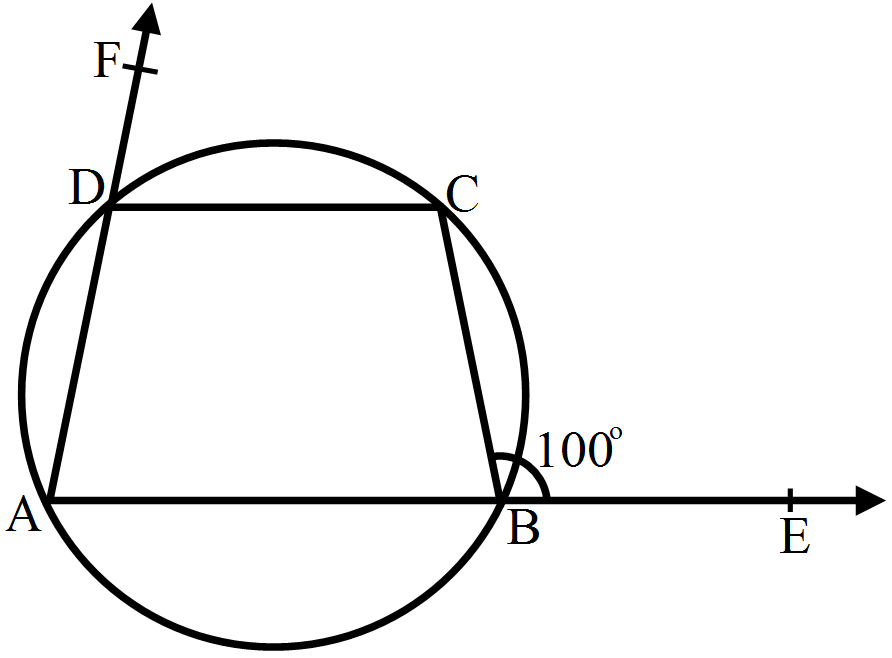
In the given figure, sides $AB$ and $AD$ of quad. $ABCD$ are produced to $E$ and $F$ respectively. If $\angle\text{CBE}=100^\circ,$ then $\angle\text{CDE}=?$
  • A
    $130^\circ$
  • B
    $100^\circ$
  • $80^\circ$
  • D
    $90^\circ$
Answer
Correct option: C.
$80^\circ$
In a cyclic quadrilateral $ABCD,$ we have:
Interior opposite angle, $\angle\text{ADC}=\text{exterior }\angle\text{CBE}=100^\circ$
$\therefore\angle\text{CDF}=(180^\circ-\angle\text{ADC})=(180^\circ-100^\circ)=80^\circ$ (Linear pair)
$\Rightarrow\angle\text{CDF}=80^\circ$
View full question & answer
MCQ 1041 Mark
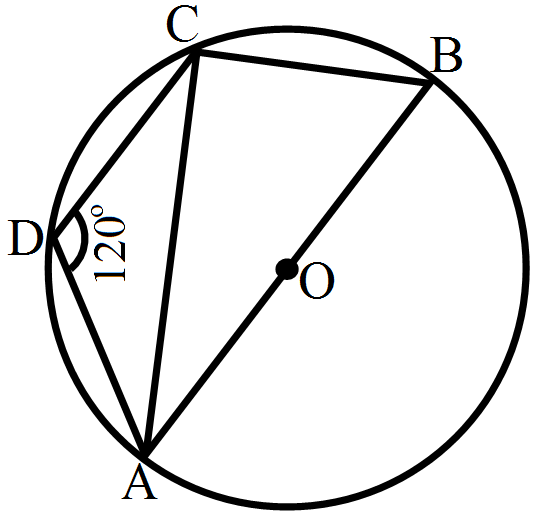
In the given figure, $AOB$ is a diameter and $ABCD$ is a cyclic quadrilateral. If $\angle\text{ADC}=120^\circ$ then $\angle\text{BAC}=?$
  • A
    $60^\circ$
  • $30^\circ$
  • C
    $20^\circ$
  • D
    $45^\circ$
Answer
Correct option: B.
$30^\circ$

We know that the opposite angles of a quadrilateral are supplementary.
$\angle\text{ADC}+\angle\text{ABC}=180^\circ$
$\Rightarrow\ 120^\circ+\angle\text{ABC}=180^\circ$
$\Rightarrow\ \angle\text{ABC}=60^\circ$
Since BOC is a diameter $\angle\text{ACB}=90^\circ.$
In $\triangle\text{CAB},$
$\angle\text{ABC}+\angle\text{BAC}+\angle\text{ACB}=180^\circ$ [Angle sum property]
$\Rightarrow\ 60^\circ+\angle\text{BAC}+90^\circ=180^\circ$
$\Rightarrow\ \angle\text{BAC}=30^\circ$

View full question & answer
MCQ 1051 Mark
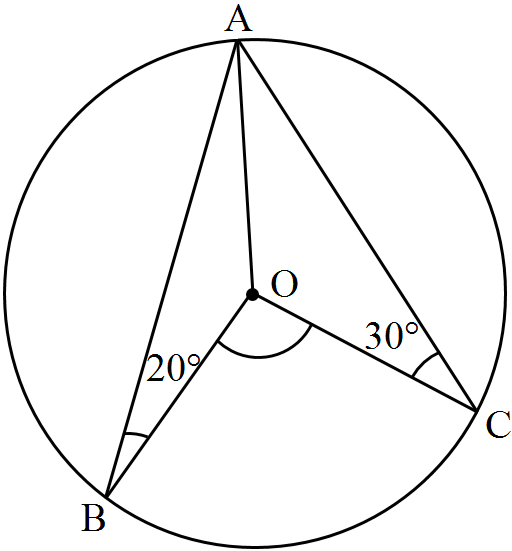
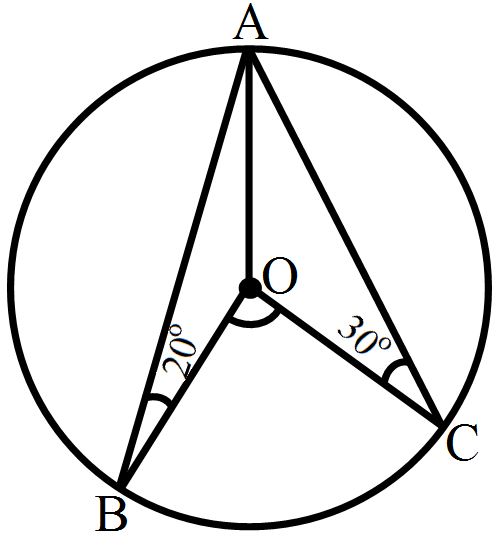
In the given figure, $O$ is the centre of a circle in which $\angle\text{OBA}=20^\circ$ and $\angle\text{OCA}=30^\circ.$ Then, $\angle\text{BOC}=?$
  • A
    $130^\circ$
  • B
    $90^\circ$
  • C
    $50^\circ$
  • $100^\circ$
Answer
Correct option: D.
$100^\circ$

In $\triangle\text{OAB},$ we have:
$OA = OB ($Radii of a circle$)$
$\Rightarrow\angle\text{OAB}=\angle\text{OBA}=20^\circ$
In $\triangle\text{OAC},$ we have:
$OA = OC ($Radii of a circle$)$
$\Rightarrow\angle\text{OAC}=\angle\text{OCA}=30^\circ$
Now, $\angle\text{BAC}=(20^\circ+30^\circ)=50^\circ$
$\therefore\angle\text{BOC}=(2\times\angle\text{BAC})=(2\times50^\circ)=100^\circ$
$\Rightarrow\angle\text{BOC}=100^\circ$

View full question & answer
MCQ 1061 Mark
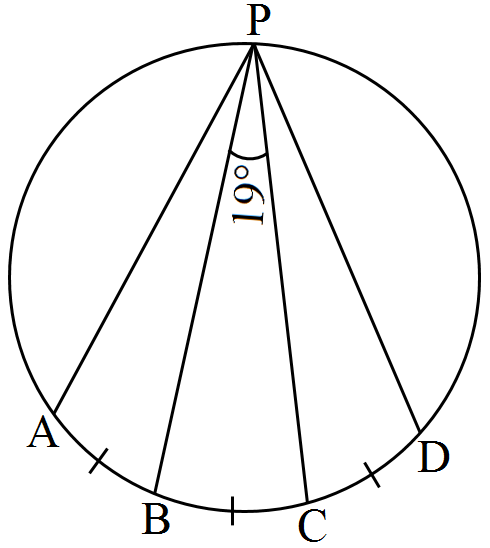
In the given figure, $\angle\text{BPC}=19^\circ,$ arc $AB = arc\ BC = arc\ CD,$ Then, the measure of $\angle\text{APD}$ is:
  • A
    $38^\circ$
  • B
    $76^\circ $
  • $57^\circ$
  • D
    $59^\circ$
Answer
Correct option: C.
$57^\circ$

Equal arcs subtend equal angles at the centre and the angle subtended by them at the circumference would be double the angle subtended by them at the centre. As the angle subtended at centre were same so the angle subtended at the circumference would also become same. Thus each arc would make an angle of $19^\circ .$ Thus the total length of all the three angles would be thrice $19^\circ$ that is $57^\circ .$

View full question & answer
MCQ 1071 Mark
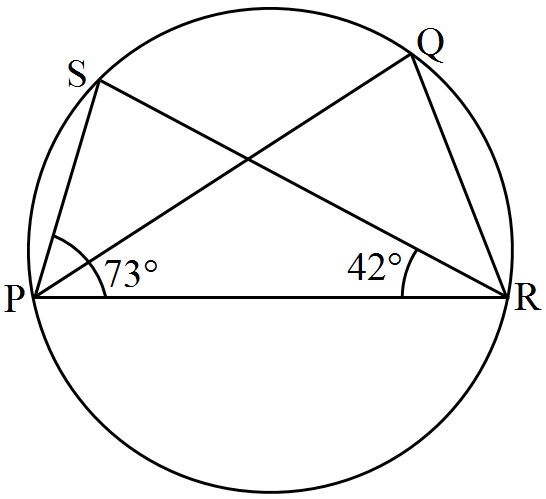
In the figure, if $\angle\text{SPR}=73^\circ,\angle\text{SRP}=42^\circ$ then $\angle\text{PQR}$ is equal to:
  • A
    $74^\circ$
  • B
    $76^\circ$
  • $65^\circ$
  • D
    $70^\circ $
Answer
Correct option: C.
$65^\circ$
$\angle\text{PQR}=\angle\text{PSR}=180^\circ-73^\circ-42^\circ=65^\circ$
View full question & answer
MCQ 1081 Mark
If $P$ and $Q$ are any two Points on a circle then $PQ$ is called a:
  • A
    Radius
  • B
    Diameter
  • C
    Secant
  • Chord
Answer
Correct option: D.
Chord

A chord is a line formed by any two points on a circle.

View full question & answer
MCQ 1091 Mark
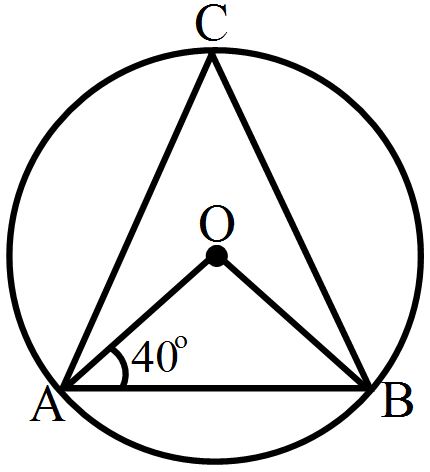
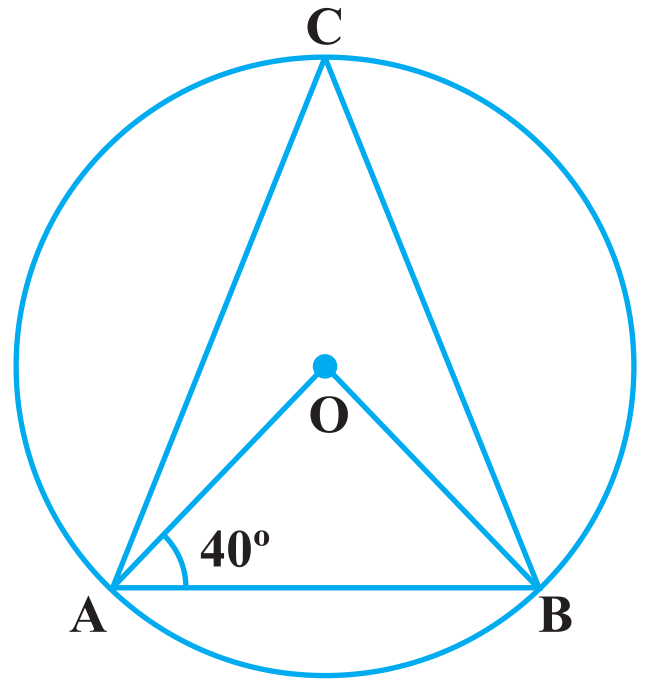
In the given figure, $O$ is the centre of a circle. If $\angle\text{OAB}=40^\circ$ and $C$ is a point on the circle, then $\angle\text{ACB}=?$
  • A
    $40^\circ$
  • $50^\circ$
  • C
    $80^\circ$
  • D
    $100^\circ $
Answer
Correct option: B.
$50^\circ$
In $\triangle\text{OAB},$
$\text{OA}=\text{OB}$ [Radii of the same circle]
$\Rightarrow\ \angle\text{OAB}=\angle\text{OBA}$ [Angle opposite equal sides are equal]
$\angle\text{OAB}+\angle\text{OBA}+\angle\text{AOB}=180^\circ$ [Angle sum property]
$\Rightarrow\ 40^\circ+40^\circ+\angle\text{AOB}=180^\circ$
$\Rightarrow\ \angle\text{AOB}=100^\circ$
We know that, the angle subtended by an arc of a circle at the centre is double the angle subtended by it at any point on the remaining part of the circle.
So, $\angle\text{ACB}=\frac{1}{2}\angle\text{AOB}$
$=\frac{1}{2}(100^\circ)$
$=50^\circ$
View full question & answer
MCQ 1101 Mark
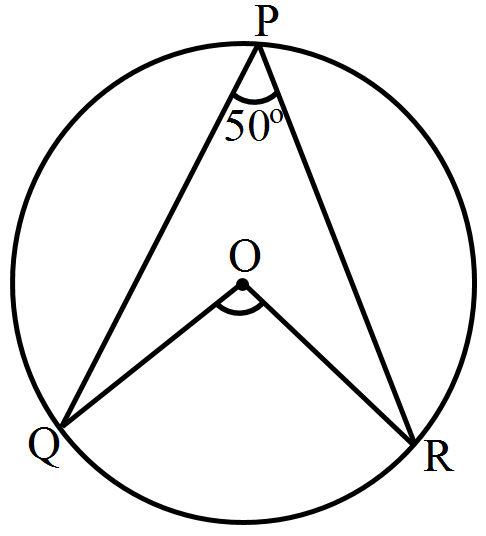
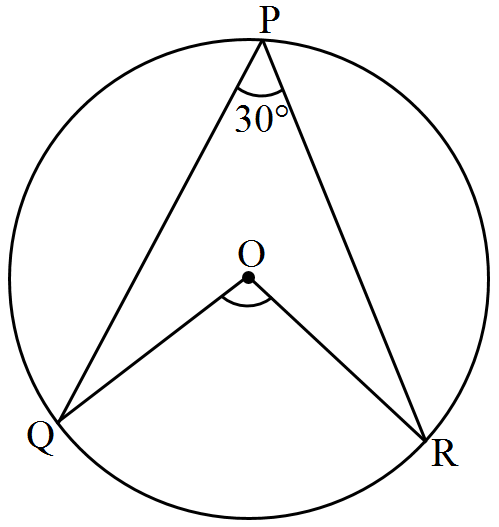
In the given figure, $O$ is the centre of the circle. If $\angle\text{QPR}$ is $50^\circ ,$ then $\angle\text{QOR}$ is:
  • $100^\circ$
  • B
    $130^\circ$
  • C
    $40^\circ$
  • D
    $50^\circ$
Answer
Correct option: A.
$100^\circ$

Angle made by a chord at the centre is twice the angle made by it on any point on the circumference. Therefore,
$\angle\text{QOR}=2\angle\text{QPR}=50^\circ\times2=100^\circ$

View full question & answer
MCQ 1111 Mark
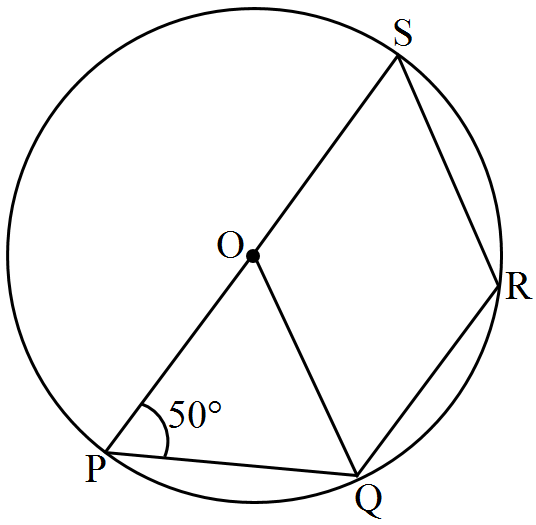
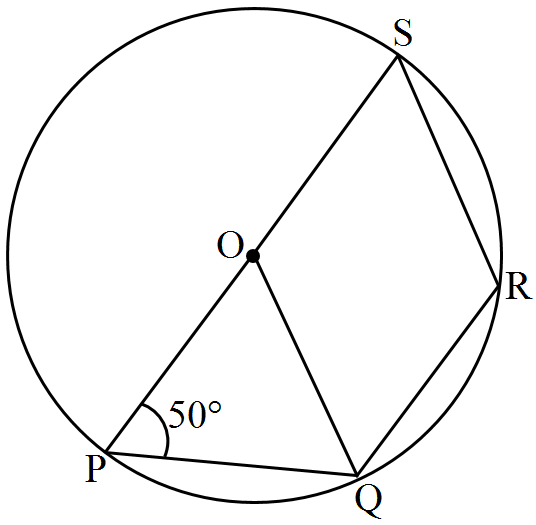
In the given figure, $O$ is the centre of the circle and $\angle\text{SPQ}=50^\circ.$ Then, the measure of $\angle\text{SRQ}$ is:
  • $130^\circ$
  • B
    $100^\circ$
  • C
    $110^\circ$
  • D
    $120^\circ$
Answer
Correct option: A.
$130^\circ$


$\angle\text{OQP}=\text{OPQ}=50^\circ$
$\angle\text{POQ}=80^\circ$ (From angle sum property)
$\angle\text{SOQ}=180^\circ-80^\circ=100^\circ$ (From linear pair)
Completing the cyclic quadrilateral, $QRSL, (L$ being any point on the circumference$)$
$\angle\text{SLQ}=50^\circ$
From cyclic quadrilateral, we have
$\angle\text{SRQ}=180^\circ-50^\circ=130^\circ$
View full question & answer
MCQ 1121 Mark
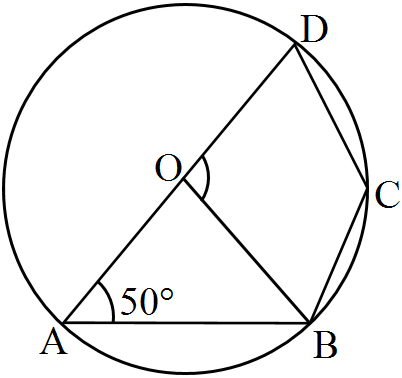
In the given figure, $O$ is the centre of a circle and $\angle\text{OAB}=50^\circ.$ Then, $\angle\text{BOD}=?$
  • A
    $80^\circ$
  • $100^\circ $
  • C
    $130^\circ$
  • D
    $50^\circ$
Answer
Correct option: B.
$100^\circ $

$OA = OB ($Radii of a circle$)$
$\Rightarrow\angle\text{OBA}=\angle\text{OAB}=50^\circ$
In $\triangle\text{OAB},$ we have:
$\angle\text{OAB}+\angle\text{OBA}+\angle\text{AOB}=180^\circ( $Angle sum property of a triangle$)$
$\Rightarrow50^\circ+50^\circ+\angle\text{AOB}=180^\circ$
$\Rightarrow\angle\text{AOB}=(180^\circ-100^\circ)=80^\circ$
Since $\angle\text{AOB}+\angle\text{BOD}=180^\circ$ (Linear pair)
$\therefore\angle\text{BOD}=(180^\circ-80^\circ)=100^\circ$
$\Rightarrow\angle\text{BOD}=100^\circ$

View full question & answer
MCQ 1131 Mark
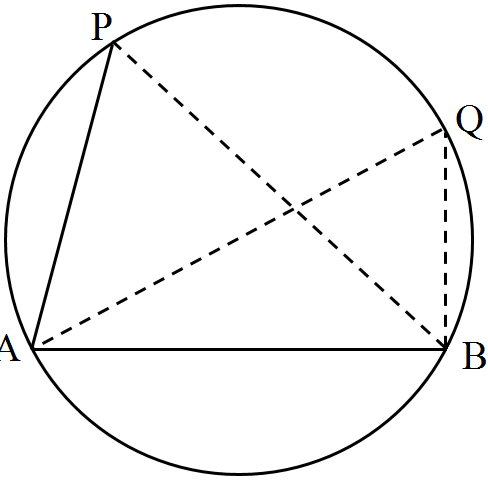
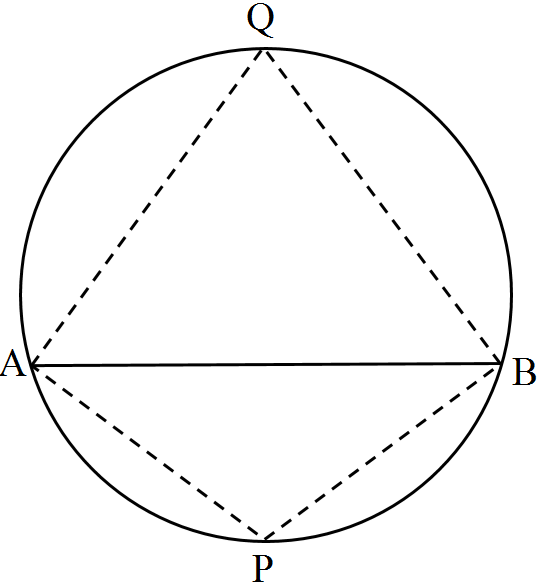
If $AB$ is a chord of a circle, $P$ and $Q$ are the two points on the circle different from $A$ and $B,$ then:
  • A
    $\angle\text{APB}+\angle\text{AQB}=90^\circ$
  • $\angle\text{APB}+\angle\text{AQB}=180^\circ$ or $\angle\text{APB}+\angle\text{AQB}$
  • C
    $\angle\text{APB}+\angle\text{AQB}=180^\circ$
  • D
    $\angle\text{APB}=\angle\text{AQB}$
Answer
Correct option: B.
$\angle\text{APB}+\angle\text{AQB}=180^\circ$ or $\angle\text{APB}+\angle\text{AQB}$
We are given $AB$ is a chord of the circle; $P$ and $Q$ are two points on the circle different from $A$ and $B.$
We have the following figure.
Case $1:$ Consider $P$ and $Q$ are on the same side of $AB.$

We know that angles in the same segment are equal.
Hence, $\angle\text{APB}=\angle\text{AQB}$
Case $2:$ Now consider $P$ and $Q$ are on the opposite sides of $AB.$
In this case, we have the following figure.

Since quadrilateral $APBQ$ is a cyclic quadrilateral.
Therefore,
$\angle\text{APB}+\angle\text{AQB}=180^\circ ($Sum of the pair of opposite angles of a cyclic quadrilateral is $180^\circ )$
Therefore,from case $1$ and case $2,$ $\angle\text{APB}=\angle\text{AQB}$ or $\angle\text{APB}+\angle\text{AQB}=180^\circ$
View full question & answer
MCQ 1141 Mark
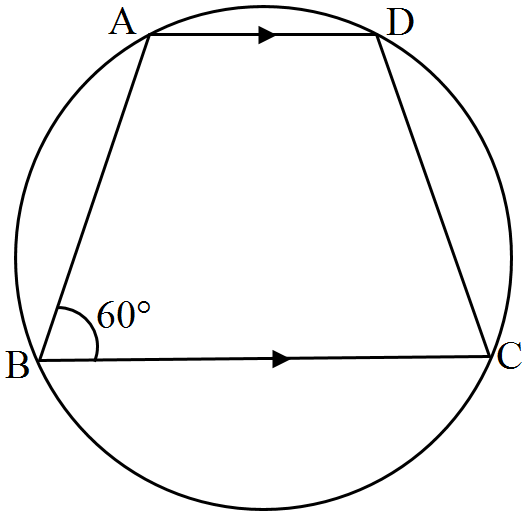
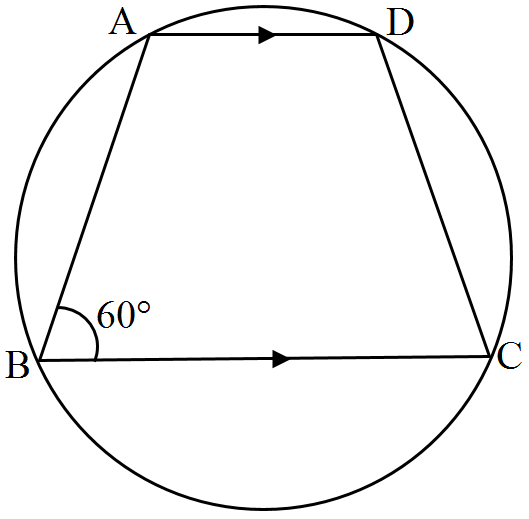
If $ABCD$ is a cyclic trapezium in which $\text{AD}||\ ||\text{BC}$ and $\angle\text{B}=60^\circ,$ then $\angle\text{BCD}$ is equal to:
  • A
    $100^\circ $
  • $60^\circ$
  • C
    $90^\circ$
  • D
    $80^\circ$
Answer
Correct option: B.
$60^\circ$


Since $ABCD$ is a cyclic quadrilateral
$\angle\text{B}+\angle\text{D}=180^\circ$
$60^\circ+\angle\text{D}=180^\circ$
$\angle\text{D}=120^\circ$
Now since $AD$ is parallel to $BC$
$\angle\text{C}+\angle\text{D}=180^\circ$
$\angle\text{C}+120^\circ=180^\circ$
$\angle\text{C}=60^\circ$

View full question & answer
MCQ 1151 Mark
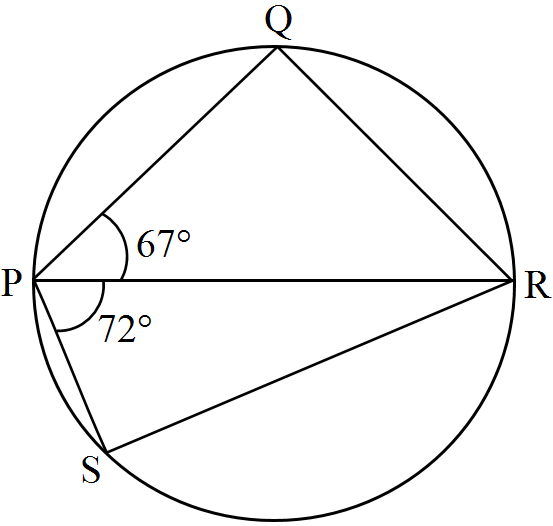
$PQRS$ is a cyclic quadrilateral such that $PR$ is a diameter of the circle. If $67^\circ $ and $\angle\text{SPR}=72^\circ,$ then $\angle\text{QRS}=$
  • $41^\circ $
  • B
    $23^\circ$
  • C
    $67^\circ$
  • D
    $18^\circ$
Answer
Correct option: A.
$41^\circ $

Here we have a cyclic quadrilateral $PQRS$ with $PR$ being a diameter of the circle. Let the centre of this circle be $O.$
We are given that $\angle\text{QPR}$ and $\angle\text{SPR}=72^\circ.$

So, we see that,
$\angle\text{QPS}=\angle\text{QPR}+\angle\text{RPS}$
$=67^\circ+72^\circ$
$=139^\circ$
In a cyclic quadrilateral, it is known that the opposite angles as supplementary.
$\angle\text{QPS}+\angle\text{QRS}=180^\circ$
$\angle\text{QRS}=180^\circ-\angle\text{QPS}$
$\angle\text{QRS}=180^\circ-139^\circ=41^\circ$
$\angle\text{QRS}=41^\circ$

View full question & answer
MCQ 1161 Mark
Greatest chord of a circle is called its:
  • A
    Chord
  • Diameter
  • C
    Secant
  • D
    Radius
Answer
Correct option: B.
Diameter
Since diameter is the longest segment that can be drawn in a circle$($touching the circle at both ends$),$ therefore it is the longest possible chord also.
View full question & answer
MCQ 1171 Mark
Write the correct answer in the following: In Fig. if $\angle\text{OAB}=40^\circ,$ then $\angle\text{ACB}$ is equal to:
  • $50^\circ .$
  • B
    $40^\circ .$
  • C
    $60^\circ .$
  • D
    $70^\circ .$
Answer
Correct option: A.
$50^\circ .$

In $\triangle\text{QAB, OA} = \text{OB}$ [both are the radius of a circle]
$\angle\text{OAB} = \angle\text{OBA}\Rightarrow \angle\text{OBA} = 40^\circ$
[angles opposite to equal sides are equal]
Also, $\angle\text{AOB} = \angle\text{OBA}\Rightarrow \angle\text{BAO} = 180^\circ$
[by angle sum property of a triangle]
$\angle\text{AOB} + 40^\circ + 40^\circ = 180^\circ$
$\Rightarrow\ \angle\text{AOB} = 180^\circ – 80^\circ = 100^\circ$
We know that, in a circle, the angle subtended by an arc at the centre is twice the angle subtended by it at the remaining part of the circle.
$\angle\text{AOB} = 2 \angle\text{ACB} \Rightarrow 100^\circ =2 \angle\text{ACB}$
$\angle\text{ACB} = \frac{100}{2} = 50^\circ$

View full question & answer
MCQ 1181 Mark
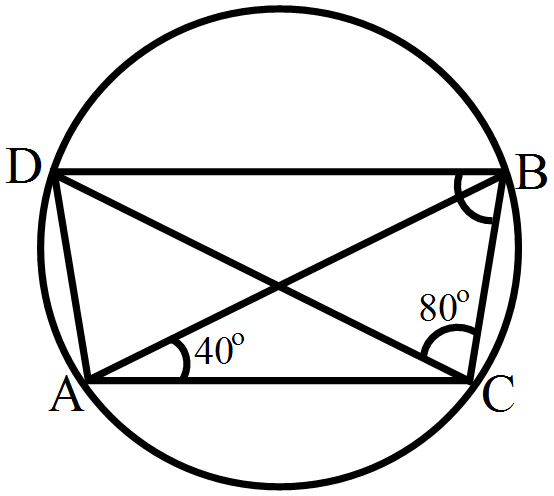
In the give figure, $AB$ and $CD$ are two intersecting chords of a circle. If $\angle\text{CAB}=40^\circ$ and $\angle\text{BCD}=80^\circ$then $\angle\text{CBD}=?$
  • A
    $80^\circ$
  • $60^\circ$
  • C
    $50^\circ$
  • D
    $70^\circ$
Answer
Correct option: B.
$60^\circ$
Since angles in the same segment are equal,
$\angle\text{BDC}=\angle\text{BAC}=40^\circ$
In $\triangle\text{BDC},$
$\angle\text{BDC}+\angle\text{BCD}+\angle\text{CBD}=180^\circ$ [Angle sum property]
$\Rightarrow\ 40^\circ+80^\circ+\angle\text{CBD}=180^\circ$
$\Rightarrow\ \angle\text{CBD}=60^\circ$
 
View full question & answer
MCQ 1191 Mark
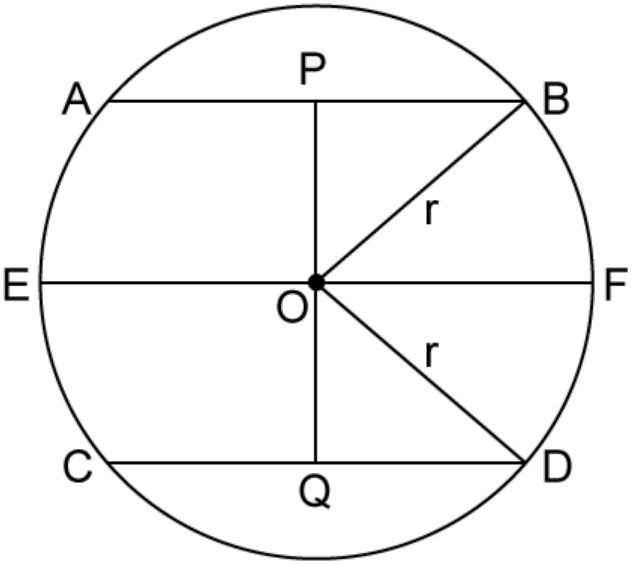
In a circle of radius $17\ cm,$ two parallel chords are drawn on opposite side of a diameter. The distance between the chords is $23\ cm.$ If the length of one chord is $16\ cm,$ then the length of the other is:
  • A
    $34\ cm.$
  • B
    $15\ cm.$
  • C
    $23\ cm.$
  • $30\ cm.$
Answer
Correct option: D.
$30\ cm.$

$P Q=23 \mathrm{~cm}$
$A B=16 \mathrm{~cm}$
$\Rightarrow B P=A P=8 \mathrm{~cm}$
$r=17 \mathrm{~cm}$
$\Rightarrow E F=\text { diameter }=2 \mathrm{r}=34 \mathrm{~cm}$
Consider $\triangle \mathrm{OPB}$,
$\mathrm{r}^2=O P^2+B P^2$
$\Rightarrow O P^2=(17)^2-(8)^2=289-64=225$
$\Rightarrow O P=15 \mathrm{~cm}$
$\Rightarrow O Q=23-15=8 \mathrm{~cm}$
Consider $\triangle \mathrm{OQD}$,
$r^2=O Q^2+Q D^2$
$\Rightarrow Q D^2=r^2-O Q^2=(17)^2-(8)^2=225$
$\Rightarrow O D=15 \mathrm{~cm}$
$\Rightarrow C D=2 \times Q D=30 \mathrm{~cm}$
View full question & answer
MCQ 1201 Mark
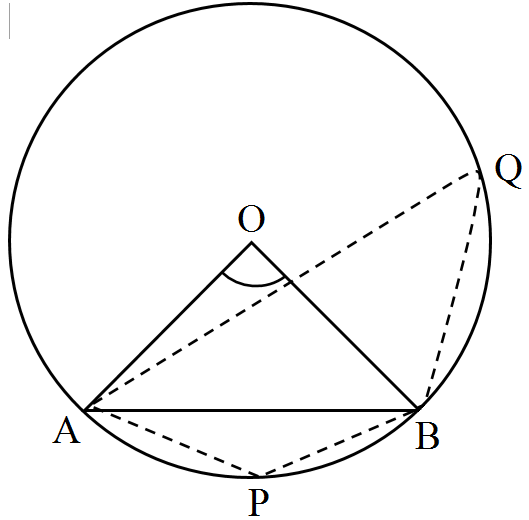
The chord of a circle is equal to its radius. The angle subtended by this chord at the minor arc of the circle, is:
  • A
    $60^\circ$
  • B
    $75^\circ$
  • C
    $120^\circ$
  • $150^\circ$
Answer
Correct option: D.
$150^\circ$

We are given that the chord is equal to its radius.
We have to find the angle subtended by this chord at the minor arc.
We have the corresponding figure as follows:

We are given that
$AO = OB = AB$
So,
$\triangle\text{AOB}$ is an equilateral triangle.
Therefore, we have
$\angle\text{AOB}=60^\circ$
Since the angle subtended by any chord at the centre is twice the angle subtended at any point on the circle.
So, $\angle\text{AQB}=\frac{\angle\text{AOB}}{2}=\frac{60}{2}=30^\circ$
$\Rightarrow\angle\text{AQB}=30^\circ$
Take a point $P$ on the minor arc
Since $APBQ$ is a cyclic quadrilateral
So, opposite angles are supplementary. That is
$\angle\text{APB}+\angle\text{AQB}=180^\circ$
$\angle\text{APB}+130^\circ=180^\circ\ [\angle\text{AQB}=30^\circ]$
$\angle\text{APB}=180^\circ-30^\circ=150^\circ$

View full question & answer
MCQ 1211 Mark
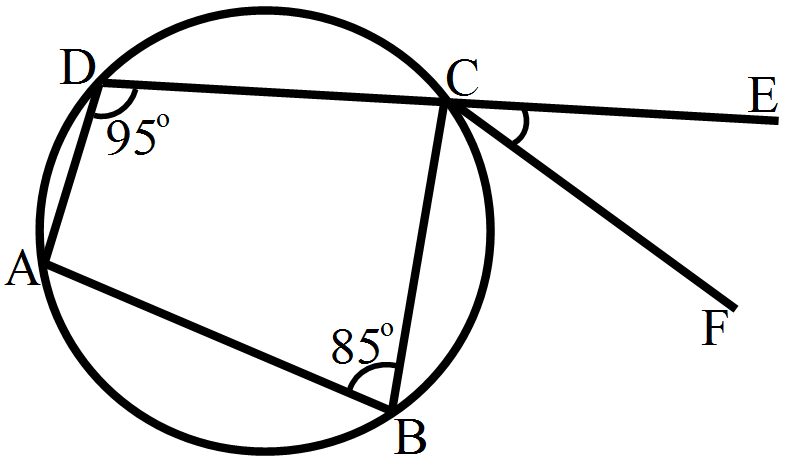
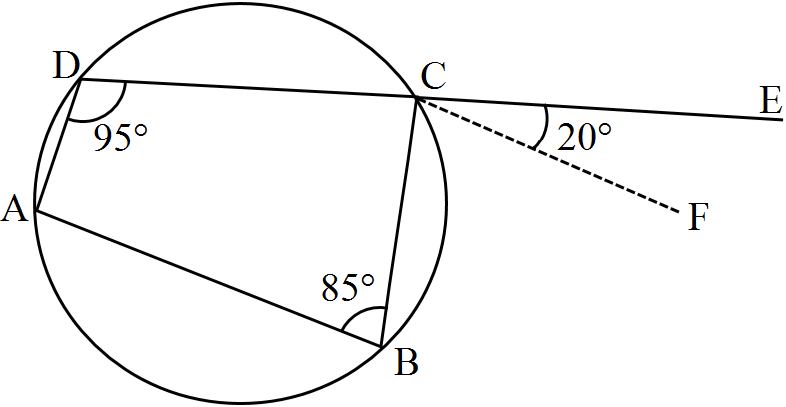
In the given figure, $ABCD$ is a cyclic quadrilateral in which $DC$ is produced to $E$ and $CF$ is drawn parallel to $AB$ such that $\angle\text{ADC}=95^\circ$ and $\angle\text{ECF}=20^\circ.$ Then, $\angle\text{EAD}=?$
  • A
    $95^\circ$
  • B
    $85^\circ$
  • $105^\circ$
  • D
    $75^\circ$
Answer
Correct option: C.
$105^\circ$
Since $ CF || AB, \angle\text{ABC}=\angle\text{BCF}=85^\circ$
$\angle\text{BAD}=\angle\text{BCE}$
$\Rightarrow\ \angle\text{BAD}=\angle\text{BCF}+\angle\text{ECF}$
$\Rightarrow\ \angle\text{BAD}=105^\circ$
View full question & answer
MCQ 1221 Mark
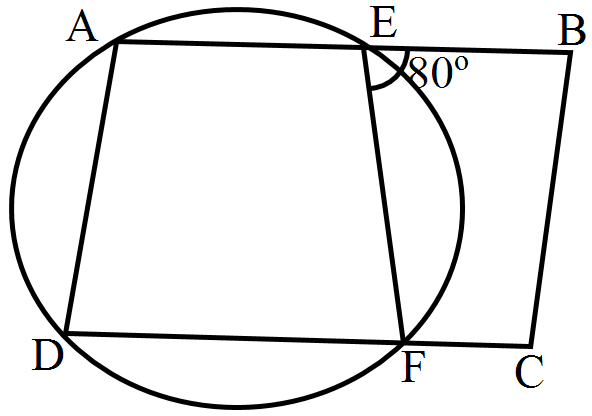
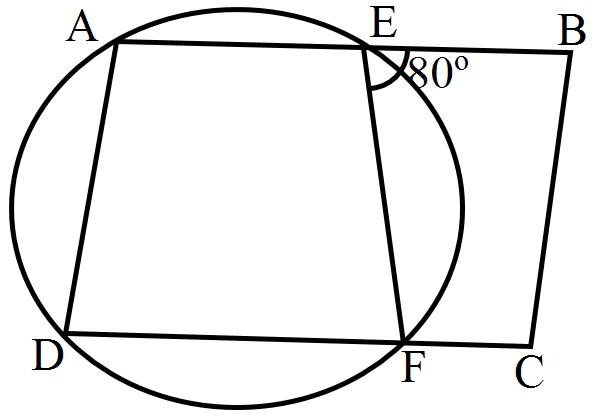
$ABCD$ is a parallelogram. $A$ circle passes through $A$ and $D$ and cuts $AB$ at $E$ and $DC$ at $F.$ If $\angle\text{BEF}=80^\circ,$ then $\angle\text{ABC}$ is equal to:
  • $80^\circ$
  • B
    $75^\circ$
  • C
    $120^\circ$
  • D
    $100^\circ$
Answer
Correct option: A.
$80^\circ$

$\angle\text{AEF}+80^\circ=180^\circ$
$\angle\text{AEF}=100^\circ$
$\angle\text{ADF}+\angle\text{AEF}=180^\circ$ (Opposite angles of a cyclic quadrilateral)
$\angle\text{ADF}=180^\circ-100^\circ=80^\circ$
$\angle\text{ADF}=\angle\text{ABC}=80^\circ$ (opposite angles of a parallelogram)
View full question & answer
MCQ 1231 Mark
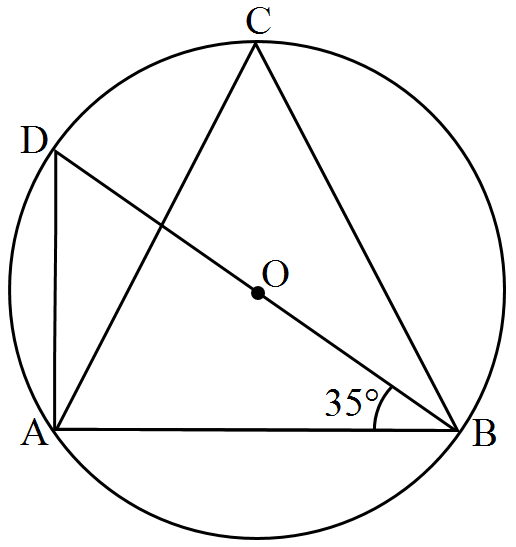
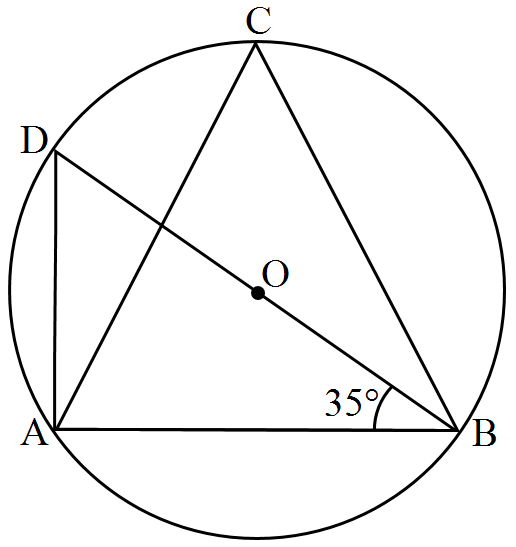
In the given figure, $O$ is the centre of the circle. If $\angle\text{DBA}=35^\circ,$ then the measure of $\angle\text{ACB}$ is equal to:
  • A
    $60^\circ$
  • $55^\circ$
  • C
    $65^\circ$
  • D
    $45^\circ$
Answer
Correct option: B.
$55^\circ$

Join $OA.$
Now, in triangle $AOB,$ from angle sum property we can find that $\angle\text{AOB}=110^\circ$
Now, $2\angle\text{ACB}=\angle\text{AOB}=\frac{110^\circ}{2}=55^\circ$
View full question & answer
MCQ 1241 Mark
If a chord of a circle is equal to its radius, then the angle subtended by this chord in major segment is:
  • $30^\circ$
  • B
    $90^\circ$
  • C
    $45^\circ$
  • D
    $60^\circ$
Answer
Correct option: A.
$30^\circ$

Since the chord is equal to the radius therefore, it will form an equilateral triangle inside the circlewith the third vertex being the centre of the circle.
So the chord will make an angle of $60^\circ $ at the centre. As the angle made by the chord at any other point of the circumfrence would be half.
So, we have that angle made at the major segment would be $30^\circ .$

View full question & answer
MCQ 1251 Mark
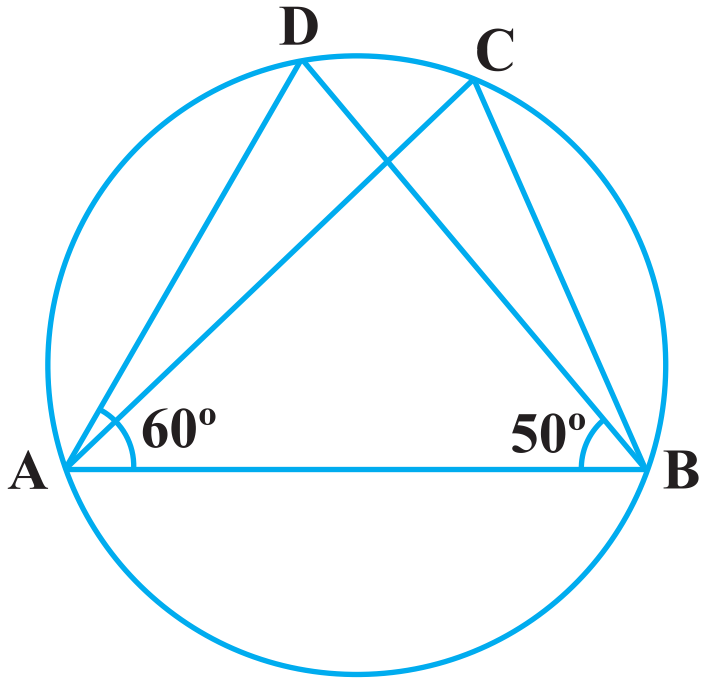
Write the correct answer in the following: In Fig. if $\angle\text{DAB} = 60^\circ, \angle\text{ABD} = 50^\circ,$ then $\angle\text{ACB}$ is equal to:
  • A
    $60^\circ .$
  • B
    $50^\circ .$
  • $70^\circ .$
  • D
    $80^\circ .$
Answer
Correct option: C.
$70^\circ .$
In $\triangle\text{ADB},$ we have
$\angle\text{A}+\angle\text{B}+\angle\text{D}=180^\circ$ [Angle sum property of a triangle]
$\Rightarrow60^\circ+50^\circ+\angle\text{D}=180^\circ$
$\Rightarrow\angle\text{D}=180^\circ-110^\circ=70^\circ$
i.e., $\angle\text{ABD}=70^\circ$
Now, $\angle\text{ACB}=\angle\text{ADB}=70^\circ$
[$\because$ Angles in the same segment of a circle are equal]
Hence, $(c)$ is the correct answer.
View full question & answer
MCQ 1261 Mark
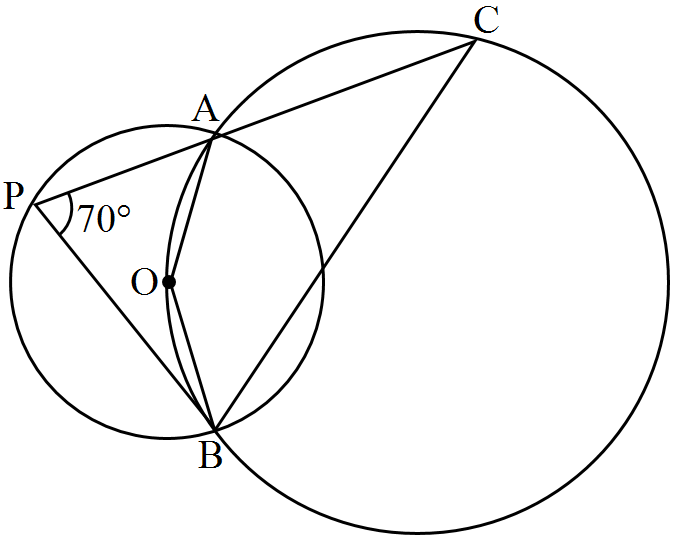
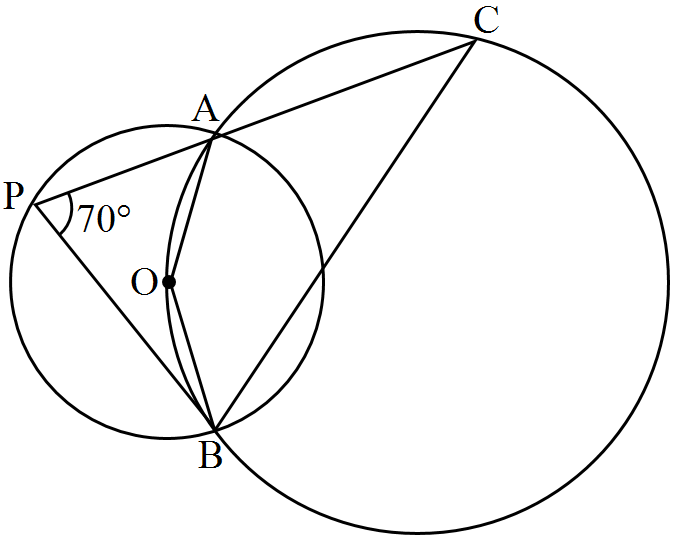
The figure shows two circles which intersect at $A$ and $B.$ The centre of the smaller circle is $O$ and it lies on the circumference of the larger circle. If $\angle\text{APB}=70^\circ,$ then the measure of $\angle\text{ACB}$ is:
  • $40^\circ$
  • B
    $50^\circ$
  • C
    $60^\circ$
  • D
    $70^\circ$
Answer
Correct option: A.
$40^\circ$

Since, $AB$ is a chord and makes $\angle\text{APB}=70^\circ$ at the circumference,
so $\angle\text{AOB}=140^\circ$
Now, as $AOBC$ is a cyclic quadrilateral then, sum of opposite angles must be $180^\circ $
$\angle\text{AOB}+\angle\text{ACB}=180^\circ$
$\Rightarrow140^\circ+\angle\text{ACB}=180^\circ$
$\Rightarrow\angle\text{ACB}=40^\circ$
View full question & answer
MCQ 1271 Mark
In the given figure, sides $AB$ and $AD$ of quad. $ABCD$ are produced to $E$ and $F$ respectively. If $\angle\text{CBE}=100^\circ$ then $\angle\text{CDF}=?$
  • A
    $100^\circ$
  • $80^\circ$
  • C
    $130^\circ$
  • D
    $90^\circ$
Answer
Correct option: B.
$80^\circ$
Since $ABCD$ is a cyclic equilateral,
$\angle\text{CBE}=\angle\text{ADC}=100^\circ$
Since $ADF$ is a straight line,
$\angle\text{CDF}+\angle\text{ADC}=180^\circ$
$\Rightarrow\ \angle\text{CDF}+100^\circ=180^\circ$
$\Rightarrow\ \angle\text{CDF}=80^\circ$
View full question & answer
MCQ 1281 Mark
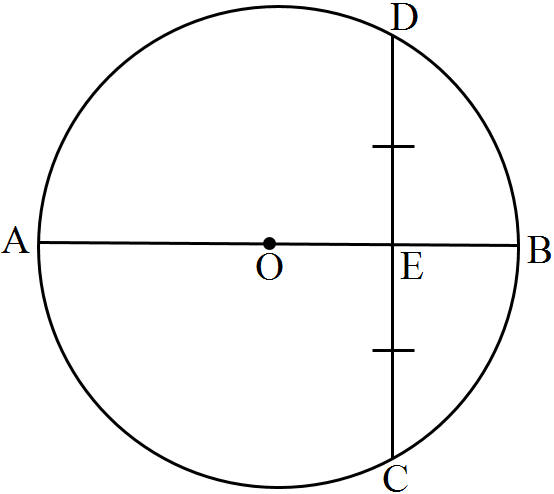
In the given figure, $O$ is the centre of a circle and diameter $AB$ bisects the chord $CD$ at a point $E$ such that $CE = ED = 8\ cm$ and $EB = 4\ cm.$ The radius of the circle is:
  • A
    $8\ cm$
  • $10\ cm$
  • C
    $6\ cm$
  • D
    $12\ cm$
Answer
Correct option: B.
$10\ cm$
Let the radius of the circle be $r\ cm .$
Then, $O D=O B=r \mathrm{~cm}, O E=(r-4) \mathrm{cm}, E D=8 \mathrm{~cm}$.
Now, $\mathrm{OD}^2=\mathrm{OE}^2+\mathrm{ED}^2 \Rightarrow \mathrm{r}^2=(\mathrm{r}-4)^2+8^2$ [using pythagoras theorem]
$\Rightarrow r^2=r^2-8 r+16+64 \Rightarrow 0=-8 r+80$
$\therefore 8 r=80 \Rightarrow r=10\ cm.$
View full question & answer
MCQ 1291 Mark
In the given figure, $O$ is the centre of a circle and $\angle\text{OAB}=50^\circ.$ Then, $\angle\text{BOD}=?$
  • A
    $130^\circ$
  • B
    $50^\circ$
  • $100^\circ$
  • D
    $80^\circ$
Answer
Correct option: C.
$100^\circ$

$OA = OB [$Radii of the same circle$]$
$\Rightarrow\ \angle\text{OAB}=\angle\text{OBA}=50^\circ [$Angle opposite equal sides are equal$]$
$\angle\text{BOD}=\angle\text{OAB}+\angle\text{OBA}$
$\Rightarrow\ \angle\text{BOD}=50^\circ+50^\circ$
$\Rightarrow\ \angle\text{BOD}=100^\circ$

View full question & answer
MCQ 1301 Mark
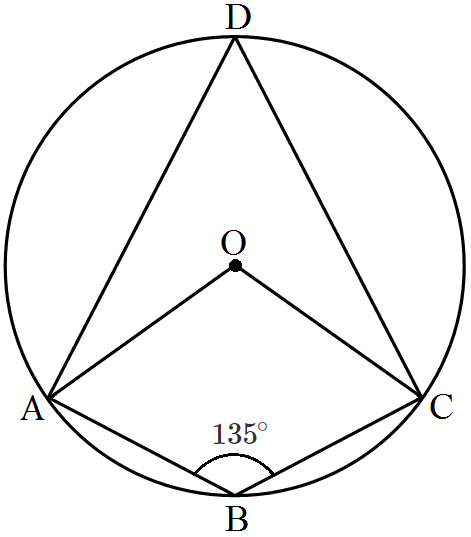
If $ABC$ is an arc of a circle and $\angle\text{ABC} = 135^\circ,$ then the ratio of arc $\widehat{\text{ABC}}$ to the circumference is:
  • $1 : 4$
  • B
    $3 : 4$
  • C
    $3 : 8$
  • D
    $1 : 2$
Answer
Correct option: A.
$1 : 4$


$ABC$ is an arc of circle.
Take point $D$ in the altrenative segment and join $AD$ and $CD.$
$\angle\text{ABC}=135^\circ$ (Given)
$\angle\text{ABC}+\angle\text{ADC}=180^\circ ($Sum of opposite angles of cyclic quadrilateral is $180^\circ )$
$\Rightarrow\angle\text{ADC}=180^\circ-\angle\text{ABC}=180^\circ-135^\circ=45^\circ$
Now, $\angle\text{AOC}=2\times\angle\text{ADC}=2\times45^\circ=90^\circ$
$\widehat{\text{ABC}}=$ measure of the central angle $=\angle\text{AOC}=90^\circ$
$\Rightarrow\text{Required ratio}=\frac{\text{arc}\widehat{\text{ABC}}}{\text{circumference}}$
$=\frac{90^\circ}{360^\circ}=\frac{1}{4}=1:4$

View full question & answer
MCQ 1311 Mark
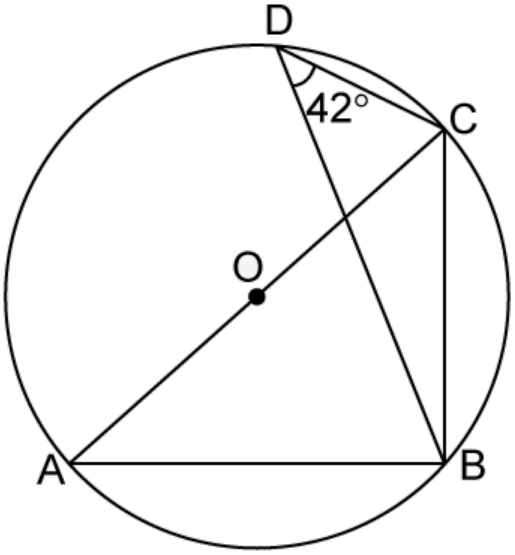
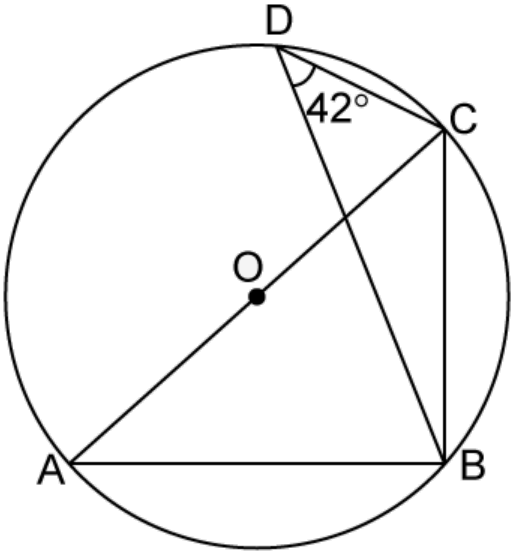
In the given figure, $O$ is the centre of the circle and $\angle\text{BDC} = 42^\circ.$ The measure of $\angle\text{ACB}$ is:
  • A
    $42^\circ$
  • $48^\circ$
  • C
    $58^\circ$
  • D
    $52^\circ$
Answer
Correct option: B.
$48^\circ$

$\angle\text{ABC}=90^\circ ...($Diameter $AC$ makes $90^\circ$ at circumference$)$
$\angle\text{CDB}=\angle\text{CAB}$ ...(Angles on the same arc)
$\Rightarrow\angle\text{CAB}=42^\circ$
In $\triangle\text{ABC},$
$\angle\text{ACB}=180^\circ-90^\circ-42^\circ=48^\circ$
View full question & answer
MCQ 1321 Mark
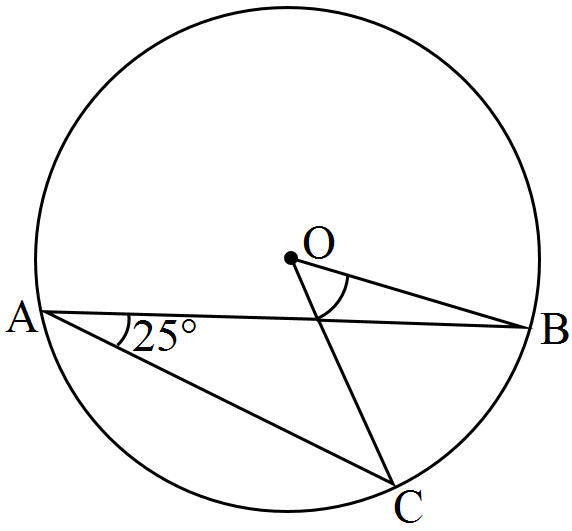
In the given figure, $\angle\text{BAC}=25^\circ,$ then $\angle\text{BOC}$ is equal to:
  • A
    $25^\circ$
  • B
    $60^\circ$
  • $50^\circ$
  • D
    $125^\circ$
Answer
Correct option: C.
$50^\circ$

Angle made at centre by an arc is double the angle made by it on any point on the circumference.
View full question & answer
MCQ 1331 Mark
An equilateral triangle $ABC$ is inscribed in a circle with centre $O.$ The measures of $\angle\text{BOC}$ is:
  • A
    $30^\circ$
  • B
    $60^\circ$
  • C
    $90^\circ$
  • $120^\circ$
Answer
Correct option: D.
$120^\circ$


$\angle\text{BAC}=60^\circ$ (Angle of equilateral triangle)
Arc $\widehat{\text{BC}}$ makes angle $\angle\text{BAC}$ at circle and $\angle\text{BOC}$ at center of circle.
$\Rightarrow\angle\text{BAC}=\frac{1}{2}\angle\text{BOC}$
$\Rightarrow2\times\angle\text{BAC}=\angle\text{BOC}$
$\Rightarrow2\times60^\circ=\angle\text{BOC}$
$\Rightarrow\angle\text{BOC}=120^\circ$

View full question & answer
MCQ 1341 Mark
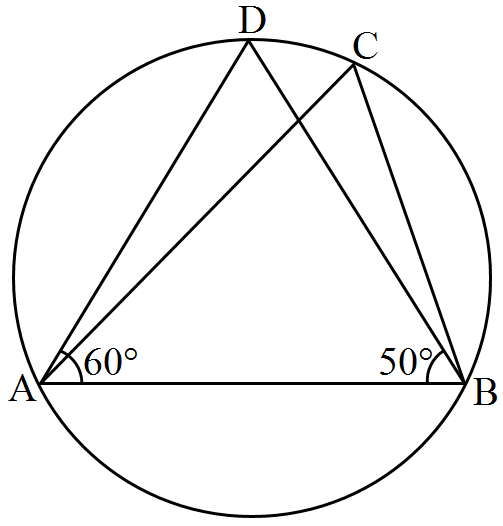
In the figure, if $\angle\text{DAB}=60^\circ,\angle\text{ABD}=50^\circ$ then $\angle\text{ACB}$ is equal to:
  • A
    $60^\circ$
  • B
    $80^\circ$
  • C
    $50^\circ$
  • $70^\circ$
Answer
Correct option: D.
$70^\circ$


In, $\triangle\text{ABD}$
$\angle\text{D}=180^\circ-\angle\text{A}-\angle\text{B}$
$=180^\circ-110^\circ=70^\circ$
Since angles made by same chord at any point of circumference are equal so, $\angle\text{ACB}=\angle\text{ADB}=70^\circ$

View full question & answer
MCQ 1351 Mark
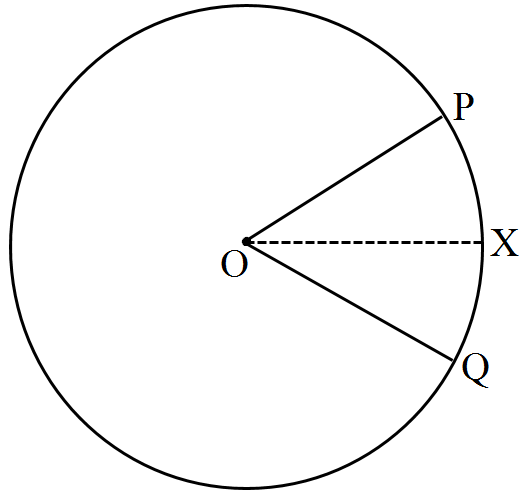
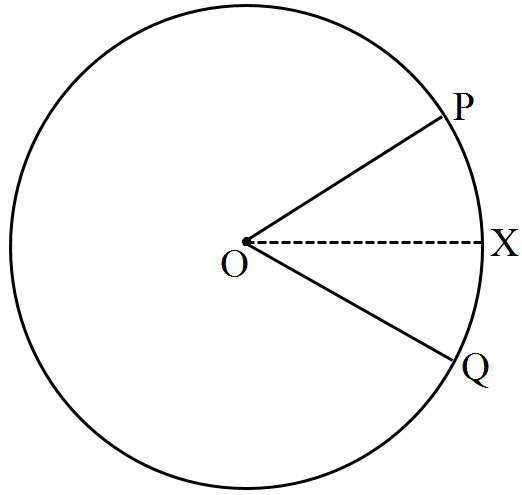
$X$ is a point on a circle with centre $O.$ If $X$ is equidistant from the two radii $OP, OQ,$ then arc $PX : arc\ PQ$ is equal to:
  • It is $1 : 2$
  • B
    It is $2 : 1$
  • C
    It is $2 : 3$
  • D
    It is $1 : 1$
Answer
Correct option: A.
It is $1 : 2$


Since, $PX = XQ$
$2PX = PQ$
$PX : PQ = 1 : 2$

View full question & answer
MCQ 1361 Mark
The angle in a semicircle measures.
  • $90^\circ$
  • B
    $36^\circ$
  • C
    $60^\circ$
  • D
    $45^\circ$
Answer
Correct option: A.
$90^\circ$

The angle in a semicircle measures $90^\circ .$

View full question & answer
MCQ 1371 Mark
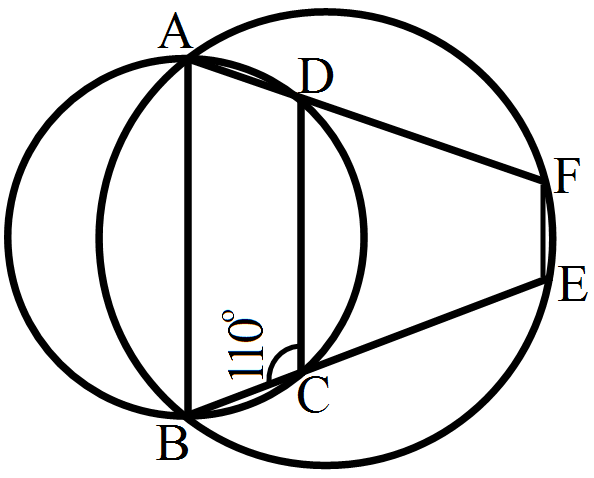
In the given figure, $ABCD$ and $ABEF$ are two cyclic quadrilaterals. If $\angle\text{BCD}=110^\circ$ then $\angle\text{BEF}=?$
  • A
    $55^\circ$
  • B
    $70^\circ$
  • C
    $90^\circ$
  • $110^\circ$
Answer
Correct option: D.
$110^\circ$

Since $ABCD$ is a cyclic qyadrilateral, we have:
$\angle\text{BAD}+\angle\text{BCD}=180^\circ$
$\Rightarrow\ \angle\text{BAD}+110^\circ=180^\circ$
$\Rightarrow\ \angle\text{BAD}=70^\circ$
Since $ABEF$ is a cyclic qyadrilateral, we have:
$\angle\text{BAD}+\angle\text{BEF}=180^\circ$
$\Rightarrow\ 70^\circ+\angle\text{BEF}=180^\circ$
$\Rightarrow\ \angle\text{BEF}=110^\circ$

View full question & answer
MCQ 1381 Mark
If a chord of a circle is equal to its radius, then the angle subtended by this chord in major segment is:
  • A
    $90^\circ$
  • B
    $60^\circ$
  • C
    $45^\circ$
  • $30^\circ$
Answer
Correct option: D.
$30^\circ$

Since the chord is equal to the radius therefore, it will form an equilateral triangle inside the circle with the third vertex being the centre of the circle.
So the chord will make an angle of $60^\circ $ at the centre. As the angle made by the chord at any other point of the circumference would be half.
So, we have that angle made at the major segment would be $30^\circ .$

View full question & answer
MCQ 1391 Mark
One chord of a circle is known to be $10\ cm$. The radius of this circle must be:
  • Greater than $5\ cm.$
  • B
    $5\ cm$
  • C
    Greater than or equal to $5\ cm.$
  • D
    Less than $5\ cm.$
Answer
Correct option: A.
Greater than $5\ cm.$
We are given length of a chord to be $10\ cm$ and we have to give information about the radius of the circle.
Since in any circle, the diameter of the circle is greater than any chord.
So diameter $> 10$
$⇒ 2r > 10$
$⇒ r > 5\ cm$
Radius is greater than $5\ cm.$
View full question & answer
MCQ 1401 Mark
In the given figure, $O$ is the centre of a circle and $\angle\text{AOC}=130^\circ.$ Then, $\angle\text{ABC}=?$
  • A
    $50^\circ$
  • B
    $65^\circ$
  • $115^\circ$
  • D
    $130^\circ$
Answer
Correct option: C.
$115^\circ$
Minor $\angle\text{AOC}=130^\circ$
Major $\angle\text{AOC}=360^\circ-130^\circ$
$⇒$ Major $\angle\text{AOC}=230^\circ$
Since $\angle\text{ABC}=\frac{1}{2}\text{major}\angle\text{AOC}$
$\Rightarrow\ \angle\text{ABC}=\frac{1}{2}(230^\circ)$
$\Rightarrow\ \angle\text{ABC}=115^\circ$
View full question & answer
MCQ 1411 Mark
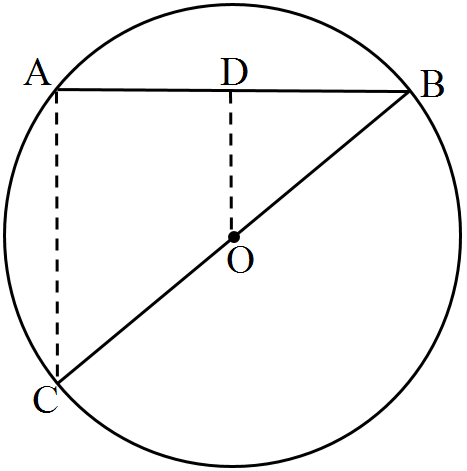
In the given figure, $AB$ is a chord of a circle with centre $O$ and $BOC$ is a diameter. If $OD \perp AB$ such that $OD = 6\ cm,$ then $AC = ?$
  • $12\ cm$
  • B
    $7.5\ cm$
  • C
    $15\ cm$
  • D
    $9\ cm$
Answer
Correct option: A.
$12\ cm$
$OD \perp AB$
i.e., $D$ is the midpoint of $AB.$
Also, $O$ is the midpoint of $BC.$
Now, in $\triangle\text{ BAC}, D$ is the midpoint of $AB$ and $O$ is the midpoint of $BC.$
$\therefore\text{OD}=\frac{1}{2}\text{AC} ($By mid point theorem$)$
$\Rightarrow AC = 2OD = (2 \times 6)\ cm = 12\ cm$
$\Rightarrow AC = 12\ cm$
View full question & answer
MCQ 1421 Mark
In the given figure, $O$ is the centre of a circle in which $\angle\text{OBA}=20^\circ$ and $\angle\text{OCA}=30^\circ.$ Then, $\angle\text{BOC}=?$
  • A
    $50^\circ $
  • B
    $90^\circ $
  • $100^\circ $
  • D
    $130^\circ $
Answer
Correct option: C.
$100^\circ $

In $\triangle\text{OAB},$
$OA = OB [$Radii of the same circle$]$
$\Rightarrow\ \angle\text{OBA}=\angle\text{OAB}=20^\circ[ $Angle opposite equal sides are equal$]$
In $\triangle\text{OAC},$
$OA = OC [$Radii of the same circle$]$
$\Rightarrow\ \angle\text{OCA}=\angle\text{OAC}=30^\circ [$Angle opposite equal sides are equal$]$
Now, $\angle\text{BAC}=\angle\text{BAO}+\angle\text{CAO}$
$=20^\circ+30^\circ$
$=50^\circ$
$\angle\text{BOC}=2\angle\text{BAC}=2(50^\circ)=100^\circ.$

View full question & answer
MCQ 1431 Mark
In the given figure, $O$ is the centre of the circle. If $\angle\text{QPR}$ is 50º then $\angle\text{QOR}$ is:
  • A
    $130^\circ$
  • B
    $40^\circ$
  • $100^\circ$
  • D
    $50^\circ$
Answer
Correct option: C.
$100^\circ$
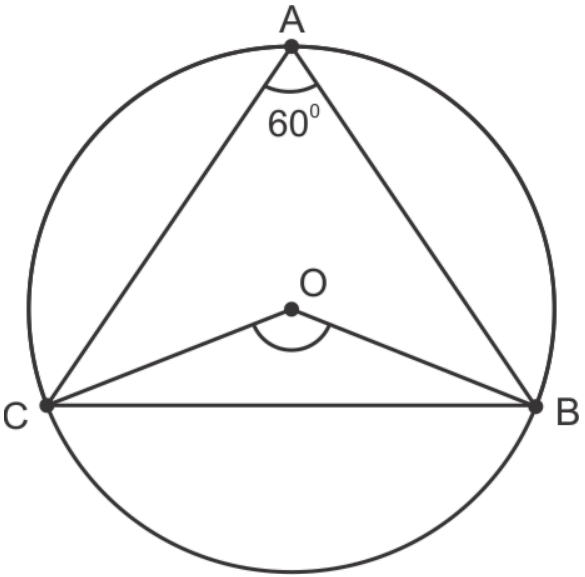
Angle made by a chord at the centre is twice the angle made by it on any point on the circumference. Therefore,
$\angle\text{QOR}=2\angle\text{QPR}=50^\circ\times2=100^\circ$

View full question & answer
MCQ 1441 Mark
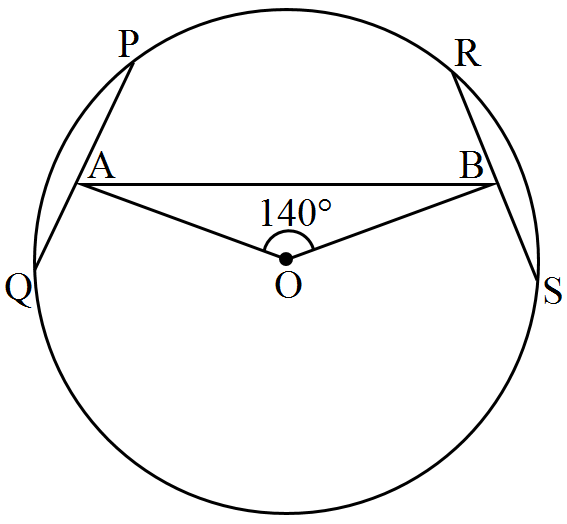
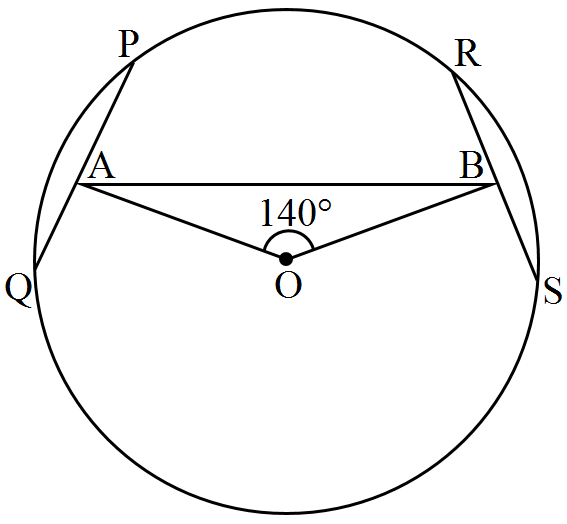
In the given figure $PQ$ and $RS$ are two equal chords of a circle with centre $O. OA$ and $OB$ are perpendiculars on chords $PQ$ and $RS,$ respectively. If $\angle\text{AOB}=140^\circ,$ then $\angle\text{PAB}$ is equal to.
  • $70^\circ$
  • B
    $50^\circ$
  • C
    $60^\circ$
  • D
    $40^\circ$
Answer
Correct option: A.
$70^\circ$


In triangle $ABO, AO = BO$
So, $\angle\text{BAO}=\angle\text{ABO}=\text{x}$
$\text{x}+\text{x}+140^\circ=180^\circ$
$\Rightarrow2\text{x}=40^\circ$
$\text{x}=20^\circ$
Now $\angle\text{QAO}+\angle\text{BAO}+\angle\text{PAB}=180^\circ$
Substituting the values we get:
$90^\circ+20^\circ+\angle\text{PAB}=180^\circ$
$\angle\text{PAB}=70^\circ$

View full question & answer
MCQ 1451 Mark
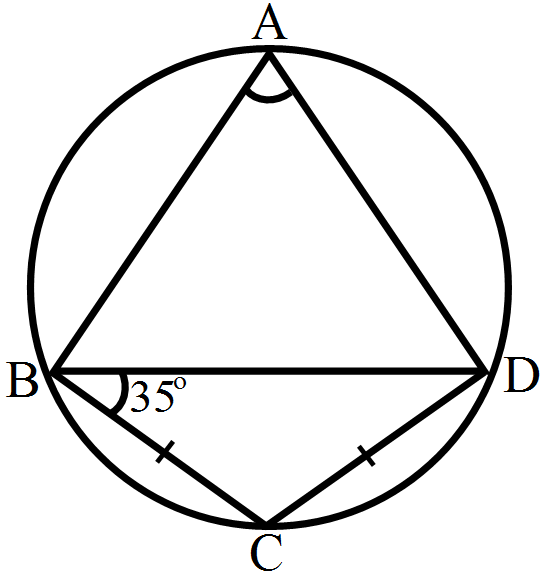
In the give figure, $ABCD$ is a cyclic quadrilateral in which $BC = CD$ and $\angle\text{CBD}=35^\circ.$ Then, $\angle\text{BAD}=?$
  • A
    $65^\circ$
  • $70^\circ$
  • C
    $110^\circ$
  • D
    $90^\circ$
Answer
Correct option: B.
$70^\circ$

$BC = BD [$Given$]$
$\angle\text{BDC}=\angle\text{CBD}=35^\circ$ [Angle opposite equal sides are equal]
In $\triangle\text{BCD},$
$\angle\text{BCD}+\angle\text{BDC}+\angle\text{CBD}=180^\circ$ [Angle sum property]
$\Rightarrow\ \angle\text{BCD}+35^\circ+35^\circ=180^\circ$
$\Rightarrow\ \angle\text{BCD}=110^\circ$
Since $ABCD$ is a cyclic quadrilateral,
$\angle\text{BAD}+\angle\text{BCD}=180^\circ$
$\Rightarrow\ \angle\text{BAD}+110^\circ=180^\circ$
$\Rightarrow\ \angle\text{BAD}=70^\circ$

View full question & answer
MCQ 1461 Mark
In the given figure, $ABCD$ is a cyclic quadrilateral in which $DC$ is produced to $E$ and $CF$ is drawn parallel to $AB$ such that $\angle\text{ADC}=95^\circ$ and $\angle\text{ECF}=20^\circ.$ Then, $\angle\text{BAD}=?$
  • A
    $95^\circ$
  • B
    $85^\circ $
  • C
    $75^\circ$
  • $105^\circ$
Answer
Correct option: D.
$105^\circ$

We have:
$\angle\text{ABC}+\angle\text{ADC}=180^\circ$
$\Rightarrow\angle\text{ABC}+95^\circ=180^\circ$
$\Rightarrow\angle\text{ABC}=(180^\circ-95^\circ)=85^\circ$
Now, $CF || AB$ and $CB$ is the transversal.
$\therefore\angle\text{BCF}=\angle\text{ABC}=85^\circ($Alternate interior angles$)$
$\Rightarrow\angle\text{BCE}=(85^\circ+20^\circ)=105^\circ$
$\Rightarrow\angle\text{DCB}=(180^\circ-105^\circ)=75^\circ$
$\Rightarrow\angle\text{DCB}=75^\circ$
Now, $\angle\text{BAD}+\angle\text{BCD}=180^\circ$
$\Rightarrow\angle\text{BAD}+75^\circ=180^\circ$
$\Rightarrow\angle\text{BAD}=(180^\circ-75^\circ)$
$\Rightarrow\angle\text{BAD}=105^\circ$

View full question & answer
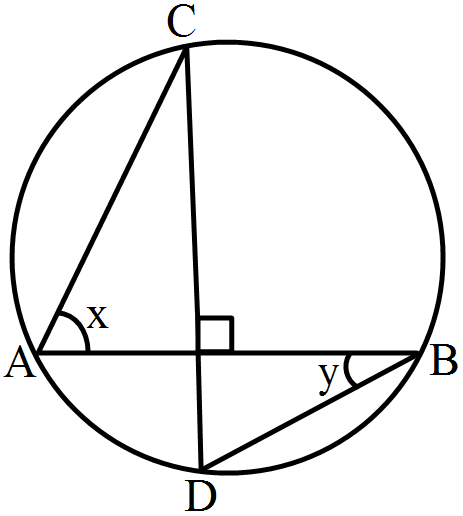
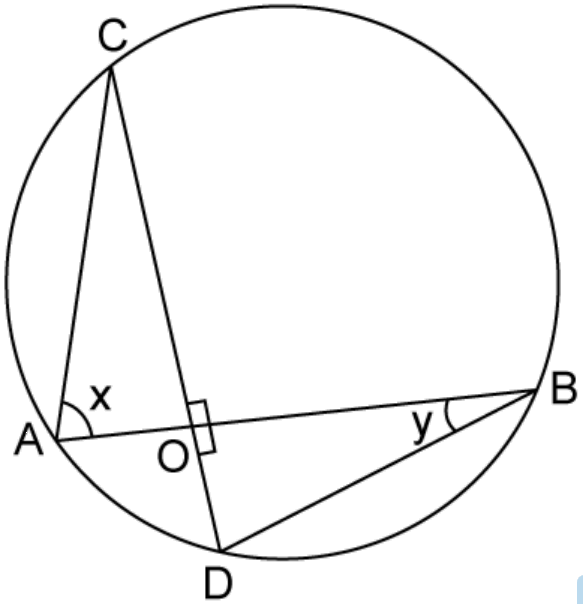
MCQ 1471 Mark
In the given figure, if chords $AB$ and $CD$ of the circle intersect each other at right angles, then $x + y =$
  • A
    $45^\circ$
  • B
    $60^\circ$
  • C
    $75^\circ$
  • $90^\circ$
Answer
Correct option: D.
$90^\circ$

$\angle\text{CAB}=\angle\text{CDB}=\text{x}^\circ$ ...(Both are on the same arc)
Consider $\triangle\text{ODB},$
$\angle\text{DOB}=90^\circ,\ \angle\text{OBD}=\text{y},\ \angle\text{ODB}=\text{x}$
In $\triangle\text{ODB},$
$x + y + 90^\circ = 180^\circ $
$\Rightarrow x + y = 90^\circ $
View full question & answer
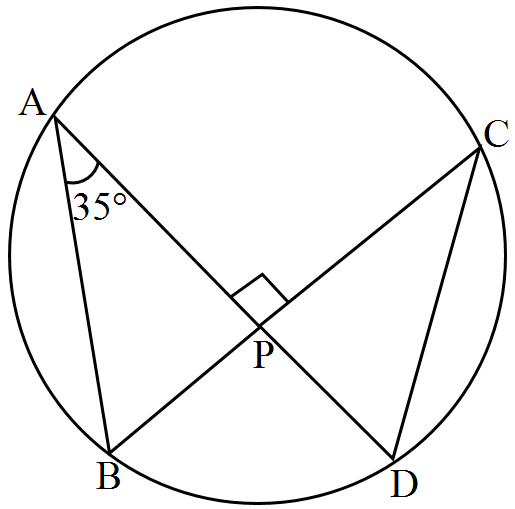
MCQ 1481 Mark
In a given figure, chords $AD$ and $BC$ intersect each other at right angles at point $P.$ If $\angle\text{DAB}=35^\circ,$ then $\angle\text{ADC}=$
  • A
    $65^\circ $
  • B
    $35^\circ$
  • $55^\circ$
  • D
    $45^\circ$
Answer
Correct option: C.
$55^\circ$
From triangle $APB, \angle\text{ABP}=180^\circ-90^\circ-35^\circ=55^\circ$
Thus, $\angle\text{ADC}=55^\circ(\angle\text{ABC}=\angle\text{ADC})$
View full question & answer
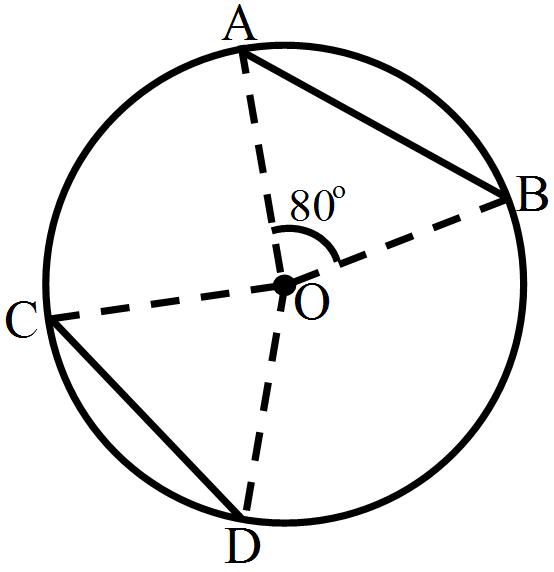
MCQ 1491 Mark
$AB$ and $CD$ are two equal chords of a circle with centre $O$ such that $\angle\text{AOB}=80^\circ$ then $\angle\text{COD}=?$
  • A
    $100^\circ$
  • $80^\circ$
  • C
    $120^\circ$
  • D
    $40^\circ$
Answer
Correct option: B.
$80^\circ$

Given that $AB = CD.$
Since equal chord, subtend equal angles at the centre,
$\angle\text{COD}=\angle\text{AOB}=80^\circ.$

View full question & answer
MCQ 1501 Mark
In the given figure, $O$ is the centre of a circle and $\angle\text{OAB}=50^\circ.$ Then, $\angle\text{CDA}=?$
  • A
    $40^\circ$
  • $50^\circ$
  • C
    $75^\circ$
  • D
    $25^\circ$
     
Answer
Correct option: B.
$50^\circ$
$OA = OB [$Radii of the same circle$]$
$\Rightarrow\ \angle\text{OBA}=\angle\text{OAB}=50^\circ$
Since angles in the same segment are equal, $\angle\text{ABC}=\angle\text{CDA}.$
That is, $\angle\text{ABO}=\angle\text{CDA}=50^\circ$
View full question & answer