Questions

M.C.Q

🎯

Test yourself on this topic

18 questions · timed · auto-graded

MCQ 11 Mark
An icecream cone has hemispherical top. If the height of the cone is $9 \ cm$ and base radius is $2.5 \ cm,$ then the volume of icecream is
  • $91.67 \ cm^3$
  • B
    $96.67 \ cm^3$
  • C
    $90.67 \ cm^3$
  • D
    $91.76 \ cm^3$
Answer
Correct option: A.
$91.67 \ cm^3$
Height of ice$-$cream cone is $9 \ cm$ and radius of the hemispherical top is $2.5 \ cm.$
Now, Volume of ice$-$cream cone $=$ Volume of cone $+$ volume of Hemispherical top
$=\frac{1}{3} \pi r^2 h+\frac{2}{3} \pi r ^3$
$=\frac{1}{3} \pi r ^2(h+2 r )$
$=\frac{1}{3} \times \frac{22}{7} \times 2.5 \times 2.5(9+5)$
$=\frac{1}{3} \times \frac{22}{7} \times 2.5 \times 2.5 \times 14$
$=91.67 \ cm^3$
View full question & answer
MCQ 21 Mark
$\sqrt{3}$ is a polynomial of degree.
  • A
    $0$
  • B
    2
  • C
    $\frac{1}{2}$
  • D
    1
Answer
(a) 0
Explanation: $\sqrt{3}$ is a constant term, so it is a polynomial of degree 0.
View full question & answer
MCQ 31 Mark
In a $\ce{\triangle ABC}$, if $\angle A-\angle B=42^{\circ}$ and $\angle B-\angle C=21^{\circ}$ then $\angle B= ?$
  • A
    $95^{\circ}$
  • B
    $63^{\circ}$
  • $53^{\circ}$
  • D
    $32^{\circ}$
Answer
Correct option: C.
$53^{\circ}$
Let $\angle A-\angle B=42^{\circ}\ldots(i)$ and
$\angle B-\angle C=21^{\circ}\ldots(ii)$
Adding $(i)$ and $(ii),$ we get
$\angle A-\angle C=63^{\circ} \ldots(iii)$
$\angle B=\angle A-42^{\circ} \ldots \ldots .[$ using $(i)]$
$\angle C=\angle A-63^{\circ} [$Using $(iii)]$
$\therefore \angle A+\angle B+\angle C=180^{\circ} [$ Sum of the angles of a triangle$] $
$\Rightarrow \angle A+\angle A-42^{\circ}+\angle A-63^{\circ}=180^{\circ}$
$\Rightarrow 3 \angle A-105^{\circ}=180^{\circ}$
$\Rightarrow 3 \angle A=285^{\circ}$
$\therefore \angle B=(95-42)^{\circ}$
$\Rightarrow \angle B=53^{\circ}$
View full question & answer
MCQ 41 Mark
The line represented by the equation x + y = 16 passes through (2, 14). How many more lines pass through the point (2, 14)
  • A
    10
  • B
    2
  • C
    many
  • D
    100
Answer
(c) many
Explanation: There are many lines pass through the point (2, 14). 
For example
x - y = -12
2x + y = 18
and many more.  
View full question & answer
MCQ 51 Mark
If $\sqrt{3}=1.732$ and $\sqrt{2}=1.414$, then the value of $\frac{1}{\sqrt{3}-\sqrt{2}}$ is
  • $3.146$
  • B
    $\frac{1}{3.146}$
  • C
    $0.318$
  • D
    $\frac{1}{\sqrt{1.732}-\sqrt{1.414}}$
Answer
Correct option: A.
$3.146$
$\frac{1}{\sqrt{3}-\sqrt{2}}$
$\Rightarrow \frac{1}{\sqrt{3}-\sqrt{2}} \times \frac{\sqrt{3}+\sqrt{2}}{\sqrt{3}+\sqrt{2}}$
$\Rightarrow \frac{\sqrt{3}+\sqrt{2}}{3-2}=\sqrt{3}+\sqrt{2}$
$\Rightarrow 1.732+1.414$
$\Rightarrow 3.146$
View full question & answer
MCQ 61 Mark
In the given figure, a circle is centred at $O.$ The value of $x$ is :
Image
  • $110^{\circ}$
  • B
    $55^{\circ}$
  • C
    $125^{\circ}$
  • D
    $70^{\circ}$
Answer
Correct option: A.
$110^{\circ}$
Image
$\ce{\angle ACO =\angle CAO}=20^{\circ}($ because  $\text{OA = OC})$
$\ce{\angle OBC =\angle OCB}=35^{\circ}($ because $\text{OB = OC})$
$\ce{\angle ACB}=55^{\circ}$
$x =2 \ce{\angle ACB}$
$=2 \times 55^{\circ}$
$=110^{\circ}$
View full question & answer
MCQ 71 Mark
Two adjacent angles of a parallelogram are in the ratio 4 : 5. The angles are
  • A
    $90^{\circ}, 90^{\circ}$
  • B
    $80^{\circ}, 100^{\circ}$
  • C
    $60^{\circ}, 120^{\circ}$
  • D
    $40^{\circ}, 140^{\circ}$
Answer
(b) $80^{\circ}, 100^{\circ}$
Explanation: Let the adjacent angles of a parallelogram be $4 x$ and $5 x$ and sum of adjacent angles of parallelogram is $180^{\circ}$.
$\therefore 4 x+5 x=180^{\circ}$
$\Rightarrow 9 x =180^{\circ} \Rightarrow x =20^{\circ}$
$\therefore$ Angles are $80^{\circ}$ and $100^{\circ}$.
View full question & answer
MCQ 81 Mark
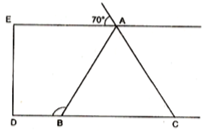
In figure, if $\ce{AE \| DC}$ and $\ce{AB = AC}$, the value of $\ce{\angle ABD}$ is
Image
  • $110^{\circ}$
  • B
    $120^{\circ}$
  • C
    $130^{\circ}$
  • D
    $70^{\circ}$
Answer
Correct option: A.
$110^{\circ}$
$\ce{\angle EAP =\angle BCA} ($Corresponding angles$)$
$\ce{\angle BCA} =70^{\circ}$
$\ce{\angle CBA =\angle BCA}($ Angles opposite to equal sides are equal$)$
$\ce{\angle CBA}=70^{\circ}$
Now,
$\ce{\angle ABD +\angle CBA}=180^{\circ}$
$\ce{\angle ABD} +70=180^{\circ}$
$\ce{\angle ABD} =110^{\circ}$
View full question & answer
MCQ 91 Mark
A linear equation in two variables is of the form ax + by + c = 0, where
  • A
    $a \neq 0$ and $b=0$
  • B
    $a =0$ and $b =0$
  • C
    a $\neq 0$ and $b \neq 0$
  • D
    $a = 0$ and $b \neq 0$
Answer
(c) a $\neq 0$ and b $\neq 0$
Explanation: A linear equation in two variables is of the form $a x+b y+c=0$ as $a$ and $b$ are cofficient of x and y so if $a =0$ and $b =0$ or either of one is zero in that case the equation will be one variable or their will be no equation respectively.
therefore when $a \neq 0$ and $b \neq 0$ then only the equation will be in two variable
View full question & answer
MCQ 101 Mark
The remainder when $x^{31}-31$ is divided by $x+1$ is
  • $-32$
  • B
    $31$
  • C
    $30$
  • D
    $0$
Answer
Correct option: A.
$-32$
$x^{31}-31$
Using remainder theorem.
$=(-1)^{31}-31$
$=-1-31$
$=-32$
View full question & answer
MCQ 111 Mark
A diagonal of a Rectangle is inclined to one side of the rectangle at an angle of $2 5 { }^{\circ}$. The Acute Angle between the diagonals is :
  • A
    $115^{\circ}$
  • B
    $40^{\circ}$
  • C
    $50^{\circ}$
  • D
    $25^{\circ}$
Answer
(c) $50^{\circ}$
Explanation: Two diagonals of a rectangle divides it into four triangles. Out of these four triangles a pair of opposite triangles are congruent by SSS in which a pair of triangles have two equal angles of 25 each and in another pair of opposite triangles have two equal angles of 65 each. By angle sum property we have two options of angle fromed between diagonals. Either it is of 130 or 50.50 is an acute angle. So, it is a correct option.
View full question & answer
MCQ 121 Mark
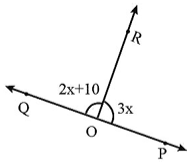
Given $\ce{\angle POR}=3 x$ and $\ce{\angle QOR}=2 x+10^{\circ}$. If $\ce{\angle POQ}$ is a straight line, then the value of $x$ is
Image
  • A
    $36^{\circ}$
  • B
    $30^{\circ}$
  • $34^{\circ}$
  • D
    $42^{\circ}$
Answer
Correct option: C.
$34^{\circ}$
Given,
$\text{POQ}$ is a straight line 
$\ce{\angle POR +\angle QOR}=180^{\circ}($ Linear pair $)$
$3 x+2 x+10^{\circ}=180^{\circ}$
$5 x=170^{\circ}$
$x=34^{\circ}$
View full question & answer
MCQ 131 Mark
The line segment with one end point at the centre and the other at any point on the circle is called ________.
  • A
    diameter
  • B
    sector
  • C
    chord
  • D
    radius
Answer
(d) radius
Explanation: The radius of a circle is the distance from the center of the circle to any point on its circumference.
View full question & answer
MCQ 141 Mark
If (2, 0) is a solution of the linear equation 2x + 3y = k, then the value of k is
  • A
    2
  • B
    4
  • C
    5
  • D
    6
Answer
(b) 4
Explanation: (2, 0) is a solution of the linear equation 2x + 3y = k  
$\Rightarrow 4=k$
View full question & answer
MCQ 151 Mark
In a histogram the class intervals or the groups are taken along
  • A
    X-axis
  • B
    Y-axis
  • C
    both of X-axis and Y-axis
  • D
    in between X and Y axis
Answer
(a) X-axis  
Explanation: Histogram states that a two dimensional frequency density diagram is called as a histogram. The histograms are diagrams which represent the class interval and the frequency in the form of a rectangle. There will be as many adjoining rectangles as there are class intervals.
View full question & answer
MCQ 161 Mark
Point (- 10,0) lies
  • A
    on the negative direction of the y-axis
  • B
    on the negative direction of the X-axis
  • C
    in the third quadrant
  • D
    in the fourth quadrant
Answer
(b) on the negative direction of the X-axis
Explanation: In point (-10, 0) y-coordinate is zero, so it lies on X-axis and its x-coordinate is negative, so the point (-10, 0) lies on the X-axis in the negative direction.  
View full question & answer
MCQ 171 Mark
The graph of y = 6 is a line
  • A
    Parallel to x-axis at a distance 6 units from the origin
  • B
    Making an intercept 6 on the x- axis.
  • C
    Making an intercept 6 on both the axes.
  • D
    Parallel to y-axis at a distance 6 units from the origin
Answer
(a) Parallel to x-axis at a distance 6 units from the origin
Explanation: As y = a is an equation of a line parallel to x-axis at a distance of a units from the origin.
View full question & answer
MCQ 181 Mark
$\sqrt{12} \times \sqrt{15}=$
  • A
    $5$
  • B
    $5 \sqrt{6}$
  • $6 \sqrt{5}$
  • D
    $6$
Answer
Correct option: C.
$6 \sqrt{5}$
$\sqrt{12}=\sqrt{3 \times 2^2}=2 \sqrt{3}$ and $\sqrt{15}=\sqrt{5} \times \sqrt{3}$
so,$\sqrt{12} \times \sqrt{15}$
$=2 \sqrt{3} \times \sqrt{3} \times \sqrt{5}$
$=2 \times 3 \sqrt{5}$
$=6 \sqrt{5}$
View full question & answer