Questions

Answer the questions.[Che-3M]

🎯

Test yourself on this topic

32 questions · timed · auto-graded

Question 13 Marks
You are provided with a fine white coloured powder which is either sugar or salt. How would you identify it without testing?
Answer
If the white coloured powder is a sugar, it will char when heated. Alternatively, the powder may be dissolved in water and the aqueous solution can be checked for conduction of electricity. If the solution conducts electricity, it is a salt solution and the white coloured powder is a salt. If the solution does not conduct electricity, it is a sugar solution and the white coloured powder is a sugar.
View full question & answer
Question 23 Marks
Write the molecular formulae of all the compounds that can be formed by the combination of following ions.
$\text{Cu}^{2+},\text{Na}^+,\text{Fe}^{3+},\text{CL}^-,\text{SO}^{2-}_{4},\text{PO}^{3-}_4$
View full question & answer
Question 33 Marks
Write the chemical formulae of Nitrates (NO3) of Na+, K+, Al3+, Mg2+, Ca2+, Zn2+.
Answer
  1. NaNO3
  2. KNO3
  3. Al(NO3)3
  4. Mg(NO3)2
  5. Ca(NO3)2
  6. Zn(NO3)2.
View full question & answer
Question 43 Marks
Why is it necessary to use the symbol for the elements?
Answer
Yes it is necessary to write symbols for element because it makes equations easy to write as well as to read and understand. they also saves time and complexity.
e.g 
Consider the following chemical reaction
Zinc + Sulphuric acid → Zinc sulphate + Hydrogen gas 
This can be written easily using symbols as
$\text{Zn}+\text{H}_2\text{SO}_4\rightarrow\text{ZnSO}_4+\text{H}_2$
View full question & answer
Question 53 Marks
When 5g of calcium is burnt in 2g of oxygen, then 7g of calcium oxide is produced. What mass of calcium oxide will be produced when 5g of calcium is burnt in 20g of oxygen? Which law of chemical combination will govern your answer?
Answer
When 5gm of calcium is burnt in 2gm of oxygen, then 7gm of calcium oxide is formed. So, calcium and oxygen combine in the fixed proportion of 5 : 2 by mass. Now, when 5gm of calcium is burnt in 20gm of oxygen, then also 7gm of calcium oxide will be formed because chemical reactions follows law of constant proportion. As a result, 18gm of oxygen will be left unreacted.
View full question & answer
Question 63 Marks
What is the significance of the symbol of an element? Explain with the help of an example.
Answer
Significance of symbol of element:
  1. It represents name of the element.
  2. It represents one atom of the element.
  3. It represents a definite mass of the element.
  4. It represents one mole of atoms of the element. 
For example: C represents one atom of the element Carbon. It also represents 12gms of Carbon.
View full question & answer
Question 73 Marks
What is the number of zinc atoms in a piece of zinc weighing 10g?
(Atomic mass of Zn = 65u)
Answer
1 mole of Zn = 65gm of zinc = 6.022 × 1023 atoms of zinc
Given mass of zinc = 10gm
No. of moles of zinc $=\frac{10}{65}=0.15\text{ moles of zinc}$
Total no. of atoms in 0.15 moles = 0.15 × 6.022 × 1023 atoms of zn
= 9.264 × 1022 atoms of zn
View full question & answer
Question 83 Marks
The formula of carbonate of a metal M is M2CO3.
  1. What will be the formula of its iodide?
  2. What will be the formula of its nitride?
  3. What will be the formula of its phosphate?
Answer
Let us first work out the valency of the metal M (we know that carbonate ion has a valency of -2):

$\text{Element/ Ion}\ \ \ \ \ \ \ \text{M}\ \ \ \ \ \ \text{CO}^{2-}_3\\ \ \ \ \text{Valency}\ \ \ \ \ \ \ \ \ \ \ \ \ \ 1\ \ \ \ \ \ \ \ \ 2$

It is clear that M has a valency of 1

  1. Formula of iodide of M:

$\text{Element}\ \ \ \ \ \ \ \text{M}\ \ \ \ \ \ \ \text{I}\\ \text{Valency}\ \ \ \ \ \ \ \ 1\ \ \ \ \ \ \ \ 1$

Crossing the valencies, formula of the iodide of M is Ml

  1. Formula of nitride of M:

$\text{Element/ Ion}\ \ \ \ \ \ \ \text{M}\ \ \ \ \ \ \ \ \ \ \ \text{N}^{3-}\\ \ \ \ \text{Valency}\ \ \ \ \ \ \ \ \ \ \ \ \ \ 1\ \ \ \ \ \ \ \ -3$

Crossing the valencies, formula of the nitride of M is M3N

  1. Formula of phosphate of M:

$\text{Element/ Ion}\ \ \ \ \ \ \ \text{M}\ \ \ \ \ \ \ \ \ \text{PO}^{3-}_4\\ \ \ \ \text{Valency}\ \ \ \ \ \ \ \ \ \ \ \ \ \ 1\ \ \ \ \ \ \ \ \ -3$

Crossing the valencies, formula of the phosphate of M is M3PO4

View full question & answer
Question 93 Marks
Show by means of calculations that 5 moles of CO2 and 5 moles of H2O do not have the same mass. How much is the difference in their masses?
Answer
Molar mass of CO2 = 44g
Molar mass of H2O = 18g
Mass of 5 mole of H2O = 5 × 18g = 90g
Mass of 5 mole of CO2 = 5 × 44g = 220g
So, 5 mole of H2O and 5 mole of CO2 do not have same mass.
And the difference in their masses = 220g - 90g = 130g
View full question & answer
Question 103 Marks
Potassium chlorate decomposes, on heating, to form potassium chloride and oxygen. When 24.5g of potassium chlorate is decomposed completely, then 14.9g of potassium chloride is formed. Calculate the mass of oxygen formed. Which law of chemical combination have you used in solving this problem?
Answer
$\text{Potassium chlorate}\xrightarrow{\ \ \ \ \ \ \ \ \ \ \ }\text{Potassium chloride}\ +\ \text{Oxygen}\\ \ \ \ \ \ \ \ \ \ \ ^{(24.5\text{gm})}\ \ \ \ \ \ \ \ \ \ \ \ \ \ \ \ \ \ \ \ \ \ \ \ \ \ \ \ \ \ \ \ \ ^{(14.9\text{gm})}\ \ \ \ \ \ \ \ \ \ \ \ \ \ \ \ \ \ \ \ \ ^{(\text{x gm})}$
Let, x gm of oxygen is formed,
Then, according to law of conservation of mass,
24.5gm = 14.9gm + x gm
So, x = (24.5 - 14.9)gm = 9.6gm.
Thus, 9.6 gm of oxygen is formed in the reaction.
View full question & answer
Question 113 Marks
Magnesium and oxygen combine in the ratio of 3 : 2 by mass to form magnesium oxide. What mass of oxygen gas would be required to react completely with 24h of magnesium?
Answer
$\text{Magnesium}+\text{Oxygen}\xrightarrow{\ \ \ \ \ \ \ \ \ \ \ \ }\text{Magnesium oxide}\\ \ \ \ \ \ \ \ \ 3\text{x}\ \ \ \ \ \ \ \ \ \ \ \ \ \ \ \ 2\text{x}\ \ \ \ \ \ \ \ \ \ \ \ \ \ \ \ \ \ \ \ \ \ \ \ \ \ \ \ \ \ \ \ \text{x}$
i.e. three equivalents of Mg reacts with 2 equivalents of O2 to form 1 equivalent of MgO.
When mass of Mg = 3x = 24gm
So, x = 8gm
Then, mass of oxygen required = 2x = 16gm
View full question & answer
Question 123 Marks
In photosynthesis, 6 molecules of carbon dioxide combine with an equal number of water molecules through a complex series of reactions to give a molecule of glucose having a molecular formula C6H12O6. How many grams of water would be required to produce 18g of glucose? Compute the volume of water so consumed assuming the density of water to be 1g cm–3.
Answer
$6\text{CO}_2+6\text{H}_2\text{O}\xrightarrow[\text{sunlight}]{\text{Choloropyll}}\text{C}_6\text{H}_{12}\text{O}_6+6\text{O}_2$
1 mole of glucose requires 6 moles of water.
180g glucose will require (6 × 18)g of water.
1g of glucose will need $\frac{108}{180}\text{g}$ of water.
18g of glucose would need $\frac{108}{180}\times18\text{g}$ of water = 10.8g
Volume of water consumed $=\frac{\text{Mass}}{\text{Density}}=\frac{10.8}{1\text{g cm}^{-3}}=10.8\text{cm}^3$
View full question & answer
Question 133 Marks
In an experiment, 1.288g of barium sulphate was obtained from 1.03g of barium. In another experiment, 3.672g of barium sulphate gave, on reduction, 2.938g of barium. Show that these figures verify the law of constant proportions.
Answer
First experiment
Copper oxide = 1.288g
Copper left = 1.03g
Oxygen present = 1.288 - 1.03 = 0.258g
Percentage of oxygen in CuO $=\frac{(0.258\times100)}{1.288}=19.98^\sim20\%$
Second experiment
Copper oxide = 3.672g
Copper left = 2.938g
Oxygen present = 3.672 - 2.938 = 0.734g
 Percentage of oxygen in CuO $=\frac{0.734\times100}{3.672}=20.03^\sim20\%$
So, it is verified that these figures verify the law of constant proportion.
View full question & answer
Question 143 Marks
If the aluminium salt of an anion X is Al2X3, what is the valency of X? What will be the formula of the magnesium salt of X?
Answer
Valency X in the aluminium salt Al2X3, can be worked out as follows (we know that valency of Al is 3):

$\text{Element}\ \ \ \ \ \ \ \text{Al}\ \ \ \ \ \ \text{X}\\ \text{Valency}\ \ \ \ \ \ \ \ 3\ \ \ \ \ \ \ \ 2$

Thus, it is clear that the valency of X is two.

Formula for the magnesium salt of X can be worked out as follows:

$\text{Element}\ \ \ \ \ \ \ \text{Mg}\ \ \ \ \ \ \text{X}\\ \text{Valency}\ \ \ \ \ \ \ \ 2\ \ \ \ \ \ \ \ \ 2$

Crossing the valencies gives us the formula of the magnesium salt of X i.e., MgX.

View full question & answer
Question 153 Marks
Identify the total number of inert gases, their names and symbols from this cross word puzzle.
Answer
Total number of inert gasses in this crossword puzzle is 6. Their names and symbols are as follows.
S.No.
Name of gas
Symbol
1
Helium
He
2
Argon
Ar
3
Neon
Ne
4
Krypton
Kr
5
Xenon
Xe
6
Radon
Rn
View full question & answer
Question 163 Marks
How many moles of oxygen atoms are present in one mole of the following compounds?
  1. Al2O3
  2. CO2
  3. Cl2O7
  4. H2SO4
  5. Al2(SO4)3
Answer
Moles of oxygen atom are:
  1. Al2O3: 3 mole
  2. CO2: 2 mole
  3. Cl2O7:  7 mole
  4. H2SO4: 4 mole
  5. Al2(SO4)3: 12 mole
View full question & answer
Question 173 Marks
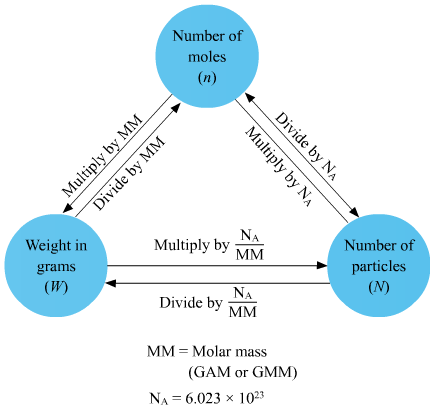
How are given mass, molar mass and number of moles related to each other?
View full question & answer
Question 193 Marks
Give symbol and valency of the following ions. Hydroxide ion, carbonate ion.
Answer
Hydroxide ion that is OH is a compound made up of hydrogen and oxygen. To know the valency of an atom you need to understand the concept of electronegativity. Oxygen is more electronegative atom as compared to hydrogen, thus the oxygen atom has a charge of -2 whereas hydrogen atom has a charge +1. Thus OH has an overall charge of -1
Carbonate is formed when Na2CO3 or CaCO3 or similar carbonate compound break-up into ions. Now, (CO3)2 i.e., carbonate ion can exist alone but only through resonance.
View full question & answer
Question 203 Marks
Copper sulphate reacts with sodium hydroxide to form a blue precipitate of copper hydroxide and sodium sulphate. In an experiment, 15.95g of copper sulphate reacted with 8.0g of sodium hydroxide to form 9.75g of copper hydroxide and 14.2g of sodium sulphate. Which law of chemical combination is illustrated by this data? Give reason for your choice.
Answer
$\text{CuSO}_4\ +\ 2\text{NaOH}\xrightarrow{\ \ \ \ \ \ \ \ \ \ \ \ \ }\text{Cu}(\text{OH})_2\ +\ \text{Na}_2\text{SO}_4\\ ^{(15.95\text{gm})} \ \ \ \ \ \ \ \ ^{(8\text{gm})}\ \ \ \ \ \ \ \ \ \ \ \ \ \ \ \ \ \ \ ^{9.75\text{gm}}\ \ \ \ \ \ \ \ \ \ \ \ \ ^{14.2\text{gm}}$
Clearly, in this case,
Total mass of reactants = (15.95gm + 8gm) = 23.95gm
Total mass of products = (9.75gm + 14.2gm) = 23.95gm
Hence, Law of conservation of mass is valid here.
View full question & answer
Question 213 Marks
Compute the difference in masses of one mole each of aluminium atoms and one mole of its ions (Mass of an electron is 9.1 × 10-28 g). Which one is heavier?
Answer
Mass of 1 mole of aluminium atom = the molar mass of aluminium = 27g mol-1
An aluminium atom needs to lose three electrons to become an iron AI3+
For one mole of AI3+ iron, three moles of electrons will be lost.
$\therefore$ Mass of three moles of electrons
= 3 × (9.1 × 10-28) 6.022 × 1023g
= 27.3 × 6.022 × 10-5g
= 164.400 × 10-5g
= 0.00164g
$\therefore$ Molar mass of AI3+
= (27 - 0.00164)g mol-1 = 26.998g mol-1
$\therefore$ Difference in mass = 27 - 26.9984 = 0.0016g
View full question & answer
Question 223 Marks
Calculate the number of sodium ions that are present in 212g of sodium carbonate.
Answer
Foemula for Sodiun Carbonete Na2CO3
Molecular mass of Na2CO2 = (23 × 2) + 12 + (16 × 3)
⇒ 46 + 12 + 48
⇒ 106g
No. of moles in 212g of Na2CO3
$\text{n}=\frac{\text{m}}{\text{M}}$
(n = No of moles m = mass given M = Molecular mass)
$\Rightarrow\text{n}=\frac{212}{106}...(1)$
Also, we know that:
$\text{n}=\frac{\text{N}}{\text{N}_\circ}...(2)$
(n = No of moles: N = No of particles: Nº Avagadro's constant, i.e = 6.023 × 1023)
We can keep (1) and (2) equal:
$\frac{212}{106}\times\frac{\text{N}}{6.023 \times10^{23}}$
$\Rightarrow\frac{6.023\times10^{23}\times212}{106}$
$\Rightarrow12.046\times10^{23}$
Now, we know that there are 2 atoms of na (sodium) in Na2CO3
Therefore,
⇒ 12.046 × 1023 × 2
⇒ 24.092 × 1023
View full question & answer
Question 233 Marks
Calculate the number of moles present in a drop of chloroform (CHCl3) weighing 0.0239g.
(Atomic masses: C = 12u; H = 1u; Cl = 35.5u)
Answer
Given mass of CHCl3 = 0.0239g
Molar mas of CHCl3 = 1 × C + 1 × H + 3 × Cl = 119.5g
No. of moles $=\frac{\text{Given mass}}{\text{Molar mass}}$
No. of moles $=\frac{0.0239}{119.5}=0.0002$
So, no. of molecules present in 0.0239g in chloroform = 0.0002 × 6.022 × 1023
= 12.044 × 1019 molecules
View full question & answer
Question 243 Marks
Calculate the number of molecules in 4g of oxygen.
Answer
32g of oxygen (1 mole of oxygen) has = 6.022 × 1023 molecules of oxygen
So, 4g of oxygen will have $=\frac{6.022\ \times\ 10^{23}\ \times\ 4}{32}$
$=7.528\times10^{22}\text{ molecules of oxygen}$
View full question & answer
Question 253 Marks
Calculate the molecular masses of the following:
  1. Hydrogen, H2
  2. Oxygen, O2
  3. Chlorine, Cl2
  4. Ammonia, NH3
  5. Carbon dioxide, CO2
(Atomic masses: H = 1 u; O = 16 u; Cl = 35.5 u; N = 14 u; C = 12 u)
Answer
  1. Molecular mass of Hydrogen (H2) = 2 × H = 2 × 1u = 2u

  2. Molecular mass of oxygen (O2) = 2 × O = 2 × 16u = 32u

  3. Molecular mass of chlorine (Cl2) = 2 × Cl = 2 × 35.5 = 71u

  4. Molecular mass of Ammonia (NH3) = 1 × N + 3 × H = 14 + 3 = 17u

  5. Molecular mass of carbon dioxide (CO2) = 1 × C + 2 × O = 12 + 32 = 44u

View full question & answer
Question 263 Marks
Calculate the molecular masses of the following compounds:
  1. Methane, CH4
  2. Ethane, C2 H6
  3. Ethene, C2 H4
  4. Ethyne, C2 H2
(Atomic masses: C = 12u; H = 1u)
Answer
  1. Molecular mass of methane (CH4) = 12 + 4 = 16u

  2. Molecular mass of ethane (C2H6) = 2 × 12 + 6 × 1 = 30u

  3. Molecular mass of ethane (C2H4) = 2 × 12 + 4 × 1 = 28u

  4. Molecular mass of ethyne (C2H2) = 2 × 12 + 2 × 1 = 26u

View full question & answer
Question 273 Marks
Calcium chloride when dissolved in water dissociates into its ions according to the following equation.
CaCl2(og) → Ca2+ (aq) + 2Cl_ (aq)
Calculate the number of ions obtained from CaCl2 when 222g of it is dissolved in water.
Answer
Molar mass of CaCl2 = 40 + 2 × 35.5

= 40 + 71 = 111g mol-1

$\because$ 111g of CaClproduces ions = 3mol = 3 6.022 × 1023ions

$\therefore$ 222g of CaCl2 produces ions $=\frac{3\times6.022\times10^{23}}{111}\times222$

$=36.132\times10^{23}=3.6132\times10^{24}\text{ions}$

View full question & answer
Question 283 Marks
A silver ornament of mass’m’ gram is polished with gold equivalent to 1% of the mass of silver. Compute the ratio of the number of atoms of gold and silver in the ornament.
Answer
Mass of silvar = mg
Mass of gold $=\frac{\text{m}}{100}\text{g}$
Number of atoms of silvar $=\frac{\text{mass}}{\text{atomic mass}}\times\text{N}_\text{A}=\frac{\text{m}}{108}\times\text{N}_\text{A}$
Number of atoms of gold $=\frac{\text{m}}{100\times197}\times\text{N}_\text{A}$
$\therefore$ Ratio of number of atoms of gold to that of silvar
= Number of atoms of Au : Number of atoms of Ag
$=\frac{\text{m}}{100\times197}\times\text{N}_\text{A}:\frac{\text{m}}{108}\times\text{N}_\text{A}$
$=108:100\times197$
$=108:19700=1:182.41$
View full question & answer
Question 293 Marks
A sample of ethane (C2H6) gas has the same mass as 1.5 × 10²⁰ molecules of methane (CH4). How many C2H6 molecules does the sample of gas contain?
Answer
Mass of 1 molecule of methane $(\text{CH}_4)=\frac{16\text{g}}{\text{N}_\text{A}}$
Mass of 1.5 × 1020 molecule of methane $=\frac{1.5\times10^{20}\times16}{\text{N}_\text{A}}\text{g}$
Mass of C2H6 molecule $=\frac{1.5\times10^{20}\times16}{\text{N}_\text{A}}\text{g}$
But mass of 1 molecule of $\text{C}_2\text{H}_6=\frac{30\text{g}}{\text{N}_\text{A}}\text{g}$
$\therefore$ Number of molecules of eathan in the sample of gas
= mass of C2H6 molecules in the sample/ mass of 1 molecule of C2H6
$=\frac{\frac{1.5\times10^{20}\times16}{\text{N}_\text{A}}}{\frac{30}{{\text{N}_\text{A}}}}=\frac{1.5\times10^{20}\times16}{\text{N}_\text{A}}\times\frac{{\text{N}_\text{A}}}{30}$
$=0.8\times10^{20}$
View full question & answer
Question 303 Marks
An oxide of nitrogen is found to contain nitrogen and oxygen combined together in the ratio of 7: 16 by mass. Derive the formula of the oxide and name it.
Answer
  1. Nitrogen dioxide is a compound, which is formed by the combination of nitrogen and oxygen. The ratio of nitrogen and oxygen by mass in nitrogen dioxide is in 7:16
  2. The chemical formula is NO2
  3. Mass of nitrogen = 14u

Mass of 2 atoms of oxygen = 32

  1. Therefore

Mass ratio in NO2 is 14 ; 32 or 7 ; 16.

View full question & answer
Question 313 Marks
An element A forms an oxide A2O5.
  1. What is the valency of element A?
  2. What will be the formula of chloride of A?
Answer
  1. Element A forms an oxide A2O5. Crossing the valencies, we can see that the valency of O(oxide) is -2 and that of element A is 5.

  2. Formula of chloride of A:

$\text{Element/ Ion}\ \ \ \ \ \ \ \text{A}\ \ \ \ \ \ \text{Cl}^-\\ \ \ \ \text{Valency}\ \ \ \ \ \ \ \ \ \ \ \ \ \ 5\ \ \ \ -1$

Formula of the chlcride of element A can be worked out by crossing over the valencies. Thus, the formula is ACl5

View full question & answer
Question 323 Marks
A gold sample contains 90% of gold and the rest copper. How many atoms of gold are present in one gram of this sample of gold?
Answer
Let, the mass of the sample is 100g

$\therefore$ Mass of gold = 90g

and mass of copper = (100 - 90) = 10g

$\because$ 100g of sample has gold = 90g

$\therefore$ 1g of this sample has gold $=\frac{90}{100}=0.9\text{g}$

Atomic mass of gold (Au) = 197g

$\because$ 197g of gold have number of atoms = 6.022 × 1023

$\therefore$ 0.9g of gold will have number of atoms $=\frac{6.022\times10^{23}\times0.9}{197}=2.75\times10^{21}$

View full question & answer
Answer the questions.[Che-3M] - Science STD 9 Questions - Vidyadip






