Sample QuestionsAtoms and Molecules questions
One sample from each question group in this chapter. Select any group above to see the full set with answer keys.
The anion of an element has:
- ✓
More electrons than the normal atom.
- B
Less electrons than the normal atom.
- C
More protons than the normal atom.
- D
Same number of electrons as normal atom.
Answer: A.
View full solution →In hydrogen peroxide $\left( H _2 O _2\right)$, the proportion of hydrogen and oxygen by mass is:
- A
$1 : 8$
- B
$1 : 16$
- C
$8 : 1$
- ✓
$16 : 1$
Answer: D.
View full solution →$1.008$ grams of hydrogen combines with $35.453 g$ of chlorine to form $36.463 g$ of a pure compound (hydrogen chloride). Dalton's explanation for this experimental fact might be:
Answer: D.
View full solution →When we mix $\text{BaCl} _2(aq)$ with $Na _2 SO _4(aq)$, which of the following observations is correct?
- A
- B
colourless solution is obtained.
- ✓
White precipitate is formed.
- D
Green precipitate is formed.
Answer: C.
View full solution →Which of the following is not a postulate of Dalton's atomic theory
- A
Different elements have atoms of different masses.
- B
Atoms combine in simple whole number ratios to form compounds.
- C
Atoms are not created or destroyed in chemical change.
- ✓
Atoms of a single element can have different masses.
Answer: D.
View full solution →‘X’ and ‘Y' are two elements which form X2Y3 and X3Y4. If 0.2mol of X2Y3 weighs 32g and 0.4mol of X3Y4, weighs 92.8g, the atomic weights of X and Y respectively are:
Why is atom electrically neutral:
- A
It has same number of neutrons & protons
- B
It has same number of neutrons & electrons
- C
It has same number of protons & electrons
- D
View full solution →Who was the first scientist which proposed that "Matter is made up of indivisible particles called atoms"?
Who stated the law of constant proportion:
Who postulated that matter is made up of very small particles in 430 BC?
In the following questions, a statement of assertion $(A)$ is followed by a statement of reason $(R)$. Mark the correct choice as:
- If both Assertion and Reason are true and Reason is the correct explanation of Assertion.
- If both Assertion and Reason are true but Reason is not the correct explanation of Assertion.
- If Assertion is true but Reason is false.
- If Assertion is false and Reason is true.
- If both Assertion and Reason are false.
Assertion: Atomicity of $O_3$ is $3$.
Reason: $1$ mole of an element contains $6.023 \times 10^{23}$ atoms. View full solution →In the following Questions, the Assertion and Reason have been put forward. Read the statements carefully and choose the correct alternative from the following:
Assertion: $23g$ of Na contains $6.022 \times 10^{23}$ sodium atoms.
Reason: $23g$ of Na contains $1$ atom of Na.
- ✓
Both the Assertion and the Reason are correct and the Reason is the correct explanation of the Assertion.
- B
The Assertion and the Reason are correct but the Reason is not the correct explanation of the Assertion.
- C
Assertion is true but the Reason is false
- D
The statement of the Assertion is false but the Reason is true.
Answer: A.
View full solution →In the following questions, a statement of assertion $(A)$ is followed by a statement of reason $(R)$.
Mark the correct choice as:
Assertion: When $10g$ of $Caco_3$ is decomposed, $5.6g$ of residue is left and $4.4g$ of $CO_2$ escapes.
Reason: Law of conservation of mass is followed.
- ✓
If both Assertion and Reason are true and Reason is the correct explanation of Assertion.
- B
If both Assertion and Reason are true but Reason is not the correct explanation of Assertion.
- C
If Assertion is true but Reason is false.
- D
If Assertion is false and Reason is true.
Answer: A.
View full solution →In the following Questions, the Assertion and Reason have been put forward. Read the statements carefully and choose the correct alternative from the following:
Assertion: The formula of aluminium sulphate is $Al_2(SO_4)_3$.
Reason: The valency of $Al$ is $3$ and charge on $SO_4{}^{2-}$.
- ✓
Both the Assertion and the Reason are correct and the Reason is the correct explanation of the Assertion.
- B
The Assertion and the Reason are correct but the Reason is not the correct explanation of the Assertion.
- C
Assertion is true but the Reason is false
- D
The statement of the Assertion is false but the Reason is true.
Answer: A.
View full solution →In the following Questions, the Assertion and Reason have been put forward. Read the statements carefully and choose the correct alternative from the following:
- Both the Assertion and the Reason are correct and the Reason is the correct explanation of the Assertion.
- The Assertion and the Reason are correct but the Reason is not the correct explanation of the Assertion.
- Assertion is true but the Reason is false
- The statement of the Assertion is false but the Reason is true.
Assertion: The formula of aluminium sulphate is Al
2(SO
4)
3.
Reason: The valency of Al is 3 and charge on SO
42-.
In the following Questions, the Assertion and Reason have been put forward. Read the statements carefully and choose the correct alternative from the following:
- Both the Assertion and the Reason are correct and the Reason is the correct explanation of the Assertion.
- The Assertion and the Reason are correct but the Reason is not the correct explanation of the Assertion.
- Assertion is true but the Reason is false
- The statement of the Assertion is false but the Reason is true.
Assertion: 23g of Na contains 6.022 × 10²³ sodium atoms.
Reason: 23g of Na contains 1 atom of Na.
In the following questions, a statement of assertion (A) is followed by a statement of reason (R).
Mark the correct choice as:
- If both Assertion and Reason are true and Reason is the correct explanation of Assertion.
- If both Assertion and Reason are true but Reason is not the correct explanation of Assertion.
- If Assertion is true but Reason is false.
- If Assertion is false and Reason is true.
- If both Assertion and Reason are false.
Assertion: When 10g of Caco
3 is decomposed, 5.6g of residue is left and 4.4g of CO
2 escapes.
Reason: Law of conservation of mass is followed.
In the following questions, a statement of assertion (A) is followed by a statement of reason (R).
Mark the correct choice as:
- If both Assertion and Reason are true and Reason is the correct explanation of Assertion.
- If both Assertion and Reason are true but Reason is not the correct explanation of Assertion.
- If Assertion is true but Reason is false.
- If Assertion is false and Reason is true.
- If both Assertion and Reason are false.
Assertion: SI unit of atomic mass and molecular mass is kg.
Reason: It is equal to the mass of 6.023 × 10
23 atoms.
In the following questions, a statement of assertion (A) is followed by a statement of reason (R).
Mark the correct choice as:
- If both Assertion and Reason are true and Reason is the correct explanation of Assertion.
- If both Assertion and Reason are true but Reason is not the correct explanation of Assertion.
- If Assertion is true but Reason is false.
- If Assertion is false and Reason is true.
- If both Assertion and Reason are false.
Assertion: Atomicity of O
3 is 3.
Reason: 1 mole of an element contains 6.023 × 10
23 atoms.
The name of $\mathrm{Li}_3 \mathrm{N}$ is lithium nitrite.
View full solution →State whether the following statements are true or false: A sodium ion has positive charge because it has more protons than a neutral atom.
State whether the following statements are true or false: A chloride ion has negative charge because it has more electrons than a neutral atom.
The lightest element is ________.
Matter can neither be created nor be destroyed is law of __________.
The particle which is formed by the loss or gain of electrons by an atom is called _________.
The particle which is formed by the loss of electrons by an atom is called _________.
The particle which is formed by the gain of electrons by an atom is called _________.
Fill in the following blanks with suitable words: The particle which is formed by the loss of electrons by an atom is called _________.
Fill in the following blanks with suitable words:
The particle which is formed by the gain of electrons by an atom is called _________.
Fill in the following blanks with suitable words: In a chemical reaction, the sum of the masses of the reactants and the products remains unchanged. This is called _________.
Fill in the blanks. In a chemical reaction, the sum of the masses of the reactants and products remains unchanged. This is called ______.
The lightest element is ________.
The name of Li3N is lithium nitrite.
State whether the following statements are true or false:
A sodium ion has positive charge because it has more protons than a neutral atom.
State whether the following statements are true or false:
A chloride ion has negative charge because it has more electrons than a neutral atom.
One mole of sodium sulphate contains 2 atoms of Na, 1 atom of S, 4 atoms of oxygen.
Calculate the molar mass of the following substances: Hydrochloric acid, $HCl.$
View full solution →Calculate the molecular mass of hydrogen bromide $(HBr). ($Atomic masses: $H = 1u; Br = 80u)$
View full solution →What is the mass of.
$1$ mole of nitrogen atoms$?$
View full solution →What is the mass of. $4$ mole of aluminium atoms $($Atomic mass of aluminium $= 27)?$
View full solution →Write the atomicity of the following:
$\mathrm{HNO}_3$
View full solution →Write the symbols/ formulae of two simple ions and two compound ions (or polyatomic ions).
Write the relation between nanometer and metre.
Write the molecular formulae for the following compounds.
Mercury (II) chloride.
Write the molecular formulae for the following compounds.
Magnesium (II) acetate.
Write the molecular formulae for the following compounds.
Iron (III) sulphide.
The difference in the mass of $100$ moles each of sodium atoms and sodium
ions is $5.48002\ g$. Compute the mass of an electron.
View full solution →Define the atomic mass unit.
What is meant by atomicity? Explain with two examples.
What are $(i)$ ionic compounds, and $(ii)$ molecular compounds? Give two examples of each type of compounds.
View full solution → Which postulate of Dalton’s atomic theory is the result of the law of conservation of mass?
Write the cations and anions present (if any) in the following compounds.
- CH3COONa
- NaCI
- H2
- NH4N03
Write the atomicity of the following:
I2
With the help of example, explain the law of conservation of mass.
Why the symbols of few elements, like sodium, do not start with the initial letter of the name?
Why is it not possible to see an atom even with the most powerful microscope?
Show by means of calculations that $5$ moles of $CO_2$ and $5$ moles of $H_2O$ do not have the same mass. How much is the difference in their masses?
View full solution →How are given mass, molar mass and number of moles related to each other?
An oxide of nitrogen is found to contain nitrogen and oxygen combined together in the ratio of $7: 16$ by mass. Derive the formula of the oxide and name it.
View full solution →Magnesium and oxygen combine in the ratio of $3 : 2$ by mass to form magnesium oxide. What mass of oxygen gas would be required to react completely with $24h$ of magnesium?
View full solution →What is the number of zinc atoms in a piece of zinc weighing $10\ g? ($Atomic mass of $Zn = 65u)$
View full solution →You are provided with a fine white coloured powder which is either sugar or salt. How would you identify it without testing?
Write the molecular formulae of all the compounds that can be formed by the combination of following ions.
$\text{Cu}^{2+},\text{Na}^+,\text{Fe}^{3+},\text{CL}^-,\text{SO}^{2-}_{4},\text{PO}^{3-}_4$
View full solution →Write the chemical formulae of Nitrates (NO3–) of Na+, K+, Al3+, Mg2+, Ca2+, Zn2+.
Why is it necessary to use the symbol for the elements?
When 5g of calcium is burnt in 2g of oxygen, then 7g of calcium oxide is produced. What mass of calcium oxide will be produced when 5g of calcium is burnt in 20g of oxygen? Which law of chemical combination will govern your answer?
State the law of constant proportions. Give one example to illustrate this law.
In this crossword puzzle (Figure), names of $11$ elements are hidden. Symbols of these are given below. Complete the puzzle.
-
$Cl$
-
$H$
-
$Ar$
-
$O$
-
$Xe$
-
$N$
-
$He$
-
$F$
-
$Kr$
-
$Rn$
-
$Ne$
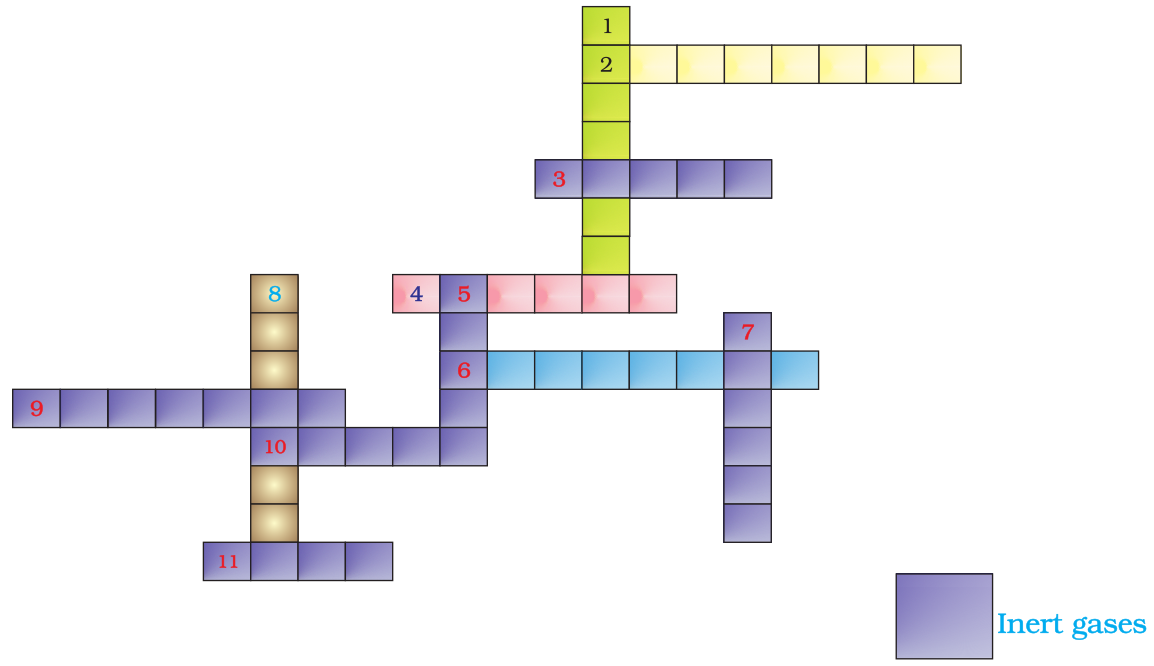
View full solution →What mass of nitrogen $N_2$, will contain the same number of molecules as $1.8g$ of water, $H_2O$? (Atomic masses: $N = 14u; H = 1u; O = 16u)$
View full solution →In a reaction, $5.3g$ of sodium carbonate reacted with $6g$ of acetic acid. The products were $2.2g$ of carbon dioxide, $0.9g$ water and $8.2g$ of sodium $Q$ acetate. Show that these observations are in agreement with the law of conservation of mass. sodium carbonate + acetic acid $\rightarrow $ sodium acetate + carbon dioxide + water.
View full solution →Raunak took $5$ moles of carbon atoms in a container and Krish also took $5$ moles of sodium atoms in another container of same weight.
- Whose container is heavier?
- Whose container has more number of atoms?
View full solution →Write the formulae of the following compounds. Also name the elements present in them.
- Water.
- Ammonia.
- Methane.
- Sulphur dioxide.
- Ethanol.
Write the formulae for the following and calculate the molecular mass for each one of them.
- Caustic potash
- Baking powder
- Lime stone
- Caustic soda
- Ethanol
- Common salt
Write the cations and anions present, if any, in the following:
- CH3COONa
- NaCl
- H2
- NH4NO3
Which has more number of atoms?
100g of N2 or 100g of NH3
Which has more number of atoms, 100grams of sodium or 100grams of iron (given, atomic mass of Na = 23u, Fe = 56u)?