Questions · Page 1 of 5

Do as directed; [Che-1 M]

🎯

Test yourself on this topic

50 questions · timed · auto-graded

Question 11 Mark
Write the symbols/ formulae of two simple ions and two compound ions (or polyatomic ions).
Answer
Write the symbols/ formulae of two simple ions and two compound ions (or polyatomic ions).
View full question & answer
Question 21 Mark
Write the relation between nanometer and metre.
Answer
The relation between nanometer and meter is 1 nanometer = 10−9m.
View full question & answer
Question 31 Mark
Write the molecular formulae for the following compounds.
Mercury (II) chloride.
Answer
It consists of one mercury (II) cation (Hg+2) and two chloride anions (Cl-1). The molecular or chemical formula of Mercury (II) chloride is HgCl2.
View full question & answer
Question 51 Mark
Write the molecular formulae for the following compounds.
Iron (III) sulphide.
Answer
Oxidation state of sulphide is −2 and that of iron is given as +3. Therefore, to balance the charges, molecular formula will be Fe2S3.
View full question & answer
Question 81 Mark
Write the molecular formulae for the following compounds.
Aluminium (III) nitrate.
Answer
The molecular formula of the compound is Al NO 3 3 .
View full question & answer
Question 91 Mark
Write the ions present in:
  1. Al2(CO3)3
  2. AlBr3
Answer
  1. 2 ions of Al3+

3 ions of CO32-

Hence total no. of ions = 5

  1. The ions present in AlBr3 are aluminum ion (Al3+) and bromide ions (Br1-)
View full question & answer
Question 111 Mark
Write the formula of the following compound:
Sodium phosphate.
Answer
The formula of sodium phosphate is Na 3 PO 4 .
View full question & answer
Question 121 Mark
Write the formula of the following compound:
Sodium bromide.
Answer
Sodium Bromide is an inorganic compound with the chemical formula NaBr.
View full question & answer
Question 171 Mark
Write the chemical formula using criss-cross method:
Magnesium bicarbonate.
Answer
The Criss cross method is shown below: The atomic number of magnesium is 12, and the valency of magnesium is two, while the valency of bicarbonate is one. To satisfy the valency of the magnesium atom, it requires two bicarbonates. Therefore, the correct formula of magnesium bicarbonate is M g ( H C O 3 ) 2 .
View full question & answer
Question 191 Mark
Write the chemical formula using criss-cross method:
Ammonium sulphate.
Answer
Ammonium sulphate (NH4)2 + (SO4)1
Cross multiply (NH4)1 (SO4)2 = (NH4)2SO4
View full question & answer
Question 201 Mark
Write the chemical formulae of the following:
Magnesium chloride.
Answer
The chemical formula for Magnesium chloride is MgCl2.
View full question & answer
Question 251 Mark
Write the chemical formulae and names of the compounds formed by the following ions:
Pb2+ and NO3 ​​​​
Answer
Pb2+ and NO3- : Pb(NO3)2 = Lead nitrate.
View full question & answer
Question 261 Mark
Write the chemical formulae and names of the compounds formed by the following ions:
Mg2+ and CO32–
Answer
Mg2+ and CO32–: MgCO3 = Magnesium carbonate.
View full question & answer
Question 271 Mark
Write the chemical formulae and names of the compounds formed by the following ions:
Cr3+ and SO42–
Answer
Cr3+ and SO42- : Cr2(SO4)3 = Chromium sulphate.
View full question & answer
Question 281 Mark
Write the atomicity of the following:
S8
Answer
S8: The atomicity of S8 is 8 because it contains 8 atoms of Sulphur.
View full question & answer
Question 301 Mark
Write the atomicity of the following:
H2S
Answer
H2S: The Atomicity of H2S is 3 because it contains 2 atoms of hydrogen and one atom of Sulphur.
View full question & answer
Question 311 Mark
Write the atomicity of the following:
HNO3
Answer
In HNO3 , there are three atoms of oxygen, one atom of nitrogen and one atom of hydrogen sulphur constituting a molecule of HNO3 . Hence, the atomicity is five.
View full question & answer
Question 321 Mark
Write down the names of Q compounds represented by the following formulae:

K2 SO4

Answer
K2SO4→ Potassium sulphate.
View full question & answer
Question 351 Mark
Write down the names of Q compounds represented by the following formulae:
CaCO3.
Answer
CaCO3 represents the compound calcium carbonate.
View full question & answer
Question 361 Mark
Write down the names of Q compounds represented by the following formulae:
CaCl2
Answer
CaCl2→ Calcium chloride.
View full question & answer
Question 411 Mark
Write down the formulae for the following compounds:
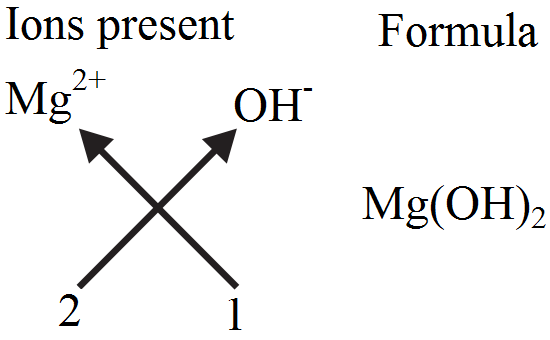
Magnesium hydroxide
Answer
Magnesium hydroxide: Mg(OH)2
View full question & answer
Question 421 Mark
Write down the formulae for the following compounds:
Calcium oxide.
Answer
The chemical formula of calcium oxide is C a O.
View full question & answer
Question 431 Mark
Work out the formula for sulphur dioxide.
(Valencies: S = 4; O = 2)
Answer
$\ \text{Symbols}:\ \ \ \ \ \text{S}\ \ \ \ \ \ \ \ \ \text{O}\\ {\text{Valencies}}:\ +4\ \ \ \ -2$
Chemical formula of sulphur dioxide is SO2
View full question & answer
Question 441 Mark
Work out the formula for magnesium hydrogencarbonate.
Answer
A compound, Mg(HCO3)2, that is stable only in solution. It is formed by the action of carbon dioxide on a suspension of magnesium carbonate in water:MgCO3(s)+CO2(g)+H2O(l) → Mg(HCO3)2(aq) On heating, this process is reversed.
View full question & answer
Question 451 Mark
Work out the formulae for the following compounds:
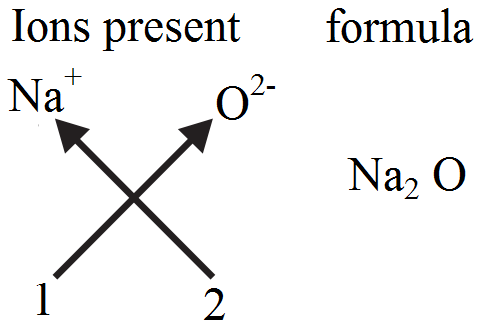
Sodium oxide.
Answer
The chemical formula for sodium oxide is Na2O.
View full question & answer
Question 461 Mark
Work out the formulae for the following compounds:
Calcium carbonate.
Answer
Calcium carbonate:

$\ \text{Symbols}:\ \ \ \ \ \text{Ca}\ \ \ \ \ \ \ \ \ \text{CO}_3\\ {\text{Valencies}}:\ \ +2\ \ \ \ \ \ \ \ -2$

Thus, the resulting compound is CaCO3

View full question & answer
Question 471 Mark
Why is it not possible to see an atom with the unaided eyes?
Answer
Atoms are very tiny particles that are measured in nanometres. Hence they cannot be seen with the naked eye, but can only be seen under a microscope.
View full question & answer
Question 481 Mark
Why is it not possible to see an atom with naked eyes?
Answer
The size of an atom is so small that it is not possible to see it with naked eyes. Also, the atom of an element does not exist independently.
View full question & answer
Question 491 Mark
Which unit is used to measure the atomic radius? Convert it into metre.
Answer
Fermi unit is used to measure the atomic radius. 1 Fermi = 10-15 m.
View full question & answer
Question 501 Mark
Which postulate of Dalton’s atomic theory can explain the law of definite proportions?
Answer
The postulate which can explain the law of definite proportions is that the relative number and the kinds of atoms are constant in a given compound.
View full question & answer
Do as directed; [Che-1 M] - Science STD 9 Questions - Vidyadip