Questions

Answer the questions.[Che-3M]

🎯

Test yourself on this topic

50 questions · timed · auto-graded

Question 13 Marks
You want to wear your favourite shirt to a party, but the problem is that it is still wet after a wash. What steps would you take to dry it faster?
Answer
This can be done by the following (any one or more) steps:
  1. Dry it under the fan: Under the fan when the speed of wind increases, the particles of water vapour from the shirt move away with the wind, decreasing the amount of water vapour in the surroundings. It increases the rate of evaporation of water and the washed wet shirt dries more quickly.
  2. Use hanger for exposing its larger surface to air: When shirt is spread, it has large surface area. This makes the evaporation of water faster. Due to this, shirt dries up more quickly.
  3. Dry it in Sun: On sunny day, temperature of atmosphere is more, therefore, the rate of evaporation increases. It is because, on increasing temperature, more particles of water get enough kinetic energy to go into the vapour state. This increases the rate of evaporation.
  4. Use iron: By the use of iron, temperature increases and water converts into vapour state (steam) very quickly. Hence, rate of evaporation increases and shirt dries very quickly.
View full question & answer
Question 23 Marks
With the help of an example, explain how diffusion of gases in water is essential?
Answer
The gases from the atmosphere diffuse and dissolve in water. Gases like oxygen and carbon dioxide diffuse in water, are essential for the survival of aquatic animals and plants.
Animals breathe in this oxygen dissolved in water for their survival and plants can use carbon dioxide dissolved in water for photosynthesis.
View full question & answer
Question 33 Marks
Why is it advisable to use pressure cooker at higher altitudes for cooking food?
Answer
It is advisable to use pressure cooker at higher altitudes for cooking food because:
A liquid boils only when its vapour pressure is equal to the atmospheric pressure. At high altitudes, the atmospheric pressure is very low. This causes the water to boil at a lower temperature which will take a lot of time for food to be cooked. A pressure cooker stops the boiling of water at lower temperature.
As a result, food cooks quickly.
View full question & answer
Question 43 Marks
Why is heat energy needed to melt a solid? What is this heat energy called?
Answer
When a solid is heated, the heat energy makes its particles vibrate more vigorously. At the melting point, the particles of solid have sufficient energy to overcome the strong forces of attraction holding them in fixed positions and break to form small groups of particles. This heat energy is kinetic energy.
View full question & answer
Question 53 Marks
Why do solids are generally denser than liquids and gases?
Answer
Density of a substance is given by a formula
Density $=\frac{\text{Mass}}{\text{Volume}}$
In case of solids the molecules are tightly packed and hence large mass is concentrated in very small volume. Hence their density is more. But in case of liquids and gases, their molecules have intermolecular space and hence they don’t have large mass concentrated in small volume. So the density of solids is generally more than that of the liquids and gases.
View full question & answer
Question 63 Marks
Why does the temperature remain constant during the melting of ice even though heat is supplied continuously?
Answer
The heat energy supplied to ice during the change of state (at its melting point) is all used up in overcoming (or breaking) the force of attraction between its particles without increasing its kinetic energy. Since the heat (or latent heat) supplied during the change of state does not increase the kinetic energy of the ice cubes, therefore no rise in temperature takes place. The temperature remains constant.
View full question & answer
Question 73 Marks
Why does the temperature remain constant during the boiling of water even though heat is supplied continuously?
Answer
The heat energy supplied to water during the change of state (at its boiling point) is all used up in overcoming (or breaking) the force of attraction between its particles without increasing its kinetic energy. Since the heat (or latent heat) supplied during the change of state does not increase the kinetic energy of the water, therefore no rise in temperature takes place. The temperature remains constant.
View full question & answer
Question 83 Marks
Why does the temperature of a substance remain constant during its melting point or boiling point?
Answer
The temperature of a substance remains constant during melting and boiling points till the completion of melting and boiling. It is because substance makes use of latent heat of fusion to overcome force of attraction between particles of solid to change into liquid during melting and latent heat of vaporisation to overcome force of attraction between particles of liquid to change into vapours during boiling.
Therefore, temperature remains constant.
View full question & answer
Question 93 Marks
Why does our palm feel cold when we put some acetone (or perfume) on it?
Answer
Acetone (or perfume) is volatile in nature. When we apply it to our palm, we feel cold. This happens due to the fact that to change from liquid to the vapour state, acetone requires latent heat of vaporization. Acetone takes this latent heat of vaporization from the hand due to which the palm loses heat and feels cold.
View full question & answer
Question 103 Marks
Why does a desert cooler cool better on a hot dry day?
Answer
When a liquid evaporates, the particles of the liquid absorb energy from the surroundings to compensate the loss of energy during evaporation. This makes the surroundings cool.
In a desert cooler, the water inside it is made to evaporate. This leads to absorption of energy from the surroundings, thereby cooling the surroundings. Again, we know that evaporation depends on the amount of water vapour present in air (humidity). If the amount of water vapour present in air is less, then evaporation is more. On a hot dry day, the amount of water vapour present in air is less. Thus, water present inside the desert cooler evaporates more, thereby cooling the surroundings more. That is why a desert cooler cools better on a hot dry day.
View full question & answer
Question 113 Marks
Why burns caused by the steam are much more severe than boiling water?
Answer
Steam causes more severe burns that boiling water because even when both are in equal temp. steam will require to give latent heat also to change its state and then it will give away heat until the object's temp is made equal to the steam and therefore it will giveaway more heat and so cause more severe burn.
View full question & answer
Question 123 Marks
When a gas jar containing air is inverted over a gas jar containing bromine vapour, the red-brown bromine vapour diffuse into air. Explain how bromine vapour diffuse into air.
Answer
Both bromine gas and air is made up of tiny moving particles. When a gas jar containing air is inverted over gas jar containing bromine vapour, both bromine and air molecules move and collide with one another and bounce about in all directions due to which we see a uniform red brown colour in both the jars.
View full question & answer
Question 143 Marks
What type of clothes should we wear in summer? Why?
Answer
We should wear cotton clothes in hot summer days because we perspire more through the pores of the skin during such days. Since, sweat is mainly water and cotton clothes are good absorber of water, they absorb the sweat quickly and expose it to the atmosphere for evaporation. The evaporation of sweat from the cotton clothes takes the latent heat of vaporization from our skin hence the skin loses heat and makes us feel cool and comfortable.
View full question & answer
Question 153 Marks
What is the value of the latent heat of fusion of ice?
Answer
Latent heat of fusion is the amount of heat energy required to change 1kg of a solid into liquid at its melting point. The latent heat of fusion of ice is 80cal/g.
View full question & answer
Question 163 Marks
Water as ice has a cooling effect, whereas water as steam may cause severe burns. Explain these observations.
Answer
In the case of ice, the water molecules have low energy; while in the case of steam, the water molecules have high energy. In the case of ice, the water molecules absorb energy from the body and thus produce a cooling effect. On the other hand, the high energy of water molecules in steam is transformed as heat which may cause burns.
View full question & answer
Question 173 Marks
The substance X normally exists in a physical state which can flow easily but does not fill its vessel completely. It also turns anhydrous copper sulphate blue. When substance X is cooled excessively, it changes into a substance Y which has a fixed shape as well as a fixed volume. If, however, the substance X is heated strongly, it changes into a substance Z which has neither a fixed shape nor a fixed volume.
  1. Name the substances (i) X (ii) Y and (iii) Z.
  2. What is the process of conversion of X into Y known as?
  3. At which temperature X gets converted into Y?
  4. What is the process of conversion of X into Z known as?
  5. At which temperature X gets converted into Z?
Answer
  1. The substances X, Y and Z are water, ice and steam, respectively.
  2. The process of conversion of X into Y is known as freezing.
  3. At 0°C X is converted to Y.
  4. Boiling or vaporisation is the name of the process of conversion of X to Z.
  5. At 100°C X gets converted to Z.
View full question & answer
Question 183 Marks
The scientists now say that there are actually five states of matter A, B, C, D and E. The state A has a fixed volume but no fixed shape. The state B can be compressed very easily by applying pressure and state C has a fixed shape as well as a fixed volume. The state D is mixture of free electrons and ions whereas state E is named after an Indian scientist and a famous physicist.
  1. Name the physical states (i) A (ii) B (iii) C (iv) D, and (v) E.
  2. Name one substance belonging to state C which can directly change into vapours on heating. What is this process known as?
  3. Name one substance which normally belongs to state B but whose solid form changes directly into gaseous state.
  4. Name the most common substance belonging to state A.
  5. Which state of matter makes the sum and other stars to glow.
Answer
  1. The physical states are:
  • A-liquid.
  • B-gas.
  • C-solid.
  • D-plasma.
  • E-Bose-Einstein condensate (BEC).
  1. Ammonium chloride; and the name of the process is sublimation.
  2. Carbon dioxide.
  3. Water.
  4. Plasma is the state of matter that allows the sun and the other stars to glow.
View full question & answer
Question 193 Marks
The melting point of ice is 273.16K. What does this mean? Explain in detail.
Answer
Ice is solid at 0°C i.e., 273°K. The molecules of ice are tightly packed. These molecules have to overcome the force of attraction with which they are held and hence they gain this heat from the surrounding but the temperature remains the same as their energy is used to overcome the force of attraction between the particles. The particles have their state and starts vibrating freely and a stage reaches when the solid ice melts and is converted to liquid state at the same temperature i.e., 273K.
View full question & answer
Question 203 Marks
State two characteristic properties each of:
  1. A solid
  2. A liquid
  3. A gas
Answer
  1. Characteristics of a solid:
  • Solids have a fixed shape and fixed volume.
  • Solids do not flow.
  1. Characteristics of a liquid:
  • Liquids have a fixed volume but no fixed shape, they take the shape of the vessel in which they are placed.
  • They generally flow easily.
  1. Characteristics of a gas:
  • Gases can be compressed easily.
  • Gases fill their container completely.
View full question & answer
Question 213 Marks
Show experimentally that matter is made up of small particles.
Answer
  • Take 2-3 crystals of potassium permanganate and dissolve them in 100ml of water.
  • Take out approximately 10ml of this solution and put it into 90ml of clear water.
  • Take out 10ml of this solution and put it into another 90ml of clear water.
  • Keep diluting the solution like 5 to 8 times.
  • Is the water still coloured?

This experiment shows that just a few crystals of potassium can colour a large volume of water. So we conclude that there must be millions of tiny particles.

View full question & answer
Question 223 Marks
Show by an experiment that by increasing the temperature, the substance can be changed into liquid and then into vapours.
Answer
Take some ice cubes in a beaker and heat it by spirit lamp or Bunsen burner and put a thermometer in the beaker, when the temperature reaches to zero degree Celsius the temperature will not increase.
Till the whole amount of ice does not changes into its liquid state next heat it continuously and then when the temperature reaches hundred degree Celsius the temperature will not increase till the whole amount of water does not changes into its gaseous state as water vapours.
View full question & answer
Question 233 Marks
‘Osmosis is a special kind of diffusion’. Comment.
Answer
Osmosis is a special kind of diffusion. In both the phenomena, there is a movement of particles from the region of higher concentration to a region of lower concentration. However, in case of osmosis, the movement is of "solvent particles" from a less concentrated "solution" and the movement is through a semi-permeable membrane.
View full question & answer
Question 243 Marks
On a hot sunny day, why do we feel pleasant sitting under a tree?
Answer
Tree has lot of leaves which constantly show transpiration. Transpiration is loss of water through small tiny pores of leaves called stomata. When this water comes on the surface of leaf the water evaporates thereby causing cooling effect. Therefore we feel pleasant sitting under the tree on a hot sunny day.
View full question & answer
Question 253 Marks
Name the scientist who studied the movement of pollen grains suspended in water through a microscope. What is this phenomenon known as?
Answer
Robert Brown suspended extremely small pollen grains in water and observed it through a microscope. It was found that pollen grains were moving very rapidly throughout the water in a very irregular way. He also observed that warmer the water, faster the pollen grains move on the surface of water. This phenomenon is known as the ‘Brownian Motion’.
View full question & answer
Question 263 Marks
Liquids generally have lower density as compared to solids. But you must have observed that ice floats on water. Find out why.
Answer
The mass per unit volume of a substance is called density (density = mass/volume). As the volume of a substance increases, its density decreases.
Though ice is a solid, it has large number of empty spaces between its particles. These spaces are larger as compared to the spaces present between the particles of water. Thus, the volume of ice is greater than that of water. Hence, the density of ice is less than that of water. A substance with lower density than water can float on water. Therefore, ice floats on water.
View full question & answer
Question 273 Marks
It is a hot summer day, Priyanshi and Ali are wearing cotton and nylon clothes respectively. Who do you think would be more comfortable and why?
Answer
Cotton is a soft fibre whereas nylon is a synthetic polymer. Cotton absorbs water (moisture) better as compared to nylon. Therefore, cotton helps in a faster absorption of sweat followed by evaporation. Evaporation of sweat from a cotton shirt, particularly during a windy weather, leads to a cooling effect. So, Priyanshi would be more comfortable in a cotton shirt, whereas Ali (wearing a nylon shirt) would not be that comfortable.
View full question & answer
Question 283 Marks
Ice at 0°C is more effective in cooling than water at 0°C. Give reason.
Answer
Both ice and water at 0°C cool down other bodies by extracting heat from them. However, when you supply heat to water, it's temperature rises, but in the case of ice, it first melts, and then the temperature of the formed water rises.
Therefore, even if both the ice and the water end up as water finally, the ice extracts an extra amount of heat from the body to be cooled, given by:
$\Delta\text{H}=\text{L}_\text{f}\times\text{M}$
View full question & answer
Question 293 Marks
How will you demonstrate that water vapour is present in air?
Answer
The presence of water vapour in air can be demonstrated by the following experiment: We take a steel tumbler and put some well crushed ice in it. Allow the steel tumbler to stand undisturbed for about 5 minutes with the ice in it. We would observe that a large number of tiny drops of water appear on the outer surface of the steel tumbler. This happens because the air around the steel tumbler contains water vapour in it. When these water vapour come in contact with the cold, outside surface of steel tumbler, they condense to form tiny drops of liquid.
View full question & answer
Question 303 Marks
How is melting point related to intermolecular forces of attraction? Why is latent heat of vaporization higher than latent heat of fusion?
Answer
  1. Melting point is directly related to inter molecular forces of attraction i.e. higher is the inter molecular forces of attraction, higher is the melting point.

Melting point is the temperature at which solid phase is converted into liquid phase. Thus to break the strong molecular forces present in solid, energy has to be supplied in the form of heat which helps to break the forces and molecules gain kinetic energy which overcome the inter molecular forces and thus liquid phase is achieved.

  1. Latent heat of vaporization is the amount of heat required to convert 1 gram of liquid into its vapor state without change in its temperature. The latent heat of vaporization of water is 40.67 kJ/mol.

Latent heat of fusion is the amount of heat required to convert 1 gram of solid into its liquid state without change in its temperature. The latent heat of fusion of water is 6.01 kJ/mol.

In fusion or melting, the molecules just need enough energy to slide around each other, while for vaporization, they need enough energy to completely escape the system. Thus the enthalpy of vaporization is always going to be higher than the enthalpy of fusion.

View full question & answer
Question 313 Marks
How is high compressibility property of gas is useful to us?
Answer
The gases have high compressibility. This property is used in the following situation:
  1. LPG (liquefied petroleum gas) is a fuel which is made up of petroleum gas. On compressing this petroleum gas it forms liquid.
  2. Oxygen cylinders in the hospitals have compressed gas filled in it.
  3. CNG (compressed natural gas) is a natural gas, methane, which is compressed and used as a fuel in vehicles and at home.
View full question & answer
Question 323 Marks
How gases can be liquefy?
Answer
In general, gases can be liquefied by one of three general methods:
  1. By compressing the gas at temperatures less than its critical temperature.
  2. By making the gas do some kind of work against an external force, causing the gas to lose energy and change to the liquid state.
  3. By using the Joule-Thomson effect.
View full question & answer
Question 333 Marks
How does the water kept in an earthen pot (matka) become cold during summer?
Answer
The earthen pot (or matka) has a large number of extremely small pores on its walls. Some of the water kept in the earthen pot continuously keeps seeping through these pores to the outside of the pot. This water evaporates continuously by taking the latent heat of vaporization from the earthen pot and the remaining water. In this way, the earthen pot and remaining water loses heat and gets cooled.
View full question & answer
Question 343 Marks
How are particles of matter affected with increasing or reducing pressure at a given temperature?
Answer
Increasing or decreasing the pressure can change the state of matter. Applying pressure and reducing temperature can liquefy gases.
For an example, Solid carbon dioxide (CO2) is stored under high pressure. Solid CO2 gets converted directly to gaseous state on decrease of pressure to 1 atmosphere without coming into liquid state. This is the reason that solid carbon dioxide is also known as dry ice.
View full question & answer
Question 353 Marks
Explain why, we can easily move our hand in air but to do the same through a plank of wood, we need a karate expert.
Answer
Air is a gas whose particles are very far apart and there are very weak forces of attraction between them. Extremely weak forces between particles of air can be overcome easily due to which we can move our hand in air. On the other hand, the particles of a solid plank of wood are very closely packed and there are very strong forces of attraction between the particles of wood. Hence, it needs a huge outside force to overcome the strong inter particle attractions which only a karate expert can apply.
View full question & answer
Question 363 Marks
Explain why, osmosis can be considered to be a special kind of diffusion. Classify the following into (i) osmosis, and (ii) diffusion:
  1. Swelling up of a raisin on keeping in water.
  2. Spreading of virus on sneezing.
  3. Earthworm dying on coming in contact with common salt.
  4. Shrinking of grapes kept in thick sugar syrup.
  5. Preserving of pickles in salt.
  6. Spreading of smell of cake being baked in the kitchen.
  7. Aquatic animals using oxygen dissolved in water during respiration.
Answer
Osmosis is considered to be a special kind of diffusion because it takes place only through a semi-permeable membrane, which allows only solvent particles to pass through it.
  1. Osmosis: a, c, d and e.
  2. Diffusion: b, f and g.
View full question & answer
Question 373 Marks
Explain why, ice at 0°C is more effective in cooling than water at the same temperature.
Answer
This is due to the fact that for melting, each kilogram of ice takes its latent heat of 3.34 × 10⁵ joules from the substance and hence cools the substance more effectively. On the other hand, water at 0° cannot take any such latent heat from the substance.
View full question & answer
Question 403 Marks
Draw a labeled diagram of the experimental set-up to demonstrate the sublimation of ammonium chloride.
View full question & answer
Question 413 Marks
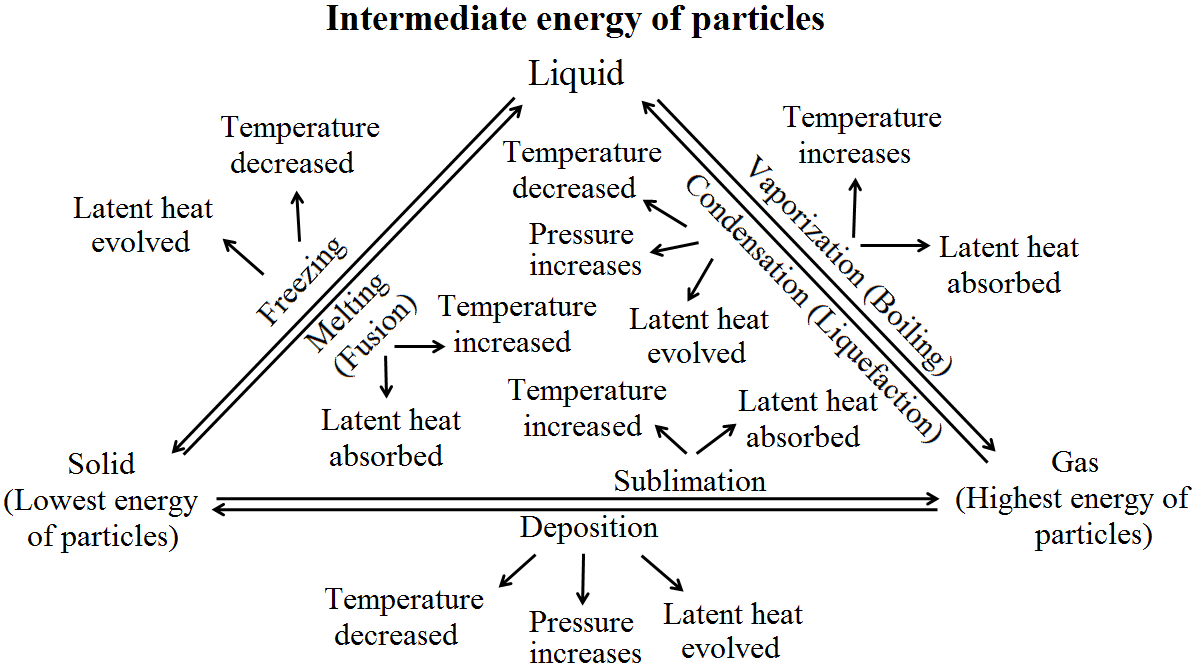
Draw a cyclic figure to show interconversation of states and explain fusion, vapourisation, condensation, solidification and sublimation.
View full question & answer
Question 423 Marks
Describe by experiment the relationship between the rate of diffusion and density of the liquid.
Answer
Diffusion is one of the most important chemical characteristics of a substance which is necessary for different chemical reactions.
The rate of diffusion is dependent on many chemical and physical characteristics of that substance, such as density.
The rate of diffusion and the density of the substance are inversely proportional to each other.
Which means, a higher density substance will perform the diffusion slowly than a lower density substance.
View full question & answer
Question 433 Marks
Comment upon the following:
Rigidity, compressibility, fluidity, filling a gas container, shape, kinetic energy and density.
View full question & answer
Question 443 Marks
Comment on the following statements:
  1. Evaporation produces cooling.
  2. Rate of evaporation of an aqueous solution decreases with increase in humidity.
  3. Sponge though compressible is a solid.
Answer
  1. Evaporation produces cooling.This is based on the fact that when a liquid evaporates, it takes (or draws) the latent heat of vaporisation from ‘another matter’ which it touches. This ‘another matter’ looses heat and gets cooled. Therefore, evaporation causes cooling.
  2. If humidity is high, then air is already saturated with water vapours, i.e., it has a lot of water vapours. Therefore, it will not take more water vapours easily. Hence, rate of evaporation decreases.
  3. Sponge has minute holes in which air is trapped. The material is also not so rigid. On pressing this, air is expelled out, that is why it can be compressed but it is solid as it has a definite shape and volume and does not change its shape unless compressed.
View full question & answer
Question 453 Marks
Classify the following into osmosis/ diffusion:
  1. Swelling up of a raisin on keeping in water.
  2. Spreading of virus on sneezing.
  3. Earthworm dying on coming in contact with common salt.
  4. Shrinking of grapes kept in thick sugar syrup.
  5. Preserving pickles in salt.
  6. Spreading of smell of cake being baked through out the house.
  7. Aquatic animals using oxygen dissolved in water during respiration.
Answer
Osmosis occurs in:
  1. Swelling up of a raisin on keeping in water.
  1. Earthworm dying on coming in contact with common salt.
  1. Shrinking of grapes kept in thick sugar syrup.
  1. Preserving pickles in salt.
Diffusion occurs in:
  1. Spreading of virus on sneezing.
  1. Spreading of smell of cake being baked throughout the house.
  1. Aquatic animals using oxygen dissolved in water during respiration.
View full question & answer
Question 463 Marks
Bromine and air take about 15 minutes to diffuse completely but bromine diffuses into a vacuum very rapidly. Why is this so?
Answer
Bromine diffuses slowly in air because the motion of bromine particles is obstructed due to the collision with the moving air particles. But bromine diffuses very rapidly in vacuum because in vacuum there is no gas, and the motion of the particles of bromine gas is not obstructed by any other particle. Therefore, the diffusion rate in vacuum is high.
View full question & answer
Question 473 Marks
Answer
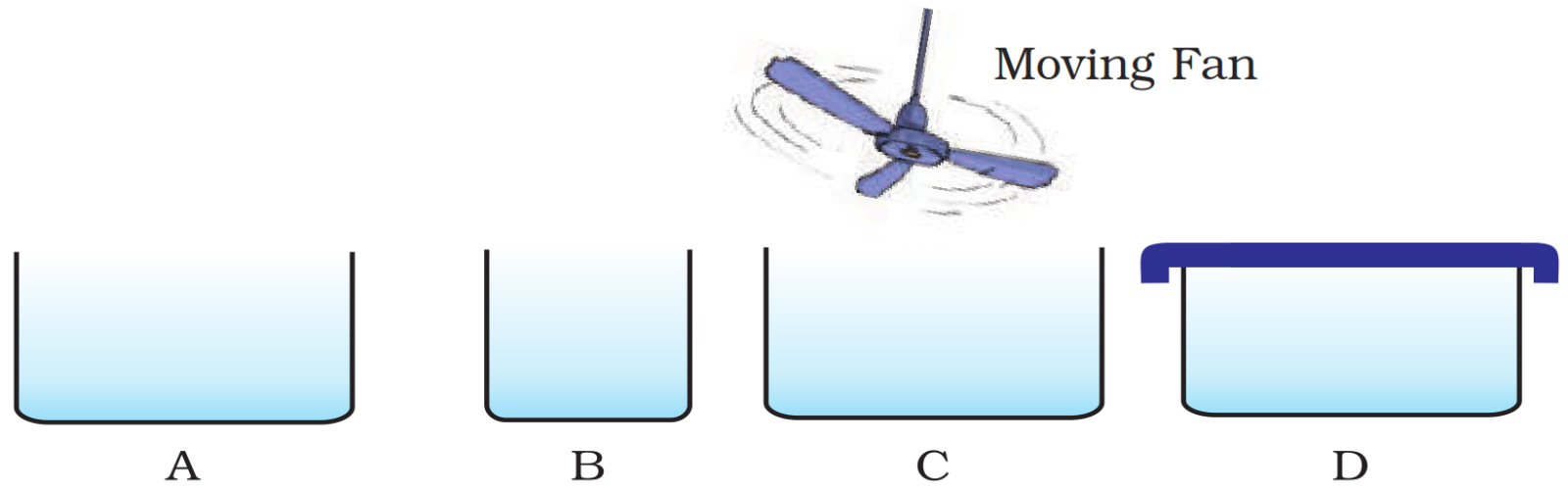
The rate of evaporation will be highest in vessel C as the surface area exposed for evaporation is larger than 6 (smaller size). The moving fan increases the wind speed which also increases the rate of evaporation. Although A and D are also equal in size to that of C but A is at a greater distance from the fan and D is covered with a lid.
View full question & answer
Question 483 Marks
A sample of water under study was found to boil at 102°C at normal pressure. Is the water pure? Will this water freeze at 0°C? Comment.
Answer
The boiling point of pure water is 100°C at 1 atm. The freezing point of pure water is 0°C. The sample of water under study boils at 102°C at normal pressure. Hence, the sample is not pure water. The sample of water is not pure, it will not freeze at 0°C. It will freeze at a temperature below 0°C.
View full question & answer
Question 493 Marks
A piece of chalk can be broken into small particles on hammering, but it is not possible to break a piece of iron in the same fashion. Why?
Answer
Because of forces of attraction. Force of attraction between particles of chalks is less than force of attraction between particles of iron and because of weak forces of attraction in chalk piece, we are able to break it easily and it's difficult to break a piece of iron.
View full question & answer
Question 503 Marks
Alka was making tea in a kettle. Suddenly she felt intense heat from the puff of steam gushing out of the spout of the kettle. She wondered whether the temperature of the steam was higher than that of the water boiling in the kettle. Comment.
Answer
The temperature of steam is not different from that of boiling water. The high energy of steam leads Alka to wonder whether the temperature of steam was higher than that of the water boiling in the kettle. The temperature of boiling water as well as that of steam is 100°C, but steam has more energy because of the latent heat of vaporization.
View full question & answer