- ✓Atmospheric pressure is low at higher altitudes.
- BTemperature is low at higher altitudes.
- CAtmospheric pressure is high at higher altitudes.
- DNone of the above.
Answer: A.
View full solution →919 questions across 18 question groups — pick any mix to generate a Science paper with step-by-step answer keys.
M.C.Q. [1 M]
155 Q→02M.C.Q-[Che-1M]
151 Q→03Assertion (A) & Reason (B) MCQ
5 Q→04Assertion - Reasoning [Che-1 M]
5 Q→05true or false
4 Q→06Fill in the blank [Che-1M]
24 Q→07Fill in the blank
24 Q→08True-False [Che-1M]
4 Q→09Do as directed; [1 M ]
111 Q→10Do as directed; [Che-1 M]
111 Q→11Que-Ans (Each of 2 Mark )
90 Q→12Answer the questions.[Che-2M]
90 Q→13Que-Ans (Each of 3 Mark )
49 Q→14Answer the questions.[Che-3M]
50 Q→15Que-Ans (Each of 5 Mark )
18 Q→16case /data -based [Che-4M]
5 Q→17Case study ( 4 Marks )
5 Q→18Answer the questions.[Che-5M]
18 Q→One sample from each question group in this chapter. Select any group above to see the full set with answer keys.
Answer: A.
View full solution →Answer: B.
View full solution →Answer: C.
View full solution →Answer: A.
View full solution →Answer: B.
View full solution →Substance | Boiling Point (ºC) | Melting Point (ºC) |
A | -183 | -219 |
B | 445 | 119 |
C | 78 | -15 |
Answer: B.
View full solution →Answer: A.
View full solution →Answer: C.
View full solution →Answer: A.
View full solution →Answer: B.
View full solution →
With the increase of temperature, more number of particles get enough kinetic energy to go into the vapour state.
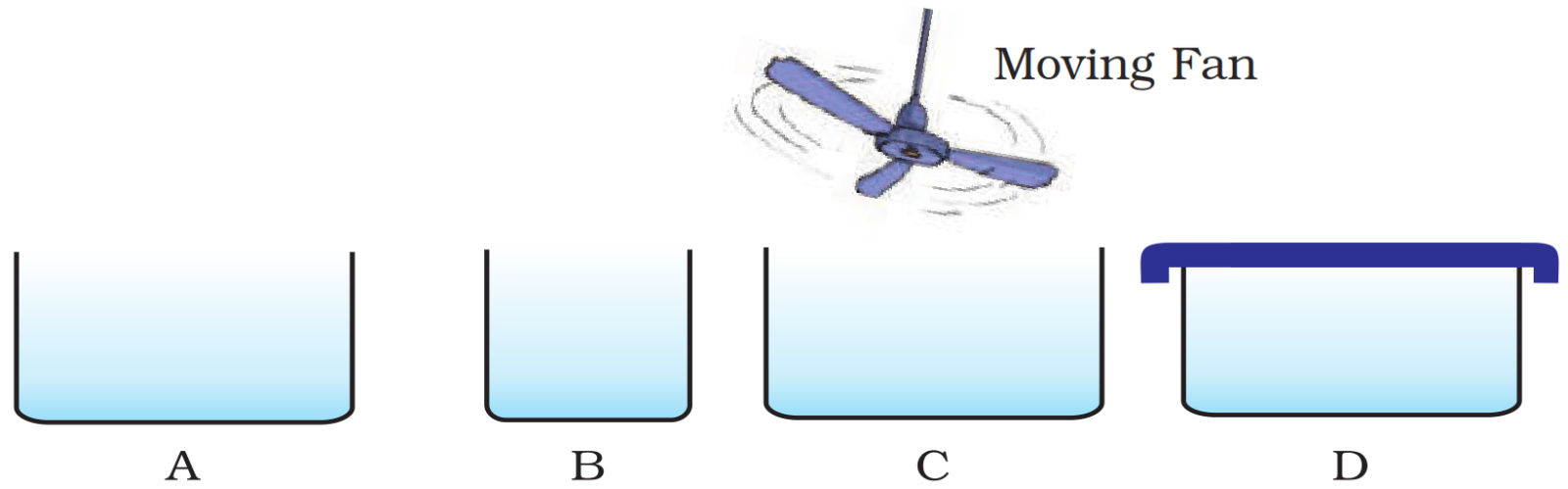
In an open vessel, the liquid keeps on evaporating. The particles of liquid absorb energy from the surrounding to regain the energy lost during evaporation. This absorption of energy from the surroundings makes the surroundings cold. What happens when you pour some acetone (nail polish remover) on your palm? The particles gain energy from your palm or surroundings and evaporate causing the palm to feel cool. After a hot sunny day, people sprinkle water on the roof or open ground because the large latent heat of vaporization of water helps to cool the hot surface.
i.) Evaporation is surface phenomenon. True or false
a.) True
b.) False
c.) None of these
ii.) As temperature increases the rate of evaporation is
a.) increases
b.) decreases
c.) remains constant
d.) None of these
iii.) The rate of evaporation increases with
a.) Increase in wind speed
b.) Decrease in wind speed
c.) Does not have any effect from wind speed
d.) None of these
iv.) What happens when you pour some acetone (nail polish remover) on your palm?
v.) We are able to sip hot tea from saucer than from cup. Why?
Particles start vibrating with greater speed. The energy supplied by heat overcomes the forces of attraction between the particles. The particles leave their fixed positions and start moving more freely. A stage is reached when the solid melts and is converted to a liquid. The minimum temperature at which a solid melts to become a liquid at the atmospheric pressure is called its melting point.
The temperature of the system does not change after the melting point is reached, till all the ice melts. This happens even though we continue to heat the beaker, that is, we continue to supply heat. This heat gets used up in changing the state by overcoming the forces of attraction between the particles. The amount of heat energy that is required to change 1 kg of a solid into liquid at atmospheric pressure at its melting point is known as the latent heat of fusion. So, particles in water at 00 C (273 K) have more energy as compared to particles in ice at the same temperature.
The temperature at which a liquid starts boiling at the atmospheric pressure is known as its boiling point. Boiling is a bulk phenomenon. Particles from the bulk of the liquid gain enough energy to change into the vapour state. A change of state directly from solid to gas without changing into liquid state is called sublimation and the direct change of gas to solid without changing into liquid is called deposition.
i.) A change of state directly from solid to gas without changing into liquid state is called
a.) Sublimation
b.) Deposition
c.) Boiling point
d.) None of these
ii.) The direct change of gas to solid without changing into liquid is called
a.) Sublimation
b.) Deposition
c.) Boiling point
d.) None of these
iii.) The energy supplied by heat to solid is used to overcome the forces of attraction between the particles. True or false
a.) True
b.) False
c.) None of these
iv.) Define melting point and boiling point
v.) Define latent heat of fusion
Solids have a definite shape, distinct boundaries and fixed volumes, that is, have negligible compressibility. Solids have a tendency to maintain their shape when subjected to outside force. Solids may break under force but it is difficult to change their shape, so they are rigid.
Liquids have no fixed shape but have a fixed volume. They take up the shape of the container in which they are kept. Liquids flow and change shape, so they are not rigid but can be called fluid.
Gas as has indefinite shape, no fixed volume. Gas gets the shape and volume of container.
Gas has very low density hence are light. Gas can flow easily and hence are called fluid.
i.) Which of the following state of matter takes shape of container in which it is filled?
a.) Solid
b.) Liquid
c.) Gas
d.) Both b and c
ii.) Distance between particles of matter least in
a.) Solid
b.) Liquid
c.) Gas
d.) None of these
iii.) Compressibility is least in case of
a.) Solid
b.) Liquid
c.) Gas
d.) None of these
iv.) Give properties of solids.
v.) Give properties of Gases.
i.) Evaporation of liquid takes place at
a.) Boiling point
b.) Above boiling point
c.) Below boiling point
d.) None of these
ii.) Evaporation takes place at surface of liquid because
a.) They are heavy as compare to other particles
b.) They have sufficient kinetic energy to break the force
c.) They are light weight as compare to other particles
d.) None of these
iii.) During evaporation particles of liquid change into vapour
a.) From the surface
b.) From the bottom
c.) From all over the liquid
d.) None of these
iv.) Define evaporation.
v.) Explain process of evaporation
Answer the following questions by referring above paragraph.
i.) Which of following is not matter?
a.) Pen
b.) air
c.) smell of perfume
d.) None of these
ii.) Thoughts coming in our mind are example of matter. True or false
a.) True
b.) False
c.) None of these
iii.) Which of the following is true about particles of matter?
a.) Particles of matter has spaces between them
b.) Particles of matter are continuously moving
c.) Particles of matter attract each other
d.) All of these
iv.) Give 5 examples of matter in our surroundings
v.) Enlist all properties of particles of matter
Pick question groups from the list above, set marks and difficulty, and export a branded PDF with step-by-step answer keys. First 3 chapters free — no signup.