Questions

Answer the questions.[Che-5M]

🎯

Test yourself on this topic

18 questions · timed · auto-graded

Question 15 Marks
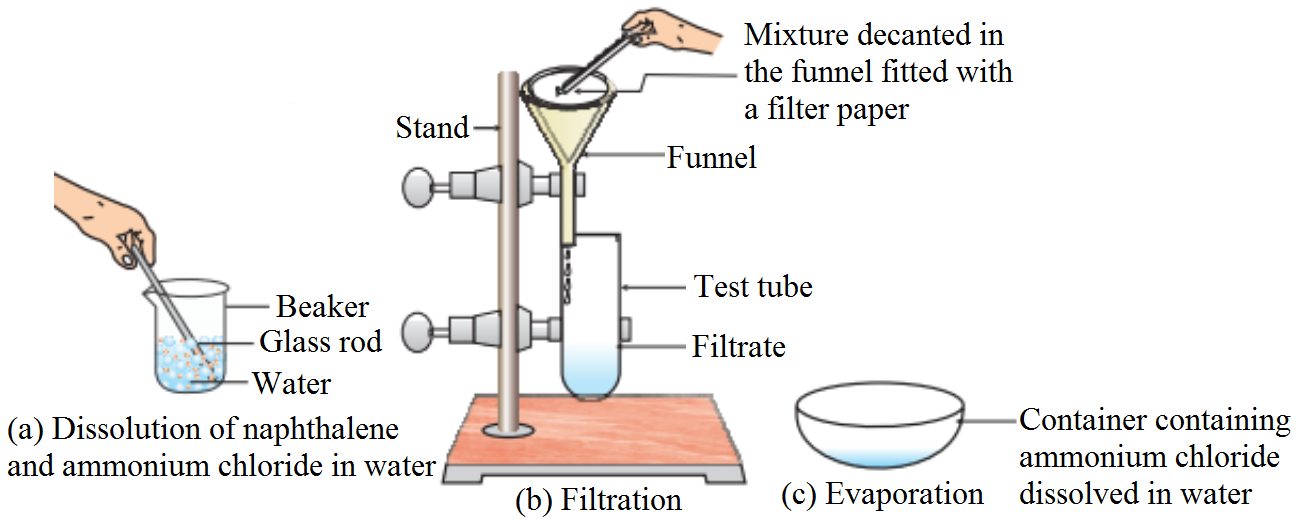
You are provided with a mixture of naphthalene and ammonium chloride by your teacher. Suggest an activity to separate them with well labelled diagram.
View full question & answer
Question 25 Marks
Write an activity to show that water can be made to boil even at a temperate below its normal boiling point (100°C).
Answer
Activity:

  1. Take some warm water in a cup. Gently, fill a 12ml plastic syringe with around 3ml of the warm water from the cup.
  2. Hold the syringe horizontally and press your index finger tightly over the tip of the syringe.
  3. Slowly pull out the plunger. The plunger will show some resistance and it pulls back in the opposite direction.
  4. Allow the plunger to slide back slowly into the syringe and then pull the plunger out again. Release the plunger quickly.
  5. Pull the plunger out the 2nd time. Bubbles will start forming as the water in the syringe boils.

Explanation:

The boiling of water does not only depend on temperature. Pressure also plays a role in the boiling of any liquid. When the pressure goes down below the atmospheric pressure of 1atm, water starts to boil at a temperature lower than its boiling temperature. By pulling the plunger out, we increase the volume inside the syringe but decrease the pressure. This causes the water molecules to gain more kinetic energy. The increase of energy breaks the forces of attraction between the water molecules and they begin to move freely. Hence the water starts to boil.

View full question & answer
Question 35 Marks
Write an activity of show that the rate of diffusion of liquids decreases with increase in density of the liquids.
Answer
Take two beakers filled with water:
  1. Put a drop of blue ink slowly along the sides of the first beaker and honey in the same way in another beaker.
  2. Leave it undisturbed.
  3. We observe that honey diffuses slowly as compared to ink.
This experiment shows that lesser the density, faster the rate of diffusion.
View full question & answer
Question 45 Marks
Why are we able to sip hot tea or milk faster from a saucer rather than from a cup?
Answer
If the hot tea or milk is taken in a cup, then due to the narrow shape of the cup, the surface area of hot tea in the cup is comparatively small. Due to this, the evaporation of hot tea is slow, cooling caused by evaporation is less and hence the hot tea remains appreciably hot for a much longer time. On the other hand, the saucer has a large surface area due to which the tea taken in the saucer evaporates much faster, thus cooling it quickly and making it convenient to sip or drink.
View full question & answer
Question 55 Marks
Which of the following are matter?
Chair, air, love, smell, hate, almonds, thought, cold, lemon water, smell of perfume.
Answer
Anything that occupies space and has mass is called matter. Matter can exist in three physical states— solid, liquid, and gaseous.
Chair and almond are forms of matter in the solid state.
Cold drink is a liquid state of matter.
Air is a gaseous state of matter.
Note: The sense of smell is not matter. However, the smell or odour of a substance is classified as matter. The smell of any substance (say, perfume) can be classified as matter. This is because, perfume is in liquid state inside the bottle. It comes out in the form of tiny droplets. These droplets of perfume are matter and spread out in the atmosphere to create a sense of smell. This smell can be detected by our olfactory system.
View full question & answer
Question 65 Marks
When extremely small particles X derived from the another of a flower were suspended in a liquid Y and observed through a microscope, it was found that the particles X were moving throughout the liquid Y in a very zig zag way. It was also observed that warmer the liquid Y, faster the particles X moved in its surface.
  1. What could particles X be?
  2. What do you think liquid Y is?
  3. What is the zig-zag movement of particles X?
  4. What is causing the zig-zag movement of particles X?
  5. Name the scientist who discovered this phenomenon.
  6. What does this experiment tell us about the nature of liquid Y?
Answer
  1. The particles, 'X' are pollen grains.
  2. The fluid, 'Y' is Water.
  3. The zigzag movement of 'X' is called Brownian motion.
  4. The zigzag motion of the pollen grains occurs because the particles of water are in constant motion. These particles collide with the pollen grains and cause them to move.
  5. Robert Brown is the scientist who discovered Brownian motion.
  6. Liquid Y is made up of extremely small particles, which are moving constantly.
View full question & answer
Question 75 Marks
When a beam of sunlight enters a room through a window, we can see tiny particles X suspended in a gas (or rather a mixture of gases) Y which are moving rapidly in a very haphazard manner.
  1. What could particles X be?
  2. Name the gas (or mixture of gases) Y.
  3. What is the phenomenon exhibited by particles X known as?
  4. What is causing the movement of particles X?
  5. What conclusion does the existence of this phenomenon give us about the nature of matter?
Answer
  1. The particles, 'X' are dust particles.
  2. Gas 'Y' is Air.
  3. This phenomenon being exhibited by 'X' particles is called the Brownian motion.
  4. The fast moving air molecules are constantly hitting the tiny dust particles, causing them to move rapidly in a very haphazard manner.
  5. The gaseous matter ‘air’ is made up of tiny particles that are constantly moving.
View full question & answer
Question 85 Marks
There are four substances W, X, Y and Z. The substance W is a dark violet solid having diatomic molecules. A solution of W in alcohol is used as a common antiseptic C. The substance X is a white solid which is usually recovered from sea water on a large scale. The substance Y is a white solid which is insoluble in water and used in the form of small balls for the safe storage of woollen clothes. The substance Z is a yet another white solid which is used in making commonly used dry cells.
  1. Name (i) W (ii) X (iii) Y and (iv) Z.
  2. Out of W, X, Y and Z, which substance/ substances can undergo sublimation?
  3. Which substances organic in nature?
  4. What is the name of substance C?
  5. Which substance belongs to the halogen family?
Answer
  1. The names are:
  • Iodine.
  • Sodium chloride, which is commonly known as common salt.
  • Naphthalene.
  • Ammonium chloride.
  1. In this ‘W’-iodine, ‘Y’-naphthalene and ‘Z’-ammonium chloride that undergo sublimation.
  2. ‘Naphthalene’ is organic in nature.
  3. The name of the substance ‘C’ is tincture iodine.
  4. In this Iodine belongs to the halogen family.
View full question & answer
Question 95 Marks
Tabulate the differences in the characterisitcs of states of matter.
Answer
The differences in the characteristics of states of matter are given in the following table.
S.No.Solid stateLiquid stateGaseous state
1.Definite shape and volume.No definite shape. Liquids attain the shape of the vessel in which they are kept.Gases have neither a definite shape nor a definite volume.
2.Incompressible.Compressible to a small extent.Highly compressible.
3.There is little space between the particles of a solid.These particles have a greater space between them.The space between gas particles is the greatest.
4.These particles attract each other very strongly.The force of attraction between liquid particles is less than solid particles.The force of attraction is least between gaseous particles.
5.Particles of solid cannot move freely.These particles move freely.Gaseous particles are in a continuous, random motion.
View full question & answer
Question 105 Marks
Show by an activity that the gases are highly compressible as compared to liquids.
Answer
AIM - To show that gases are more compressible than solids and liquids.
MATERIAL REQUIRED - Syringe(100ml, two), rubber cork.
PROCEDURE:
  1. Try to push the piston into both the syringes with almost equal force. See what happens.
  2. Insert a nozzle in each syringe into a rubber cork.
  3. Pull out the piston from both the syringes.
  4. Fill one with water. Let other one have water inside it.
  5. Insert piston in both the syringes.
OBSERVATIONS:
  • The piston can be easily pushed inside the syringe that contained it.
  • The piston in the syringe filled with water cannot be pushed inside.
CONCLUSION:
  • Gases are highly compressible.
  • Liquids are slightly compressible.
View full question & answer
Question 115 Marks
Pressure and temperature determine the state of a substance. Explain this in detail.
Answer
  1. Any matter i.e., solid, liquid or gas when experiences an increase in temperature then they change their state.

$\text{Example:}\ \ \ \ \text{Solid ice} \xrightarrow{\text{heat}}\text{Liquid water}\xrightarrow{\text{heat}}\text{Gas steam}$

Take ice cubes in a beaker or heat them slowly, the temperature increases and the ice melts to form liquid. Heat this liquid further it will become steam.

  1. On lowering down the temperature of any matter, show change in their state.

$\text{Example:}\ \ \ \ \text{Solid steam} \xrightarrow{\text{cool}}\text{Liquid water}\xrightarrow{\text{cool}}\text{Solid ice}$

Take the steam that is coming out of a boiling water and allow it to cool down, it condenses to form water and on further cooling of this water we get ice.

  1. On applying pressure and reducing temperature we can liquefy gases or change them into solid.

Example: Take carbon-dioxide gas, reduce its temperature and apply lot of pressure on it so that it changes into solid carbon dioxide, called dry ice, which is used as refrigerant for cooling.

If the pressure on it is decreased it directly changes into gas.

In LPG cylinders, the petroleum gas is cooled and with lot of pressure changes it into liquid state.

While using this LPG, we release the pressure exerted on it and hence it comes out in the form of gas.
View full question & answer
Question 125 Marks
If the back of your hand is moistened with alcohol, you will find that it rapidly becomes dry. Why is it that while it is drying, your hand feels cool?
Answer
Liquids like alcohol, petrol and perfume are volatile (which can change into vapours easily). When we apply alcohol to the back of our hand, we find that it dries up quickly and while it is drying, the hands feel cold. This happens due to the fact that to change from liquid to the vapour state, alcohol requires latent heat of vaporization. The alcohol takes this latent heat of vaporization from the hand due to which the hand loses heat and we feel cold.
View full question & answer
Question 135 Marks
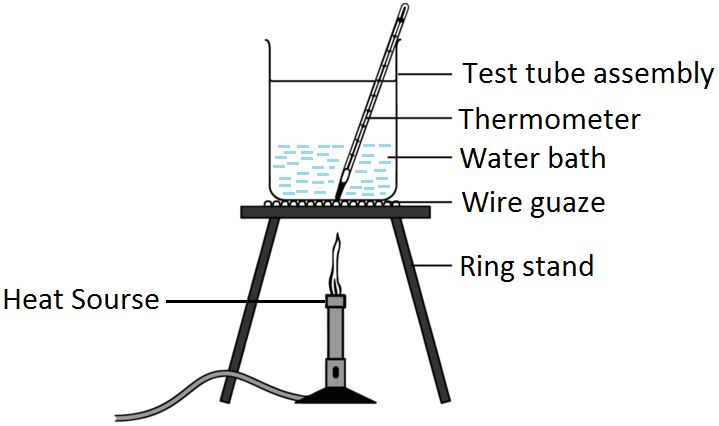
How will you determine the melting point of ice experimentally with the help of a neat and labelled diagram?
Answer
To determine the melting point of ice we need:
  1. Beaker
  2. Funnel
  3. Stand
  4. Thermometer $\frac{1}2{}$
  5. Crushed ice and Stopwatch
Procedure:
  1. Take a funnel and fix it in the stand. place the beaker below the funnel. put some ice cubes in the funnel. take the thermometer and find the least count and also find the least count in stopwatch.
  2. Suspend the thermometer in such a way that the bulb is well inside the crushed ice.
  3. Note the readings on the thermometer.

​​​​​​​
View full question & answer
Question 145 Marks
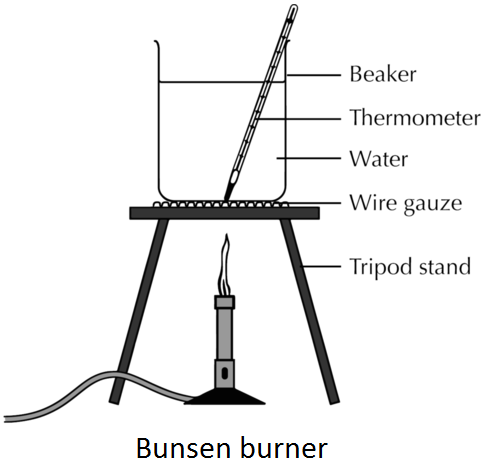
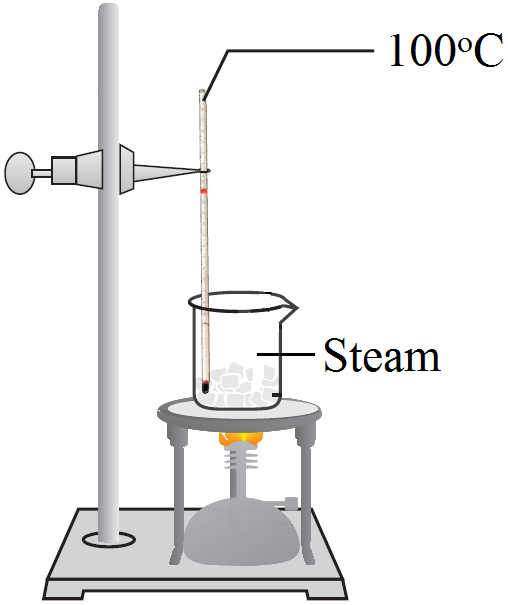
How will you determine the boiling point of water experimentally? Draw a neat and labelled diagram.
Answer
Explanation:

  • Take a clean beaker of volume 200ml, fill the beaker with 100ml of distilled water.
  • Now place a tripod stand on the Bunsen burner. Place wire gauze on the tripod stand.
  • Keep the beaker filled with water and thermometer dipped in it on the wire gauze and light the Bunsen burner.

When small bubbles are observed on the walls of beaker take the temperature reading from the thermometer and remove the flame.
View full question & answer
Question 155 Marks
Describe an activity of determine the boiling point of water and melting point of ice.
Answer

Determination of boiling point of water:

  1. In a beaker take some water and insert a thermometer in it with the help of a clamp.
  2. Put the beaker on a tripod stand and heat the apparatus with the help of kerosene burner slowly.
  3. Observe what happens to water.
  4. You will observe a steady stream of bubbles. This temperature is the boiling point of water.

Determination of melting point of ice:
  1. Take crushed ice in a beaker and insert a thermometer in the beaker by hanging it from the clamp of the stand in such a way that the bulb of the thermometer is completely inside the ice.
  2. Wait for some time and keep recording the temperature after small intervals of time.
  3. Note down the temperature when ice just starts melting.
  4. Let the bulb of the thermometer remain in mixture of ice and water for some more time and keep recording the temperature. This temperature is the melting point of ice.
View full question & answer
Question 165 Marks
By which physical process the fragrance of burning an incense stick spreads all around?
Answer
When we observe the incense stick that is burning, we can observe it smell from the several metres away.
The smoke of incense stick is the gaseous state of matter.
Smoke of incense stick is gaseous state of matter has the larger intermolecular space and highest kinetic energy.
So because of the high kinetic energy its particle starts vibrating and move rapidly and reaches to our nose from the several metres away.
So, two factors that are responsible for this spirit of smell are:-
  1. Intermolecular space.
  2. Higher kinetic energy in the particles.
View full question & answer
Question 175 Marks
View full question & answer
Question 185 Marks
Answer
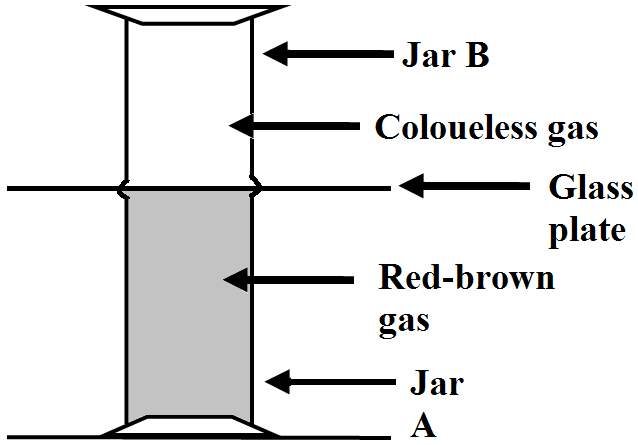
  1. When the glass plate between the two jars is pulled away then the red brown gas will diffuse from jar A into colourless jar B and vice versa, due to which the red brown colour will spread into jar B.
  2. The phenomenon occurring here is diffusion.
  3. Bromine vapour.
  4. Air.
  5. Potassium permanganate (coloured solid) and water (colourless liquid) also show the same phenomenon.
View full question & answer
Answer the questions.[Che-5M] - Science STD 9 Questions - Vidyadip