Questions · Page 1 of 3

Do as directed; [1 M ]

🎯

Test yourself on this topic

50 questions · timed · auto-graded

Question 21 Mark
Convert the following temperatures to the celsius scale.
  1. $293\ K$
  2. $470\ K$
Answer
Kelvin is an $SI$ unit of temperature, where $0^\circ C = 273.16K$ (approximately $273\ K$)
  1. $293K = (293 − 273)^\circ C = 20°C$
  2. $470K = (470 − 273)^\circ C = 197°C$
View full question & answer
Question 31 Mark
The boiling point of alcohol is $78^\circ\ C$. What is this temperature on Kelvin scale?
Answer
$273 + 78 = 351\ K$.
View full question & answer
Question 41 Mark
When a crystal of copper sulphate is placed at the bottom of a beaker containing water, the water slowly turns blue. Why?
Answer
The spreading of blue colour of copper sulphate into water, on its own, is due to the diffusion of copper sulphate particles into water.
View full question & answer
Question 61 Mark
When sugar is dissolved in water, there is no increase in the volume. Which characteristic of matter is illustrated by this observation?
Answer
The characteristic of matter illustrated by this observation is that the particles of matter have spaces between them.
View full question & answer
Question 71 Mark
A piece of chalk can be broken into small particles by hammering but a piece of iron cannot be broken into small particles by hammering. Which characteristic of the particles of matter is illustrated by these observations?
Answer
This displays that the particles of matter attract one another. In case of chalk, the force of attraction between the particles is weak whereas the force of attraction between the particles of iron is very strong.
View full question & answer
Question 81 Mark
Which single term is used to describe the mixing of copper sulphate and water kept in a beaker, on its own?
Answer
Diffusion.
View full question & answer
Question 91 Mark
Name one property of liquids and gases which tells us that their molecules are moving constantly.
Answer
Diffusion.
View full question & answer
Question 101 Mark
The mass per unit volume of a substance is called density. (density = mass/volume). Arrange the following in order of increasing density– air, exhaust from chimneys, honey, water, chalk, cotton and iron.
Answer
Increasing density:
Air < exhaust from chimneys < cotton < water < honey < chalk < iron.
View full question & answer
Question 131 Mark
Convert the following temperatures to the kelvin scale.
  1. $25^\circ\ C$
  2. $373^\circ\ C$
Answer
  1. $25^\circ\ C = (25 + 273)K = 298K$
  2. $373^\circ\ C = (373 + 273)K = 646K$
View full question & answer
Question 141 Mark
Name two gases which are supplied in compressed form in homes and hospitals.
Answer
$LPG$ (Liquefied Petroleum Gas) and Oxygen Gas respectively.
View full question & answer
Question 151 Mark
Even two or three crystals of potassium permanganate can impart colour to a very large volume of water. Which characteristic of particles of matter is illustrated by this observation?
Answer
This displays that each crystal of Potassium Permanganate must be made up of millions of small particles i.e. particles of matter are very-very small.
View full question & answer
Question 161 Mark
What is meant by saying that the latent heat of vaporization of water is $22.5 \times 10^5 \mathrm{~J} / \mathrm{kg}$?
Answer
It means that $22.5 \times 10^5 \mathrm{~J}$ of heat is required to change $1\ Kg$ of water (at its boiling point, $100\ C$ ) into steam at the same temperature of $100^{\circ} \mathrm{C}$.
View full question & answer
Question 171 Mark
Ice at $273K$ is more effective in cooling than water at $273K$. Why?
Answer
At same temperature of $273K$, large amount of heat will be removed by ice from the surroundings than in case of water. Hence, ice at $273K$ is more effective in cooling than water at the same temperature.
View full question & answer
Question 181 Mark
‘A substance has a definite shape as well as a definite volume’. Which physical state is represented by this statement?
Answer
Solid.
View full question & answer
Question 191 Mark
Define matter. Give four examples of matter.
Answer
Anything which occupies space and has mass is called matter.
Examples: Air, water, sugar, iron.
View full question & answer
Question 201 Mark
Conversion of solid to vapour is called sublimation. Name the term used to denote the conversion of vapour to solid.
Answer
It is also called sublimation.
View full question & answer
Question 211 Mark
In a beam of sunlight entering a room, we can sometimes see dust particles moving in a haphazard way in the air. Why do these dust particles move?
Answer
These dust particles move in a haphazard way because they are constantly hit by the fast moving particles of air.
View full question & answer
Question 221 Mark
Give two reasons to justify— An iron almirah is a solid at room temperature.
Answer
An iron almirah is a solid at room temperature because melting point of iron is higher than room temperature.
View full question & answer
Question 231 Mark
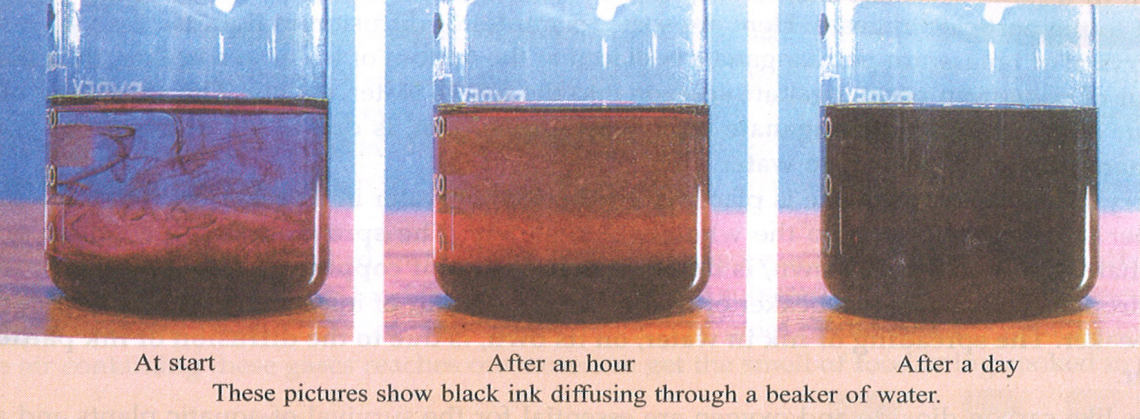
When a drop of blue ink is put in water, the blue colour spreads and the whole solution becomes blue. Name the phenomenon due to which this happens.
Answer
Diffusion is the process through which the ink is dissolved into the water.
It plays an important role in transferring of the solution from area of low concentration to the higher concentration.
In other words, the solvent with higher solute percentage attracts the solution that is lower in terms of the concentration of the solvent.
View full question & answer
Question 251 Mark
The Kelvin temperature is $270K$. What is the corresponding Celsius scale temperature?
Answer
$270 - 273 = -3^\circ\ C$.
View full question & answer
Question 271 Mark
State one condition necessary to liquefy gases (other than applying high pressure).
Answer
Lowering temperature (or cooling).
View full question & answer
Question 281 Mark

Name the process by which a drop of ink spreads in a beaker of water.
Answer
Diffusion is the process by which a drop of ink spreads in a beaker containing water.
View full question & answer
Question 291 Mark
What should be added to a Celsius scale reading so as to obtain the corresponding Kelvin scale reading?
Answer
$273$
View full question & answer
Question 301 Mark
Explain why, when a bottle of perfume is opened in a room, we can smell it even from a considerable distance.
Answer
The smell of perfume spreads due to the diffusion of perfume vapours into the air.
View full question & answer
Question 321 Mark
A substance has neither a fixed shape nor a fixed volume. State whether it is a solid, a liquid or a gas.
Answer
Gas.
View full question & answer
Question 331 Mark
What are the characteristics of matter?
Answer
The characteristics of matter are:
  1. The particles of matter are very, very small.
  2. The particles of matter have spaces between them.
  3. The particles of matter are constantly moving.
  4. The particles of matter attract each other.
View full question & answer
Question 341 Mark
Convert the temperature of $70^\circ\ C$ to the Kelvin scale.
Answer
$70 ^\circ\ $ Celesius $= 343.15$ Kelvin (exact result)
View full question & answer
Question 361 Mark
Define the following terms: Condensation
Answer
Condensation: The process of changing a gas (or vapour) to a liquid by cooling is called condensation.
View full question & answer
Question 371 Mark
What are the two ways in which the physical states of matter can be changed?
Answer
The physical states of matter can be changed by changing pressure and changing the temperature.
View full question & answer
Question 381 Mark
Sugar and salt kept in different jars gain the shape of their respective jars. Are they solids?
Answer
When sugar and common salt are kept in different jars, they take the shape of the jars, still they are considered as solid.
Reason:
  • As, solids are rigid form of matter and have fixed shape and volume.
  • Even though, common salt and sugar crystals when poured in any container, they take the shape of container, still each granule of common salt and sugar retain their fixed shape and volume.
Conclusion: Hence, they are considered as Solids.
View full question & answer
Question 391 Mark
Name two processes which provide the best evidence for the motion of particles in matter.
Answer
Diffusion and Brownian motion.
View full question & answer
Question 401 Mark
Arrange the following substances in increasing order of force of attraction between their particles (keeping the substance having them in imum force of attraction first): Water, Sugar, Oxygen
Answer
Oxygen < Water < Sugar.
View full question & answer
Question 411 Mark
Write the full form of $BEC$.
Answer
Bose-Einstein condensate (BEC): A state of matter in which separate atoms or subatomic particles, cooled to near absolute zero
$(0K, - 273.15^\circ C$, or $- 459.67^\circ F; K$ = kelvin$)$, coalesce into a single quantum mechanical entity-that is, one that can be described by a wave function-on a near-macroscopic scale.
View full question & answer
Question 431 Mark
Under what conditions heat can be given to a substance without raising its temperature?
Answer
When a change of state of a substance has to take place the heat given would not raise the temperature.
View full question & answer
Question 441 Mark
What is meant by saying that the latent heat of fusion of ice is $3.34 \times 105J/ kg?$
Answer
It means that $3.34 \times 105J$ of heat has to be supplied to change $1\ Kg$ of ice (at its melting point, $0^\circ\ C$) into water at the same temperature of $0^\circ\ C$.
View full question & answer
Question 471 Mark
Which state of matter is responsible for the glow of the sun and the stars?
Answer
Plasma which is $4th$ state of matter is responsible for glow of suns and star.
View full question & answer
Question 481 Mark
Why solid ice floats on water?
Answer
It’s because the water which is in solid form have lighter density when compared to liquid form.
View full question & answer
Question 491 Mark
Give one example of diffusion of gases in a liquid.
Answer
Gases like carbon dioxide and oxygen present in the atmosphere diffuse into water (of ponds, lakes etc) and dissolves in it.
View full question & answer
Question 501 Mark
What is the physical state of water at:
  1. $250^\circ\ C$
  2. $100^\circ\ C$
Answer
  1. Gaseous State (As Boiling temperature of the water is $100^\circ\ C$).
  2. Since water boils at this temperature thus it can exist in both liquid and gaseous form. At this temperature, after getting the heat equal to the latent heat of vaporisation, water starts changing from liquid state to gaseous state.
View full question & answer
Do as directed; [1 M ] - Science STD 9 Questions - Vidyadip