Questions · Page 2 of 3

Do as directed; [1 M ]

Question 511 Mark
Name the physical quantity whose $SI$ unit is:
  1. $\mathrm{m/s}$
  2. $\mathrm{~m} / \mathrm{s}^2$
Answer
  1. Speed (or Velocity)
  2. Acceleration
View full question & answer
Question 531 Mark
What do the following measure in a car?
  1. Speedometer.
  2. Odometer.
Answer
  1. The speedometer of a car measures instantaneous speed of the car.
  2. Odometer is a device used to record the distance travelled by the car.
View full question & answer
Question 541 Mark
In addition to speed, what else should we know to predict the position of a moving body?
Answer
In addition to speed, we should know the direction in which the body is moving.
View full question & answer
Question 551 Mark
Give one example of a motion where an object does not change its speed but its direction of motion changes continuously.
Answer
Motion of moon around the earth.
View full question & answer
Question 561 Mark
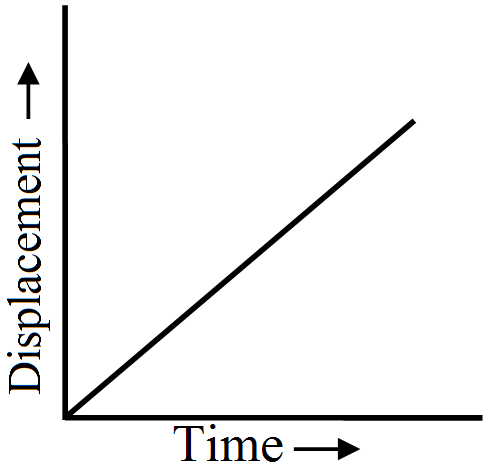
What conclusion can you draw about the velocity of a body from the displacement-time graph shown below:
Answer
It represents uniform velocity.
View full question & answer
Question 581 Mark
Name the type of motion in which a body has a constant speed but not constant velocity.
Answer
Uniform circular motion.
View full question & answer
Question 591 Mark
A car is moving along a straight road at a steady speed. It travels $150m$ in $5$ seconds: How long does it take to travel $240m?$
Answer
Distance $= 240m$
$\text{Time}=\frac{\text{Distance}}{\text{V}_\text{av}}=\frac{240}{30}=8\text{s}$
View full question & answer
Question 601 Mark
If the distance-time graph of a particle is parallel to time axis, then how much is the velocity of the particle?
Answer
Displacement Time graphs represent the change in the magnitude of a position vector of a particle with respect to its initial position over time. If it is straight line, parallel to the time axis, it represents that the position of the object does not change with respect to time. As the position does not change, the object is at rest. As the object remains at rest with respect to time, the velocity is zero.
View full question & answer
Question 611 Mark
Give two examples of vector quantity.
Answer
Some examples of vector quantities include force, velocity, acceleration, displacement, and momentum.
View full question & answer
Question 621 Mark
What is the acceleration of a body moving with uniform velocity?
Answer
When a body is moving with uniform velocity, its acceleration is zero.
View full question & answer
Question 631 Mark
Under what conditions can a body travel a certain distance and yet its resultant displacement be zero?
Answer
When the body comes back to its starting point, it has zero resultant displacement but covers a certain non-zero distance.
View full question & answer
Question 641 Mark
Write the SI unit of the both distance and displacement.
Answer
The S.I. unit of both distance and displacement is metre.
View full question & answer
Question 651 Mark
Write the formula for acceleration. Give the meaning of each symbol which occurs in it.
Answer
$\text{Acceleration}=\frac{\text{Final velocity}-\text{Initial velocity}}{\text{Time taken}}$

$\text{a}=\frac{\text{v}-\text{u}}{\text{t}}$

View full question & answer
Question 661 Mark
Which of the two can be zero under certain conditions average speed of a moving body or average velocity of a moving body?
Answer
Average velocity of a moving body can be zero.
View full question & answer
Question 671 Mark
Which of the following is true for displacement?
  1. It cannot be zero.
  2. Its magnitude is greater than the distance travelled by the object.
Answer
None of the statement is true for displacement First statement is false because displacement can be zero. Second statement is also false because displacement is less than or equal to the distance travelled by the object.
View full question & answer
Question 691 Mark
What type of motion is represented by the tip of the ‘seconds’ hand’ of a watch? Is it uniform or accelerated?
Answer
The tip of the ‘seconds’ hand’ of a watch represents uniform circular motion. It is an accelerated motion.
View full question & answer
Question 721 Mark
What name is given to the speed in a specified direction?
Answer
Speed of a body in a specified direction is called velocity.
View full question & answer
Question 741 Mark
What is the quantity which is measured by the area occupied below the velocity -time graph?
Answer
The area below velocity-time graph gives the distance covered by the object.
View full question & answer
Question 751 Mark
What is the other name of negative acceleration?
Answer
Negative acceleration is also called retardation.
View full question & answer
Question 761 Mark
What is the displacement of a satellite when it makes a complete round along its circular path?
Answer
The displacement is always zero when satellite makes a complete round along its circular path. It is because of the fact that initial and final positions coincide in one complete round.
View full question & answer
Question 771 Mark
What is the acceleration of a body moving with uniform velocity?
Answer
When a body is moving with uniform velocity, its acceleration is zero.
View full question & answer
Question 781 Mark
What do the following measure in a car?
  1. Speedometer. 
  2. Odometer.
Answer
  1. The speedometer of a car measures instantaneous speed of the car.
  2. Odometer is a device used to record the distance travelled by the car.
View full question & answer
Question 791 Mark
What does the slope of a speed-time graph indicate?
Answer
The slope of a speed-time graph indicates acceleration.
View full question & answer
Question 801 Mark
What does the slope of a distance-time graph indicate?
Answer
The slope of a distance-time graph indicates speed.
View full question & answer
Question 811 Mark
What does the path of an object look like when it is in uniform motion?
Answer
The path of an object looks like line, zigzag line and curve etc.
Explanation:
Uniform motion refers only to speed of the object. Speed is described by distance traveled by an object with time. Uniform motion i.e. speed conveys no information regarding the direction of the object.
If object continues to move in fixed direction, then path will look like the straight line. Otherwise with varying direction & uniform motion, there could be various paths like straight line, zigzag line, circle, curve and many more.
View full question & answer
Question 821 Mark
What does the odometer of an automobile measure?
Answer
The odometer of an automobile measures the distance covered by an automobile.
View full question & answer
Question 831 Mark
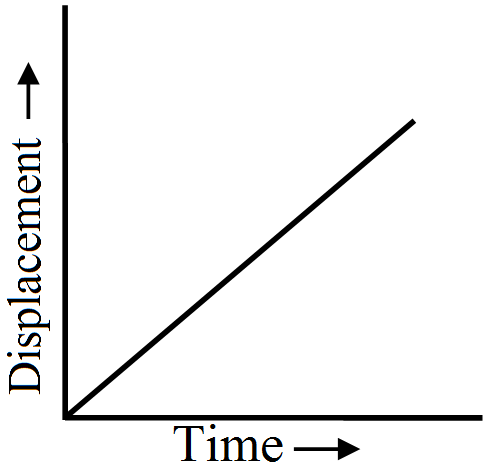
What conclusion can you draw about the velocity of a body from the displacement-time graph shown below:


Answer
It represents uniform velocity.
View full question & answer
Question 841 Mark
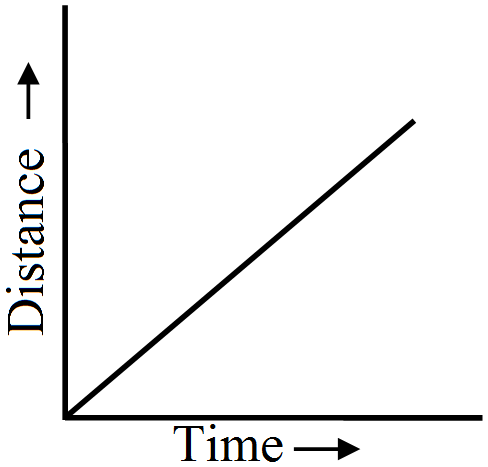
What conclusion can you draw about the speed of a body from the following distance-time graph?


Answer
The body has uniform speed.
View full question & answer
Question 851 Mark
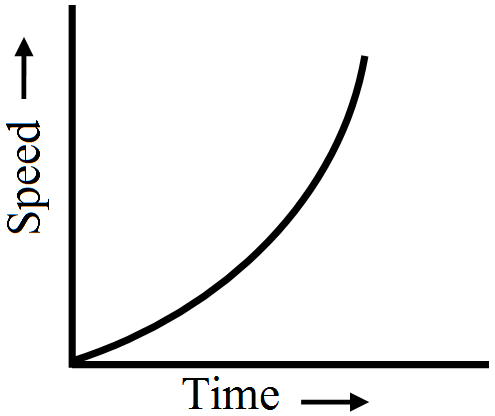
What conclusion can you draw about the acceleration of a body from the speed-time graph shown below?


Answer
It represents non-uniform acceleration.
View full question & answer
Question 871 Mark
What can you say about the motion of a body whose distance-time graph is a straight line parallel to the time axis?
Answer
The body is not moving. It is stationary.
View full question & answer
Question 881 Mark
What can you say about the motion of a body if its speed-time graph is a straight line parallel to the time axis?
Answer
The Speed of the body is constant or uniform.
View full question & answer
Question 891 Mark
Under which condition is the magnitude of average velocity equal to average speed?
Answer
When the object moves in a single straight line, the magnitude of average velocity equal to average speed.
View full question & answer
Question 901 Mark
Under what condition(s) is the magnitude of average velocity of an object equal to its average speed?
Answer
The magnitude of average velocity of an object is equal to its average speed, only when an object is moving in a straight line.
View full question & answer
Question 911 Mark
Under what conditions can a body travel a certain distance and yet its resultant displacement be zero?
Answer
When the body comes back to its starting point, it has zero resultant displacement but covers a certain non-zero distance.
View full question & answer
Question 921 Mark
The velocity of a body increases by 10m/s in every one second. What physical quantity does the body represent and what is its magnitude?
Answer
Rate of change of velocity is known as acceleration.

Since, if is sfraight line motion so the physical quantity will be" unifrom acceleration"

$\overrightarrow{\text{a}}=\frac{\Delta\text{v}}{\text{t}}$

$=\frac{20-10}{1}=10\text{m/s}^{2}$

$\overrightarrow{\text{a}}=10\text{m/s}^{2}$

physical quantity = uniform acceleration.

View full question & answer
Question 931 Mark
The displacement of a moving object in a given interval of time is zero. Would the distance travelled by the object also be zero? Give reason for your answer.
Answer
No, because if a body takes a round trip such that its final position is same as the starting position, then the displacement of the body is zero but the distance travelled is non-zero.
View full question & answer
Question 941 Mark
State which of the following situations are possible and give an example for each of these:
an object with a constant acceleration but with zero velocity.
Answer
Possible
When a ball is thrown up at maximum height, it has zero velocity, although it will have constant acceleration due to gravity, which is equal to 9.8m/ s2.
View full question & answer
Question 951 Mark
State which of the following situations are possible and give an example for each of these:
an object moving with an acceleration but with uniform speed.
Answer
Possible
When a car is moving in a circular track with constant speed, it is accelerating due to change in direction of motion.
View full question & answer
Question 961 Mark
State which of the following situations are possible and give an example for each of these:
an object moving in a certain direction with an acceleration in the perpendicular direction.
Answer
Possible
A car is moving in a circular track, its acceleration is perpendicular to the direction of motion.
View full question & answer
Question 971 Mark
State whether the following statement is true or false:
Earth moves round the sun with uniform velocity.
Answer
No, earth moves round the sun with uniform speed, but its velocity changes continuously.
View full question & answer
Question 981 Mark
State whether speed is a scalar or a vector quantity. Give reason for your choice.
Answer
Speed is a scalar quantity as it has magnitude only, it has no specified direction.
View full question & answer
Question 1001 Mark
State whether displacement is a scalar or a vector quantity.
Answer
Distance is considered as a scalar quantity because it shows only magnitude, there is not use of direction.
View full question & answer
Do as directed; [1 M ] - Page 2 - Science STD 9 Questions - Vidyadip