Questions · Page 3 of 3

Do as directed; [1 M ]

Question 1011 Mark
Name the type of motion in which a body has a constant speed but not constant velocity.
Answer
Uniform circular motion.
View full question & answer
Question 1031 Mark
Name the physical quantity which gives us an idea of how slow or fast a body is moving.
Answer
Speed gives an idea of how slow or fast a body is moving.
View full question & answer
Question 1041 Mark
Name the physical quantity obtained by dividing ‘Distance travelled’ by ‘Time taken’ to travel that distance.
Answer
Speed is defined as the distance travelled per unit time.
View full question & answer
Question 1061 Mark
Name the quantitity, the slope of whose graph gives:
Acceleration.
Answer
Speed (or velocity) and Time.
View full question & answer
Question 1081 Mark
In addition to speed, what else should we know to predict the position of a moving body?
Answer
In addition to speed, we should know the direction in which the body is moving.
View full question & answer
Question 1091 Mark
If the velocity-time graph of an object is parallel to X-axis, then what does it mean? Can it be parallel to Y-axis?
Answer
If the velocity time graph of an abject is parallel to x-axis then it doesn't parallel to y axis but it is parallel to x-axis. It means the body moves with constant velocity.
View full question & answer
Question 1101 Mark
If the distance-time graph of a particle is parallel to time axis, then how much is the velocity of the particle?
Answer
Displacement Time graphs represent the change in the magnitude of a position vector of a particle with respect to its initial position over time.
If it is straight line, parallel to the time axis, it represents that the position of the object does not change with respect to time.
As the position does not change, the object is at rest.
As the object remains at rest with respect to time, the velocity is zero.
View full question & answer
Question 1111 Mark
If the acceleration of the particle is constant in magnitude but not in direction, then what type of path does the particle follow?
Answer
The particle will follow any curved path (circular or elliptical etc.) except straight line path. Because in straight line path direction of acceleration remains same.
View full question & answer
Question 1121 Mark
Give two examples of vector quantity.
Answer
Some examples of vector quantities include force, velocity, acceleration, displacement, and momentum.
View full question & answer
Question 1131 Mark
Give two examples of bodies having non-uniform motion.
Answer
  1. Motion of a bus on a road.
  2. Motion of a racing horse.
View full question & answer
Question 1141 Mark
Give SI unit of angular velocity.
Answer
The SI unit of angular velocity is radians per second. But it may be measured in other units as well (such as degrees per second, degrees per hour, etc.).
View full question & answer
Question 1161 Mark
Give one example of a motion where an object does not change its speed but its direction of motion changes continuously.
Answer
Motion of moon around the earth.
View full question & answer
Question 1171 Mark
Does the motion of second’s hand of a watch represent uniform velocity or uniform speed?
Answer
The seconds hand of the watch represents uniform motion. It moves with constant or uniform speed. It would have had a uniform or constant velocity if it travels in a specified direction in a straight line and moves over equal distance in equal intervals of time.
View full question & answer
Question 1181 Mark
Define average speed.
Answer
The "total distance" traveled by a "body in a definite interval of time" is known as "average speed".
By derivation it is represented as,
Average/ quad speed $=\Big(\frac{\text{Total distance}}{\text{Total timetaken}}\Big)$
Speed is a scalar quantity. So it does not have a unit. the "instantaneous speed" is the "limit of the average speed" as the "duration of the time interval" approaches zero."
View full question & answer
Question 1191 Mark
Convert a speed of 54km/h into m/s.
Answer
We have to convert 5km/h into m/s.

$54\text{km/hr}=\frac{(54)(1000)}{3600}\text{m/s}$

$=15\text{m/s}$

View full question & answer
Question 1201 Mark
Change the speed of 6m/s into km/h.
Answer
$6\text{m}/\text{s}$

$=6\times\Big(\frac{3600}{1000}\Big)\text{km}/\text{hr}=21.6\text{km}/\text{hr}$
View full question & answer
Question 1221 Mark
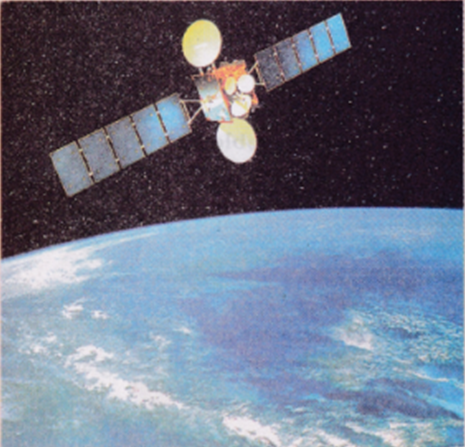
A satellite goes round the earth in a circular orbit with constant speed. Is the motion uniform or accelerated?


This photograph shows a man-made 'communication satellite' going round the earth in a circular orbit (or circular path). We can see the dish antennae and solar panels (made of solar cells) clearly in this photograph.


This photograph shows a watch. The tip of seconds 'hand of this watch moves rapidly on the dial of the watch. The tips of minutes' hand and hours' also move on the dial but they move slowly.
Answer
It is accelerated motion as the velocity is changing continuously.
View full question & answer
Question 1231 Mark
Area under the velocity-time graph line is 40m. What physical quantity does this area represent?
Answer
It represent the distance covered is 40 metre.
View full question & answer
Question 1241 Mark
An object has moved through a distance. Can it have zero displacement? If yes, support your answer with an example.
Answer
Yes,an object can have zero displacement even when it has moved through a distance.This happens when final position of the object coincides with its initial position. For example,if a person moves around park and stands on place from where he started then here displacement will be zero.
View full question & answer
Question 1251 Mark
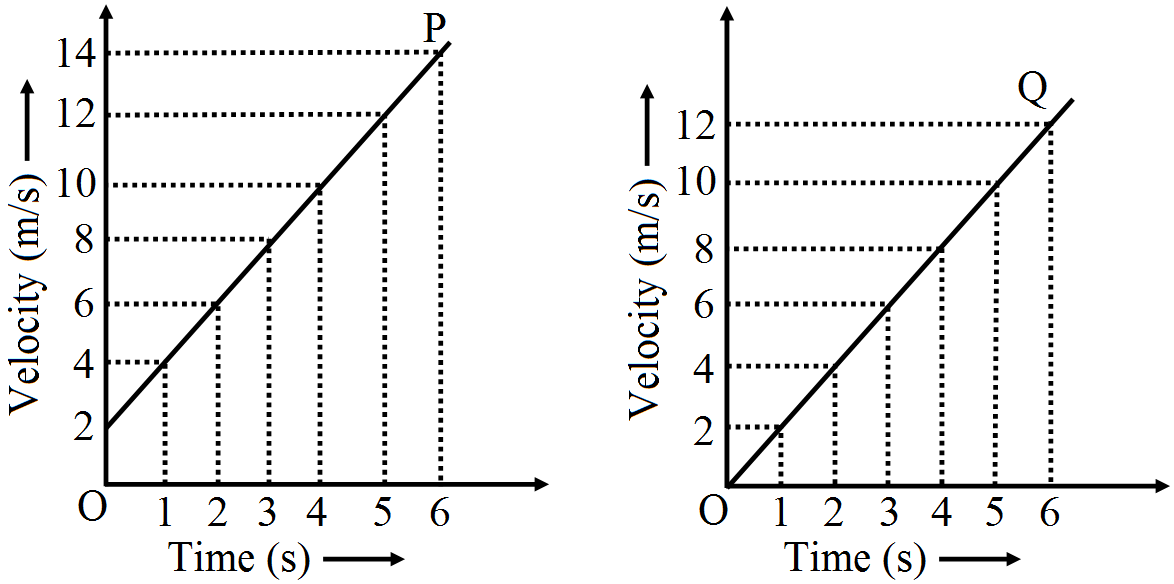
A car is moving along a straight road at a steady speed. It travels 150m in 5 seconds:
How long does it take to travel 240m?
Answer
Distance = 240m

$\text{Time}=\frac{\text{Distance}}{\text{V}_\text{av}}=\frac{240}{30}=8\text{s}$
View full question & answer
Question 1261 Mark
A body goes round the sun with constant speed in a circular orbit. Is the motion uniform or accelerated?
Answer
The motion is accelerated.
View full question & answer
Do as directed; [1 M ] - Page 3 - Science STD 9 Questions - Vidyadip