Questions

Answer the questions.[Che-3M]

🎯

Test yourself on this topic

35 questions · timed · auto-graded

Question 13 Marks
Will 35Cl and 37Cl have different valencies? Justify your answer.
Answer
No, 35Cl and 37Cl have same valency. 35Cl and 37Cl are the isotopes. So, they have same number of protons and electrons and have the same atomic number viz. 17 Hence, their electronic configuration and valencies are also the same K L M.
Electronic configuration = 2, 8, 7 Valency 8 - 7 = 1.
Therefore, both of them have valency = 1.
View full question & answer
Question 23 Marks
Why did Rutherford select a gold foil in his α–ray scattering experiment?
Answer
For the scattering experiment, Rutherford wanted a metal sheet which could be as thin as possible. Gold is the most malleable of all known metals. It can easily be converted into very thin sheets. Hence, Rutherford selected a gold foil for his alpha-ray scattering experiment.
View full question & answer
Question 33 Marks
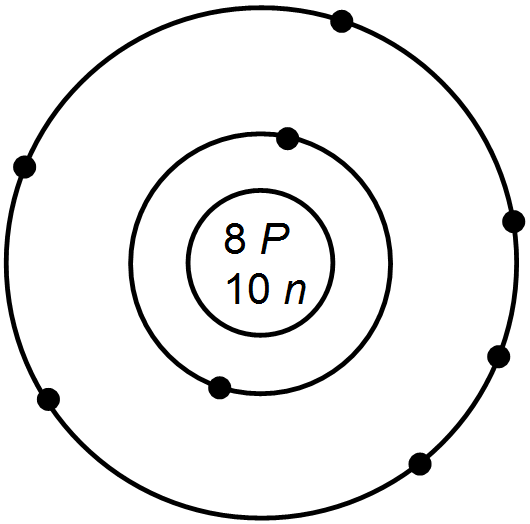
What information do you get from the figure given below about the atomic number, mass number and valency of atom X?


Answer
  1. Atomic Number(no. of p) = 8

  2. Mass Number(no. of p + n) = 8 + 10 = 18

  3. Valency of atom = 2

View full question & answer
Question 43 Marks
What conclusion would be drawn by Rutherford when he observed that most of the fast moving $\alpha $ -particles passed straight through the gold foil?
Answer
The observation that most alpha particles passed straight through the gold foil led Rutherford to conclude that the the positive charge in an atom in concentrated in a very small area, the nucleus. Atoms are mostly empty space. Electrons, which are negatively charged, are distributed throughout this space but take up a very small part of it.
View full question & answer
Question 53 Marks
What are the limitations of Rutherford’s model of the atom?
Answer
According to Rutherford’s model of an atom, electrons revolve around the nucleus in fixed orbits. But, an electron revolving in circular orbits will not be stable because during revolution, it will experience acceleration. Due to acceleration, the electrons will lose energy in the form of radiation and fall into the nucleus. In such a case, the atom would be highly unstable and collapse.
View full question & answer
Question 63 Marks
What are the limitations of J.J. Thomson’s model of the atom?
Answer
According to J.J. Thomson’s model of an atom, an atom consists of a positively charged sphere with electrons embedded in it. However, it was later found that the positively charged particles reside at the centre of the atom called the nucleus, and the electrons revolve around the nucleus.
View full question & answer
Question 73 Marks
Three different atoms of oxygen are represented as:
$^{16}_{\ 8}\text{O},\ ^{17}_{\ 8}\text{O}\text{ and }^{18}_{\ 8}\text{O}$
  1. What do the subscripts (lower figures) and superscripts (upper figures) represent?
  2. What factor is responsible for the change in the superscripts 16, 17 and 18, though the element is the same?
  3. What is the usual name for such atoms of an element?
  4. Give the nuclear composition of $​​^{18}_{\ 8}\text{O}$
Answer
  1. Subscript represents atomic number, whereas superscript represents atomic mass.
  2. Number of neutrons is responsible for the change in superscripts.
  3. Isotope is the usual name for such atoms of an element.
  4. Nuclear composition of 18O8 is

No. of protons = 8

No. of neutrons = 18 - 8 = 10

View full question & answer
Question 83 Marks
The number of neutrons and protons present in the nuclei of two atomic species A and B are given below.
Atomic SpeciesAB
Protons88
Neutrons810
  1. Write the mass numbers of A and B.
  2. What is the relation between two species?
  3. Write the electronic configuration of atoms A and B.
Answer
  1. Mass number of A = 8 + 8 = 16

Mass number of B = 8 + 10 = 18

  1. Both the species are isotopes of an element because they have the same atomic number or the number of protons.
  1. Electronic configuration of A = 2, 6

Electronic configuration of B = 2, 6

View full question & answer
Question 93 Marks
The chlorine atom is electrically neutral but chloride ion is charged. Explain.
Answer
A chlorine atom contains 17 electrons and 17 protons. The charges are balanced. If a chlorine atom accept one more electron it becomes negatively charged specie called as chloride ion (Cl-), containing 18 electrons.
(If an atom gains one or more electrons, it now carries a net negative charge, and is thus "anionic").
View full question & answer
Question 103 Marks
The average atomic mass of a sample of an element X is 16.2u. What are the percentages of isotopes ${^{16}_{8}\text{X}}$ and ${^{18}_{8}\text{X}}$ in the sample?
Answer
It is given that the average atomic mass of the sample of element X is 16.2u.

Let the percentage of isotope ${^{18}_{8}\text{X}}$ be y%. Thus, the percentage of isotope ${^{16}_{8}\text{X}}$ will be (100 – y)%.

Therefore,

$18\times\frac{\text{y}}{100}+16\times\frac{(100-\text{y})}{100}=16.2$

$\frac{18\text{y}}{100}+\frac{16(100-\text{y})}{100}=16.2$

$\frac{18\text{y}+1600-16\text{y}}{100}=16.2$

$18\text{y}+1600-16\text{y}=1620$

$2\text{y}=1620-1600$

$\text{y}=10$

Therefore, the percentage of isotope ${^{18}_{8}\text{X}}$ is 10%.

And, the percentage of isotope ${^{16}_{8}\text{X}}$ is (100 – 10)% = 90%.

View full question & answer
Question 113 Marks
Atomic Number
Mass Number
Number of Neutrons
Number of Protons
Number of Electrons
Name of the Atomic Species
9
16
-
-
-
-
32
24
2
1
10
-
-
-
0
-
-
12
1
1
-
-
-
-
0
-
Sulphur
-
-
-
Answer
Atomic Number
Mass Number
Number of Neutrons
Number of Protons
Number of Electrons
Name of the Atomic Species
9
16
12
1
1
19
32
24
2
1
10
16
12
1
0
9
16
12
1
1
9
16
12
1
0
Fluorine
Sulphur
Magnesium
Deuterium
Hydrogen
View full question & answer
Question 123 Marks
Summarise the rules for writing of distribution of electrons in various shells for the first eighteen elements.
Answer
The rules for writing of distribution of electrons in various shells for the first eighteen elements are:

  1. The maximum number of electrons present in a shell is given by the formula -2n2

$\because$ n = orbit number i.e., 1, 2, 3

$\because$ Maximum number of electrons in different shells are:

K shell n = 1 2n2 = > 2(1)2 = 2

L shell n = 2 2n2 = > 2(2)2 = 8

M shell n = 3 2n2 = > 2(3)2 = 18

N shell n = 4 2n2 = > 2(4)2 = 32

  1. The maximum number of electrons that can be accommodated in the outermost orbit is 8.
  2. Electrons are not accommodated in a given shell unless the inner shells are filled. (Shells are filled step-wise).
View full question & answer
Question 133 Marks

Why do Helium, Neon and Argon have a zero valency?

Answer
Helium has two electrons in its only energy shell. Argon and Neon have 8 electrons each in their valence shells. As the elements have the maximum number of electrons in their valence shells (thereby achieving duplet and octet configurations), they do not have any tendency to combine with other elements. Hence, Helium, Neon and Argon have zero valency.
View full question & answer
Question 143 Marks

What were the drawbacks of Rutherford’s model of an atom?

Answer
Rutherford had proposed a model in which the electrons revolved around the nucleus in well-defined orbits. However, the orbital revolution of the electron was not expected to be stable. Any particle in a circular orbit would undergo an acceleration and the charged particles would radiate energy. Thus, the revolving electrons would lose energy and finally fall into the nucleus. Revolution of electrons around the atom would make the atom highly unstable and matter would not exist. But this is contrary to our common observations.
View full question & answer
Question 153 Marks

The ratio of the radii of hydrogen atom and its nucleus is ~ 10. Assuming the atom and the nucleus to be spherical,

 If atom is represented by planet earth ‘R e’ = 6.4 × 10m, estimate the size of the nucleus.

Answer
If atom is represented by planet earth Re = 6.4 × 106m
Then, Volume of atom (VH$=\frac{4}{3}\pi\text{R}_\text{e}^3=\frac{4}{3}\times3.14\times(6.4\times10^6\text{m})^3$
$=1097.5\times10^{18}\text{m}^3=1.0975\times10^{21}\text{m}^3$
Volume of nucleus $=10^{-15}\times(1.0975\times10^{21})\text{m}^3$
$=1.0975\times10^6\text{m}^3$
View full question & answer
Question 163 Marks

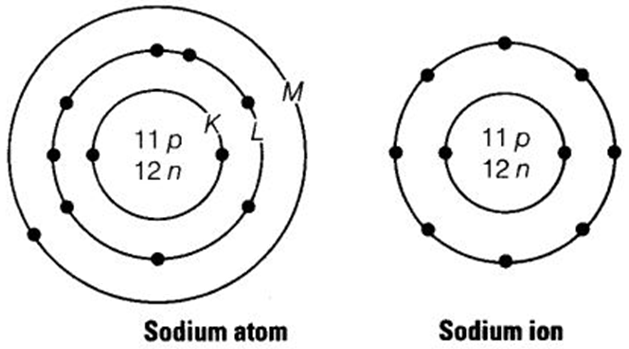
Show diagramatically the electron distributions in a sodium atom and a sodium ion and also give their atomic number.

Answer
Atomic number of sodium (Z) = 11
Mass number of sodium (A) = 23
$\therefore$ Number of protons in the nucleus = 11
Number of neutrons in the nucleus = 23 -11 = 12
Number of electrons = 11
$\therefore$ Electronic configuration of Na atom = $\text{K}\ \ \ \ \text{L}\ \ \ \ \text{M}\\2\ \ \ \ \ 8\ \ \ \ \ 1$
Naion is formed from sodium atom by loss of an electron (present in outer most cell).
Hence, its electronic configuration is $\text{K}\ \ \ \ \text{L}\\2\ \ \ \ \ 8$ however. number of protons and nutrones remains same.


View full question & answer
Question 173 Marks

In the gold foil experiment of Geiger and Marsden, that paved the way for Rutherford’s model of an atom, ~ 1.00% of the a-particles were found to deflect at angles > 50°. If one mole of a-particles were bombarded on the gold deflect at angles foil, compute the number of a-particles that would less than 50°.

Answer

Percentage of a-particles deflected by more than 50° = 1% of total a-particles.

% of a-particles deflected by less than 50° = 100% - 1% = 99% of total a-particles.

Number of a-particles bombarded on the gold foil = 1 mole = 6.022 × 10²

Number of particles that deflected by an angle less than 50°

$=\frac{99}{100}\times6.022\times10^{23}$

$=\frac{596.178}{100}\times10^{-23}$

$=5.96\times10^{23}$

View full question & answer
Question 183 Marks

Enlist the conclusions drawn by Rutherford from his α-ray scattering experiment.

Answer
Conclusion of Rutherford’s a-rays scattering experiment:
  1. Most of the space inside the atom is empty because most of the a-particles passed through the gold foil without getting deflected.
  2. Very few particles were deflected from their path, indicating that the positive charge of the atom occupies very little space.
  3. Avery small fraction of a-particles were deflected by 180°, indicating that all the positive charge and mass of the gold atom were concentrated in very small volume within the atom.
View full question & answer
Question 193 Marks
One electron is present in the outer most shell of the atom of an element X. What would be the nature and value of charge on the ion formed if this electron is removed from the outer most shell?
Answer
When the single electron present in the outer most shell of the atom of an element X is removed, the atom loses negative charge and forms a positively charged ion with +1 charge. The value of the net charge on the ion will be equal to the amount of charge present on one electron.
View full question & answer
Question 203 Marks
Nucleus of an atom is positively charged and electrons around it are negatively charged. Then why do electrons not just fall to the nucleus out of attraction?
Answer
In classical physics, electrons should fall into the nucleus even if they weren't attracted by the charge of the proton. Early models of atoms had electrons orbiting the nucleus the way a planet orbits a sun. Orbiting in a circle means making a lot of changes of direction- which means acceleration.
View full question & answer
Question 213 Marks
 What are the number of protons, neutrons, and electrons in $^{16}_8\text{O}$ and $^{40}_{18}\text{Ar}?$ What are their atomic number and mass number?
Answer
Any element can be represented with its atomic number, symbol and its atomic mass using a simple representation. Any element ‘X’ having the atomic number ‘A’ and atomic mass ‘M’ can be represented as $^{\text{A}}_{\text{M}}\text{X}.$
For $^{16}_8\text{O}:$
No. of protons = 8
No. of electrons = 8
No. of neutroms = (16 - 8) = 8 (atomic mass minus the protons in nutrons)
Atomic no. = 8
Mass no. = 16
For $^{40}_{18}\text{Ar}:$
No. of protons = 18
No. of electrons = 18
No. of neutrons = (40 - 18) = 22
Atomic no. = 18
Mass no. = 40
View full question & answer
Question 223 Marks
In response to a question, a student stated that in an atom, the number of protons is greater than the number of neutrons, which in turn is greater than the number of electrons. Do you agree with the statement? Justify your answer.
Answer
The statement of the student is not correct. The number of protons in an atom can never be greater than the number of neutrons. The number of protons will be equal to or less than the number of neutrons. The number of electrons and protons are always equal in a neutral atom.
View full question & answer
Question 233 Marks
In an atom first four shells (K, L, M, and N) are completely filled. Then what is the total number of electrons in that atom?
Answer
  1. If in an atom the first four shells are completely filled then the total number of the electrons in the atom would be 26.
  2. This is because the first four shells of the atom are K, L, M and N. using the formula 2(n2) we can find out the maximum electron in each shell which comes out to be

K = 2 electrons

L = 8 electrons

M and N = 18 electrons as

  1. The maximum number of the electrons in outermost orbit cannot be more than 8.
  2. So the total number of electrons for first four completely filled shells is 26.
View full question & answer
Question 243 Marks
If K and L-shells of an atom are full and in M-shell, there is only one electron, then what would be the total number of electrons in the atom? Name the element. Write the symbol and draw the Bohr model.
Answer
If K and L shells of an atom are full and only one electron is present in the M shell, then the total number of the electrons in the atom would be 11 because the maximum number of electrons that can occupy K and L shells are 2 and 8 respectively. As only 1 electron is present in the M shell the total comes out to be 11.

Corresponding to 11 electrons there will be 11 protons in the atom, so the atomic number of the element will be 11. The element with atomic number 11 is Sodium which has the symbol Na.


View full question & answer
Question 253 Marks
How many electrons can be accommodated in a M and N-shell?
Answer
Following the order: KLMN, N is fourth shell of an atom. The number of electrons in a shell depends on the element, its oxidation state and its electronic state. Considering a electrically neutral atom in the ground state, the elements in H-Ar range does have no electron in the N shell (K, L and M shells are being filled).
K is the first element where N shell begins to be filled ([Ar]4s¹ configuration) followed by Ca ([Ar]4s²). The next elements are transition metals (Sc-Zn) which, owing to the filling of 3d orbitals, does not have its N shell changed (except by a couple of exceptions). After Zn, in Ga-Kr range, N shell is filled with 3rd to 8th electrons which occupy 4p orbitals. The next two elements, Rb and Sr still have 8 electron in N shell because 5s orbitals are filled. Then 4d orbitals are filled across Y-Cd transition metals, growing N shell from 9 to 18 electrons. In the next elements (In-Xe) 5p orbitals are filled and N shell remains unchanged, the same happening to Cs and Ba where 6s orbitals are filled.
The N shell are filled again in the lanthanoid series (La-Yb) where 4f orbitals are occupied. In the last element of this series (Yb) N shell is full, with 32 electrons, and no further electron can be added to this shell.
View full question & answer
Question 263 Marks
How did the discovery of protons take place?
Answer
Through scientific discovery, protons have been accepted as the particle that contributes to the positive charge of an atom. The discovery of protons can be attributed to Rutherford.

In 1886 Goldstein discovered existence of positively charged rays in the discharge tube by using perforated cathode. These rays were named as anode rays or cannal rays.

In 1899, Rutherford discovered alpha and beta ‘rays’ from uranium. He later demonstrated that alpha rays are the nuclei of helium atoms. He discovered in 1914 that the nucleus of an atom constituted and extremely dense but small fraction of the volume of an atom and that this nucleus was positive in charge.

Given the discoveries of electrons in 1897 by Thomson, Rutherford and other scientists decided that a positively charged particle must exist to center the electron to create equally neutral atoms.

Thomson proposed the name ‘positive rays’. Rutherford, in 1914, suggested that this something that was positively charged or the sportive ray of Thompson was a particle.

He gave the name ‘positive electron’ to it. The word ‘proton’ was assigned to this particle by 1920.

View full question & answer
Question 273 Marks
How cathode rays are different from anod rays?
Answer
Cathode rays Anode rays
1They have negatively charged ions called electrons.1They have positively charges material particles.
2Cathode rays deflect towards the positive plate of an electric field.2Anode rays deflect towards the negative plate of an electric field.
3The charge to mass ratio (e/m) for the gaseous particles taken in the discharge tube.3The charge to mass (e/ m) ratio of the particles in anode rays depends upon the nature of the gas taken in the discharge tube.
View full question & answer
Question 283 Marks
From the symbol $^{31}_{15}\text{P},$ state:
  1. Mass number of phosphorus.
  2. Atomic number of phosphorus.
  3. Electron configuration of phosphorus. 
Answer
  1. Mass no. = 31
  2. Atomic no. = 15
  3. Electron configuration: 2, 8, 5.

That is,

$\text{K}\ \ \ \ \ \ \text{L}\ \ \ \ \ \ \text{M}\\2\ \ \ \ \ \ \ 8\ \ \ \ \ \ \ 5$

View full question & answer
Question 293 Marks
Define valency by taking examples of silicon and oxygen.
Answer
Valency is the combining capacity of an atom.

Atomic number of oxygen = 8 Atomic number of silicon = 14 K L M

Electronic configuration of oxygen = 2 6

Electronic configuration of silicon = 2 8 4

In the atoms of oxygen the valence electrons are 6 (i.e., electrons in the outermost shell). To fill the orbit, 2 electrons are required. In the atom of silicon, the valence electrons are 4. To fill this orbit 4 electrons are required.

Hence, the combining capacity of oxygen is 2 and of silicon is 4.

i.e., Valency of oxygen = 2

Valency of silicon = 4

View full question & answer
Question 303 Marks
Complete the following table.
ElementsAtomic numberMass numberProtonsElectronsneutronsElectronic configurationValency
Chlorine17_________18______
Silicon___28___14_________
Fluorine______9___10______
Answer
ElementsAtomic numberMass numberProtonsElectronsneutronsElectronic configurationValency
Chlorine17351717182, 8, 71
Silicon14281414142, 8, 44
Fluorine919910102, 71

Chlorine atomic number is 17 so protons = electrons = 17 since number of protons/electrons in an atom determine the atomic number. Mass number will be sum of protons and neutrons = 17 + 18 = 35.Since the atomic number is 17 for chlorine so electronic configuration is 2, 8, 7. Valency is 1.Silicon atomic number is 14 = number of electrons/ protons. Since the mass number is 28 so the number of neutrons is a mass number - the number of protons = 28 - 14 = 14.The electronic configuration will be 2, 8, 4 and valency is 4.Fluorine atomic number is 9 = number of protons/ electrons. Mass number is 9 + 10 = 19. Electronic configuration is 2, 7 and valency 1.
View full question & answer
Question 313 Marks
Compare the properties of electrons, protons and neutrons.
Answer
Particle
Nature of Charge
Mass
Location
Electron
Electrons are negatively charged.
9 × 10–31kg
Extra nuclear part distributed in different shell or orbits.
Proton
Protons are positively charged.
1.672 × 10⁻²⁷kg (1µ)
(approx. 2000 times that of the electron)
Nucleus
Neutron
Neutrons are neutral.
Equal to mass of proton
Nucleus
View full question & answer
Question 323 Marks
An element X has a mass number = 37 and it contains 17 protons.
  1. Write the symbolic representation of the element.
  2. Find the number of neutrons and electrons in the element.
  3. Write the electronic configuration of the element.
Answer
The mass number of the element X = 37

Number of protons = 17

  1. Symbolic representation is:

Element = Aluminium (Al)

  1. Number of neutrons = 37 - 17 = 20

Number of the electrons are = 17

  1. Electronic configuration is 2, 8, 7
View full question & answer
Question 333 Marks
An atom X has 4 protons and 5 neutrons with electronic configuration 2, 2. Give information about its.
  1. Atomic number.
  2. Mass number.
  3. Valency.
Answer
Protons = 4

Neutrons = 5

Number of protons = Number of electrons

Number of electrons = 4

Electronic Configuration
= 2, 2

Number of Valence electrons in the outermost shell = 2
Valency = 2

  1. Since, protons =electrons = atomic no. 

So atomic no. is 4

  1. Mass Number = No. of Protons + No. of Neutrons

= 4 + 5 = 9

  1. Now electronic distribution, K = 2, L = 2

So as the outermost shell has 2 electrons, so the valency will be 2

View full question & answer
Question 343 Marks
An atom of an element has 17 proton, 17 electrons, and 18 neutrons.
  1. Calculate the mass number of the element.
  2. Write its electronic configuration.
  3. Find the valency and an atomic number of the element.
Answer
  1. Mass Number = 18 + 17 = 35
  2. Now, Electronic Configuration of the element:
K LM
2 87
That is, the element is configured as (2, 8, 7).
  1. Atomic No. = No. of Electrons = No. of Protons = 17
So, we can conclude that the element has 17 electrons in total.Thus, valence electrons (electrons in outermost shell) = 7The element can be stable by being octant, i.e, having 8 electrons in valence shell.For that, it must gain 1 more electron.Therefore,Valency = 1
View full question & answer
Question 353 Marks
A certain species X has 17 protons, 18 electrons and 20 neutrons.
  1. What is such a particle called?
  2. What is the mass number of X?
  3. What is the atomic number of X?
Answer
  1. What is such a particle called anion.
  2. What is the mass number of X is 35.
  3. What is the atomic number of X is 17.
View full question & answer
Answer the questions.[Che-3M] - Science STD 9 Questions - Vidyadip