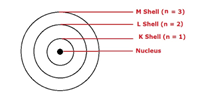
- There is a positively charged centre in an atom called the nucleus. Nearly all the mass of an atom resides in the nucleus.
- The electrons revolve around the nucleus in circular paths.
- The size of the nucleus is very small as compared to the size of the atom.
Drawbacks of Rutherford’s model of the atom: The revolution of the electron in a circular orbit is not expected to be stable. Any particle in a circular orbit would undergo acceleration. During acceleration, charged particles would radiate energy. Thus, the revolving electron would lose energy and finally fall into the nucleus. If this were so, the atom should be highly unstable and hence matter would not exist in the form that we know. We know that atoms are quite stable.
(1) Which of the following scientist was known as the ‘Father of nuclear physics?
(a) J.J. Thomson
(b) John Dalton
(c) E. Rutherford
(d) Neilsbhore
(2) Positively charged centre in an atom is termed as
(a) Nucleus
(b) Molecule
(c) Atom
(d) Protons
(3) Identify the correct statement
Statement 1 – Positively charged centre in an atom called the nucleus.
Statement 2 – The electrons revolve around the nucleus in circular paths.
Statement 3 – Nearly all the mass of an atom resides in the nucleus.
Statement 4 – The size of the nucleus is very small as compared to the size of the atom.
(a) Only 2
(b) Both 3 & 4
(c) Both 1 & 2
(d) All of the above
(4) Write the features of Rutherford’s nuclear model of an atom?
(5) Define Nucleus.
(2) a
(3) d
(4) Rutherford put forward the nuclear model of an atom, which had the following features:
- There is a positively charged centre in an atom called the nucleus. Nearly all the mass of an atom resides in the nucleus.
- The electrons revolve around the nucleus in circular paths.
- The size of the nucleus is very small as compared to the size of the atom.
(5) There is a positively charged centre in an atom called the nucleus. Nearly all the mass of an atom resides in the nucleus