Questions · Page 1 of 3

Do as directed; [1 M ]

🎯

Test yourself on this topic

50 questions · timed · auto-graded

Question 11 Mark
What is the number of valence electrons in the chlorine atom$?$
Answer
You know this by looking at the groups (vertical) of the periodic table. Chlorine is in the Halogens $($Group $17)$ so it has a $- 1$ charge $($meaning $7$ valence electrons; one short of $8,$ which makes a full octet$)$
View full question & answer
Question 21 Mark
The total number of electrons in a nitrogen atom is $7.$ Find the number of valence electrons in it.
Answer
$E.C$ of Nitrogen $= 2, 5$ So, no. of valence electrons in Nitrogen atom $= 5$
View full question & answer
Question 31 Mark
All the gases form cathode rays and anode rays when electricity is passed through them: What does the formation of anode rays tell us about the atoms?
Answer
Formation of anode rays tells about the presence of positively charged protons in all the atoms.
View full question & answer
Question 41 Mark
What are isotopes? Explain by giving an example.
Answer
Isotopes are the atoms of the same element having the same atomic number but different mass numbers. For example: $^{35}\text{Cl}_{17}\text{ and }^{37}\text{Cl}_{17}$ are isotopes of chlorine.
View full question & answer
Question 51 Mark
What is a neutron? State its relative mass and charge.
Answer
The neutron is a neutral particle found in the nucleus of an atom. Its relative mass is $1u.$ It has no charge.
View full question & answer
Question 61 Mark
What is the number of sub-atomic particles in this isotope$?$
Answer
Sub particles in Uranium $- 235$ are: Protons $= 92$ Neutrons $= 143$ Electrons $= 92$
View full question & answer
Question 71 Mark
Name the discoveror of electrons, protons and neutrons.
Answer
Neutron: The neutron was discovered in $1932$ by the English physicist James Chadwick.
Proton: Goldstein in $1886$
Electron: J.J Thomson n in $1897$
View full question & answer
Question 81 Mark
Is it possible for the atom of an element to have one electron, one proton and no neutron. If so, name the element.
Answer
Yes, it is true for the common, stable isotope of hydrogen (protium) which is represented as $1^{1\text{H}}.$
View full question & answer
Question 91 Mark
Which part of an atom was discovered by Rutherford’s alpha particle scattering experiment?
Answer
Nucleus was discovered by Rutherford in the alpha particle scattering experiment.
View full question & answer
Question 101 Mark
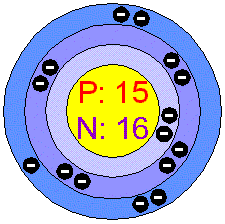
If an atom of an element has atomic number $= 15$ and, mass number $= 31,$ find the number of protons, electrons, neutrons in its atoms.
Answer
The atomic number for any element is the number of protons in its atomic nuclei. In a neutral atom, the number of electrons are the same as the number of protons. The atomic mass $($mass number$)$ is the sum of the protons and neutrons in the nucleus. Mass number can vary due to the fact that the number of neutrons can vary. Isotopes are named for their mass numbers. So, this element has $15$ protons $($atomic number$),$ $15$ electrons, and $16$ neutrons
$($mass number minus atomic number$).$ This isotope is phosphorus$-31,$ which has atomic number $15.$
View full question & answer
Question 111 Mark
Explain why, the atomic masses of many elements are in fractions and not whole numbers.
Answer
The fractional atomic masses of elements are due to the existence of their isotopes having different masses.
View full question & answer
Question 121 Mark
The atomic number of an element $X$ is $16.$ Write down the electronic configuration of $X.$
Answer
Atomic No. of $X = 16\ E.C.$ of $X = (2, 8, 6)$
View full question & answer
Question 141 Mark
Write the distribution of electrons in an atom of element whose atomic number is $18.$ What is special about the outermost electron shell (or valence shell) of the atom of this element?
Answer
Atomic No: $18$
Electronic configuration: $(2, 8, 8)$
The special thing about the outermost shell is that it is completely filled with the electrons.
View full question & answer
Question 151 Mark
What do we call this number which is characteristic of a particular element?
Answer
Atomic no. is characteristic for any particular element.
View full question & answer
Question 161 Mark
What is the relationship between an atom containing $11$ protons, $11$ electrons ad $11$ neutrons, and another atom containing $11$ protons, $11$ electrons and $12$ neurtrons$?$
Answer
Isotopes.
View full question & answer
Question 171 Mark
What are valence electrons? Where are valence electrons situated in an atom?
Answer
The number of electrons present in the valence shell are called valence electrons. Valence electrons are situated in the outermost shell.
View full question & answer
Question 181 Mark
Name the particles used by Rutherford in his experiment on the discovery of nucleus. Also state the charge on these particles.
Answer
Alpha-particles were used by Rutherford in his experiment on the discovery of nucleus. Alpha-particles have $+2$ units of charge.
View full question & answer
Question 201 Mark
Which shell of an atom can accommodate a maximum of:
  1. $8$ electrons$?$
  2. $32$ electrons$?$
Answer
a. $L$ shell can accommodate maximum of $8 \mathrm{e}^{-}$
b. $N$ shell can accommodate maximum of $32 \mathrm{e}^{-}$
View full question & answer
Question 211 Mark
What is the number of valence electrons in the atoms of an element having atomic number $13?$ Name the valence shell of this atom.
Answer
There are $3$ valence electrons present in the element with atomic no. $13.$ Valence shell of this atom is $M.$
View full question & answer
Question 221 Mark
Does the nucleus contain neutrons also?
Answer
The nucleus, that dense central core of the atom, contains both protons and neutrons. Electrons are outside the nucleus in energy levels. Protons have a positive charge, neutrons have no charge, and electrons have a negative charge. Atoms of the same element that have differing numbers of neutrons are called isotopes.
View full question & answer
Question 231 Mark
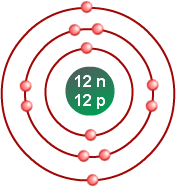
An element has an atomic number $12.$ How many electrons will be present in the $K, L$ and $M$ energy shells of its atom$?$
Answer
Electronic configuration of element with atomic no. $12-(2, 8, 2)$ So, $K-2, L-8, M-2$
View full question & answer
Question 241 Mark
How are the following pairs of atoms related? $ _8\text{X}^{16},\ _8\text{X}^{17},\ _{18}\text{Y}^{40},\ _{20}\text{Z}^{40}$
Answer
Elements $_8\text{X}^{16}$ and $_8\text{X}^{17}$ are isotopes because of a same number of protons.Elements $_{18}\text{Y} ^{40}$ and $_{20}\text{Z}^{40}$ are isobars because of the same mass number.
View full question & answer
Question 251 Mark
Make a schematic atomic structure of Magnesium of Phosphorus. (Given number of protons of Magnesium $= 12$, Phosphorus $= 15).$
Answer
Atomic structure of Mg:
Electronic configuration of Mg. $K L M _{12}Mg = 2, 8, 2$ Atomic structure of P:

​​​​​​​
Electronic configuration of $P K L M _{15}P = 2, 8, 5$
View full question & answer
Question 261 Mark
What is the nucleus of an atom and what is the nature of charge on it?
Answer
Nucleus is a small positively charged part at the center of an atom. Nucleus is positively charged.
View full question & answer
Question 271 Mark
What name is given to those isotopes which have unstable nuclei and emit various types of radiations?
Answer
Radioactive isotopes have unstable nuclei and emit various types of radiations.
View full question & answer
Question 281 Mark
What is the similarity in the electronic structure of the following set of atoms$?$
  1. Lithium.
  2. Sodium.
  3. Potassium.
Answer
  1. $Li: 2, 1$
  2. $Na: 2, 8, 1$
  3. $K: 2, 8, 8, 1$
Clearly, all of these have one electrons each in their outermost shells.
The main points of similarity are:
  • They all have an unpaired electron in an s orbital.
  • They all have an unpaired electron with a magnetic quantum number, $ml = 0.$
  • They all have an unpaired electron with an angular momentum quantum number, $l = 0.$
View full question & answer
Question 291 Mark
What are canal rays$?$
Answer
Canal rays are positively charged radiations. These rays consist of positively charged particles known as protons. They were discovered by Goldstein in $1886.$
View full question & answer
Question 301 Mark
The number of electrons in the outermost shell of an element is $5.$ What is its valency and why$?$
Answer
Valency is the combining power of an element, especially as measured by the number of electrons it has to share, loose or gain in order to form an octet. Since the given element has $5$ electrons in its outermost shell, then to complete octet, it has to gain $3$ electrons . Hence the valency of the element $= 3$
View full question & answer
Question 311 Mark
What is the reason for the different atomic masses of the isotopes of an element?
Answer
The difference in the masses of isotopes of an element is due to different number of neutrons in their nuclei.
View full question & answer
Question 321 Mark
Which of the following are isotopes and which are isobars? Argon, Deuterium, Calcium, Tritium, Protium.
Answer
Deuterium, Protium and Tritium are isotopes. Argon and Calcium are isobars.
View full question & answer
Question 331 Mark
What conclusion is obtained from the fact that all the gases form cathode rays?
Answer
The conclusion is that all the atoms contain negatively charged particles called electrons.
View full question & answer
Question 341 Mark
Name the three sub-atomic particles of an atom.
Answer
The three sub-atomic particles of an atom are:
  1. Protons.
  2. Electrons.
  3. Neutrons.
View full question & answer
Question 351 Mark
What is the absolute mass and charge of an electron?
Answer
Absolute mass of electron is $9 \times 10^{-28} \mathrm{Kg}$
Absolute charge on electron is $1.6 \times 10^{-19} \mathrm{C}$
View full question & answer
Question 361 Mark
What is the general name of the elements having 8 electrons in the valence shell of their atoms?
Answer
Noble gases.
View full question & answer
Question 371 Mark
Name the gas which produces anode rays consisting of protons in the discharge tube experiment.
Answer
Hydrogen gas produces anode rays consisting of protons in the discharge tube experiment.
View full question & answer
Question 381 Mark
Name the central part of an atom where protons and neutrons are held together.
Answer
Nucleus is the central part of an atom in which protons and neutrons are held together.
View full question & answer
Question 391 Mark
All the gases form cathode rays and anode rays when electricity is passed through them: What does the formation of cathode rays tell us about the atoms?
Answer
Formation of cathode rays tells about the presence of negatively charged electrons in all the atoms.
View full question & answer
Question 401 Mark
For the symbols $H, D$ and $T,$ write the subatomic particles (protons, neutrons and electrons) found in each one of them.
Answer
$H–1$ proton, $1$ electron and no neutron. $D–1$ proton, $1$ electron and $1$ neutron. $T–1$ proton, $1$ electron and $2$ neutrons.
View full question & answer
Question 411 Mark
An element $X$ has $5$ electrons in its $M-$shell. What is its atomic number$?$
Answer
If the element has $5$ electrons in the $M$ shell, it is in the $3rd$ period of Periodic Table and $15th$ group.
The element in $3rd$ period and $15th$ group is Phosphorous.
Hence $"X"$ is Phosphorous $(P).$
View full question & answer
Question 421 Mark
What is the relation between the atomic number and mass number of an element?
Answer
Mass No. $=$ Atomic no. $+$ No. of neutrons
View full question & answer
Question 431 Mark
If an element $M$ has mass number $24$ and atomic number $12,$ how many neutrons does its atom contain$?$
Answer
No. of neutrons $=$ Mass No. $-$ Atomic no. $= 24 - 12 = 12$
View full question & answer
MCQ 441 Mark
Put tick $(\checkmark)$ against correct choice and cross $(\times)$ against wrong choice.
Rutherford’s alpha$-$particle scattering experiment was responsible for the discovery of
  • Atomic Nucleus.
  • B
    Electron.
  • C
    Proton.
  • D
    Neutron.
Answer
Correct option: A.
Atomic Nucleus.
View full question & answer
Question 451 Mark
Which of the nuclear particles is present in the same fixed number in the atoms of any particular element?
Answer
Proton is present in same fixed no. in the atoms of any particular element.
View full question & answer
Question 461 Mark
Compare an electron, a proton and a neutron in respect of their relative masses and charges.
Answer
Electron has relative mass of $\frac{1}{1840\text{u}}$ proton has $1u$ and neutron also has $1u.$ Electron has relative charge of $-1u,$ proton has $+1u$ and neutron has $0$ relative charge.
View full question & answer
Question 471 Mark
What is the maximum number of electrons which can be accommodated in the:
Innermost shell of an atom?
Answer
Maximum of $2 \mathrm{e}^{-}$ can be accommodated in innermost shell of an atom.
View full question & answer
Question 481 Mark
Name the particles which actually determine the mass of an atom.
Answer
Protons and neutrons actually determine the mass of atom.
View full question & answer
Question 491 Mark
What name is given to the pair of atoms such as $^{14}_\text{ 7}\text{N}\ \text{and }^{15}_\text{ 7}?$
Answer
The given pair are isotopes.
View full question & answer
Question 501 Mark
Explain why $^3_1\text{H}\text{ and }^3_2\text{He}$ are not considered isotopes.
Answer
$^{3}{\text{H}_1}\text{ and }^3\text{He}_2$ are not consideredas isotopes because they do not have same atomic number.
View full question & answer
Do as directed; [1 M ] - Science STD 9 Questions - Vidyadip