Questions

Answer the questions.[Bio-5M]

Take a timed test

8 questions · self-marked practice — reveal the answer and mark yourself.

Question 15 Marks

What is epithelial tissue? Give its characteristics and functions.

Answer

Epithelial tissue is the simplest animal tissue which composed of one or more layer of cells covering external and internal body organs.

Characteristics of epithelial tissue:

  1. The cells of epithelial tissue are tightly packed and form continuous sheets.
  2. Epithelial cells have small amount of cementing material between them and almost no intercellular space.
  3. The surface of cells may be smooth, columnar or cuboidal.
  4. The cells of the lowermost layer rest on non-cellular basement membrane which separates it from the underlying connective tissue.

Functions:

Epithelial tissue performs following functions:

  1. It protects the organs which it covers.
  2. It absorbs water and other nutrients inside the body.
  3. Some epithelial cells secrete ear wax, mucus and digestive juices.
  4. It keeps different organs separate.
View full question & answer
Question 25 Marks

What do you know about complex tissue Classify and explain its different types in plants with suitable diagrams.

Answer

The complex tissue consists of more than one type of cells having a common origin.

They are of two types:

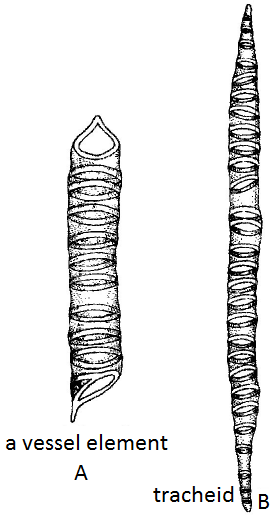
  1. Xylem: Xylem is a vascular and mechanical tissue which conducts water. Xylem is composed of cells of four different types:
  1. Tracheids.
  2. Vessels or tracheae.
  3. Xylem parenchyma.
  4. Xylem Sclerenchyma.

Except xylem parenchyma, all other xylem elements are dead and bounded by thick lignified walls. Vessels are shorter and wider than tracheids. Vessels are very long tube-like structures formed by a row of cells placed end to end. Tracheids are elongated cells with tapering ends. They also conduct water.


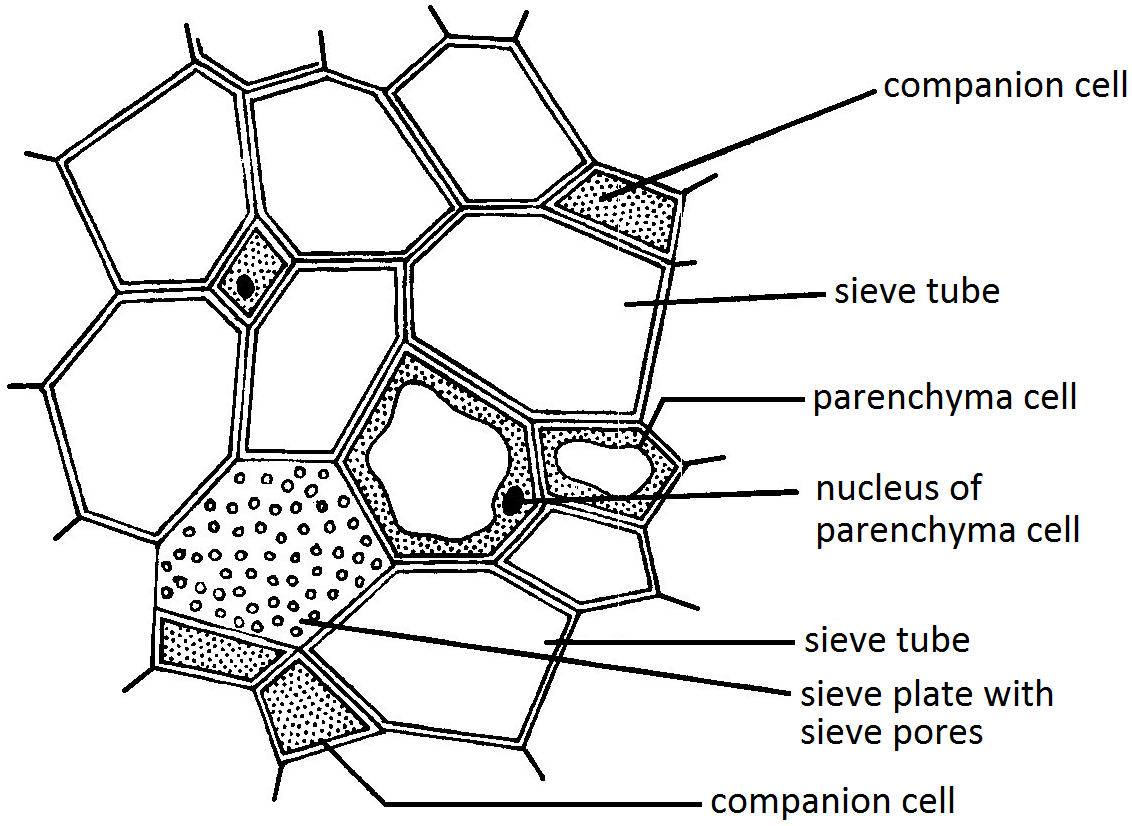
  1. Phloem: Phloem is also a vascular tissue which transports food from the leaves to the various parts of the plant. It is composed of:

  1. Sieve tubes: Sieve tubes are slender, tube-like structures composed of elongated thin-walled cells, placed end to end. Their end walls are perforated by numerous pores and are called sieve plates.

  2. Companion Cells: It is a small thin-walled cell containing dense and very active cytoplasm and large elongated nucleus.

  3. Phloem parenchyma: These are thin-walled, living cells of parenchyma of phloem. They have two functions, storage and slow lateral conduction of food.

  4. Phloem Fibres: These are thick-walled, elongated spindled shaped dead cells which posses narrow lumen. They provide mechanical strength to the tissue.


View full question & answer
Question 35 Marks

Describe the structure of a nerve cell.

Answer

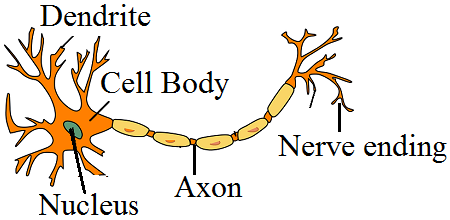
The cells of the nervous tissue are called nerve cells or neurons. A neuron or nerve cell is structural and functional unit of the nervous tissue. It consists of:

  • Cell body or cyton.
  • Axon.
  • Dendrons or dentrites.


Cell body or cyton has a prominent nucleus and cytoplasm. Cell organelles like golgi bodies, mitochondria, etc are also present in the cytoplasm. From the cell body extend out two kinds of cytoplasmic extensions called dentrites and axons. The axon is covered by a fatty myelin sheath. Myelin sheath is discontinuous and broken at intervals by nodes of Ranvier.

Axons usually a long, unbranched, cylindrical process that ends in many terminal end fibres. The axon ending of one nerve cell is lossely placed on the cell body of another nerve cell. The other small branch given out by the cyton are called dendrons which branch further into numerous thin hair-like dentrites.

View full question & answer
Question 45 Marks

Describe the structure and functions of epithelium.

Answer

Epithelium is the simplest tissue. It is the protective tissue of the animal body in which the cells are tightly packed having no intercellular matrix. Epithelial cells lie on a delicate non-cellular basement membrane which contains a special form of matrix protein, called collagen. These tissues perform the function of excretion, secretion and absorption. Depending upon the shape and functions of the cells.

The epithelial tissue is of various types:

  1. Squamous: The cells are flat and polygonal and are arranged as tiles. These tissues occur in skin, lining of alveoli of lungs, blood vessels etc. Its function includes protection, diffusion and osmosis.

  2. Cuboidal: The cells are cube like. These occur in glands, germinal layer of ovary, kidney tubules etc. Its function is secretion and absorption.

  3. Columnar: The cells are pillar or column like resting on a thin membrane. Such tissues occur in the lining of stomach, intestine etc. Its function includes protection, absorption and secretion.

  4. Ciliated: It has cuboidal, columnar cells with fine hair like structures called cilia. It is present in the lining of respiratory tract, fallopian tube, nephron etc. Its function is protection, spreading of mucus and motion of gases and liquids by cilia.

  5. Glandular: The cells are cubical. These can be branched or unbranched. Such tissues are present in glands. Its main function is secretion.

View full question & answer
Question 55 Marks

Describe the composition and functions of blood

Answer

Blood is a fluid connective tissue. There are three types of blood corpuscles:

  1. RBC's or Erythrocytes: These are bi-concave, denucleated, disc like. They contain red coloured respiratory pigment called haemoglobin that helps in the transportation of oxygen.

  2. WBC's or leucocytes: These are irregular, amoeboid, phagocytic cells with one to many lobed nucleus. These cells protect the body against the diseases by producing antibodies.

  3. Blood platelets or thrombocytes: These are spindle shaped cells which help in the clotting of blood.

Functions of blood:

  1. It transports nutrients, hormones and vitamins to the tissues and transports excretory products from the tissues to the liver and kidney.
  2. The RBCs carry oxygen to the tissues for the oxidation of food stuff.
  3. WBCs fight disease by engulfing and destroying foreign bodies.
View full question & answer
Question 65 Marks

Define connective tissue. Write down functions of connective tissue.

Answer

Connective tissues are most abundant and widely distributed in the body of complex animals. The cells of connective tissue are loosely spaced and embedded in an inercellular matrix. The matrix may be jelly like, fluid, dense or rigid.

Functions of connective tissue:

  1. It binds different structure with another like skin with muscles and muscles with bones, etc.
  2. It forms a supporting framework of cartilage and bones in the body.
  3. Blood flows and transports gases, digested food, hormones and waste materials to different parts of the body.
  4. Adipose tissue helps in the storage of fats.
View full question & answer
Question 75 Marks

Classify connective tissue and give one example of each type.

Answer

The connective tissue is specialized to connect and anchor various body organs.

There are five types of connective tissues:

  1. Areolar: This tissue is a loose and cellular connective tissue. Its matrix consists of white collagen fibre and yellow elastic fibre. It joins skin to muscles, fills spaces inside organs and is found around muscles, blood vessels and nerves.

  2. Dense Regular Connective tissue: It is fibrous connective tissue having densely packed fibres and cells. It is the principal component of tendons, ligaments and aponeuroses.

  3. Adipose tissue: It is an aggregation of fat cells or adipocytes. The fat cells are arranged into lobules separated by partitions of collagen and elastin fibres. These are found abundant below the skin, between the internal organs and in yellow bone marrow.

  4. Skeletal tissue: It is a supporting tissue which includes cartilage and bone. Both these tissues form the endoskeleton of a vertebrate body. Cartilage is located in ear pinna, nose tip, epiglottis etc. Bone forms the endoskeleton in human beings and provides shape to the body.

  5. Fluid tissue: It links the different parts of the body and maintains continuity in the body. It includes blood and lymph.

View full question & answer
Question 85 Marks

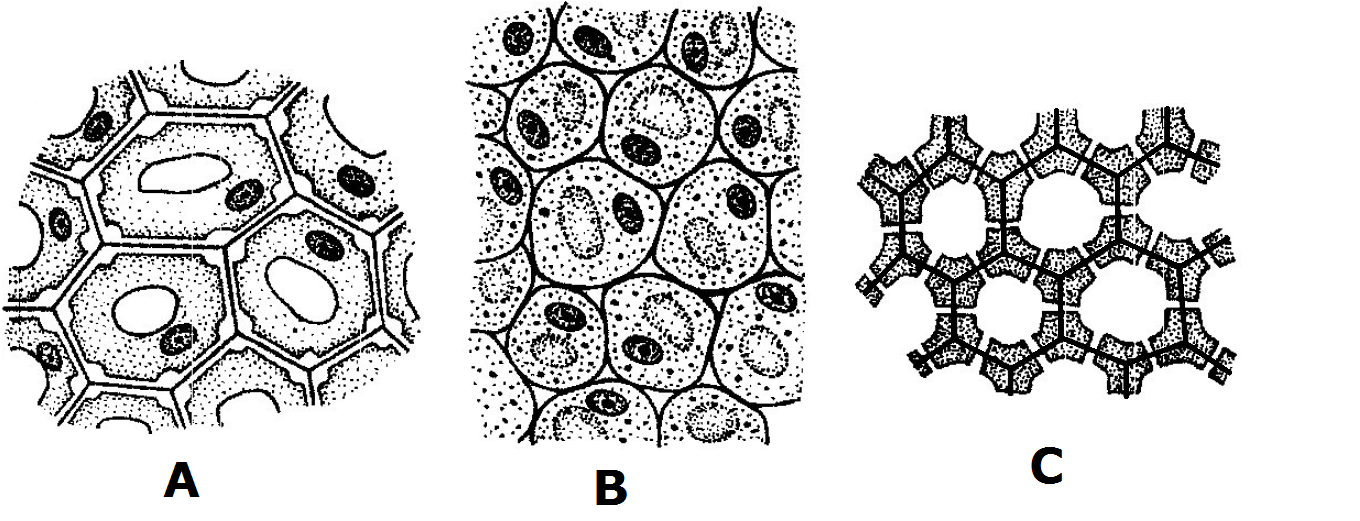
  1. Identify Figure A, B and C.
  2. Which one of them has heavy deposition of lignin?
  3. Which one of them provides both mechanical strength as well as flexibility?
  4. Which one of them can be modified to form air cavities in awuatic plants?
  5. Which one of them is commercially exploited to obtain Hemp and Jute?
Answer
  1. A: Transverse section of collenchyma.

B: T.S. parenchyma.

C: T.S. sclerenchyma fibres.

  1. Sclerenchym tissue has heavy deposition of lignin.
  2. Collenchyma tissue provides both mechanical strength and flexibility.
  3. In aquatic plants, large air cavities are present in parenchyma tissue to given buoyancy to the plants to help them float. Such a modified parenchyma is called aerenchyma.
  4. Fibres of Hemp and Jute are obtained from the sclerenchyma fibres.
View full question & answer
Answer the questions.[Bio-5M] - Science STD 9 Questions - Vidyadip