Questions · Page 1 of 3

Answer the questions.[Bio-2M]

🎯

Test yourself on this topic

50 questions · timed · auto-graded

Question 12 Marks
You can very easily bend the stem of a plant without breaking it. Name the tissue in the plant, which makes it possible. Where is it located? State any two characteristics of the cells of this tissue.
Answer
Due the presence of collenchyma tissue.
Function: provide flexibility and strength.
Location: between nodes and internodes.
Features: thickened at the corners due to pectin and cellulose, very less intercellular spaces.
View full question & answer
Question 22 Marks
Write the name of varuous types of white blood cells (WBCs).
Answer
Types of white blood cells (WBCs) are:
  • Eosinophils.
  • Basophils.
  • Neutrophils.
  • Monocytes.
  • Lymphocytes.
View full question & answer
Question 32 Marks
Write one main function of:
  1. Apical meristem.
  2. Lateral meristem.
Answer
  1. Apical meristem: It brings about the elongation of the root and stem.

  2. Lateral meristem: It causes the organ (stem or root) to increase in diameter and girth.

View full question & answer
Question 42 Marks
Write one function of fluid connective tissue.
Answer
Function of fluid connective tissue: Blood a fluid connective tissue provides transport system within our body and other important substance. cartilage provides strong support and connection for our skeletal framework and function of bones is to support and protect soft tissue and organs in our body.
View full question & answer
Question 52 Marks
Write a short note on sclerenchyma.
Answer
Sclerenchyma cells are dead cells and they are devoid of protoplasm. The cells walls of sclerenchyma are greatly thickened by lignin. The cells of sclerenchyma are closely packed without intercellular spaces.
View full question & answer
Question 62 Marks
Write a short note on intercalary meristem.
Answer
They are located at the base of leaves or internodes, e.g., stems of grasses and other monocots. Such tissues also occur below the nodes. It produces an increase in the length of an organ such as leaves and internodes.
View full question & answer
Question 72 Marks
Why the growth of plants occurs only in certain specific regions?
Answer
Meristematic tissue consist of actively dividing cell and leads to increase in length and thickness of plant. The primary growth of plant occur only in specific region such as the tips of roots and stems because in these region meristematic tissue is present.
View full question & answer
Question 82 Marks
Why is epidermis important for the plants?
Answer
Epidermis is the protective covering of plant body. It protects the plants from desiccation and infection.
View full question & answer
Question 92 Marks
Why is blood considered to be connective tissue?
Answer
When blood circulates in the body, it passes through all the organs and thus connects different tissues and organs of the body. Hence it is considered to be a connective tissue.
View full question & answer
Question 102 Marks
Why are plant and animal tissues different?
Answer
  1. Plants are stationary or fixed as they don’t move while animlas move around in search of food, mates and shelter.
  2. The growth in plants is limited to certain regions, while this is not so in animals.
View full question & answer
Question 112 Marks
Which type of skeletal tissue contain chondrin and ossein respectively?
Answer
Cartilage contains chondrin and bone contains ossein respectively.
View full question & answer
Question 122 Marks
Which type of epithelium (on the basis of function) is present in:
  1. Sweat gland.
  2. Testis?
Answer
  1. Glandular epithelium is present in sweat gland.
  2. Germinal epithelium is present in testis.
View full question & answer
Question 132 Marks
Which type of epithelium is present in the organs where exchange of substances takes place?
Answer
Simple squamous epithelial cells are extremely thin and flat which allows diffusion of substances through it.
View full question & answer
Question 142 Marks
Which tissue is called middleman between tissues cells and blood?
Answer
Lymph is a colorless or slightly yellowish fluid which is called the middleman between tissues cells and blood.
View full question & answer
Question 152 Marks
Which tissue forms blubber of whale and hump of camel?
Answer
Adipose tissue forms blubber of whale and hump of camel.
View full question & answer
Question 162 Marks
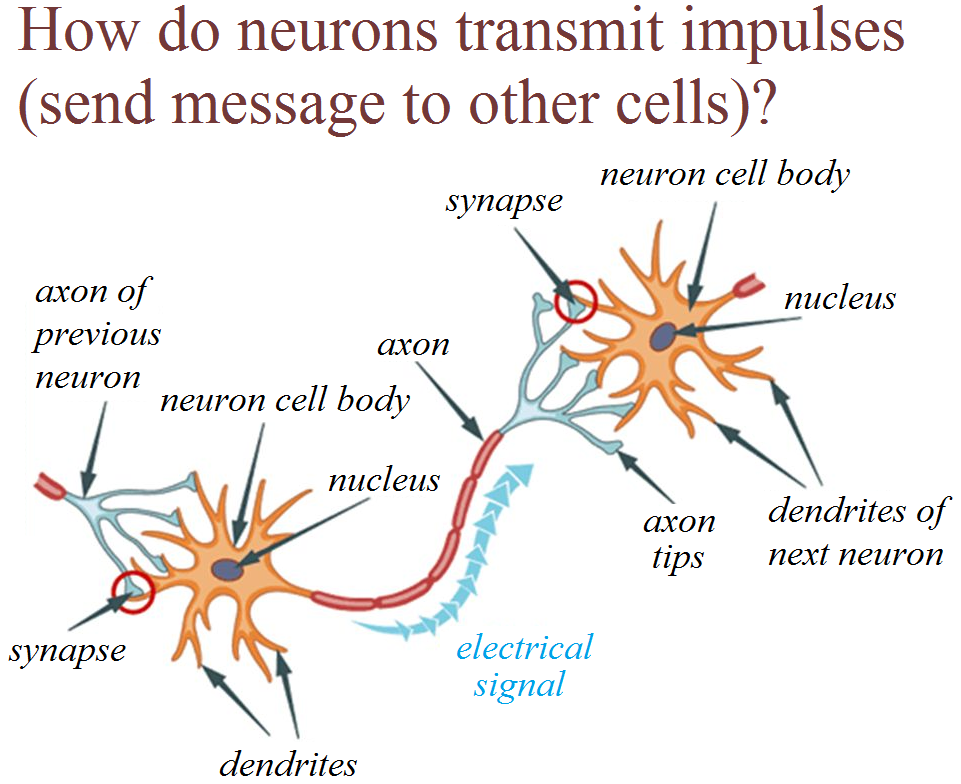
Which part of neuron receives and transmits impulses?
Answer
Cell body receives impulse and is transmitted through axon and axon terminals.
Following picture also depicts the same phenomenon:

View full question & answer
Question 172 Marks
Which chemical compound does make cork impermeable for liquid and gases?
Answer
The cell wall of cork is coated with suberin, a waxy substance which which makes these impermeable to water and gases.
View full question & answer
Question 182 Marks
Which are soliers of the body in offence and defence?
Answer
White blood cells are protect our body from various germs that infact our body, hence they are known as soldiers of the body.
View full question & answer
Question 192 Marks
Where do bone and cartilage cells reside?
Answer
Bone and cartilage cells reside in small spaces within the matrix that are called lacunae.
View full question & answer
Question 202 Marks
Where are the permanent tissues located in plant?
Answer
Permanent plant tissues are found in mature plants. Simple tissues are composed of only one type of cell. Parenchyma is a flexible tissue that makes up many parts of the plant, like photosynthetic leaves and soft parts of fruit.
View full question & answer
Question 212 Marks
Where are companion cells located in plants? Mention their functions.
Answer
The companion cells are usually found in the phloem area of the plants
The major functions of companion cells are as follows:
  1. Companion cells in the veins of leaves function in the transfer of assimilates from photosynthetic tissues and bundle sheaths into the sieve tubes.
  2. Apoplastic loading, a process utilizing energy, is facilitated by carrier proteins called sucrose transporters which are located in the plasma membranes of companion cells and/or sieve tube members.
  3. Companion cells that function as transfer cells are characterized by extensive wall in growths that vastly increase the surface area of the plasma membrane.
  4. Companion cells also play an important role in maintaining the viability and long-distance translocation system of the enucleate sieve tube members by providing them with proteins, including informational (signaling) molecules, and ribonuclear protein complexes as well as ATP.
View full question & answer
Question 222 Marks
What will happen if bone marrow is destroyed.
Answer
Bone marrow is responsible for the production of blood cells in the body. If bone marrow is destroyed, the formation of white blood cells, red blood corpuscles and platelets will stop.
View full question & answer
Question 232 Marks
What will happen if apical meristem is damaged or cut?
Answer
Apical meristems are the growing parts of the roots and stems and are present at the tips of roots, branches, leaves and shoots. If the apical meristems are damanged or cut, the growth of that part of the plant will stop.
View full question & answer
Question 242 Marks
What will happen if all blood platelets are removed from blood?
Answer
Blood platelets are responsible for clotting of blood. If blood platelets are removed from the blood, clotting will not happen after injury and bleeding will continue. This might lead to the death of the injured person.
View full question & answer
Question 252 Marks
What types of functions does the single cell of unicellular organisms such as Amoeba perform?
Answer
Amoeba is a single cell unicellular organism. It performs all vital life activities like respiration, intake of food, exchange of respiratory gases, excretion, reproduction.
View full question & answer
Question 262 Marks
What types of functions does the single cell of multicellular organism perform?
Answer
In multicellur organisms, each kind of cell is structured to perform all vital life activities and one specific function as a component of tissues.
View full question & answer
Question 272 Marks
What type of tissue is present in bone marrow?
Answer
Areolar connective tissue is present in bone marrow.
View full question & answer
Question 282 Marks
What type of thickening of cell wall does occur in collenchymas?
Answer
The cell wall is generally unevenly thickened in collenchymas. The walls are rich in hemicellulose.
View full question & answer
Question 292 Marks
What is the utility of tissues in multi-cellular organisms?
Answer
In multicellular organisms, the different types of tissues perform different functions. Since a particular group of cells carry out only a particular function, they do it very efficiently. So, multicellular organisms possess a definite division of labour.
View full question & answer
Question 302 Marks
What is the specific function of the cardiac muscle?
Answer
  • They are cylindrical and branched.
  • They are uninucleated.
  • Involuntary muscles.
  • They contract and relax throughout life in rhythm.
View full question & answer
Question 312 Marks
What is the number of blood platelets?
Answer
The number of blood platelets is 2,50,000-300,000 per cubic mm.
View full question & answer
Question 322 Marks
What is the name of sheath of nerve fibre?
Answer
Myelin (medullary) sheath is a fatty covering that surrounds axon of nerve fibres. It insulates the nerve fibre (axon) and prevents leakage of ions.
View full question & answer
Question 332 Marks
What is the name of contractile elements of muscles?
Answer
Muscular tissue is responsible for movement in our body. The cells of this tissue contain special proteins called contractile proteins, which contract and relax to cause movement.
View full question & answer
Question 342 Marks
What is the importance of tissues?
Answer
Importance of tissues:
  1. Formations of tissues have brought about a division of labour in multicellular organisms.
  2. Tissues become organised to form organs and organs organise into organ system.
View full question & answer
Question 352 Marks
What is the function of thin, hair-like projections present on the cuboidal epithelium?
Answer
The hair like projection in cuboidal epithelium is called cilia. it prevents the blockage of waste material.
View full question & answer
Question 362 Marks
What is the function of meristematic tissues (meristem)?
Answer
  1. Meristematic tissue developed from parent cell.
  2. Meristematic tissue take part in growth.
  3. The place of injury is held up by the formation of new cell.
View full question & answer
Question 382 Marks
What is the difference between sclerenchyma and collenchyma?
Answer
Collenchyma cells have thin primary walls with some areas of secondary thickening. Collenchyma provides extra mechanical and structural support, particularly in regions of new growth. Sclerenchyma cells have thick lignified secondary walls and often die when mature.
View full question & answer
Question 392 Marks
What is skeletal connective tissue? Give its functions.
Answer
Skeletal connective tissue forms the endoskeleton of the body. It includes bones and cartilage.
Functions of skeletal connective tissue:
  1. It provides support to the body.
  2. Protects the vital organs of the body like brain, ear, heart, lungs etc.
  3. It anchors the muscles and provide movement to animal body.
View full question & answer
Question 412 Marks
What is relation between division of labour and various types of tissues?
Answer
Division of labour is adaptation of different parts of an organism to carry out different functions. Hence, there are several kinds of tissues, each with specific properties to carry out specific function in the body.
View full question & answer
Question 422 Marks
What is RBC count of normal humans?
Answer
The normal RBC range for men is 4.7 to 6.1 million cells per microliter. The normal RBC range for women is 4.2 to 5.4 million cells per microliter.
View full question & answer
Question 432 Marks
What is medullary sheath? Mention its significance.
Answer
Myelin (medullary) sheath is a fatty covering that surrounds axon of nerve fibres. It insulates the nerve fibre (axon) and prevents leakage of ions.
View full question & answer
Question 442 Marks
What is leucocyte count of normal humans?
Answer
In human, it ranges from 5000 to 11000 leucocytes/ mm3 blood.
View full question & answer
Question 452 Marks
What is function of tendon?
Answer
Tendon is a fibrous (dense) connective tissue which connects a muscle with a bone.
View full question & answer
Question 462 Marks
What is economic use of sclerenchyma?
Answer
The sclerenchyma fibers are of great economical importance since they constitute the source material for many fabrics, hemp, flex, jute.
View full question & answer
Question 472 Marks
What is differentiation?
Answer
The process of taking up a permanent shape, size and a function is called differentiation.
View full question & answer
Question 482 Marks
What is cyton?
Answer
A neuron consists of a cell body or cyton with a nucleus and cytoplasm, from which long thin hair-like parts arise.
View full question & answer
Question 492 Marks
What is apical meristem?
Answer
The meristem which occurs at the growing tips of roots and shoots and increases the length of the stem and root is called apical meristem.
View full question & answer
Question 502 Marks
What are tracheary elements? Describe their functions.
Answer
Tracheary elements are the elements of xylem. Their function is to carry water and mineral salts in upward direction from the roots to different part of shoots.
View full question & answer
Answer the questions.[Bio-2M] - Science STD 9 Questions - Vidyadip