Questions · Page 2 of 3

Answer the questions.[Bio-2M]

Question 512 Marks
What are tissues? Give importance of tissue.
Answer
Group of cells that are similar in structure and perform same function is called a tissue.
Tissue provide structural strength, mechanical strength and show division of labour.
View full question & answer
Question 522 Marks
What are the two types of striated muscle fibres?
Answer
Skeletal and cardiac muscles are two types of striated muscle fibres.
View full question & answer
Question 532 Marks
What are the functiors of phloem?
Answer
Functions of Phloem:
Phloem transports photosynthetically prepared food materials from the leaves to the storage organs and later from storage organs to the growing regions of the plant body.
View full question & answer
Question 542 Marks
What are the functions of xylem?
Answer
Functions of Xylem:
  1. The main function of xylem is to carry water and mineral salts upward from the root to different parts of shoots.
  2. Since walls of tracheids, vessels and sclerenchyma of xylem are lignified, they give mechanical strength to the plant body.
View full question & answer
Question 552 Marks
What are the constituents of phloem?
Answer
It is made up of 4 elements:
  • Sieve tube.
  • Companion cells.
  • Phloem fibres.
  • Phloem parenchyma.
View full question & answer
Question 562 Marks
What are simple tissres? Explain their three different types
Answer
Simple permanent tissues: These tissues are composed of cells which are structurally and functionally similar.
There are three types of simple permanent tissues:
  1. Parenchyma: Parenchyma cells are living and posses the power of division. The cell wall is thin and encloses a dense cytoplasm which contains a small nucleus and surrounds a large central vacuole.
  2. Collenchyma: Its tissues consists of living cells. It is characterized by the deposition of extra cellulose at the corners of the cells. In collenchymas, intercellular spaces are generally absent. Collenchyma cells are elongated in shape. They often contain a few chloroplasts.
  3. Sclerenchyma: Sclerenchyma cells are dead cells and they are devoid of protoplasm. The cells walls of Sclerenchyma are greatly thickened of lignin. The cells of Sclerenchyma are closely packed without intercellular spaces.
View full question & answer
Question 572 Marks
What are medullated nerve fibres?
Answer
The nerve fiber which is surrounded by a myelin sheath is called medullated nerve fiber. In this nerve fiber, conduction of nerve impulse is faster.
View full question & answer
Question 582 Marks
What are conducting elements of xylem?
Answer
Xylem vessels and tracheids are two elements of xylem tissue which help in the transportation of water.
View full question & answer
Question 592 Marks
Water hyacinth float on water surface. Explain.
Answer
A special type of parenchyma; called aernchyma is present in water hyacinth. This tissue has air filled spaces inside and because the air gets trapped inside especially in the stem part so it becomes buoyant. Due to this, water hyacinth floats on water surface.
View full question & answer
Question 602 Marks
The sites where cuboidal epithelium is present, will be specialized in which type of functions?
Answer
It is specialized in providing mechanical support.
They often get specialized in secretions through the epithelium and therefore are known as gland cells. Sometimes by folding inwards they form multicellular gland and is termed as glandular cells.
View full question & answer
Question 612 Marks
The cells of stratified squamous epithelium are arranged in many layers. Why?
Answer
The cells of stratified squamous epithelium are arranged in many layers to prevent any kind of wearing and tearing for providing protection.
View full question & answer
Question 622 Marks
Tabulate differences between plants and animal tissues.
Answer
Plant Tissues
Animal Tissues
1.
They require less maintenance energy.
1.
They require more maintenance energy.
2.
There is a differentiation of meristematic and permanent tissues.
2.
Such a differentiation is absent in them.
View full question & answer
Question 632 Marks
State two characteristics of nerve cells.
Answer
Two characteristics of nerve cells are:
  1. They are highly specialised unit cells.
  2. Neurons have the ability to receive stimuli from within or outside the body and to conduct (send) impulses (signals) to different parts of the body.
View full question & answer
Question 642 Marks
State the function of microvilli.
Answer
Functions of microvilli:
  1. They increase the absorptive surface of the intestinal cell (enterocyte).
  2. They increase the surface area available for reactions.
View full question & answer
Question 652 Marks
Specify any two parts of the plant, where these tissues are present.
Answer
These are present in the hard coverings of the seed, in the stems, in the veins of the leaves etc.
View full question & answer
Question 662 Marks
Smooth muscles are also called unstriated muscles. Why?
Answer
Smooth muscles are called unstriated muscles because these muscles show no cross striations and look smooth . Therefore, are called non striated muscles or unstriped muscles.

These muscles are seen in hollow internal organs (viscera) such as stomach, intestine, blood vessels, urinary bladder, uterus etc.

In contrast to this , the muscle which shows cross striations are called striated muscles or striped muscles.

View full question & answer
Question 672 Marks
Root hair is extension of which type of cell?
Answer
Root hair is formed by the extension of epidermal cell in roots of a plant.
View full question & answer
Question 682 Marks
Read the statement given below:
They lack vacuoles and intercellular spaces. The above statements refer to which type of tissue in plants.
Answer
Schlerenchyma tissue lack vacuoles and intercellular spaces.
View full question & answer
Question 692 Marks
Read the statement given below:
Cells are active with dense cytoplasm and prominent nuclei.
Answer
Meristematic cells have dense cytoplasm and prominent nuclei because they are actively dividing cells, so they require cytoplasm and nucleus to control their activities.Schlerenchyma tissue lack vacuoles and intercellular spaces.
View full question & answer
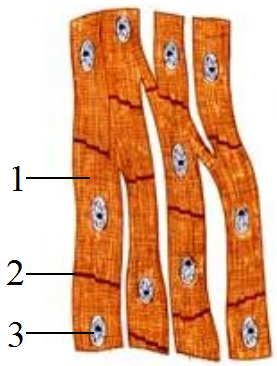
Question 702 Marks
  1. Identify the tissue.
  2. Labels the parts marked 1, 2 and 3.
  3. What type of this tissue and where it occurs in body.

; width:
Answer
  1. Muscular tissue.
  2.  
  1. Sarcoplasm.
  2. Intercalated disc.
  3. Nucleus.
  1. It is cardiac muscles which are exclusively present in the wall of heart.
View full question & answer
Question 712 Marks
Name two lateral meristems which help in secondary growth of stem and root.
Answer
Cork cambium and vascular cambium help in secondary growth of stem and root.
View full question & answer
Question 722 Marks
Name the type of muscles that accomplish peristalsis.
Answer
Smooth muscles are found in alimentary canal and accomplish peristalsis movement.
View full question & answer
Question 732 Marks
Name the tissue which helps in easy bending of plants.
Answer
The simple permanent tissue which gives flexibility to the plants and allow them to bend is collenchyma.
View full question & answer
Question 742 Marks
Name the tissue and write characteristic feature of following.
Transports water and minerals, in plants.
Answer
Xylem components tracheids and vessels transport the water and minerals in the plants. Following are the characteristic feature of the xylem tracheids and vessels:
  • Tracheids and vessels are dead elements of xylem.
  • They have thick walls and are tubular structures.
  • Tracheids and vessels provide unidirectional flow of water and minerals.
View full question & answer
Question 752 Marks
Name the tissue and write characteristic feature of following.
Has prominent middle lamella.
Answer
Cell wall has the prominent middle lamella.
A major function of the cell wallis to give the cell strength and structure, and to filter molecules that pass in and out of the cell.
View full question & answer
Question 762 Marks
Name the tissue and write characteristic feature of following.
Forms inner lining of alveoli.
Answer
Simple squamous epithelium forms the inner lining of the alveoli. Following functions are given below:
  • These cells provide protection for underlying tissues.
  • They forms a barrier between the body and the exterior environment.
  • Simple squamous epithelial cells(glomerulus) in nephrons of kidneys enable rapid filtration of blood and diffusion of small molecules.
  • Squamous epithelial cells of lungs (alveoli of lungs) helps to reduce friction and controls vessel permeability.
  • It also helps in absorption and filtration.
View full question & answer
Question 772 Marks
Name the tissue and write characteristic feature of following.
Connects bone to bone in humans.
Answer
Ligaments are connective tissue which are very similar in composition to tendons. However they connect bones with each other and are important in maintaining them in place especially at articulating joints. Without ligaments, the bones can be displaced upon muscle contraction or even during movement. Ligaments help in maintaing the bones in place and aid in controling the range of movement.
View full question & answer
Question 782 Marks
Name the protein is found in white fibre and yellow fibre.
Answer
White fibre: collagen protein.
Yellow fibre: elastin protein.
View full question & answer
Question 792 Marks
Name the plant tissue found in the husk of coconut and also identify the chemical which is responsible for its stiffness.
Answer
Plant tissue in husk of coconut is sclerenchvma fibres.
Reason for stiffness of scrererrchyma is deposition of iig'in in cell walls of its cells.
View full question & answer
Question 802 Marks
Name the living components common to both the complex permanent tissues found in plants. What is its function?
Answer
Parenchyma is the common living component of two complex permanent tissues, xylem and phloem.
Xylem parenchyma store food and helps in later conduction of water.
Phloem parenchyma store food, latex, resins, etc.
View full question & answer
Question 812 Marks
Name the leucocytes that increase in number during worm infestations.
Answer
Eosinophils increases during worm infection.
View full question & answer
Question 822 Marks
Name the following:
  1. Tissue which stores fat.
  2. Epithelium which lines lung alveoli.
Answer
  1. Adipose tissues.
  2. Ciliated epithelium.
View full question & answer
Question 832 Marks
Name the following:
  1. Neurons which carry impulses towards brain.
  2. Process of neuron which carries impulses away from cyton.
Answer
  1. Sensory neurons carry impulses towards brain.
  2. Axon is long, branch process of neuron which carries impulses away from cyton.
View full question & answer
Question 842 Marks
Name the following:
  1. Multinucleate muscle fibre.
  2. Spindle shape muscle fibre.
Answer
  1. Skeletal or striated muscle fibre is multinucleated.
  2. Smooth or unstriated muscle fibre is long and spindle shape.
View full question & answer
Question 852 Marks
Name the distinctive features of complex plants, that helped in their survival on the Earth.
Answer
There are certain plants which are living in extreme conditions and it is possible due to the presence of certain distinctive features:
  • Plants living in extreme dry habitats have a thick epidermal layer which prevents the loss of water.
  • In desert plants, they have a thick waxy cuticle over the outer surface which prevents the loss of water.
View full question & answer
Question 862 Marks
Name the different types of elements found in the xylem.
Answer
Xylem is composed of cells of four different types:

  1. Tracheids.
  2. Vessels or tracheae.
  3. Xylem parenchyma.
  4. Xylem Sclerenchyma.

Except xylem parenchyma, all other xylem elements are dead and bounded by thick lignified walls. Vessels are shorter and wider than tracheids. Vessels are very long tube-like structures formed by a row of cells placed end to end. Tracheids are elongated cells with tapering ends. They also conduct water.

View full question & answer
Question 872 Marks
Name the complex tissue which helps in:
  1. Conduction of water and minerals.
  2. Conduction/ transport of food.
Answer
  1. Xylem helps in conduction of water and minerals.
  2. Phloem helps in conduction of food.
View full question & answer
Question 882 Marks
Name any two simple and two complex permanent tissues in plants.
Answer
Two simple permanent tissue in plants are parenchyma and collenchyma while two complex permanent tissue in plants are xylem and phloem.
View full question & answer
Question 892 Marks
Name a component of phloem formed by the end to end fusion of cells with the perforated transverse wall.
Answer
A component of phloem formed by end to end fusion of cells with perforated transverse wall is "SIEVE TUBE".

Phloem is a vascular bundel in plants which helps in the transportation of food.

View full question & answer
Question 902 Marks
In which type of epithelium, cilia are present? What is their role in this epithelium?
Answer
Ciliated Epithelium: When the columnar epithelial tissues have cilia, then they are called the ciliated epithelium. Their main function is to move particles or mucus in a specific direction. The rhythmic movement of the cilia helps in the movement of material in one direction. This tissue is found in the inner surface of organs like bronchioles and fallopian tubes.
View full question & answer
Question 912 Marks
If a potted plant is covered with a glass jar, water vapours appear on the wall of glass jar. Explain why?
Answer
Transpiration takes place through stomata. Water vapour comes out of leaves during transpiration. When a potted plant is covered with a glass jar, water vapour (coming out because of transpiration) condenses on the wall of glass jar and hence it appears as fine droplets.
View full question & answer
Question 922 Marks
Identify the type of tissue in the following: skin, bark of tree, bone, lining of kidney tubule, vascular bundle.
Answer
  • Skin: Stratified squamous epithelial tissue.
  • Bark of tree: Simple permanent tissue.
  • Bone: Connective tissue.
  • Lining of kidney tubule: Cuboidal epithelial tissue.
  • Vascular bundle: Complex permanent tissue.
View full question & answer
Question 932 Marks
Identify the animal tissues from the given descriptions:
Tissue 'A’- cells are filled with fat globules and the tissue acts as an insulator.
Tissue 'B'- has cylindrical branched cells and the tissue shows rhythmic contraction and relaxation thought life.
Answer
  1. Adipose tissue is the tissue that is filled with the fat globules and acts as an insulator.

Location of adipose tissue- It is present below the skin and in between the internal organs.

  1. Cardiac muscles have cylindrical branched cells and shows rhythmic contraction and relaxation throughout the life.

Location- Cardiac muscle cells are present in heart.

View full question & answer
Question 942 Marks
Identify the animal tissues from the given descriptions and also mention their location in the human body.
Tissue A cells are filled with fat globules and the tissue acts as an insulator.
Answer
Adipose tissue is the tissue that is filled with the fat globules and acts as an insulator.
Location of adipose tissue: It is present below the skin and in between the internal organs.
View full question & answer
Question 952 Marks
How many types of muscles occur in animals?
Answer
Three types of muscles occur in animals namely striated muscles, smooth muscles and cardiac muscles.
View full question & answer
Question 962 Marks
How many types of elements together make up the xylem tissue? Name them.
Answer
There are four different types of cells that make up the xylem tissue. They are:
  1. Tracheids.
  2. Vessels.
  3. xylem parenchyma.
  4. Xylem fibres.
View full question & answer
Question 972 Marks
How is glandular epithelium formed?
Answer
Most glands are formed during development by proliferation of epithelial cells so that they project into the underlying connective tissue. Some glands retain their continuity with the surface via a duct and are known as EXOCRINE GLANDS.
View full question & answer
Question 982 Marks
How does the cork act as a protective tissue?
Answer
The outer protective layer or bark of a tree is known as the cork. It is made up of dead cells. Therefore, it protects the plant against mechanical injury, temperature extremes, etc. It also prevents the loss of water by evaporation.
View full question & answer
Question 992 Marks
Growth in plant is restricted to certain regions, Give reason for this fact.
Answer
Plants contain meristematic tissue located at certain regions where growth takes place by division of cells. They are present only at the growing regions such as root tip, shoot tip and cambium. Cells of other regions of plant, do not divide and the growth is restricted in those regions.
View full question & answer
Question 1002 Marks
Give two examples of cartilage.
Answer
Cartilage is present at the tip of nose and in the external ear.
View full question & answer
Answer the questions.[Bio-2M] - Page 2 - Science STD 9 Questions - Vidyadip