Questions · Page 3 of 3

Answer the questions.[Bio-2M]

Question 1012 Marks
Give three features of cardiac muscles.
Answer
Three features of cardiac muscles are:
  1. Cardiac muscles are involuntary muscles that contract rapidly, but do not get fatigued.
  2. The cells of cardiac muscles are cylindrical, branched, and uninucleate.
  3. They control the contraction and relaxation of the heart.
View full question & answer
Question 1022 Marks
Give the functions of skeletal connective tissues.
Answer
Skeletal connective tissue are the tissues which join skeletal organs like bones. These oragans include tendons, ligaments and bones and make the whole skeletal system of our body.
Function:
  1. It helps in the movement of body.
  2. Protects major organs of our body like skull and rib cage.
View full question & answer
Question 1032 Marks
Give the characteristic features of their cells.
Answer
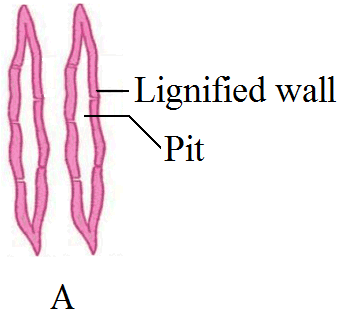
Features of sclerenchyma fibers:
  • These are dead elements.
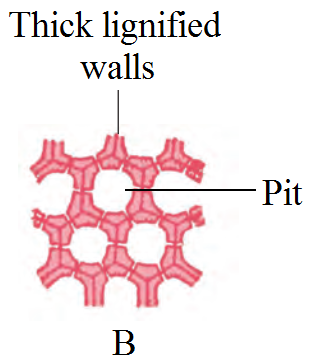
  • They have thick wall of lignin, are elongated and pointed at ends.
  • They have pits also.
  • They mostly occur in groups.
Features of sclereids:
  • These are dead elements.
  • These are oval, spherical and are thickened due to lognin deposition.
  • They have very narrow cavities at the centre.
View full question & answer
Question 1042 Marks
Give reasons for:
Intercellular spaces are absent in sclerenchymatous tissues.
Answer
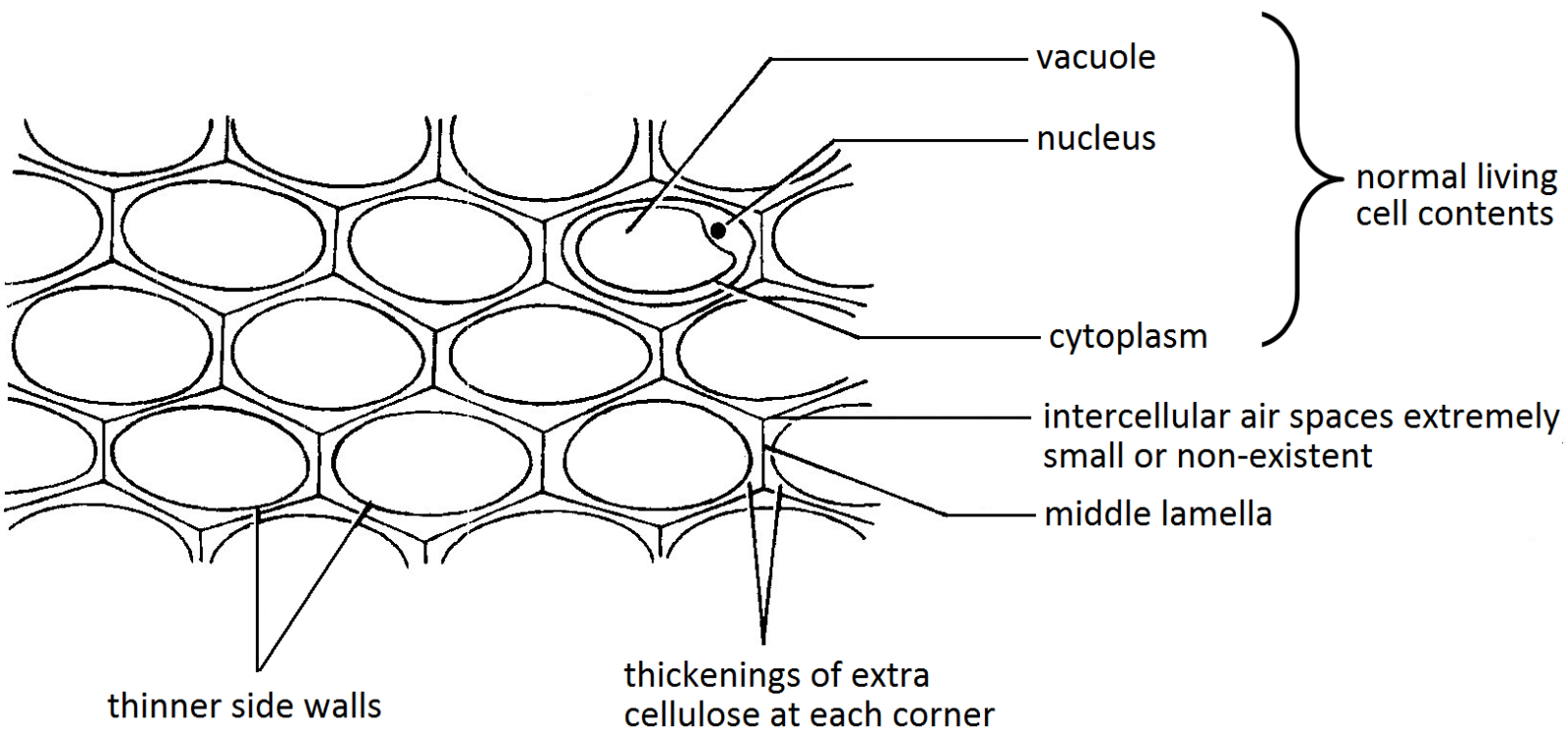
Sclerenchyma tissue are dead simple permanent tissue of the plant. The cells of sclerenchyma are closely packed without intercellular spaces, like tiles in mosaic floor so that, it can provide the strength, rigidity, flexibilty and elasticity to the plant to withstand various strains.
View full question & answer
Question 1052 Marks
Give one word for:
  1. Zig-zag thickenings in cardiac muscles.
  2. Thickening present in sclerenchyme cell.
Answer
  1. Intercalated discs.
  2. Lignin.
View full question & answer
Question 1062 Marks
Give one example each of:
  1. Squamous epithelium.
  2. Columnar epithelium.
Answer
  1. Blood vessels.
  2. Intestine.
View full question & answer
Question 1072 Marks
Give any two main functions of stomata.
Answer
  1. It helps in transpiration in plants.
  2. It helps in exchanging gases with the atmosphere.
  3. The gas exchange that occurs when stomata are open facilitates photosynthesis.
View full question & answer
Question 1082 Marks
Explain how sieve tubes manage to be living?
Answer
Sieve tube elements do not have nuclei but have cytoplasm. They are dependent on adjacent companion cells which contains dense and very active cytoplasm and a large elongated nucleus.
View full question & answer
Question 1092 Marks
Explain different types of elements present in phloem.
Answer
The different types of elements present in the phloem are:
  1. Sieve tubes: Sieve tubes are slender, tube-like structures composed of elongated thin-walled cells, placed end to end. Their end walls are perforated by numerous pores and are called sieve plates.
  2. Companion cells: It is a small thin-walled cell containing dense and very active cytoplasm and large elongated nucleus.
  3. Phloem parenchyma: These are thin-walled, living cells of parenchyma of phloem. They have two functions, storage and slow lateral conduction of food.
  4. Phloem Fibre: These are thick-walled, elongated spindled shaped dead cells which posses narrow lumen. They provide mechanical strength to the tissue.
View full question & answer
Question 1102 Marks
Enumerate various cells of connective tissue.
Answer
The various cells of connective tissue are fibroblasts, adipose cells, macrophages, mast cells and lymphocytes.
View full question & answer
Question 1112 Marks
Enumerate protein fibres of connective tissue.
Answer
The protein fibres of connective tissue are white fibres of collagen, yellow fibres of elastin and reticular fibres of reticulin.
View full question & answer
Question 1122 Marks
Enumerate four main types of animal tissues.
Answer
Four main types of animal tissues are:
  1. Epithelial tissues.
  2. Muscular tissues.
  3. Connective tissues.
  4. nervous tissue.
View full question & answer
Question 1172 Marks
Distinguish between xylem and phloem.
Answer
Xylem:
  1. It conducts water and minerals.
  2. Conducting channels or tracheary elements are tracheids and vessels.
Phloem:
  1. It conducts organic solutes and food materials.
  2. Conducting channels are sieve tubes.
View full question & answer
Question 1182 Marks
Distinguish between tracheids and vessels.
Answer
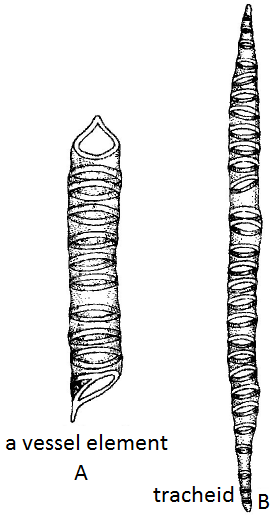
Tracheids:
  1. Single celled.
  2. The end walls remain intact.
Vessels:
  1. Made up of a row of cells.
  2. End walls get dissolved and become perforated.
View full question & answer
Question 1192 Marks
Distinguish between the following pairs in one or two sentences for each:
Tendon and ligament.
Answer
Tendon
Ligament
1.
It is inelastic in nature.
1.
It is elastic in nature.
2.
It joins muscles to bones.
2.
It joins bones to bones.
View full question & answer
Question 1202 Marks
Distinguish between the following pairs in one or two sentences for each:
Striated and unstriated muscles.
Answer
Striated Muscles
Unstriated Muscles
1.
They are long and cylindrical in shape.
1.
These are spindle shaped.
2.
These muscles show alternate light and dark bands or striations.
2.
These muscles do not show striations.
View full question & answer
Question 1212 Marks
Distinguish between the following pairs in one or two sentences for each:
RBCs and WBCs.
Answer
RBCs
WBCs
1.
They are red in colour.
1.
They are colourless.
2.
Nucleus is absent.
2.
Nucleus is present.
View full question & answer
Question 1222 Marks
Distinguish between the following pairs in one or two sentences for each:
Bone and cartilage.
Answer
Bone
Cartilage
1.
It is hard and inflexible.
1.
It is soft and flexible.
2.
Blood vessels are present.
2.
Blood vessels are absent.
View full question & answer
Question 1232 Marks
Distinguish between the following pairs in one or two sentences for each:
Blood and lyrnph.
Answer
Blood
Lymph
1.
Blood is red in colour.
1.
Lymph is a colourless fluid.
2.
RBCs are present.
2.
It's composition is almost similar to blood except RBCs are absent.
View full question & answer
Question 1242 Marks
Distinguish between the following pairs in one or two sentences for each:
Axon and dedrite.
Answer
Axon
Dendrite
1.
It is a long uniformly thickened fibre like process of a neuron.
1.
It is a short tapering process of the neuron.
2.
It carried impulses away from the cell body.
2.
It carries impulses towards the cell body.
View full question & answer
Question 1252 Marks
Differentiate the following activities on the basis of voluntary (V) or involuntary (IV) muscles.
Writing with hand.
Answer
Writing with hand is voluntary muscles action.
View full question & answer
Question 1262 Marks
Differentiate the following activities on the basis of voluntary (V) or involuntary (IV) muscles.
Pumping of the heart.
Answer
Pumping of heart involuntary, e., it is controlled by cardiac muscles.
View full question & answer
Question 1272 Marks
Differentiate the following activities on the basis of voluntary (V) or involuntary (IV) muscles.
Movement of chocolate in your intestine.
Answer
Movement of choclate in your intestine is involuntary muscles.
View full question & answer
Question 1282 Marks
Differentiate the following activities on the basis of voluntary (V) or involuntary (IV) muscles.
Jumping of frog.
Answer
Jumping of frog is the activity of voluntary muscles as it is controlled by skeletal muscles.
View full question & answer
Question 1292 Marks
Differentiate between fibers and sclereids.
Answer
Fibres
Sclereids
Cell
Sclerenchyma fibres are elongated cells which have long tapered ends and are present in most parts of the plant.
Sclerenchyma Sclereids are cells which have a varying shape and are distributed in the cortex, pith, xylem, and phloem of the plants.
Cell Origin
Origin of the fibres is meristematic.
Sclereids origin from mature parenchymal cells.
Shape
Fibres are elongated.
Sclereids are broad and in varied shapes.
Endings
Fibres have tapering ends.
Sclereids have blunt ends.
View full question & answer
Question 1302 Marks
Differentiate between Chlorenchyma and Aerynchyma.
Answer
Aerenchyma: It have spaces or air channels on the leaves, stems and roots of few plants that allows exchange of gases between the shoot and root.
Chlorenchyma: It consists parenchyma cells that contain chloroplasts and forming the basic green tissue of plant leaves and stems.
View full question & answer
Question 1312 Marks
Differential between voluntanry and involuntary muscls. Given one example of type.
Answer
Voluntary muscles
Involuntary muscles
i.
Their action is under our concious control.
i.
Their action is not under our conscious control.
ii.
Cells are multinu cleate.
ii.
Cells are un inucleate.
iii.
Skeletal muscles.
iii.
Smooth muscle.
View full question & answer
Question 1322 Marks
Define connective tissue.
Answer
Connective tissues are most abundant and widely distributed in the body of complex animals. The cells of connective tissue are loosely spaced and embedded in an inercellular matrix. The matrix may be jelly like, fluid, dense or rigid.
View full question & answer
Question 1342 Marks
Bark of a tree is impervious to gases and water. Give reasons.
Answer
Cells of bark are dead and compactly arranged without intercellular spaces. They have a chemical called suberin in their walls that make them impervious to gases and water.
View full question & answer
Question 1362 Marks
Animals of colder regions and fishes of cold water have thicker layer of subcutaneous fat. Describe why?
Answer
Fat acts as subcutaneous insulation of body for thermoregulation. The animals living in cold regions have various layers of fat so that the temperature of the body can be maintained and also because fats do not allow the internal heat to escape out of the body.
View full question & answer
Question 1372 Marks
Adipose tissue acts as an insulator in the body. Why?
Answer
Because adipose tissue stores fats ,storage of fats act as insulator.
View full question & answer
Answer the questions.[Bio-2M] - Page 3 - Science STD 9 Questions - Vidyadip