Questions · Page 2 of 4

M.C.Q. [1 M]

MCQ 511 Mark
Which of the following is not a part of epidermal tissue system?
  • Companion cells.
  • B
    Guard cells.
  • C
    Root hairs.
  • D
    Subsidiary cells.
Answer
Correct option: A.
Companion cells.
Epidermal tissue system is the outermost covering of plants. It consists of epidermis, stomata and epidermal outgrowths. Epidermis is generally composed of single layer of parenchymatous cells compactly arranged without intercellular spaces. But it is interrupted by stomata. In leaves some specialized cells which surround the stomata are called the guard cells. Chloroplasts are present only in the guard cells of the epidermis. Other epidermal cells usually do not have chloroplasts. The outer wall of epidermis is usually covered by cuticle.
Stoma is a minute pore surrounded by two guard cells. The stomata occur mainly in the epidermis of leaves. In some plants such as sugarcane, the guard cells are bounded by some special cells. They are distinct from other epidermal cells. These cells are called subsidiary or accessory cells. Trichomes and root hairs are some epidermal outgrowths. The unicellular or multicellular appendages that originate from the epidermal cells are called trichomes. Trichomes may be branched or unbranched. Rhizodermis has two types of epidermal cells $-$ long cells and short cells. The short cells are called trichoblasts. Root hairs are produced from these trichoblasts.
View full question & answer
MCQ 521 Mark
Which of the following is not a type of $WBC:$
  • A
    Neutrophils
  • B
    Eosinophils
  • C
    Basophils
  • Erythrocytes
Answer
Correct option: D.
Erythrocytes

Erythrocytes are the $RBC$s. White blood cells are the cells that help the body fight infection.
There are a number of different types and sub-types of white blood cells which each have different roles to play.
The two major types of white blood cells are:
Granulocytes
Agranulocytes

View full question & answer
MCQ 531 Mark
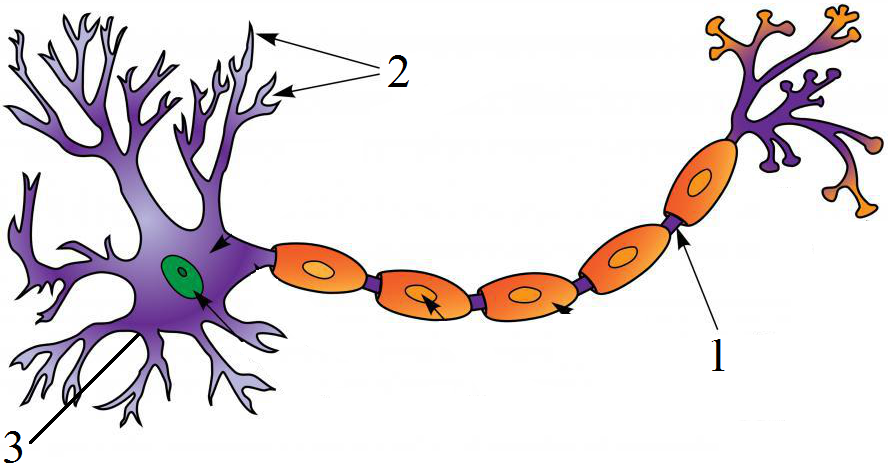
In the given figure, which of the following parts transmits impulse away from the cell body?
  • $1$
  • B
    $2$
  • C
    $1$ and $2$
  • D
    $3$
Answer
Correct option: A.
$1$

$1$ represents axon here through which impulse travels away from the cell body and toward the axon terminals.

View full question & answer
MCQ 541 Mark
The mast cells secrete which of the following substances:
  • A
    Heparin
  • B
    Histamine
  • C
    Serotonin
  • All of the above
Answer
Correct option: D.
All of the above
Mast cells are scattered throughout the connective tissues of the body and they mediate inflammatory responses such as hypersensitivity and allergic reactions.
Mast cells secrete a number of different chemical mediators including heparin, histamine, serotonin, interleukins, proteoglycan $($like heparin$)$ and various enzymes in coarse granules found throughout the cytoplasm of cells.
View full question & answer
MCQ 551 Mark
Actively dividing cells are present in:
  • A
    Xylem.
  • Cambium.
  • C
    Phloem.
  • D
    Collenchymas.
Answer
Correct option: B.
Cambium.
The cambium is the zone where the woody stem of a plant will thicken over time $($ie. tree rings$)$ and is the site of cell division of new vascular tissue as a woody stemmed plants grow wider $($lateral growth$).$
View full question & answer
MCQ 561 Mark
Tendon is a structure which connects $.......$
  • A
    A bone with another bone.
  • A muscle with bone.
  • C
    A nerve with a muscle.
  • D
    A muscle with a muscle.
Answer
Correct option: B.
A muscle with bone.
Tendon is a fibrous $($dense$)$ connective tissue which connects a muscle with a bone.
View full question & answer
MCQ 581 Mark
Flexibility in plants is due to:
  • A
    Collenchyma.
  • B
    Sclerenchyma.
  • C
    Parenchyma.
  • Chlorenchyma.
Answer
Correct option: D.
Chlorenchyma.
Explanation: D Chlorenchyma.
Collenchyma is a mechanical tissue in young dicotyledonous stems and provides mechanical support and elasticity. It provides great tensile strength with flexibility to those organs in which it is found. It allows easy bending in various parts of a plant mainly young growing stem without breaking them.
View full question & answer
MCQ 591 Mark
The cell division is restricted to:
  • Meristematic cells.
  • B
    Permanent cells.
  • C
    Secretory cells.
  • D
    All the above.
Answer
Correct option: A.
Meristematic cells.
Permanent tissues formed by meristematic tissues take up a specific role and lose the ability to divide further.
View full question & answer
MCQ 601 Mark
All phloem cells are living except.
  • Phloem fibres.
  • B
    Companion cells.
  • C
    Sieve tubes.
  • D
    Phloem parenchyma.
Answer
Correct option: A.
Phloem fibres.
All cells are living except the Phloem fibres $($Phloem fibres are dead cells$).$
View full question & answer
MCQ 611 Mark
Which cell does not have perforated cell wall
  • A
    Tracheids.
  • Companion cells.
  • C
    Sieve tubes.
  • D
    Vessels.
Answer
Correct option: B.
Companion cells.
Tracheids and vessels are xylem elements and are concerned with the transport of water. They are long tube$-$like structures with partially or completely dissolved walls to form water pipes $($in vessels$)$ and pits in cell wall $($in tracheids$)$ for conducting water. Sieve tubes are slender tube$-$like structures with their end walls perforated by numerous pores and are called sieve plates. They are phloem elements and are main food conducting elements. Companion cells possess numerous mitochondria and ribosomes and are supporting units of sieve tube.
View full question & answer
MCQ 621 Mark
Nucleus is not present in$-$
  • A
    Companion cell
  • Mature sieve tube
  • C
    Phloem parenchyma
  • D
    Collenchyma
Answer
Correct option: B.
Mature sieve tube
View full question & answer
MCQ 631 Mark
Life span of $RBC$ is:
  • A
    $50$ days
  • B
    $75$ days
  • $120$ days
  • D
    $100$ days
Answer
Correct option: C.
$120$ days
$120$ days
View full question & answer
MCQ 641 Mark
Phloem in the plants perform the function of:
  • Conduction of food.
  • B
    Conduction of water.
  • C
    Providing support.
  • D
    Photosynthesis.
Answer
Correct option: A.
Conduction of food.
Phloem is a complex tissue in the plant which conducts water from leaves to the other parts of the plant.
View full question & answer
MCQ 651 Mark
A long tree has several branches. The tissue that helps in the side ways conduction of water in the branches is:
  • A
    Collenchymas.
  • B
    Xylem parenchyma.
  • C
    Parenchyma.
  • Xylem vessels.
Answer
Correct option: D.
Xylem vessels.
Xylem vessels are very long tube$-$like structures formed by a row of cells placed end to end. The transverse wails between these cells are partially or completely dissolved to form continous water channels.
View full question & answer
MCQ 661 Mark
Lignified, narrow, elongated and dead cells are found in:
  • A
    Parenchyma.
  • B
    Collenchyma.
  • Sclerenchyma.
  • D
    Phloem.
Answer
Correct option: C.
Sclerenchyma.
The cells of the sclerencyma are dead. They are long, elongated, narrow, thick walled and lignified.
View full question & answer
MCQ 671 Mark
Meristematic tissues in plants are:
  • A
    Localised and permanet.
  • B
    Not limited to certain regions.
  • Localised and dividing cells.
  • D
    Growing in volume.
Answer
Correct option: C.
Localised and dividing cells.
Cells of meristematic tissue are actively dividing cells. Meristematic tissue is present only in those parts which needs to grow.
View full question & answer
MCQ 681 Mark
Active divisions take place in the cells of:
  • A
    Xylem.
  • B
    Phloem.
  • C
    Sclerenchyma.
  • Cambium.
Answer
Correct option: D.
Cambium.
Active divisions take place in the cells of cambium. Cambium is a meristematic tissue.
View full question & answer
MCQ 691 Mark
Whose living cells provide tensile and mechanical strength?
  • Collenchymas.
  • B
    Sclerenchyma.
  • C
    Phloem.
  • D
    Sclereids.
Answer
Correct option: A.
Collenchymas.
The cells of this tissue are living, elongated and tightly packed with no inter$-$cellular space.
View full question & answer
MCQ 701 Mark
Nasal and genital tracts are lined by:
  • A
    Simple columnar.
  • B
    Stratified columnar epithelium.
  • Pseudostratified epithelium.
  • D
    Stratified cuboidal epithelium.
Answer
Correct option: C.
Pseudostratified epithelium.
Nasal and genital tracts are lined by pseudostratified epithelium.
View full question & answer
MCQ 711 Mark
The hardness of the bone tissue is due to the phosphates and carbonates of:
  • A
    Calcium and sodium.
  • Calcium and magnesium.
  • C
    Magnesium and sodium.
  • D
    Magnesium and potassium.
Answer
Correct option: B.
Calcium and magnesium.
The matrix of bone is made up of proteins and is heavily coated with salts of calcium and phosphorous. These minerals make the bone very tough.
View full question & answer
MCQ 721 Mark
Epithelial tissue is found in:
  • A
    Skin
  • B
    Linning of blood vessels
  • C
    Alveoli of lungs
  • All of these
Answer
Correct option: D.
All of these
View full question & answer
MCQ 731 Mark
The most common type of ground tissue is:
  • A
    Epidermis.
  • B
    Collenchymas.
  • C
    Sclerenchyma.
  • Parenchyma.
Answer
Correct option: D.
Parenchyma.
The parenchyma is present in soft parts of the plant such as cortex, pith, palisade and some parts of the flower. It is considered as a fundamental or ground tissue.
View full question & answer
MCQ 741 Mark
Intercalated disc is present in:
  • A
    Striated muscle.
  • B
    Smooth muscle.
  • Cardiac muscle.
  • D
    Both $b$ and $c.$
Answer
Correct option: C.
Cardiac muscle.
Cardiac muscle fibre contains intercalated discs.
View full question & answer
MCQ 751 Mark
Cork cambium is an example of$-$
  • Lateral meristem
  • B
    Primary meristem
  • C
    Apical meristem
  • D
    Intercalary meristem
Answer
Correct option: A.
Lateral meristem
View full question & answer
MCQ 761 Mark
While doing work and running, you move your organs like hands, legs, etc. Which among the following is correct?
  • A
    Smooth muscles contract and pull the ligament to move the bones.
  • B
    Smooth muscles contract and pull the tendons to move the bones.
  • C
    Skeletal muscles contract and pull the ligament to move the bones.
  • Skeletal muscles contract and pull the tendon to move.
Answer
Correct option: D.
Skeletal muscles contract and pull the tendon to move.
Skeletal muscles are striped, voluntary muscles, due to presence of alternate dark and light bands. They are called voluntary as they work according to our will. While doing work and running skeletal muscles contract and pull the tendon $($which connects muscles to bones$)$ to move the bone.
View full question & answer
MCQ 781 Mark
The plant tissue which provides mechanical strength and consists of living cells, is
  • A
    Parenchyma
  • B
    Aerenchyma
  • Collenchyma
  • D
    Sclerenchyma
Answer
Correct option: C.
Collenchyma
View full question & answer
MCQ 791 Mark
Which type of tissue forms glands?
  • A
    Connective
  • Epithelial
  • C
    Nervous
  • D
    Muscle
Answer
Correct option: B.
Epithelial
Glands develop from epithelial tissue. They may be unicellular or multicellular.
View full question & answer
MCQ 801 Mark
Bone marrow is important for:
  • A
    Breakdown of $WBC$
  • Production of $RBC$
  • C
    Breakdown of $RBC$
  • D
    Production of $WBC$
Answer
Correct option: B.
Production of $RBC$
Production of $RBC$
View full question & answer
MCQ 811 Mark
In desert plants, rate of water loss gets reduced due to the presence of:
  • Cuticle
  • B
    Stomata
  • C
    Lignin
  • D
    Suberin
Answer
Correct option: A.
Cuticle
Cuticle are protective, hydrophobic waxy covering produced by epidermal cells of leaves, young shoots and other aerial parts. It minimises the water loss through transpiration $($with the help of stomata$)$ and also reduces pathogen entry.
Lignin hardens the cell wall and provides flexibilty, tensile and compressional strength to the cell wall. Suberin is present in cork cells and makes the cell impervious to water.
View full question & answer
MCQ 821 Mark
Which type of tissue forms the inner lining of a blood vessel?
  • Epithelial.
  • B
    Connective.
  • C
    Nervous.
  • D
    Muscle.
Answer
Correct option: A.
Epithelial.
Simple squamous epithelial cells are extremely thin and flat and form a delicate lining. Squamous epithelial tissue forms the inner lining of a blood vessel.
View full question & answer
MCQ 831 Mark
Pavement epithelium is the name of:
  • Squamous epithelium.
  • B
    Cuboidal epithelium.
  • C
    Ciliated epithelium.
  • D
    Columnar epithelium.
Answer
Correct option: A.
Squamous epithelium.
Squamous epithelium is also called pavement epithelium as it is made up of single thin layer of flattened cells.
View full question & answer
MCQ 841 Mark
Elongated lignified cells with pointed ends belong to:
  • A
    Collenchyma
  • B
    Parenchyma
  • Sclerenchyma
  • D
    None of these
Answer
Correct option: C.
Sclerenchyma
View full question & answer
MCQ 851 Mark
The innermost layer of cortex which has casparian thickenings in its cells is the
  • A
    Epidermis
  • Endodermis
  • C
    Pericycle
  • D
    Exodermis
Answer
Correct option: B.
Endodermis
View full question & answer
MCQ 861 Mark
The meristerm which develops into primary vascular tissue is:
  • A
    Protonema
  • B
    Promeristem
  • C
    Ground meristem
  • Procambium
Answer
Correct option: D.
Procambium
View full question & answer
MCQ 871 Mark
The fibres of commercial importance are obtained from:
  • A
    Parenchyma
  • B
    Collenchyma
  • C
    Chlorenchyma
  • Sclerenchyma
Answer
Correct option: D.
Sclerenchyma
Sclerenchyma is the tissue that makes the plant hard and stiff.
It is the supporting tissue in plants and is composed of dead cells with highly thickened cell walls $($due to extensive deposition of lignin$)$.
Two types of sclerenchyma cells exist: fibres and sclereids.
Sclerenchyma fibres are of great economic importance since they constitute the source material for many fabrics $($e.g. flax, hemp, jute, etc$)$.
View full question & answer
MCQ 881 Mark
The nuclei of meristematic cells are:
  • A
    Small
  • Large
  • C
    Medium sized
  • D
    None of these
Answer
Correct option: B.
Large
The meristematic cells are full of cytoplasm and have a big nucleus.
View full question & answer
MCQ 891 Mark
Matrix of connective tissue is produced by:
  • A
    Plasma cells
  • B
    Mast cell
  • C
    Fibroblasts
  • Both $(b)$ and $(c)$
Answer
Correct option: D.
Both $(b)$ and $(c)$

The cells of connective tissue are embedded in a matrix. The matrix may be jelly like, fluid, dense or rigid. It is produced by fibroblasts.

View full question & answer
MCQ 901 Mark
Bone matrix is rich in:
  • A
    Fluoride and calcium.
  • Calcium and phosphorus.
  • C
    Calcium and potassium.
  • D
    Phosphorus and potassium.
Answer
Correct option: B.
Calcium and phosphorus.
Bone cells are embedded in a hard matrix which is composed of calcium and phosphorus.
View full question & answer
MCQ 911 Mark
Smooth muscles occur in:
  • A
    Uterus.
  • B
    Artery.
  • C
    Vein.
  • All the above.
Answer
Correct option: D.
All the above.
Smooth muscles are found in alimentary canal and blood vessels. The movement of food in the alimentary canal or the contraction and relaxation of blood vessels are involuntary movement.
View full question & answer
MCQ 921 Mark
Areolar connective tissue is found between:
  • A
    Blood vessels and nerves.
  • B
    Skin and muscles.
  • C
    In the bone marrow.
  • All the three.
Answer
Correct option: D.
All the three.
Areolar connective tissue is found between the skin and muscles, around blood vessels and nerves and in the bone marrow. It fills the space inside the organs, supports internal organs and helps in repair of tissues.
View full question & answer
MCQ 931 Mark
Phloem is made of:
  • A
    Sieve tubes.
  • B
    Companion cells.
  • Both of these.
  • D
    None of these.
Answer
Correct option: C.
Both of these.
Phloem is made up of four types of elements:
Sieve tubes, companion cells, phloem fibres and the phloem parenchyma.
View full question & answer
MCQ 941 Mark
Tissue found in area of regular wear and tear is:
  • A
    Simple squamous epithelium.
  • Stratified squamous epithelium.
  • C
    Simple cuboidal epithelium.
  • D
    Stratified muscle fibres are.
Answer
Correct option: B.
Stratified squamous epithelium.
Skin epithelial cells are arranged in many layers to prevent wear and tear. Since they are arranged in a pattern of layers, the epithelium is called stratified squamous epithelium.
View full question & answer
MCQ 961 Mark
Which one is made of dead cells:
  • A
    Sclerenchyma
  • B
    Tracheids
  • C
    Vessels
  • All the above
Answer
Correct option: D.
All the above
View full question & answer
MCQ 971 Mark
Simple tissues are these:
  • A
    Parenchyma, xylem and collenchymas.
  • Parenchyma, collenchymas and sclerenchyma.
  • C
    Parenchyma, xylem and sclerenchyma.
  • D
    Parenchyma, xylem and phloem.
Answer
Correct option: B.
Parenchyma, collenchymas and sclerenchyma.
Simple tissues are made up of only one type of cells. There are three types of simple tissue occur in plants: Parenchyma, collenchyma and sclerenchyma.
View full question & answer
MCQ 981 Mark
Collenchyma mainly forms $..........$
  • Hypodermis
  • B
    Epidermis
  • C
    Phloem
  • D
    Inner cortex
Answer
Correct option: A.
Hypodermis
Collenchyma tissue are found below epidermis in leaves and stem.
View full question & answer
MCQ 991 Mark
Intestine absorb the digested food materials. What type of epithelial cells are responsible for that?
  • A
    Stratified squamous epithelium.
  • Columnar epithelium.
  • C
    Spindle fibres.
  • D
    Cuboidal epithelium.
Answer
Correct option: B.
Columnar epithelium.
Columnar epithelium consist of pillar like cells with their nuclei towards the base. They form the lining of stomach, small intestine and colon, forming the mucous membrane. Their main function is absorption $($e.g., stomach, intestine$)$ and secretion $($e.g., mucous by goblet cells$)$.
Stratified squamous epithelium, also known as pavement epithelium is covered by fibrous protein, $($keratin$)$ that covers the skin. This epithelium is waterproof and resistant to mechanical injury. Cuboidal epithelium is found in kidney tubules, thyroid vesicles and in glands.
View full question & answer
MCQ 1001 Mark
Cardiac muscle fibres are:
  • A
    Branched
  • B
    Striated
  • C
    Involuntary
  • All the above
Answer
Correct option: D.
All the above
Cardiac muscle fibres are branched, striated and involuntary. These muscles are exclusively present in the heart.
View full question & answer
M.C.Q. [1 M] - Page 2 - Science STD 9 Questions - Vidyadip