MCQ 1011 Mark
Nervous tissue is not found in:
- ABrain
- BSpinal cord
- CTendons
- DNerves
Answer
View full question & answer→- Tendons
Explanation:
Tendons are fibrous connective tissues and hence option 'c' is incorrect.
Explanation:
Tendons are fibrous connective tissues and hence option 'c' is incorrect.
Explanation:
Axons, nerve endings and dendrites are a part of neurons (nerve cells).
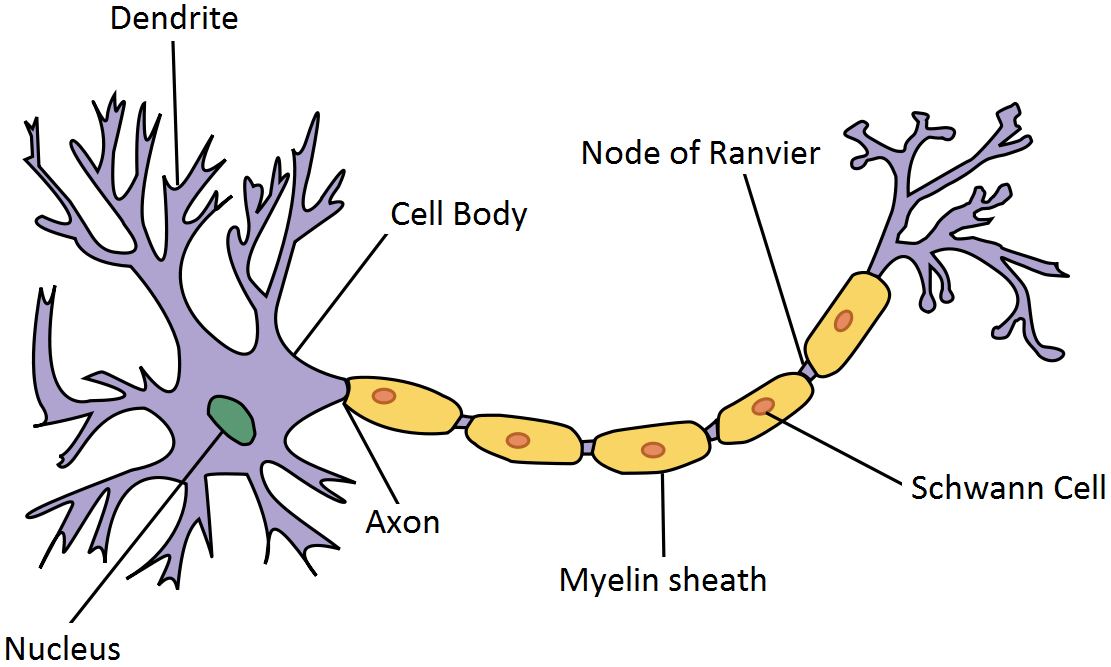
Neurons do not contain tendons as they are connective tissues that join skeletal muscles to bones.
Explanation:
Nasal and genital tracts are lined by pseudostratified epithelium.
Explanation:
Connective tissues are most abundant and widely distributed in the body of complex animals.
Explanation:
Cells of meristematic tissue are actively dividing cells. Meristematic tissue is present only in those parts which needs to grow.
Explanation:
The cells of connective tissue are embedded in a matrix. The matrix may be jelly like, fluid, dense or rigid. It is produced by fibroblasts.
Explanation:
Mast cells are cells that secrete histamine and heparin during allergic response and are specialized components of the areolar tissue.
Explanation:
Matrix of cartilage is made up of chondrin.
Explanation:
The mineral constituent of bone is composed of a salt of calcium and phosphorus called calcium phosphate.
This makes the bony framework hard and strong.
Explanation:
The cells of the sclerencyma are dead. They are long, elongated, narrow, thick walled and lignified.
Explanation:
The cells of the sclerencyma are dead. They are long, elongated, narrow, thick walled and lignified.
Explanation:
Dense connective tissue is of two types- tenonds and ligaments.
Explanation:
Ligament is a dense connective tissue which connects a bone with bone.
Explanation:
Monocytes are largest blood cells. These are white blood cells.
Explanation:
A stratified squamous epithelium consists of squamous (flattened) epithelial cells arranged in layers upon a basal membrane. Only one layer is in contact with the basement membrane; the other layers adhere to one another to maintain structural integrity.
Explanation:
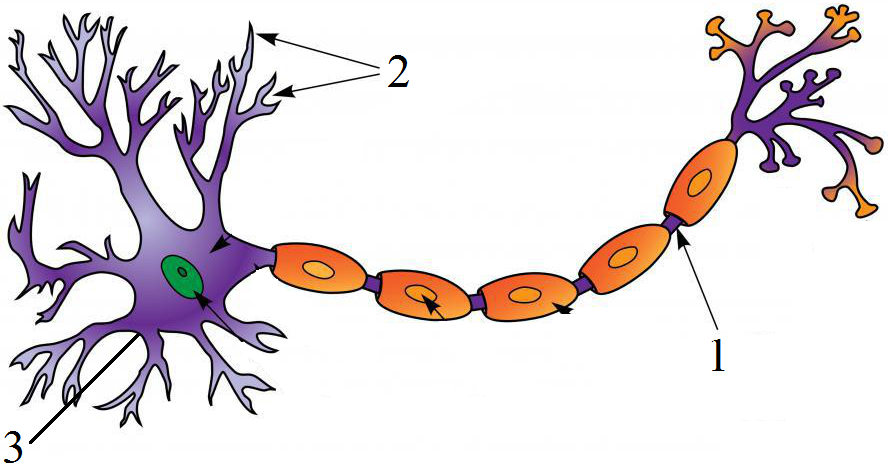
1 represents axon here through which impulse travels away from the cell body and toward the axon terminals.
Explanation:
Columnar epithelium consist of pillar like cells with their nuclei towards the base. They form the lining of stomach, small intestine and colon, forming the mucous membrane. Their main function is absorption (e.g., stomach, intestine) and secretion (e.g., mucous by goblet cells).
Stratified squamous epithelium, also known as pavement epithelium is covered by fibrous protein, (keratin) that covers the skin. This epithelium is waterproof and resistant to mechanical injury. Cuboidal epithelium is found in kidney tubules, thyroid vesicles and in glands.
Explanation:
Columnar epithelium consist of pillar-like cells with their nuclei towards the base.
They form the lining of stomach, small intestine, colon, forming mucus membrane. Their main function is absorption and secretion Stratified squamous epithelium, also known as pavement epithelium, is covered by fibrous protein,(keratin) that covers the skin.
The epithelium is waterproof and resistant to mechanical injury. Cuboidal epithelium is found in kidney tubules, thyroid vesicles and glands.
Explanation:
Cardiac muscle fibre contains intercalated discs.
Explanation:
Cuticle are protective, hydrophobic waxy covering produced by epidermal cells of leaves, young shoots and other aerial parts. It minimises the water loss through transpiration (with the help of stomata) and also reduces pathogen entry.
Lignin hardens the cell wall and provides flexibilty, tensile and compressional strength to the cell wall. Suberin is present in cork cells and makes the cell impervious to water.
Explanation:
Cuticle are protective, hydrophobic waxy covering produced by epidermal cells of leaves, young shoots and other aerial parts. It minimises the water loss through transpiration (with the help of stomata) and also reduces pathogen entry. Lignin hardens the cell wall and provides flexibilty, tensile and compressional strength to the cell wall. Suberin is present in cork cells and makes the cell impervious to water.
Explanation:
If the tip of sugarcane plant is removed the apical meristem is also removed as it is situated in the apices of growing roots and stem.
Intercalary meristem are located at the base of leaves or nodes and leads to the increase in the length of an organ such as leaves and internodes.
Explanation:
It is because of the intercalary meristem which is found at the base of the nodes of the sugarcane which divides to form long stems of the sugarcane.
Explanation:
Husk of a coconut is made up of sclerenchymatous fibres.
Explanation:
Cardiac muscle fibres are branched, striated and uninucleate. These muscles are involuntary. These muscles are exclusively present in the heart and show rhythmic contraction and relaxation throughout life.
Explanation:
Haversian canals are present in bone.
Explanation:
Haversian canals are a series of microscopic tubes in the outermost region of bone called cortical bone that allows blood vessels and nerves to travel through them.
They are absent in muscles,nerves and cartilage.
Explanation:
Each stomata is surrounded by a pair of guard cells. Guard cells regulate the opening and closing of stomata.
Explanation:
The grit of pear is formed of stone cells also known as sclereids.
Explanation:
Intercalary meriste is commonly present at the base of the leaves or internodes (on either side of the node). The intercalary meristem increses the internode length, hence the stem elongates.
Explanation:
Other meristems in options facilities growth in length, while lateral meristem cause the organ to increase in diameter and growth which happens in the case of girth.
Explanation:
Blood consists of plasma and blood corpuscles. Plasma is a liquid part of blood which contains 85-90% water.
Explanation:
Collenchyma is a mechanical tissue in young dicotyledonous stems and provides mechanical support and elasticity. It provides great tensile strength with flexibility to those organs in which it is found. It allows easy bending in various parts of a plant mainly young growing stem without breaking them.
Explanation:
Apical and intercalary meristems are permanent tissues
Parenchyma serves as a packing tissue in plants therefore they do not have intercellular spaces. Collenchymatous tissues are mechanical tissues in the plants and are characterised by deposition of cellulose at the corners of the cell, which leads to localised thickenings of the cell wall. Apical and intercalary meristem bring primary growth (increase in height) and secondary growth (increase in diameter) respectively and are classified under meristematic tissues. Meristematic tissue are dividing units of the plants and contain dense cytoplasm and large nucleus with few or no vacuoles at all.
Explanation:
Collenchymatous tissues are mechanical tissues in the plants and are characterized by deposition of cellulose at the corners of the cell, which leads to localized thickenings of the cell wall.
Explanation:
Adipose tissue consists of oval and round cells filled with fat globules, scattered in the matrix. This tissue is found below the skin, between internal organs and in the yellow bone marrow. It stores fat and acts as an insulator.
Cuboidal epithelium help in absorption, excretion and secretion, whereas bones and cartilage are specialised connective tissue and they provide support to the internal organs.
Explanation:
Bichat is also known as “Father of histology”.
Explanation:
Epithelial tissue always has an exposed outer surface and an inner surface anchored to connective tissue by a thin, non-cellular structure called the basement membrane.